Author: Britt Ambrose

Get more from your salary or bonus

Smart super strategies for this EOFY
Get more from your salary or bonus

1. Add to your super – and claim a tax deduction

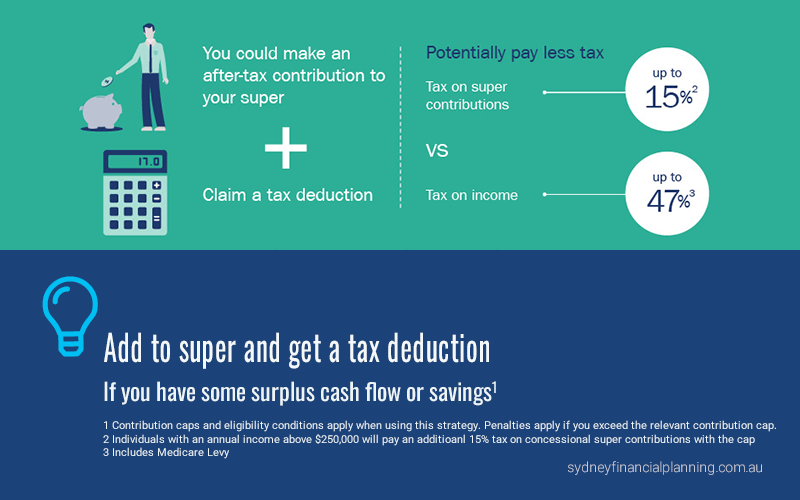
If you contribute some of your after-tax income or savings into super, you may be eligible to claim a tax deduction. This means you’ll reduce your taxable income for this financial year – and potentially pay less tax. And at the same time, you’ll be boosting your super balance.

How it works

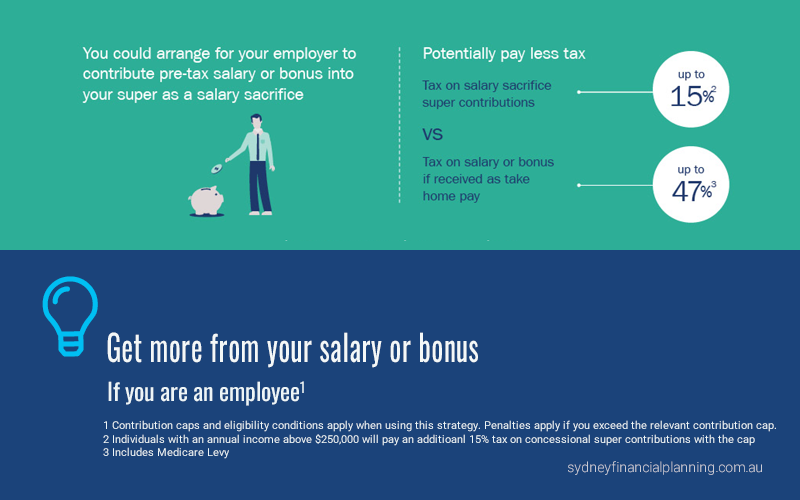
The contribution is generally taxed at up to 15% in the fund (or up to 30% if your income from certain sources is $250,000 or more). Depending on your circumstances, this is potentially a lower rate than your marginal tax rate, which could be up to 47% (including the Medicare Levy) – which could save you up to 32%. Once you’ve made the contribution to your super, you need to send a valid ‘Notice of Intent’ to your super fund, and receive an acknowledgement from them, before you complete your tax return, start a pension,or withdraw or rollover the money.

Keep in mind that personal deductible contributions count towards your concessional contribution cap, which is $27,500 for the 2021/22 financial year. However, you may be able to contribute more than that without penalty if you didn’t use the your entire concessional cap in financial years since 1 July 2018 and are eligible to make ‘catch-up’ contributions.

Concessional contributions also include all employer contributions, including Superannuation Guarantee and salary sacrifice. Other eligibility rules may also apply so speak to your financial adviser for more information.

2. Get more from your salary or a bonus

If you’re an employee, you may be able to arrange for your employer to direct some of your pre-tax salary or a bonus into your super as a ‘salary sacrifice’ contribution.

Again, you’ll potentially pay less tax on this money than if you received it as take-home pay – generally 15% for those earning under $250,000 pa, compared with up to 47% (including Medicare Levy).

How it works

Ask your employer if they offer salary sacrifice. If they do, it can be a great way to help grow your super tax-effectively because the contributions are made from your pre-tax pay – before you get a chance to spend it on other things.

You can only salary sacrifice amounts that you’re not yet entitled to receive. This includes both your regular salary, and any entitlement to a bonus.

Remember salary sacrifice contributions count towards your concessional contribution cap, along with any superannuation guarantee contributions from your employer and personal deductible contributions. Also, you may be able to make catch up (extra) contributions if your concessional contributions were less than the annual concessional cap since 1 July 2018.

3. Convert your savings into super savings

Another way to invest more in your super is with some of your after-tax income or savings, by making a personal non-concessional contribution.

Although these contributions don’t reduce your taxable income for the year, you can still benefit from the low tax rate of up to 15% that’s paid in super on investment earnings. This tax rate may be lower than what you’d pay if you held the money in other investments outside super.

How it works

Before you consider this strategy, make sure you’ll stay under your non-concessional contribution (NCC) cap, which in 2021/22 is $110,000 – or up to $330,000 if you meet certain conditions. That’s because after-tax contributions count as non-concessional contributions – and penalties apply if you exceed the cap.

Also, to use this strategy in 2021/22, your total super balance (TSB) must have been under $1.7 million on 30 June 2021.

If you’re 67–74, you’ll also need to meet the work test (or be eligible to apply the ‘work test exemption) to make NCCs this financial year. The work test will be removed for NCCs from 1 July.

Remember, once you’ve put any money into your super fund, you won’t be able to access it until you reach your preservation age or meet other ‘conditions of release’. For more information, visit the ATO website at ato.gov.au.

4. Get a super top-up from the Government

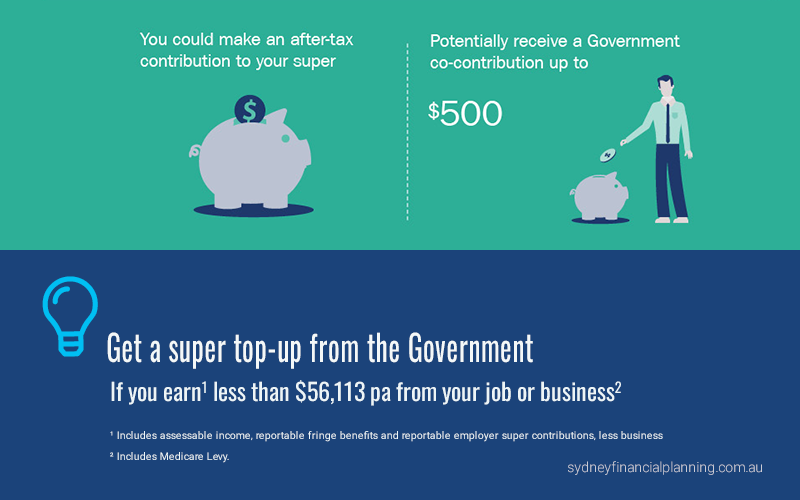
If you earn less than $56,113 in the 2021/22 financial year, and at least 10% is from your job or a business, you may want to consider making an aftertax super contribution. If you do, the

Government may make a ‘co-contribution’ of up to $500 into your super account.

How it works

The maximum co-contribution is available if you contribute $1,000 and earn $41,112 pa or less. You may receive a lower amount if you contribute less than $1,000 and/or earn between $41,113 and $56,112 pa.

Be aware that earnings include assessable income, reportable fringe benefits and reportable employer super contributions. Other conditions also apply – your financial adviser can run you through them.

5. Boost your spouse’s super and reduce your tax

If your spouse is not working or earns a low income, you may want to consider making an after-tax contribution into their super account. This strategy could potentially benefit you both: your spouse’s super account gets a boost and you may qualify for a tax offset of up to $540.

How it works

You may be able to get the full offset if you contribute $3,000 and your spouse earns $37,000 or less pa (including their assessable income, reportable fringe benefits and reportable employer super contributions).

A lower tax offset may be available if you contribute less than $3,000, or your spouse earns between $37,000 and $40,000 pa.

Need advice?

You’ll need to meet certain eligibility conditions before benefitting from any of these strategies. If you’re thinking about investing more in super before 30 June, talk to us. We can help you decide which strategies are appropriate for you.


If you aren’t sure how to proceed or if you meet the specific criteria…

Speak with one of our Financial Planners about the best approach for your circumstances asap, either book a meeting or get in contact with us on 02 9328 0876.

1 Individuals with income above $250,000 pa will pay an additional 15% tax on personal deductible and other concessional super contributions.

2 Includes Medicare Levy.

General Disclaimer: While every care has been taken in the preparation of this document, Sydney Financial Planning and Charter FP make no representations or warranties as to the accuracy or completeness of any statement in it.This article contains information that is general in nature. It does not take into account the objectives, financial situation or needs of any particular person. You need to consider your financial situation and needs before making any decisions based on this information. Please seek personal financial advice prior to acting on this information.

 

Top-up your super with help from the Government

Top-up your super with help from the Government

Top-up your super with help from the Government

How does the strategy work?

If you earn¹ less than $56,112 pa (of which at least 10% is from eligible employment or carrying on a business) and you make personal after-tax super contributions, the Government may also contribute into your super account. This additional super contribution, which is known as a co-contribution, could make a significant difference to the value of your retirement savings over time. To qualify for a co-contribution, you will need to meet a range of conditions, but as a general rule:

  • the maximum co-contribution of $500 is available if you contribute $1,000 and earn $41,112 or less
  • a reduced amount may be received if you contribute less than $1,000 and/or earn between $41,113 and $56,112, and
  • you will not be eligible for a co-contribution if you earn $56,113 or more.

The Australian Taxation Office (ATO) will determine whether you qualify based on the data received from your super fund and the information contained in your tax return for that financial year.

As a result, there can be a time lag between when you make your personal after-tax super contribution and when the Government pays the co‑contribution.

If you’re eligible for the co-contribution, you can nominate which fund you would like to receive the payment.

Alternatively, if you don’t make a nomination and you have more than one account, the ATO will pay the money into one of your funds based on set criteria.

Note: Some funds or superannuation interests may not be able to receive co-contributions. This includes unfunded public sector schemes, defined benefit interests, traditional policies (such as endowment or whole of life) and insurance only superannuation interests.

Other key considerations

  • You can’t access super until you meet certain conditions.
  • You may want to consider other ways to contribute to super, such as salary sacrifice or personal deductible contributions.

Seek advice

A financial adviser can help you determine whether you should make personal super contributions and assess whether you will qualify for a Government co-contribution.

Case Study

Ryan, aged 40, is employed and earns $35,000 pa. He wants to build his retirement savings and can afford to invest $1,000 a year.

After speaking to a financial adviser, he decides to use the $1,000 to make a personal after-tax super contribution.

By using this strategy, he’ll qualify for a cocontribution of $500 and the investment earnings will be taxed at a maximum rate of 15%.

Conversely, if he invests the money outside super each year (in a managed fund, for example), he will not qualify for a cocontribution and the earnings will be taxable at his marginal rate of 21%


Details

Receive pay rise as after-tax salary

Sacrifice pay rise into super

Amount invested $1,000 $1,000
Plus co-contribution Nil $500
Total investment $1,000 $1,500
Tax rate payable on investment earnings 21%2 15%


Next steps

Contribution rules and eligibility criteria for catch up CCs are complex. This guide is not designed to provide comprehensive information about how the rules work or apply to you. It is important that you speak with your financial adviser, your registered tax agent and visit the ato.gov.au for more information.


If you aren’t sure how to proceed or if you meet the specific criteria…

Speak with one of our Financial Planners about the best approach for your circumstances asap, either book a meeting or get in contact with us on 02 9328 0876.


1Includes assessable income, reportable fringe benefits and reportable employer super contributions, less business deductions and assessable First Home Super Saver amounts. Other conditions apply.

2 Includes Medicare Levy.


General Disclaimer: While every care has been taken in the preparation of this document, Sydney Financial Planning and Charter FP make no representations or warranties as to the accuracy or completeness of any statement in it.This article contains information that is general in nature. It does not take into account the objectives, financial situation or needs of any particular person. You need to consider your financial situation and needs before making any decisions based on this information. Please seek personal financial advice prior to acting on this information.

Sacrifice pre-tax salary into super

Sacrifice pre-tax salary into super

Sacrifice pre-tax salary into super

How does the strategy work?

With this strategy, known as salary sacrifice, you need to arrange for your employer to contribute some of your pre‑tax salary, wages or bonus directly into your super fund.

The amount you contribute will generally be taxed at the concessional rate of 15%1, not your marginal rate which could be up to 47%2. Depending on your circumstances, this strategy could reduce the tax you pay on your salary, wages or bonus by up to 32%.

Also, by paying less tax, you can make a larger after-tax investment for your retirement, as the case study on the opposite page illustrates.

What income can be salary sacrificed?

  • You can only sacrifice income that relates to future employment and entitlements that have not been accrued.
  • With salary and wages, the arrangement needs to be in place before you perform the work that entitles you to the salary or wages.
  • With a bonus, the arrangement needs to be made before the bonus entitlement is determined.
  • The arrangement, which should be documented and signed by you and your employer, should include details such as the amount to be sacrificed into super and the frequency of the contributions.

Other key considerations

  • Salary sacrifice contributions count towards the ‘concessional contribution’ cap. This capis $27,500 in FY 2021/22, or may be higherif you didn’t contribute your full concessionalcontribution cap since 1 July 2018 and areeligible to make ‘catch-up’ contributions. Tax implications and penalties apply if you exceed your cap.
  • You can’t access super until you meet certain conditions.
  • Another way you may be able to grow your super tax-effectively is to make personal deductible contributions (see opposite page).

Seek advice

A financial adviser can help you determine whether salary sacrifice suits your needs and circumstances.

Case Study

William, aged 45, was recently promoted and has received a pay rise of $5,000, bringing his total salary to $90,000 pa.

He plans to retire in 20 years and wants to use his pay rise to boost his retirement savings..

After speaking to a financial adviser, he decides to sacrifice the extra $5,000 into super each year.

By using this strategy, he’ll save on tax and have an extra $975 in the first year to invest into super, when compared to receiving the $5,000 as after-tax salary (see Table 1).

If he continued to salary sacrifice this amount into super, this could lead to William having an additional $150,394 in his super after 20 years (see Table 2).


Table 1. After-tax income vs salary sacrifice

Details

Receive pay rise as after-tax salary

Sacrifice pay rise into super

Personal super contribution $5,000 $5,000
Less income tax at 34.5%3 ($1,725) (N/A)
Less 15% contributions tax (N/A) ($750)
Net amount $3,275 $4,250
Additional amount in super 21%2 $975


Table 2. Super balances4

Year

No salary sacrifice

Salary sacrifice into super

Difference

Year 5 $279,725 $304,029 $24,304
Year 10 $416,168 $472,072 $55,904
Year 15 $593,558 $690,543 $96,985
Year 20 $824,183 $974,577 $150,394

Personal Deductible Contributions

Like salary sacrifice, making a personal super contribution and claiming a tax deduction may enable you to boost your super tax-effectively. There are, however, a range of issues you should consider before deciding to use this strategy.

Your financial adviser can help you determine whether you should consider making personal deductible contributions instead of (or in addition to) salary sacrifice.

You may also want to ask your financial adviser for a copy of our super strategy card, called ‘Make tax-deductible super contributions’.


If you aren’t sure how to proceed or if you meet the specific criteria…

Speak with one of our Financial Planners about the best approach for your circumstances asap, either book a meeting or get in contact with us on 02 9328 0876.

1 Individuals with income above $250,000 pa will pay an additional 15% tax on personal deductible and other concessional super contributions.

2 Includes Medicare Levy.

3 Includes Medicare Levy. Based on FY 2021/22 tax rates.

4 Assumptions: A 20-year comparison based on contribution of $5,000 pa of pre-tax salary on top of compulsory superannuation guarantee. Super investments earn a total return of 6.34% pa, balances shown at the end of 5/10/15/20 year periods. All figures are after income tax of 15% in super and capital gains tax (including discounting). These rates are assumed to remain constant over the investment period. William’s salary of $90,000 pa is indexed to CPI. Difference does not take into account money potentially invested outside super if pay rise received as after tax salary.

General Disclaimer: While every care has been taken in the preparation of this document, Sydney Financial Planning and Charter FP make no representations or warranties as to the accuracy or completeness of any statement in it.This article contains information that is general in nature. It does not take into account the objectives, financial situation or needs of any particular person. You need to consider your financial situation and needs before making any decisions based on this information. Please seek personal financial advice prior to acting on this information.
 

5 useful charts on investing

5 useful charts on investing in times of uncertainty like the present

5 useful charts on investing

  • Here are another five great charts to help illuminate those basic principles: the importance of time in the market versus timing; the case to look less at your investments; the relationship between risk and return; the value of diversification; & the role of property.
  • Introduction

    Successful investing can be really hard in times like the present when share markets are down sharply & very volatile on the back of uncertainty around inflation, rising interest rates and the war in Ukraine. I will be the first to admit that my crystal ball is even hazier than normal in times like the present. As the US economist JK Galbraith once said “there are two types of economists – those that don’t know and those that don’t know they don’t know.” And this is certainly an environment where much is unknown. But the basic principles of investing are simple and timeless and can be particularly useful to bear in mind in times like this. This note continues our updated series that began with “Five great charts on investing”.

    Chart #1 Time in versus timing

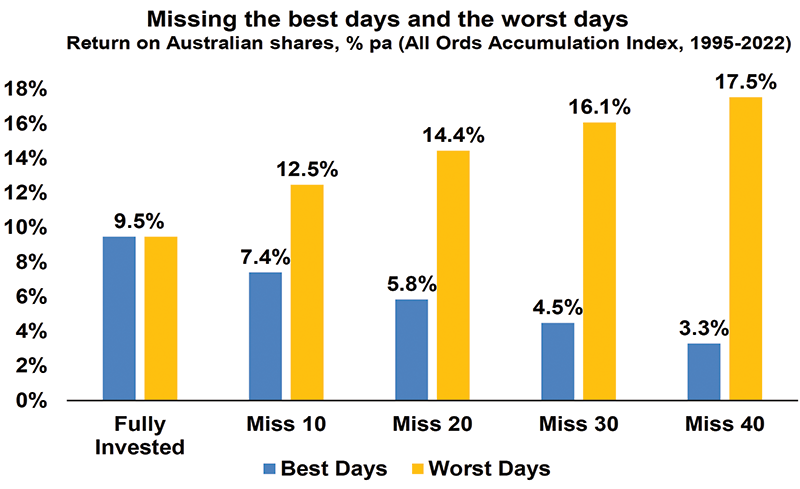
    In times of uncertainty its temping to try and time the market, ie to sell ahead of falls & buy in anticipation of gains. But without a proven asset allocation or stock picking process, trying to time the market is very difficult. A good way to demonstrate this is with a comparison of returns if an investor is fully invested in shares versus missing out on the best (or worst) days. The next chart shows that if you were fully invested in Australian shares from January 1995, you would have returned 9.5%pa (including dividends but not allowing for franking credits, tax and fees).

    Best and worst days 001

    Source: Bloomberg, AMP

    If by trying to time the market you avoided the 10 worst days (yellow bars), you would have boosted your return to 12.5% pa. If you avoided the 40 worst days, it would have been boosted to 17.5% pa. But this is very hard to do, and many investors only get out after the bad returns have occurred, just in time to miss some of the best days and so end up damaging their longer term returns. For example, if by trying to time the market you miss the 10 best days (blue bars), the return falls to 7.4% pa. If you miss the 40 best days, it drops to just 3.3% pa. Hence the old cliché that “it’s time in that matters, not timing”.

    Key message: market timing is great if you can get it right, but without a process the risk of getting it wrong is very high and, if so, it can destroy your longer-term returns.

    Chart #2 Look less

    Percentage of positive share market 001

    Daily and monthly data from 1995, data for years and decades from 1900.
    Source: Bloomberg, RBA, ASX, AMP

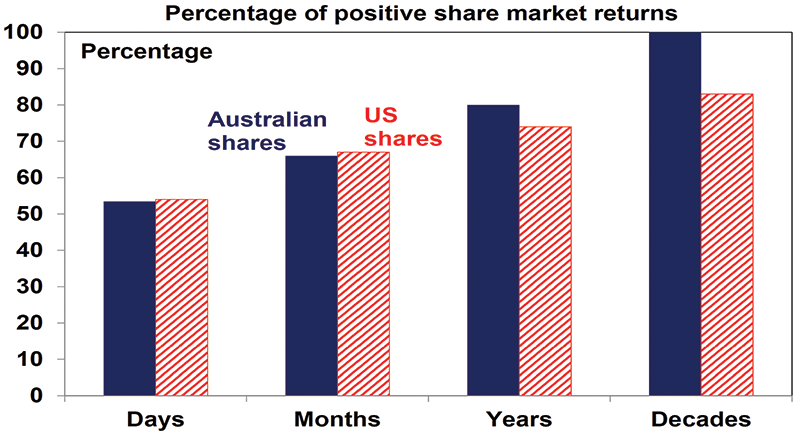
    If you look at the daily movements in the share market, they are down almost as much as they are up, with only just over 50% of days seeing positive gains. See the next chart for Australian and US shares. So day by day, it’s pretty much a coin toss as to whether you will get good news or bad news. But if you only look monthly and allow for dividends, the historical experience tells us you will only get bad news around a third of the time. Looking only on a calendar year basis, data back to 1900 indicates the probability of a loss slides to just 20% in Australian shares and 26% for US shares. And if you go all the way out to once a decade, since 1900 positive returns have been seen 100% of the time for Australian shares and 82% for US shares.

    Chart #3 Risk and return

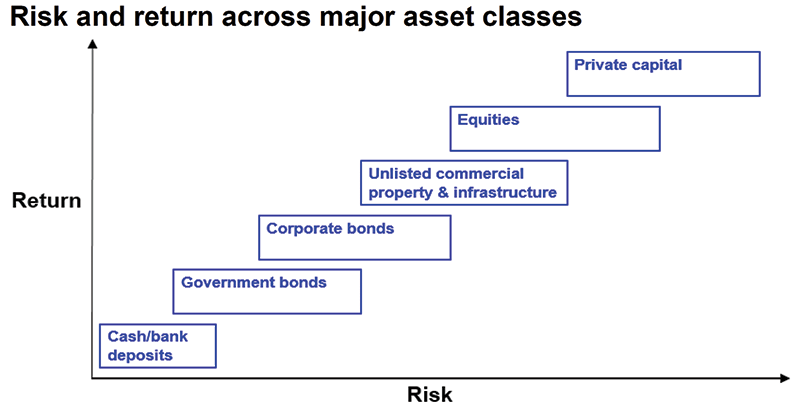
    This chart is basic to investing. Each asset class has its own risk (in terms of volatility and risk of loss) and return characteristics. Put simply: the higher the risk of an asset, the higher the return you will likely achieve over the long term and vice versa. The next chart shows a stylised version of this. Starting with cash, it’s well known that its very low risk but so is its return potential. Government bonds usually offer higher returns but their value can move around a bit in the short term (although major developed countries have not defaulted on their bonds). Corporate debt has a higher return potential again but a higher risk of default. Unlisted or directly held commercial property and infrastructure offer a higher return again but they come with higher risk and are less liquid and can be less able to be diversified (except via say a managed fund).

    Equities can offer another step up in return, but this is because they come with higher risk as they are subject to share market volatility and individual companies can go bankrupt wiping out share holder capital. Beyond this, private equity entails more risk again & so tends to command an even higher return premium. Each step up involves more risk, and this is compensated for with more long-term return. Of course, this neat relationship may not hold in the short-term – eg, government bonds have had worse returns over the last 12 months than shares. And its hard to place “crypto currencies” on the chart – they are very volatile but have not been around long enough to have confidence their long-term returns will compensate for this.

    Risk return major assett classes 001

    Source: AMP

    Key message: Investors need to allow for the risk (and liquidity) and return characteristics of each asset. Those who don’t mind short-term risk (and illiquidity in the case of unlisted assets) can take advantage of the higher returns growth assets offer over long periods. The key is that there is no free lunch.

    Chart #4 Diversification

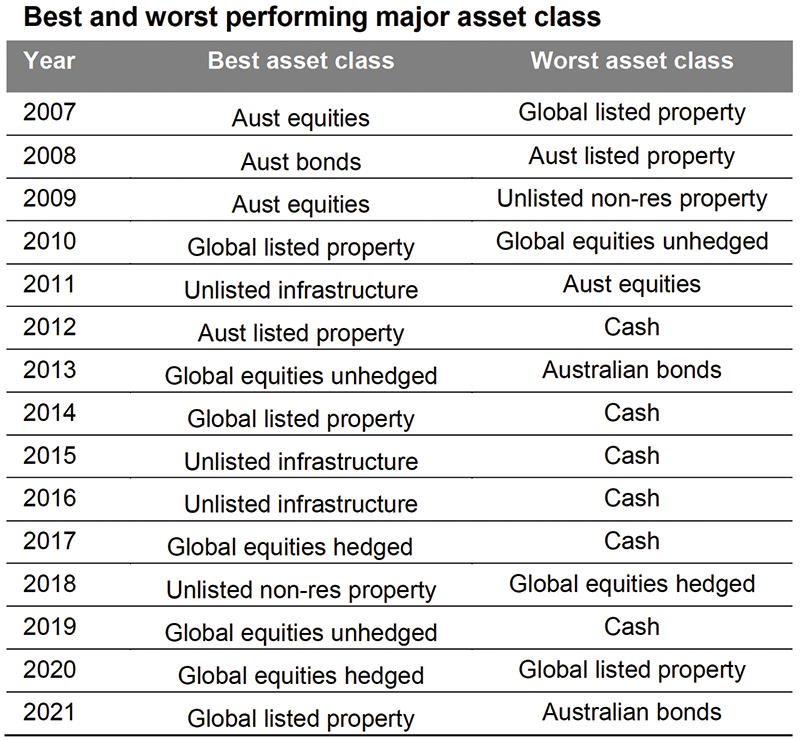
    But this not the end of the story. The next table shows the best and worst performing asset class in each year over the last 15.

    Risk best worst performing major assett class 001

    Source: Reuters, Bloomberg, AMP

    It can be seen that the best performing asset each year can vary dramatically, and that last year’s top performer is no guide to the year ahead. So, it makes sense to have a combination of asset classes in your portfolio. This particularly applies to assets that are lowly correlated, ie that don’t just move in lock step with each other. For example, global and Australian shares tend to move together during extreme events. But bonds and shares tend to diverge when crises hit threatening recession – as we saw in the GFC when shares fell but bonds rallied. So there is a case to have bonds in a portfolio to help stabilise returns. Of course, this doesn’t always work, eg like now when inflation is the key danger, highlighting the case for cash & real assets like unlisted commercial property and infrastructure too.

    Key message: diversification is also a bit like the magic of compound interest. Having a well-diversified exposure means your portfolio won’t be as volatile.

    Chart #5 Residential property has a role

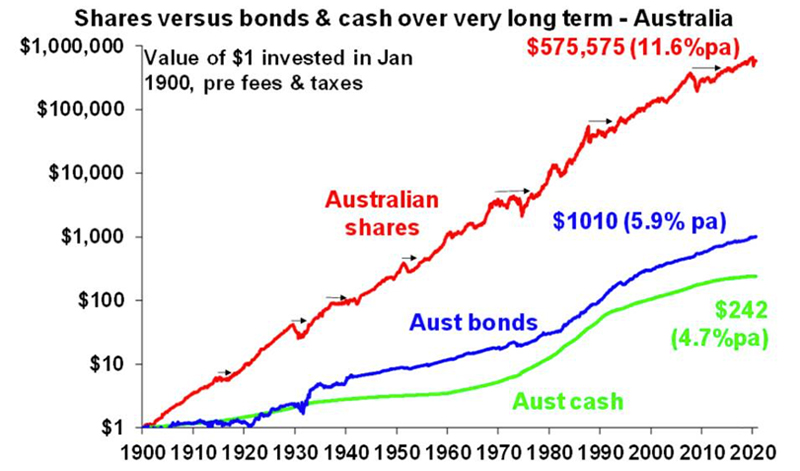
    Chart #1 in the first edition in this Five Charts series highlighted the power of compound interest, with a comparison showing the value of $1 invested in various Australian asset classes back in 1900 and what it would be worth today. Unfortunately, I do not have monthly data for Australian residential property returns back that far but I do have them on an annual basis back to 1926 and this is shown in the next chart starting with a $100 investment.

    Long term assett class returns 001

    Source: ABS, REIA, RBA, ASX, AMP

    Again it can be seen that over very long periods the power of compounding works wonders for shares compared to bonds and cash. But it can also be seen to work well for Australian residential property with an average total return (capital growth plus net rental income) of 11% pa, which is similar to that for shares. All of which highlights, along with the diversification benefits of a real asset like property, the case to have it in a well-diversified portfolio along with listed assets like shares, bonds and cash. The key is to allow for the different “risks” experienced by property versus shares. Property prices are less volatile than share prices as they are not traded on share markets and so are not as subject to the whims of investors and movements in their values tend to relate more to movements in the real economy. But residential property takes longer to buy and sell and it’s harder to diversify as you can’t easily have exposure to hundreds or thousands of properties exposed to different sectors and countries like you can with shares. So, there are trade-offs between residential property and shares.

    Key message: given their long-term returns and diversification benefits, there is a key role for residential property in your investment portfolio – putting aside the current threat to the housing market from poor affordability and rising interest rates.

    Closing commentary

    So following on from our SFP insights over the past 6 months, where we keep you up to date on whats going on in Financial Markets and what to expect moving forward. As we suggested in our last 3 newsletters we will experienced market volatility in the short term and that is currently occurring. For some unadvised people that’s scary, for the well advised SFP clients they know volatility although unpleasant in the short term, is a normal part of financial markets and if they require better long term return, they need to hold growth assets like shares and property.

    When these asset prices fall it can be a wonderful time to buy at a discounted rate, rather than pay for over valued assets.

    Many of our clients have taken advantage of this and invested while these a discount is offered, rather than paying over priced assets. And as I continually say, that’s how the rich get richer, sadly they buy quality assets at a reduced price from unadvised people who panic. Sad for the seller, good for the buyer who knows value and buys quality at a lower price.

    Advice that stands the test of time!

    Bill Bracey – CEO and Founder
    Sydney Financial Planning


    Is your portfolio well positioned for long-term returns and benefits?

    Speak with one of our Financial Planners about the best approach for your circumstances, either book a meeting or get in contact with us on 02 9328 0876.


    This article was prepared by William Bracey and Dr Shane Oliver. Dr Shane Oliver who provides economic forecasts and analysis of key variables and issues affecting, or likely to affect, all asset markets. He also provides economic forecasts and analysis of key variables and issues affecting, or likely to affect, all asset markets.

    Important note: While every care has been taken in the preparation of this document, AMP Capital Investors Limited (ABN 59 001 777 591, AFSL 232497) and AMP Capital Funds Management Limited (ABN 15 159 557 721, AFSL 426455) make no representations or warranties as to the accuracy or completeness of any statement in it including, without limitation, any forecasts. Past performance is not a reliable indicator of future performance. This document has been prepared for the purpose of providing general information, without taking account of any particular investor’s objectives, financial situation or needs. An investor should, before making any investment decisions, consider the appropriateness of the information in this document, and seek professional advice, having regard to the investor’s objectives, financial situation and needs. This document is solely for the use of the party to whom it is provided.

    General Disclaimer: This article contains information that is general in nature. It does not take into account the objectives, financial situation or needs of any particular person. You need to consider your financial situation and needs before making any decisions based on this information. Please seek personal financial advice prior to acting on this information.

    Splitting your super contributions to your spouse

    Splitting your super contributions to your spouse

    Splitting your super contributions to your spouse

    How does the strategy work?

    You may be able to split (transfer) eligible concessional contributions (CCs) that you’ve made or received to your spouse’s super account.

    Eligible CCs include employer super contributions and personal super contributions for which you have claimed a tax deduction.

    Contribution splitting can be a great way to increase your spouse’s super savings particularly where they, for example:

    • are not working
    • have had time out of the workforce, or
    • have a lower super balance.

    What’s the benefit?

    In addition to boosting your spouse’s retirement savings, there may be other benefits depending on your specific circumstances.

    Help to cover insurance premiums

    Contribution splitting can help to pay your spouse’s insurance premiums for policies held inside super. This may be beneficial during times where your spouse has reduced their working hours or is out of the workforce and their contributions have reduced.

    Maximise tax-free retirement savings

    A limit applies to how much super can be transferred into ‘retirement phase’ income streams, where investment earnings are taxed at 0%. Contribution splitting may help you take better advantage of these limits as a couple and maximise the total amount you can hold tax-effectively when you retire.

    Maximise Age Pension

    If you have a younger spouse who is under their Age Pension age, contribution splitting may help to improve your Centrelink entitlements. Superannuation held in the ‘accumulation phase’ is not assessed for social security purposes until the account holder reaches their Age Pension age. Splitting super to your younger spouse may therefore reduce the assets assessed when your entitlement is calculated, potentially increasing your Age Pension entitlement.

    What contributions can be split?

    Only eligible CCs can be split to your spouse, such as superannuation guarantee (SG), salary sacrifice and personal deductible contributions. Non-concessional or ‘after-tax’ contributions cannot be split.

    Generally, the maximum amount that can be split is the lesser of:

    • 85% of your CCs for the year (after taking into account 15% contributions tax), or
    • your CC cap for the financial year.

    The CC cap was $25,000 in 2020/21 and is $27,500 in 2021/22. However, if you’re eligible to make larger CCs in a financial year using the ‘catch-up’ contribution rule, your applicable CC cap may be higher.1

    You can generally only split CCs made in the previous financial year. Also, you need to request to split your CCs in writing to the trustee of your super fund within 12 months after the end of the financial year the CCs were made to your super fund (unless you’re going to roll over your balance or close your account).

    For more information on catch-up contributions, ask your financial adviser for a copy of our ‘Top up your super with ‘catchup’ contributions’ super strategy card.

    Case study

    Lucy would like to split some of her eligible CCs made during 2020/21 to her husband Luke’s (age 40) super fund.

    In FY 2020/21, her employer contributed $20,000 to her super fund and her CC cap was $25,000. The maximum amount that Lucy can split to Luke is the lesser of:

    • $17,000 (85% of the $20,000 contributed by her employer), and
    • $25,000 (her CC cap in 2020/21).

    Lucy elects to split $15,000 of her CCs to Luke’s super fund and submits the contribution splitting application form to her fund in 2021/22.

    Her super fund transfers $15,000 to Luke’s super fund. This won’t reduce Lucy’s CCs for the financial year and the transfer won’t be assessed as a contribution against Luke’s contribution caps.

    Note: If Lucy was eligible to make larger CCs in 2020/21 using the ‘catch-up’ contribution rule, her CC cap may be greater than $25,000. This may increase the maximum amount of contributions she could potentially split to Luke if she made larger CCs in that financial year.

    Is your spouse eligible?

    To be eligible to split your super to your spouse, they must be either:

    • under their ‘preservation age’2, or
    • between their preservation age and under 65 and declare they are not currently retired for superannuation purposes.

    Once your spouse reaches age 65, they are no longer eligible to receive a contribution split from your super.

    Other key considerations

    Contribution splitting may be used by married couples, de facto partners and same sex couples.

    Contributions split to your spouse:

    • will form part of the taxable component of your spouse’s super account
    • don’t count towards their CC cap, as they have already counted towards your CC cap in the year the contributions were made to your account.
    • The split amount is fully preserved in the receiving spouse’s account and they can’t access their super until they meet certain conditions.
    • Where a personal deductible contribution forms part or all of the amount to be split, a Notice of Intent to claim a tax deduction must be lodged and acknowledged by the super fund prior to the contribution split being processed.
    • If you’re intending to rollover or withdraw your entire benefit and you wish to split CCs made in the same financial year or from the previous financial year, the split must be completed prior to the rollover or withdrawal request being processed.
    • It’s not compulsory for a super fund to offer contribution splitting. You will need to check with your fund to see if they allow it.

    Seek advice

    Your financial adviser can help determine whether this strategy is right for you. This includes working out whether your spouse is eligible to receive a contributions split from your super and how much you’re eligible to split.

    Where your CCs in a financial year have exceeded your available cap, the excess amounts cannot be split to your spouse and additional tax and other penalties may apply.

    We recommend you consult with a registered tax agent.

    You will need to confirm the total amount of CCs in the previous financial year. You can access information about your contributions by logging on to my.gov.au. Information displayed might not be up to date, so it’s also important to keep accurate contributions records and enquire directly to your super fund before requesting to split.


    If you aren’t sure how to proceed or if you meet the specific criteria…

    Speak with one of our Financial Planners about the best approach for your circumstances asap, either book a meeting or get in contact with us on 02 9328 0876.

    1 Individuals with income above $250,000 pa will pay an additional 15% tax on personal deductible and other concessional super contributions.
    2 Includes Medicare Levy.
    3 Includes Medicare Levy. Based on FY 2021/22 tax rates.
    4 Assumptions: A 20-year comparison based on contribution of $5,000 pa of pre-tax salary on top of compulsory superannuation guarantee. Super investments earn a total return of 6.34% pa, balances shown at the end of 5/10/15/20 year periods. All figures are after income tax of 15% in super and capital gains tax (including discounting). These rates are assumed to remain constant over the investment period. William’s salary of $90,000 pa is indexed to CPI. Difference does not take into account money potentially invested outside super if pay rise received as after tax salary.

    General Disclaimer: While every care has been taken in the preparation of this document, Sydney Financial Planning and Charter FP make no representations or warranties as to the accuracy or completeness of any statement in it.This article contains information that is general in nature. It does not take into account the objectives, financial situation or needs of any particular person. You need to consider your financial situation and needs before making any decisions based on this information. Please seek personal financial advice prior to acting on this information.

    tax deduction for your super contribution

    Steps to claiming a tax deduction for your super contribution

    tax deduction for your super contribution

    What are personal deductible contributions? 

    A personal deductible contribution (PDC) is a voluntary contribution that you make to super on your own behalf and claim a tax deduction in your tax return. These contributions are made with after-tax money, such as your take-home pay or other funds that you might have in savings, such as a bank account. PDCs are generally taxed in the super fund at up to 15%1, instead of your marginal tax rate which could be up to 47%2.

    Caps apply which limit the total amount you’re able to contribute to super. Personal contributions ordinarily count towards your non-concessional contribution (NCC) cap. However, if you follow the steps below and claim a tax deduction for some or all of your personal contributions, these amounts will instead count towards your concessional contribution (CC) cap. To find out whether you could benefit from this strategy, you should speak to a financial adviser and a registered tax agent.

    Overview on the steps

    Step 1:

    Check your contribution eligibility and CC cap

    step1 check eligility 001

    Details:

    Ensure that directing savings to super is right for you and you are eligible to contribute.
    The amount that can be contributed with concessional tax treatment is limited by the CC cap. The general CC cap is $27,500 in 2021/22 and 2022/23.

    Your personal CC cap might be higher if you haven’t fully utilised your CC cap each year since 1 July 2018. In this case, you may be eligible to make ‘catch-up concessional contributions’ where certain conditions are met. See ato.gov.au for more information.

    Other considerations:

    Eligibility to contribute – age limits
    If you’re 67-74 at the time you make the contribution, you’ll need to have met a work test for the financial year, or be eligible to apply the work-test exemption.
    You cannot make a PDC if you’re aged 75 or older3.

    Consider all CCs and timing
    Consider what other CCs have been made during the financial year as well as those you’re likely to receive from all sources including employer
    contributions and salary sacrifice. It’s important to also consider possible changes to CCs such as additional employer contributions due to a salary increase or bonuses.

    If you’re not able to accurately predict your CCs from other sources, you can wait until closer to the end of financial year to make your PDC. You can make more than one personal contribution throughout the year, but be sure to follow all of the steps below to make sure you’re able to claim a deduction for each contribution.

    1 If you’re a high income earner and have income from certain sources of more than $250,000 pa, you’ll need to pay an additional 15% tax on your CCs within your CC cap. This is called Division 293 tax. If you’re liable, you’ll receive a notice from the ATO.
    2 Includes Medicare levy
    3 Contributions must be received no later than 28 days after the month in which you turn 75. Limitations can also apply to other types of contributions, Refer to ato.gov.au for more information.


    Step 2:

    Make a personal contribution

    step2 make contributions 001

    Details:

    Once you’ve worked with your financial adviser to confirm that a PDC is right for you, it’s time to make your personal contribution to your super fund.

    Be mindful of your fund’s requirements and timeframes.

    Other considerations:

    Check cut off dates
    If you’re contributing right at the end of the financial year, it is important to check cut-off dates with your super fund to make sure that your contribution is received and allocated to the right financial year.

    A contribution is generally ‘made’ when it is received by your super fund which can be different to when you have actioned your contribution (such as via electronic transfer). Therefore, it is important to ensure there is sufficient time for your super fund to receive the contribution in the financial year which you want the contribution to be made.

    Check BPay codes
    It is also important to check your contribution payment options with your super fund, making sure if you’re using BPay for example, that you use the correct BPay code. Even though a PDC is a CC, you’re making a personal contribution to super which will usually have a different BPay code.


    Step 3:

    Lodge a Notice of Intent to claim form with your super fund

    step3 lodge notice 001

    Details:

    The Notice of Intent form notifies your fund that you are going to claim a deduction for all or part of the personal contributions that you’ve made to super.

    Tax law requires that this form is lodged within certain timeframes. If you don’t meet this requirement, your notice will be invalid and you’ll be ineligible to claim a tax deduction. Unfortunately your fund has no discretion to waive this requirement.

    Other considerations:

    Important timing requirements
    You must lodge the form with your super fund before the earlier of:

    • the day you submit your tax return for the financial year, or
    • the end of the following financial year.

    For example, for PDCs made in the 2021/22 financial year, you must submit the Notice of Intent to your super fund either before you lodge your tax return for 2021/22, or by 30 June 2023, whichever occurs first.


    Step 4:

    Receive acknowledgement from the fund

    step4 receive acknowledgement 001

    Details:

    Your super fund will send you an acknowledgement to confirm that they have received your Notice of Intent form.

    Other considerations:

    Seek tax advice
    An ackowledgement only confirms reciept of a valid Notice of Intent and is not a subsitiute for tax advice. You will need to seek advice from your registered tax agent to claim the deduction in your tax return.

    Ensure that you file this letter as you may wish to provide it to your registered tax agent when your tax return is being prepared.


    Step 5:

    Submit your tax return

    step5 submit tax return 001

    Details:

    Only after your Notice of Intent is submitted and acknowledgement received should you complete your tax return.

    Other considerations:

    If you’re late in submitting your tax return
    Remember that if for some reason you don’t complete your 2021/22 tax return before 30 June 2023, you’ll still need to make sure your Notice of Intent has been submitted before this date or you won’t be eligibile to claim the deduction.


    Step 6:

    Make sure steps 3 and 4 are completed before rolling over or withdrawing funds

    step6 make sure 001

    Details:

    You need to ensure you’ve lodged your Notice of Intent and received acknowledgement before you withdraw or rollover some or all of the funds in your super account. This may occur in the same financial year as making the contribution.

    If you don’t lodge your Notice of Intent first, you may only be entitled to a:

    • partial deduction (if you withdraw or rollover part of your balance), or
    • no deduction if you’ve rolled over or withdrawn the full balance.

    Other considerations:

    If you completed a partial rollover or withdrawal before lodging your Notice of Intent
    You’ll need to seek advice from your financial adviser or registered tax agent to determine the reduced amount that you’re able to claim a deduction for. You must submit a valid Notice of Intent for this amount. Your super fund is not a registered tax agent and cannot do this for you.

    If you submit a Notice of Intent for the full value of the personal contribution after a parital rollover or withdrawal occurs, the notice is invalid, and you’ll need to follow the above steps to resubmit a valid notice.

    Be aware that an automatic rollover that is established to rollover funds periodically to pay for insurance premiums in another super account is a considered a partial rollover. You must ensure that a Notice of Intent is lodged and ackowledged for any contributions made before the rollover occurs during the financial year.


    Step 7:

    Make sure steps 3 and 4 are completed before you commence an income stream during the year

    step7 make sure 001

    Details:

    If you commence an income stream with any of your account balance before lodging your Notice of Intent and receiving the acknowledgment, you won’t be eligible to claim any deduction for a personal contribution made to the fund during the financial year.

    Other considerations:

    No discretion available
    Once an income stream has commenced using any of the account balance, there is no action that can be taken to rectify this and tax law states that any subsequent notice is invalid. Unfortunately the super fund and the ATO have no discretion to accept a Notice of Intent after the income stream has commenced.


    Other important considerations

    Change in circumstances

    If your circumstances change after you’ve lodged a valid Notice of Intent, you may be able to submit another form to:

    • vary down the amount you intend to claim a deduction for (including to nil), or
    • notify your fund that you intend to claim a deduction for additional contributions.

    Time limits and other requirements apply. This is a complex area and you should seek advice from your financial adviser and/or registered tax agent. ATO denies deduction When you lodge your tax return, you include the value of the deduction for your superannuation contributions that you wish to claim.

    However, the ATO will assess your tax return and, in limited situations, may deny your entitlement to the deduction as permitted under the legislation. Generally, this will arise if you don’t have sufficient assessable income to offset the deduction you are claiming after allowing for other tax deductions.

    If the ATO denies your deduction, certain steps must be followed which are similar to varying the amount claimed as a tax deduction (see change in circumstances). However, as time limits and other requirements apply, you should seek advice from your financial planner and/or registered tax agent.

    If you want to make a PDC and split some of your contributions with your spouse

    If eligible, you may be able to split some of your CCs, including PDCs, with your spouse. Generally, you’ll need to wait to lodge a contribution splitting application with your fund until after the end of the financial year in which the contribution was made (unless you’re going to rollover your entire balance to another fund, or withdraw your balance in full, during the financial year). However, you’ll need to make sure that your Notice of Intent has been lodged and acknowledged before lodging your splitting application.

    Next steps

    Contribution rules and eligibility criteria for catch up CCs are complex. This guide is not designed to provide comprehensive information about how the rules work or apply to you. It is important that you speak with your financial adviser, your registered tax agent and visit the ato.gov.au for more information.


    If you aren’t sure how to proceed or if you meet the specific criteria…

    Speak with one of our Financial Planners about the best approach for your circumstances asap, either book a meeting or get in contact with us on 02 9328 0876.


    General Disclaimer: While every care has been taken in the preparation of this document, Sydney Financial Planning and Charter FP make no representations or warranties as to the accuracy or completeness of any statement in it.This article contains information that is general in nature. It does not take into account the objectives, financial situation or needs of any particular person. You need to consider your financial situation and needs before making any decisions based on this information. Please seek personal financial advice prior to acting on this information.
     

    Advantages of a family trust

    What are the advantages of having a family trust?

    If you want to protect your assets, plan to reduce tax over a long period of time or transfer assets, then trust could be suitable.

    Trust are a complex area and need specialist advice. We can help you decide if it is right for your personal circumstances.


    Could a trust be the right path for you?

    Book a call with one of our investment specialist to discuss your personal situation, to arrange an appointment contact our team on 02 9328 0876.


    General Disclaimer: While every care has been taken in the preparation of this document, Sydney Financial Planning and Charter FP make no representations or warranties as to the accuracy or completeness of any statement in it. This article contains information that is general in nature. It does not take into account the objectives, financial situation or needs of any particular person. You need to consider your financial situation and needs before making any decisions based on this information. Please seek personal financial advice prior to acting on this information.
    SFP Investment Outlook Q&A - February 2022

    SFP investment outlook Q&A – February 2022

    SFP Investment Outlook Q&A - February 2022

  • Wages growth is likely to pick up to 3% this year.
  • A Russian invasion of Ukraine risks a short term hit to shares followed by recovery over the next 3 to 12 mths.
  • Introduction

    This note covers the main questions investors commonly have regarding the investment outlook in a simple Q&A format.

    Is the rise in inflation temporary or permanent?

    I suspect it’s a bit of both. Much of the rise in inflation (to a 40 year high in the US and to 3.5%yoy in Australia) can be traced to distortions caused by the pandemic which boosted goods demand and restricted supply (both of goods & workers). Global energy prices are also being boosted by geopolitical tensions (notably in Europe). As consumer demand rebalances back to services, workers return and production catches up to demand, inflation should subside over the next 12 months or so.

    However, underlying inflation is unlikely to fall back to pre-pandemic lows and risks running above central banks targets over the next 5-10 years: we are now seeing much easier monetary and fiscal policy & many of the structural forces that drove low inflation look to be going in reverse: globalisation is in retreat; the ratio of workers to consumers is in decline; and we are now seeing bigger more interventionist government.

    Will wages growth rise too?

    Wages growth has already lifted to 4-5% yoy in the US, depending on the measure. But it has higher inflation and has seen less workers return through the reopening than in Australia. Nevertheless, numerous signs point to faster wages growth in Australia: the jobs market is tight, pushing towards full employment; various business surveys point to rising labour costs; ABS data shows payroll wages accelerating relative to jobs; and there are numerous anecdotes of wage pressure. We expect wages growth to rise to a 3% annual pace by mid-year.

    How high will Australian interest rates rise?

    We expect the RBA to start raising the cash rate in August (possibly June) after news of more strong inflation data, unemployment below 4% and wages growth pushing up to 3% and see the cash rate rising to around 1.5 to 2% over the next two years or so. This would add a similar amount to variable mortgage rates. It will take household debt interest payments relative to income back to around 2018 levels. Higher household debt to income levels relative to the past and compared to say, the US, along with falling house prices will allow the RBA to proceed cautiously in raising rates through next year and see rates peak at lower levels compared to the past. Australia also has half the US’s inflation rate.

    Will the end of QE & rate hikes be a double whammy?

    Not really. Bond buying by central banks (or Quantitative Easing) was an alternative to cutting rates when rates had hit zero. With economic activity recovering and inflation up, it makes sense to end it and begin the withdrawal of the liquidity that was pumped in via QE (ie start quantitative tightening). But central banks can manage this with rate hikes to make sure the overall tightening in monetary conditions is not excessive.

    Is coronavirus no longer an economic concern?

    Not quite, but nearly. Starting last year each successive covid wave seems to have had progressively less economic impact. This reflects a combination of vaccines, new treatments and recent covid variants being less harmful which has combined to enable reopening to continue. While the risk remains of a new variant which is more harmful, causing a setback, coronavirus could finally be moving from a pandemic to being endemic.

    Is the economic recovery on track?

    While supply side constraints, monetary tightening, geopolitical threats and covid will constrain global and Australian economic growth, it will still be reasonable at around 4.5% this year. Key drivers are likely to be: ongoing reopening; pent up demand and excess savings; still easy monetary policy; strong business investment; and low inventory levels.

    How would a Russian invasion of Ukraine impact investment markets?

    Russia has been building up its military presence on the Ukraine border and is demanding that Ukraine never join NATO and NATO not station strategic weapons there. Negotiations have made little progress as the US fears consequences in other parts of the world if NATO does not stand tough. If anything, tensions have worsened as NATO has been shoring up Ukrainian defences and Russia has built up more military assets around it, with the US warning of possible imminent invasion. However, Russia has signalled it will continue with talks. Of course, there is a long history of various crisis events impacting share markets (major events in wars, terrorist attacks, financial crisis, etc) and the pattern is the same – an initial sharp fall followed by a rebound. Based on multiple crisis since 1907 Ned Davis Research found an average decline of 7% in the US share market from such events, but 6 months later the market is up 10% on average and 1 year later its up around 15%. Put very simply, there are four scenarios:

    1. Russia stands down – this would provide a very brief boost for share markets, including Australian shares (eg +1%).
    2. Russia moves in to occupy the Donbas (which is already controlled by Russian separatists) with sanctions from the west but not so onerous that Russia cuts of gas to Europe – this could see a brief hit to markets (say -2-4%) like in the 2014 Ukraine crisis but it would soon be forgotten about.
    3. Russian invasion of all of Ukraine with significant sanctions and Russia stopping gas to Europe (causing a stagflationary shock to Europe & possibly globally as oil prices rise further) but no NATO military involvement – this could see a bigger hit to markets (say -10%) but then recovery over six months.
    4. Invasion of all of Ukraine with significant sanctions, gas supplies cut & NATO military involvement – this could be a large negative for markets (say -15-20%) as war in Europe, albeit on its edge, fully reverses the “peace dividend” of the 1990s. Markets may then take 6-12 months to recover.

    Scenario 1 is still possible & it’s hard to see Russia undertaking a full invasion of Ukraine given the huge cost it would incur, let alone NATO troops being involved, but some combination of scenarios 2 and 3 are possible. But the history of such events points to an initial hit to shares, followed by a rebound.

    What is the threat posed by global geopolitical tensions – including those with China?

    Geopolitical issues have been building since the GFC and seemed to get a push along by the pandemic. The key drivers have been: a populist backlash against economically rationalist policies; the declining relative power of the US; and the polarising impact of social media. The most pressing are those with Russia (see above), China (in relation to Taiwan and trade with Australia) and Iran (in relation to its nuclear ambitions and oil supply). Although hard to time, they all make for a potentially more volatile ride in markets and possibly contribute to a less favourable return environment as they threaten higher inflation and less globalisation. It should be noted though that the economic impact of Australia’s tensions with China has been minor to date as most of the exports impacted were fungible commodities and able to find other markets. The same may apply in relation to iron ore if the adjustment occurs slowly.

    Will the Australian Federal election have much impact?

    There is a tendency for Australian shares to be somewhat flat in the run up to Federal elections followed by a bounce once it’s over and this is likely to apply this year with the election likely in May. In contrast to the 2019 election where Labor offered a higher tax and higher regulation agenda the policy differences so far appear less significant and if this remains the case the impact on investment markets is likely to be minor.

    What is the outlook for Australian home prices?

    From their pandemic lows in 2020 Australian dwelling prices are up 25%, but the gains have been slowing since March last year. We expect a further slowing in the months ahead as a result of worsening affordability, already rising fixed mortgage rates and rising variable rates from around August with average prices peaking in the September quarter and then falling into 2024. While prices are likely to rise 3% this year, they are likely to fall -5-10% next year. Top to bottom the fall could be around -10-15%, which would take prices back to the levels of mid last year. Sydney and Melbourne are the most vulnerable to higher rates as they have worse affordability and higher debt to income levels. They are both likely to see house prices peak by mid-year and risk top to bottom price falls of around 15%, whereas other cities and regions may not peak till later this year and have more modest top to bottom price falls.

    Will the return of immigrants support home prices?

    The return of immigrants this year will provide some support but will unlikely be enough to stop falls given the dominant impact of higher mortgage rates in constraining demand and given the likelihood that the initial return of immigrants will be gradual and won’t offset the net negative immigration of the last two years.

    How can we improve housing affordability?

    This requires a multifaceted solution across all levels of government with targets to be achieved over say a five-year period. My list of policies to improve affordability includes:

    • Measures to boost new supply – relaxing land use rules, releasing land faster and speeding up approval processes.
    • Matching the level of immigration in a post pandemic world to the ability of the property market to supply housing.
    • Encouraging greater decentralisation – the “work from home” phenomenon shows this is possible, but it should be helped along with appropriate infrastructure and of course measures to boost regional housing supply. Excess CBD office space should be speedily converted to residential.
    • Tax reform to replace stamp duty with land tax (to make it easier for empty nesters to downsize & cutting the upfront burden for first home buyers) & cutting the capital gains tax discount (to end a distortion favouring speculation).

    What is the outlook for commercial property?

    Commercial property may see weakness in retail and office returns as the influence of the pandemic on online buying and working from home impacts as retail and office leases come up for renewal, but industrial property is likely to be strong.

    Should investors invest in Bitcoin and other cryptos?

    It’s hard to see Bitcoin becoming digital cash – its transactions are slow and high cost, its highly volatile and it’s a massive user of electricity. It’s not an asset generating cash flows like rent or dividends which makes it very hard to value. And it appears to move in magnified fashion relative to shares, particularly during share market falls making it a poor portfolio diversifier. All of which makes it hard to justify other than as something to speculate on! Of course, this is not to say it can’t go up further as more jump on the bandwagon. Blockchain and distributed ledger technology offer significant potential but it’s hard to separate this from the speculation around crypto currencies.

    Will high inflation cause a share market crash?

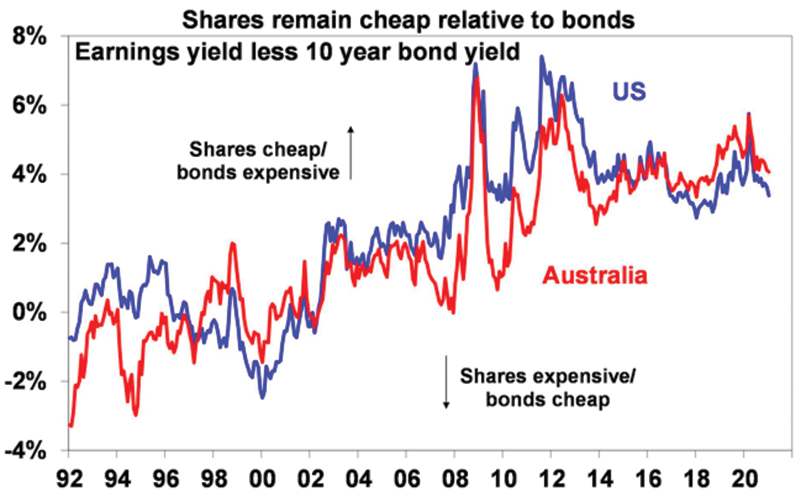
    Shares have had a very strong rebound from their pandemic lows and are vulnerable to higher inflation as it puts upwards pressure on interest rates and downwards pressure on share market valuations (or price to earnings multiples). However, while a crash is always a risk it’s not our base case. First, earnings expectations are still being revised up albeit not as strongly as a year ago. Second, while monetary policy will be tightened its unlikely to become so tight as to cause a recession and slump in earnings. Finally, share markets still offer a strong earnings yield premium relative to bond yields in contrast to in the year 2000 when bond yields rose above earnings yields. Of course, if inflation just continues to surge then the risks to shares will increase.

    What are good hedges against higher inflation?

    Sustained higher inflation will ultimately mean upwards pressure on the yield structure in the economy which is negative for investments that have benefitted from years of low and falling interest rates, like high PE tech stocks. The best protection against sustained higher inflation would be inflation linked bonds, real assets like commodities and parts of the share market that will see stronger earnings growth.

    With bond yields still low why invest in bonds?

    Bonds are likely to see another year of negative returns this year reflecting still low starting point yields and capital losses as yields rise. However, they are still a good portfolio diversifier as they are likely to rally if significant concerns arise about a recession.

    Closing comments

    So, in closing , although we sent an economic update only 4 weeks ago, a lot has happened in the past 4 weeks and potentially a lot more can happen. It’s how we react in these times. Rather than panic, we take advantage of mispriced markets that always recover given some time.

    As I also say, if you’re an advised client, you don’t need to worry. However, if you’re not regularly reviewing your investments and overall strategy with one of our Financial Planners, you need to act swiftly. 

    Stay calm, review if needed and ride this one out with our recommended strategies.


    Bill Bracey – CEO, Managing Director
    Sydney Financial Planning  


    Your long-term strategy and investments positioned for taking take advantage of mispriced markets?

    Speak with one of our Financial Planners about the best approach for your circumstances, either book a meeting or get in contact with us on 02 9328 0876.


    This article was prepared by William Bracey and Dr Shane Oliver. Dr Shane Oliver who provides economic forecasts and analysis of key variables and issues affecting, or likely to affect, all asset markets. He also provides economic forecasts and analysis of key variables and issues affecting, or likely to affect, all asset markets.

    Important note: While every care has been taken in the preparation of this document, AMP Capital Investors Limited (ABN 59 001 777 591, AFSL 232497) and AMP Capital Funds Management Limited (ABN 15 159 557 721, AFSL 426455) make no representations or warranties as to the accuracy or completeness of any statement in it including, without limitation, any forecasts. Past performance is not a reliable indicator of future performance. This document has been prepared for the purpose of providing general information, without taking account of any particular investor’s objectives, financial situation or needs. An investor should, before making any investment decisions, consider the appropriateness of the information in this document, and seek professional advice, having regard to the investor’s objectives, financial situation and needs. This document is solely for the use of the party to whom it is provided.

    General Disclaimer: This article contains information that is general in nature. It does not take into account the objectives, financial situation or needs of any particular person. You need to consider your financial situation and needs before making any decisions based on this information. Please seek personal financial advice prior to acting on this information.
    What is the real value of financial planning

    There is no such thing as a perfect plan, planning is process.

    The real value of a plan is as a starting reference, the nature of planning is things change.


    Still have some questions?

    If you want to discuss how we can work with you in more detail. Call us to arrange an appointment with one of our advisors on 02 9328 0876.


    General Disclaimer: While every care has been taken in the preparation of this document, Sydney Financial Planning and Charter FP make no representations or warranties as to the accuracy or completeness of any statement in it. This article contains information that is general in nature. It does not take into account the objectives, financial situation or needs of any particular person. You need to consider your financial situation and needs before making any decisions based on this information. Please seek personal financial advice prior to acting on this information.
    2022 macro investment outlook

    Macro investment update – January 2022

    2022 macro investment outlook

  • 2022 is likely to see more constrained returns with increased volatility.
  • Watch: coronavirus and vaccines; inflation; the US mid-term elections; China issues; Russian tensions with Ukraine and the west; & the Australian election.
  • Introduction

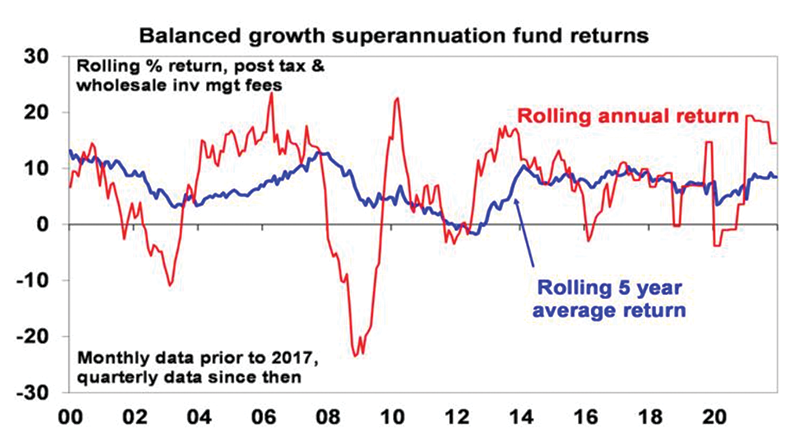
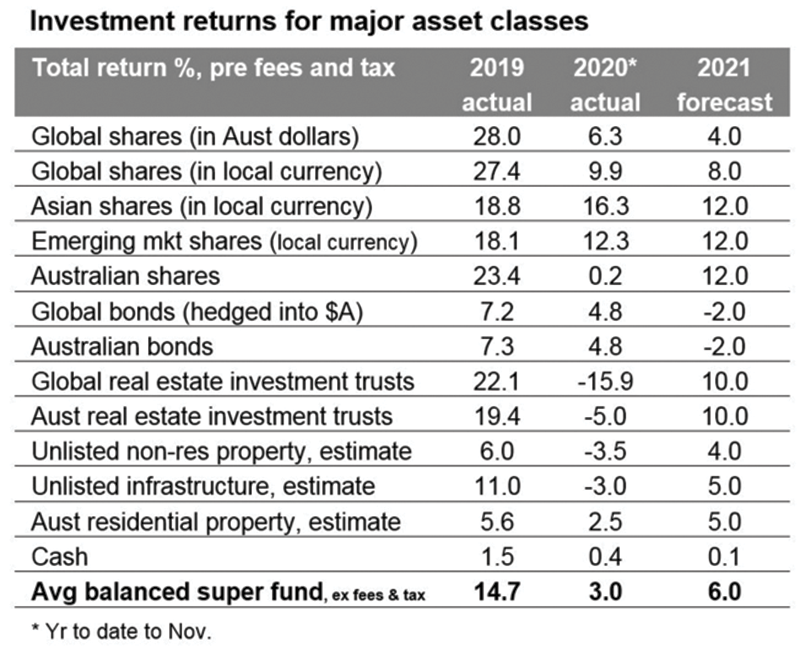
    Despite a wall of worry with coronavirus and inflation, 2021 was a great year for diversified investors, with average balanced growth super funds looking like they have returned around 14%, after just 3.6% in 2020. Balanced growth super fund returns have averaged around 8.5%pa over the last five years, well above inflation and bank deposit rates.

    But can strong returns continue? Here is a simple point form summary of key insights and views on the investment outlook.

    spf ed24 balanced growth super fund returns 001

    Source: Mercer Investment Consulting, Morningstar, AMP

    Six things that went wrong in 2021

    • Several coronavirus waves disrupted economic activity.
    • Inflation took off as coronavirus boosted spending on goods and disrupted production and supply chains
    • Some key central banks started to remove monetary stimulus earlier than expected with some raising rates.
    • Bond yields surged.
    • Chinese growth slowed sharply.
    • Geopolitical tensions with China, Russia & Iran stayed high.

    But there were three big positives

    • Science and medicine appeared to offer hope of getting on top of coronavirus. This saw less severe illness through the mid-year Delta wave compared to the 2020 waves.
    • As a result, the broad trend was towards global reopening.
    • Monetary and fiscal policy remained ultra-easy.

    As a result, global growth is estimated to have been nearly 6% and this drove strong profit growth and along with low rates saw strong returns from shares and other growth assets offsetting losses in bonds.

    Four lessons from 2021

    • Inflation is not dead – a surge in money supply under the right circumstances, in this case massive fiscal stimulus and supply shortages, can still boost inflation.
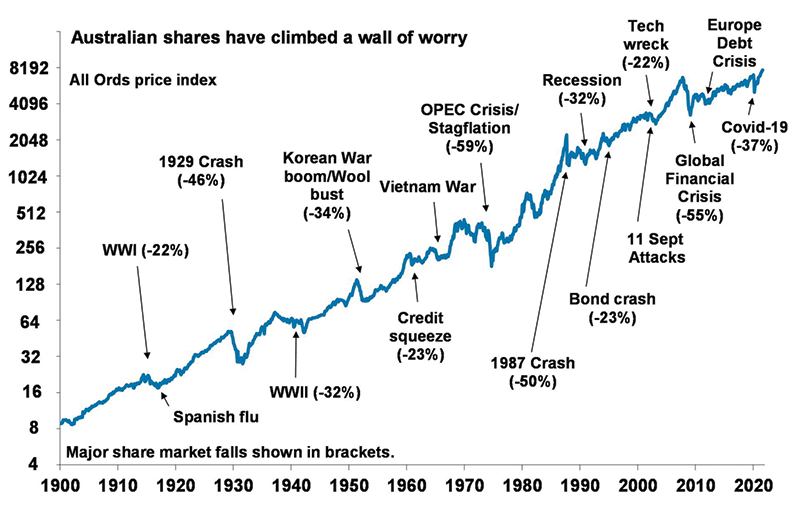
    • Shares climb a wall of worry – particularly if earnings are rising and interest rates are low/monetary policy is easy.
    • Timing market moves is hard and the key is to have a well-diversified portfolio – despite lots of worries share markets overall surprised with their strength but some share markets (eg in Asia missed out) and bonds performed poorly.
    • Turn down the noise – investors are getting bombarded with irrelevant, low quality and conflicting information which confuses and adds to uncertainty. So, the best approach is to turn down the noise and stick to a long-term strategy.

    Seven reasons for optimism on economic growth

    • Coronavirus could finally be moving from a pandemic to being endemic – more on this below.
    • Excess savings of around $US2.3trn in the US and $250bn in Australia will provide an ongoing boost to spending.
    • While Fed and likely RBA monetary policy will tighten this year it will still be easy. It’s usually only when policy becomes tight that it ends the economic cycle & the bull market and that’s a fair way off.
    • Inventories are low and will need to be rebuilt which will provide a boost to production.
    • Positive wealth effects from the rise in share and home prices will help boost consumer spending.
    • China is likely to ease policy to boost growth.
    • While business surveys are down from their highs, they remain strong and consistent with good growth.

    Global growth is likely to slow this year but to a still strong 5% with Australian growth of around 4%, despite the Omicron wave resulting in a brief set back in the March quarter. We have revised down our March quarter Australian GDP forecast by 1% to 0.6%, but revised up subsequent quarters by the same.

    Four reasons for optimism regarding coronavirus

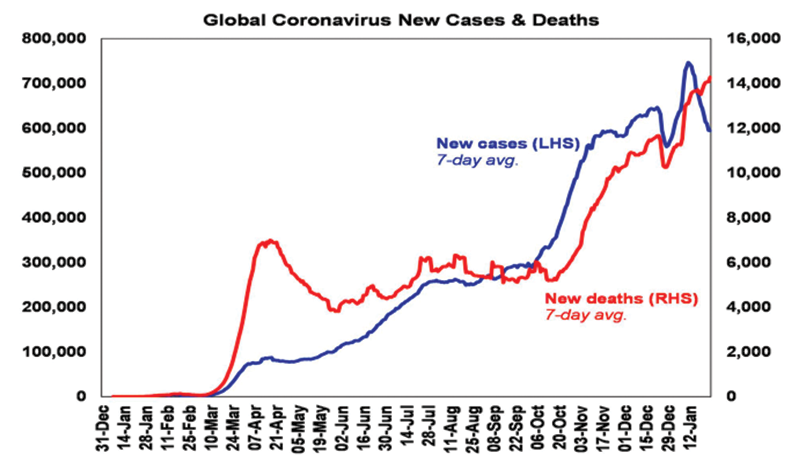
    The current situation is quite worrying. Global and Australian coronavirus cases have surged over the last month. Australia managed the first 22 months of the pandemic highly effectively with a suppression strategy that minimised deaths and supported the economy. Following the further relaxation of restrictions since November, significant pressure has been placed on the health system. Overseas experience showed a reopening rebound in Delta cases in even highly vaccinated countries (eg, Singapore). And the Omicron variant arrived in late November with clear evidence it was far more transmissible than Delta. All at a time when much of the population has yet to have a booster shot. The end result looks like being another hit to the economic recovery in the current quarter as people self-regulate to avoid covid or have to isolate. However, each covid wave seems to be having a smaller negative economic impact. More fundamentally, despite the short-term uncertainty there are four reasons for optimism regarding coronavirus:

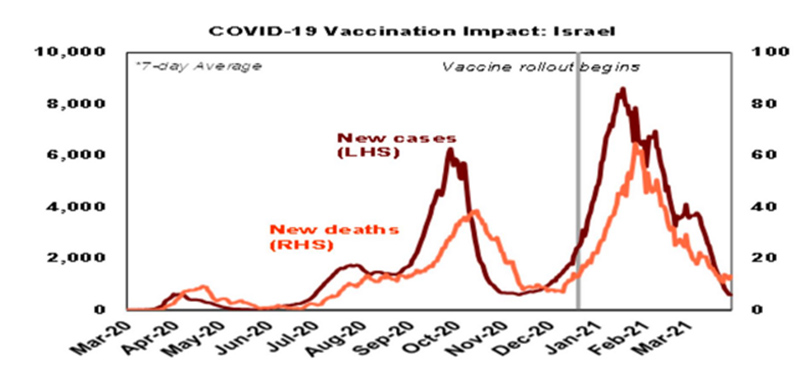
    • Vaccines are still providing protection against serious illness – particularly once booster shots are administered.
    • New coronavirus treatments are on the way which will aid in the treatment of the more vulnerable.
    • Omicron is more transmissible but less harmful (evident in far lower levels of hospitalisations and deaths relative to the surge in new cases compared to past waves) and so could come to dominate other variants.
    • Past covid exposure is providing a degree of herd immunity.

    Combined, this could set coronavirus on the path to being endemic where we learn to “live” with it. South Africa, London and New York are possibly already seeing signs of a peak in Omicron. Of course, the risk of new variants that are more transmissible & more deadly remains – which is why it’s in the interest of developed countries to speed up global vaccination.

    Key views on markets for 2022

    Still solid economic growth, rising profits and still easy monetary conditions should result in good overall investment returns.

    • Global shares are expected to return around 8% but expect to see a rotation away from growth and tech heavy US shares to more cyclical markets.
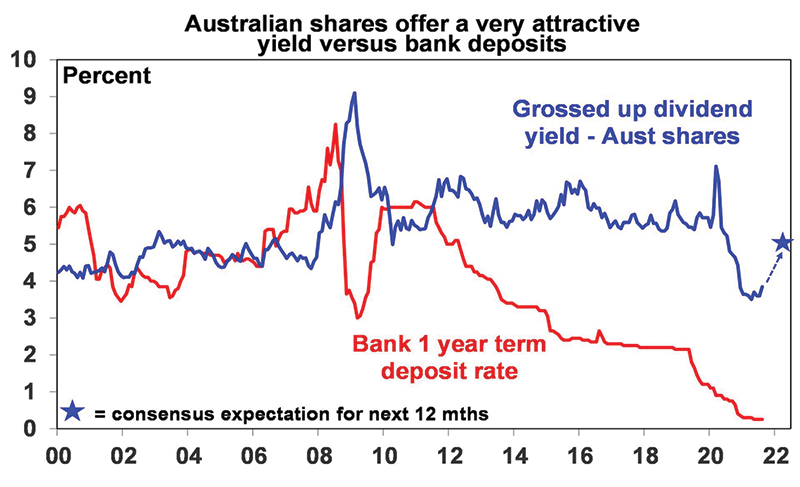
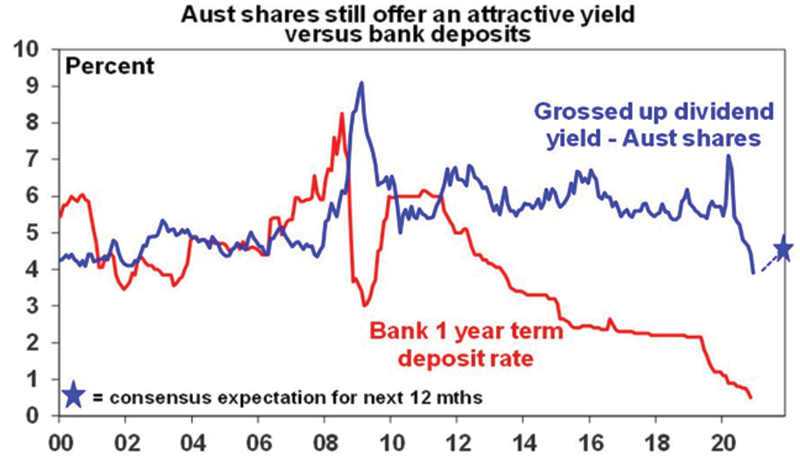
    • Australian shares are likely to outperform, helped by leverage to the global cyclical recovery and as investors continue to search for yield in the face of near zero deposit rates but a grossed-up dividend yield of around 5%.
    • Still very low yields & a capital loss from a rise in yields are likely to again result in negative returns from bonds.
    • Unlisted commercial property may see some weakness in retail and office returns, but industrial is likely to be strong. Unlisted infrastructure is expected to see solid returns.
    • Australian home price gains are likely to slow with prices falling later in the year as poor affordability, rising fixed rates, higher interest rate serviceability buffers, reduced home buyer incentives and higher listings impact.
    • Cash and bank deposits are likely to provide very poor returns, given the ultra-low cash rate of just 0.1%.
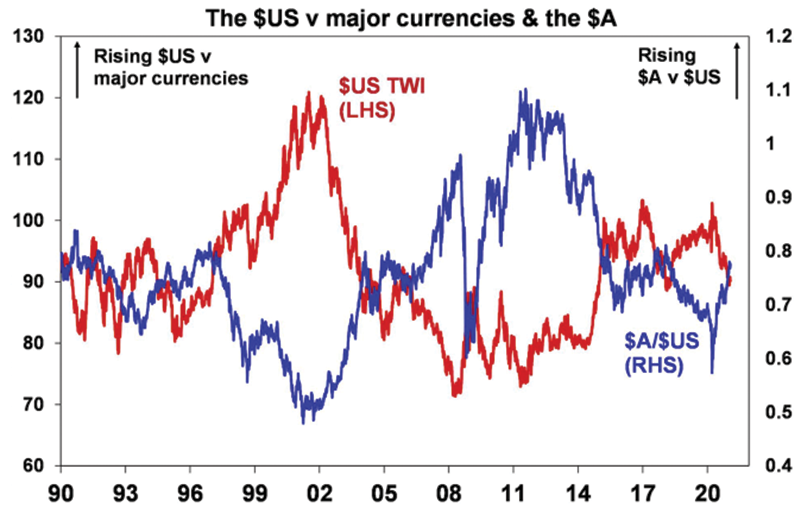
    • Although the $A could fall further in response to coronavirus and Fed tightening, a rising trend is likely over the next 12 months, helped by still strong commodity prices and a decline in the $US, probably taking it to around $US0.80.

    Five reasons to expect more volatility

    • Inflation – while its likely to moderate this year as production rises & goods demand subsides it is likely to be associated with ongoing scares and the risk that its higher for longer.
    • The start of Fed and RBA rate hikes and quantitative tightening – monetary policy is unlikely to get tight enough to threaten the economic recovery and cyclical bull market, but monetary tightening could still cause volatility.
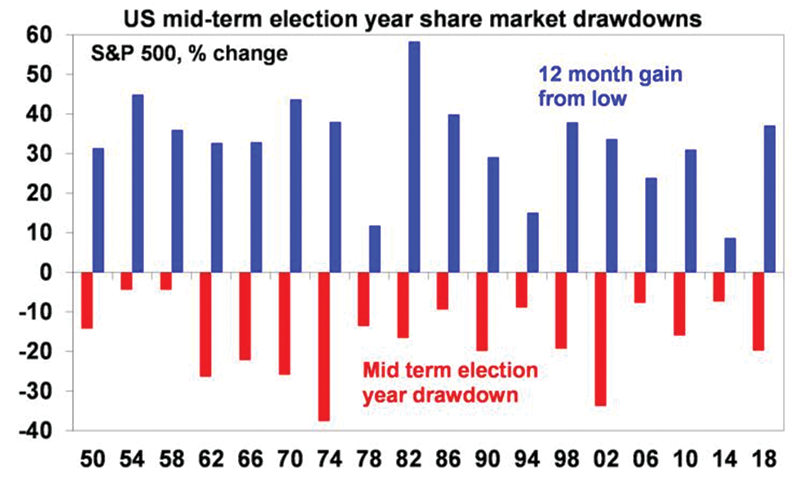
    • The US mid-term elections – mid-term election years normally see below average returns in US shares, and since 1950 have seen an average drawdown of 17%, albeit with an average 33% gain over the subsequent 12 months.
    spf ed24 us mid term election year share drawdowns 002

    Source: Strategas, AMP

    • China/Russia/Iran tensions – a partial Russian invasion of Ukraine could lead to even higher European gas prices.
    • Mean reversion – shares are no longer cheap, the easy gains are behind us and calm years like 2021 tend to be followed by volatile years.

    Six things to watch

    • Coronavirus – new variants could set back the recovery.
    • Inflation – if it continues to rise and long-term inflation expectations rise, central banks will have to tighten aggressively putting pressure on asset valuations.
    • US politics – political polarisation is likely to return to the fore in the US, posing the risk of a deeper than normal mid-term election year correction in shares.
    • China issues are likely to continue – with the main risks around its property sector and Taiwan.
    • Russia – a Ukraine invasion could add to EU energy issues.
    • The Australian election – but if the policy differences remain minor, a change in government would have little impact.

    Nine things investors should remember

    Yeah – I put these in most years!

    • Make the most of the power of compound interest. Saving regularly in growth assets can grow wealth substantially over long periods. Using the “rule of 72”, it will take 144 years to double an asset’s value if it returns 0.5%pa (ie, 72/0.5) but only 14 years if the asset returns 5%pa.
    • Don’t get thrown off by the cycle. Falls in asset markets can throw investors out of a well thought out strategy.
    • Invest for the long-term. Given the difficulty in timing market moves, for most it’s best to get a long-term plan that suits your wealth, age & risk tolerance & stick to it.
    • Diversify. Don’t put all your eggs in one basket.
    • Turn down the noise.
    • Buy low, sell high. The cheaper you buy an asset, the higher its prospective return will likely be and vice versa.
    • Avoid the crowd at extremes. Don’t get sucked into euphoria or doom and gloom around an asset.
    • Focus on investments you understand offering sustainable cash flow. If it looks dodgy, hard to understand or has to be justified by odd valuations or lots of debt, then stay away.
    • Seek advice. Investing can get complicated and its often hard to stick to a long-term investment strategy on your own

    Closing comments

    We send out economic updates like this one to provide our valued clients with a so much needed perspective. Not to create headlines, not to forecast, but instead, to give you a balanced update of what we’ve been doing behind the scenes. To let you know that we’re monitoring this stuff, so you don’t have to.

    Mainstream and financial services media make it very attractive to capture our eyeballs. They want us to think that whatever the crisis du jour is, it’s something we really need to know. The difference between you and other people around you is that you have a plan in place, and you have someone to talk to. Someone who knows you and your plan and someone who understands what’s important to you and your family. It’s what really matters – knowing if one’s on track with their long-term plan. Everything else is commentary. If you review your progress and strategies with us yearly, you maximise your chances to achieve your desired lifestyle.

    You and I are long-term, goal-focused, plan-driven equity investors. We believe that the key to lifetime success in equity investing is to act continuously on a specific, written plan. Likewise, we believe substandard returns and even investment failure proceeds inevitably from reacting to (let alone trying to anticipate) current economic/market events. We’re convinced that the economy cannot be consistently forecast, nor the markets consistently timed. Therefore, we believe that the only reliable way to capture the full long-term return of equities is to ride out their frequent but historically always temporary declines.

    We look forward to seeing all our clients face to face or via video link depending on what works best at the time. The important thing is when your financial planner says we need to talk, make sure you put time aside as it’s about your future.
    Goodbye and good riddance to 2021, wishing all our clients a healthy and prosperous 2022.


    Bill and the team at SFP.


    What does your long-term strategy and investment opportunity for 2022 look like?

    Speak with one of our Financial Planners about the best approach for your circumstances, either book a meeting or get in contact with us on 02 9328 0876.


    This article was prepared by William Bracey and Dr Shane Oliver. Dr Shane Oliver who provides economic forecasts and analysis of key variables and issues affecting, or likely to affect, all asset markets. He also provides economic forecasts and analysis of key variables and issues affecting, or likely to affect, all asset markets.

    Important note: While every care has been taken in the preparation of this document, AMP Capital Investors Limited (ABN 59 001 777 591, AFSL 232497) and AMP Capital Funds Management Limited (ABN 15 159 557 721, AFSL 426455) make no representations or warranties as to the accuracy or completeness of any statement in it including, without limitation, any forecasts. Past performance is not a reliable indicator of future performance. This document has been prepared for the purpose of providing general information, without taking account of any particular investor’s objectives, financial situation or needs. An investor should, before making any investment decisions, consider the appropriateness of the information in this document, and seek professional advice, having regard to the investor’s objectives, financial situation and needs. This document is solely for the use of the party to whom it is provided.

    General Disclaimer: This article contains information that is general in nature. It does not take into account the objectives, financial situation or needs of any particular person. You need to consider your financial situation and needs before making any decisions based on this information. Please seek personal financial advice prior to acting on this information.
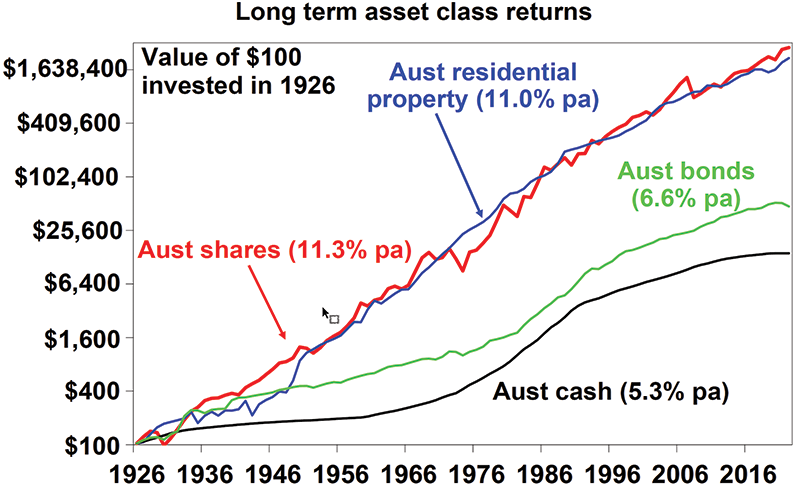
    Tax effective structures for investors

    What sort of structure should you use? What is the most ‘tax effective’ structure to use?

    The answer isn’t simple, there are all types of structures and reasons for using a particular type.


    Not sure on what structure you should consider?

    Book a call with one of our investment specialist to discuss your personal situation, to arrange an appointment contact our team on 02 9328 0876.


    General Disclaimer: While every care has been taken in the preparation of this document, Sydney Financial Planning and Charter FP make no representations or warranties as to the accuracy or completeness of any statement in it. This article contains information that is general in nature. It does not take into account the objectives, financial situation or needs of any particular person. You need to consider your financial situation and needs before making any decisions based on this information. Please seek personal financial advice prior to acting on this information.

    The importance of retirement planning

     Why is it important to plan for your retirement?

    Why having a trusted guide to help you though the ever changing landscape and managing emotional investment decisions in times of uncertainty is critital.


    If you have questions on your retirement planning, we’re here to help.

    Book a call with one of our retirement specialist to discuss your personal situation, to arrange an appointment contact our team on 02 9328 0876.


    General Disclaimer: While every care has been taken in the preparation of this document, Sydney Financial Planning and Charter FP make no representations or warranties as to the accuracy or completeness of any statement in it. This article contains information that is general in nature. It does not take into account the objectives, financial situation or needs of any particular person. You need to consider your financial situation and needs before making any decisions based on this information. Please seek personal financial advice prior to acting on this information.
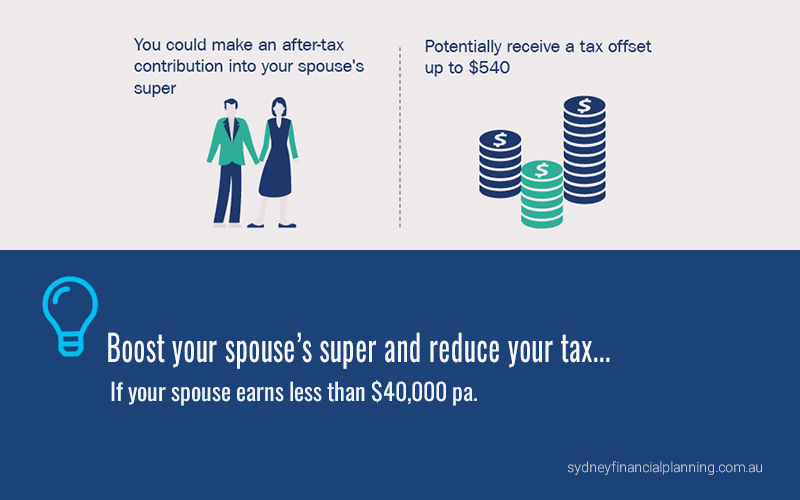
    Correction time? Shares get the wobblies

    Correction time? Shares get the wobblies – seven things investors need to keep in mind.

    Correction time? Shares get the wobblies

  • Shares may still have more downside as it will take a while to resolve some of these issues.
  • Key things for investors to bear in mind are that: corrections are healthy and normal; a renewed recession is unlikely and this will limit share market falls; selling shares after a fall locks in a loss; share pullbacks provide opportunities for investors to buy them more cheaply; shares offer an attractive income flow; and finally, to avoid getting thrown off a long-term investment strategy it’s best to turn down the noise during times like this.
  • Introduction

    The past week has seen share markets wobble – with US shares and global shares down 4% from their recent high and Australian shares falling about 5% – amidst concern about global growth, central banks starting to reduce monetary stimulus and problems at a major Chinese property developer. Some are even talking about a “Lehman moment” in relation to the latter – a reference to the collapse of Lehman Brothers in September 2008 that contributed to the worst of the GFC. Markets have stabilised a bit in the last day or so but its too early to say that we have seen the bottom. This note looks at the key issues for investors and puts the falls into context.

    A long worry list is behind the weakness

    The wobbles in shares reflects a long worry list that has been building for a few months now.

    • Recent economic data globally has been softer than expected, leading to concerns peak growth is behind us.
    • Uncertainty remains over the impact of the Delta variant.
    • Supply side constraints globally appear to be constraining growth and threatening to continue boosting inflation.
    • Central banks are starting to slow monetary stimulus with a focus this week on when the Fed will announce a “tapering”, or slowing, of its bond buying.
    • The US Congress needs to pass a continuing resolution to fund Federal spending by the end of the month (to avoid another Government shutdown) and will need to increase or suspend the debt ceiling sometime between mid-October and mid-November (to avoid the US Government defaulting on its debt servicing and social security commitments).
    • Congress is looking at tax hikes (on corporates which could knock 5% off US earnings, capital gains and dividends) to help fund Biden’s $US3.5trillion remaining stimulus plans.
    • The Chinese economy has been slowing in response to earlier policy tightening and recent coronavirus restrictions, adding to concerns about global growth.
    • Debt servicing problems at China Evergrande Group – China’s second largest property developer has gotten into trouble as a result of high debt levels and property tightening measures. If Evergrande ends in a full-scale default and liquidation of its assets, some worry that this may lead to another “Lehman moment” in terms of a flow on the Chinese financial system and property market, posing a big threat to the Chinese economy, global growth and commodity prices (like iron ore).
    • And share markets having had huge gains since their March lows last year – with US shares doubling having risen 14 of the last 17 months and Australian shares up 68% having risen 16 of the last 17 months – are arguably vulnerable to a bit of a pull back.

    Considerations for investors

    Sharp market falls with talk of “Lehman moments” are stressful for investors as no one likes to see their investments fall in value. However, several things are worth bearing in mind:

    First, while they all have different triggers and unfold differently, periodic corrections in share markets of the order of 5%, 15% and even 20% are healthy and normal. For example, during the tech/dot-com boom from 1995 to early 2000, the US share market had seven pull backs ranging from 6% to 19% with an average decline of 10%.

    During the same period, Australian shares had eight pullbacks ranging from 5% to 16% with an average fall of 8%. All against a backdrop of strong returns every year. During the 2003 to 2007 bull market, the Australian share market had five 5% plus corrections ranging from 7% to 12%, again with strong positive returns every year. And the last decade regularly saw major pullbacks. See the next chart.

    sfp ed23 share market pullback 001

    Source: Bloomberg, AMP Capital

    SFP ed23 september rough month 002

    Source: Bloomberg, AMP Capital

    And right now, we are in the time of year often associated with share market pullbacks. Over the last 35 years, September has been the weakest month of the year for both US and Australian shares. See the next chart. US shares have fallen in five of the last 10 Septembers and the Australian share market has fallen in seven of the last 10, with both falling in September last year.

    But while share market pullbacks can be painful, they are healthy as they help limit complacency and excessive risk taking. Related to this, shares climb a wall of worry over many years with numerous events dragging them down periodically, but with the long-term trend ultimately up & providing higher returns than other more stable assets. Bouts of volatility are the price we pay for the higher longer-term returns from shares.

    SFP ed23 australian shares climb wall 003

    Source: ASX, AMP Capital

    Second, historically the main driver of whether we see a correction (a fall of say 5% to 15%) or even a mild bear market (with say a 20% decline that turns around relatively quickly like we saw in 2015-2016) as opposed to a major bear market (like that seen in the global financial crisis (GFC) or the 35% or so falls seen in February/March last year going into the coronavirus pandemic) is whether we see a recession or not – notably in the US as the US share market tends to lead most major global markets.

    Right now it’s doubtful that the worry list referred to above, while extensive, will be enough to drive a US, global or Australian recession:

    • While global growth is likely to slow in 2022 business surveys remain strong and global growth is still likely to be strong at around 4%.
    • The exit from the coronavirus pandemic is proving longer and messier than expected – but vaccines are helping protect against serious illness with little support for a return to lockdowns in developed countries. In Australia, the delayed but now rapid vaccination program looks on track to allow a gradual reopening as we learn to live with higher levels of coronavirus though next quarter, avoiding recession ahead of much stronger growth next year.
    • Supply side constraints and hence the near-term inflation threat is likely to recede as recovery continues and spending rotates back towards services from goods.
    • While central banks are heading towards the exits from ultra-easy money, it’s likely to be gradual with low interest rates for some time and the sort of tight monetary policy that brings an end to cyclical bull markets looks a long way off.
    • The path to pass a funding resolution and resolve the debt ceiling in the US looks likely to be a white-knuckle ride with lots of brinkmanship, but neither side wants to be blamed for shutting the government or causing a default so a last minute deal remains likely.
    • Confirmation of rising taxes in the US will be a negative for shares – but tax hikes are likely to be watered down from already watered-down plans such that it’s only a partial reversal of the Trump tax cuts and the direct drag on US profits will only be about 5%.
    • While there is much uncertainty about how Evergrande will be resolved – which could cause more short-term weakness in share markets and the iron ore price – it’s not as systemically important to the Chinese/global financial system as Lehman Brothers was. While the Chinese authorities want to teach property developers and investors a lesson about the dangers of too much debt, it’s unlikely to allow Evergrande’s failure to mushroom into a full-on credit squeeze or a “Lehman moment” that collapses the property sector (via forced property sales) and the economy. So ultimately, some sort of debt restructuring rather than full bankruptcy is likely, with reports of a deal with bond holders regarding a payment due on 23rd September and the relative calm in China’s own debt markets possibly being a sign of that. And more broadly China is likely to provide policy stimulus to support growth into year end.

    Third, selling shares or switching to a more conservative investment strategy whenever shares suffer a setback just turns a paper loss into a real loss with no hope of recovering. And trying to time a market recovery is very hard. The best way to guard against deciding to sell on the basis of emotion after weakness in markets is to adopt a well thought out, long-term strategy and stick to it.

    Fourth, when shares and growth assets fall, they’re cheaper and offer higher long-term return prospects. So, the key is to look for opportunities’ pullbacks provide. It’s impossible to time the bottom but one way to do it is to average in over time.

    Fifth, Australian shares are offering a very attractive dividend yield compared to banks deposits. While resource stocks dividend payments may have peaked for a while following the plunge in iron ore prices, they’re unlikely to fall back much as they didn’t go up as much as earnings and high prices for gas, coal and metals are providing some offset. So, the income flow you are receiving from a well-diversified portfolio of shares is likely to remain attractive, particularly against bank deposits.

    SFP ed23 australian shares attractive yeild 004

    Source: RBA, Bloomberg, AMP Capital

    Sixth, shares and other related assets often bottom at the point of maximum bearishness, ie, just when you and everyone else feel most negative towards them. So, the trick is to buck the crowd. “Be fearful when others are greedy. Be greedy when others are fearful,” as Warren Buffett has said.

    Closing comments

    Finally, turn down the noise. In times of uncertainty, negative news can reach fever pitch. But it often provides no perspective and only adds to the sense of panic. All of this makes it harder to stick to an appropriate long-term strategy let alone see the opportunities that are thrown up. So as always, it’s best to turn down the noise.

    Bill and the team at SFP.


    How is your long-term strategy and investment opportunity looking?

    Speak with one of our Financial Planners about the best approach for your circumstances, either book a meeting or get in contact with us on 02 9328 0876.


    This article was prepared by William Bracey and Dr Shane Oliver. Dr Shane Oliver who provides economic forecasts and analysis of key variables and issues affecting, or likely to affect, all asset markets. He also provides economic forecasts and analysis of key variables and issues affecting, or likely to affect, all asset markets.

    Important note: While every care has been taken in the preparation of this document, AMP Capital Investors Limited (ABN 59 001 777 591, AFSL 232497) and AMP Capital Funds Management Limited (ABN 15 159 557 721, AFSL 426455) make no representations or warranties as to the accuracy or completeness of any statement in it including, without limitation, any forecasts. Past performance is not a reliable indicator of future performance. This document has been prepared for the purpose of providing general information, without taking account of any particular investor’s objectives, financial situation or needs. An investor should, before making any investment decisions, consider the appropriateness of the information in this document, and seek professional advice, having regard to the investor’s objectives, financial situation and needs. This document is solely for the use of the party to whom it is provided.

    General Disclaimer: This article contains information that is general in nature. It does not take into account the objectives, financial situation or needs of any particular person. You need to consider your financial situation and needs before making any decisions based on this information. Please seek personal financial advice prior to acting on this information.

    Opportunity of being young and free

    The opportunity called being ‘Young and Free’

    Opportunity of being young and free

    Because I think it’s really easy NOT to manage your money differently to people around you – to simply do what everyone else is doing. Ok, this may be completely fine if you’re only surrounded by successful people with happy life and balance. If this is the case, no need to read further.

    If you’re still reading though, you need to realise one thing – most people around you can’t help you – they’ve done more money mistakes in their lives they would ever admit to…

    They’ll tell you things like – ‘You’re young, enjoy life, you have plenty of time…’

    What they don’t say is – ‘You’ll end up like us – having to slave for forty odd years working in the jobs you hate (but you’ll turn up to anyway because you have to pay the bills somehow), all just because you leave important money decisions for later’.

    I wonder how many of them would say – ‘Don’t copy what we did. Learn how to prioritise with your money. Learn how to save and invest when you get your first job. It’s when you have much less commitments and much more flexibility. Don’t waste your early years and use your time potential to your advantage.’

    If you form your good money habits and start early, your life can be full of options later. Options like working doing what you love (most likely owning your own business), living closer to your work and being home early every night so you can read your kids a book before they go to bed. Isn’t that what life is all about – spending memorable moments with your loved ones?

     In order to get there, you need to stop living for today only. Although it sounds great and hippy, what it’s going to create for you is money slavery.

     Instead, start looking at your life in ten-year blocks. This means looking at a consequence of every decision you make with your money – what will it be in ten years’ time?

     For example – How much do you spend on coffees, lunches, dinners, drinks, parties, clothes every week? Let’s make assumptions, but be fairly conservative, shall we? One coffee a day ($4), three lunches a week, including weekends ($60), trendy café brunch on Saturday ($20), one dinner a week ($40), drinks on the weekend ($100), one new outfit per month ($150).

    Putting all the ad-hoc expenses aside – trips, buying of new gadgets, birthdays, holidays etc. our regular assumed expenditure totals at staggering $282 per week! Once that $282 leaves your wallet, it’s gone forever. The opportunity you had is lost.

    Now, let’s imagine you’ll keep doing some of those things, but only spend $132 per week – meaning you save and invest $150 every week.

    Starting at zero, investing in a low-cost diversified share fund, in ten years, you’ll end up with a portfolio worth over $145,000! Boom!

    Who said it’s hard to buy a home in Sydney? It can be, if you do what everyone else around you is doing. But if you start this exercise at 18, you’ll have some options available to you at 28, right?

    Ok, you may not want to buy a home, but you can invest this money for income and have a perpetual portfolio generating over $7,000 per year income (whilst still fully preserving the capital). It’s a great way to fund your annual holidays – with no extra work required. Ever.

    These are pretty basic concepts which are simple and easy to understand. But are they easy to do? No way!

    Two main reasons:

    •  We get lost in details – the best time to invest, the best investments, the best performance – we live in the timing and selection culture which is putting us through so much pressure and noise we get confused.
    •  Even simple concepts can be hard to do (or to keep doing consistently for long time) – patience and discipline is not taught at schools.


    That’s where you need clarity, focus and a constant push from someone else to make sure you stick to your plan and you don’t mess it up. After all, it’s worth every cent – have options to live your life the way you want it.

    What are you planning to do with your opportunity? One thing is clear – it’s never too late to start.


    Need some help getting clarity and focus with your money?

    Why not book an appointment with one of our planners to review your opportunity to get ahead, contact us on 02 9328 0876.


    NB: Numbers are based on 2015 prices (written in 2015), however the same principles apply.

    General Disclaimer: This article contains information that is general in nature. It does not take into account the objectives, financial situation or needs of any particular person. You need to consider your financial situation and needs before making any decisions based on this information. Please seek personal financial advice prior to acting on this information.
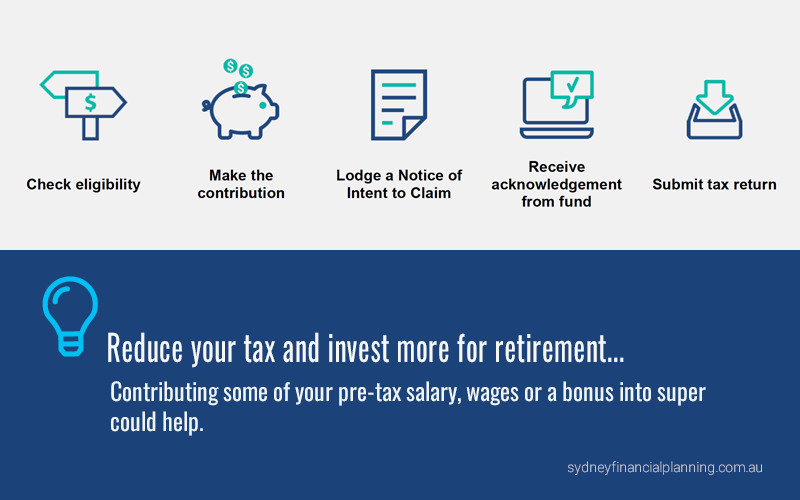
    Photo by Krists Luhaers on Unsplash

    April 2021 Market Update

    SFP market update and commentary – April 2021 – your questions answered

    April 2021 Market Update

    The global rebound was led by China but looks like being led by the US this year reflecting rapid vaccine dissemination and massive fiscal stimulus. Expect stronger growth in Europe and Japan in the second half as vaccine dissemination there speeds up.

    Are vaccines working? What about new variants?

    Yes. There are now five western vaccines along with vaccines from Russia and China. The evidence from numerous trials and results from Israel (where 58% of the population have received at least one dose) and the UK (where 45% have received at least one dose) indicate that the various vaccines are around 75% plus effective in heading off infection and 100% or near effective in preventing serious illness, hospitalisation or death (including for new variants).

    This is evident in a sharp fall in new cases, hospitalisation and deaths in Israel, the UK and US (where “only” 29% have received at least one dose but about 3 million people a day are now being vaccinated).

    Diagram Covid Vacine impact

    Source: ourworldindata.org; AMP Capital

    Protection against hospitalisation and deaths though is key in providing confidence in a sustained reopening. There may still be occasional new waves of cases until herd immunity is reached and uncertainty remains around how long vaccines last, and this may require top ups. Europe has seen a resurgence in new cases but is lagging in vaccination (10% having received one dose) as are emerging countries and Australia. Vaccine production is ramping up rapidly though so most developed countries will approach some degree of herd immunity (70% plus vaccination) in the second half (mid-year in the US) and emerging countries through next year.

    Will the ending of JobKeeper derail the Australian recovery?

    This is doubtful. The best guide to those vulnerable to job loss from JobKeeper’s end is those working zero hours and this was only running around 70,000 above normal in February which is down from 720,000 in April last year – the loss of 70,000 jobs would push unemployment up but only by around 0.5% and from a much lower than expected level of 5.8% in February and don’t forget that nearly 90,000 jobs were created in February; another 100,000 above normal were working reduced hours but they are more likely to see a reduction in income rather than job loss; various measures of job vacancies are running around 15% above year ago levels suggesting that job losses in travel and CBD-related service businesses should be made up elsewhere; JobKeeper’s injection into the economy has already dropped from $12bn a month last September to $2.5bn a month in March and yet the economy has continued to recover; and its removal will be partly offset by other forms of stimulus such as personal tax cuts and investment incentives. We expect the Australian economy to grow by around 5% this year.

    What about the ongoing snap lockdowns in Australia?

    These are disruptive and a huge barrier to making domestic travel plans, but providing they remain short, the overall economic impact will be minor (as they have been lately). Faster vaccine rollout (with CSL production kicking in) should end them later this year once herd immunity is reached. Of course, if the Brisbane’s snap lockdown (or any other) turns out to be long then the Government may have to consider reinstating JobKeeper or something similar for areas affected.
    The new travel bubble is another sign of recovery and a positive outlook.

    Is inflation going to become a problem?

    Annual inflation is likely to rise towards 4% in both the US and Australia in the months ahead as last year’s price falls drop out, higher commodity prices along with goods supply bottlenecks impact and flood driven rises in fresh fruit and vegetable prices in Australia impact. However, this is likely to be temporary as distortions drop out, goods supply picks up & demand swings back towards services and as wages growth likely remains low.

    Beyond the next 2 to 3 years though the risks on inflation are likely to swing to the upside as spare capacity is used up and ultra-aggressive monetary policy ultimately pushes up inflation at a time when the disinflationary impact of globalisation is starting to fade, and governments are becoming more interventionist in their economies. In other words, we appear to be at a similar juncture to the peak in inflationary pressures seen in the early 1990s – but in reverse.

    What is the best protection against higher inflation?

    Sustained higher inflation will ultimately mean upwards pressure on the yield structure in the economy which could be negative for investments that have benefitted from years of low and falling interest rates like high PE tech stocks. Share market is generally the best protection against sustained higher inflation as it provides higher than inflation total returns. In the next couple of years we also expect inflation linked bonds and real assets like commodities and infrastructure to provide quality yields.

    When will interest rates start to rise?

    Both the Fed and RBA are signalling no rate hikes until 2024 at the earliest as they see it taking this long before labour markets are tight enough to sustain inflation at or just above target. We think it could come a bit earlier in 2023 but that’s still a long way off. Europe and Japan are even further away from raising rates.

    Note though that fixed mortgage rates take their que from long term bond yields and so have already started to bottom out.

    Will massive levels of public debt cause a problem?

    This could become an issue, but a major crisis should be avoided.

    First, public sector borrowing costs are still ultra-low.

    Second, Japan has had high public debt for years without a major problem.

    Third, it’s conceivable that if a problem did arise, governments could cancel the bonds that their central banks now own. Finally, in Australia public debt is relatively low.

    What is the risk of next share market ‘crash’?

    Shares have had a strong rebound from their pandemic lows a year ago and are always vulnerable to a decent correction, this could be triggered by an ongoing sharp rise in bond yields or new coronavirus waves ahead of heard immunity. While a correction is always a risk, as you (hopefully) know, it’s not something to fear.

    First, it’s normal for share market returns to slow in the second 12 months after a bear market low as markets are no longer cheap and they become dependent on higher earnings.

    Second, while the rise in bond yields this year has been sharp it reflects the bond market playing catch up to the economic recovery that share markets started to anticipate last year.

    Third, share market offers strong earnings yield premium relative to bond yields in contrast to in the year 2000 when bond yields rose were above earnings yields. So, shares are not overvalued. Fourth, earnings expectations have been revised up sharply so far this year on the back of the improving growth outlook. Fifth, we are still not seeing the sort of economic overheating, monetary tightening and investor euphoria seen at major market tops. Finally, in relation to the US share market being at a record high – markets are often at all-time highs as shares rise over time.

    Will the $A resume its upswing?

    After briefly hitting $US0.80, the rise in the $A has stalled as the $US rebounded. But with non-US growth likely to accelerate with vaccine deployment, Chinese growth likely to remain strong and some US stimulus leaking globally commodity prices are likely to be strong and safe haven demand for the $US will continue to fall so the upswing in the $A is likely to resume, seeing it end the year above $US0.80.

    Should investors invest in Bitcoin?

    It’s hard to see Bitcoin becoming digital cash – its transactions are slow and high cost, its highly volatile and it’s a massive user of electricity – and it’s not an asset generating cashflows – it doesn’t produce anything and it doesn’t pay any income while you hold it. This means the only way to benefit from bitcoin is to sell it for profit. Once you sell it, you need to think about what you buy with it. All of which makes it hard to justify other than as something to speculate on! Of course, this is not to say that it can’t go up a lot further (or down) as more jump on (or off) its bandwagon.

    Should investors invest in Bitcoin?

    How big a threat are tensions with China?

    For now, the impact on the Australian economy (as opposed to individual sectors) by the tensions with China has been muted by strong commodity prices, the ability to redirect some exports to other markets and China’s practical short-term difficulties in replacing Australian iron ore (there is basically not enough other supply sources). But it’s an issue to keep an eye on.

    Why is there another boom in Australian house prices?

    Australian house price boom

    Economic recovery, the strengthening jobs market, ultra-low interest rates, buyer incentives and FOMO are driving a new boom in property prices. Home prices in March look to have seen their fastest gain since the 1980s. With ultra-low mortgage rates this could run for another 18 months with prices rising by a further 20% or so.

    Several things are likely to eventually slow it down though, particularly from the second half:

    • Government housing incentives are likely to be curtailed;
      • the RBA and APRA are expected to reach yet again for macro prudential controls to slow housing lending. While they don’t target house prices, past experience indicates that surging house prices leads to a deterioration in lending standards and increasing financial stability risks, so it makes sense to start taping the lending standards’ brake soon. First thing to do would be to increase interest rate buffers
      • the recovery in immigration once international borders are reopened is likely to be gradual, resulting in an underlying oversupply of dwellings;
    • it’s likely that the 30-year tailwind for the property market of falling interest rates has now run its course and longer dated fixed rates are starting to rise; and
    • poor affordability is starting to become a constraint again.

    Closing comments

    There is a lot to digest here but if you think about where we were this time last year, a lot of these headlines are what we were hoping for back then. Having faith in the future is crucial in investing and this recovery was a good example of what happens when we stick to our plans and we don’t abandon this important investment principle. Big congratulations to all our clients who listened to our guidance and rode out another bear market via disciplined dollar cost averaging. You and your families have benefited from the correction’s discounted prices, not because we’re smarter, not because we have better investment skills, but because of the faith in the future.

    The value of the advice you have received is paying off, please make sure you respond to our annual progress review calls, as this is where we will address your individual situation and plan and help you navigate the times ahead.

    Bill and the team at SFP.


    Is your investment strategies for your 2021 portfolio in need of review?

    Speak with one of our Financial Planners to help you navigate the best approach for you, either book a meeting or get in contact with us on 02 9328 0876.


    This article was prepared by William Bracey and Dr Shane Oliver. Dr Shane Oliver who provides economic forecasts and analysis of key variables and issues affecting, or likely to affect, all asset markets. He also provides economic forecasts and analysis of key variables and issues affecting, or likely to affect, all asset markets.

    Important note: While every care has been taken in the preparation of this document, AMP Capital Investors Limited (ABN 59 001 777 591, AFSL 232497) and AMP Capital Funds Management Limited (ABN 15 159 557 721, AFSL 426455) make no representations or warranties as to the accuracy or completeness of any statement in it including, without limitation, any forecasts. Past performance is not a reliable indicator of future performance. This document has been prepared for the purpose of providing general information, without taking account of any particular investor’s objectives, financial situation or needs. An investor should, before making any investment decisions, consider the appropriateness of the information in this document, and seek professional advice, having regard to the investor’s objectives, financial situation and needs. This document is solely for the use of the party to whom it is provided.

    General Disclaimer: This article contains information that is general in nature. It does not take into account the objectives, financial situation or needs of any particular person. You need to consider your financial situation and needs before making any decisions based on this information. Please seek personal financial advice prior to acting on this information.

    Does money buy you happiness?

    Good health and wealth certainly help, but confidence plays the biggest part and your interpretation of certainty.

    As we have discovered, our happiest clients are content. You need to be ‘content’ that what you have in place can work for you.


    If you have questions on your retirement planning, we’re here to help.

    Book a call with one of our retirement specialist to discuss your personal situation, to arrange an appointment contact our team on 02 9328 0876.


    General Disclaimer: While every care has been taken in the preparation of this document, Sydney Financial Planning and Charter FP make no representations or warranties as to the accuracy or completeness of any statement in it. This article contains information that is general in nature. It does not take into account the objectives, financial situation or needs of any particular person. You need to consider your financial situation and needs before making any decisions based on this information. Please seek personal financial advice prior to acting on this information.

    7 key charts for investors to watch in 2021

    Seven key charts for investors to watch regarding the global economy and investment markets this year

    7 key charts for investors to watch in 2021

  • Seven key global charts worth keeping an eye on by investors this year are: the trend in new coronavirus cases and deaths; global business conditions PMIs; unemployment; global inflation; bond yields; the gap between earnings yields and bond yields; and the US dollar.
  • Introduction

    Our high-level investment view is that while shares are vulnerable to a short term correction having run up hard since early November, overall investment returns will be solid this year on the back of economic recovery (driven by stimulus and the deployment of vaccines allowing a more sustained reopening) at the same time that interest rates remain low. And we are likely to see a further shift in relative returns to investments that benefit from recovery – resources, industrials, tourism stocks and financials. This note looks at seven charts we see as critical to the outlook.

    Chart #1 – new coronavirus cases

    The deployment of vaccines holds hope for a sustained global reopening and return to something more normal and our base case is that this will be successful over the next year or so. Key to watch will be the trend in new coronavirus cases and deaths.

    global covid cases and deaths

    Source: ourworldindata.org, AMP Capital

    Global new cases have slowed again lately but this appears to owe more to the latest round of lockdowns as only around 5% of developed countries’ populations and less in emerging countries have been vaccinated. Uncertainty remains around vaccine effectiveness in preventing infection and serious illness, their effectiveness against new mutations, how long protection lasts for, what portion of the population will need exposure or vaccination for herd immunity, etc. That said, there are some positive signs regarding vaccine efficacy beyond formal trials out of Israel where vaccination is above 30%.

    Chart # 2 – global business conditions PMIs

    global composite pmi vs global gdp

    Source: Bloomberg, AMP Capital

    Global Purchasing Managers Indexes (PMIs) – surveys of purchasing managers at businesses in most major countries – are an excellent and timely guide to the state of the global economy. Since the initial lockdown lows early last year they have rebounded sharply, albeit with the services sector still lagging given distancing restrictions and remain consistent with strong growth this year. They will ideally need to improve further to see our expectation for global growth of over 5% this year and to underpin a strong rebound in profits.

    Chart 3 – unemployment and underemployment

    At present, investors face the ideal backdrop of improving growth but low interest rates. Key to watch in terms of the latter is spare capacity. One of the best measures of this is unemployment and underemployment

    labour underutilisation rate

    Source: Bloomberg, AMP Capital

    The combination of unemployment and underemployment has fallen sharply from last year’s highs but remains relatively high in the US and Australia. A continuing sharp fall from here would bring forward the time when central banks move from easing to being primed for tightening. That said we have a long way to go to full employment as even pre-coronavirus levels did not generate much inflationary pressure.

    Chart 4 – global inflation

    core inflation

    Source: Bloomberg, AMP Capital

    This year has started with a bit of an inflation scare and US and Australian headline CPI inflation measures look like rising to around 3.5-4% over the year to the June quarter as last year’s June quarter price slump drops out of annual calculations and higher commodity prices feed through. Core and underlying inflation measures will remain the main focus of central banks and right now they are well below target in the US, Europe, Japan and China as is the RBA’s preferred measure of underlying inflation in Australia at 1.2% year on year.

    Chart 5 – bond yields

    Long term bond yields plunged in the initial stages of the pandemic on safe haven demand and then as central banks bought bonds to inject cash into their economies. Higher long bond yields and steeper yield curves (i.e. the gap between long term yields and short-term interest rates) are part and parcel of economic recovery as a result of less saving and more borrowing.

    If we don’t see higher bond yields it would raise concerns that risk taking and investment – or borrowing short and lending long – may not occur. That said, we don’t want bond yields to rise too far too fast lest they boost borrowing costs too quickly and so crimp the recovery and put pressure on share market valuations – as occurred in 1994. So far so good with bond yields up from last year’s lows (by around 0.5% in the US and Australia and less elsewhere) but not dramatically so. More upside in yields is likely this year but too rapid a rise – perhaps as investors who are loaded up on bonds seek to offload them – would be a concern.

    us and au 10 year bond yields

    Source: NBER, Bloomberg, AMP Capital

    Chart 6 – the gap between earnings and bond yields

    The rebound in shares since March has pushed traditional valuations like price to earnings multiples to extremes leading some to fret about overvaluation and a bubble. But shares should trade on higher PEs and hence lower earnings yields when interest rates and bond yields fall. Once this is allowed for, share valuations are not extreme.

    shares remain cheap relative to bonds

    Source: Thomson Reuters, AMP Capitall

    One way to look at this is to compare the earnings yield on shares (i.e. the inverse of the PE) to the 10-year bond yield. Despite the rally in shares and recent rise in bond yields, it indicates that shares still provide a decent risk premium over bonds. This gap is worth watching – rising bond yields would make shares less attractive, but this can be offset by rising company profits where we expect to see strong gains this year.

    Chart 7 – the US dollar

    The US dollar is a counter cyclical currency so cyclical moves in it against a range of currencies are of global significance and bear close watching. Because of the relatively low exposure of the US economy to cyclical sectors like manufacturing and materials, the $US tends to be a “risk-of” currency, i.e. it goes up when there are worries about global growth and down when the outlook brightens. And a lot of global debt is denominated in US dollars particularly in emerging countries, so when the $US goes up it makes it tough for emerging countries.

    If we are right though and the global economy continues to recover, then the $US is likely to decline further (i.e. the red line in the next chart will fall further) which would be positive for emerging countries. It would also mean more upside for the $A against the $US (i.e. the blue line will continue to trend up) – the big movements in which are primarily a $US story. 

    us vs major currencies and australia

    Source: Bloomberg, AMP Capital

    Concluding Comments

    Well, we survived 2020, what a wide year ending in a huge recovery, as dramatic as the correction which caused it. Thanks again to all our well-advised clients, who heeded our advice to ride the correction out.

    Our January 2021 SFP Insight, gives you a snap shot of where we think the world and the world markets are and what to watch out for 2021, as market indicators.

    The US elections over now, so we are all getting back to work and hopefully getting ‘the jab’ soon.
    The sooner it happens, the sooner the economy will recover. In 2021 we expect to see a lot of volatility. Governments and households have gorged on cheap debt, which inflates shares and property markets. Every concerning news will also scare the markets as nations and households hold more debt. As that continues, a lot of incidental investors will sell hard assets fast causing compounding effect of the market volatility.

    After saying that, as interest rates will remain low for a while, governments worldwide wanting to stimulate economies, what better place to invest other than shares and property. So, in short, we see a continued rush to buy these assets as interest rates remain so low and inflation starting to come back.

    You can only take advantage of investment opportunities and purchase discounted assets if you have surplus cashflow and cash reserves. Reinvestment plans benefit from dollar cost averaging in volatile markets. Planning for opportunities and guiding our clients in the changing landscape is what we specialise in. This is a cycle that has been going on for hundreds of years, our job is to help our clients navigate this maze and build wealth.

    Hang onto your hats as we enter the new year, already full of unexpected ups and downs. No matter what happens in the markets, by the end of 2021 well advised clients will have built considerably more wealth.  

    Best wishes for 2021, we look forward to advising you in exciting times.


    Bill and the team at SFP.


    Need some help working the best investment strategies for your 2021 portfolio?

    Speak with one of our Financial Planners to help you navigate these exciting times, either book a meeting or get in contact with us on 02 9328 0876.


    This article was prepared by William Bracey and Dr Shane Oliver. Dr Shane Oliver who provides economic forecasts and analysis of key variables and issues affecting, or likely to affect, all asset markets. He also provides economic forecasts and analysis of key variables and issues affecting, or likely to affect, all asset markets.

    Important note: While every care has been taken in the preparation of this document, AMP Capital Investors Limited (ABN 59 001 777 591, AFSL 232497) and AMP Capital Funds Management Limited (ABN 15 159 557 721, AFSL 426455) make no representations or warranties as to the accuracy or completeness of any statement in it including, without limitation, any forecasts. Past performance is not a reliable indicator of future performance. This document has been prepared for the purpose of providing general information, without taking account of any particular investor’s objectives, financial situation or needs. An investor should, before making any investment decisions, consider the appropriateness of the information in this document, and seek professional advice, having regard to the investor’s objectives, financial situation and needs. This document is solely for the use of the party to whom it is provided.

    General Disclaimer: This article contains information that is general in nature. It does not take into account the objectives, financial situation or needs of any particular person. You need to consider your financial situation and needs before making any decisions based on this information. Please seek personal financial advice prior to acting on this information.

    Why invest and what principles to follow

    Why do we invest in growth assets? How do you know what is right for you?

    Our process with clients, helps clarify and strategicaly plan their investment portfolio and fully understand the plan that is in place.


    Not sure on what investment strategies you should consider for your portfolio?

    Speaking with one of our investment specialist to discuss your personal situation is a great start, get in contact with our team to book a call on 02 9328 0876.


    General Disclaimer: While every care has been taken in the preparation of this document, Sydney Financial Planning and Charter FP make no representations or warranties as to the accuracy or completeness of any statement in it. This article contains information that is general in nature. It does not take into account the objectives, financial situation or needs of any particular person. You need to consider your financial situation and needs before making any decisions based on this information. Please seek personal financial advice prior to acting on this information.

    2021 road to recovery

    Review of 2020 and the 2021 road to recovery

    2021 road to recovery

  • For 2021, the combination of massive policy stimulus and the prospect of vaccines allowing a return to something more normal by end 2021/early 2022 should see a decent rebound in economic growth.
  • This plus lower interest rates is likely to see solid returns from share markets but poor returns from bonds. Australian shares are likely to be relative outperformers.
  • The main things to keep an eye on are: coronavirus and vaccines; China tensions; inflation; as well as the hit to immigration in Australia and its impact on home prices.
  • 2020 – not what it was supposed to be

    2020 didn’t exactly turn out the way I or many expected a year ago. For Australia, the year started badly as severe drought had given way to the worst bushfires on record. But just as the bushfires were receding it gave way to the coronavirus pandemic. Every year has a big surprise but they don’t usually have such a profound impact as the coronavirus pandemic has.

    It caused a massive health crisis claiming at least 1.5 million lives, with many countries seeing at least two waves.
    It shut down big chunks of economies, driving the biggest fall in economic activity since the end of WW2 if not the Great Depression, with major economies seeing peak to trough falls in GDP of 10% to 20% and the Australian economy contracting by 7.3%. This saw unemployment surge and inflation plunge.

    Share market prices collapsed 35% in a matter of days, commodity prices collapsed with the oil price going negative at one point as investors sought out safe havens like bonds.
    And it, or rather the poor management of it, lost President Trump the US election (even though he denies losing).

    The pandemic also increased tensions with China and is likely to leave a longer-term mark with a further set back to globalisation, more social tensions, bigger government and public debt, the risk that massive money printing eventually results in higher inflation, faster structural change due to an accelerated embrace of technology, more consumer caution and a lower population in Australia due to the hit to immigration.

    However, while 2020 is a year many of us would prefer to forget and coronavirus continues to wreak havoc in much of the world, the end result for economies hasn’t been as bad as had been feared back in March. This reflected a combination of:

    • An unprecedented and rapid fiscal stimulus that protected businesses, jobs and incomes;
    • Debt forbearance schemes that headed off defaults;
    • Massive monetary stimulus that saw interest rates plunge
    • Social distancing which has helped contain the virus enabling some reopening – albeit better in some countries (eg, Asia, Australia and New Zealand) than others.

    This enabled economic activity to bounce back fast through the second half as restrictions eased, even though it wasn’t always smooth (eg, in Victoria or in Europe and the US) and we still have a way to go to full recovery. As a result, investment markets also performed far better than feared.

    spf ed20 investment returns for major classes

    Source: Thomson Reuters, Morningstar, REIA, AMP Capital

    While share markets plunged in March during the early stages of the pandemic, they then rebounded thanks to massive fiscal stimulus and reopening, low interest rates and bond yields that made shares cheap as well as good news on vaccines that enabled investors to look forward to further recovery in 2021. 

    This all drove solid returns in global shares with Asian and US shares (which were boosted by a relatively a high exposure to IT and initially health care stocks which benefitted from the pandemic) outperforming. The more cyclical Japanese and European markets underperformed.

    Real estate investment trusts had negative returns as a result of a hit to property space demand and rents. 
    It was the same story for unlisted commercial property and infrastructure, although industrial property did well.

    Home prices fell 3% around mid-year but then started to recover as low interest rates, government support measures and reopening swamped the hit to immigration, weak rental markets and higher unemployment. Houses, outer suburbs & regions benefitted from “escape from the city.”

    Cash and bank term deposit returns were poor as the RBA cut the cash rate to just 0.1%. 

    2021 – recovery

    Just as 2020 was dominated by the pandemic and this determined the relative performance of investment markets and stocks, 2021 is likely to be dominated by the recovery. This in turn will have a profound effect on investment markets.

    There are four reasons for optimism:

    First, massive fiscal and monetary stimulus is still feeding through economies with very high saving rates indicating pent up demand that can be spent once confidence improves, which will also help offset the wind down of some support measures like JobKeeper in Australia.

    Second, the news on vaccines is positive. While uncertainties remain, by end 2021 or early 2022 there is a good chance the world will be approaching a degree of herd immunity.

    Third, a new US president in Joe Biden should usher in a period of more stable and expert based policy making in what is still the world’s biggest economy. In particular, it will likely head off a return to trade wars that could have wreaked havoc in 2021. A more diplomatic US approach to resolving differences with China could also help Australia move down a path to resolving its own differences with China.

    Finally, Australia along with NZ has navigated 2020 remarkably well, controlling coronavirus far better than most comparable countries and seeing its politicians and institutions work well together. It also led to structural reforms that may help future growth (eg, property tax reform in NSW, IR reform nationally).

    The combination of vaccines, policy stimulus and pent up demand is expected to see a supercharged cyclical rebound in global GDP of around 5.2% and 4.5% in Australia in 2021. This is likely to see strong double-digit rebounds in profit growth.

    Inflation is likely to remain weak, reflecting still high levels of spare capacity which in turn means interest rates will remain low. While this is not good for those relying solely on bank interest, it benefits the household sector as a whole (with debt exceeding bank deposits) & corporates, eases the servicing of high public debt levels and makes shares cheap. So, in a way we remain in the sweet spot of the investment cycle with improving growth but low rates. In Australia, the cash rate is expected to end 2021 at 0.1% but there is still a risk of more quantitative easing.

    Implications for investors

    Shares are volatile. Volatility is normal and there’s always a possibility of a short-term correction after having ran up so hard in recent months since the collapse in February and 2021 is likely to see a few rough patches along the way (much like we saw in 2010 after the recovery from the GFC), but looking through the inevitable short-term noise, the combination of improving global growth and low interest rates positions growth assets like shares and property well for 2021.

    Global shares are expected to return around 8%, but expect a rotation away from growth heavy US shares to more cyclical markets in Europe, Japan and emerging countries. 

    Australian shares are also likely to be relative outperformers helped by better virus control, enabling a stronger recovery in the near term, stronger stimulus, sectors like resources, industrials and financials benefitting from the rebound in growth.

    Income investors like retirees will continue to drive a search for quality yield, mainly from the share market as dividends are increased resulting in a 4.4% grossed up dividend yield.

    Australian shares still offer yeild

    Source: Bloomberg, AMP Capital

    Ultra-low yields & a capital loss from a 0.5-0.75% or so rise in yields are likely to result in negative returns from bonds.

    Unlisted commercial property and infrastructure are ultimately likely to benefit from a resumption of the search for yield but the hit to space demand and hence rents from the virus will continue to weigh on near term returns.

    Australian home prices are being boosted by record low mortgage rates, government home buyer incentives, income support measures and bank payment holidays but high unemployment, a stop to immigration and weak rental markets will likely weigh on inner city areas and units in Melbourne and Sydney. Outer suburbs, houses, smaller cities and regional areas will see stronger gains in 2021.

    Cash and bank deposits are likely to provide very poor returns, given the ultra-low cash rate of just 0.1%.

    What to watch?

    The main things to keep an eye on in 2021 are as follows:

    • Coronavirus and vaccines – problems with vaccines or their deployment could result in ongoing waves of new coronavirus cases & slower recovery than we are assuming. 
    • US politics – a Democrat victory in Georgia’s January 5 US senate elections would risk more of a leftward tilt under Biden, although conservative Democrat senators will limit this. Trump could also try to throw a spanner in the works. 
    • China tensions – we expect a shift to a diplomatic approach here but there is a risk of misjudgement on either side which could start to slow our longer-term economic growth rate.
    • Inflation – we are assuming it remains weak but if it rebounds faster than expected it will mean faster increases in bond yields and downward pressure on asset valuations.
    • The hit to immigration in Australia – 700,000 less immigrants out to mid-2023 will continue to impact on inner city Sydney and Melbourne property prices and rental incomes.

    Concluding Comment

    In closing, uncertainty about the future will never go away. Uncertainty is, in fact, the only certainty we have. Although 2020 was difficult due to crisis which directly impacted literally everyone, the fundamentals of free market and the adaptability of human nature prevailed.

    Our clients have prospered from sticking to their financial plans and listening to our guidance. Staying the course can be difficult sometimes but it’s during the tough years like these (COVID-19, GFC, etc.) when we have proven that what we do is right – your portfolios are well diversified and well managed and if we don’t abandon them, we are well positioned to benefit, regardless of what happens. It’s the reason you hired us – to be a guide in the ever-changing landscape and provide you with what we call ‘The Value of Advice’.

    After 32 years of running Sydney Financial Planning, it’s what gets me out of the bed every morning – knowing that we are here for you. Thank you for being our clients, it is a privilege to serve you.

    Hope you all have Merry Christmas with your families and friends and here’s to the next adventure in 2021!


    Bill and the team of Sydney Financial Planning.


    Need expert advice on the best investment strategies for your portfolio?

    Speak with one of our experienced Financial Planners, we’re here to help, either book a virtual meeting of get in contact with us on 02 9328 0876.


    This article was prepared by William Bracey and Dr Shane Oliver. Dr Shane Oliver who provides economic forecasts and analysis of key variables and issues affecting, or likely to affect, all asset markets. He also provides economic forecasts and analysis of key variables and issues affecting, or likely to affect, all asset markets.

    Important note: While every care has been taken in the preparation of this document, AMP Capital Investors Limited (ABN 59 001 777 591, AFSL 232497) and AMP Capital Funds Management Limited (ABN 15 159 557 721, AFSL 426455) make no representations or warranties as to the accuracy or completeness of any statement in it including, without limitation, any forecasts. Past performance is not a reliable indicator of future performance. This document has been prepared for the purpose of providing general information, without taking account of any particular investor’s objectives, financial situation or needs. An investor should, before making any investment decisions, consider the appropriateness of the information in this document, and seek professional advice, having regard to the investor’s objectives, financial situation and needs. This document is solely for the use of the party to whom it is provided.

    General Disclaimer: This article contains information that is general in nature. It does not take into account the objectives, financial situation or needs of any particular person. You need to consider your financial situation and needs before making any decisions based on this information. Please seek personal financial advice prior to acting on this information.

    8 key learnings from 2020

    8 key learnings from 2020

    8 key learnings from 2020

    Or by talk of the next best thing that’s going to make you rich.

    The investment world is far from predictable and neat. In fact, it’s the exact opposite – the uncertainty is the only certainty we have. It’s well known for sucking investors in during the good times and spitting them out during the bad times. We hear claims that investing ‘has become more difficult’ in recent years reflecting a surge in the flow of information and opinion. This has been magnified by a digital media where everyone is vying for attention and the best way to get this attention is via headlines of impending crisis. This all adds to the uncertainty and potentially erratic investment decisions.

    Against this backdrop, we present you with eight key things for investors to bear in mind in order to be successful. But how does the coronavirus pandemic impact these? This note reviews each in view of the pandemic.

    1. Make the most of the power of compound interest

    The next chart is one of our favourites and it shows the value of one dollar invested in 1900 in Australian cash, bonds and equities with interest and dividends reinvested along the way. That one dollar would be worth $242 today if it had been invested in cash. But if it had been invested in bonds it would be worth $1,010 and if it was allocated to Australian shares it would be worth $575,575. Although the average return on shares (11.6% pa) is just double that on bonds (5.9% pa), the magic of compounding higher returns over long periods leads to a substantially higher balance. The same applies to other growth assets like property. So, the best way to build wealth is to take advantage of the power of compound interest and have a decent exposure to growth assets. Of course, the price for higher returns is higher volatility but the impact of compounding higher returns from growth assets is huge over long periods.

    chart shares vs bonds cash over long term

    Source: Global Financial Data, AMP Capital

    The coronavirus pandemic does nothing to change this, any more than previous setbacks like WW1 and Spanish Flu, the Great Depression, the 1973-74 bear market, the 1987 crash or the GFC did. The collapse in interest rates and earnings yields means the returns seen over the last 120 years will likely be a lot lower over the next decade. But this partly reflects the collapse in inflation (so in real terms things are not quite so bad). And without getting into forecasting, shares offering a dividend yield of 3.5% (4.5% with franking credits) should provide superior medium term returns and hence grow wealth far better than bonds where the ten-year income is 0.85% pa!!! (which is the return you will get over the next ten years).

    2. Don’t get thrown off by the cycle

    Investment markets constantly go through cyclical phases of good times and bad. Some are short and sharp, some can spread over many years. But all eventually set up their own reversal – eg. as falls make shares cheap and low interest rates help them rebound. The trouble is that cycles can throw investors off a well thought out investment strategy that aims to meet their financial goals and take advantage of longer-term returns. But they also create opportunities. In a longer term context the roughly 35% plunge and then rebound in shares associated with coronavirus was just another cyclical swing – albeit it occurred faster reflecting the unique nature of the shock which saw a faster than normal hit to economies and then faster than normal deployment of fiscal stimulus and monetary easing. The key was not to get thrown off when markets plunge and stick to your strategy – it was designed to meet your goals.

    3. Invest for the long term

    This one is a little no brainer. Investing is all about long term returns. If you ever wondered why (or you just can’t remember), it’s because of one thing – inflation. In the long run, the cost of living doubles every 15-20 years and if we keep money sit in the bank account, we’re eroding the purchasing power of what we own.

    Looking back, it always looks obvious as to why things happened. But that’s just Harry Hindsight talking! Looking forward no-one has a perfect crystal ball. As JK Galbraith observed “there are two kinds of forecasters: those who don’t know, and those who don’t know they don’t know.” Usually the grander the forecast the greater the need for scepticism as such calls invariably get the timing wrong or are dead wrong. If getting markets right were easy, then all the predictors would be mega rich and would have stopped doing it. During the pandemic with all sorts of forecasts as to what it would mean, most of which provided little help in actually getting the market low back in March let alone the rebound. Given the difficulty in getting market moves right in the short-term, it’s best to have a long-term plan, focused on your long-term goals and stick to it.

    4. Diversify

    Don’t put all your eggs in one basket. Hands up if this is the first time you hear it! It’s a well-known fact that having a well-diversified portfolio will provide a much smoother ride. But for whatever reason, especially when it comes to larger sums of money, we don’t do what we know we should be doing. For example, global and Australian shares provide similar returns over the very long term but in the March quarter this year global shares in Australian dollars fell less than half as much as Australian shares. Similarly, income investors who just had a few Australian bank stocks would have been hard hit by bank dividend cuts earlier this year whereas those with a broader exposure to high dividend paying companies would have seen their dividend income hold up a lot better. Lastly, those property investors, relying only on rental income from tenants would feel a heat not being able to replace them during the pandemic.

    5. Turn down the noise

    After having worked out a plan and investment strategy that’s right for you, it’s important to turn down the noise. Like most things, it’s easier said than done. The digital world we live in is providing us (minute by minute) with market updates, opinions about economy and what we should do. But much of this information and opinion is of poor quality. As “bad news sells” there has always been pressure on editors to put the negative news on the front page of newspapers. This has gone into hyperdrive through the coronavirus pandemic (as it does through any temporary period of increased uncertainty) – with a massively stepped up flow of economic information (eg the Australian Bureau of Statistics now publishes key jobs reports three times a month and there is now a focus on weekly economic statistics). This may be of use in providing timely information on how the economy is travelling but it’s also added immensely to the flow of information and often its contradictory. This is all leading to heightened uncertainty and shorter investment horizons which in turn can add to the risk that you could be thrown off well thought out investment strategies. The key is to turn down the volume on all this noise.

    Contact your planner and talk through your thinking process. This also means keeping your investment strategy relatively simple. Don’t waste too much time on individual shares or funds as it’s your high-level asset allocation that will mainly drive the return and volatility you will get. Here are several tips to help turn down the noise:

    • Talk to your adviser. One of the (if not the biggest) values they can provide you with is put things into perspective and help you stick to your plan.
    • Recognise that it’s normal for markets to swing from one extreme to another – the volatility is there for a good reason – to deliver premium long-term returns.
    • Only follow reliable news (if there’s such a thing) and turn off all “notifications” on your smart device.
    • Focus on things you can control. If it’s beyond your control, move on.
    • Try to avoid making big investment decisions during the ‘crisis du jour’ until you’re feeling less emotional.
    • Don’t’ check your investments on a day to day basis it’s a coin toss as to whether the share market will rise or fall but the longer you stretch it out between looking at your investments the more likely you will get positive news.

    6. Beware the crowd at extremes

    It feels safe to stick with a crowd (it’s in our DNA) and at times the investment crowd can be right. However, at extremes the crowd is invariably wrong – whether it’s at market highs like in the late 1990s tech boom or market lows like in March 2020. The problem with crowds is that eventually everyone who wants to buy in a boom (or sell in a bust) will do so and then the only way is down (or up after crowd panics). As Warren Buffet has said the key is to “be fearful when others are greedy and greedy when others are fearful”. And coronavirus does nothing to change that.

    7. Focus on investments with sustainable premium income

    If it looks dodgy, hard to understand or has to be based on obscure valuation measures then it’s best to stay away. By contrast, quality assets that generate sustainable income (profits, rents, dividends) and don’t rely on debt or financial engineering are more likely to deliver. Again, the coronavirus hit does nothing to change this.

    8. Get advice

    Last but not least by any means – having a third party, objective point of view to stop us from acting emotionally is money well spent. Given the psychological traps we are all susceptible to (like discounting of the future or tendency to over-react to current investment market conditions), we pay more attention to information and opinion that confirms our own views and the increasing complexity of investing that makes it anything but easy.

    A good approach is to seek advice in much the same way you might use a specialist to look after your needs. As with doctors or personal trainers, it’s best to hire service of a professional adviser you are comfortable with and you can trust. All of our planners have planners of their own – to provide valuable third-party perspective and to help them deal with their own emotions and complexities of planning.

    In closing, we realise we have sent you more than usual communications this year. It was for a good reason – to explain things and to guide you through an extremely challenging year. The upshot of this is that if you listened, you’d have prospered. Investing needs a lot of patience, cold head and constant guidance. After 32 years of guiding our clients, we can confidently say that knowing what to do is not enough. It’s what we end up doing actually matters to our financial outcomes and that’s why we’re here – to help you do what you might know you need to do, just sometimes your gut feeling says otherwise.

    As we wind down 2020 and look forward to 2021, please know that if you let us help you with your decisions, you are well positioned to take advantage of these volatile times. It will surely continue to be a wild ride but that’s what builds long term wealth and prosperity for our advised clients.


    Thank you for your ongoing trust.

    Bill Bracey FChFP | Managing Director of Sydney Financial Planning


    Are you in the best position to take advantage or these volatile times?

    Why not book an appointment with one of our planners to review your current situation, contact us on 02 9328 0876.


    General Disclaimer: This article contains information that is general in nature. It does not take into account the objectives, financial situation or needs of any particular person. You need to consider your financial situation and needs before making any decisions based on this information. Please seek personal financial advice prior to acting on this information.