Tag: Aged Care Planning

Upcoming changes to Aged Care fees

Upcoming changes to Aged Care fees

Upcoming changes to Aged Care fees

Proposed government reforms are increasing the fees people will have to pay across almost every front, and worse yet, they are now allowing facilities to keep a portion of the “refundable” accommodation deposits people make at entry into care. The overall impact of these changes means that people will pay more up front, pay more each day while in care, and get less back at the end. This can have serious consequences, and not only jeopardize your ability to pay your own way, but also means you’ll be leaving less behind for your family too.

While the government is spending an additional $2.2 Billion on aged care reforms, these are primarily aimed at trying to modify and strengthen the system by attracting new staff and funding the development of more appropriate systems. This is in response to the anticipated increase in demand for aged care services as our population ages. None of this funding, unfortunately, is being used to ease the burden on aged care recipients. In fact, the intent here is the exact opposite, with the changes to the fee systems being designed expressly to make “those who have more pay more”. Our preliminary testing and modelling shows that they have achieved just that; high net worth individuals in particular will be significantly impacted by these changes, although everyone will feel the bite at least somewhat.

However, it is not all bad news. These changes bring with them their own set of new considerations, and we at Sydney Financial Planning have been hard at work finding new solutions for people needing aged care. Our specialist aged care team have already identified strategies to minimize the impacts of the changes on our clients, and we are excited to begin implementing these new strategies in the coming year. In particular, we have focused on strategies aimed at preserving capital over the long term, ensuring that you and your family retain the wealth that you have worked so hard to build.

If you, or any of your loved ones, are considering aged care, our door is open. Aged care can be a stressful time, and the complicated mess of rules around it can just add to that stress. At Sydney Financial Planning, we navigate that maze for you, and provide the simplest, most effective outcomes to help you and your family through these difficult times. We encourage you to reach out for a friendly, no-obligation chat with one of our aged care specialists.


Article by James Middleton
Financial Planner


Do you know how the November aged care changes could affect your family?

Our Aged Care specialists can help you protect wealth and plan ahead. Call 02 9328 0876 to arrange a meeting.


General Disclaimer: This article contains information that is general in nature. It does not take into account the objectives, financial situation or needs of any particular person. You need to consider your financial situation and needs before making any decisions based on this information. Please seek personal financial advice prior to acting on this information.
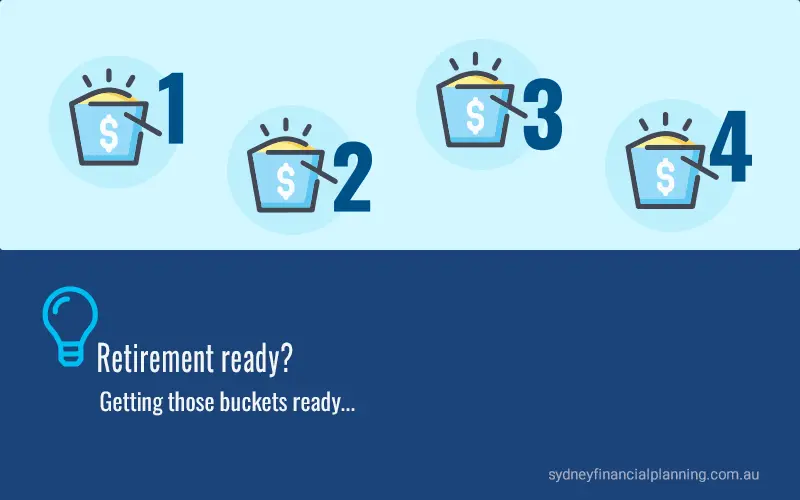

 

Transitioning into retirement? Start to get your buckets in place early.

Transitioning into retirement? Start to get your buckets in place early.

Transitioning into retirement? Start to get your buckets in place early.

However, the devils in the detail when executing a well-diversified investment portfolio and it largely depends on which life stage you’re at when selecting the right approach.

There are two approaches to implementing a well-diversified investment portfolio, the first being a diversified multi asset investment fund and the second being a well-diversified “investment bucket” portfolio approach. They both spread a client’s funds across difference asset classes to smooth the returns however one approach works especially well for our accumulator clients whilst the other is the foundation for managing our retired client’s portfolio’s.

This article focuses on the “investment bucket” diversification approach for our retired clients. This framework generally has a least 4 “buckets” ranging from the short-term bucket for transactions to the long term bucket for capital growth and protecting our clients purchasing power.

Bucket 1: The short-term bucket.

The transaction or cash account. Pays for pension payments and costs.

Think of bucket number 1 like a glass of water, as we drink from it (draw money out) the water level reduces. We need to top this glass back up to ensure we can keep drinking as retirement is thirsty work. How do we top it back up? We direct the ‘water’ from buckets 2, 3 and 4 to this bucket. That way we can keep drinking. Should the water levels fall too low we may need to sell some of the profits from buckets 3 and 4 to top back up however we only want to do this when there are profits to take, however, we need to allow sufficient time for those assets to flourish and grow.

sfp bucket 002

Bucket 2: The cash reserve.

Holds a year of pension payment provisions along with an amount reserved for emergencies and unexpected expenses.

In the event we need to top up bucket 1 within the first 5 years we can call on the reserve bucket to help us out. We can use these funds at a pinch to ensure there’s enough water (or cash) in bucket 1 to draw on. This is our contingency account for what ifs. Needs to be readily accessible. Could be a high interest cash managed fund and a Term Deposit (depending on how much we’re holding in reserve).


sfp bucket 003

Bucket 3: The medium-term bucket.

Our 5–7-year money with a focus on delivering steady, reliable, and growing income.

Generally invested with the primary goal to provide growing income and ensure asset value keeps pace with inflation to preserve the purchasing power of our funds. This bucket generally invests largely in blue chip Australian shares with a focus on paying fully franked dividends, infrastructure and bonds with high yields. As we all know the cost of living doesn’t stop increasing for anybody and retirees know they need to be drawing a higher income each year.

sfp bucket 004

Bucket 4: The long-term bucket.

Our 7 – 10-year money. Invested largely in growth assets such as shares and property with a timeframe of 7-10 years.

Our primary investment objective for this bucket is to preserve the purchasing power of our capital. Therefore, this bucket’s goal is to produce capital growth along with some income. Income from this bucket is directed to bucket number 1 (or reinvested in we can afford it).

When should I start transitioning to an “investment bucket: portfolio approach?

There’s no set answer however generally speaking allowing somewhere between 3 and 5 years prior to retirement is best practice and allows sufficient time to build up our short and medium term buckets. We’ll be raising this with you at your annual progress meeting.


Gary Winwood-Smith
Director | Senior Financial Planner


Do you need help with the conundrum of income or growth?

Speak with one of our Financial Planners about the best investment strategy for your circumstances, call 02 9328 0876 to arrange a meeting.


General Disclaimer: This article contains information that is general in nature. It does not take into account the objectives, financial situation or needs of any particular person. You need to consider your financial situation and needs before making any decisions based on this information. Please seek personal financial advice prior to acting on this information.

 

Rising importance of aged care planning

Rising importance of aged care planning

Rising importance of aged care planning

This can be a really difficult time for families as our elders come to terms with their new circumstance.

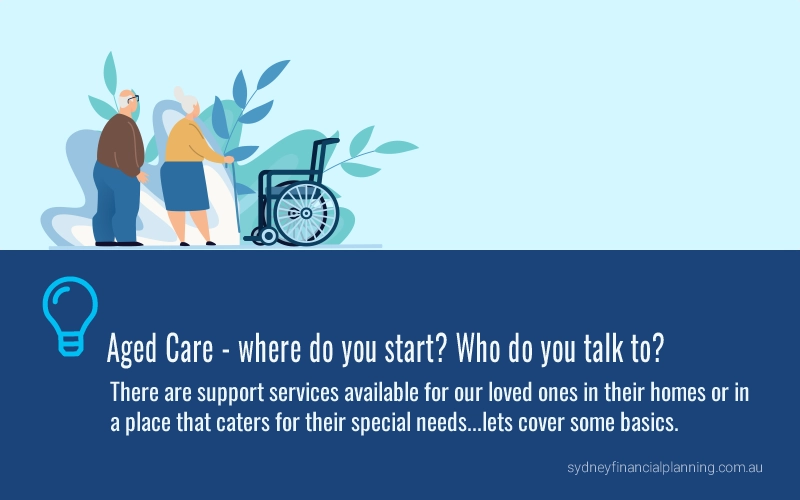
 There are support services available for our loved ones in their homes or in a place that caters for their special needs.

The Aged Care Sector offers help for both but can be difficult to navigate. Where do I start? Who do I talk to? What will they have to pay? How will it affect their home? How does it affect their Aged Pension? What home is best to cater to their needs.

These questions and more come up in what can be a very confusing and emotional time.

Important considerations for Aged Care

  • Does my elderly relative need support to stay at home, what are the Aged Care Home Packages available and how do I apply for them?
  • Does my elderly relative need to go into Aged Care, what facility would they like to go to and what are their particular needs (there are different levels of cover depending on the relative’s medical needs and not all Aged Care facilities cover all areas of need)?
  • How do I start the process of getting them into Aged Care?
  • How do I go about contacting the facilities and what is needed by them before they will accept someone?
  • Can I or anyone else speak to Aged Care on my elderly relative’s behalf?
  • How does my elderly relative pay for care and what are their options (There are at least four different payments for Aged Care that differ in complexity)?
  • What government or Centrelink assistance is available and what to do with the family home?

icon quoteLife threw a curve ball when Mum was no longer able to make financial decisions about her future. Navigating the aged care system left me utterly confused. I knew what we needed to achieve for mum but having the know-how was another matter. Andrew Tate was brought into this process and helped us not only establish clear goals but produced a comprehensive strategic paper that compared scenarios to achieve such goals. He comprehensively walked us through the findings to the point where we felt 100% confident in making the same decisions that a short time ago seemed overwhelming. I am incredibly grateful to Andrew for his precise knowledge and desire to help my family.’

Sasha Campbell (Daughter of Estelle Pulman who recently went into Aged Care)

These are just some of the questions that have to be considered for Aged Care and the answers can have a varying effect on each of them.

At Sydney Financial Planning we understand the complex rules around Aged Care. As Aged Care specialists we understand how sensitive this situation can be when dealing with your elderly relatives. Let us work together with you to find a solution that will satisfy your loved ones. Call our team to have a discussion around any prospective family members who may need extra care in their twilight years.


If you aren’t sure how to proceed, lets start with a call…

Speak with one of our Aged Care Specialists about the best approach for your circumstances, either book a meeting or get in contact with us on 02 9328 0876.


General Disclaimer: While every care has been taken in the preparation of this document, Sydney Financial Planning and Charter FP make no representations or warranties as to the accuracy or completeness of any statement in it.This article contains information that is general in nature. It does not take into account the objectives, financial situation or needs of any particular person. You need to consider your financial situation and needs before making any decisions based on this information. Please seek personal financial advice prior to acting on this information.