Tag: Getting Organised

Get on the Property Ladder

3 ways to get your feet on the property ladder

Get on the Property Ladder

So it can be tough to put together a deposit, especially when you’re starting out. It’s a far cry from back in your parents’ day, when it seemed to be easier to achieve the great Australian dream of owning a home.

But while it’s easy to focus on the downside, there are reasons to be cheerful. Interest rates today are at record lows, compared with the 17% that your parents might have been paying off as recently as 1990.ii And credit is more readily available, with more competition among lenders.

So getting approval for a loan might be easier. But you still need to put a deposit together and cover the repayments. Here are three more creative ways to get your foot on the property ladder.

1. Go in together

Buying a property with a bunch of mates or family can be a good way of pooling your resources.

  • You can save a deposit more quickly.
  • You can share up-front costs, like stamp duty.
  • You can borrow more and buy a better home.
  • You can avoid paying mortgage insurance, if you can raise a 20% deposit.

But you need to go into a co-ownership arrangement with your eyes wide open. Think about what would happen if one of you wants to sell up or can’t make a repayment. Watertight legal commitments can reduce the risks if things go pear-shaped.

  • Establish the right co-ownership structure—stipulating whether you are ‘joint tenants’ or ‘tenants in common’ can make a big difference down the track.
  • Set up a co-ownership agreement to cover all the potential financial pitfalls.
  • Make sure your will is in order so that if anything happens to you, your share in the property will go to the people you want it to.

2. Buy an investment property

Back in the day, an investment property was something you turned your mind to later in life once you were firmly established in your family home. But renting out an investment property is an increasingly attractive way for younger Australians to get into the housing market while continuing to live with their parents or renting somewhere else cheaper.

You’ll need to make the finances work.

  • If the income you receive from your investment property is greater than your loan repayments, interest and other costs, you’ll be receiving a regular boost to your cash flow.
  • If the income you receive from your investment property is less than your loan repayments, interest and other costs, you’ll be making a loss. That loss reduces your taxable income and, in turn, your tax bill. The higher the rate of tax you’re paying, the more tax you can save in deductions. This is what’s known as negative gearing and means your investment needs to gain enough in value during the time you hold it to offset the losses you make along the way. Negative gearing can be a risky strategy, particularly if your situation changes and you can’t service the debt as easily.

And you’ll need to do your homework.

  • Buy in the right area—somewhere with decent transport links and close to schools and amenities will attract tenants and future buyers for both rental income and capital growth.
  • Shop around for the best home loan – don’t be afraid to ask lenders for a better rate.
  • Get the right type of loan—think about which type of loan suits you. Choose between a fixed or variable interest rate—or a split between the two.

Make sure your will is in order so that if anything happens to you, your share in the property will go to the people you want it to.

3. Invest in indirect property

Bricks and mortar isn’t the only option. You can invest in commercial or residential property through your super or a managed fund to generate a regular income and potential capital growth without the hassle and expense of maintaining a home.


For more information on getting on the ladder…

It can really help to create a financial roadmap with the help of a professional. Why not call us to arrange an appointment on 02 9328 0876.

i: 2014 Demographia Housing Affordability Survey – www.macrobusiness.com.au/2014/01/2014-demographia-housing-affordability-survey
ii: Reserve Bank of Australia – www.rba.gov.au/statistics/cash-rate/cash-rate-1990-1996.html

General Disclaimer: This article contains information that is general in nature. It does not take into account the objectives, financial situation or needs of any particular person. You need to consider your financial situation and needs before making any decisions based on this information. Please seek personal financial advice prior to acting on this information.


Photo by Jessica Castro on Unsplash

Some things never change

Some things never change

Some things never change

Predicting future can be difficult and mostly impossible. Especially if one’s trying to predict things which are completely out of their hands. Like, entirely! But guess what, surprisingly (not really that surprising to the scholars of human behaviour), most predictions are made about exactly those – things that are out of our hands!

We’re in the third week of the New Year and the mainstream media are already saturated with headlines about market predictions, interest rate predictions etc..So I made my own list. However, the difference is, that these are about the one thing we can all fully control, if we choose to – our own behaviour.

I’m almost certain that my forecast won’t make the headlines because it doesn’t contain the information ‘the people want’. It’s not the sensational news or ‘the secret’ information that will bring them wealth. Well, actually it will, but not in the immediate form as they all expect.So without further ado, here are my top 5 behavioural predictions for this year (and in fact every year thereafter, since human behaviour just doesn’t change):

1 . We will keep looking for ‘the right’ product that will ‘save’ us.

Most corporations spend ridiculous amounts of money to employ top marketing agencies to sell their products. These behaviour wizards understand too well how the human brain works and create wonderful campaigns that simply fool us. They play to our basic emotions – fear and desire, but lately also pride, frustration and self-esteem. And the vast majority of the population will follow and buy whatever they’re selling, not realising, the new product won’t make any difference in their long term well-being – financial or emotional. They will happily keep chasing it, year and year again, with their super fund, insurance company, mortgage provider.

2. We will ignore the behavioural (please read boring) issues that actually make all the difference.

After more than a decade of professional practice, I’m yet to see a prospective client who will come to me asking for assistance with their patience, disciplined spending or emotional decision making. They all come asking to check if their super can be ‘’invested better’ (whatever that means) to deliver greater returns, or for better rates with their mortgage, or a cheaper insurance product. When I start explaining to them that it’s not the product that will deliver the outcomes they’re after and that it’s actually themselves who can do that via better money habits and mindful consideration of how they go about things, they get disappointed. Many don’t believe me. They continue pursuing the ‘whatever other crazy issues they’re convinced are important’ as everyone else, which will eventually drive them to the ground.

blog content spf quote the question

3. We will continue focusing on (out) performance.

The ‘timing and selection’ culture we live in is obsessed with being better than average. We were told by our parents we can be the best so we expect nothing less from the results of financial products we buy. Not realising that the consistently best performance can’t be delivered year in, year out, we allow ourselves to participate in the rat race we can never win. Most of us will not want to see that it doesn’t have to be that way. That the best product performance (or the outperformance) isn’t required to pay off our debts fast, educate our kids or retire early. Most of us will not accept that the only real outperformance is the one we can deliver ourselves via long term and disciplined planning, with the help of a third party coach, keeping an eye on our vulnerable money behaviour.

4. We’ll keep buying things we don’t need.

There is a considerable amount of research through books, movies and more about ‘how buying stuff does not make us happy’ (in the long term). Most of us just don’t want to (?) get the memo. It’s actually getting worse and more pathetic, with big companies now skipping parents and market directly to our children. And oh boy, do we all know what a kid’s shitty behaviour does to a parent who is tired, lacking sleep and just wants to have a quiet moment or just wants to pop into the grocery store to only buy milk. So what do we do? We give in. To our kids, to fashion, to our marketing and social media driven culture… but it’s so hard to save money these days, isn’t it…?

5. We won’t listen to financial advice professionals.

Less than 5% of the Australian population has a dedicated financial coach who overlooks their family’s finances and long term interest. How can we expect to get ahead, to live lives on our own terms, to get financially independent, to retire early or whatever the headlines we buy into say if we choose not to have hard conversations about the way we spend money? Well, because it’s easier and so much more exciting to look up stuff online or chat to our friends or read an article about the latest products and hottest suburbs to buy in right now. Therefore, we will continue to choose to not engage a financial advice professional because we’ll continue to justify it to ourselves – don’t you read the paper or watch a TV report about them? It makes us feel better to say that and we won’t have to look for anyone (and use our brain). So we’ll just continue to Google…

Well, there you go. My top five (although the list goes on). I’ll be delighted to check in again in December to see if they came true.

But I’m pretty bloody confident…because they do every year…


Need some help getting started?

If you’d like the prediction for your future to be different, maybe it’s time to look at your financial behaviour, we can help you – call us for professional advice on how to achieve a different future 02 9328 0876.


Article by Michal Bodi | Senior Financial Planner


General Disclaimer: This article contains information that is general in nature. It does not take into account the objectives, financial situation or needs of any particular person. You need to consider your financial situation and needs before making any decisions based on this information. Please seek personal financial advice prior to acting on this information.

Courage to change

The fear of the new creates the average

Courage to change


I can’t even begin to tell you how incredibly proud I am of the people in the second group.

Why? Because it’s easier to keep doing what the crowd is doing, it’s safer not to stand out. It’s common to keep talking about the dreams you have forever, and letting the fear of the new hold you back.

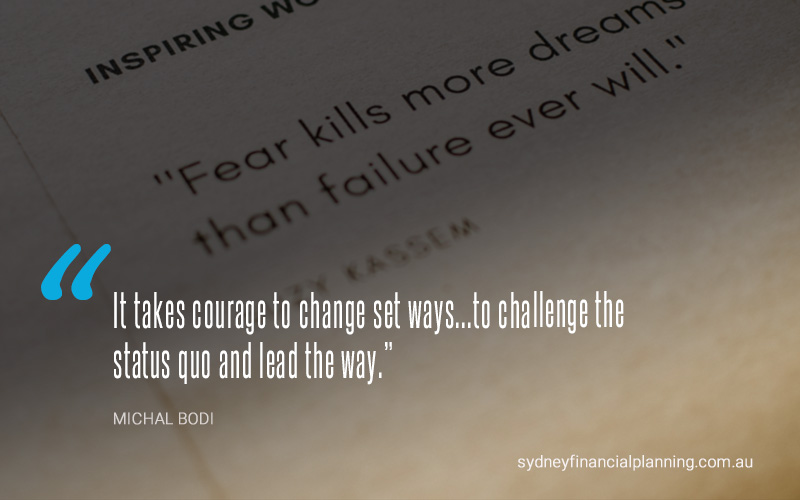
But it takes courage to change set ways, to challenge the status quo, and to lead the way.

It’s true what people say – we really don’t know what we don’t know.  We can never improve our lives, create a life balance, achieve happiness or gain a competitive advantage if we’re not open to new ideas and not prepared to do something different.

There are moments when someone questions the way we do things, or even the direction we’re heading in.  And they’ll show us what would clearly be an improvement.  It might even be us, realising this on our own.  But how often do we actually do something about it?  How often do we take the first step and start working to change?

Yes, but … the famous words that justify and defend the status quo – no matter how average it is.  It’s easier to stick with what we’ve got, than to take that first step.

Procrastination is poison.  What a waste.


Do you need some help with the first step?

It can really help to create a financial roadmap with the help of a professional. Why not call us to arrange an appointment on 02 9328 0876.


Article by Michal Bodi | Senior Financial Planner

General Disclaimer: This article contains information that is general in nature. It does not take into account the objectives, financial situation or needs of any particular person. You need to consider your financial situation and needs before making any decisions based on this information. Please seek personal financial advice prior to acting on this information.


Get your sheep in order

Get Your Sheep Together

Get your sheep in order

The question is…why? Why can’t I just chill out, roll with the punches, play things by ear? Like most character traits in a mature (I think mature) adult, this part of my personality has evolved through countless life experiences. I’ve missed out on events, failed exams, underperformed at work and let my friends and family down. 

That is until I got my life in order…

 My philosophy is that by looking after the cents the dollars look after themselves; that the bigger picture is clearer when the smaller things aren’t allowed to spiral out of control. By having a degree of organisation in the day-to-day, I don’t lose sight of the long term. In other words I can focus on the big picture…my goals and dreams.  I guess the great German philosopher Friedrich Nietzsche said it best when he pondered

“to forget one’s purpose is the commonest form of stupidity”.

Whilst I understand we all have unique personalities and find what works well for us through experience, I cannot understand why people choose to maintain a life pattern of disorder when it is relatively simple to establish procedure and process to ensure a smoothly functioning life.

The most amazing thing I’ve found is that once we set up a system to deal with the daily, weekly, monthly, and annually occurring events in our lives, the curve balls we’re thrown are much more manageable! And what this achieves in my life is a sense of being in control, and the peace of mind in knowing that I haven’t forgotten or overlooked anything.

This of course includes my finances. In fact, this is one of the most important factors in life to address in a modern world. This can be done by simply completing and sticking to a household budget. This allows us to know when we can afford luxuries like a holiday or a meal at an expensive restaurant….and when we simply can’t! It also gives us peace of mind that those large regular expenses like registering the family car have been planned for, and money put aside during the year to address.

Whilst not everyone will achieve the heights of anal retentiveness that I pride myself on, they can certainly take the time to work out if they are living beyond their means. Knowing where your money goes and how this helps you to maintain the lifestyle you want is the most fundamental part of having a plan for life…a financial plan.

Wouldn’t it be great knowing you have control of your life and your future? Wouldn’t that alone make life more satisfying? I certainly believe so…enough to have made it the foundation of my day-to-day life.  And because I have the daily chaos of living mostly under control by organising every controllable part of my life, I have more time to focus on the actual living part.


Have some bigger goals you want to plan for?

It can really help to create a financial roadmap with the help of a professional. Why not call us to arrange an appointment on 02 9328 0876.


General Disclaimer: This article contains information that is general in nature. It does not take into account the objectives, financial situation or needs of any particular person. You need to consider your financial situation and needs before making any decisions based on this information. Please seek personal financial advice prior to acting on this information.


Is Aged Care Factored into Your Future?

Most older Aussies prefer home care over a nursing home

Is Aged Care Factored into Your Future?

According to a recent study by McCrindle, nearly 90% of Australians aged 50 and over said they’d prefer to live out their days in their own home, even though most admitted to not having given much thought to what support they’d need in order to do so.i

We look at some of the findings that came out of the research as well as what aged care options are available, so that you might be more informed around what avenues are available to you and your loved ones.

Preparation and planning are lacking

In a national survey of more than 1,000 Aussies aged 50 and over, responses revealed the following:i

  • 46% of older Aussies haven’t discussed their wishes around their future care with anyone
  • 75% haven’t taken any steps to ensure they’ll receive their preferred means of future care
  • Around 40% aren’t confident they or the government will be able to sufficiently fund their care needs, with only 9% having a secure financial or savings plan in place
  • 30% have been involved in organising care for a parent in the past, but admit they had to make decisions quickly and with limited information.

Why conversations need to be had

Today there are more than 3.8 million Australians aged 65 and older (compared to 1.7 million 30 years ago), with that number expected to increase to 7.5 million in three decade’s time.i

Australia’s ageing population indicates that it’s not just older people who need to prepare for future aged care needs, but all Australians, who need to talk to their families, while prioritising finances and ensuring they’re informed about the services available.

In-home care the fastest growing sector

Over a ten-year period, the number of people receiving aged care in Australia grew from 189,000 to 249,000, with in-home care the fastest growing sector within the care industry, outperforming growth in residential care by five to one.i

Staying at home is a priority for many older Australians, with 74% indicating they’d likely use in-home care services and 82% saying they’d be prepared to pay for such services to live at home for longer.i

With 33% of older Aussies not aware that the government funds certain in-home care services, the research highlighted that there was a need for more awareness around aged care support.i

Aged care options available

More than 50% of Aussies over age 45 have previously or are currently dealing with aged care services for themselves, or on someone else’s behalf, which is why considering your options in aged care earlier rather than later could provide you or a loved one with greater flexibility.i

Each aged care service available in Australia has eligibility criteria and an assessment process which can be organised through the government’s My Aged Care initiative.

Keep in mind that the costs of different aged care services vary and may depend on income and assets, as assessed by the Department of Human Services or the Department of Veterans’ Affairs.

Help in your own home

If you’re generally able to manage, but require some assistance, there are various home-care packages available that may help with things such as:

  • getting dressed,
  • catching transport,
  • cooking,
  • making modifications to your home, as well as a range of other things.

Short-term help

  • After-hospital (transition) care – If you’ve been in hospital but need assistance while you recover, this type of service can be provided in your own home or ‘live-in’ setting.
  • Short-term restorative care – This provides a range of services to help prevent or slow down difficulties with completing everyday tasks. It aims to delay or reverse the need to enter long- term care.
  • Respite care – This service provides support for you and your primary carer when your carer has other duties to attend to, or when they’re on holiday.


Residential aged care

This is where you live in full-service residences and receive ongoing care and support. If it’s the best option for you, it’s a good idea to research and visit several homes to find the right place for you.


Need help understanding your options?

Speaking with one of our professional planners can help you put plans in place that match your wishes. Make a booking or call us on 02 9328 0876 to arrange a meeting.


Aricle by John Collett

General Disclaimer: Originally published by The Sydney Morning Herald on 13 October 2018. This article contains information that is general in nature. It does not take into account the objectives, financial situation or needs of any particular person. You need to consider your financial situation and needs before making any decisions based on this information. Please seek personal financial advice prior to acting on this information.


Do you need help managing your money?

6 steps to get your money stuff together

Do you need help managing your money?

Here are some easy wins to keep you on the right track for 2019

1. Work out your goals

If you don’t know what you’re trying to achieve, you’ll never get anywhere. And different goals need different strategies…saving for a new car is very different from building up your retirement income.

Take a few minutes to write down your goals for this year and beyond. If your goal is to pay for this year’s big trip, you’ll need to start making some savings to free up some cash.

If your goal is to finance your upcoming wedding, you’ll need to think about putting some money away in a fairly low-risk investment option. If your goal is to buy a house, you’ll need to work out where you can afford to live and how you’re going to build up a deposit.

And if your goal is to put your kids through school, you’ll need to start thinking about a long-term investment plan.

2. Go paperless

You might be the kind of person who enjoys paperwork. But for many of us the age of electronic commerce has been a game changer. Unless you want to, there’s no reason to be receiving any bills or statements by snail mail.

You don’t have to sort it all out today. Just make a point of every time a bill comes in, follow the simple instructions to go paperless—most suppliers offer an electronic option these days. In a few months the postie will only be stopping at your door with exciting purchases from Amazon.

3. Start a budget

We’re all different. Some of us work best off a screen, some of us prefer old fashioned pen and paper.

If an Excel spreadsheet sounds too hard, there are a number of apps that can take the hard work out of paying, saving and spending.

4. Shop around for better deals

You wouldn’t willingly pay more for an item of clothing when the store down the road is selling it for less. So when it comes to your home loan, your utility bills or your credit card why shouldn’t the same rule apply?

Talk to your providers about whether you’re getting the best deal for your particular circumstances. And if not, be prepared to take your business elsewhere.

5. Make a will

It doesn’t matter what stage of life you’re at, you don’t want complications for your loved ones in the event anything happens to you. If your needs are fairly simple, you might want to consider setting up a will online. If your needs are a bit more complicated, your financial adviser, a solicitor or a public trustee can help.

And remember, if you experience major life changes like embarking on a new relationship, starting a family or splitting up with your partner, you need to make sure that your will is up-to-date.

7. Get your tax sorted

If you’re the kind of person who’s already got their receipts filed in date and alphabetical order, you can skip this bit.

But if you’re like many of us, you tend to approach tax time with trepidation. Your receipts are all over the place, you’ve forgotten the work HR password to retrieve your payslip and you still haven’t got around to looking into the Medicare levy surcharge.

It’s time to get back to basics. Don’t worry about how disorganised you’ve been in the past, focus instead on getting your affairs in order for the future.Create a simple spreadsheet for your tax receipts to make your next tax return much easier.

You’ll be surprised at what difference a few really basic steps can make to your personal finances. A phone call here, an online form there…and before you know it, you’ll be well on the way to getting your money stuff together this year and beyond.

If you need help getting your money stuff together, give us a call.


Is your credit card debt sinking you?

Speaking with one of our financial advisors would be a good place to start. Make a booking or call us on 02 9328 0876 to arrange a meeting.


i https://corporate.amp.com.au/newsroom/2018/january/new-year–new-financial-resolutions- 

General Disclaimer: This article contains information that is general in nature. It does not take into account the objectives, financial situation or needs of any particular person. You need to consider your financial situation and needs before making any decisions based on this information. Please seek personal financial advice prior to acting on this information.


Planning is key to getting ahead financially

Planning is the key to making it financially

Planning is key to getting ahead financially


A study by comparison site Finder found paying off the mortgage is the financial milestone 74% of Australians value most. 

Having enough in super to retire comfortably comes a close second for 59% of us, and one in three people see the ability to jet-set overseas each year as a sign of financial achievement. 

These are all reasonable goals, and definitely a lot more sensible than owning a sports car, which 5% of people say indicates financial success (for the record, cars are a dreadful investment!).

A plan of action

No matter what your financial goals look like, you’ve got a far better chance of achieving them with a plan of action in place. 

Let’s say for instance, that you’re keen on paying off your mortgage early. It’s a smart strategy that will leave plenty of spare cash to devote to overseas travel. And it can be done.

Start with your loan

The trick is to plan how you’ll get there with clear steps you can stick with over time. A good starting point is to check the rate you’re paying. The average variable rate is currently 5.3% – that’s a terrible rate when you consider there are plenty of loans costing less than 4%. 

If you’re sure your loan is competitive, one of the easiest yet most effective strategies to be mortgage–free sooner is to pay a bit extra off your loan each month. 

On a mortgage of $400,000 with a rate of 4.0%, tipping just $20 more into the loan each week could see you clear the slate 18 months ahead of schedule and pocket savings of $17,217 on overall interest.

Grow your super

If you’re keen to grow your super, talk to the boss about contributing to your fund through salary sacrifice. This is where part of your before-tax wage or salary is paid into your super rather than receiving it as cash in hand. 

Before-tax contributions are taxed at just 15%, which is below the personal tax rate of most workers, so salary sacrifice can be a very tax-friendly way to boost retirement savings. Chances are, after a few pay days you won’t notice the difference in your pay cheque but it can have a valuable impact on your final nest egg.

Think about your money milestones

The start of the new financial year is a good time to think about the money milestones that matter to you – from building a portfolio of investments to starting a successful business or being able to retire early. Don’t just nut out some goals though, think about how you will achieve them, and start putting plans in place to make it all happen.


We can help – It’s an area where good advice can pay off!

We will work with you to prioritise goals, and develop a roadmap of action that helps you work through your personal bucket list. Make a booking with one of our financial planners or call us on 02 9328 0876.

Article by Paul Clitheroe AM – Co-founder and Executive Director of ipac securities limited, Chairman of the Australian Government Financial Literacy Board and Chief Commentator for Money magazine.

General Disclaimer: This article contains information that is general in nature. It does not take into account the objectives, financial situation or needs of any particular person. You need to consider your financial situation and needs before making any decisions based on this information. Please seek personal financial advice prior to acting on this information.