Tag: Retirement Strategies

Comfortable retirement?

Achieving a comfortable retirement

Comfortable retirement?


But this step often means being free from financial worries or concerns and for a large proportion of women, the prospect of a comfortable retirement can seem elusive. Especially when you do the sums.

The latest Intergenerational Report predicts the number of Australians aged 65 and over is likely to more than double by 2055 compared to today – and there could be as many as 40,000 people aged 100 and over by 2055. There were only 122 Australian centenarians forty years ago. Both male and female average life expectancies will jump significantly, with males at birth expected to live for 95.1 years and females for 96.6 yearsi.

While the prospect of a longer life is great news, the rub is that we’ll need to find extra money to fund lengthier retirements. Pauline Vamos, CEO of peak superannuation industry association, ASFA, says this issue is particularly important for women, who are expected to live longer, “yet are retiring with around half as much superannuation as men”.

Less superannuation than men

Women retire, on average, with $105,000 in super savings, which is $92,000 less than men, according to ASFAii. More concerning is that 1 in 3 women retire with no superannuation at all. The upshot is that around 90% of women retire with inadequate savings to fund a comfortable retirement. “Adequacy will also be a key factor, which is why we will continue to advocate for the Superannuation Guarantee (SG) to be increased to 12% as soon as possible,” said Ms Vamos.

There are many reasons for the difference in super savings. Not consolidating super accounts, a lack of personal contributions, and even a lack of knowledge about how superannuation works are factors. For many women taking time out of the workforce for children or caring for others, has a massive impact. According to an American research reportiii, women are likely to take an average of 12 years out of the workforce for family related reasons – and it’s likely the situation is pretty similar in Australia. When women return to the workforce, they often take part-time/low-paid or even free employment for several years to balance having a care-giver role as well.

When women work full-time, their average earnings are often lower than the take home pay of men. As our SG contributions are often linked to our earnings, men generally end up with larger superannuation nest eggs than their female counterparts.

Building a bigger superannuation nest egg

On the plus side, women can take steps to build their retirement funds. For instance, it’s critical to check your super balance regularly, as well as the insurance and investment options to ensure they match your circumstances and future requirements.

If you’ve worked in several jobs, you’re likely to have multiple super accounts and you can save fees by consolidating your super into a good quality, low fee super account. This could save thousands in unnecessary fees, which over time can make a big difference. Also note there is more than $14 billioniv in lost super and some of it could be yours. To find lost super, go to www.ato.gov.au/Super and then ‘Find your lost super’ tab.

Some super funds are trying to close the ‘knowledge-gap’ when it comes to retirement savings and what individuals are eligible for. Consider taking advantage of the seminars offered by your super fund.

Richard Denniss – Executive director, The Australia Institute, says “another way women can help themselves is to compare and switch funds with the aim of saving on fees: the average Australian spends more on super fees than they do on electricity.”v

And for working women backing yourself when it comes to discussing pay and negotiating total remuneration is vital. Being prepared to discuss your remuneration with confidence means making sure you can demonstrate the tangible value you contribute through your role. Never underestimate the lifetime value of earning your full worth.

Whatever your situation, “Those who receive financial advice are more likely to only rely on a part-pension rather than a full pension,” said Mark Rantall, CEO of the Financial Planning Association of Australia (FPA). “They are more financially secure, have a greater level of standard of living and are able to better manage any longevity risk.

Doing what you most want in your later years means taking regular, active steps to look after your financial health.


Will you have the financial freedom you dream?

Whether your goal is to be debt-free, save enough to buy a property or to have a comfortable retirement, we can help you. Call us for professional advice on how to achieve your goals on 02 9328 0876.


i.  www.treasury.gov.au/PublicationsAndMedia/Publications/2015/2015-Intergenerational-Report
ii. www.superguru.com.au/super-sorter-power-hour
iii. www.caregiver.org/women-and-caregiving-facts-and-figures
iv. www.ato.gov.au/Media-centre/Media-releases/New-statistics-reveal-$14-billion-in-lost-super/
v. www.wgea.gov.au/sites/default/files/Womens-Super-Summit.pdf

General Disclaimer: This article contains information that is general in nature. It does not take into account the objectives, financial situation or needs of any particular person. You need to consider your financial situation and needs before making any decisions based on this information. Please seek personal financial advice prior to acting on this information.


Photo by Rawpixel on Unsplash

Is Downsizing right for you?

Is downsizing right for you?

Is Downsizing right for you?

At first glance, it would seem that downsizing is a popular choice amongst older Australians. However recent research (Downsizers and Other Movers – The Housing Options Choices and Dilemmas of Older Australiansi) highlights that only 9% of 50+ year olds moved to a smaller home in the period 2006-2011. We explore some of the issues to consider when reviewing your housing needs. 

So why do we downsize?

Of those surveyed for research, ‘Lifestyle preference’ was the number one reason for downsizing, with ‘Retirement’ and ‘Financial gain’ coming in fourth and sixth place respectively. However, with the recent announcements during the Federal Budget, we now see another major reason to downsize. An opportunity has been presented to those aged 65 or more to downsize their home in return for super incentives and tax breaks.  “The measure reduces a barrier to downsizing for older people. Encouraging downsizing may enable more effective use of the housing stock by freeing up larger homes for younger, growing families,” Treasurer Scott Morrison said.

Making the most of your space

Another belief explored in the research findings, is that older people are under-utilising family homes, so downsizing would seem like a sensible step. However – when questioned – 91% regarded their (mostly three or more bedroom) dwellings as suitable for the needs of their household. While 86% had one or more ‘spare’ bedrooms, close to 75% of those had temporary residents requiring the use of that bedroom – that being an adult child, grandchild or other relative. 

And it seems that after retirement, we could actually need more room, not less. As we spend more time at home, an office or hobby room is a common requirement. For couples, each having their own personal space was considered important. Even if your grown-up children have long flown the nest, many come back for weekend visits, so a spare bedroom can be a necessity. 

Time to move on

But what if you feel that downsizing is right for you? A big driver for those that do opt for a smaller home is the inability to maintain the current family house and/or garden. This can also be compounded by the loss of a partner, relationship breakdown or ill health, all of which would make it harder to continue with the up keep of a larger property. 33% of those who downsized said reducing living costs was the main reason for moving. 

Downsizing certainly can mean a lesser financial burden for some, but it’s important to take into consideration other costs such as removalists and stamp duty – which 11% of downsizers included as a ‘difficulty’ of the moving process. There may also be implications on the age pension, so it’s important to make sure you are fully informed. Another important factor is that with many Australian suburbs dominated by large family homes, finding a suitable place may mean moving to a different area. It could mean moving further away from friends, family and your support network. Something we tend to rely on more heavily as we get older. 

Seeking professional financial advice is something currently only 14% of downsizers do. But it could make a significant difference. Deciding whether to stay put or sell up is complicated. Talk to us today before you make the big decision. Using contemporary financial modelling tools, we can model a range of “what if” scenarios to equip you with the information you need to make the right decision for your circumstances. 


Not sure if you should downsize?

If you want to discuss your options and retirement plans one of our advisors to make sure – call us to arrange an appointment on 02 9328 0876.

i Judd, B., Liu, E., Easthope, H. & Bridge, C. 2014, ‘Downsizers and Other Movers: The Housing Options, Choices and Dilemmas of Older Australians’, Three Days of Creativity and Diversity, vol. 35, pp. 129-38. 

General Disclaimer: This article contains information that is general in nature. It does not take into account the objectives, financial situation or needs of any particular person. You need to consider your financial situation and needs before making any decisions based on this information. Please seek personal financial advice prior to acting on this information.

Making the most of change

Ch-ch-changes

Making the most of change

Recent super reforms, particularly the changes to non-concessional contributions (NCC’s), present a timely opportunity for you to capitalise on current superannuation laws before 30 June 2017.

The changes

From 1 July 2017 several key changes will come into play including but not limited to the following:

  • the NCC cap will be lowered from $180,000 to $100,000.
  • the bring forward amount will be reduced from $540,000 to $300,000.
  • individuals whose total super balance is above $1.6 million will no longer be eligible to make NCC’s. This may be particularly relevant for those who have a transition to retirement (TTR) arrangement.
  • the concessional contributions (before tax) cap will decrease to $25,000 per year for everyone.
  • the high income threshold will be lowered from $300,000 to $250,000. Anyone earning $250,000 or more will pay 30% tax on their contributions.

The opportunities 

Depending on your personal circumstances, you may be able to reap the maximum benefits available to you right now by making some adjustments to your financial plan. Here are a few effective strategies that that may or may not apply to you:

  • If you are turning 50 and over: you could contribute an extra $10,000 (before-tax) this financial year, before the cap is reduced to $25,000 from 1 July 2017.
  • If you are turning 49 or under: you could contribute an extra $5,000 (before-tax) this financial year, before the cap is reduced to $25,000 from 1 July 2017.
  • If you are under age 65: you could bring forward three years’ worth of after-tax super contributions up to a maximum of $540,000. This is significantly higher than the $300,000 limit that will apply from 1 July 2017.
  • Do you have a term deposit that you want to cash in? Have you made some money from the recent sale of your house or investment property? Maybe you’ve received an inheritance from a family member? It’s worth considering contributing these proceeds into your superannuation account before the 30 June deadline to make the most of the NCC caps.
  • If you are earning between $250,000 and $300,000 pa (inclusive of super contributions): you could seek to make the most of your concessional contributions this financial year (up to $30,000 or $35,000 depending on your age, without paying the additional 15% tax that will be imposed from 1 July 2017).

The benefits

What are the benefits of getting in early?

  • Greater accumulated superannuation balance to enjoy in retirement tax free.
  • One off opportunity to restructure existing assets to take advantage of the upcoming changes in legislation.
  • Boost your knowledge and understanding around superannuation.

We’ve covered some of the main points here but there are other changes that may also affect you. It’s likely you’ll have questions about the best course of action in the lead up to the changes and after they take effect. Now is a good time to contact us and set up a time to come in so we can look ahead and put plans in place to help you make the most of your money.

Important reminder

If you contribute more than the contribution caps, you may have to pay extra tax. Also, once your funds are invested in super, you need to meet a condition of release such as retirement and reaching preservation age, to get access to the funds. The value of your investment in super can go up and down. Before making extra contributions to your super, make sure you understand and are comfortable with any risks associated with your chosen investment option.


Still have some questions?

If you want to find out how these changes could impact you before making any financial decisions, arrange to speak with one of our advisors. Call us to arrange an appointment on 02 9328 0876.


General Disclaimer: This article contains information that is general in nature. It does not take into account the objectives, financial situation or needs of any particular person. You need to consider your financial situation and needs before making any decisions based on this information. Please seek personal financial advice prior to acting on this information.

Super Basics

Back to basics

Super Basics

Effectively, Superannuation is a way to fund your retirement. It’s an investment vehicle and a means of saving for your future. Within your superannuation fund, you can have a portfolio of shares, property, cash and a variety of other investments. Superannuation is appealing because of its lenient tax treatment when you’re working (accumulation phase) as well as when you’ve hit retirement (pension phase).

The notion is backed by the government who have made it mandatory for all Australian employers to pay ‘super’ to their workers – this is what’s known as ‘super guarantee’.

There are many ways to build your super balance and the easiest way is through the super guarantee scheme.  For the current financial year (FY16/17), the general super guarantee percentage is 9.5% of normal earnings.

If your total salary is $70,000 inclusive of super than $6,073 (9.5%) of your salary will be contributed into your super fund leaving you with a net salary of $63,927.

In addition to the super guarantee concept, you can choose to make personal contributions. There are various ways to make personal contributions:

  • Salary sacrifice
    your employer pays part of your salary directly into your super fund instead of your bank account
  • Non concessional contributions (NCC)
    After-tax income that you deposit into your super fund
  • Spouse contributions
    Depositing money into your partners super fund may entitle you to a tax offset

One of the most common questions is ‘how much money will I need before I can retire?’

The answer is dependent upon the lifestyle you choose to lead, the age at which you retire, your outgoings, and income producing options i.e. working part-time in retirement etc.


Our experienced team of financial advisers can help you get your super sorted and put you on the right path to financial success. Reach out today by submitting a meeting request or call us to arrange an appointment for your preferred time and date on 02 9328 0876.


Is your super working well for you?

Our experienced team of financial advisers can help you get your super sorted and put you on the right path to financial success. To arrange an appointment call us on 02 9328 0876.


When is the right time to retire well?

Living retirement well: Living life on your own terms

When is the right time to retire well?

This is not to say that the initial adjustment to your new life stage won’t come with its challenges, most will go through stages of disorientation and disenchantment and experience a wide range of emotions and that’s normal. I encourage you to look for healthy ways to deal with those feelings. Do more of what you enjoy, keep the body moving, walk regularly, read, write, draw or paint, tap into your creative side. Talking with others who have already retired can be a big help also.

What’s the hardest part of retirement?

When I asked some of my clients what was the hardest part of retirement, for some it was coming to terms with budgeting tighter and the limited chance of making money compared with working life. For others it was a feeling of loss of purpose in their new life stage. Again, this is normal, and they went on to explain that this feeling passes as they replace their previous routines and colleagues with new pastimes and friends.

What’s the best part of retirement?

My clients have shared that the best part of retirement is the newfound freedom to pursue personal interests, spend more time with loved ones, and enjoy a slower pace of life. They also said it’s a time to focus on health and hobbies, build stronger relationships with family and friends (even making new ones), and to fulfill long-held bucket list dreams such as travel.

When’s the right time?

When we’re goal setting, we ask people at what age do they see or would like to see themselves retired.

Some say tomorrow, others say 60 or 65 and we set the target date to aspire towards. We then start putting in place strategies to ensure we have sufficient funds to achieve this goal. We come around to our 60 or 65th birthday and quite often we’re still enjoying our work, our health is good, and we aren’t ready to retire yet. This happens often.

Over the years I’ve observed the reality is retirement is a state of mind and reaching an age or date is not the trigger for entering the next stage of life. From what I’ve detected, the biggest determinant for retirement and readiness for change is the reducing capacity to tolerate living life on someone else’s terms. Some might say their “bulldust meter” is full, others have experienced close friends of family’s health suffer and this brings things into perspective and priorities change. Either way, when you know
you know.

Any regrets?

I asked some of my clients if they felt they retired at the right time. Most said yes, as we had discussed this at length many times in the lead up to prepare ourselves as best we can.A small number have returned to work (in a slower paced environment) as they crave the sense of purpose that work can bring, but most often than not, most people are happy with their decision.

Reach out to your financial planner if you’d like to chat further about these insights and retiring well.


Article by Gary Winwood-Smith
Senior Financial Planner | Director


Are you confident your retirement plan will support the life you want?

Talk to us about retirement strategies that provide freedom and peace of mind. Call 02 9328 0876 to arrange a meeting.


General Disclaimer: This article contains information that is general in nature. It does not take into account the objectives, financial situation or needs of any particular person. You need to consider your financial situation and needs before making any decisions based on this information. Please seek personal financial advice prior to acting on this information.


Is Investing a gift to your future self?

Investing in your future: Why it matters

Is Investing  a gift to your future self?

As a financial planner, I’ve seen time and again how early, consistent investing can transform lives. Let’s delve into the motivations behind investing, the benefits for your future self, and the peace of mind it brings to your current self.

Motivations for investing

Investing is more than just a financial strategy; it’s a commitment to your future.

Financial Independence: One of the primary reasons to invest is to achieve financial independence. By building a robust investment portfolio, you can create a steady stream of income that supports your lifestyle without relying solely on your job. This independence allows you to pursue passions, travel, or even retire early.

Security and Peace of Mind: Knowing that you have a financial cushion can provide immense peace of mind. Whether it’s an emergency fund for unexpected expenses or a retirement nest egg, having savings and investments ensures you’re prepared for life’s uncertainties.

Achieving Life Goals: Investing helps you reach significant milestones, such as buying a home, funding education, or starting a business. By setting aside money and watching it grow, you can turn your dreams into reality.

Benefits for your future self

Investing is a gift to your future self. Here’s how:

Compound Growth: The earlier you start investing, the more time your money has to grow through compound interest. This means your investments generate earnings, which are then reinvested to generate even more earnings. Over time, this compounding effect can lead to substantial wealth accumulation.

Retirement Planning: Investing early ensures you have enough
funds to enjoy a comfortable retirement. By consistently contributing to retirement accounts, you can build a sizable nest egg that supports you in your golden years.

Legacy Building: Investing over the long term allows you to leave a financial legacy for your loved ones or passion projects.

Peace of mind for your current self

While investing is about the future, it also benefits your present self:

Financial Discipline: Regularly setting aside money for investments instils financial discipline. This habit helps you manage your finances better, avoid unnecessary debt, and make informed spending decisions.

Reduced Stress: Knowing that you’re actively working towards your financial goals can reduce stress and anxiety. It provides a sense of control over your financial future, allowing you to focus on other aspects of your life.

Flexibility and Opportunities: Having investments gives you financial flexibility. It opens opportunities to take calculated risks, such as starting a new venture or making a career change, without jeopardising your financial stability.

We take from this then, that investing can be a powerful tool when leveraged over the longer term, it can help to secure your financial future and enhance your present life.
By understanding the motivations behind investing and the benefits it brings, you can make informed decisions that align with your goals. If you’re ready to take the next step, consider reaching out to your financial planner to discuss what strategy may work best for you.


Article by Steven Stolle
Financial Planner | Director


Does your financial plan include a long-term investing strategy?

Our team can help you create an investment approach that aligns with your goals. Call 02 9328 0876 to arrange meeting.


General Disclaimer: This article contains information that is general in nature. It does not take into account the objectives, financial situation or needs of any particular person. You need to consider your financial situation and needs before making any decisions based on this information. Please seek personal financial advice prior to acting on this information.


Why super and growth assets like shares really are long term investments

Why super and growth assets like shares really are long term investments

Why super and growth assets like shares really are long term investments

  • The best approach is to simply recognise that occasional sharp falls in share markets and hence super funds are normal and that investing in both is a long-term investment.
  • Introduction

    “Aussie share market loses $100bn in bloodbath”

    Two weeks ago, there were lots of headlines like that after share markets fell sharply in response to US recession fears. But such headlines are nothing new. After such falls, the usual questions are: What caused the fall? What’s the outlook? And what does it mean for superannuation? The correct answer to the latter should be something like: “Nothing really, as super is a long-term investment and share market volatility is normal”.

    But that can seem like marketing spin. However, the reality is that – except for those who are into trading – shares and superannuation really are long-term investments. Here’s why.

    Super funds, shares & the power of compound interest

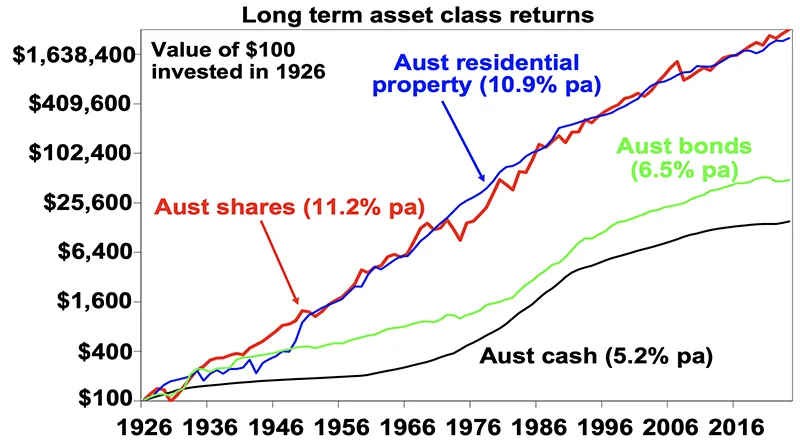
    Superannuation seeks to provide maximum risk-adjusted funds, within reason, for use in retirement. So typical super funds have a bias towards shares and other growth assets, and some exposure to defensive assets like bonds and cash in order to avoid excessive short-term volatility. This approach seeks to take advantage of the power of compound interest. The next chart shows the value of a $100 investment in Australian cash, bonds, shares and residential property from 1926 assuming any interest, dividends and rents are reinvested on the way, and their annual returns. As return series for commercial property and infrastructure only go back a few decades I have used residential property as a proxy.
    long term asset class returns 001

    Source: ASX, Bloomberg, RBA, REIA, AMP

    Because shares and property provide higher returns over long periods the value of an investment in them compounds to a much higher amount over time. So, it makes sense to have a decent exposure to them. The higher return from shares and other growth assets reflects compensation for their greater risk (seen in volatility & illiquidity) versus cash & bonds.

    But investors don’t have 100 years?

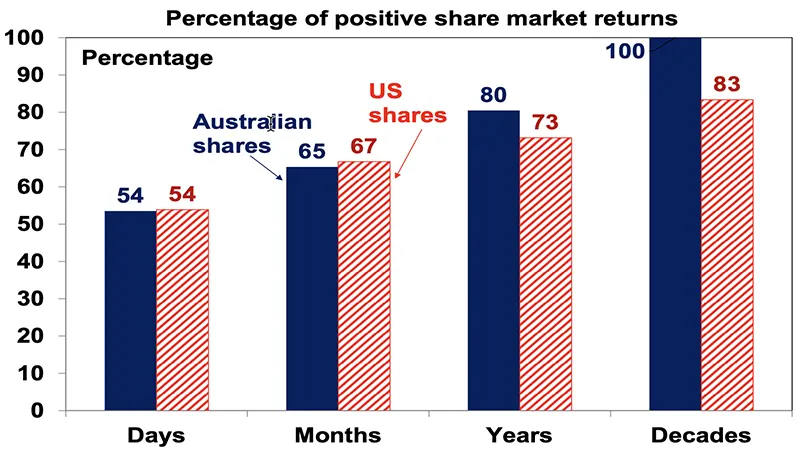
    Of course, we don’t have one hundred years to save for retirement. In fact, our natural tendency is to think very short term. And this is where the problem starts. On a day-to-day basis shares are down almost as much as they are up. See the next chart. So, day-to-day, it’s pretty much a coin toss as to whether you will get good news or bad when you tune in for the nightly finance update.

    But if you just look monthly and allow for dividends, the historical experience tells us you will only get bad news around a third of the time. And if you only look each year, you will only get negative news 20% of the time for Australian shares and 27% of the time for US shares. And if you look just once a decade, positive returns have been seen 100% of the time for Australian shares and 82% for US shares. So, while it’s hard given the bombardment of financial news these days it makes sense to look at your returns less because then are you more likely to get positive news and less likely to make rash decisions or end up adopting an investment strategy that it too cautious.
    percentage of positive share market returns 001

    Source: ASX, Bloomberg, RBA, REIA, AMP

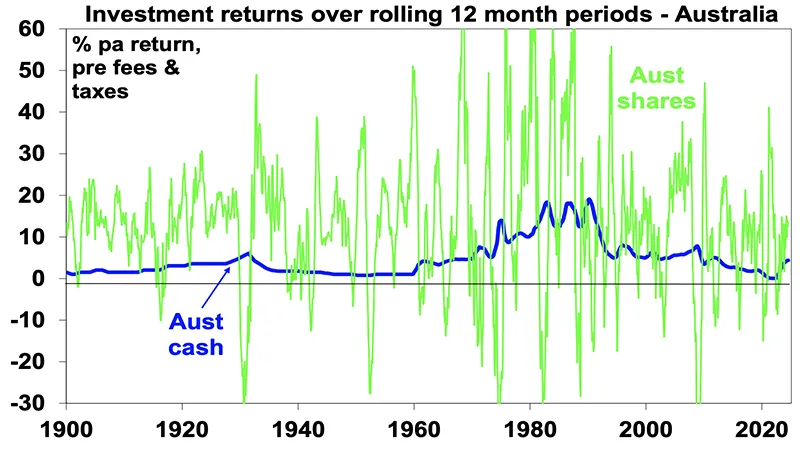
    This can also be demonstrated in the following charts. On a rolling 12 month ended basis the returns from shares bounce around all over the place versus cash & bonds.

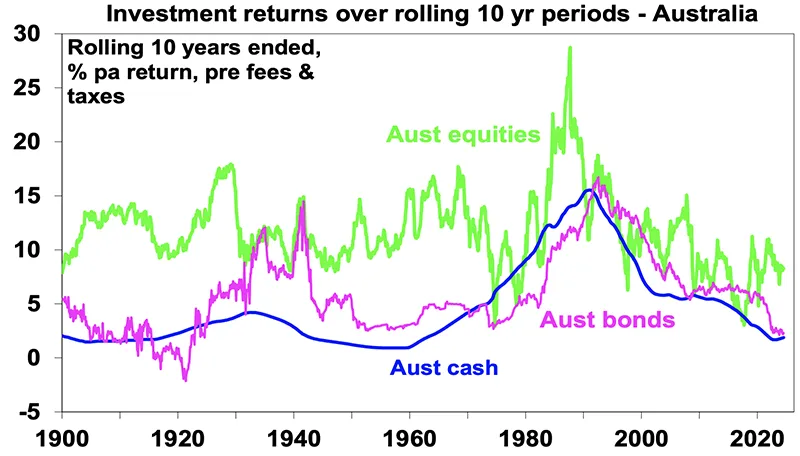
    However, over rolling ten-year periods, shares have invariably done better, although there have been some periods where returns from bonds and cash have done better, albeit briefly.
    12 months investment returns aus

    Source: ASX, Bloomberg, RBA, AMP

    10 year investment returns aus

    Source: ASX, Bloomberg, RBA, AMP

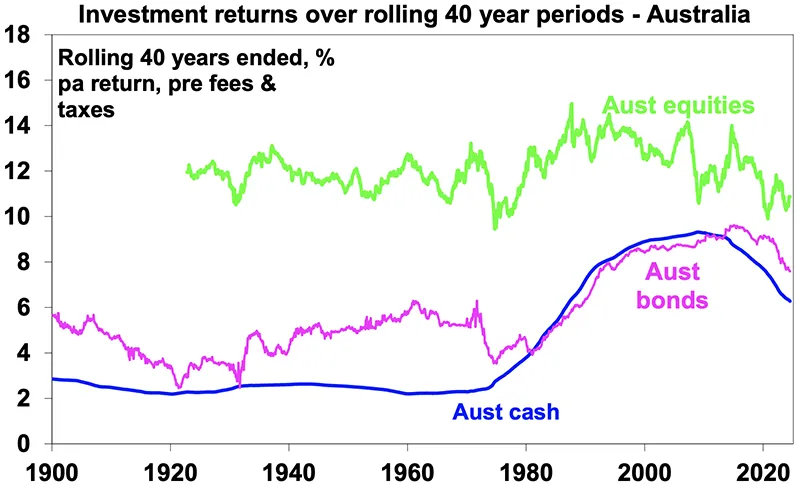
    Pushing the horizon out to rolling 20-year periods, returns from shares have almost always done even better, although a surge in cash and bond returns after the very high interest rates of the late 1970s/1980s saw the gap narrow for a while. Over rolling 40-year periods – the working years of a typical person – shares have always done better.
    40 year investment returns 001

    Source: ASX, Bloomberg, RBA, AMP

    This is consistent with the basic proposition that higher short-term volatility from shares (often around periods of falling profits & a risk that companies go bust) is rewarded over the long term with higher returns.

    But why not try and time short-term market moves?

    The temptation to do this is immense. With the benefit of hindsight many swings in markets like the tech boom and bust, the GFC and the plunge and rebound in shares around the COVID pandemic look inevitable and hence forecastable and so it’s natural to think “why not give it a go?” by switching between cash and shares within your super to anticipate market moves. Fair enough. But without a tried and tested market timing process, trying to time the market is difficult. A good way to demonstrate this is with a comparison of returns if an investor is fully invested in shares versus missing out on the best (or worst) days. The next chart shows that if you were fully invested in Australian shares from January 1995, you would have returned 9.5% pa (with dividends but not allowing for franking credits, tax and fees).

    If by trying to time the market you avoided the 10 worst days (yellow bars), you would have boosted your return to 12.2% pa. And if you avoided the 40 worst days, it would have been boosted to 17% pa! But this is really hard, and many investors only get out after the bad returns have occurred, just in time to miss some of the best days. For example, if by trying to time the market you miss the 10 best days (blue bars), the return falls to 7.5% pa. If you miss the 40 best days, it drops to just 3.5% pa.
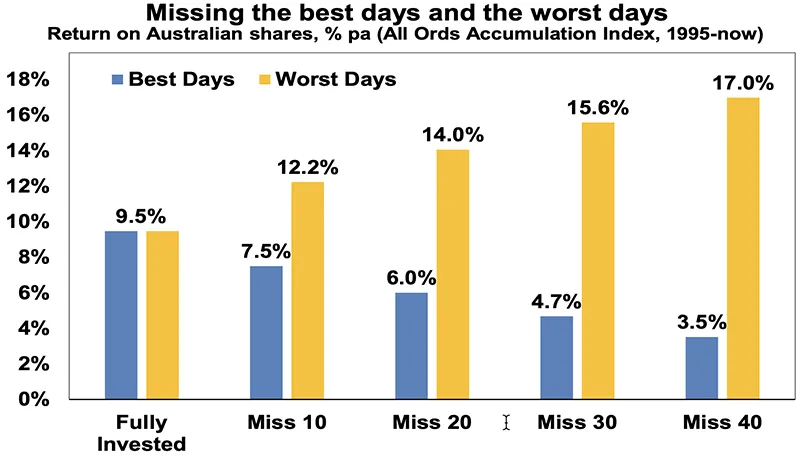
    Missing the best and worst days

    Source: Bloomberg, AMP

    The following chart shows the difficulties of short-term timing in another way. It shows the cumulative return of two portfolios.

    • A fixed balanced mix of 70 per cent Australian equities, 25 per cent bonds and five per cent cash;
    • A “switching portfolio” which starts off with the above but moves 100 per cent into cash after any negative calendar year in the balanced portfolio & doesn’t move back until after the balanced portfolio has a calendar year of positive returns. We have assumed a two-month lag.
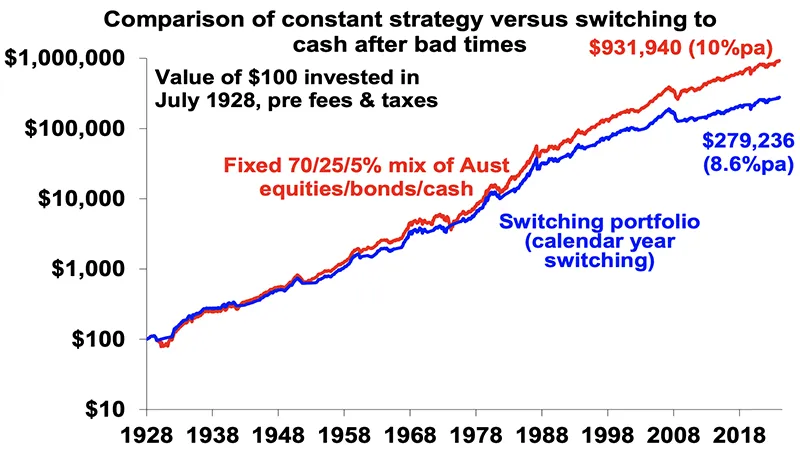
    Comparison of constant strategy

    Source: ASX, Bloomberg, RBA, AMP

    Over the long run the switching portfolio produces an average return of 8.6% pa versus 10% pa for the balanced mix. From a $100 investment in 1928 the switching portfolio would have grown to $279,236, but the constant mix would have ended more than 3 times bigger at $931,940.

    Key messages

    First, while shares and growth assets have periods of short-term underperformance versus cash & bonds they provide superior long-term returns. So, it makes sense for super to have a high exposure to them.

    Second, switching to cash after a bad patch is not the best strategy for maximising wealth over time. In fact, it can just lock in losses.

    Third, the less you look at your investments the less you will be disappointed. This reduces the chance of selling at the wrong time.

    The best approach is to recognise that super and shares are long-term investments and adopt a long-term strategy to suit your circumstances – in terms of your age, income, wealth and risk tolerance.

    Finally, anything that cuts your super balance early on can cut your super at retirement a lot. Eg, a $20,000 withdrawal from super at age 30 – say for a dental expense – can cut your super at age 67 by around $74,000 (in today’s dollars) due to the loss of compounding returns on that amount (using the assumptions in the ASIC MoneySmart Super calculator).

    Bill Bracey
    CEO & Founder of Sydney Financial Planning


    Does your wealth creation strategy have the right mix of growth & assets?

    Speak with one of our Financial Planners about the best approach for your circumstances, either book a meeting or get in contact with us on 02 9328 0876.


    This article was prepared by Dr Shane Oliver with opening and closing summary by William Bracey – CEO & Senior Financial Planner from Sydney Financial Planning. Dr Shane Oliver who provides economic forecasts and analysis of key variables and issues affecting, or likely to affect, all asset markets. He also provides economic forecasts and analysis of key variables and issues affecting, or likely to affect, all asset markets.

    Sydney Financial Planning Pty Ltd (ABN 29 606 413 254), trading as Sydney Financial Planning & Illawarra Financial Planning is an Authorised Representative & Credit Representative of Charter Financial Planning Limited, Australian Financial Services Licensee and Australian Credit Licensee.

    This article contains information that is general in nature. It does not take into account the objectives, financial situation or needs of any particular person. You need to consider your financial situation and needs before making any decisions based on this information. If you decide to purchase or vary a financial product, your financial adviser, and other companies within the AMP Group may receive fees and other benefits. The fees will be a dollar amount and/or a percentage of either the premium you pay or the value of your investments. Please contact us if you want more information. If you no longer wish to receive direct marketing from us you may opt out by contacting Sydney Financial Planning . You may still receive direct marketing from AMP as a product issuer, bringing to your attention products, offerings or other information that may be relevant to you. If you no longer wish to receive this information you may opt out by contacting AMP on 1300 157 173.

    Comparison of constant strategy

    Source: ASX, Bloomberg, RBA, AMP

    Over the long run the switching portfolio produces an average return of 8.6% pa versus 10% pa for the balanced mix. From a $100 investment in 1928 the switching portfolio would have grown to $279,236, but the constant mix would have ended more than 3 times bigger at $931,940.

    Key messages

    First, while shares and growth assets have periods of short-term underperformance versus cash & bonds they provide superior long-term returns. So, it makes sense for super to have a high exposure to them.

    Second, switching to cash after a bad patch is not the best strategy for maximising wealth over time. In fact, it can just lock in losses.

    Third, the less you look at your investments the less you will be disappointed. This reduces the chance of selling at the wrong time.

    The best approach is to recognise that super and shares are long-term investments and adopt a long-term strategy to suit your circumstances – in terms of your age, income, wealth and risk tolerance.

    Finally, anything that cuts your super balance early on can cut your super at retirement a lot. Eg, a $20,000 withdrawal from super at age 30 – say for a dental expense – can cut your super at age 67 by around $74,000 (in today’s dollars) due to the loss of compounding returns on that amount (using the assumptions in the ASIC MoneySmart Super calculator).

    Bill Bracey
    CEO & Founder of Sydney Financial Planning


    Does your wealth creation strategy have the right mix of growth & assets?

    Speak with one of our Financial Planners about the best approach for your circumstances, either book a meeting or get in contact with us on 02 9328 0876.


    This article was prepared by Dr Shane Oliver with opening and closing summary by William Bracey – CEO & Senior Financial Planner from Sydney Financial Planning. Dr Shane Oliver who provides economic forecasts and analysis of key variables and issues affecting, or likely to affect, all asset markets. He also provides economic forecasts and analysis of key variables and issues affecting, or likely to affect, all asset markets.

    Sydney Financial Planning Pty Ltd (ABN 29 606 413 254), trading as Sydney Financial Planning & Illawarra Financial Planning is an Authorised Representative & Credit Representative of Charter Financial Planning Limited, Australian Financial Services Licensee and Australian Credit Licensee.

    This article contains information that is general in nature. It does not take into account the objectives, financial situation or needs of any particular person. You need to consider your financial situation and needs before making any decisions based on this information. If you decide to purchase or vary a financial product, your financial adviser, and other companies within the AMP Group may receive fees and other benefits. The fees will be a dollar amount and/or a percentage of either the premium you pay or the value of your investments. Please contact us if you want more information. If you no longer wish to receive direct marketing from us you may opt out by contacting Sydney Financial Planning . You may still receive direct marketing from AMP as a product issuer, bringing to your attention products, offerings or other information that may be relevant to you. If you no longer wish to receive this information you may opt out by contacting AMP on 1300 157 173.


    The income or growth conundrum

    The income or growth conundrum

    The income or growth conundrum

    We love investment income at SFP, because it adds real money to your investment account which you can use in the real world. Don’t get me wrong, capital growth is great (both the income and capital are important considerations for any investment), however, until you sell something it’s not real money we can use at the shops. And the problem with selling investments is that we then have to give up the future income from it. A bit of a conundrum.

    They say, “horses for courses”. Depending on what life stage you’re in will depend on what investment return you might be favouring. Our accumulator clients might be focusing more on capital growth, whereas our retired clients might be more focused on a growing income from their investments.

    Investment income may come in the form of interest, rent, dividends or distributions (as they call them from managed funds). The quality of the income is determined by the quality of the underlying investment, with consistency and reliability being two important factors we deem to be represented in quality income. The other important factor is the ability for the income to increase over time.

    If you’re accumulating wealth over the longer-term, your focus is likely to be on capital growth, with income generated from that investment being used to purchase additional investments. However, there comes a point in time where your capital has grown sufficiently, and now your focus will be more on generating income to support your lifestyle.

    If you need to access capital to fund your lifestyle expenses, you become a forced seller and must accept what the market gives you. This is generally not a situation many of our accumulator clients have dealt with, as we can set a retirement target date and plan accordingly, so we know when we’re likely going to need to access our investment capital.

    The greatest challenge is for our pre-retiree or retiree clients, in that they may be in a situation where they have insufficient cash to fund their next pension payment. If the underlying investments produce sufficient income to top-up your cash account, then you won’t need to sell assets to fund your withdrawals, which is an ideal scenario.

    This is where having a well-defined strategy comes into play, and why it forms an important part of our planning process for clients in retirement, or close to retirement. By looking ahead, we can determine the optimal timing for adjusting your investment strategy, as well as consider appropriate underlying investments to meet your needs going forward.

    Re-investing dividends provides the opportunity to grow your portfolio at a greater pace over time, compared to banking your dividends. This applies regardless of whether you’re putting additional funds in or not, the dividends will be used to purchase more shares or units in your portfolio. This is known as “compounding returns”.

    Where your strategy is largely to build your portfolio over a long period of time and your personal circumstances enable this to happen consistently (generally while you’re working) then re-investing dividends has proven to be an effective strategy.

    However, if you require a regular income from your investments (such as in retirement), your dividends may be better served being directed to your cash or transaction account. This will in effect ‘top up’ your cash account and allow you to continue funding your income needs.

    The decision to re-invest income, or allocate income to cash, really depends on your overall needs and there may be a combination of both of these approaches built into your overall plan.


    Article by Steven Stolle
    Financial Planner | Director


    Does your portfolio have a long-term investing strategy in place?

    Speak with one of our Financial Planners about the best investing approach for your circumstances, call 02 9328 0876 to arrange a meeting.


    General Disclaimer: This article contains information that is general in nature. It does not take into account the objectives, financial situation or needs of any particular person. You need to consider your financial situation and needs before making any decisions based on this information. Please seek personal financial advice prior to acting on this information.


    Transitioning into retirement? Start to get your buckets in place early.

    Transitioning into retirement? Start to get your buckets in place early.

    Transitioning into retirement? Start to get your buckets in place early.

    However, the devils in the detail when executing a well-diversified investment portfolio and it largely depends on which life stage you’re at when selecting the right approach.

    There are two approaches to implementing a well-diversified investment portfolio, the first being a diversified multi asset investment fund and the second being a well-diversified “investment bucket” portfolio approach. They both spread a client’s funds across difference asset classes to smooth the returns however one approach works especially well for our accumulator clients whilst the other is the foundation for managing our retired client’s portfolio’s.

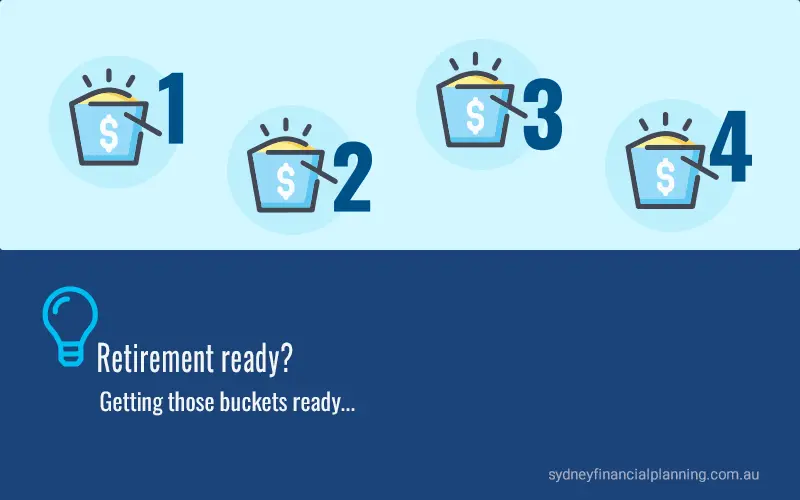
    This article focuses on the “investment bucket” diversification approach for our retired clients. This framework generally has a least 4 “buckets” ranging from the short-term bucket for transactions to the long term bucket for capital growth and protecting our clients purchasing power.

    Bucket 1: The short-term bucket.

    The transaction or cash account. Pays for pension payments and costs.

    Think of bucket number 1 like a glass of water, as we drink from it (draw money out) the water level reduces. We need to top this glass back up to ensure we can keep drinking as retirement is thirsty work. How do we top it back up? We direct the ‘water’ from buckets 2, 3 and 4 to this bucket. That way we can keep drinking. Should the water levels fall too low we may need to sell some of the profits from buckets 3 and 4 to top back up however we only want to do this when there are profits to take, however, we need to allow sufficient time for those assets to flourish and grow.

    sfp bucket 002

    Bucket 2: The cash reserve.

    Holds a year of pension payment provisions along with an amount reserved for emergencies and unexpected expenses.

    In the event we need to top up bucket 1 within the first 5 years we can call on the reserve bucket to help us out. We can use these funds at a pinch to ensure there’s enough water (or cash) in bucket 1 to draw on. This is our contingency account for what ifs. Needs to be readily accessible. Could be a high interest cash managed fund and a Term Deposit (depending on how much we’re holding in reserve).


    sfp bucket 003

    Bucket 3: The medium-term bucket.

    Our 5–7-year money with a focus on delivering steady, reliable, and growing income.

    Generally invested with the primary goal to provide growing income and ensure asset value keeps pace with inflation to preserve the purchasing power of our funds. This bucket generally invests largely in blue chip Australian shares with a focus on paying fully franked dividends, infrastructure and bonds with high yields. As we all know the cost of living doesn’t stop increasing for anybody and retirees know they need to be drawing a higher income each year.

    sfp bucket 004

    Bucket 4: The long-term bucket.

    Our 7 – 10-year money. Invested largely in growth assets such as shares and property with a timeframe of 7-10 years.

    Our primary investment objective for this bucket is to preserve the purchasing power of our capital. Therefore, this bucket’s goal is to produce capital growth along with some income. Income from this bucket is directed to bucket number 1 (or reinvested in we can afford it).

    When should I start transitioning to an “investment bucket: portfolio approach?

    There’s no set answer however generally speaking allowing somewhere between 3 and 5 years prior to retirement is best practice and allows sufficient time to build up our short and medium term buckets. We’ll be raising this with you at your annual progress meeting.


    Gary Winwood-Smith
    Director | Senior Financial Planner


    Do you need help with the conundrum of income or growth?

    Speak with one of our Financial Planners about the best investment strategy for your circumstances, call 02 9328 0876 to arrange a meeting.


    General Disclaimer: This article contains information that is general in nature. It does not take into account the objectives, financial situation or needs of any particular person. You need to consider your financial situation and needs before making any decisions based on this information. Please seek personal financial advice prior to acting on this information.


    Focusing on the right thing with investing

    Focusing on the right thing

    Focusing on the right thing with investing

    2022 could have gone into the books as an unrelievedly ‘bad’ year, indeed quite the worst one since the onset of the Global Financial Crisis in 2008. But of course, that isn’t the case because the share prices are just one aspect of their total return.

    The other is dividends – the actual cash disbursements companies make to their owners (shareholders) out of their earnings, and the income on which many retired investors are living. In 2022, those dividends went up just shy of 11% from 2021. You read that right, last year’s S&P 500 cash dividend was 10.8% higher than 2021’s. (It was the 13th year in a row that dividends went up, and the 11th consecutive record high.)

    That’s sort of what dividends do, and indeed it only makes common sense: since in the aggregate the 500 companies in the Index have significantly increased their earnings over time, they’ve been able – and quite willing – to reward their shareholders by raising their cash dividends. 

    This wasn’t a one-year wonder. In the last 50 years – beginning with the annus horribilis 1973, the dividends went up because the earnings went up – more than 18 times.

    Well fine, in fact pretty terrific. But in the next breath, you might very intelligently ask: how much of that dividend increase was lost to the erosion of purchasing power? In other words, how much did the cost of living go up in those 50 years? The answer is that the Consumer Price Index increased 6.4 times, from December 1973 to December 2022.

    If that’s starting to look to you like the S&P 500’s cash dividend has quietly gone up, this half century past, close to three times more than has the cost of living, I’m happy to confirm that you’re reading the situation just exactly right.

    You may wonder why no one (apart from your financial planner, who may have to be restrained from shouting it from the housetops) has ever reported this to you. Permit me to speculate: (1) It’s a pure goodness, and financial journalism tends to devote very little space to purely good things. And (2) it isn’t really “news”, but rather a cumulatively very powerful truth.

    So, if some bank you’d never even heard of busted out today because it lent a bunch of money to some crypto bros, be assured that that’s just about all you’re going to be reading and hearing about for a while. Indeed, I can pretty much guarantee that “Tortoise continues inexplicably to beat hare” won’t ever be the big headline on your financial “news” feed, so you needn’t bother looking for it.

    Here’s why an 11% jump in the cash dividend in spite of any temporary declines in the share prices, should have been every long-term equity investor’s key takeaway from 2022:

    For the pre-retirement investor – trying with all his/her might to accumulate enough capital for retirement – it’s because a significantly increased stream of dividends was being reinvested at significantly reduced share prices. That’s the great (though somehow not obvious) beauty of compounding, as you make most of your money in a bear market; you just don’t realize it at the time.

    And of course, for retired investors, it’s how their increased income may well have stayed ahead of their inflating living costs. CPI inflation was pretty dreadful in 2022, but it was nowhere near 11%. Remember: it isn’t your account statement you’ll be taking to the supermarket throughout perhaps three decades of retirement; it’s your income.

    Just one man’s opinion, I guess. But if people looked up their dividend income every 90 days instead of checking their account balances every 90 minutes, they just might become markedly more successful investors.


    Article by Michal Bodi

    Senior Financial Planner | Partner


    Does your portfolio have a long-term investing strategy in place?

    Speak with one of our Financial Planners about the best investing approach for your circumstances, call 02 9328 0876 to arrange a meeting.


    General Disclaimer: This article contains information that is general in nature. It does not take into account the objectives, financial situation or needs of any particular person. You need to consider your financial situation and needs before making any decisions based on this information. Please seek personal financial advice prior to acting on this information.


    Get more from your salary or bonus

    Smart super strategies for this EOFY

    Get more from your salary or bonus

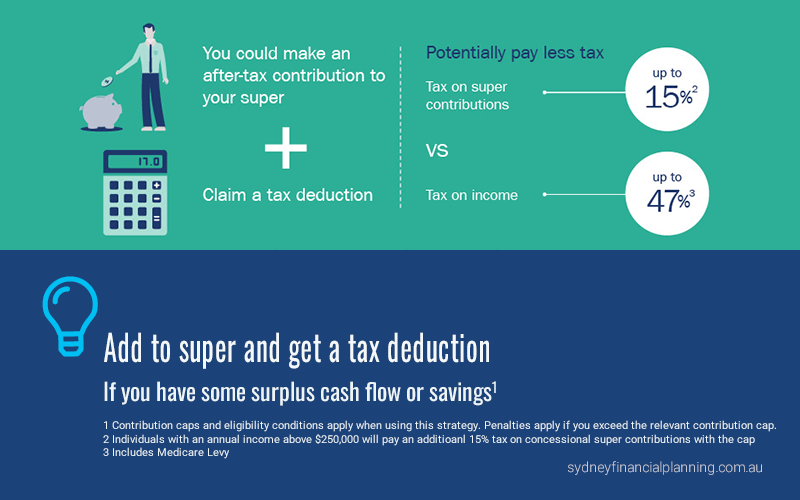
    1. Add to your super – and claim a tax deduction

    If you contribute some of your after-tax income or savings into super, you may be eligible to claim a tax deduction. This means you’ll reduce your taxable income for this financial year – and potentially pay less tax. And at the same time, you’ll be boosting your super balance.

    How it works

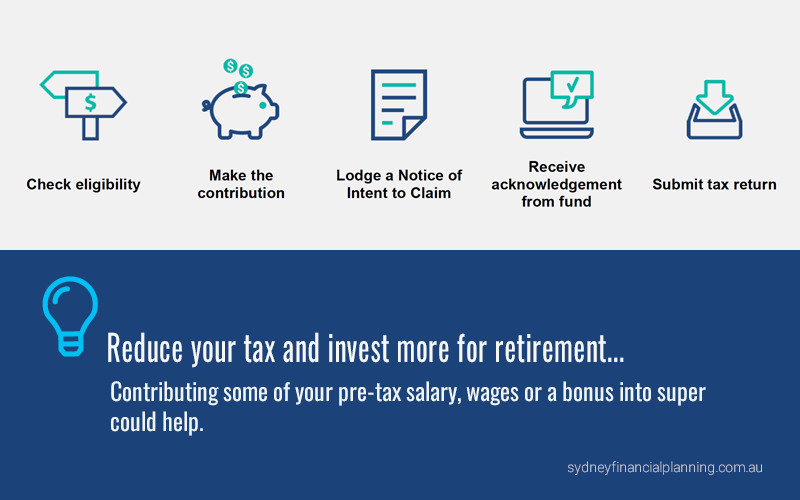
    The contribution is generally taxed at up to 15% in the fund (or up to 30% if your income from certain sources is $250,000 or more). Depending on your circumstances, this is potentially a lower rate than your marginal tax rate, which could be up to 47% (including the Medicare Levy) – which could save you up to 32%. Once you’ve made the contribution to your super, you need to send a valid ‘Notice of Intent’ to your super fund, and receive an acknowledgement from them, before you complete your tax return, start a pension,or withdraw or rollover the money.

    Keep in mind that personal deductible contributions count towards your concessional contribution cap, which is $27,500 for the 2021/22 financial year. However, you may be able to contribute more than that without penalty if you didn’t use the your entire concessional cap in financial years since 1 July 2018 and are eligible to make ‘catch-up’ contributions.

    Concessional contributions also include all employer contributions, including Superannuation Guarantee and salary sacrifice. Other eligibility rules may also apply so speak to your financial adviser for more information.

    2. Get more from your salary or a bonus

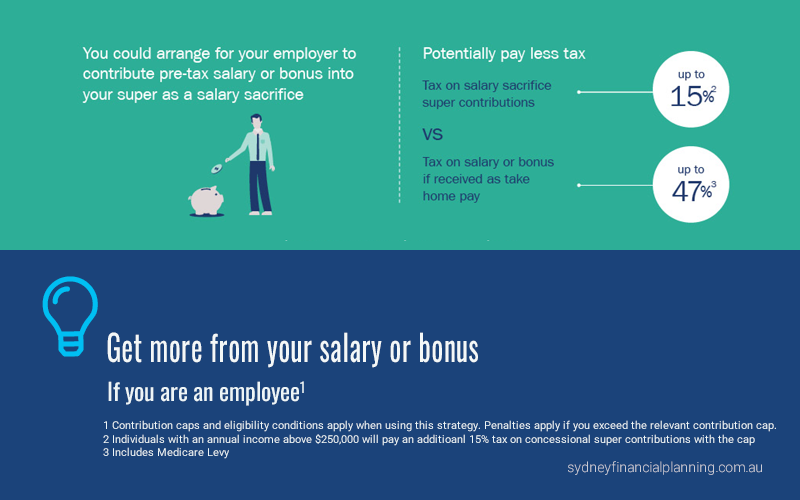
    If you’re an employee, you may be able to arrange for your employer to direct some of your pre-tax salary or a bonus into your super as a ‘salary sacrifice’ contribution.

    Again, you’ll potentially pay less tax on this money than if you received it as take-home pay – generally 15% for those earning under $250,000 pa, compared with up to 47% (including Medicare Levy).

    How it works

    Ask your employer if they offer salary sacrifice. If they do, it can be a great way to help grow your super tax-effectively because the contributions are made from your pre-tax pay – before you get a chance to spend it on other things.

    You can only salary sacrifice amounts that you’re not yet entitled to receive. This includes both your regular salary, and any entitlement to a bonus.

    Remember salary sacrifice contributions count towards your concessional contribution cap, along with any superannuation guarantee contributions from your employer and personal deductible contributions. Also, you may be able to make catch up (extra) contributions if your concessional contributions were less than the annual concessional cap since 1 July 2018.

    3. Convert your savings into super savings

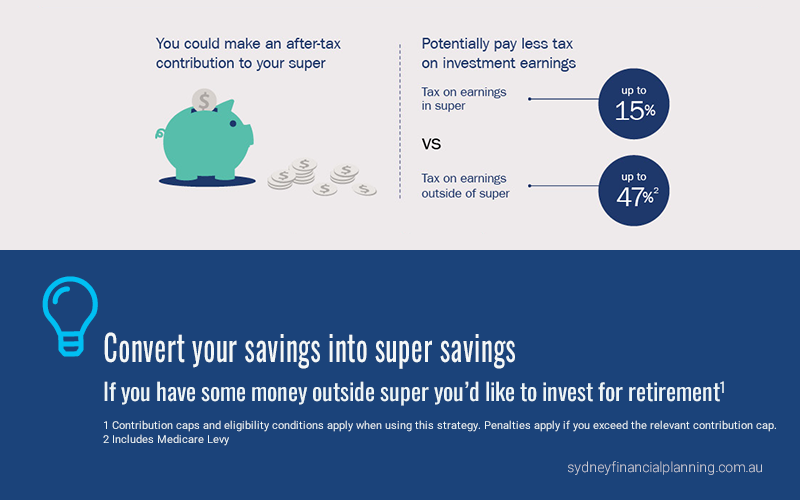
    Another way to invest more in your super is with some of your after-tax income or savings, by making a personal non-concessional contribution.

    Although these contributions don’t reduce your taxable income for the year, you can still benefit from the low tax rate of up to 15% that’s paid in super on investment earnings. This tax rate may be lower than what you’d pay if you held the money in other investments outside super.

    How it works

    Before you consider this strategy, make sure you’ll stay under your non-concessional contribution (NCC) cap, which in 2021/22 is $110,000 – or up to $330,000 if you meet certain conditions. That’s because after-tax contributions count as non-concessional contributions – and penalties apply if you exceed the cap.

    Also, to use this strategy in 2021/22, your total super balance (TSB) must have been under $1.7 million on 30 June 2021.

    If you’re 67–74, you’ll also need to meet the work test (or be eligible to apply the ‘work test exemption) to make NCCs this financial year. The work test will be removed for NCCs from 1 July.

    Remember, once you’ve put any money into your super fund, you won’t be able to access it until you reach your preservation age or meet other ‘conditions of release’. For more information, visit the ATO website at ato.gov.au.

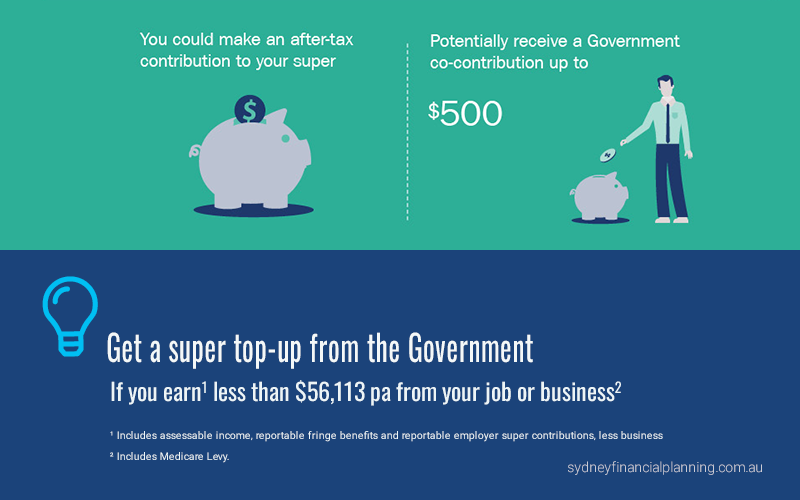
    4. Get a super top-up from the Government

    If you earn less than $56,113 in the 2021/22 financial year, and at least 10% is from your job or a business, you may want to consider making an aftertax super contribution. If you do, the

    Government may make a ‘co-contribution’ of up to $500 into your super account.

    How it works

    The maximum co-contribution is available if you contribute $1,000 and earn $41,112 pa or less. You may receive a lower amount if you contribute less than $1,000 and/or earn between $41,113 and $56,112 pa.

    Be aware that earnings include assessable income, reportable fringe benefits and reportable employer super contributions. Other conditions also apply – your financial adviser can run you through them.

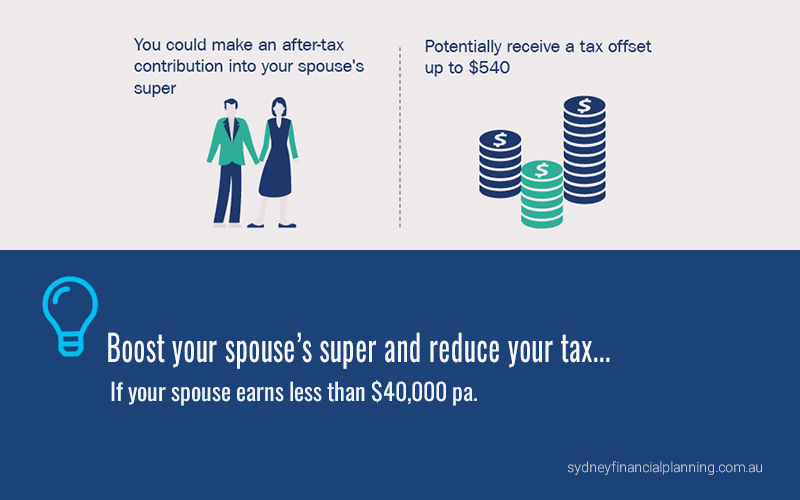
    5. Boost your spouse’s super and reduce your tax

    If your spouse is not working or earns a low income, you may want to consider making an after-tax contribution into their super account. This strategy could potentially benefit you both: your spouse’s super account gets a boost and you may qualify for a tax offset of up to $540.

    How it works

    You may be able to get the full offset if you contribute $3,000 and your spouse earns $37,000 or less pa (including their assessable income, reportable fringe benefits and reportable employer super contributions).

    A lower tax offset may be available if you contribute less than $3,000, or your spouse earns between $37,000 and $40,000 pa.

    Need advice?

    You’ll need to meet certain eligibility conditions before benefitting from any of these strategies. If you’re thinking about investing more in super before 30 June, talk to us. We can help you decide which strategies are appropriate for you.


    If you aren’t sure how to proceed or if you meet the specific criteria…

    Speak with one of our Financial Planners about the best approach for your circumstances asap, either book a meeting or get in contact with us on 02 9328 0876.

    1 Individuals with income above $250,000 pa will pay an additional 15% tax on personal deductible and other concessional super contributions.

    2 Includes Medicare Levy.

    General Disclaimer: While every care has been taken in the preparation of this document, Sydney Financial Planning and Charter FP make no representations or warranties as to the accuracy or completeness of any statement in it.This article contains information that is general in nature. It does not take into account the objectives, financial situation or needs of any particular person. You need to consider your financial situation and needs before making any decisions based on this information. Please seek personal financial advice prior to acting on this information.


    Topping up super with ‘catch-up’ contributions

    Topping up super with ‘catch-up’ contributions

    Topping up super with ‘catch-up’ contributions

    Depending on your circumstances, this could help you to maximise tax-effective super contributions and invest more for retirement.

    How does the strategy work?

    If your concessional contributions (CCs) in a financial year are below the annual CC cap, you’re able to accrue these unused amounts and carry them forward. This applies to unused cap amounts since 1 July 2018 and can be carried forward for up to five years. This means if you meet certain eligibility rules, you’ll be able to make larger CCs in a later financial year.

    This may give you greater flexibility to make larger CCs when your circumstances allow. This may be helpful if, for example, you have irregular employment income, fluctuating income or have had time out of the workforce.

    What’s the benefit?

    The amount you contribute is generally taxed at the concessional rate of up to 15%1. Once contributed, any earnings are also taxed at a concessional rate of 15%, rather than your marginal rate, which could be up to 47%2. Depending on your circumstances, this strategy could result in a tax saving of up to 32% and enable you to increase your super savings.

    Key conditions

    To be eligible to utilise your carried forward unused CCs by making a catch-up contribution you must:

    • have a ‘total superannuation balance’3 below $500,000 on the prior 30 June
    • be under 75 and meet the work test rules (or be eligible to apply the work test exemption) if you’re aged 67 to 74, and
    • have unused CC cap amounts accrued from one of the five prior financial years (but not before 2018/19).

    Accruing unused CC cap amounts

    The first financial year you could accrue unused CCs was in 2018/19. Unused CC amounts can be carried forward for up to five years before they expire.

    Seek advice

    Your financial adviser can help determine whether this strategy is right for you. They can also help you to work out what your available carried forward unused CC balance4 is and how much you’re eligible to contribute. Additional tax and other penalties may apply if you make contributions that exceed your available cap.

    To work out your carried forward amounts, you need to confirm the total amount of CCs you have made in each financial year since 1 July 2018. You can access information about your contributions by logging on to my.gov.au. Information displayed might not be up to date, so it is also important to keep accurate contributions records and enquire directly to your super fund before contributing.

    Case Study

    In 2018/19 and 2019/20, Fatima made CCs of $15,000, which was $10,000 less than the annual CC cap of $25,000.

    Fatima took 12 months maternity leave from 1 July 2020 and didn’t make any CCs in FY 2020/21.

    From 1 July 2021, Fatima returns to full-time work where her employer contributions (CCs) total $15,000 in 2021/22. This is $12,500 less than the annual cap that applies in this financial year ($27,500).

    Fatima receives an inheritance of $35,000 in 2021/22 that she wants to contribute to super. The table below shows how she can carry forward unused CCs to make catch up contributions in 2021/22 in later years.

    Financial year

    Annual CC cap amount

    Total CC cap including any carried forward CCs

    CCs made

    Unused CCs that may be carried forward

    2018/19 $25,000 $25,000 $15,000 $10,000
    2019/20 $25,000 $35,000 $15,000 $20,000
    2020/21 $25,000 $45,000 $0 $45,000
    2021/22 $27,500 $72,500 $50,000 $22,500

    Other key considerations

    • It’s important to check your total CCs for the financial year from all sources before adjusting your contribution strategy. CCs include:
      • contributions made for you by your employer as well as an estimate of any further employer contributions for the year
      • salary sacrifice contributions, and
      • personal contributions that you claim a tax deduction for.
    • For personal deductible contributions, you need to lodge a ‘Notice of Intent’ form and receive an acknowledgement from the superfund before certain timeframes, and alsobefore starting a pension, withdrawal or rollover.
    • If you are not eligible to make catch-up CCs, tax penalties apply if you exceed the annual CC cap of $27,500 in FY 2021/22.
    • You can’t access super until you meet certain conditions.


    If you aren’t sure how to proceed or if you meet the specific criteria…

    Speak with one of our Financial Planners about the best approach for your circumstances asap, either book a meeting or get in contact with us on 02 9328 0876.


    1 Individuals with income from certain sources above $250,000 in FY 2021/22 will pay an additional 15% tax on salary sacrifice, personal deductible and other CCs within your cap.

    2 Includes Medicare levy.

    3 Your ‘total superannuation balance’ includes all of your super accumulation interests and amounts held in superannuation income stream products. For more information, visit ato.gov.au, and check your total super balance by logging into my.gov.au.

    4 You can also obtain this information by logging into my.gov.au


    General Disclaimer: While every care has been taken in the preparation of this document, Sydney Financial Planning and Charter FP make no representations or warranties as to the accuracy or completeness of any statement in it.This article contains information that is general in nature. It does not take into account the objectives, financial situation or needs of any particular person. You need to consider your financial situation and needs before making any decisions based on this information. Please seek personal financial advice prior to acting on this information.

    Top-up your super with help from the Government

    Top-up your super with help from the Government

    Top-up your super with help from the Government

    How does the strategy work?

    If you earn¹ less than $56,112 pa (of which at least 10% is from eligible employment or carrying on a business) and you make personal after-tax super contributions, the Government may also contribute into your super account. This additional super contribution, which is known as a co-contribution, could make a significant difference to the value of your retirement savings over time. To qualify for a co-contribution, you will need to meet a range of conditions, but as a general rule:

    • the maximum co-contribution of $500 is available if you contribute $1,000 and earn $41,112 or less
    • a reduced amount may be received if you contribute less than $1,000 and/or earn between $41,113 and $56,112, and
    • you will not be eligible for a co-contribution if you earn $56,113 or more.

    The Australian Taxation Office (ATO) will determine whether you qualify based on the data received from your super fund and the information contained in your tax return for that financial year.

    As a result, there can be a time lag between when you make your personal after-tax super contribution and when the Government pays the co‑contribution.

    If you’re eligible for the co-contribution, you can nominate which fund you would like to receive the payment.

    Alternatively, if you don’t make a nomination and you have more than one account, the ATO will pay the money into one of your funds based on set criteria.

    Note: Some funds or superannuation interests may not be able to receive co-contributions. This includes unfunded public sector schemes, defined benefit interests, traditional policies (such as endowment or whole of life) and insurance only superannuation interests.

    Other key considerations

    • You can’t access super until you meet certain conditions.
    • You may want to consider other ways to contribute to super, such as salary sacrifice or personal deductible contributions.

    Seek advice

    A financial adviser can help you determine whether you should make personal super contributions and assess whether you will qualify for a Government co-contribution.

    Case Study

    Ryan, aged 40, is employed and earns $35,000 pa. He wants to build his retirement savings and can afford to invest $1,000 a year.

    After speaking to a financial adviser, he decides to use the $1,000 to make a personal after-tax super contribution.

    By using this strategy, he’ll qualify for a cocontribution of $500 and the investment earnings will be taxed at a maximum rate of 15%.

    Conversely, if he invests the money outside super each year (in a managed fund, for example), he will not qualify for a cocontribution and the earnings will be taxable at his marginal rate of 21%


    Details

    Receive pay rise as after-tax salary

    Sacrifice pay rise into super

    Amount invested $1,000 $1,000
    Plus co-contribution Nil $500
    Total investment $1,000 $1,500
    Tax rate payable on investment earnings 21%2 15%


    Next steps

    Contribution rules and eligibility criteria for catch up CCs are complex. This guide is not designed to provide comprehensive information about how the rules work or apply to you. It is important that you speak with your financial adviser, your registered tax agent and visit the ato.gov.au for more information.


    If you aren’t sure how to proceed or if you meet the specific criteria…

    Speak with one of our Financial Planners about the best approach for your circumstances asap, either book a meeting or get in contact with us on 02 9328 0876.


    1Includes assessable income, reportable fringe benefits and reportable employer super contributions, less business deductions and assessable First Home Super Saver amounts. Other conditions apply.

    2 Includes Medicare Levy.


    General Disclaimer: While every care has been taken in the preparation of this document, Sydney Financial Planning and Charter FP make no representations or warranties as to the accuracy or completeness of any statement in it.This article contains information that is general in nature. It does not take into account the objectives, financial situation or needs of any particular person. You need to consider your financial situation and needs before making any decisions based on this information. Please seek personal financial advice prior to acting on this information.

    Sacrifice pre-tax salary into super

    Sacrifice pre-tax salary into super

    Sacrifice pre-tax salary into super

    How does the strategy work?

    With this strategy, known as salary sacrifice, you need to arrange for your employer to contribute some of your pre‑tax salary, wages or bonus directly into your super fund.

    The amount you contribute will generally be taxed at the concessional rate of 15%1, not your marginal rate which could be up to 47%2. Depending on your circumstances, this strategy could reduce the tax you pay on your salary, wages or bonus by up to 32%.

    Also, by paying less tax, you can make a larger after-tax investment for your retirement, as the case study on the opposite page illustrates.

    What income can be salary sacrificed?

    • You can only sacrifice income that relates to future employment and entitlements that have not been accrued.
    • With salary and wages, the arrangement needs to be in place before you perform the work that entitles you to the salary or wages.
    • With a bonus, the arrangement needs to be made before the bonus entitlement is determined.
    • The arrangement, which should be documented and signed by you and your employer, should include details such as the amount to be sacrificed into super and the frequency of the contributions.

    Other key considerations

    • Salary sacrifice contributions count towards the ‘concessional contribution’ cap. This capis $27,500 in FY 2021/22, or may be higherif you didn’t contribute your full concessionalcontribution cap since 1 July 2018 and areeligible to make ‘catch-up’ contributions. Tax implications and penalties apply if you exceed your cap.
    • You can’t access super until you meet certain conditions.
    • Another way you may be able to grow your super tax-effectively is to make personal deductible contributions (see opposite page).

    Seek advice

    A financial adviser can help you determine whether salary sacrifice suits your needs and circumstances.

    Case Study

    William, aged 45, was recently promoted and has received a pay rise of $5,000, bringing his total salary to $90,000 pa.

    He plans to retire in 20 years and wants to use his pay rise to boost his retirement savings..

    After speaking to a financial adviser, he decides to sacrifice the extra $5,000 into super each year.

    By using this strategy, he’ll save on tax and have an extra $975 in the first year to invest into super, when compared to receiving the $5,000 as after-tax salary (see Table 1).

    If he continued to salary sacrifice this amount into super, this could lead to William having an additional $150,394 in his super after 20 years (see Table 2).


    Table 1. After-tax income vs salary sacrifice

    Details

    Receive pay rise as after-tax salary

    Sacrifice pay rise into super

    Personal super contribution $5,000 $5,000
    Less income tax at 34.5%3 ($1,725) (N/A)
    Less 15% contributions tax (N/A) ($750)
    Net amount $3,275 $4,250
    Additional amount in super 21%2 $975


    Table 2. Super balances4

    Year

    No salary sacrifice

    Salary sacrifice into super

    Difference

    Year 5 $279,725 $304,029 $24,304
    Year 10 $416,168 $472,072 $55,904
    Year 15 $593,558 $690,543 $96,985
    Year 20 $824,183 $974,577 $150,394

    Personal Deductible Contributions

    Like salary sacrifice, making a personal super contribution and claiming a tax deduction may enable you to boost your super tax-effectively. There are, however, a range of issues you should consider before deciding to use this strategy.

    Your financial adviser can help you determine whether you should consider making personal deductible contributions instead of (or in addition to) salary sacrifice.

    You may also want to ask your financial adviser for a copy of our super strategy card, called ‘Make tax-deductible super contributions’.


    If you aren’t sure how to proceed or if you meet the specific criteria…

    Speak with one of our Financial Planners about the best approach for your circumstances asap, either book a meeting or get in contact with us on 02 9328 0876.

    1 Individuals with income above $250,000 pa will pay an additional 15% tax on personal deductible and other concessional super contributions.

    2 Includes Medicare Levy.

    3 Includes Medicare Levy. Based on FY 2021/22 tax rates.

    4 Assumptions: A 20-year comparison based on contribution of $5,000 pa of pre-tax salary on top of compulsory superannuation guarantee. Super investments earn a total return of 6.34% pa, balances shown at the end of 5/10/15/20 year periods. All figures are after income tax of 15% in super and capital gains tax (including discounting). These rates are assumed to remain constant over the investment period. William’s salary of $90,000 pa is indexed to CPI. Difference does not take into account money potentially invested outside super if pay rise received as after tax salary.

    General Disclaimer: While every care has been taken in the preparation of this document, Sydney Financial Planning and Charter FP make no representations or warranties as to the accuracy or completeness of any statement in it.This article contains information that is general in nature. It does not take into account the objectives, financial situation or needs of any particular person. You need to consider your financial situation and needs before making any decisions based on this information. Please seek personal financial advice prior to acting on this information.


    Splitting your super contributions to your spouse

    Splitting your super contributions to your spouse

    Splitting your super contributions to your spouse

    How does the strategy work?

    You may be able to split (transfer) eligible concessional contributions (CCs) that you’ve made or received to your spouse’s super account.

    Eligible CCs include employer super contributions and personal super contributions for which you have claimed a tax deduction.

    Contribution splitting can be a great way to increase your spouse’s super savings particularly where they, for example:

    • are not working
    • have had time out of the workforce, or
    • have a lower super balance.

    What’s the benefit?

    In addition to boosting your spouse’s retirement savings, there may be other benefits depending on your specific circumstances.

    Help to cover insurance premiums

    Contribution splitting can help to pay your spouse’s insurance premiums for policies held inside super. This may be beneficial during times where your spouse has reduced their working hours or is out of the workforce and their contributions have reduced.

    Maximise tax-free retirement savings

    A limit applies to how much super can be transferred into ‘retirement phase’ income streams, where investment earnings are taxed at 0%. Contribution splitting may help you take better advantage of these limits as a couple and maximise the total amount you can hold tax-effectively when you retire.

    Maximise Age Pension

    If you have a younger spouse who is under their Age Pension age, contribution splitting may help to improve your Centrelink entitlements. Superannuation held in the ‘accumulation phase’ is not assessed for social security purposes until the account holder reaches their Age Pension age. Splitting super to your younger spouse may therefore reduce the assets assessed when your entitlement is calculated, potentially increasing your Age Pension entitlement.

    What contributions can be split?

    Only eligible CCs can be split to your spouse, such as superannuation guarantee (SG), salary sacrifice and personal deductible contributions. Non-concessional or ‘after-tax’ contributions cannot be split.

    Generally, the maximum amount that can be split is the lesser of:

    • 85% of your CCs for the year (after taking into account 15% contributions tax), or
    • your CC cap for the financial year.

    The CC cap was $25,000 in 2020/21 and is $27,500 in 2021/22. However, if you’re eligible to make larger CCs in a financial year using the ‘catch-up’ contribution rule, your applicable CC cap may be higher.1

    You can generally only split CCs made in the previous financial year. Also, you need to request to split your CCs in writing to the trustee of your super fund within 12 months after the end of the financial year the CCs were made to your super fund (unless you’re going to roll over your balance or close your account).

    For more information on catch-up contributions, ask your financial adviser for a copy of our ‘Top up your super with ‘catchup’ contributions’ super strategy card.

    Case study

    Lucy would like to split some of her eligible CCs made during 2020/21 to her husband Luke’s (age 40) super fund.

    In FY 2020/21, her employer contributed $20,000 to her super fund and her CC cap was $25,000. The maximum amount that Lucy can split to Luke is the lesser of:

    • $17,000 (85% of the $20,000 contributed by her employer), and
    • $25,000 (her CC cap in 2020/21).

    Lucy elects to split $15,000 of her CCs to Luke’s super fund and submits the contribution splitting application form to her fund in 2021/22.

    Her super fund transfers $15,000 to Luke’s super fund. This won’t reduce Lucy’s CCs for the financial year and the transfer won’t be assessed as a contribution against Luke’s contribution caps.

    Note: If Lucy was eligible to make larger CCs in 2020/21 using the ‘catch-up’ contribution rule, her CC cap may be greater than $25,000. This may increase the maximum amount of contributions she could potentially split to Luke if she made larger CCs in that financial year.

    Is your spouse eligible?

    To be eligible to split your super to your spouse, they must be either:

    • under their ‘preservation age’2, or
    • between their preservation age and under 65 and declare they are not currently retired for superannuation purposes.

    Once your spouse reaches age 65, they are no longer eligible to receive a contribution split from your super.

    Other key considerations

    Contribution splitting may be used by married couples, de facto partners and same sex couples.

    Contributions split to your spouse:

    • will form part of the taxable component of your spouse’s super account
    • don’t count towards their CC cap, as they have already counted towards your CC cap in the year the contributions were made to your account.
    • The split amount is fully preserved in the receiving spouse’s account and they can’t access their super until they meet certain conditions.
    • Where a personal deductible contribution forms part or all of the amount to be split, a Notice of Intent to claim a tax deduction must be lodged and acknowledged by the super fund prior to the contribution split being processed.
    • If you’re intending to rollover or withdraw your entire benefit and you wish to split CCs made in the same financial year or from the previous financial year, the split must be completed prior to the rollover or withdrawal request being processed.
    • It’s not compulsory for a super fund to offer contribution splitting. You will need to check with your fund to see if they allow it.

    Seek advice

    Your financial adviser can help determine whether this strategy is right for you. This includes working out whether your spouse is eligible to receive a contributions split from your super and how much you’re eligible to split.

    Where your CCs in a financial year have exceeded your available cap, the excess amounts cannot be split to your spouse and additional tax and other penalties may apply.

    We recommend you consult with a registered tax agent.

    You will need to confirm the total amount of CCs in the previous financial year. You can access information about your contributions by logging on to my.gov.au. Information displayed might not be up to date, so it’s also important to keep accurate contributions records and enquire directly to your super fund before requesting to split.


    If you aren’t sure how to proceed or if you meet the specific criteria…

    Speak with one of our Financial Planners about the best approach for your circumstances asap, either book a meeting or get in contact with us on 02 9328 0876.

    1 Individuals with income above $250,000 pa will pay an additional 15% tax on personal deductible and other concessional super contributions.
    2 Includes Medicare Levy.
    3 Includes Medicare Levy. Based on FY 2021/22 tax rates.
    4 Assumptions: A 20-year comparison based on contribution of $5,000 pa of pre-tax salary on top of compulsory superannuation guarantee. Super investments earn a total return of 6.34% pa, balances shown at the end of 5/10/15/20 year periods. All figures are after income tax of 15% in super and capital gains tax (including discounting). These rates are assumed to remain constant over the investment period. William’s salary of $90,000 pa is indexed to CPI. Difference does not take into account money potentially invested outside super if pay rise received as after tax salary.

    General Disclaimer: While every care has been taken in the preparation of this document, Sydney Financial Planning and Charter FP make no representations or warranties as to the accuracy or completeness of any statement in it.This article contains information that is general in nature. It does not take into account the objectives, financial situation or needs of any particular person. You need to consider your financial situation and needs before making any decisions based on this information. Please seek personal financial advice prior to acting on this information.

    tax deduction for your super contribution

    Steps to claiming a tax deduction for your super contribution

    tax deduction for your super contribution

    What are personal deductible contributions? 

    A personal deductible contribution (PDC) is a voluntary contribution that you make to super on your own behalf and claim a tax deduction in your tax return. These contributions are made with after-tax money, such as your take-home pay or other funds that you might have in savings, such as a bank account. PDCs are generally taxed in the super fund at up to 15%1, instead of your marginal tax rate which could be up to 47%2.

    Caps apply which limit the total amount you’re able to contribute to super. Personal contributions ordinarily count towards your non-concessional contribution (NCC) cap. However, if you follow the steps below and claim a tax deduction for some or all of your personal contributions, these amounts will instead count towards your concessional contribution (CC) cap. To find out whether you could benefit from this strategy, you should speak to a financial adviser and a registered tax agent.

    Overview on the steps

    Step 1:

    Check your contribution eligibility and CC cap

    step1 check eligility 001

    Details:

    Ensure that directing savings to super is right for you and you are eligible to contribute.
    The amount that can be contributed with concessional tax treatment is limited by the CC cap. The general CC cap is $27,500 in 2021/22 and 2022/23.

    Your personal CC cap might be higher if you haven’t fully utilised your CC cap each year since 1 July 2018. In this case, you may be eligible to make ‘catch-up concessional contributions’ where certain conditions are met. See ato.gov.au for more information.

    Other considerations:

    Eligibility to contribute – age limits
    If you’re 67-74 at the time you make the contribution, you’ll need to have met a work test for the financial year, or be eligible to apply the work-test exemption.
    You cannot make a PDC if you’re aged 75 or older3.

    Consider all CCs and timing
    Consider what other CCs have been made during the financial year as well as those you’re likely to receive from all sources including employer
    contributions and salary sacrifice. It’s important to also consider possible changes to CCs such as additional employer contributions due to a salary increase or bonuses.

    If you’re not able to accurately predict your CCs from other sources, you can wait until closer to the end of financial year to make your PDC. You can make more than one personal contribution throughout the year, but be sure to follow all of the steps below to make sure you’re able to claim a deduction for each contribution.

    1 If you’re a high income earner and have income from certain sources of more than $250,000 pa, you’ll need to pay an additional 15% tax on your CCs within your CC cap. This is called Division 293 tax. If you’re liable, you’ll receive a notice from the ATO.
    2 Includes Medicare levy
    3 Contributions must be received no later than 28 days after the month in which you turn 75. Limitations can also apply to other types of contributions, Refer to ato.gov.au for more information.


    Step 2:

    Make a personal contribution

    step2 make contributions 001

    Details:

    Once you’ve worked with your financial adviser to confirm that a PDC is right for you, it’s time to make your personal contribution to your super fund.

    Be mindful of your fund’s requirements and timeframes.

    Other considerations:

    Check cut off dates
    If you’re contributing right at the end of the financial year, it is important to check cut-off dates with your super fund to make sure that your contribution is received and allocated to the right financial year.

    A contribution is generally ‘made’ when it is received by your super fund which can be different to when you have actioned your contribution (such as via electronic transfer). Therefore, it is important to ensure there is sufficient time for your super fund to receive the contribution in the financial year which you want the contribution to be made.

    Check BPay codes
    It is also important to check your contribution payment options with your super fund, making sure if you’re using BPay for example, that you use the correct BPay code. Even though a PDC is a CC, you’re making a personal contribution to super which will usually have a different BPay code.


    Step 3:

    Lodge a Notice of Intent to claim form with your super fund

    step3 lodge notice 001

    Details:

    The Notice of Intent form notifies your fund that you are going to claim a deduction for all or part of the personal contributions that you’ve made to super.

    Tax law requires that this form is lodged within certain timeframes. If you don’t meet this requirement, your notice will be invalid and you’ll be ineligible to claim a tax deduction. Unfortunately your fund has no discretion to waive this requirement.

    Other considerations:

    Important timing requirements
    You must lodge the form with your super fund before the earlier of:

    • the day you submit your tax return for the financial year, or
    • the end of the following financial year.

    For example, for PDCs made in the 2021/22 financial year, you must submit the Notice of Intent to your super fund either before you lodge your tax return for 2021/22, or by 30 June 2023, whichever occurs first.


    Step 4:

    Receive acknowledgement from the fund

    step4 receive acknowledgement 001

    Details:

    Your super fund will send you an acknowledgement to confirm that they have received your Notice of Intent form.

    Other considerations:

    Seek tax advice
    An ackowledgement only confirms reciept of a valid Notice of Intent and is not a subsitiute for tax advice. You will need to seek advice from your registered tax agent to claim the deduction in your tax return.

    Ensure that you file this letter as you may wish to provide it to your registered tax agent when your tax return is being prepared.


    Step 5:

    Submit your tax return

    step5 submit tax return 001

    Details:

    Only after your Notice of Intent is submitted and acknowledgement received should you complete your tax return.

    Other considerations:

    If you’re late in submitting your tax return
    Remember that if for some reason you don’t complete your 2021/22 tax return before 30 June 2023, you’ll still need to make sure your Notice of Intent has been submitted before this date or you won’t be eligibile to claim the deduction.


    Step 6:

    Make sure steps 3 and 4 are completed before rolling over or withdrawing funds

    step6 make sure 001

    Details:

    You need to ensure you’ve lodged your Notice of Intent and received acknowledgement before you withdraw or rollover some or all of the funds in your super account. This may occur in the same financial year as making the contribution.

    If you don’t lodge your Notice of Intent first, you may only be entitled to a:

    • partial deduction (if you withdraw or rollover part of your balance), or
    • no deduction if you’ve rolled over or withdrawn the full balance.

    Other considerations:

    If you completed a partial rollover or withdrawal before lodging your Notice of Intent
    You’ll need to seek advice from your financial adviser or registered tax agent to determine the reduced amount that you’re able to claim a deduction for. You must submit a valid Notice of Intent for this amount. Your super fund is not a registered tax agent and cannot do this for you.

    If you submit a Notice of Intent for the full value of the personal contribution after a parital rollover or withdrawal occurs, the notice is invalid, and you’ll need to follow the above steps to resubmit a valid notice.

    Be aware that an automatic rollover that is established to rollover funds periodically to pay for insurance premiums in another super account is a considered a partial rollover. You must ensure that a Notice of Intent is lodged and ackowledged for any contributions made before the rollover occurs during the financial year.


    Step 7:

    Make sure steps 3 and 4 are completed before you commence an income stream during the year

    step7 make sure 001

    Details:

    If you commence an income stream with any of your account balance before lodging your Notice of Intent and receiving the acknowledgment, you won’t be eligible to claim any deduction for a personal contribution made to the fund during the financial year.

    Other considerations:

    No discretion available
    Once an income stream has commenced using any of the account balance, there is no action that can be taken to rectify this and tax law states that any subsequent notice is invalid. Unfortunately the super fund and the ATO have no discretion to accept a Notice of Intent after the income stream has commenced.


    Other important considerations

    Change in circumstances

    If your circumstances change after you’ve lodged a valid Notice of Intent, you may be able to submit another form to:

    • vary down the amount you intend to claim a deduction for (including to nil), or
    • notify your fund that you intend to claim a deduction for additional contributions.

    Time limits and other requirements apply. This is a complex area and you should seek advice from your financial adviser and/or registered tax agent. ATO denies deduction When you lodge your tax return, you include the value of the deduction for your superannuation contributions that you wish to claim.

    However, the ATO will assess your tax return and, in limited situations, may deny your entitlement to the deduction as permitted under the legislation. Generally, this will arise if you don’t have sufficient assessable income to offset the deduction you are claiming after allowing for other tax deductions.

    If the ATO denies your deduction, certain steps must be followed which are similar to varying the amount claimed as a tax deduction (see change in circumstances). However, as time limits and other requirements apply, you should seek advice from your financial planner and/or registered tax agent.

    If you want to make a PDC and split some of your contributions with your spouse

    If eligible, you may be able to split some of your CCs, including PDCs, with your spouse. Generally, you’ll need to wait to lodge a contribution splitting application with your fund until after the end of the financial year in which the contribution was made (unless you’re going to rollover your entire balance to another fund, or withdraw your balance in full, during the financial year). However, you’ll need to make sure that your Notice of Intent has been lodged and acknowledged before lodging your splitting application.

    Next steps

    Contribution rules and eligibility criteria for catch up CCs are complex. This guide is not designed to provide comprehensive information about how the rules work or apply to you. It is important that you speak with your financial adviser, your registered tax agent and visit the ato.gov.au for more information.


    If you aren’t sure how to proceed or if you meet the specific criteria…

    Speak with one of our Financial Planners about the best approach for your circumstances asap, either book a meeting or get in contact with us on 02 9328 0876.


    General Disclaimer: While every care has been taken in the preparation of this document, Sydney Financial Planning and Charter FP make no representations or warranties as to the accuracy or completeness of any statement in it.This article contains information that is general in nature. It does not take into account the objectives, financial situation or needs of any particular person. You need to consider your financial situation and needs before making any decisions based on this information. Please seek personal financial advice prior to acting on this information.


    Opportunity of being young and free

    The opportunity called being ‘Young and Free’

    Opportunity of being young and free

    Because I think it’s really easy NOT to manage your money differently to people around you – to simply do what everyone else is doing. Ok, this may be completely fine if you’re only surrounded by successful people with happy life and balance. If this is the case, no need to read further.

    If you’re still reading though, you need to realise one thing – most people around you can’t help you – they’ve done more money mistakes in their lives they would ever admit to…

    They’ll tell you things like – ‘You’re young, enjoy life, you have plenty of time…’

    What they don’t say is – ‘You’ll end up like us – having to slave for forty odd years working in the jobs you hate (but you’ll turn up to anyway because you have to pay the bills somehow), all just because you leave important money decisions for later’.

    I wonder how many of them would say – ‘Don’t copy what we did. Learn how to prioritise with your money. Learn how to save and invest when you get your first job. It’s when you have much less commitments and much more flexibility. Don’t waste your early years and use your time potential to your advantage.’

    If you form your good money habits and start early, your life can be full of options later. Options like working doing what you love (most likely owning your own business), living closer to your work and being home early every night so you can read your kids a book before they go to bed. Isn’t that what life is all about – spending memorable moments with your loved ones?

     In order to get there, you need to stop living for today only. Although it sounds great and hippy, what it’s going to create for you is money slavery.

     Instead, start looking at your life in ten-year blocks. This means looking at a consequence of every decision you make with your money – what will it be in ten years’ time?

     For example – How much do you spend on coffees, lunches, dinners, drinks, parties, clothes every week? Let’s make assumptions, but be fairly conservative, shall we? One coffee a day ($4), three lunches a week, including weekends ($60), trendy café brunch on Saturday ($20), one dinner a week ($40), drinks on the weekend ($100), one new outfit per month ($150).

    Putting all the ad-hoc expenses aside – trips, buying of new gadgets, birthdays, holidays etc. our regular assumed expenditure totals at staggering $282 per week! Once that $282 leaves your wallet, it’s gone forever. The opportunity you had is lost.

    Now, let’s imagine you’ll keep doing some of those things, but only spend $132 per week – meaning you save and invest $150 every week.

    Starting at zero, investing in a low-cost diversified share fund, in ten years, you’ll end up with a portfolio worth over $145,000! Boom!

    Who said it’s hard to buy a home in Sydney? It can be, if you do what everyone else around you is doing. But if you start this exercise at 18, you’ll have some options available to you at 28, right?

    Ok, you may not want to buy a home, but you can invest this money for income and have a perpetual portfolio generating over $7,000 per year income (whilst still fully preserving the capital). It’s a great way to fund your annual holidays – with no extra work required. Ever.

    These are pretty basic concepts which are simple and easy to understand. But are they easy to do? No way!

    Two main reasons:

    •  We get lost in details – the best time to invest, the best investments, the best performance – we live in the timing and selection culture which is putting us through so much pressure and noise we get confused.
    •  Even simple concepts can be hard to do (or to keep doing consistently for long time) – patience and discipline is not taught at schools.


    That’s where you need clarity, focus and a constant push from someone else to make sure you stick to your plan and you don’t mess it up. After all, it’s worth every cent – have options to live your life the way you want it.

    What are you planning to do with your opportunity? One thing is clear – it’s never too late to start.


    Need some help getting clarity and focus with your money?

    Why not book an appointment with one of our planners to review your opportunity to get ahead, contact us on 02 9328 0876.


    NB: Numbers are based on 2015 prices (written in 2015), however the same principles apply.

    General Disclaimer: This article contains information that is general in nature. It does not take into account the objectives, financial situation or needs of any particular person. You need to consider your financial situation and needs before making any decisions based on this information. Please seek personal financial advice prior to acting on this information.

    Photo by Krists Luhaers on Unsplash

    What do Australians want financial advice on?

    What do Australians want financial advice on?

    What do Australians want financial advice on?

    According to the recent ASIC report [1], the topics Australians want financial advice on:

    • Investments (e.g. shares and managed funds) 45%
    • Retirement income planning 37%
    • Growing superannuation 31%
    • Budgeting or cash flow management 22%
    • Aged care planning 18%

    Despite this, only 12% of Australian surveyed sought financial advice in the past 12 months.

    Like many Australians, you might have thought about helping secure your family’s financial future by working with a financial adviser.

    According to the recent Australian Securities & Investments Commission report, ‘Financial advice: What consumers really think [2], 79% of Australians believe “financial advisers have expertise in financial matters that I do not have”.

    Yet here’s the kicker: only 12% have actually sought advice in the past 12 months.

    The good news is 41% of Australians intend to get financial advice in the future, and 25% intend on doing so in the next 12 months. Below we’ve covered the areas they are most interested in seeking advice on.

    1. Investment Advice

    According to the ASIC report, perhaps unsurprisingly, 45% of Australians want advice on investments (e.g. shares and managed funds)

    But, a 2019 report by global investment solutions firm Russell Investments – ‘Why work with a financial adviser? [3]’ states that researchers have discovered over 200 unconscious biases that influence our decisions, which could have a detrimental effect on our future wealth.

    “People tend to let their emotions and other human tendencies influence their decision making. But when it comes to investing, acting like a human may actually cost you money,” the Russell Investments report states.

    “To be a successful investor, it is important to be objective and disciplined when making investment decisions.

    2. Retirement Income Planning

    According to the ASIC report, 37% of survey participants wanted advice on retirement income planning.

    Indeed, according to the 2017 ASX Australian Investor Study [4] report, retirement and wealth accumulation are “front of mind for all age groups, and individuals are investing in products that reflect these goals”.

    The ASX report states that a single person seeking a ‘modest’ lifestyle in retirement requires a lump sum of at least $370,000 (without the age pension) invested and returning 7% p.a.

    For couples, this lump sum needs to be at least $400,000.

    In order to have a ‘comfortable’ retirement, households will require double these amounts.

    One of the most important jobs a financial adviser has is helping you to determine the best investment strategy and risk profile to achieve your long-term retirement objectives.

    “Investing early to accumulate wealth will make the difference between a modest and a comfortable retirement in the future – and whether or not individuals will need to rely on the age pension,” the ASX report states.

    Financial advisers, like us, can help you craft a diversified portfolio that is intended to provide not just a comfortable living when you eventually retire, but also design a strategy that takes into account your age, circumstances and risk appetite.

    3. Superannuation

    The ASIC survey shows that 31% of Australians also want advice on growing their superannuation.

    Now, superannuation seems to be another one of those financial topics that people know about, but don’t truly understand, despite the major long-term benefits.

    In fact, research by the Association of Superannuation Funds of Australia (ASFA)[5], has found that Australians under 30 years of age tend to have higher balances in their superannuation accounts than their bank accounts.

    And yet, 40% of young people have absolutely no idea what their superannuation balance is.

    There are also several tax deduction benefits related to superannuation contributions, and this is the kind of information a financial adviser can provide while helping you get the most out of your superannuation plan.

    4. Cash Flow

    It turns out that 22% of ASIC survey participants wanted advice on budgeting or cash flow management. And for good reason.

    This is where we can really make an impact in your current day-to-day life – not just decades down the track. We can help you manage your monthly budgets, reduce your debt and make sure you have enough cash flow to comfortably make it to the end of each month.


    Let us help you sleep better and get your financial future on track.

    Speaking with one of our financial advisors is a good place to start. Make a booking or call us on 02 9328 0876 to arrange a meeting.


    [1] & [2] Australian Securities and Investments Commission (ASIC) August 2019, Financial advice: what consumers really think, viewed January 2020 https://download.asic.gov.au/media/5243978/rep627-published-26-august-2019.pdf © AUSTRALIAN SECURITIES & INVESTMENTS COMMISSION. REPRODUCED WITH PERMISSION. PLEASE SEE THE WEBSITE FOR FURTHER INFO
    [3] Russell Investments 2019, Why work with a financial adviser?, viewed January 2200 https://www.jsagroup.com.au/wp-content/uploads/2019/08/2019-Value-of-an-Adviser_Investor-Report.pdf
    [4] Deloitte Access Economics 2017, ASX Australian Investor Study, viewed January 2020 https://www.asx.com.au/documents/resources/2017-asx-investor-study.pdf
    [5] The Association of Superannuation Funds of Australia Limited (AFSA) 2020, Young people and superannuation, viewed January 2020 http://www.superguru.com.au/about-super/youngpeople

    General Disclaimer: This article contains information that is general in nature. It does not take into account the objectives, financial situation or needs of any particular person. You need to consider your financial situation and needs before making any decisions based on this information. Please seek personal financial advice prior to acting on this information.


    Are grandparents giving too much?

    Are grandparents giving too much?

    Are grandparents giving too much?

    Not so long ago, it was the norm for adult children to lend a financial helping hand to their ageing parents. These days, the support is more likely to flow downwards, and grandparents are increasingly likely to provide financial support to their children – and even grandchildren.

    As school costs soar for instance, a growing number of grandparents are dipping into their pockets to give their grandchildren a quality education. Industry research shows almost one in four education savings plans are started by people aged 60 or older.i

    In other families, time rather than money is being provided. Faced with expensive and often limited formal childcare options, many working families turn to grandparents as a source of low cost childcare. A 2014 report by AMP and the National Centre for Social and Economic Modelling (NATSEM)ii found that grandparents provide 23% of all childcare to children aged under 12.

    Informal childcare can be taxing

    Quite naturally, many grandparents relish the opportunity to spend one-on-one time with their grandkids. However, along with the physical demands of caring for a youngster, providing childcare can also be financially taxing, and it’s not just about occasional outings to the zoo or the purchase of a few age appropriate toys.

    At a time when the pension eligibility age is being raised and pension rates reduced, caring for a grandchild can have a significant impact on a grandparent’s financial wellbeing.

    One in five have changed jobs to offer childcare

    A survey by National Seniors Australiaiii found many grandparents who provide informal childcare are ‘working around care’, and making significant adjustments to their own career as a result. Among those surveyed, 70% altered the days or shifts they worked, 55% reduced their working hours, and 18% had even changed their job because of their caring commitment.

    On the plus side, the same study found grandparents reported enjoying a far better relationship with both their grandchild and adult child as a result of providing care. But it comes at a cost. Just over one-third (34%) of respondents said their childcare responsibilities had a negative impact on their incomes, household budgets and/or retirement savings.

    It’s all about finding a balance

    These results highlight the need for seniors to find a balance in how – and how much – they help their adult offspring and grandchildren.

    We all want the best for our family but as we age we need to think about our own needs too. Increasing longevity means longer retirement periods to plan for, and giving too much today could limit your ability to remain financially independent throughout retirement.

    Having open and frank discussions with your adult children about the level of support you can realistically provide – both physical and financial – is the starting point in achieving this balance. These may not be easy conversations to have but they are critical to achieve a win-win for all family members.

    Speak to us about the best way to structure your finances so you can help your adult children while still achieving your retirement goals.


    Need help structuring your finances so you can help your children?

    Speaking with one of our financial advisors is a good place to start. Make a booking or call us on 02 9328 0876 to arrange a meeting.


    i Australian Unity media release: Grandparents step in to fill the education savings gap, 31 October 2014
    ii AMP.NATSEM Income and Wealth Report, Child Care Affordability in Australia, Issue 35 – June 2014.
    iii National Seniors Australia, Grandparent childcare and labour market participation in Australia, September 2015

    General Disclaimer: This article contains information that is general in nature. It does not take into account the objectives, financial situation or needs of any particular person. You need to consider your financial situation and needs before making any decisions based on this information. Please seek personal financial advice prior to acting on this information.


    Super investment options

    Super investment options – what’s right for you?

    Super investment options

    If there’s one thing certain in life it’s change. And generally your attitude towards saving and investing will change as you get older.

    How your super is invested when starting your first job may not be the right approach when you’re approaching retirement. Luckily you can change your investment options at any time and this could make a real difference to how much money you have when you retire.

    There are usually several different investment options to choose from. If you haven’t selected an investment option, you’re probably invested in your fund’s default option, which will generally take a balanced approach to risk and return.

    To get up to speed on your super investment options, we’ve answered three common questions: how your money is invested, the different options available, and how your stage of life may influence your preferences.

    What do super funds do with my money?

    Typically, no less than 9.5% of your before-tax salary (if you’re eligible) is paid into super, which is then taxed at a maximum of 15%. Your super fund will invest this money over the course of your working life, so you can hopefully retire comfortably.

    Your super fund will let you choose from a range of investment options and generally the main difference will be the level of risk you’re willing to take to potentially generate higher returns.

    If you’re not sure what you’re invested in, contact your super fund. You may also be able to see your current investment option by logging into your super fund’s online portal – this may also give you a current balance and other information such as your projected super savings over a lifetime.

    What are the super investment options I can choose from?

    Most super funds let you choose from a range, or mix of investment options and asset classes. These might include ‘growth’, ‘balanced’, ‘conservative’ and ‘cash’ but the terms can differ across super funds. Here’s a small sample of the typical type of investment options available:

      • Growth options aim for higher returns over the long term, however losses can also be notable when markets aren’t performing. They typically invest around 85% in shares or property.


      • Balanced options don’t tend to perform as well as growth options over the long term, but the loss is also less when there are market downturns. They typically invest around 70% in shares or property, with the rest in fixed interest and cash.


      • Conservative options generally aim to reduce the risk of market volatility and therefore may generate lower returns. They typically invest around 30% in shares and property, with the rest in fixed interest and cash.


    • Cash options aim to generate stable returns to safeguard the money you’ve accumulated. They typically invest 100% in deposits with Australian deposit-taking institutions, such as banks, building societies and credit unions.

    Super funds may have different allocations, so it’s important to read your super fund’s product disclosure statement before making any decisions. It could be a good idea to consider factors such as your current stage in life, and future plans and goals before choosing the super investment option that’s right for you.

    What’s the right investment option for me?

    Choosing the most suitable investment option generally comes down to your goals for retirement, your attitude to risk and the time you have available to invest.

    If you’re young, you may have more time to ride out market highs and lows, and therefore be willing to take on more risk in the hope of achieving higher returns.

    If you’re closer to being able to access your super, you may prefer a conservative approach as a share market crash could be harder to recover from than if you’re 20 years away from retirement.

    While many people put off thinking about super, being informed and engaged from a young age and throughout your career may make a big difference to the returns generated and your final super balance.


    Need some help working out the best option for you?

    Why not book an appointment with one of our planners to go through your individualc circumstances, contact us on 02 9328 0876.


    Article by – AMP Life Limited. First published December 2019.

    General Disclaimer: This article contains information that is general in nature. It does not take into account the objectives, financial situation or needs of any particular person. You need to consider your financial situation and needs before making any decisions based on this information. Please seek personal financial advice prior to acting on this information.