Tag: Financial Planning

Digital Footprint

A digital life after death

Digital Footprint

They are all clients of a non-profit company that researches, advocates for and performs cryonics. That is, the preservation of humans in liquid nitrogen after death with hopes of restoring them to full health when new technology is developed in the future.

This is just one of the more recent examples in mankind’s endless search for eternal life. But, in a roundabout manner, anyone with a laptop, smartphone and internet connection readily collects enough email addresses, passwords, hashtags, likes and PIN numbers to make it seem as if they’re figuratively frozen in ice.

Everyone has a digital footprint

Consider for a moment your own virtual footprint. At a minimum, there’s likely to be at least one or two social media accounts via Facebook or Twitter. Your bank accounts are almost certain to have online access, and perhaps there’s also a few hundred dollars in a Neteller wallet for the odd flutter on eBay. That’s before you even consider the personal data you have stored on the desktop at home, or on the iPad that never leaves your side.

These elements are an indelible part of our lives, but precious few of us consider the implications of these digital alter-egos as part of their formal estate planning.

Digital Wills and social media

Digital Wills are now being made available through respected organisations so people can ensure their online legacy lives – or fades – according to their wishes. The suggested check-list for those considering a digital Will includes:

  • What are your digital assets? Make a detailed and accurate list.
  • Who do you want to look after and deal with your digital assets after your death?
  • Where are your digital assets, who can access them and what passwords or other access controls (such as encryption, etc.) are required?
  • Which sites do you want to continue or close after your death? Are there any saved items you don’t want deleted (such of photos or videos)?

The expertise of a Digital Will maker also helps friends and family negotiate the minefield of terms and conditions that the majority of us accept with a tick of a box.

For example, some sites like Amazon do not provide any information on how to close the account of deceased users. iTunes is another grey area. No substantial law exists to say whether you really own the content forever, or just while you are alive.

These considerations are even more important for residents of Australia. While the right of publicity ceases when you die as a resident of most countries, no laws currently exist in Australia to grant a Will’s executor automatic access to someone’s social media accounts.

Storing your digital identity

In addition to Digital Wills, a popular alternative is to store important documents and passwords in an online vault. Businesses including SecureSafe and Legacy Lockbox offer secure online storage of passwords and documents. Password management accounts can also be set-up using software such as Norton Identity Safe while Google recently introduced a new program called Inactive Account Manager, which enables you to choose how you wish your Google data to be managed.

Perhaps these alternatives will be enough for the likes of Ms Hilton and Ms Spears to steer away from a trip to the liquid nitrogen tanks.

If you haven’t given this much thought, we recommend you put something in place soon.


Don’t know where to start?

For more help and strategies on taking care of your financial plans, speak to your adviser at SFP. Or if you don’t have an adviser yet let us arrange an appointment, contact us on 02 9328 0876.


This article contains information that is general in nature. It does not take into account the objectives, financial situation or needs of any particular person. You need to consider your financial situation and needs before making any decisions based on this information.


 

Managing your money

Managing your money – Budgeting in plain English

Managing your money

Do you need a budget?

A budget allows you to see how much money is coming in and going out. It helps you ensure there is enough money to cover your expenses and is an effective way to make sure you are not spending more than you can afford. More importantly, a budget can help you work out how much of your income you can put towards saving for your future, without impacting your everyday needs.

Everyone can benefit from having a budget. The purpose of a budget is not to make you go without or to force you to save. It simply allows you to manage your money in a more controlled and effective way and to understand where you are spending your money.

How do you start a budget?

Write down your normal income and expenses over the period of a month. Income can be grouped into categories such as work and income you receive from investments or other sources. Similarly, expenses can be grouped into categories such as food, clothes, entertainment and so on. This makes it easy to see exactly where your money is being spent.

A budget can help you decide what you want to spend your money on, and how much you can save.

Making your budget work

This step-by-step guide will help you build a budget that works best for you. If you have combined expenses with a partner, it is important that you work it out together.


13

Choose a timeframe

You could choose a weekly, fortnightly or monthly timeframe for your budget. Many people choose to budget on a period that matches their pay period, which makes it easier to match regular expenses with the money coming in.

2

Workout your total income

It is important to know exactly how much income you receive. This influences how much you can spend. Include any income you receive from investments, investment properties, work and any other sources.

3

Calculate your expenses

Document all your expenses, including amounts you pay towards debt. Having a clear picture of where your money is going allows you to calculate how much you can afford to save. It also helps you identify areas where you may be spending too much.4

4

Work out your surface deficit

Subtract your total expenses from your total income. If your income is greater than your expenses you will have a ‘surplus’. If your expenses are more than your income you will have a ‘deficit’.

5

Double check

  • Does your budget reflect what is actually happening?
  • Is it realistic?

If you think your budget is not quite right, then make alterations so it is accurate.

6

Track and update

Keep track of your expenses and your income, and if anything changes, update your budget. If something unexpected comes up, add this to your budget, and see if you are able to get back on track without disruption or delay. Most importantly, review your budget thoroughly at least twice a year. This will help you maintain control of your money and prevent you running into unnecessary cash flow problems.

Sticking to your budget

Be realistic

If your budget is too strict, it will be harder for you to stick to it.

Spend less than you earn

If you have a cash deficit, review your expenses and cut back where you can.

Include your goals

If you are planning an expensive holiday (or other savings goal such as home renovations or a new car), include these expenses in your budget and start saving.

Review your progress

Check how much is left in the bank each month and how much you have spent. Compare this with your budget to see how you have fared. If your budget differs from reality, you may need to make some adjustments.

Reward yourself

Managing your money in an effective way takes practice. When you are comfortable that your budget is accurate and you are able to stick to it, reward your hard work and treat yourself!

What if the unexpected happens?

Life always has a way of throw-fluiding us surprises. The financial consequences of these should not be understated. Try to keep a buffer in your budget so that when this does happen you will be able to minimise any financial strain.

Remember, if something does happen that turns your budget upside down – don’t panic. Staying calm and working out how to manage unexpected circumstances is the best way to regain control of the situation.


Looking for some help with your money management?

It really helps to get a professional perspective on things, why not arrange to meet with one of our advisors to discuss your situation. Call us to arrange an appointment on 02 9328 0876.


Photo by Rawpixel on Unsplash


General Disclaimer: This article contains information that is general in nature. It does not take into account the objectives, financial situation or needs of any particular person. You need to consider your financial situation and needs before making any decisions based on this information. Please seek personal financial advice prior to acting on this information.

How does your super compare?

How does your super balance compare?

How does your super compare?

How does your super compare?

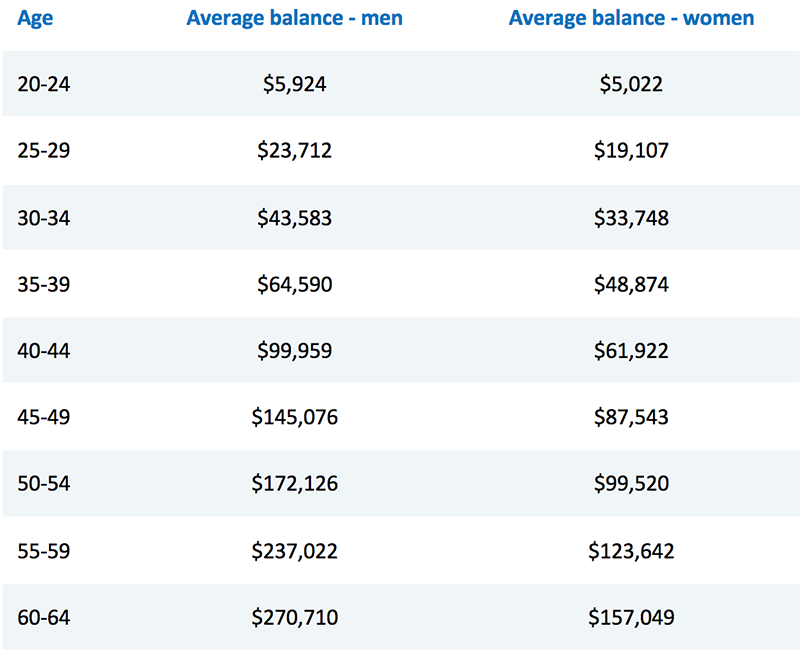
The table below shows the average super balances for Australian men and women of different ages (excluding those with no super) so you can compare your balance to others your age.   

blog content 2018 compare super

Source: Association of Superannuation Funds of Australia, Superannuation account balances by age and gender 2015-16, October 2017, pg. 9.

Does your super stack up?

If your balance looks low, there could be a number of reasons why your super is lagging your peers, such as taking time out of the workforce to study, travel, raise children, care for older relatives, or being out of work, working part-time, or earning a lower wage than others your age.

As the figures show, these issues particularly affect women, as they have lower super balances than men across all age groups.

Will your super be enough to retire on?

Even if your balance is above others of your age, will it be enough for a comfortable retirement?

The Association of Superannuation Funds of Australia (ASFA) says that “many people will still retire with inadequate superannuation savings to fund the lifestyle they want in retirement” and that “most people retiring in the next few years will rely partially or substantially on the Age Pension for some or all of their retirement as they have inadequate super savings”.1

The ASFA Retirement Standard estimates singles will need retirement savings of $545,000 for a comfortable retirement, while couples will need combined retirement savings of $640,000.2

These are lump sums required for a comfortable retirement assuming that the retiree/s will draw down all their capital and receive a part Age Pension. This simply means that the above balances will run out of money at average life expectancy (while people are still dependent on government benefits!!!)

This raises two important questions:

1. What if you (or one of you if you have a partner) will live longer than the average person?

In order to have $60,000 of annual reliable passive income (required by an average couple in NSW to live a comfortable lifestyle5) for life, our estimates show a couple would need approximately $1,340,000 of savings in total.6

2. What if your expenses are different to those of the average people?

Averages quoted by ASFA are great to start a good and relevant discussion. The next step would be work on your own individual retirement budget. Everyone’s circumstances are different, everyone’s retirement plan will look different. What will yours look like? What’s your personal retirement number?

Ways to boost your super

  • Firstly, search for lost super. Money belonging to you might be sitting in an account you’ve forgotten about.
  • Secondly, if you have super with multiple funds, think about consolidating them into one account and you could save on fees and charges that could be eating into your balance. However, you’ll need to check for exit or termination fees, and ensure that your insurance cover isn’t affected.
  • And thirdly, you could consider changing how your super is invested, for example, by switching it into a more growth-focused investment option. Just bear in mind that returns are not guaranteed and that a big part of successful investing is about understanding what you own in your portfolio and why. To change your investment option, contact your planner.

Once you’ve got your super sorted with these quick wins, you can consider ways to boost your balance, including:

  • Salary sacrificing: you can contribute extra cash into your super from your before-tax salary and it will only be taxed at 15%3, rather than at your usual marginal tax rate. However, make sure your total super contributions (including any your employer makes on your behalf) don’t exceed $25,000 per year. One of the best way to reduce tax if you’re an employee.
  • Personal tax-deductible contributions: if your employer doesn’t offer salary sacrifice, you’re unemployed, self-employed or don’t want to salary sacrifice, you can make a personal tax-deductible contribution to your super, which is also taxed at 15%, and subject to the $25,000 per year limit.
  • After-tax contributions: (also known as non-concessional contributions): There’s a $100,000 limit per financial year on the amount of after-tax contributions you can make. If you are under age 65, you can also ‘bring forward’ the next two years’ worth of after-tax contributions and make up to $300,000 contribution in a financial year.4
  • Spouse contributions: if your partner is out of work, a stay-at-home parent, working part-time or earning less than $40,000, adding to their super could benefit you both financially.
  • Contribution splitting: you can split your super contributions between you and your partner. A great way to close the gender super gap.
  • Government contributions: if you’re a low or middle-income earner, you may be eligible for contributions from the government or tax-offsets when you add after-tax money to your super.


Too many options? Need more help?

For more help and to ensure you’re on track for a comfortable retirement, speak to your financial adviser at SFP. If you don’t have an adviser, contact us on 02 9328 0876.


1 Association of Superannuation Funds of Australia, Superannuation account balances by age and gender 2015-16, October 2017, pg. 7.
2 Association of Superannuation Funds of Australia, ASFA Retirement Standard, pg. 4.
3 Or 30% if you earn $250,000 a year or more.
4 Providing your total super balance at 30 June 2017 is less than $1.4 million.
5 ASFA retirement standards – Detailed budget breakdown 
6 SFP’s estimate of required funds in today’s dollars, assuming a withdrawal rate of 4.5% pa, and income returns of 5% pa.

General Disclaimer: This article contains information that is general in nature. It does not take into account the objectives, financial situation or needs of any particular person. You need to consider your financial situation and needs before making any decisions based on this information. Please seek personal financial advice prior to acting on this information.

 

Photo by Nick Fewings on Unsplash

Financial Market 2017-2018

Review of 2017, outlook for 2018

Financial Market 2017-2018

  • The “sweet spot” combination of solid global growth and profits and yet low inflation and benign central banks is likely to continue in 2018. However, US inflation is likely to start to stir and the Fed is likely to get a bit more aggressive. Expect a gradual rise in bond yields and a rising US dollar. The RBA is unlikely to start hiking rates until late 2018 at the earliest.
  • Most growth assets are likely to trend higher, but expect more volatility and more constrained returns. Australian shares are likely to remain laggards.
  • The main things to keep an eye on are: the risks around Trump, inflation, the Fed and the $US; bond yields; the Italian election; China; and Australian property prices.
  • 2017 – a relatively smooth year

    By the standards of recent years, 2017 was relatively quiet. Sure they were the usual “worry list” – about Trump, elections in Europe, China as always, North Korea and the perennial property crash in Australia. And there was a mania in bitcoin.  But overall it has been pretty positive for investors:

    • Global growth continued the acceleration we had seen through the second half of last year.  In fact, global growth looks to have been around 3.6%, its best result in six years, with most major regions seeing good growth. Solid global growth helped drive strong growth in profits.
    • Benign inflation. While deflation fears faded further, underlying inflation stayed low and below target, surprising on the downside in the US, Europe, Japan and Australia.
    • Rising commodity prices. Better than feared global demand and a surprise fall in the $US helped commodity prices along with constrained supply in the case of oil.
    • Politics turned out to be benign. Political risks featured heavily in 2017 but they turned out less threatening than feared: while political risk around Trump rose with the Mueller inquiry into his presidential campaign’s Russian links, business-friendly pragmatism dominated Trump’s first year-policy agenda and a trade war with China did not eventuate; Eurozone elections saw pro-Euro centrists dominate; North Korean risks increased but didn’t have a lasting impact on markets; Australian politics remained messy but arguably no more so than since 2010.
    • Another year of easy money. While the Fed continued to gradually raise interest rates and started reversing quantitative easing and China tapped the monetary breaks, central banks in Europe and Japan remained in stimulus mode and overall global monetary policy remained easy.
    • Australia had okay growth hitting 26 years without a recession, but inflation remained below target. While housing construction started to slow and consumer spending was constrained, non-mining investment improved, infrastructure spending surged & export volumes were strong. Record low wages growth and low inflation kept the Reserve Bank of Australia (RBA) on hold, though.

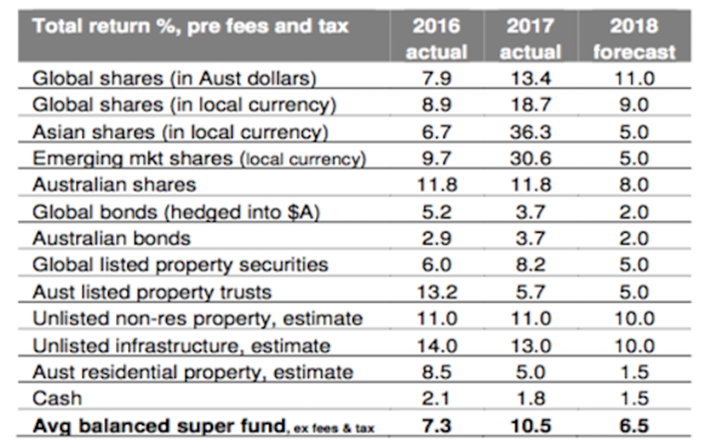
    The “sweet spot” of solid global growth and low inflation/benign central banks helped drive strong investment returns overall.

    Source: Thomson Reuters, Morningstar, REIA, AMP Capital

    • Global shares pushed sharply higher supported by strong earnings, low interests rates and growing investor confidence. While Eurozone, Japanese and Australian shares saw 5-7% corrections along the way, US shares only saw brief 2-3% pullbacks. So volatility was very low.
    • The big surprise was that the US dollar fell rather than rose as low inflation kept expectations for Fed rate hikes depressed. This helped boost US shares but dragged on Eurozone shares as the Euro rose.

    • Asian and emerging market shares were star performers thanks to leverage to global growth, rising commodity prices and a weaker $US, which reduced debt servicing costs. 
    • Australian shares had good returns but were relative laggards as has generally been the case this decade with weaker underlying profit growth. 
    • Bonds had mediocre returns. While inflation surprised on the downside, ultra-low yields constrained returns.
    • Real estate investment trusts had a somewhat constrained year as investors remained a bit wary of listed yield plays.
    • Unlisted commercial property and infrastructure continued to do well as investors sought their still relatively high yields.
    • Australian residential property returns slowed as the heat came out of the Sydney and Melbourne property markets.    
    • Cash and bank term deposit returns were poor reflecting record low RBA interest rates. 
    • Reflecting US dollar softness, the $A actually rose helped by modest gains in commodity prices. 
    • Reflecting strong returns from shares and unlisted assets, balanced superannuation fund returns were strong.


    2018 – looking ok but expect more volatility

    2018 is likely to remain favourable for investors, but more constrained and volatile. The key global themes are likely to be:

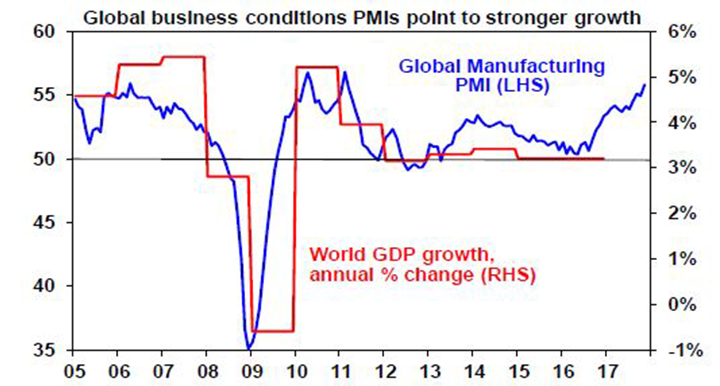
    • Global growth to remain strong. Global growth is likely to move up to 3.7%, ranging from around 2% in advanced to around 6.5% in China, with the US receiving a boost from tax cuts. Leading growth indicators such as business conditions PMIs points to continuing strong growth, but just bear in mind that they don’t get much better than this. Overall, this should mean continuing strong global profit growth albeit momentum is likely to peak.

    World GDP Growth, annual % change (RHS)

    Source: Bloomberg, IMF, AMP Capital

    • US inflation starting to lift. Global inflation is likely to remain low, but it’s likely to pick up in the US as spare capacity is declining, wages growth is picking up and as higher commodity prices feed through. We don’t expect a surge and the flow through in other major countries will be gradual. But higher US inflation may disrupt the yield trade at times and cause some nervousness.
    • Monetary policy divergence to continue. The Fed is likely to hike four times in 2018 (which is more than markets are allowing) and to continue to quantitative tightening but other central banks are likely to lag.
    • Political risk may have more impact after a relatively benign 2017. US political risk is likely to become more of a focus again (with the Mueller inquiry getting closer to Trump, the November mid-term elections likely to see the Republicans lose the House and the risk that Trump may resort to populist policies like protectionism to shore up his support), the Italian election is likely to see the anti-Euro Five Star Movement do well (albeit not well enough to firm government), North Korean risks are unresolved and there is the risk of an early election in Australia.

    Fortunately, there is still no sign of the sort of excesses the drive recessions and deep bear markets in shares: there has been no major global bubble in real estate or business investment; there is the bitcoin mania but not enough people are exposed to that to make it economically significant globally; inflation is unlikely to rise so far that it causes a major problem; share markets are not unambiguously overvalued and global monetary conditions are easy. So arguably the “sweet spot” remains in place, but it may start to become a bit messier.

    For Australia, while the boost to growth from housing will start to slow and consumer spending will be constrained, a declining drag from mining investment and strength in non-mining investment, public infrastructure investment and export volumes should see growth around 3%.  However, as a result of uncertainties around consumer spending along the low wages growth and inflation, the RBA is unlikely to start raising interest rates until late 2018 at the earliest.

    Implications for investors

    Continuing strong economic and earnings growth and still-low inflation should keep overall investment returns favorable but stirring US inflation, the drip feed of Fed rate hikes and a possible increase in political risk are likely to constrain returns and increase volatility after the relative calm of 2017;

    • Global shares are due a decent correction and are likely to see more volatility, but they are likely to trend higher and we favour Europe (which remains very cheap) and Japan over the US, which is likely to be constrained by tighter monetary policy and a rising US dollar. Favour global bans and industrials over tech stocks that have had a huge run.
    • Emerging markets are likely to underperform if the $US rises as we expect.
    • Australian shares are likely to do okay but with returns constrained to around 8% with moderate earnings growth. Expect the ASX 200 to reach 6300 by end 2018.
    • Commodity prices are likely to push higher in response to strong global growth.
    • Low yields and capital losses from a gradual rise in bond yields are likely to see low returns from bonds.
    • Commercial property and infrastructure are likely to continue benefitting from the ongoing search for yield by investors.
    • National capital city residential property price gains are expected to slow to around zero as the air comes out of the Sydney and Melbourne property boom and prices fall by around 5%, but Perth and Darwin bottom out, Adelaide and Brisbane see moderate gains and Hobart booms.
    • Cash and bank deposits are likely to continue to provide poor returns, with term deposit rates running around 2.2%.
    • The $A is likely to fall to around $US0.70, but with little change against the Yen and the Euro, as the gap between the Fed Funds rate and the RBA’s cash rate goes negative.

    What to watch?

    The main things to keep an eye on in 2018 are:

    • The risks around Trump – the Mueller inquiry and the mid-term elections. We don’t see the Republicans impeaching Trump (unless there is evidence of clear illegality) but he could turn to more popular policies such as a trade war with China, a spat over the South China Sea or a clash with North Korea to boost his support.
    • How quickly US inflation turns up – a rapid upswing is not our base case but it would see a more aggressive Fed, more upwards pressure on the $US, which would be negative for US and emerging marketing shares and a rapid rise in bond yields.
    • The Italian election – the anti-Euro Five Star Movement is likely to do well and, even though it’s hard to see them being able to form government, this could cause nervousness;
    • Whether China post the Party Congress embarks on a more reform-focused agenda resulting in a sharp decline in economic growth – unlikely but it’s a risk.
    • Whether non-mining investment, infrastructure spending and export volumes are able to offset constrained consumer spending and a downturn in the housing cycle and how far Sydney and Melbourne property prices fall.

    Concluding comment

    Well another year ended, and a new year starts.  Last year turned out to be a solid year for returns, as we still recover from the GFC running 10 years ago. And yes we will have some volatility, but barring a catastrophe, things look reasonably good.  As usual, if you’ve had a well-diversified portfolio, volatility can be well managed. They key here is to sit down and do a financial progress meeting, and if you feel a need to talk to your financial planner, please call Sydney Financial Planning to organise that meeting. 

    Thank you, Bill Bracey.

    Bill Bracey FChFP | Principal Sydney Financial Planning
    Authorised Representative Charter Financial Planning


    Still have some questions?

    If you want to discuss your investment strategy or financial strategies with one of our advisors – call us to arrange an appointment on 02 9328 0876.


    This main article was prepared by Dr Shane Oliver. Dr Shane Oliver, Head of Investment Strategy and Economics and Chief Economist at AMP Capital is responsible for AMP Capital’s diversified investment funds. He also provides economic forecasts and analysis of key variables and issues affecting, or likely to affect, all asset markets.

    Important note: While every care has been taken in the preparation of this document, AMP Capital Investors Limited (ABN 59 001 777 591, AFSL 232497) and AMP Capital Funds Management Limited (ABN 15 159 557 721, AFSL 426455) make no representations or warranties as to the accuracy or completeness of any statement in it including, without limitation, any forecasts. Past performance is not a reliable indicator of future performance. This document has been prepared for the purpose of providing general information, without taking account of any particular investor’s objectives, financial situation or needs. An investor should, before making any investment decisions, consider the appropriateness of the information in this document, and seek professional advice, having regard to the investor’s objectives, financial situation and needs. This document is solely for the use of the party to whom it is provided.

    General Disclaimer: This article contains information that is general in nature. It does not take into account the objectives, financial situation or needs of any particular person. You need to consider your financial situation and needs before making any decisions based on this information. Please seek personal financial advice prior to acting on this information.
    Spouse contributions: Win/Win!

    Spouse contributions: Win/Win!

    Spouse contributions: Win/Win!

    Building a nest egg is crucial to funding yourselves through retirement. If your spouse is a low-income earner or taking a breather from the 9-5 grind, there’s a fair chance their super contributions are pretty seldom. By contributing into your partner’s superannuation account, you could be eligible for a tax rebate.

    The Criteria:

    • You must be married or in a de facto relationship which includes same-sex couples and you must be living together
    • Contributions must be after-tax (non-concessional)
    • Both must be Australian residents
    • The recipient must be under the age of 65, however, if they are aged between 65 and 69 they must meet work test requirements
    • For the current financial year (2016-17), the receiving spouse’s income must be  $10,800 or less for you to qualify for the full tax offset and less than $13,800 for you to receive a partial tax offset

    The Benefits:

    • You can claim an 18% tax offset for your after-tax contributions (capped at $540)
    • To redeem the maximum $540 rebate you need to contribute a minimum of $3,000 into your partner’s super fund
    • If their income exceeds $10,800, you’re still eligible for a partial tax offset. However, once their income reaches $13,800, you’ll no longer be eligible, but you can still make contributions on their behalf
    • Bear in mind, any contributions you make will count towards your partner’s non-concessional contributions cap. The current limit is $180,000 per year.

    NB: From 1 July 2017 the government will increase access to the spouse contributions tax offset by raising the lower income threshold from $10,800 ($13,800 cut off) to $37,000 ($40,000 cut off).  Another thing to be aware of is the reduction of the non-concessional contributions cap from $180,000 to $100,000 per year from 1 July 2017.

    The Warnings:

    • If either of you exceed the super cap limits, additional tax and penalties may apply
    • The value of your’s and your partner’s investment in super can fluctuate. Before making contributions, make sure you both understand the associated risks linked to your investment options
    • Generally speaking, you’ll need to have reached your preservation age, which will be between 55 and 60 before you can access your super.


    Rules around spouse contributions can be complex so it’s a good idea to check with us to ensure the approach you and your partner take is the right one.


    With the June 30 deadline looming, we’re here to help…

    It’s important that you talk to us about your situation so we can help you take full advantage of any opportunities. Call us to arrange a meeting with one of our planning team on 02 9328 0876.

    General Disclaimer: This article contains information that is general in nature. It does not take into account the objectives, financial situation or needs of any particular person. You need to consider your financial situation and needs before making any decisions based on this information. Please seek personal financial advice prior to acting on this information.

    Most Trusted Advisor 2017

    2017 Most Trusted Adviser

    Most Trusted Advisor 2017

    For the fourth consecutive year, Beddoes Institute has recognised Sydney Financial Planning as a ‘Most Trusted Adviser’ (MTA) practice based on a survey of our clients, which put Sydney Financial Planning within the top 5% of advisers in Australia.  

    An adviser earns the title of ‘Most Trusted Adviser’ when they have achieved the highest level of excellence in servicing their clients whereby they have achieved an adviser trust score of at least 80%.  MTA’s are qualified advisers with five or more years’ experience and are members of the Financial Planning Association of Australia and/or the Association of Financial Advisers.

    Advisers with the MTA badge understand the importance of having a secure financial future and the challenges you face in finding an adviser you can trust. This is why Sydney Financial Planning submitted their practice to be independently assessed by Beddoes Institute. MTA’s have shown that they can transform the lives of their clients by helping them achieve their personal and financial goals.

    You can be confident that we will deliver excellent results, not because of what we say, but because of what our clients say about us.


    We’re motivated by helping our clients achieve thier dreams?

    Speaking with a trusted professional can help create a right financial roadmap suited to you. Why not call us to arrange an appointment on 02 9328 0876.


    General Disclaimer: This article contains information that is general in nature. It does not take into account the objectives, financial situation or needs of any particular person. You need to consider your financial situation and needs before making any decisions based on this information. Please seek personal financial advice prior to acting on this information.
    IFP Corrimal Office

    Our new Corrimal office is open for Business!

    IFP Corrimal Office

    Our new office  is located at 1/225, Princes Highway, Corrimal, it’s a brand new building and purpose built for our Illawarra clients.

    As Wollongong has developed so much over the past years, we found that being located in the city CBD was becoming problematic for parking and we needed to think towards the future as the region rapidly grows. Our new office is close to Corrimal train station and there is plenty of parking close by.

    For the local clients, it’s a fresh face and a fresh new start for Illawarra Financial Planning. We are dedicated to all our clients in the Illawarra and see it as a region that will grow. We intend to grow with it, so we have put our money where our mouth is, and purchased the building as a long term commitment and development plan for the future.

    We look forward to you visiting us at our new office in Corrimal and, as always we value your feedback. We are committed to continuing to deliver our clients a professional quality service and “advice that stands the test of time”


    Want to book an appointment?

    If you want to visit the new office to discuss your financial goals or its time for a review, why not give us a call and arrange an appointment with one of our advisors on 02 9328 0876.


    General Disclaimer: This article contains information that is general in nature. It does not take into account the objectives, financial situation or needs of any particular person. You need to consider your financial situation and needs before making any decisions based on this information. Please seek personal financial advice prior to acting on this information.
    Albert Einstein

    Do you really want success?

    Albert Einstein

    By far the better question is: “what will make my life more valuable?”

    This is the question we ask clients to consider as financial planners. It won’t necessarily be in these words. It may not even be in this one succinct question. But it will involve genuine conversations which, at their core, uncover the real motivators each of us have in our lives. And motivators are what get us out of bed each morning. 

    Caution: there is no universal answer!

    Our clients will have different measures of what will add value to their lives; spending more time with their families, doing volunteer work, getting into shape…again the list is endless.

    The important thing to remember is that before you can truly move in a direction which helps you to become more complete – more “happy” – you have to articulate what makes your life more valuable, and whether you have enough of it. But what next?

    After articulating what is valuable, we can assess where we are today, where we want to be tomorrow and finally, how we can get there. And guess what? It relates back to what we do every day – how we allocate our time, our money and our focus.

    It seems contrived to say the financial planning process achieves this, but only after opening up and having these honest conversations with a neutral third party is there hope of finding the clarity needed to identify what truly matters. A financial planner isn’t the only professional who can do this, but they’re the only professionals qualified to give holistic advice to help you achieve what you want to achieve.

    This is what a financial planner is:

    An accountable professional who can add real value to your life…not just your bank account.

    So, ask yourself:

    • Have I spoken to anyone about what I like about my life?
    • Have I had an honest discussion about what I want more of in my life?
    • Have I reviewed how I allocate my time, money and energy?
    • Do I maintain a plan for my life which helps me to achieve happiness?
    • Or am I hoping for the best, and achieving short term satisfaction from things that don’t add value to my life?

    Most of us would answer yes to this final question without realising the first, small step to independence and happiness could be as simple as a candid discussion with a neutral third party.


    Need some help getting started?

    No matter your dreams, sometimes getting professional advice and a plan of action in place can be life changing. Why not call us for advice on how to achieve your goals on 02 9328 0876.


    General Disclaimer: This article contains information that is general in nature. It does not take into account the objectives, financial situation or needs of any particular person. You need to consider your financial situation and needs before making any decisions based on this information. Please seek personal financial advice prior to acting on this information.
     

    Post Budget, what to do now


    Firstly, they have reduced the amount you can contribute into super for either a tax deduction or tax relief via salary sacrifice and employer contributions down to $25,000 p.a.  This comes into effect 1July 2017.

    Secondly, they have reduced the amount of after tax funds you can contribute to super.  Until now you could contribute up to $180,000 p.a. and even pay 3 years in advance, i.e. pay $540,000 as a lump sum, and continue to do this up to age 74 if you were working.  A few years ago they even let you contribute up to $1,000,000. So that’s all behind us now, and from 3 May 2016 the maximum you can contribute is $500,000 over your life time.  The buggers are even going to count all contributions you have made since 1 July 2007.

    Furthermore the most you can transfer to a tax free Super Pension is $1,600,000. This is aimed again to limit what people have done in the past to take advantage of the generous tax free status of the strategy.

    So in plain English what does this mean for the average Australian?  In short you need to start early, and regularly put money into super.  No longer will people be able quickly pay off their  mortgage , then later in life when that’s paid off , start to top up super to catch up , and possibly tipping in large amounts from sale of assets or inheritances . Now it’s all changed.

    What to do now?

    Start Early!

    The magic of compound interest means that contributions made in your 20s are 8-10 times more powerful than making the same contributions in your 50s and 60s. As an example if you start salary sacrificing $96 per week at age 25 (which will cost you much less due to the tax advantage of salary sacrifice) and stop at age 35, then you would have approximately an extra $787,000 in super at retirement. Whereas if the same person delays contributing to super until age 55 to 65, with the same salary sacrifice contributions, they would only have approximately $83,000 extra, a staggering $704,000 less.

    Contribute smaller amounts but often

    Simply put if you make modest salary sacrifice contributions early and not stop, you could be even better off than if you make larger contributions later on. It’s not rocket science, you need to go with a little less while you work, so when you retire you will have more.

    Other Strategies

    • Make sure you include your spouse in super planning as remember you can have 2 times $1,600,000 in tax free super pensions, i.e. $3,200,000. These would produce an income of $192,000 p.a. tax free income in retirement if we assume a 6% investment return.
    • Take advantage of the tax effectiveness of a Transition to Retirement Strategy (in short available to people 56 and older) allowing them to pay less tax and retire with more in super.
    • If you are self-employed you may be eligible to take advantage of the Small Business CGT Retirement Exemption rule. This is where you can sell your business, and use the proceeds to offset any Capital Gains Tax, allowing you to contribute up to $1,355,000 to super. This is in addition to the life time $500,000 cap.
    • Review your investment strategy to ensure your investment is not just in a default fund. Make sure you have a Financial Planner actually guiding you, who does not work for a bank or a union super fund. That way your best interests are put before the bank’s or the union’s interests.

    In closing there are many more strategies you can use to maximise your wealth; superannuation is just one of them, and in this article that’s all I’m focusing on. But in the real world it’s a great time to sit down and review what you’re doing both inside and outside super. After all, what most people want is a strategy to build wealth and minimise tax, while ensuring their family will be ok in the future.


    Still have some questions?

    If you want to discuss your impact of the budget and your financial future with one of our advisors. Call us to arrange an appointment on 02 9328 0876.


    Article by Bill Bracey | Principal & Senior Financial Planner

    General Disclaimer: This article contains information that is general in nature. It does not take into account the objectives, financial situation or needs of any particular person. You need to consider your financial situation and needs before making any decisions based on this information. Please seek personal financial advice prior to acting on this information.

    Life is here and now!

    Rehearsal? Life is here and now!

    Life is here and now!

    From generation to generation, the answers haven’t changed much – fire fighter, doctor, movie star or sports champ. Few of us ever follow through on this earliest example of goal setting.

    Flash forward to the final days of secondary school, and the same questions start to take on a more serious face. School grades, financial realities and the looming weight of adulthood seemingly reduce the options to a more realistic field.

    Suddenly, that aspiring movie star or sports champ finds him or herself pouring coffees to fund studies, then attached to a mundane desk job and wondering how the best years disappeared.

    Many of us treat the vast bulk of our life as a rehearsal for a time when the universes of health, wealth and happiness converge to form our idea of paradise at some point in an indeterminable future. But, as many of our Facebook friends remind us on a daily basis via myriad motivational JPEGs and messages, life is here and now and, like our day-to-day existence, needs a decent plan to deliver on our dreams.

    Only after you have clearly identified what it is you want from your life can you make good decisions regarding money and the role you want it to play. Yes, money. It’s going to be mighty hard to climb your literal or metaphoric Mt Everest without a thorough financial plan.

    Today is your life as much as tomorrow, and the best approach for achieving financial freedom is one that creates a balance between the two. At the same time, don’t aim for Mt Kosciusko when it’s Everest you really want. So let’s get started:

    Review your current situation

    You need to be honest with yourself about where you are now. To find out where you stand financially, draw up a budget showing income and outgoings. Once you know exactly what you spend each month, you can look at how to cut costs to create additional income.

    Goals to live by

    Set out your goals in writing. Most people find it helps to clarify whether they really want something. It is also part of the process involved in working out how to achieve it. Expect that there will be some compromises along the way; you might like the idea of saving up to buy a motorcycle and travelling around Australia, but your partner may be dreaming of buying a beach shack.

    Understand exactly what is involved as you are deciding both the final outcome and the journey involved in getting there. In other words, your long-term goals determine how you will live your life today.

    Be prepared for the unexpected

    You may also need to adjust a goal to reflect what is happening in the outside world, or alter what you are doing to ensure your goal is reached as originally planned. To combat this you need to regularly review your strategy and monitor where things are headed, and also prepare for that rainy day when something unexpected happens.

    At the heart of this process, never forget that time in your childhood when you dreamed of being that movie star or sports champ. With our help incorporating your goals into the financial planning process, you can still live out your dreams, whatever they may be.


    Still have some questions?

    If you want to discuss your financial future and plans one of our advisors, book a coffee or call us to arrange an appointment on 02 9328 0876.

    This article contains information that is general in nature. It does not take into account the objectives, financial situation or needs of any particular person. You need to consider your financial situation and needs before making any decisions based on this information.

    Re-designing lives for the better

    We’re all about re-designing lives for better

    Re-designing lives for the better

    Your Best Interests (www.yourbestinterests.com.au) is about financial advice and the difference it makes to the lives of everyday Australians.

    Sharing the real life stories of single Mum, Helen and her teenage daughter, Lauren and young widower, Lisa; Your Best Interests is a TV series that explores the real life challenges, concerns, hopes and dreams of these women as they come to terms with their very different life circumstances.

    Helen’s Story

    When Helen divorced, it was her teenage daughter, Lauren that urged her to seek financial help. Alone, with a home that needed renovating, a daughter to support and desire to travel, Helen couldn’t imagine how she’d ever be able to live the life she wanted. Watch how with the help of a professional financial adviser, she managed to change that with realistic plans for a future she didn’t think possible.

    Your Best Interest - Helen

    Working with Bill Bracey as their financial adviser, Helen and Lauren embark on a journey of discovery as they come to learn more about their personal priorities, managing money, new options and opportunities that open up as they re-build their lives and take control of their financial wellbeing.

    Your Best Interest - Helen and Lauren

    The program is produced by the Association of Financial Advisers (AFA), Australia’s oldest association representing financial advisers, who believe that great advice is in the best interests of more Australians.The show will screen on Channel 4Me (74) AND on the Business and Finance section of the 4Me website next Tuesday 30 June at 8pm AEST.

    Also check out the link to the promo video – https://vimeo.com/album/3441676/video/130820167


    Do you have some bigger goals you want to plan for?

    It can really help to create a financial roadmap with the help of a professional. Why not call us to arrange an appointment on 02 9328 0876.


    General Disclaimer: This article contains information that is general in nature. It does not take into account the objectives, financial situation or needs of any particular person. You need to consider your financial situation and needs before making any decisions based on this information. Please seek personal financial advice prior to acting on this information.

    When is the right time to retire well?

    Living retirement well: Living life on your own terms

    When is the right time to retire well?

    This is not to say that the initial adjustment to your new life stage won’t come with its challenges, most will go through stages of disorientation and disenchantment and experience a wide range of emotions and that’s normal. I encourage you to look for healthy ways to deal with those feelings. Do more of what you enjoy, keep the body moving, walk regularly, read, write, draw or paint, tap into your creative side. Talking with others who have already retired can be a big help also.

    What’s the hardest part of retirement?

    When I asked some of my clients what was the hardest part of retirement, for some it was coming to terms with budgeting tighter and the limited chance of making money compared with working life. For others it was a feeling of loss of purpose in their new life stage. Again, this is normal, and they went on to explain that this feeling passes as they replace their previous routines and colleagues with new pastimes and friends.

    What’s the best part of retirement?

    My clients have shared that the best part of retirement is the newfound freedom to pursue personal interests, spend more time with loved ones, and enjoy a slower pace of life. They also said it’s a time to focus on health and hobbies, build stronger relationships with family and friends (even making new ones), and to fulfill long-held bucket list dreams such as travel.

    When’s the right time?

    When we’re goal setting, we ask people at what age do they see or would like to see themselves retired.

    Some say tomorrow, others say 60 or 65 and we set the target date to aspire towards. We then start putting in place strategies to ensure we have sufficient funds to achieve this goal. We come around to our 60 or 65th birthday and quite often we’re still enjoying our work, our health is good, and we aren’t ready to retire yet. This happens often.

    Over the years I’ve observed the reality is retirement is a state of mind and reaching an age or date is not the trigger for entering the next stage of life. From what I’ve detected, the biggest determinant for retirement and readiness for change is the reducing capacity to tolerate living life on someone else’s terms. Some might say their “bulldust meter” is full, others have experienced close friends of family’s health suffer and this brings things into perspective and priorities change. Either way, when you know
    you know.

    Any regrets?

    I asked some of my clients if they felt they retired at the right time. Most said yes, as we had discussed this at length many times in the lead up to prepare ourselves as best we can.A small number have returned to work (in a slower paced environment) as they crave the sense of purpose that work can bring, but most often than not, most people are happy with their decision.

    Reach out to your financial planner if you’d like to chat further about these insights and retiring well.


    Article by Gary Winwood-Smith
    Senior Financial Planner | Director


    Are you confident your retirement plan will support the life you want?

    Talk to us about retirement strategies that provide freedom and peace of mind. Call 02 9328 0876 to arrange a meeting.


    General Disclaimer: This article contains information that is general in nature. It does not take into account the objectives, financial situation or needs of any particular person. You need to consider your financial situation and needs before making any decisions based on this information. Please seek personal financial advice prior to acting on this information.
     

    Is Investing a gift to your future self?

    Investing in your future: Why it matters

    Is Investing  a gift to your future self?

    As a financial planner, I’ve seen time and again how early, consistent investing can transform lives. Let’s delve into the motivations behind investing, the benefits for your future self, and the peace of mind it brings to your current self.

    Motivations for investing

    Investing is more than just a financial strategy; it’s a commitment to your future.

    Financial Independence: One of the primary reasons to invest is to achieve financial independence. By building a robust investment portfolio, you can create a steady stream of income that supports your lifestyle without relying solely on your job. This independence allows you to pursue passions, travel, or even retire early.

    Security and Peace of Mind: Knowing that you have a financial cushion can provide immense peace of mind. Whether it’s an emergency fund for unexpected expenses or a retirement nest egg, having savings and investments ensures you’re prepared for life’s uncertainties.

    Achieving Life Goals: Investing helps you reach significant milestones, such as buying a home, funding education, or starting a business. By setting aside money and watching it grow, you can turn your dreams into reality.

    Benefits for your future self

    Investing is a gift to your future self. Here’s how:

    Compound Growth: The earlier you start investing, the more time your money has to grow through compound interest. This means your investments generate earnings, which are then reinvested to generate even more earnings. Over time, this compounding effect can lead to substantial wealth accumulation.

    Retirement Planning: Investing early ensures you have enough
    funds to enjoy a comfortable retirement. By consistently contributing to retirement accounts, you can build a sizable nest egg that supports you in your golden years.

    Legacy Building: Investing over the long term allows you to leave a financial legacy for your loved ones or passion projects.

    Peace of mind for your current self

    While investing is about the future, it also benefits your present self:

    Financial Discipline: Regularly setting aside money for investments instils financial discipline. This habit helps you manage your finances better, avoid unnecessary debt, and make informed spending decisions.

    Reduced Stress: Knowing that you’re actively working towards your financial goals can reduce stress and anxiety. It provides a sense of control over your financial future, allowing you to focus on other aspects of your life.

    Flexibility and Opportunities: Having investments gives you financial flexibility. It opens opportunities to take calculated risks, such as starting a new venture or making a career change, without jeopardising your financial stability.

    We take from this then, that investing can be a powerful tool when leveraged over the longer term, it can help to secure your financial future and enhance your present life.
    By understanding the motivations behind investing and the benefits it brings, you can make informed decisions that align with your goals. If you’re ready to take the next step, consider reaching out to your financial planner to discuss what strategy may work best for you.


    Article by Steven Stolle
    Financial Planner | Director


    Does your financial plan include a long-term investing strategy?

    Our team can help you create an investment approach that aligns with your goals. Call 02 9328 0876 to arrange meeting.


    General Disclaimer: This article contains information that is general in nature. It does not take into account the objectives, financial situation or needs of any particular person. You need to consider your financial situation and needs before making any decisions based on this information. Please seek personal financial advice prior to acting on this information.


    Upcoming changes to Aged Care fees

    Upcoming changes to Aged Care fees

    Upcoming changes to Aged Care fees

    Proposed government reforms are increasing the fees people will have to pay across almost every front, and worse yet, they are now allowing facilities to keep a portion of the “refundable” accommodation deposits people make at entry into care. The overall impact of these changes means that people will pay more up front, pay more each day while in care, and get less back at the end. This can have serious consequences, and not only jeopardize your ability to pay your own way, but also means you’ll be leaving less behind for your family too.

    While the government is spending an additional $2.2 Billion on aged care reforms, these are primarily aimed at trying to modify and strengthen the system by attracting new staff and funding the development of more appropriate systems. This is in response to the anticipated increase in demand for aged care services as our population ages. None of this funding, unfortunately, is being used to ease the burden on aged care recipients. In fact, the intent here is the exact opposite, with the changes to the fee systems being designed expressly to make “those who have more pay more”. Our preliminary testing and modelling shows that they have achieved just that; high net worth individuals in particular will be significantly impacted by these changes, although everyone will feel the bite at least somewhat.

    However, it is not all bad news. These changes bring with them their own set of new considerations, and we at Sydney Financial Planning have been hard at work finding new solutions for people needing aged care. Our specialist aged care team have already identified strategies to minimize the impacts of the changes on our clients, and we are excited to begin implementing these new strategies in the coming year. In particular, we have focused on strategies aimed at preserving capital over the long term, ensuring that you and your family retain the wealth that you have worked so hard to build.

    If you, or any of your loved ones, are considering aged care, our door is open. Aged care can be a stressful time, and the complicated mess of rules around it can just add to that stress. At Sydney Financial Planning, we navigate that maze for you, and provide the simplest, most effective outcomes to help you and your family through these difficult times. We encourage you to reach out for a friendly, no-obligation chat with one of our aged care specialists.


    Article by James Middleton
    Financial Planner


    Do you know how the November aged care changes could affect your family?

    Our Aged Care specialists can help you protect wealth and plan ahead. Call 02 9328 0876 to arrange a meeting.


    General Disclaimer: This article contains information that is general in nature. It does not take into account the objectives, financial situation or needs of any particular person. You need to consider your financial situation and needs before making any decisions based on this information. Please seek personal financial advice prior to acting on this information.

     

    What do clients value most in advice?

    What clients really value: The enduring power of long-term financial guidance

    What do clients value most in advice?

    It shows up in a different way.
    It’s in the quiet confidence clients develop when they understand the path they’re on.
    It’s in the steady hand they feel guiding them through uncertainty.
    It’s in the shift from “Will I be okay?” to “How do I live with more intention?”

    Across countless conversations, review meetings, and long-standing relationships, clients describe the same outcomes – not in technical language, but in deeply personal terms:

    – “I finally feel like I understand my financial world.”
    – “I know where I’m going – and why.”
    – “I trust the process now. I trust myself more.”

    These reflections aren’t about emotional comfort alone. They point to something far more enduring: a sense of clarity, self-trust, and alignment with what matters most.

    Yes, financial strategy matters – sound structure, risk management, and disciplined planning form the foundation. But over time, the greatest value of long-term advice is found in what it empowers people to become.

    Here’s what we’ve observed:

    1. More confident decision-makers

    With consistent guidance, clients grow into their financial lives. They move from hesitation to informed action. Over time, they stop outsourcing all decisions and begin trusting their own judgement. That confidence is hard-earned – and life-changing. It transforms how people move through financial choices and life transitions alike.

    2. More aligned with their values

    Wealth on its own doesn’t create satisfaction. But when your money is structured around your values – family, freedom, contribution, legacy – it becomes a powerful tool for living well. Long-term advice helps bring that alignment into focus, translating your values into a lived financial strategy.

    3. More intentional in how they live

    When money is no longer a source of confusion or stress, it becomes something quieter – something that supports life, rather than controlling it. We see clients make clearer, calmer choices, less driven by reaction and more guided by intention. That’s when financial advice becomes a catalyst for a more focused, values-driven life.

    4. More future-focused and legacy-minded

    The longer the relationship continues, the more deeply clients begin thinking beyond themselves – about the kind of impact they want to make, the future they want to shape, and the values they want to pass on. At this stage, advice becomes not just strategic, but deeply personal.

    At its best, long-term financial advice does more than guide a portfolio – it supports a life. It offers perspective, structure, and calm through every season. It helps people make wiser decisions, stay anchored to their values, and live with greater purpose.

    A great adviser doesn’t just help someone make better financial decisions – they help them build confidence in their ability to navigate life’s transitions.

    They help translate complexity into clarity, fear into perspective, and overwhelm into action.

    As time goes on, that guidance becomes more than useful – it becomes transformational. That’s what meaningful advice delivers – not just over years, but over a lifetime.


    Article by Michal Bodi
    Senior Financial Planner | Partner


    Are you getting the true value from your financial advice?

    Speak with our Financial Planners about building clarity and confidence in your future. Call 02 9328 0876 to book a meeting today.


    General Disclaimer: This article contains information that is general in nature. It does not take into account the objectives, financial situation or needs of any particular person. You need to consider your financial situation and needs before making any decisions based on this information. Please seek personal financial advice prior to acting on this information.


    The income or growth conundrum

    The income or growth conundrum

    The income or growth conundrum

    We love investment income at SFP, because it adds real money to your investment account which you can use in the real world. Don’t get me wrong, capital growth is great (both the income and capital are important considerations for any investment), however, until you sell something it’s not real money we can use at the shops. And the problem with selling investments is that we then have to give up the future income from it. A bit of a conundrum.

    They say, “horses for courses”. Depending on what life stage you’re in will depend on what investment return you might be favouring. Our accumulator clients might be focusing more on capital growth, whereas our retired clients might be more focused on a growing income from their investments.

    Investment income may come in the form of interest, rent, dividends or distributions (as they call them from managed funds). The quality of the income is determined by the quality of the underlying investment, with consistency and reliability being two important factors we deem to be represented in quality income. The other important factor is the ability for the income to increase over time.

    If you’re accumulating wealth over the longer-term, your focus is likely to be on capital growth, with income generated from that investment being used to purchase additional investments. However, there comes a point in time where your capital has grown sufficiently, and now your focus will be more on generating income to support your lifestyle.

    If you need to access capital to fund your lifestyle expenses, you become a forced seller and must accept what the market gives you. This is generally not a situation many of our accumulator clients have dealt with, as we can set a retirement target date and plan accordingly, so we know when we’re likely going to need to access our investment capital.

    The greatest challenge is for our pre-retiree or retiree clients, in that they may be in a situation where they have insufficient cash to fund their next pension payment. If the underlying investments produce sufficient income to top-up your cash account, then you won’t need to sell assets to fund your withdrawals, which is an ideal scenario.

    This is where having a well-defined strategy comes into play, and why it forms an important part of our planning process for clients in retirement, or close to retirement. By looking ahead, we can determine the optimal timing for adjusting your investment strategy, as well as consider appropriate underlying investments to meet your needs going forward.

    Re-investing dividends provides the opportunity to grow your portfolio at a greater pace over time, compared to banking your dividends. This applies regardless of whether you’re putting additional funds in or not, the dividends will be used to purchase more shares or units in your portfolio. This is known as “compounding returns”.

    Where your strategy is largely to build your portfolio over a long period of time and your personal circumstances enable this to happen consistently (generally while you’re working) then re-investing dividends has proven to be an effective strategy.

    However, if you require a regular income from your investments (such as in retirement), your dividends may be better served being directed to your cash or transaction account. This will in effect ‘top up’ your cash account and allow you to continue funding your income needs.

    The decision to re-invest income, or allocate income to cash, really depends on your overall needs and there may be a combination of both of these approaches built into your overall plan.


    Article by Steven Stolle
    Financial Planner | Director


    Does your portfolio have a long-term investing strategy in place?

    Speak with one of our Financial Planners about the best investing approach for your circumstances, call 02 9328 0876 to arrange a meeting.


    General Disclaimer: This article contains information that is general in nature. It does not take into account the objectives, financial situation or needs of any particular person. You need to consider your financial situation and needs before making any decisions based on this information. Please seek personal financial advice prior to acting on this information.
     

    Transitioning into retirement? Start to get your buckets in place early.

    Transitioning into retirement? Start to get your buckets in place early.

    Transitioning into retirement? Start to get your buckets in place early.

    However, the devils in the detail when executing a well-diversified investment portfolio and it largely depends on which life stage you’re at when selecting the right approach.

    There are two approaches to implementing a well-diversified investment portfolio, the first being a diversified multi asset investment fund and the second being a well-diversified “investment bucket” portfolio approach. They both spread a client’s funds across difference asset classes to smooth the returns however one approach works especially well for our accumulator clients whilst the other is the foundation for managing our retired client’s portfolio’s.

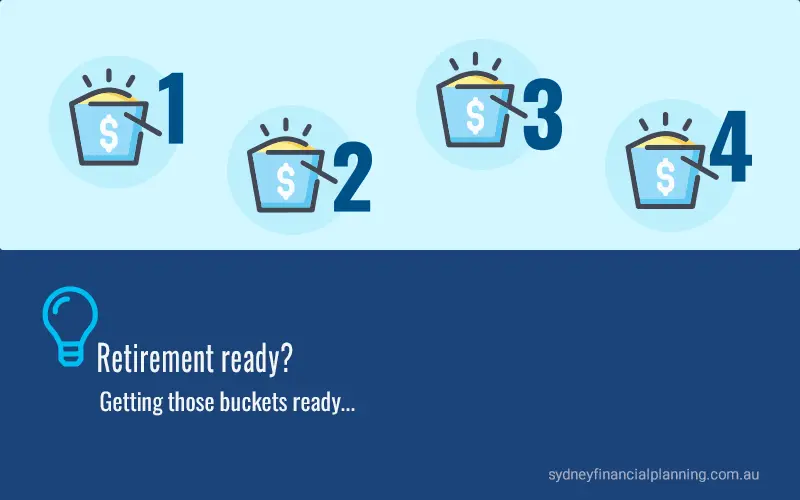
    This article focuses on the “investment bucket” diversification approach for our retired clients. This framework generally has a least 4 “buckets” ranging from the short-term bucket for transactions to the long term bucket for capital growth and protecting our clients purchasing power.

    Bucket 1: The short-term bucket.

    The transaction or cash account. Pays for pension payments and costs.

    Think of bucket number 1 like a glass of water, as we drink from it (draw money out) the water level reduces. We need to top this glass back up to ensure we can keep drinking as retirement is thirsty work. How do we top it back up? We direct the ‘water’ from buckets 2, 3 and 4 to this bucket. That way we can keep drinking. Should the water levels fall too low we may need to sell some of the profits from buckets 3 and 4 to top back up however we only want to do this when there are profits to take, however, we need to allow sufficient time for those assets to flourish and grow.

    sfp bucket 002

    Bucket 2: The cash reserve.

    Holds a year of pension payment provisions along with an amount reserved for emergencies and unexpected expenses.

    In the event we need to top up bucket 1 within the first 5 years we can call on the reserve bucket to help us out. We can use these funds at a pinch to ensure there’s enough water (or cash) in bucket 1 to draw on. This is our contingency account for what ifs. Needs to be readily accessible. Could be a high interest cash managed fund and a Term Deposit (depending on how much we’re holding in reserve).


    sfp bucket 003

    Bucket 3: The medium-term bucket.

    Our 5–7-year money with a focus on delivering steady, reliable, and growing income.

    Generally invested with the primary goal to provide growing income and ensure asset value keeps pace with inflation to preserve the purchasing power of our funds. This bucket generally invests largely in blue chip Australian shares with a focus on paying fully franked dividends, infrastructure and bonds with high yields. As we all know the cost of living doesn’t stop increasing for anybody and retirees know they need to be drawing a higher income each year.

    sfp bucket 004

    Bucket 4: The long-term bucket.

    Our 7 – 10-year money. Invested largely in growth assets such as shares and property with a timeframe of 7-10 years.

    Our primary investment objective for this bucket is to preserve the purchasing power of our capital. Therefore, this bucket’s goal is to produce capital growth along with some income. Income from this bucket is directed to bucket number 1 (or reinvested in we can afford it).

    When should I start transitioning to an “investment bucket: portfolio approach?

    There’s no set answer however generally speaking allowing somewhere between 3 and 5 years prior to retirement is best practice and allows sufficient time to build up our short and medium term buckets. We’ll be raising this with you at your annual progress meeting.


    Gary Winwood-Smith
    Director | Senior Financial Planner


    Do you need help with the conundrum of income or growth?

    Speak with one of our Financial Planners about the best investment strategy for your circumstances, call 02 9328 0876 to arrange a meeting.


    General Disclaimer: This article contains information that is general in nature. It does not take into account the objectives, financial situation or needs of any particular person. You need to consider your financial situation and needs before making any decisions based on this information. Please seek personal financial advice prior to acting on this information.


    Focusing on the right thing with investing

    Focusing on the right thing

    Focusing on the right thing with investing

    2022 could have gone into the books as an unrelievedly ‘bad’ year, indeed quite the worst one since the onset of the Global Financial Crisis in 2008. But of course, that isn’t the case because the share prices are just one aspect of their total return.

    The other is dividends – the actual cash disbursements companies make to their owners (shareholders) out of their earnings, and the income on which many retired investors are living. In 2022, those dividends went up just shy of 11% from 2021. You read that right, last year’s S&P 500 cash dividend was 10.8% higher than 2021’s. (It was the 13th year in a row that dividends went up, and the 11th consecutive record high.)

    That’s sort of what dividends do, and indeed it only makes common sense: since in the aggregate the 500 companies in the Index have significantly increased their earnings over time, they’ve been able – and quite willing – to reward their shareholders by raising their cash dividends. 

    This wasn’t a one-year wonder. In the last 50 years – beginning with the annus horribilis 1973, the dividends went up because the earnings went up – more than 18 times.

    Well fine, in fact pretty terrific. But in the next breath, you might very intelligently ask: how much of that dividend increase was lost to the erosion of purchasing power? In other words, how much did the cost of living go up in those 50 years? The answer is that the Consumer Price Index increased 6.4 times, from December 1973 to December 2022.

    If that’s starting to look to you like the S&P 500’s cash dividend has quietly gone up, this half century past, close to three times more than has the cost of living, I’m happy to confirm that you’re reading the situation just exactly right.

    You may wonder why no one (apart from your financial planner, who may have to be restrained from shouting it from the housetops) has ever reported this to you. Permit me to speculate: (1) It’s a pure goodness, and financial journalism tends to devote very little space to purely good things. And (2) it isn’t really “news”, but rather a cumulatively very powerful truth.

    So, if some bank you’d never even heard of busted out today because it lent a bunch of money to some crypto bros, be assured that that’s just about all you’re going to be reading and hearing about for a while. Indeed, I can pretty much guarantee that “Tortoise continues inexplicably to beat hare” won’t ever be the big headline on your financial “news” feed, so you needn’t bother looking for it.

    Here’s why an 11% jump in the cash dividend in spite of any temporary declines in the share prices, should have been every long-term equity investor’s key takeaway from 2022:

    For the pre-retirement investor – trying with all his/her might to accumulate enough capital for retirement – it’s because a significantly increased stream of dividends was being reinvested at significantly reduced share prices. That’s the great (though somehow not obvious) beauty of compounding, as you make most of your money in a bear market; you just don’t realize it at the time.

    And of course, for retired investors, it’s how their increased income may well have stayed ahead of their inflating living costs. CPI inflation was pretty dreadful in 2022, but it was nowhere near 11%. Remember: it isn’t your account statement you’ll be taking to the supermarket throughout perhaps three decades of retirement; it’s your income.

    Just one man’s opinion, I guess. But if people looked up their dividend income every 90 days instead of checking their account balances every 90 minutes, they just might become markedly more successful investors.


    Article by Michal Bodi

    Senior Financial Planner | Partner


    Does your portfolio have a long-term investing strategy in place?

    Speak with one of our Financial Planners about the best investing approach for your circumstances, call 02 9328 0876 to arrange a meeting.


    General Disclaimer: This article contains information that is general in nature. It does not take into account the objectives, financial situation or needs of any particular person. You need to consider your financial situation and needs before making any decisions based on this information. Please seek personal financial advice prior to acting on this information.

     

    Cashflow remains king

    Cashflow remains king

    Cashflow remains king

    Both are equally important, and if I had a dollar for each time I had a discussion with a client about how much is enough cash in a portfolio, I’d be a wealthy man.

    Today’s challenging periods have reminded us why it remains so critical our clients maintain a cash reverse and have a sound understanding of their cashflow positions (both personally and within their investment accounts).

    Over the last few years our clients have avoided selling growth assets in a downmarket and we want to keep it this way for as long as we can. We’ve managed to do this by putting in place cash reserves for our retired clients so they can continue to meet their pension payments and by putting in personal cash reserves to meet any unexpected expenses and avoid the need to make withdrawals from their investment accounts at an unfavorable time and at a discount. Our accumulators have been maintaining cash at bank to support any disruptions to their employment income.

    So back to the question, how much cash is enough? Everyone has a safety blanket number, however when determining cash allocations for our clients it really depends on their life stage. Accumulators may only need to hold 2% – 5% of cash in their portfolio’s whereas retired clients will need to hold much more than this.

    Min cash holdings for our retired clients can range from 1 – 3 years pension payments. The biggest trade off being the low return generated by cash exaggerated by interest rates being at an all-time low. A high cash allocation will have a larger drag on the long term return of your investment portfolio and ultimately impact the longevity of the account. So generally speaking, the higher the account balance the less cash allocation necessary (as a % of account balance).

    The Government has continued to help people preserve cash positions by reducing the minimum pension requirements by 50% for retirees drawing from their accountbased pensions again for the 2022/23 financial year. The minimums are:

    Age

    Normal Rate

    New rate for 2022/23

    Under 65 4.00% 2.00%
    65-74 5.00% 2.50%
    75-79 6.00% 3.00%
    80-84   7.00% 3.50%
    85-89 9.00%  4.50%
    90-94 11.00% 5.50%
    95 and over 14.00% 7.00%


    With limited opportunity for travel and a reduction in discretionary spending we’ve seen many of our clients requiring less cash to meet their living expenses. This has provided us with an opportunity to reduce payments to our pension clients over the past 12-24 months.

    However, with inflation looming we expect to see an increasing pressure on the need to increase pension payments as the cost of living increases over the next 12 -24 months.

    How can we better manage our cash positions in our investment portfolio’s going forward?

    Most of our clients have been fortunate to save more in their personal bank accounts which will help to fund travel and discretionary spending as the world continues to open up post covid. This will alleviate pressure on making large increases to pension payments in the short term. We have prepared and factored a risking cost of living into your financial plan and investment portfolios as our financial modelling allows for a CPI increase in pension payments annually.

    For our retired clients, or those transitioning to retirement its prudent to review the cashflow within your pension account. This is the cornerstone conversation at all our review meetings. Money in (distributions from our investments) and money out determine our cashflow position with pension payments making up the bulk of money going out. If there’s an opportunity to hold or even reduce your pension payments this coming year before we see significant inflation, we will be discussing this with you at your annual review meeting.

    Do you have the right amount of cash reserves?

    Speak with one of our Investment and retirement specialist about the best strategy for your circumstances, either book a meeting or get in contact with us on 02 9328 0876.


    Article by Gary Winwood-Smith | Senior Financial Planner

    General Disclaimer: While every care has been taken in the preparation of this document, Sydney Financial Planning and Charter FP make no representations or warranties as to the accuracy or completeness of any statement in it.This article contains information that is general in nature. It does not take into account the objectives, financial situation or needs of any particular person. You need to consider your financial situation and needs before making any decisions based on this information. Please seek personal financial advice prior to acting on this information.


    Rising importance of aged care planning

    Rising importance of aged care planning

    Rising importance of aged care planning

    This can be a really difficult time for families as our elders come to terms with their new circumstance.

     There are support services available for our loved ones in their homes or in a place that caters for their special needs.

    The Aged Care Sector offers help for both but can be difficult to navigate. Where do I start? Who do I talk to? What will they have to pay? How will it affect their home? How does it affect their Aged Pension? What home is best to cater to their needs.

    These questions and more come up in what can be a very confusing and emotional time.

    Important considerations for Aged Care

    • Does my elderly relative need support to stay at home, what are the Aged Care Home Packages available and how do I apply for them?
    • Does my elderly relative need to go into Aged Care, what facility would they like to go to and what are their particular needs (there are different levels of cover depending on the relative’s medical needs and not all Aged Care facilities cover all areas of need)?
    • How do I start the process of getting them into Aged Care?
    • How do I go about contacting the facilities and what is needed by them before they will accept someone?
    • Can I or anyone else speak to Aged Care on my elderly relative’s behalf?
    • How does my elderly relative pay for care and what are their options (There are at least four different payments for Aged Care that differ in complexity)?
    • What government or Centrelink assistance is available and what to do with the family home?

    icon quoteLife threw a curve ball when Mum was no longer able to make financial decisions about her future. Navigating the aged care system left me utterly confused. I knew what we needed to achieve for mum but having the know-how was another matter. Andrew Tate was brought into this process and helped us not only establish clear goals but produced a comprehensive strategic paper that compared scenarios to achieve such goals. He comprehensively walked us through the findings to the point where we felt 100% confident in making the same decisions that a short time ago seemed overwhelming. I am incredibly grateful to Andrew for his precise knowledge and desire to help my family.’

    Sasha Campbell (Daughter of Estelle Pulman who recently went into Aged Care)

    These are just some of the questions that have to be considered for Aged Care and the answers can have a varying effect on each of them.

    At Sydney Financial Planning we understand the complex rules around Aged Care. As Aged Care specialists we understand how sensitive this situation can be when dealing with your elderly relatives. Let us work together with you to find a solution that will satisfy your loved ones. Call our team to have a discussion around any prospective family members who may need extra care in their twilight years.


    If you aren’t sure how to proceed, lets start with a call…

    Speak with one of our Aged Care Specialists about the best approach for your circumstances, either book a meeting or get in contact with us on 02 9328 0876.


    General Disclaimer: While every care has been taken in the preparation of this document, Sydney Financial Planning and Charter FP make no representations or warranties as to the accuracy or completeness of any statement in it.This article contains information that is general in nature. It does not take into account the objectives, financial situation or needs of any particular person. You need to consider your financial situation and needs before making any decisions based on this information. Please seek personal financial advice prior to acting on this information.