Tag: Life Insurance

Protecting Your Wealth

Protecting your wealth – Insurance in plain English

Protecting Your Wealth

Everybody’s circumstances are different, but insurance is important for everybody. Your need for insurance will change as you move through the different stages of your life.There are many different types of insurance, and we can help you find the right level of protection for your needs.

What types of insurance are there?

There are many types of insurance.
Car or home/contents insurance allows you to insure your belongings. Personal insurance policies enable you to insure yourself and your ongoing wellbeing.
Personal insurance provides protection against sickness, injury and death, and includes:

  • Life insurance
  • Total and Permanent Disability (TPD) insurance
  • Trauma insurance, and
  • Income protection.

While insurance doesn’t remove the risk of something going wrong, it provides you and your family with protection and financial security if something does happen.
The amount of insurance you need is affected by:

  • how much you earn
  • your cost of living
  • your assets
  • your liabilities
  • your relationship status (whether you are married, in a de facto relationship or single), and how many dependants you have.

Life insurance

Life insurance protects your family by paying a lump sum if you die. Most people think that life insurance is only for the main income earner, but the person who takes care of the family is also a large contributor to the home and can be insured.

Life Insurance
Can be purchased inside or outside of superannuation Many super funds provide life insurance. Premiums can be paid from contributions made to your fund by your employer, by you personally or simply deducted from your account balance in the fund.
Tax treatment

Outside super

  • Premiums are generally
  • not tax deductible.
  • The benefit payment is tax free.
  • Broad range of potential beneficiaries.

Inside super

  • Premiums are tax deductible for the super fund.
  • The benefit payment may be taxed, depending on who receives it.
  • Limited range of potential beneficiaries.


Total and Permanent Disability insurance

TPD cover provides a lump sum payment if you suffer a disability before retirement and can’t work again, or can’t work in your usual occupation or chosen field of employment.

Total and Permanent Disability insurance
Can be purchased as an add on, or as a stand alone You can buy TPD as an add on to term life insurance, or as a stand alone product.
You can also get TPD as an extra benefit from your super fund or as part of a trauma insurance product.
Tax treatment

Outside super

  • Premiums are not tax deductible.
  • The benefit payment is tax free if paid to the injured person or their relative.

Inside super

  • Premiums are generally tax deductible for the super fund.
  • Superannuation contributions made to fund premiums may attract various tax concessions.
  • The benefit payment you receive may be taxed.


Trauma insurance

Trauma (or critical illness) insurance provides a cash lump sum if you suffer a specified illness or injury. Advances in medical treatment have increased the need for trauma insurance. The improved chance of survival means that although you are more likely to survive, you are also more likely to have substantial medical bills to pay.

Trauma Insurance
Stand alone policy or additional options Trauma insurance is usually purchased as a stand alone policy, but can be purchased with additional options, such as a TPD benefit.
Trauma insurance is generally not available through superannuation.
Cost Trauma cover is relatively more expensive than other forms of life insurance because of the greater probability of a trauma event occurring.
Tax treatment
  • Benefits are tax free.
  • There is no restriction on how you use the payments.


Income protection

Income protection insurance (also known as salary continuance or income replacement) provides a monthly payment to replace lost income if you are unable to work due to injury or sickness.

Income protection
Level of cover The maximum allowable cover is generally 75 per cent of your gross wage.
Benefit period The longer the benefit period, the higher the premium.
Can be purchased inside or outside of superannuation Income protection is available through your super fund or can be purchased as a stand alone policy outside of super.
Tax treatment
  • Premiums are generally tax deductible.
  • The payments received are considered income and are subject to tax.


Insurance as part of your superannuation

Life, TPD and income protection insurances are all offered within superannuation. If your insurance is held within superannuation, the cost of the premiums is withdrawn from your superannuation balance.
It is important to work out the best way to structure your insurance, whether inside or outside superannuation, or a combination of the two.

Benefits to having insurance in your superannuation may include:

  • automatic acceptance – there’s generally no need to complete medical checks
  • cheaper cover – from the bulk discount typically available to superannuation funds, and
  • tax deductibility – some contributions to superannuation attract a tax deduction, so you may be able to pay your premiums by making tax deductible super contributions.

Disadvantages of having insurance in your superannuation include:

  • limitations on the types of cover available
  • potential delays in the payment of benefits in the event of death, and
  • high tax rates – superannuation death benefits paid to a non-dependant may be taxed at up to 32 per cent.

Keep your insurance up to date

Insurance is not static, and your need for cover will change as you move through different stages in your life. As part of the financial advice process, we regularly review your insurances to make sure that you are adequately protected if your circumstances change.


Are your insurances up to date?

Or do you need to put something in place to better protect youself? To arrange an appointment to speak with one of our advisors call us on 02 9328 0876.


This article contains information that is general in nature. It does not take into account the objectives, financial situation or needs of any particular person. You need to consider your financial situation and needs before making any decisions based on this information.


 

Protecting you and your family

Have you got protection?

Protecting you and your family

Every day we put ourselves at risk

All of us are exposed to dangers and threats regardless of our lifestyle and circumstances. There are many types of risk factors including those related to health, genetics, geographic location, and even our occupation has a level of risk attached to it. Unfortunately, there is no way to eliminate 100% of risks, so we have to plan for the best and prepare for the worst.

Where are you going to turn if you lose your job tomorrow? What happens if a natural disaster terrorised your family home? What if you or your partner was all of a sudden struck down with cancer? It doesn’t matter how careful you are, there are things in life you can’t control. If an unforeseen event presents itself, insurance acts a protective tool that helps safeguard the things we value most like our family, our house, valuable possessions and personal belongings. Insurance enables you to replace or repair your assets, whether those assets are your belongings or your capacity to earn income.

There are several types of protection available:

  • Life Insurance
  • Total or permanent disability (TPD)
  • Income protection
  • Trauma
  • Keyman

Everybody’s circumstances are different, but insurance is important for everybody. Sydney Financial Planning can help you find the right level of protection for your needs.


Are your insurances up to date?

Or do you need to put something in place to better protect youself? To arrange an appointment to speak with one of our advisors call us on 02 9328 0876.


General Disclaimer: This article contains information that is general in nature. It does not take into account the objectives, financial situation or needs of any particular person. You need to consider your financial situation and needs before making any decisions based on this information. Please seek personal financial advice prior to acting on this information.

Will & Legacy

Will it the way you want

Will & Legacy


Having a valid and up-to-date will is a great start to ensuring those left behind get the assets you would have liked them to have and that dependent children are cared for according to your wishes.

But a will is only part of estate planning, which should form part of any financial plan. Not all assets can be dealt with in a will and a will only takes effect when you die. Dying without a will or one that is invalid means dying intestate. When this happens, after debts are paid from the assets in your estate, the remainder is distributed according to a predetermined formula.

This may mean certain family members receive more or less than you intended and any accumulated wealth may be at least partially destroyed through unnecessary taxes.

It is estimated that as many as 60 per cent of people die intestate and that of the 40 per cent who do have a will, many aren’t even sure where it is or whether it is valid.

Just like a financial plan, a will needs to be reviewed and updated when your life changes, such as with the birth of a child or a divorce. It also needs to be signed and witnessed in a specific manner and kept in a safe place.

More than a will

The best way to make sure all your affairs are in order is to establish an estate plan with the help of a solicitor. This doesn’t just involve a will. It also involves taking into account how you would like your personal and financial affairs handled if you lose the capacity to make decisions for yourself, due to age or illness. Appointing a trusted friend or relative under an enduring power of attorney gives them legal authority to look after your affairs on your behalf.

There are two main types of enduring powers of attorney for estate planning purposes: one to enable financial and legal decisions to be made on your behalf and a second to enable medical and lifestyle decisions to be made on your behalf.

Superannuation and insurance

With compulsory superannuation contributions and their generous tax concessions, it is little wonder superannuation has become one of the most valuable assets outside of the family home. What many families are not aware of however, is that both superannuation and life insurance policies (whether held inside or outside of super) are not covered under a will.1 Financial advisers can work closely with their clients to ensure these valuable assets outside a will are accounted for according to each client’s overall estate planning requirements.

In the case of superannuation, it may be possible to make a binding death benefit nomination, which ensures the trustees have clear instructions as to the intended beneficiaries.

A person’s death can be emotional and stressful enough without surprises. The best way of ensuring your assets, insurance and superannuation are preserved according to your wishes is to seek help from a trusted professional.


Case study: Anthony’s story

Take Anthony who has three children, two with his first wife and one with his second wife. His will stipulates his new wife to be the beneficiary of his estate. Rather than leave it to chance that she will give something to his older children, he directs the trustees of his superannuation fund to pay the death benefits equally to the two children. Anthony also has a life insurance policy outside of his superannuation and nominates the benefits to be paid to a trust within his estate, identifying his youngest child as the beneficiary when she turns 18.


Do you have  your will and insurances up to date?

Or do you need to put something in place to better protect youself and loved ones? To arrange an appointment to speak with one of our advisors call us on 02 9328 0876.

1 Unless super is paid to the estate or the beneficiary of an insurance policy is the estate.

General Disclaimer: This article contains information that is general in nature. It does not take into account the objectives, financial situation or needs of any particular person. You need to consider your financial situation and needs before making any decisions based on this information. Please seek personal financial advice prior to acting on this information.

Know your life insurance

Know where you stand – know your life insurance

Know your life insurance

Myth # 1 – Life insurance companies don’t pay claims

There’s a common perception that life insurance companies will do everything they can to avoid paying claims.
In fact, 92% of all life insurance claims are paid in the first instance¹.
As long as you fulfil your duty of disclosure when you apply for cover, and you’re covered for the medical condition you’re claiming for, you can be confident your claim will be paid.

Myth # 2 – I’m young and don’t have kids or a mortgage, so I don’t need it

Life insurance isn’t all about providing for debts and dependants. It’s also about looking after yourself.
Think what would happen if you became ill or disabled and couldn’t work. If you didn’t have income protection, you’d have to find another way to supplement your income – through friends or family. Having income protection means that you are more likely to be able to manage on your own.
There are benefits to applying for life insurance when you’re young and healthy. It’s generally cheaper and it means you don’t have to worry about getting cover later if your health changes (see myth #3).

Myth # 3 – I won’t be covered if my health changes

Once you start your cover, what you are covered under your life insurance for won’t change – even if your health declines.
In fact, you generally don’t even need to tell your insurer about a change in your health unless you intend to make a claim.

Myth # 4 – You have to do lots of medical tests to get covered

Some life insurance products sold through financial advisers require some medical tests before you get covered, but it may be as simple as one blood test and a GP examination.

  • If you have an existing medical condition, you may be asked to provide extra information about your condition and insurers will generally write to your doctor for a report rather than require tests
  • You generally won’t be covered for pre-existing conditions, so it’s important to establish upfront what those pre-existing conditions are. It’s important to answer all questions accurately upfront so any pre-existing conditions can be reviewed by your insurer for any impacts to your cover or ability to obtain cover.
  • That way you know exactly what is and isn’t covered under your policy.

Myth # 5 – Level premiums don’t go up

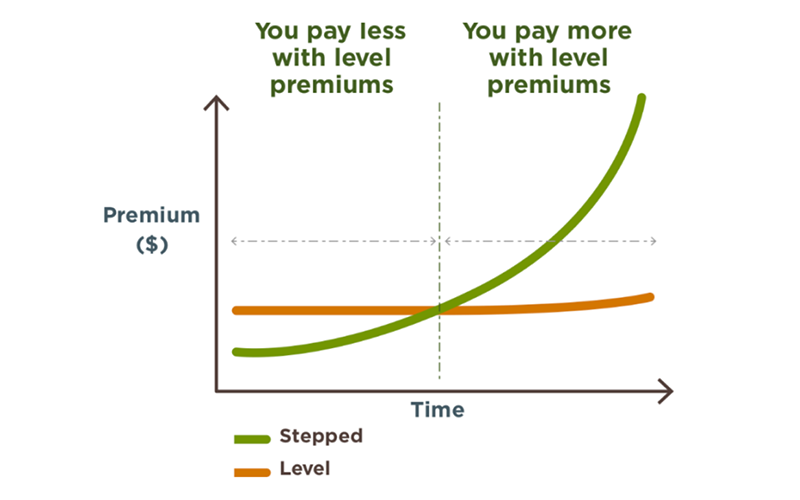
‘Level premiums’ are designed to save you money over the long term by eliminating the impact of age-based premium increases.

Level premiums are calculated based on your age when the cover started, not at each anniversary, which means premiums are generally averaged out over a number of years. This means your cover is more expensive than ‘stepped premiums’ at the beginning of your policy, but generally gets cheaper (relative to stepped premiums) as your policy continues.

It’s important to note that at policy anniversary the premium may still increase (even with level premiums), because age is just one factor that determines your premium. Other factors that impact premium (such as claims trends in Australian population) can result in a repricing of your insurance cover.

When insurers reprice stepped or level premiums, they don’t do it for an individual policy within a specific group unless they do it for every policy in that group.

Many life insurers in Australia have repriced level premiums in the past, so it’s important to talk to your financial adviser or your life insurer to understand your policy as well as any repricing activity that’s recently occurred, so you can make an informed decision.

myth 5

The above graph is for illustrative purposes only. This graph illustrates age-based premium increases for stepped against level for all covers. This premium comparison has been calculated, assuming all other factors affecting the premiums are excluded.
Both stepped and level premiums can increase due to factors other than age.

Myth # 6 – I’ll be stuck paying for cover I don’t need

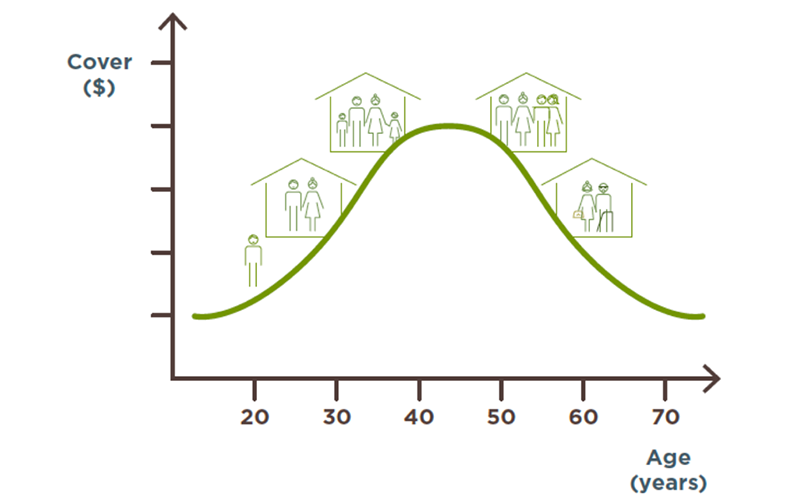
Life insurance is designed to change as your life changes, as your cover needs can vary significantly over your lifetime.

An example may be when taking out life insurance when getting married. You may want to increase your cover if you have children or increase your mortgage. But similarly you may want to reduce your cover if your children have grown up or you’ve paid down your debts.
Your financial adviser can help you work out how much cover you need at any given time, to make sure you’re not paying for any cover you don’t need.

myth 6

Myth # 7 – The cover in my super is enough

Over 70% of Australian life insurance policies – more than 13.5 million separate policies – are held through superannuation funds*.

While this cover is great to have, many of these policies only provide the minimum level of cover employers have to offer, which isn’t enough for most people.

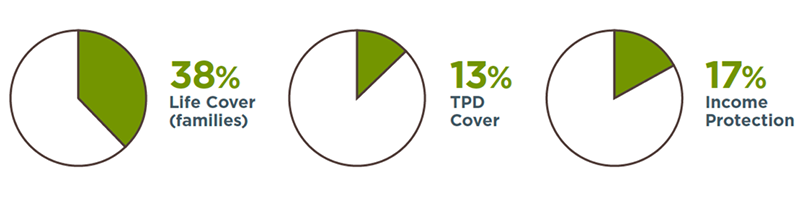
In fact, Rice Warner* estimates that the median level of cover in superannuation meets is only 60% of needs for life cover (or just 38% for families with children), 13% for TPD cover and 17% for income protection.[Insert Image]

myth 7

Myth # 8 – I’ll be covered by workers’ compensation

Workers’ compensation provides some protection for work-related accidents or injuries.

But it doesn’t cover most illnesses, nor does it cover anything that happens to you when you’re not at work. It’s worth checking your states workers compensation legislation.

Even if you are covered by workers compensation, the benefits are typically capped in terms of the amount and duration of payments, which means the cover could fall well short of what you really need.

Myth # 9 – Only the main breadwinner needs life insurance

There’s no doubt insuring the breadwinner is vital for any family’s financial security.

But if a non-working or lower income-earning partner became seriously ill or injured, their family would need a lot of assistance to replace their services within the home.

Imagine a breadwinner had to reduce their working hours to look after their partner or young children, or employ outside help.

Either option could prove very expensive, which is why both members of a couple should consider the various life insurance cover options available – regardless of their role.


Want to know more?

If you’d like to discuss any aspects covered and how it may apply to you, book an appointment with one of our planners or contact us on 02 9328 0876.


Article by – Canstar | © Copyright 2019 CANSTAR Pty Limited

General Disclaimer: This article contains information that is general in nature. It does not take into account the objectives, financial situation or needs of any particular person. You need to consider your financial situation and needs before making any decisions based on this information. Please seek personal financial advice prior to acting on this information.