Tag: Insurance

Protecting Your Wealth

Protecting your wealth – Insurance in plain English

Protecting Your Wealth

Everybody’s circumstances are different, but insurance is important for everybody. Your need for insurance will change as you move through the different stages of your life.There are many different types of insurance, and we can help you find the right level of protection for your needs.

What types of insurance are there?

There are many types of insurance.
Car or home/contents insurance allows you to insure your belongings. Personal insurance policies enable you to insure yourself and your ongoing wellbeing.
Personal insurance provides protection against sickness, injury and death, and includes:

  • Life insurance
  • Total and Permanent Disability (TPD) insurance
  • Trauma insurance, and
  • Income protection.

While insurance doesn’t remove the risk of something going wrong, it provides you and your family with protection and financial security if something does happen.
The amount of insurance you need is affected by:

  • how much you earn
  • your cost of living
  • your assets
  • your liabilities
  • your relationship status (whether you are married, in a de facto relationship or single), and how many dependants you have.

Life insurance

Life insurance protects your family by paying a lump sum if you die. Most people think that life insurance is only for the main income earner, but the person who takes care of the family is also a large contributor to the home and can be insured.

Life Insurance
Can be purchased inside or outside of superannuation Many super funds provide life insurance. Premiums can be paid from contributions made to your fund by your employer, by you personally or simply deducted from your account balance in the fund.
Tax treatment

Outside super

  • Premiums are generally
  • not tax deductible.
  • The benefit payment is tax free.
  • Broad range of potential beneficiaries.

Inside super

  • Premiums are tax deductible for the super fund.
  • The benefit payment may be taxed, depending on who receives it.
  • Limited range of potential beneficiaries.


Total and Permanent Disability insurance

TPD cover provides a lump sum payment if you suffer a disability before retirement and can’t work again, or can’t work in your usual occupation or chosen field of employment.

Total and Permanent Disability insurance
Can be purchased as an add on, or as a stand alone You can buy TPD as an add on to term life insurance, or as a stand alone product.
You can also get TPD as an extra benefit from your super fund or as part of a trauma insurance product.
Tax treatment

Outside super

  • Premiums are not tax deductible.
  • The benefit payment is tax free if paid to the injured person or their relative.

Inside super

  • Premiums are generally tax deductible for the super fund.
  • Superannuation contributions made to fund premiums may attract various tax concessions.
  • The benefit payment you receive may be taxed.


Trauma insurance

Trauma (or critical illness) insurance provides a cash lump sum if you suffer a specified illness or injury. Advances in medical treatment have increased the need for trauma insurance. The improved chance of survival means that although you are more likely to survive, you are also more likely to have substantial medical bills to pay.

Trauma Insurance
Stand alone policy or additional options Trauma insurance is usually purchased as a stand alone policy, but can be purchased with additional options, such as a TPD benefit.
Trauma insurance is generally not available through superannuation.
Cost Trauma cover is relatively more expensive than other forms of life insurance because of the greater probability of a trauma event occurring.
Tax treatment
  • Benefits are tax free.
  • There is no restriction on how you use the payments.


Income protection

Income protection insurance (also known as salary continuance or income replacement) provides a monthly payment to replace lost income if you are unable to work due to injury or sickness.

Income protection
Level of cover The maximum allowable cover is generally 75 per cent of your gross wage.
Benefit period The longer the benefit period, the higher the premium.
Can be purchased inside or outside of superannuation Income protection is available through your super fund or can be purchased as a stand alone policy outside of super.
Tax treatment
  • Premiums are generally tax deductible.
  • The payments received are considered income and are subject to tax.


Insurance as part of your superannuation

Life, TPD and income protection insurances are all offered within superannuation. If your insurance is held within superannuation, the cost of the premiums is withdrawn from your superannuation balance.
It is important to work out the best way to structure your insurance, whether inside or outside superannuation, or a combination of the two.

Benefits to having insurance in your superannuation may include:

  • automatic acceptance – there’s generally no need to complete medical checks
  • cheaper cover – from the bulk discount typically available to superannuation funds, and
  • tax deductibility – some contributions to superannuation attract a tax deduction, so you may be able to pay your premiums by making tax deductible super contributions.

Disadvantages of having insurance in your superannuation include:

  • limitations on the types of cover available
  • potential delays in the payment of benefits in the event of death, and
  • high tax rates – superannuation death benefits paid to a non-dependant may be taxed at up to 32 per cent.

Keep your insurance up to date

Insurance is not static, and your need for cover will change as you move through different stages in your life. As part of the financial advice process, we regularly review your insurances to make sure that you are adequately protected if your circumstances change.


Are your insurances up to date?

Or do you need to put something in place to better protect youself? To arrange an appointment to speak with one of our advisors call us on 02 9328 0876.


This article contains information that is general in nature. It does not take into account the objectives, financial situation or needs of any particular person. You need to consider your financial situation and needs before making any decisions based on this information.


 

Will & Legacy

Will it the way you want

Will & Legacy


Having a valid and up-to-date will is a great start to ensuring those left behind get the assets you would have liked them to have and that dependent children are cared for according to your wishes.

But a will is only part of estate planning, which should form part of any financial plan. Not all assets can be dealt with in a will and a will only takes effect when you die. Dying without a will or one that is invalid means dying intestate. When this happens, after debts are paid from the assets in your estate, the remainder is distributed according to a predetermined formula.

This may mean certain family members receive more or less than you intended and any accumulated wealth may be at least partially destroyed through unnecessary taxes.

It is estimated that as many as 60 per cent of people die intestate and that of the 40 per cent who do have a will, many aren’t even sure where it is or whether it is valid.

Just like a financial plan, a will needs to be reviewed and updated when your life changes, such as with the birth of a child or a divorce. It also needs to be signed and witnessed in a specific manner and kept in a safe place.

More than a will

The best way to make sure all your affairs are in order is to establish an estate plan with the help of a solicitor. This doesn’t just involve a will. It also involves taking into account how you would like your personal and financial affairs handled if you lose the capacity to make decisions for yourself, due to age or illness. Appointing a trusted friend or relative under an enduring power of attorney gives them legal authority to look after your affairs on your behalf.

There are two main types of enduring powers of attorney for estate planning purposes: one to enable financial and legal decisions to be made on your behalf and a second to enable medical and lifestyle decisions to be made on your behalf.

Superannuation and insurance

With compulsory superannuation contributions and their generous tax concessions, it is little wonder superannuation has become one of the most valuable assets outside of the family home. What many families are not aware of however, is that both superannuation and life insurance policies (whether held inside or outside of super) are not covered under a will.1 Financial advisers can work closely with their clients to ensure these valuable assets outside a will are accounted for according to each client’s overall estate planning requirements.

In the case of superannuation, it may be possible to make a binding death benefit nomination, which ensures the trustees have clear instructions as to the intended beneficiaries.

A person’s death can be emotional and stressful enough without surprises. The best way of ensuring your assets, insurance and superannuation are preserved according to your wishes is to seek help from a trusted professional.


Case study: Anthony’s story

Take Anthony who has three children, two with his first wife and one with his second wife. His will stipulates his new wife to be the beneficiary of his estate. Rather than leave it to chance that she will give something to his older children, he directs the trustees of his superannuation fund to pay the death benefits equally to the two children. Anthony also has a life insurance policy outside of his superannuation and nominates the benefits to be paid to a trust within his estate, identifying his youngest child as the beneficiary when she turns 18.


Do you have  your will and insurances up to date?

Or do you need to put something in place to better protect youself and loved ones? To arrange an appointment to speak with one of our advisors call us on 02 9328 0876.

1 Unless super is paid to the estate or the beneficiary of an insurance policy is the estate.

General Disclaimer: This article contains information that is general in nature. It does not take into account the objectives, financial situation or needs of any particular person. You need to consider your financial situation and needs before making any decisions based on this information. Please seek personal financial advice prior to acting on this information.

Preparing for the unknown

Preparing for an unknown future

Preparing for the unknown

Lump sum payment

Trauma insurance, also known as critical illness insurance, provides a one-off lump sum payment when an illness or condition specified in the policy is diagnosed. The money, which is tax-free, is typically paid after the insured person has survived for 14 days from the time a medical specialist confirms the diagnosis. Once the claim has been approved, the lump sum payment is made and the funds can be used to pay medical costs, upgrade treatments or to pay for private nursing, therapy or childcare assistance.

Some people use the money to pay off their mortgage or other debts to help ease financial stress during their recovery. The lump sum payment can allow a person some much-needed financial breathing space to take stock of their life.

What is covered?

Most policies cover upwards of 50 prescribed illnesses or injuries, including cancer, heart attack, stroke and paraplegia as well as other serious illnesses and injuries such as major burns and kidney failure. In contrast to trauma insurance, total and permanent disability (TPD) insurance requires you to be unable to work for a minimum of six months, and then it must be independently determined you are unable to ‘permanently’ return to your ‘own’ or ‘any’ occupation ever againi. Most trauma policies offer child cover alongside adult cover. While it may be difficult to consider one of your children being seriously ill or injured, sadly it can happen. A lump sum payment may allow parents to choose the best medical care inside or outside of Australia or give them the ability to take time off work to focus on family without worrying about the financial implications.

Know your policies

It is important not to confuse trauma insurance with income protection insurance. Instead of a lump sum, income protection insurance provides an income stream in the event you cannot work as a result of illness or injury. It provides an income while you are unable to work, replacing part of your wage or salary. For complete financial protection, both a trauma policy and an income protection policy should be considered.


Susie’s story

Taking out trauma insurance proved a wise decision for Susie and her husband, Paul.

Susie was diagnosed with breast cancer when she was 43 with a young family. She had surgery and then needed time to recover and to have ongoing treatment.

Her husband Paul had plenty to worry about – Susie’s illness, the children and his own work responsibilities. Fortunately Paul and Susie had each taken out trauma insurance, providing them with a $200,000 lump sum. With this money Paul could organise care for the children, ensure Susie received the best medical help available and take time off work to spend with his wife.

The Cancer Council estimates that a cancer diagnosis can on average cost a family more than $47,000 in lost productivity and out-of-pocket expenses. Life can be full of unexpected events, both good and bad. Having the right insurance in place can reduce the financial consequences of a traumatic event. We can help you determine whether your existing insurance cover will allow you to meet the challenges of an unknown future.


Are your insurances up to date?

Or do you need to put something in place to better protect youself? To arrange an appointment to speak with one of our advisors call us on 02 9328 0876.


i This depends on the definition of TPD in your policy.

General Disclaimer: This article contains information that is general in nature. It does not take into account the objectives, financial situation or needs of any particular person. You need to consider your financial situation and needs before making any decisions based on this information.

Workers compensation vs income protection

Workers compensation vs income protection

Workers compensation vs income protection

When it comes to covering your income if you can no longer work, what’s better? Income protection, workers compensation, or both?

What’s the difference between income protection and workers compensation?

The key difference between workers compensation and income protection is whether cover will be provided and to what extent.

When it comes to workers compensation [1], cover will only be provided if the accident or illness occurs as a direct result of the job. Payments can be used to cover income for the duration that you are unfit to work or up to 65 years old in most cases (sometimes 67), as well as any medical expenses or rehabilitation. The key point when it comes to workers compensation though is where and why the injury or illness has occurred. If you cannot prove that it was a result of jobs undertaken at work, then you will not be eligible for compensation.

In contrast, Income Protection [2] can cover you for injuries and illnesses suffered both at and because of work, and also outside of work. When you consider 75% of accidents occur when a person is at home or during leisure time, compared to 25% at work [3]. Taking out income protection may help you to cover outgoings and expenses, should something occur outside of work that impacts your ability to earn an income.

Workers’ compensation costs and benefits are paid for by the employer, with workers compensation systems varying from state to state [4]. Income protection insurance premiums on the other hand are usually paid for by the individual.

What does income protection offer? You can’t make an informed decision unless you have all the facts.

Income protection can give you the support of an alternative source of income if you are unable to work due to an injury or an illness. Benefit payments of generally up to 75% of your average income are paid monthly, which can help you to cover expenses.

Remember, relying on workers compensation means you won’t be covered if the injury or illness isn’t due to work or your workplace and usually, you’ll need to present evidence to prove the injury or illness occurred as a direct result of your job. Sometimes, this may be difficult and this can result in lengthy delays. And if you’re self-employed, a sole trader or an independent contractor you may not be covered under a workers compensation scheme. While some people believe income protection is only for high income earners, this isn’t the case.

What is the impact of having both workers compensation and income protection? You can have both workers compensation and income protection. However, having access to workers compensation may mean a reduced insurance benefit [5] from your income protection policy. Why? Income protection is designed to help cover your loss of income, but if you’re already being compensated for the loss of that income from somewhere else, such as workers compensation, this will be factored in and generally your income protection benefit will be reduced accordingly.

According to the Australian Bureau of Statistics [6] 47% of Australians who suffered an injury or illness as a result of work received no financial assistance in 2017/18. While workers compensation is great, it doesn’t cover everything, especially not broken bones that prevent you from working if they occur while on holiday or even just as a result of a fall at home.

Income protection offers peace of mind, so that you and your family can be protected should your income be affected by injury or illness.


Still have some questions? Are you covered?

Speaking with one of our financial advisors is a good place to start. Make a booking or call us on 02 9328 0876 to arrange a meeting.


[1] Fair Work Ombudsman 2020, Workers Compensations, viewed January 2020 https://www.fairwork.gov.au/leave/workers-compensation
[2] TAL Slice of Life Blog, 2 January 2019, Income Protection Insurance: Protect against the unexpected, viewed January 2020 https://www.tal.com.au/slice-of-life-blog/ip-protect-against-the-unexpected
[3] Finder.com.au 2020, Income protection insurance vs WorkCover, viewed January 2020 https://www.finder.com.au/income-protection-vs-work-cover
[4] Nolo 2020, Who Actually Pays for Workers’ Compensation?, viewed January 2020 https://www.disabilitysecrets.com/workmans-comp-question-20.html
[5] Compare the market 2020, Do I need life insurance or income protection?, viewed January 2020 https://www.comparethemarket.com.au/life-insurance/information/life-insurance-or-income-protection/
[6] Australian Bureau of Statistics, 2018, Work-Related Injuries Australia,July 2017 to June 2018, viewed January 2020, https://www.abs.gov.au/ausstats/abs@.nsf/mf/6324.0

General Disclaimer: This article contains information that is general in nature. It does not take into account the objectives, financial situation or needs of any particular person. You need to consider your financial situation and needs before making any decisions based on this information. Please seek personal financial advice prior to acting on this information.


Know your life insurance

Know where you stand – know your life insurance

Know your life insurance

Myth # 1 – Life insurance companies don’t pay claims

There’s a common perception that life insurance companies will do everything they can to avoid paying claims.
In fact, 92% of all life insurance claims are paid in the first instance¹.
As long as you fulfil your duty of disclosure when you apply for cover, and you’re covered for the medical condition you’re claiming for, you can be confident your claim will be paid.

Myth # 2 – I’m young and don’t have kids or a mortgage, so I don’t need it

Life insurance isn’t all about providing for debts and dependants. It’s also about looking after yourself.
Think what would happen if you became ill or disabled and couldn’t work. If you didn’t have income protection, you’d have to find another way to supplement your income – through friends or family. Having income protection means that you are more likely to be able to manage on your own.
There are benefits to applying for life insurance when you’re young and healthy. It’s generally cheaper and it means you don’t have to worry about getting cover later if your health changes (see myth #3).

Myth # 3 – I won’t be covered if my health changes

Once you start your cover, what you are covered under your life insurance for won’t change – even if your health declines.
In fact, you generally don’t even need to tell your insurer about a change in your health unless you intend to make a claim.

Myth # 4 – You have to do lots of medical tests to get covered

Some life insurance products sold through financial advisers require some medical tests before you get covered, but it may be as simple as one blood test and a GP examination.

  • If you have an existing medical condition, you may be asked to provide extra information about your condition and insurers will generally write to your doctor for a report rather than require tests
  • You generally won’t be covered for pre-existing conditions, so it’s important to establish upfront what those pre-existing conditions are. It’s important to answer all questions accurately upfront so any pre-existing conditions can be reviewed by your insurer for any impacts to your cover or ability to obtain cover.
  • That way you know exactly what is and isn’t covered under your policy.

Myth # 5 – Level premiums don’t go up

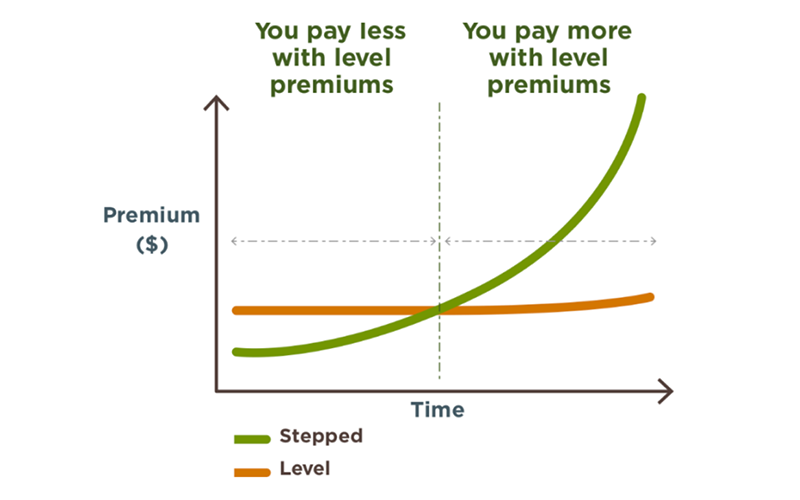
‘Level premiums’ are designed to save you money over the long term by eliminating the impact of age-based premium increases.

Level premiums are calculated based on your age when the cover started, not at each anniversary, which means premiums are generally averaged out over a number of years. This means your cover is more expensive than ‘stepped premiums’ at the beginning of your policy, but generally gets cheaper (relative to stepped premiums) as your policy continues.

It’s important to note that at policy anniversary the premium may still increase (even with level premiums), because age is just one factor that determines your premium. Other factors that impact premium (such as claims trends in Australian population) can result in a repricing of your insurance cover.

When insurers reprice stepped or level premiums, they don’t do it for an individual policy within a specific group unless they do it for every policy in that group.

Many life insurers in Australia have repriced level premiums in the past, so it’s important to talk to your financial adviser or your life insurer to understand your policy as well as any repricing activity that’s recently occurred, so you can make an informed decision.

myth 5

The above graph is for illustrative purposes only. This graph illustrates age-based premium increases for stepped against level for all covers. This premium comparison has been calculated, assuming all other factors affecting the premiums are excluded.
Both stepped and level premiums can increase due to factors other than age.

Myth # 6 – I’ll be stuck paying for cover I don’t need

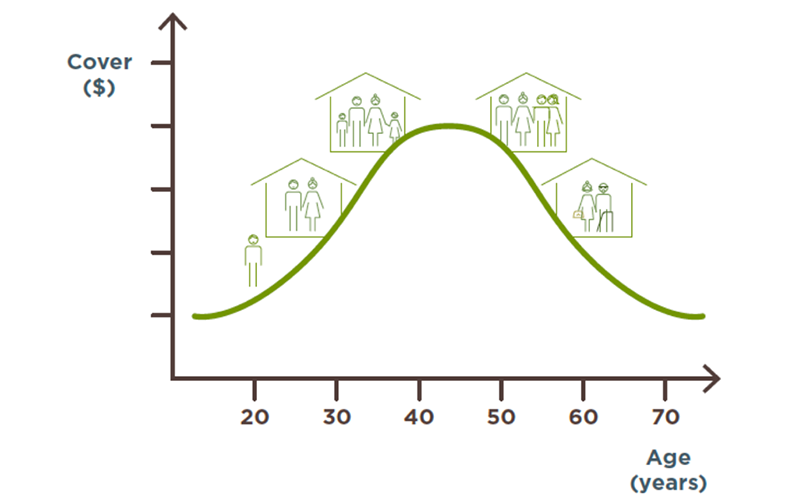
Life insurance is designed to change as your life changes, as your cover needs can vary significantly over your lifetime.

An example may be when taking out life insurance when getting married. You may want to increase your cover if you have children or increase your mortgage. But similarly you may want to reduce your cover if your children have grown up or you’ve paid down your debts.
Your financial adviser can help you work out how much cover you need at any given time, to make sure you’re not paying for any cover you don’t need.

myth 6

Myth # 7 – The cover in my super is enough

Over 70% of Australian life insurance policies – more than 13.5 million separate policies – are held through superannuation funds*.

While this cover is great to have, many of these policies only provide the minimum level of cover employers have to offer, which isn’t enough for most people.

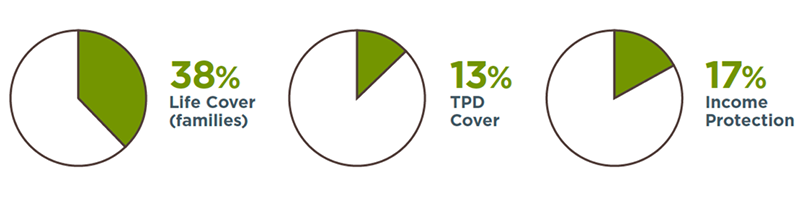
In fact, Rice Warner* estimates that the median level of cover in superannuation meets is only 60% of needs for life cover (or just 38% for families with children), 13% for TPD cover and 17% for income protection.[Insert Image]

myth 7

Myth # 8 – I’ll be covered by workers’ compensation

Workers’ compensation provides some protection for work-related accidents or injuries.

But it doesn’t cover most illnesses, nor does it cover anything that happens to you when you’re not at work. It’s worth checking your states workers compensation legislation.

Even if you are covered by workers compensation, the benefits are typically capped in terms of the amount and duration of payments, which means the cover could fall well short of what you really need.

Myth # 9 – Only the main breadwinner needs life insurance

There’s no doubt insuring the breadwinner is vital for any family’s financial security.

But if a non-working or lower income-earning partner became seriously ill or injured, their family would need a lot of assistance to replace their services within the home.

Imagine a breadwinner had to reduce their working hours to look after their partner or young children, or employ outside help.

Either option could prove very expensive, which is why both members of a couple should consider the various life insurance cover options available – regardless of their role.


Want to know more?

If you’d like to discuss any aspects covered and how it may apply to you, book an appointment with one of our planners or contact us on 02 9328 0876.


Article by – Canstar | © Copyright 2019 CANSTAR Pty Limited

General Disclaimer: This article contains information that is general in nature. It does not take into account the objectives, financial situation or needs of any particular person. You need to consider your financial situation and needs before making any decisions based on this information. Please seek personal financial advice prior to acting on this information.
 

Marriage in Later Life

Marriage in later life

Marriage in Later Life

So, if you’re considering marriage, perhaps for a second time or more, give thought to the financial implications of marrying later in life and sidestepping some of the money-related hazards.

Financially, there are two important areas to address. Probably not for the wedding day speeches – but what happens to your money if you get divorced, and what happens to it when you die? 

The answers largely depend on, in whose name your assets are held, and what you specify in your will. And let me stress, it’s essential you have a properly drawn-up will. It’s the only way to ensure your estate goes to whom you want it to. 

Let’s assume you are both getting married for a second time, and both of you have children from your previous marriages. You have to decide what assets you wish to keep in your own name and control, degree to which you combine assets, and what is passed onto your children if you die before your spouse. 

Home ownership choices

If you want to own a home together, you’ll need to choose whether to buy it as ‘joint tenants’ or ‘tenants in common’. If it’s the former and one person dies, their partner automatically owns 100% of the property, whereas with ‘tenants in common’, if one partner dies their half share in the property goes to whomever it is willed to. When there are children involved and inheritance issues to deal with, ownerships of assets such as the new marital home require careful consideration – and maybe a family conference. 

Consider super

Then there’s super. While there’s been a big move towards self-managed super, setting up a SMSF with your new spouse, as opposed to maintaining your own super fund, needs careful consideration. Your new spouse may have a different attitude to investment risk than you, leading to investments you may not be happy with. And in the unfortunate outcome your second marriage fails, getting out of a self-managed super fund is much messier than keeping your own super in your own name. Just make sure you specify, via a ‘binding nomination’, to whom your super is to go, such as your children.

Financial agreements

Many couples marrying later in life have a financial agreement drawn up by a lawyer before they tie the knot. This binding agreement spells out what assets each party brings to the union, and who gets what in the event the marriage collapses. While not very romantic, Australian lawyers have more recently shied away from these agreements in the event they get challenged in court and are found not to be watertight, leading to problems for the lawyer! There is still a case for entering into a financial agreement before marriage, particularly if there is a significant disparity between the wealth of the spouses. Just make sure a good lawyer draws it up.

Getting married again, or in your later years, particularly if you have children and/or significant assets, is a key time when seeking advice and assistance from professional advisers, both financial and legal, is likely to be a good idea.


Need a professional to go through things?

For more help and professional advice on what things you should put in place, book a coffee or call us on 02 9328 0876.


Article by AMP Life Limited

General Disclaimer: This article contains information that is general in nature. It does not take into account the objectives, financial situation or needs of any particular person. You need to consider your financial situation and needs before making any decisions based on this information. Please seek personal financial advice prior to acting on this information.