Author: Britt Ambrose

Investment Properties 2020

Sydney rental yields at new low

Investment Properties 2020

Sydney rents dropped over December, forcing yields down to a record low of 3 per cent, according to property researcher CoreLogic. Melbourne rents managed growth of 1.4 per cent but this did not stop yields falling to 3.3 per cent, while looking likely to hit 2017 lows of 3.1 per cent this year.

Nationally rents grew 1.2 per cent on an annualised basis, but the increase in property prices saw yields fall 0.2 per cent to 3.8 per cent through 2019.

CoreLogic’s head of research, Tim Lawless, said investors needed to be strategic going forward.

“It all depends on your investment philosophy,” he said. “Inherent scarcity and demand in blue-chip suburbs offer good capital gains but lower yield profiles.”

Financial planner William Bracey told The Australian, investors needed to moderate their expectations around returns from residential property.
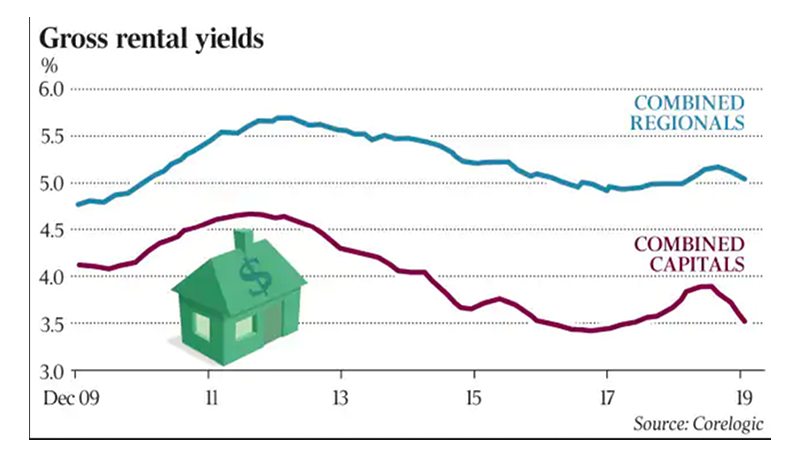
gross rental yeilds 2020

He said continually growing house prices and increased supply in the marketplace had made the 5 per cent yields that were taken for granted in the 1980s and 1990s now unattainable.

“It’s not just prices going up, but there is also a lot more stock on the market,” Mr Bracey said.

“Without a shortage, people now have choices. Therefore, it’s a pressure on yields because people aren’t going to pay as high rents.”

Mr Bracey suggested alternative investment options.

“People are always chasing yield but it’s just not there, certainly not in residential,” he said. “But interestingly enough, commercial real estate is still holding up okay.

“Generally speaking, commercial property prices have held and the yields have held reasonably well. For argument’s sake, in a well diversified commercial property fund, you may be getting 5 per cent or 6 per cent yield.”

Outside of the major cities, the tight rental market of Hobart was one of the strongest in the country, with investors benefiting from relatively affordable property and strong housing demand. Rents grew 6 per cent over the year, while yields rose to 5.1 per cent.

Darwin and Perth also grew to offer returns of 5.9 per cent and 4.3 per cent respectively. Adelaide (4.4 per cent) and Brisbane (4.5 per cent) yields held through 2019.

Independent economist Andrew Wilson said that while investors had been generally sluggish to get back into the market with tight lending acting as a barrier to entry, the fertile economic environment still made residential property a sound investment.

“We have a low yield economy at the moment and I think more investors generally will be looking at property given the potential for capital growth and what remains still a tax positive environment, in terms of those tax policies including negative gearing, tax depreciation to discounts on capital gains. You would expect to see more invested in the market,” Mr Wilson said.


Still have some questions?

If you want to discuss your property portfolio or investment property with one of our planners. Call us to arrange an appointment on 02 9328 0876.


Article by Mackenzie Scott | The Australian

Copyright The Australian – First Published in the Australian 03 January 2020 – https://www.theaustralian.com.au/business/property/sydney-rental-yields-at-new-low/news-story

Mackenzie Scott is a property and general news reporter based in Brisbane. Prior to joining The Australian in 2018, she was the editorial coordinator at NewsMediaWorks, covering media and publishing, and editor at travel and lifestyle website Xplore Sydney.

General Disclaimer: This article contains information that is general in nature. It does not take into account the objectives, financial situation or needs of any particular person. You need to consider your financial situation and needs before making any decisions based on this information. Please seek personal financial advice prior to acting on this information.


Reboot retirement - consider what makes you happy

Rebooting for retirement

Reboot retirement - consider what makes you happy

1. Think mind and body

Without a clear idea of how you’ll spend your time, the initial euphoria of the untouched morning alarm can give way to anything from boredom to panic. Most of your 24 hours may be unstructured, so figure out how you’ll spend it wisely.

You might try something new. Perhaps now is the time to keep bees, join a choir or learn archery. If you have a partner, remember to involve them in the planning. Even if they don’t fancy joining you on a skydive, they may see a chance to learn how to take better action pictures.

Travel is near the top of many wish lists in retirement. If you don’t have the funds for a Caribbean cruise, there are a host of cheaper options around Australia and even beyond. And now you’ll have more time to spend, without worrying about annual leave quotas, or who’ll look after your business while you’re away.

2. Have a purpose

A rest is as good as a change. Although it’s great to have unstructured time to think and dream, boredom can be a damaging state of mind, particularly if it’s prolonged.

If you’re already physically active, this can be a great time to extend yourself, embrace something new like yoga, or aqua aerobics. If you’re healthy but know you could improve, you might sign up for a sponsored cycle ride or walk to help a cause you care about.

3. Catch up on what you’ve missed

Many of us put off expanding our passions while we’re working because we don’t have time.

If you’ve always wanted to read the classics, now might be your chance to explore the jewels of world literature. Reading is brain expanding and inexpensive. Books older than 70 years from the death of the author are out of copyright and therefore cheap in print or even free on your Kindle.

4. Follow your heart, not the herd

Many people downsize coming up to retirement. A smaller property usually means lower utility bills and maintenance.

But it’s not for everyone. If your spare bedroom has the right natural light for your artist’s studio or you just love your lemon trees, you might be better off staying where you are and saving yourself the real estate fees and hassles.

You’re facing a change in life, but you don’t have to change for change’s sake. Put yourself and your loved ones first.

5. Listen to the voice of experience

As with so many things in life, you can learn from experts. Talk to people you know who have already retired, and see what worked for them, and what they wish they’d put in place before they took the plunge.

Consider what will make you happy in the years beyond work, so you can live the life you want. Finally,if you haven’t yet given these things serious thought yet, don’t panic. You’ve dealt with other changes in your life, this is just another one.

Think of it as a new adventure. Let’s face it, you’ve earned it.


Do you have a new adventure in mind?

For more help and strategies on identifying what your retirement plans look like, speak to your financial planner at SFP. Call us to arrange an appointment, contact us on 02 9328 0876.


Article by © AMP Life Limited. First published 10 October 2019

General Disclaimer: This article contains information that is general in nature. It does not take into account the objectives, financial situation or needs of any particular person. You need to consider your financial situation and needs before making any decisions based on this information. Please seek personal financial advice prior to acting on this information.


Improve your financial wellness

7 tips to improve your financial wellness

Improve your financial wellness

This can be measured by the financial wellness index, which measures a person’s satisfaction with their current and future financial situation.

Some days you might feel confident you can meet your needs within the boundaries of your current income, whereas other days you may feel like you don’t have nearly enough funds in order to do so.

The truth is, you’re not alone. Nearly 2.5 million Aussies say they feel moderately to severely financially stressed, even though financial stress has been decreasing year-on-year in Australia.i

Improving your financial wellbeing

On a positive note, research identified that those who have been financially stressed in the past were often able to recover through changes to their behaviour and mindset.ii

Here are some suggestions of things you could do (if you aren’t already) which may help you to improve how you feel financially.

1. Create a budget that works for you

When it comes to creating a budget, try jotting down into three categories – what money is coming in, what cash is required for the mandatory stuff (such as bills), and what dough might be left over (which you may want to put toward existing debts, savings or your social life).

Writing up a budget may take an afternoon out of your diary, but it will help you to more easily identify where there’s room for movement. For instance, could you reduce what you’re spending on luxury items, subscription or streaming services, eating out or clothing?

2. Consider rolling your debts into one

If all the small debts you once had, have multiplied and grown into bigger debts – you could look to roll them into a single loan, and reduce what you pay in fees and interest.

This could help you to save a significant amount of money (depending on what you owe) and make it easier to manage your repayments, as you’ll potentially only need to make one monthly repayment rather than having to juggle several.

The main thing to ensure is you are paying less than what you are currently when it comes to interest rates, fees and charges, and that you’re disciplined about making your repayments.

3. Try to save a bit of money regularly

Even a small amount of cash deposited on a frequent basis could go a long way toward your savings goals, with a separate research report indicating the average savings target for Aussies is a bit over $11,000.iii

Some tips people said helped them along the way was transferring spare funds into an actual savings account, setting up automatic transfers to their savings account (so they didn’t have to move money manually) and putting funds into an account which they couldn’t touch.iv

4. Set aside some emergency cash

With research showing that an emergency fund of between $4,000 and $5,000 is generally enough to cushion most working Aussies when it comes to unexpected expenses, it’s probably worth some thought.v

An emergency stash of cash could give you peace of mind and reduce the need to apply for high-interest borrowing options should you be faced with a busted phone, car tyre, or bad landlord.

5. Be open to talking money with your partner

One in two Aussie couples admit to arguing about money,vi so if you haven’t already, it might be worth sitting down to ensure you’re on the same page and that both parties’ goals are being considered.

6. See if you can get a better deal with your providers

You more than likely have several product and service providers, and figures show you could save more than a grand annually on energy alone just by switching from the highest priced plan to the most competitive on the market.vii

Again, this may take a couple of hours out of your day, but the savings you could potentially make may make a real difference to what you cough up throughout the year.

7. Don’t be afraid to seek financial assistance

If you are struggling to make repayments, you may be able to seek assistance from your providers by claiming financial hardship.

All providers must consider reasonable requests to change their terms in instances where you may be suffering genuine financial difficulties and feel help would enable you to meet your repayments, possibly over a longer period.

Of course it also helps to have an expert on your side and we are here to support you to achieve and maintain financial wellness.


Need a hand with your financial wellness?

For more help and strategies on identifying your feelings on financial wellness, speak to your financial planner at SFP. Or if you don’t have a planner yet let us arrange an appointment, contact us on 02 9328 0876.


i, ii, v AMP’s 2018 Financial Wellness in the Australian Workplace Report, pages 7, 8, 14

iii, iv MoneySmart – How Australians save money infographic

vi Finder – Heated conversations: 1 in 2 Aussie couples argue about finances paragraph 1

vii Mozo – Sick of high energy bills? Aussies willing to change providers could be saving over $1,000 a year paragraph 2

Article by © AMP Life Limited. First published October 2019

General Disclaimer: This article contains information that is general in nature. It does not take into account the objectives, financial situation or needs of any particular person. You need to consider your financial situation and needs before making any decisions based on this information. Please seek personal financial advice prior to acting on this information.

 

Economy review of 2019 and outlook for 2020

Review of 2019, outlook for 2020 – the beat goes on

Economy review of 2019 and outlook for 2020

  • 2020 is likely to see global growth pick up with monetary policy remaining easy. Expect the RBA to cut the cash rate to 0.25% and to undertake quantitative easing.
  • Against this backdrop, share markets are likely to see reasonable but more constrained & volatile returns, and bond yields are likely to back up resulting in good but more modest returns from a diversified mix of assets.
  • The main things to keep an eye on are: the trade wars; the US election; global growth; Chinese growth; and fiscal versus monetary stimulus in Australia.
  • 2019 – growth down, returns up

    Christmas 2018 was not a great one for many investors with an almost 20% slump in US shares from their high in September to their low on Christmas Eve, capping off a year of bad returns from share markets and leading to much trepidation as to what 2019 would hold. But 2019 has turned out to be a good year for investors, defying the gloom of a year ago. In fact, some might see it as perverse – given all the bad news around and the hand wringing about recession, high debt levels, inequality and the rise of populist leaders. Then again that’s often the way markets work – bottoming when everyone is gloomy then climbing a wall of worry. The big global negatives of 2019 were:

    • The trade war and escalating US-China tensions generally. A trade truce and talks collapsed several times leading to a new ratcheting up of tariffs before new talks into year end. 
    • Middle East tensions flared periodically but without a lasting global impact & the Brexit saga dragged on although a near-term hard Brexit looks to have been avoided.
    • Slowing growth in China to 6%. This largely reflected an earlier credit tightening, but the trade war also impacted.
    • Slowing global growth as the trade war depressed investment & combined with an inventory downturn and tougher auto emissions to weigh on manufacturing & profits.
    • Recession obsession with “inverted yield curves” – many saw the growth slowdown as turning into a recession.

    But it wasn’t all negative as the growth slowdown & low inflation saw central banks ease, with the Fed cutting three times and the ECB reinstating quantitative easing. This was the big difference with 2018 which saw monetary tightening.

    Australia also saw growth slow – to below 2% – as the housing construction downturn, weak consumer spending and investment and the drought all weighed. This in turn saw unemployment and underemployment drift up, wages growth remain weak and inflation remain below target. As a result, the RBA was forced to change course and cut interest rates three times from June and to contemplate quantitative easing.The two big surprises in Australia were the re-election of the Coalition Government which provided policy continuity and the rebound in the housing market from mid-year.

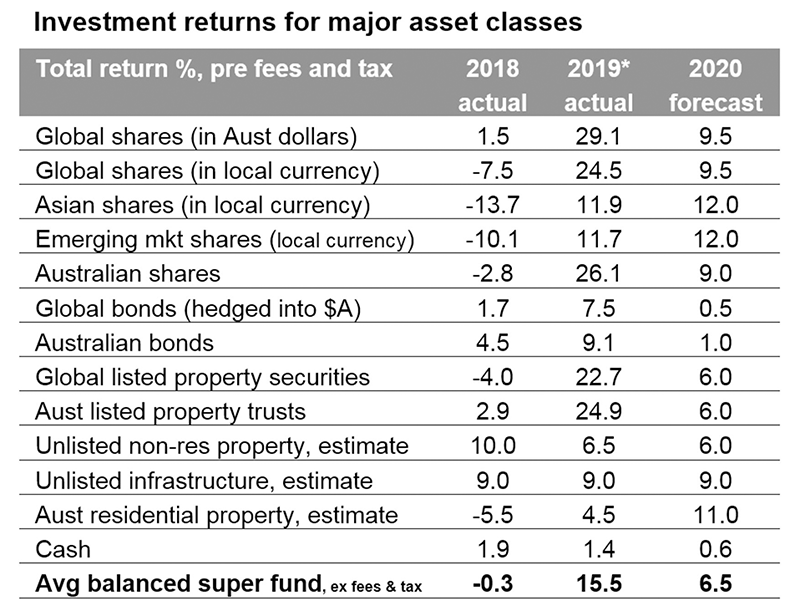
    While much of the news was bad, monetary easing and the prospect it provided for stronger growth ahead combined with the low starting point resulted in strong returns for investors. Investment returns for major asset classes 2019

    *Yr to date to Nov. Source: Thomson Reuters, Morningstar, REIA, AMP Capital

    • Global shares saw strong gains as markets recovered from their 2018 slump, bond yields fell making shares very cheap and monetary conditions eased. This was despite several trade related setbacks along the way. Global share returns were boosted on an unhedged basis because the $A fell.
    • Emerging market shares did well but lagged given their greater exposure to trade and manufacturing and a still rising $US along with political problems in some countries.
    • Australian share prices finally surpassed their 2007 record high thanks to the strong global lead, monetary easing and support for yield sensitive sectors from low bond yields.
    • Government bonds had strong returns as bond yields fell as inflation and growth slowed, central banks cut rates and quantitative easing returned.
    • Real estate investment trusts were strong on the back of lower bonds yields and monetary easing.
    • Unlisted commercial property and infrastructure continued to do well as investors sought their still relatively high yields. However, Australian retail property suffered a correction.
    • Commodity prices rose with oil & iron up but metals down.
    • Australian house prices fell further into mid-year before rebounding as the Federal election removed the threat to negative gearing & the capital gains tax discount, the RBA cut interest rates and the 7% mortgage test was relaxed.
    • Cash and bank term deposit returns were poor reflecting new record low RBA interest rates.
    • The $A fell with a lower interest rates and a strong $US.
    • Reflecting strong gains in most assets, balanced superannuation funds look to have seen strong returns.

    2020 vision – growth up, returns still good

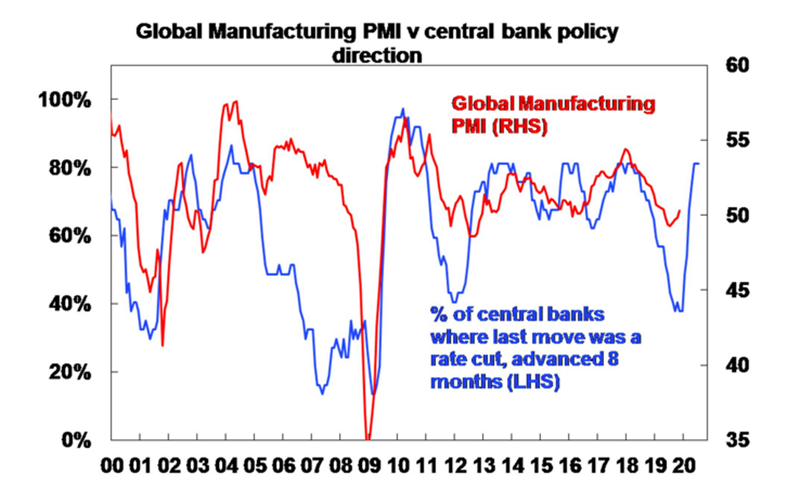
    The global slowdown still looks like the mini slowdowns around 2012 and 2015-16. Business conditions indicators have slowed but remain far from GFC levels. See next chart.

    Global manufacturing PMI vs bank policy direction

    While the slowdown has persisted for longer than we expected – mostly due to President Trump’s escalating trade wars – a global recession remains unlikely, barring a major external shock. The normal excesses that precede recessions like high inflation, rapid growth in debt or excessive investment have not been present in the US and globally. While global monetary conditions tightened in 2018, they remained far from tight and the associated “inversion” in yield curves has been very shallow and brief. And monetary conditions have now turned very easy again with a significant proportion of central banks easing this year. See chart. The big global themes for 2020 are likely to be:

    • A pause in the trade war but geopolitical risk to remain high. The risks remain high on the trade front – with President Trump still ramping up mini tariffs on various countries to sound tough to his base and uncertainty about a deal with China, but he is likely to tone it down through much of 2020 to reduce the risk to the US economy knowing that if he lets it slide into recession and/or unemployment rise he likely won’t get re-elected. A “hard Brexit” is also unlikely albeit risks remain. That said geopolitical risks will remain high given the rise of populism and continuing tensions between the US & China. In particular, the US election will be an increasing focus if a hard-left candidate wins the Democrat nomination.
    • Global growth to stabilise and turn up. Global business conditions PMIs have actually increased over the last few months suggesting that monetary easing may be getting traction. Global growth is likely to average around 3.3% in 2020, up from around 3% in 2019. Overall, this should support reasonable global profit growth.
    • Continuing low inflation and low interest rates. While global growth is likely to pick up it won’t be overly strong and so spare capacity will remain. Which means that inflationary pressure will remain low. In turn this points to continuing easy monetary conditions globally, with some risk that the Fed may have a fourth rate cut.
    • The US dollar is expected to peak and head down. During times of uncertainty and slowing global growth like over the last two years the $US tends to strengthen partly reflecting the lower exposure of the US economy to cyclical sectors like manufacturing and materials. This is likely to reverse in the year ahead as cyclical sectors improve.

    In Australia, strength in infrastructure spending and exports will help keep the economy growing but it’s likely to remain constrained to around 2% by the housing construction downturn, subdued consumer spending and the drought. This is likely to see unemployment drift up, wages growth remain weak and underlying inflation remain below 2%. With the economy remaining well below full employment and the inflation target, the RBA is expected to cut the official cash rate to 0.25% by March, & undertake quantitative easing by mid-year, unless the May budget sees significant fiscal stimulus. Some uptick in growth is likely later in the year as housing construction bottoms, stimulus impacts and stronger global growth helps.

    Implications for investors

    Improved global growth and still easy monetary conditions should drive reasonable investment returns through 2020 but they are likely to be more modest than the double-digit gains of 2019 as the starting point of higher valuations and geopolitical risks are likely to constrain gains & create some volatility:

    • Global shares are expected to see returns around 9.5% helped by better growth and easy monetary policy. 
    • Cyclical, non-US and emerging market shares are likely to outperform, particularly if the US dollar declines and trade threat recedes as we expect.
    • Australian shares are likely to do okay but with returns also constrained to around 9% given sub-par economic & profit growth. Expect the ASX 200 to reach 7000 by end 2019.
    • Low starting point yields and a slight rise in yields through the year are likely to result in low returns from bonds.
    • Unlisted commercial property and infrastructure are likely to continue benefitting from the search for yield but the decline in retail property values will still weigh on property returns.
    • National capital city house prices are expected to see continued strong gains into early 2020 on the back of pent up demand, rate cuts and the fear of missing out. However, poor affordability, the weak economy and still tight lending standards are expected to see the pace of gains slow leaving property prices up 10% for the year as a whole.
    • Cash & bank deposits are likely to provide very poor returns.
    • The $A is likely to fall to around $US0.65 as the RBA eases further but then drift up a bit as global growth improves to end 2019 little changed.

    What to watch?

    The main things to keep an eye on in 2020 are as follows:

    • The US trade wars – we are assuming some sort of de-escalation in the run up to the presidential election, but Trump is Trump and often can’t help but throw grenades.
    • US politics: the Senate is unlikely to remove Trump from office if the House votes to impeach and another shutdown is also unlikely but both could cause volatility as could the US election if a hard-left Democrat gets up (albeit unlikely). 
    • A hard Brexit looks like being avoided but watch UK/EU free trade negotiations through the year.
    • Global growth indicators – like the PMI shown in the chart above need to keep rising.
    • Chinese growth – a continued slowing in China would be a major concern for global growth.
    • Monetary v fiscal stimulus in Australia – significant fiscal stimulus could head off further RBA rate cuts and quantitative easing.
    • Low interest rates – look like they’re here to stay for some time yet, that means low returns for cash.
    • Fixed Interest and Bonds – WILL REMAIN LOW YIELDING FOR INVESTORS IN THE SHORT TO MEDIUM TERM, assets like shares and property, can and will have volatility, these assets usually increase in times of extended low interest. I call it ” There’s no Other Option Theory”, IN SHORT, if you’re only getting approx. 1.5 % on cash and can ride out volatility, there really is no other option..

    Concluding comment

    Over time and studying economics for over 120 years, we’ve seen times like this before and what usually happens; is the rich get richer and the poor get poorer.

    The reason why? the rich can borrow money cheaply and can afford to borrow at low cost. Sadly the poor cannot and are forced to sell assets cheaply. Unfair as this is, it’s our job to use this knowledge to help our clients build wealth.

    Now more than ever it’s important to have an ongoing advice relationship with an experienced Financial Planner. Make sure you’re having your regular review with one of our experienced planners and start taking advantage of the knowledge we have to help build wealth.

    Happy New Year to all our clients and hang onto your hats for yet another interesting investment year.

    Bill Bracey and the SFP team.


    Have you set things up to weather this trend?

    If you need your personal situation reviewed by your SFP Planner or you don’t have a planner yet, get in contact with us on 02 9328 0876.


    Bill Bracey – Principal & Senior Financial Planner | Sydney Financial Planning


    Original article prepared by Dr Shane Oliver. Dr Shane Oliver who provides economic forecasts and analysis of key variables and issues affecting, or likely to affect, all asset markets. He also provides economic forecasts and analysis of key variables and issues affecting, or likely to affect, all asset markets.

    Important note: While every care has been taken in the preparation of this document, AMP Capital Investors Limited (ABN 59 001 777 591, AFSL 232497) and AMP Capital Funds Management Limited (ABN 15 159 557 721, AFSL 426455) make no representations or warranties as to the accuracy or completeness of any statement in it including, without limitation, any forecasts. Past performance is not a reliable indicator of future performance. This document has been prepared for the purpose of providing general information, without taking account of any particular investor’s objectives, financial situation or needs. An investor should, before making any investment decisions, consider the appropriateness of the information in this document, and seek professional advice, having regard to the investor’s objectives, financial situation and needs. This document is solely for the use of the party to whom it is provided.

    General Disclaimer: This article contains information that is general in nature. It does not take into account the objectives, financial situation or needs of any particular person. You need to consider your financial situation and needs before making any decisions based on this information. Please seek personal financial advice prior to acting on this information.

    Financial stress keeping us awake

    Financial stress keeping you awake at night?

    Financial stress keeping us awake

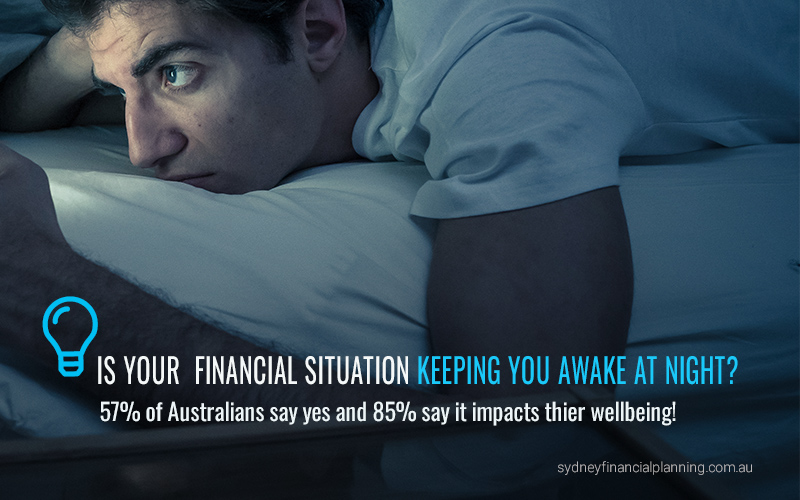
    According to the Financial Fitness Whitepaper, almost 57% of Australians are worried about their current financial situation and 85% say it impacts their wellbeing.1

    Generation Z AKA the iGen

    The youngest generation are most concerned about covering everyday expenses2, such as food and transport. According to the Australian Bureau of Statistics3, the cost of living continues to rise, which just adds to financial woes. Also, research produced by the Financial Planning Association4 notes that the ease of cashless transactions is hindering the youngest generation and those to come.

    Millennials

    Generation Y (millennials) are those who are doing it the toughest when it comes to financial stress. For many millennials, it’s work-related stress that keeps them up at night, as well as fears they won’t have enough money for retirement and pressure associated with property prices.5

    Generation X

    With worries about at least one financial issue at any given time, Generation X are losing sleep over the ability to pay living expenses and what the future holds financially.6

    Baby Boomers

    While many would believe Baby Boomers are the most well-off generation, they are struggling with the stress of health care and insurance bills, as well as retirement savings.2

    What to do

    Everyone suffers from it in some varying degree, but stress is one of the worst things for our health, especially our sleep. Poor sleep can lead to weight issues, poor concentration and productivity, and can create a greater risk of heart disease and stroke. It’s also linked to diabetes, depression and lower immunity. Sleep is important. Don’t let your financial stress affect your quality of life.

    Sorting through your financial stress is just one way you can get better quality sleep. We can help set up a financial plan, find ways to ease the tension and strategise for the future.


    Let us help you get better sleep and ease the stress.

    Speaking with one of our financial advisors is a good place to start. Make a booking or call us on 02 9328 0876 to arrange a meeting.


    1: Mortgagechoice.com.au. (2019). Financial Fitness Whitepaper. Available at: https://www.mortgagechoice.com.au/about-us/insights/financial-fitness-whitepaper-2019/ [Accessed 28 Oct. 2019].
    2: McDowell, E. (2019). Money problems are keeping every generation up at night — check out the biggest financial stressors for every age group. Business Insider Australia. Available at: https://www.businessinsider.com.au/biggest-financial-problems-facing-each-generation-2019-6 [Accessed 28 Oct. 2019].
    3: Abs.gov.au. (2016). Media Release – Inflation continues to be subdued (Media Release). [online] Available at: https://www.abs.gov.au/ausstats/abs@.nsf/lookup/6401.0Media Release1Dec 2016 [Accessed 28 Oct. 2019].
    4: Erem, C. (2018). The ‘invisible-money generation’ may be in financial trouble, says Financial Planning Association. Mozo.com.au. Available at: https://mozo.com.au/debit-cards/articles/the-invisible-money-generation-may-be-in-financial-trouble-says-financial-planning-association [Accessed 28 Oct. 2019].
    5: Banney, A. (2018). Financial stress keeping Australians awake at night. finder.com.au. Available at: https://www.finder.com.au/financial-stress-keeping-australians-awake-at-night [Accessed 28 Oct. 2019].
    6: https://s3.mapmyplan.com.au. (2015). The financial fitness of working Australians. Available at: https://s3.mapmyplan.com.au [Accessed 28 Oct. 2019].

    General Disclaimer: This article contains information that is general in nature. It does not take into account the objectives, financial situation or needs of any particular person. You need to consider your financial situation and needs before making any decisions based on this information. Please seek personal financial advice prior to acting on this information.
     

    Salary Sacrificing

    Everything you need to know about salary sacrificing

    Salary Sacrificing

    “What is salary sacrificing?”

    “Salary sacrificing (also known as salary packaging) is an arrangement between you and your employer, where you can use your pre-tax income to purchase some items or services. Your taxable income is therefore reduced and as a result, so is your tax bill. For many, it’s a win/win situation.1

    There are a lot of rules.

    But there are two key points to remember.

    1. Salary sacrificing depends on your employer and you both must agree on the arrangement.
    2. Arrangements must be made in advance – you cannot sacrifice money that you’ve already been paid.

    What to salary sacrifice for?

    The most common way to use a salary sacrifice arrangement is to boost your superannuation, buy electronics such as laptops and devices, purchase cars and even buy a new home.

    Superannuation – the contributed portion of your income will be taxed at a much lower rate (15% as opposed to 32.5% for an average weekly Australian wage of $1,238.30).2

    Buying a house – salary sacrificing through super is especially beneficial for first-home buyers who are now able to withdraw up to $30,000 plus earnings to purchase their first home. If you don’t use this towards your first home, any salary sacrificed contributions will have to stay in your super until you retire, or you can pay a special tax to access it sooner.3″

    “Purchasing a new car – the most popular way is a novated lease. Your employer takes the repayments and running costs out of your pre-tax income and you get to enjoy the car. Just make sure you’re buying a car within your means.3

    Purchasing devices – there are some rules to keep in mind, including the device must be portable and used primarily for work.4

    Is it worth it?

    Salary sacrificing is a useful tool that can help you achieve your financial goals, as long as you’re smart about it. Don’t purchase something you don’t necessarily need just because of the possible tax breaks. Making these decisions alone can be confusing, which is why it’s always a smart move to discuss your options with the experts: us.

    If you would like more information on salary sacrificing, feel free to get in touch with us anytime.”


    Interested in finding out your options?

    Speaking with one of our financial advisors would be a good place to start. Make a booking or call us on 02 9328 0876 to arrange a meeting.


    1: Australian Government Australian Securities & Investments Commission (2019). Available at: www.moneysmart.gov.au/managing-your-money/income-tax/salary-packaging [Accessed 28 Oct. 2019].
    2. Australian Government, Australian Taxation Office (2019). Salary sacrificing super. Available at: www.ato.gov.au/Individuals/Super/Growing-your-super/Adding-to-your-super/Salary-sacrificing-super [Accessed 28 Oct. 2019].
    3. Wright, P. (2019). A beginner’s guide to salary sacrificing your house, superannuation and car – ABC Life 3 Mar. Available at: www.abc.net.au/life/what-salary-packaging-is-and-how-it-works/10830070 [Accessed 28 Oct. 2019].
    4: Chapman, M. (2016). Five things you didn’t know you could salary sacrifice. Available at: https://www.moneymag.com.au/salary-sacrifice [Accessed 28 Oct. 2019].

    General Disclaimer: This article contains information that is general in nature. It does not take into account the objectives, financial situation or needs of any particular person. You need to consider your financial situation and needs before making any decisions based on this information. Please seek personal financial advice prior to acting on this information.
     

    Boost savings with compound interest

    Boost savings with compound interest

    Boost savings with compound interest

    That’s because you could be missing out on earning compound interest along the way that could make a stark difference to the overall amount you save.

    The difference between simple interest and compound interest

    There are two main types of interest:

    Simple interest is where a one-off interest payment is made at the end of an agreed, set period of time.

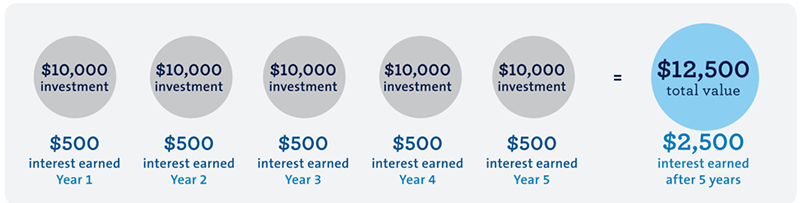
    For example: if you invest $10,000 in a term deposit at 5% interest per annum, and don’t withdraw any money, then you’ll have $12,500 at the end of 5 years. That’s because the 5% annual interest rate is worked out based on the value of the initial investment and paid in full at the end.

    Simple interest earnings over five years

    compound interest diagram 1

    Compound interest is where interest is paid in regular intervals, building on top of earlier interest paid. The result is a snowball effect of interest earning interest.

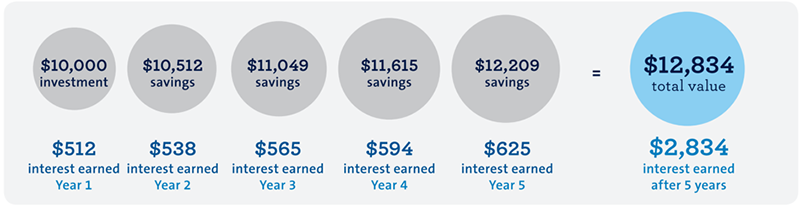
    For example, (using the same figures as the simple interest example above), an initial investment of $10,000, earning 5% interest per annum with compound interest paid monthly, will give you $12,834 after five years. That’s because every month the interest earned was earning more interest.

    Compound interest earnings over five years

    compound interest diagram 2

    Compound interest will continue to build on itself in this way, assuming nothing changes. How quickly it grows will depend on when you start your savings plan, what the interest rate is, and whether you make contributions (or withdrawals).

    Compound interest can help your savings grow faster than simple interest. It’s when interest earned on savings is reinvested, building on top of earlier interest received. The result may lead to a snowball effect of interest earning interest.

    How to work out compound interest on your savings

    The easiest way to work out how much compound interest you could earn on your savings, is to use an online compound interest calculator, that can do it for you.i

    Saving for the future

    If you’re interested in using compound interest to help your savings grow, then the sooner you start, the better. That’s because, like any good snowball, the earlier it starts rolling, the more snow it will collect along the way.

    For example, if you were keen to put aside money for your child’s education, and from the day your child was born, you put $10 per week into a bank account paying 6.25% pa, then by the time they turned 25, their savings would be $31,259. Of that, the interest earned would be $18,372 – outweighing the overall deposits made along the way.*

    If you started saving later, when your child turned 10, with a first deposit of $5,000, then by the time your child turned 25, they would have savings of $25,611. Of that, the interest earned would be about equal to the overall deposits made, and your savings would be about $6,000 less than if you’d started earlier, without an initial deposit.*

    Tax on compound interest

    It’s worth remembering that like any income, compound interest earnings must be declared to the tax office, even if it’s savings for a child.

    Who declares the interest earned, depends on who owns or uses the funds of that account. You can find out more about the tax requirements from the Australian Tax Office.


    Want to know more?

    Do you need some help with your saving plan? book an appointment with one of our planners or contact us on 02 9328 0876.


    Article by © AMP Life Limited.

    Note: * This example uses the ASIC Money Smart Calculator featuring an effective interest rate of 6.43%.i It’s important to remember that a model is not a prediction and uses assumptions. Results are only estimates, the actual amounts may be higher or lower.

    i ASIC Money Smart Compound Interest Calculator – https://www.moneysmart.gov.au/tools-and-resources/calculators-and-apps/compound-interest-calculator

    General Disclaimer: This article contains information that is general in nature. It does not take into account the objectives, financial situation or needs of any particular person. You need to consider your financial situation and needs before making any decisions based on this information. Please seek personal financial advice prior to acting on this information.
    Know your life insurance

    Know where you stand – know your life insurance

    Know your life insurance

    Myth # 1 – Life insurance companies don’t pay claims

    There’s a common perception that life insurance companies will do everything they can to avoid paying claims.
    In fact, 92% of all life insurance claims are paid in the first instance¹.
    As long as you fulfil your duty of disclosure when you apply for cover, and you’re covered for the medical condition you’re claiming for, you can be confident your claim will be paid.

    Myth # 2 – I’m young and don’t have kids or a mortgage, so I don’t need it

    Life insurance isn’t all about providing for debts and dependants. It’s also about looking after yourself.
    Think what would happen if you became ill or disabled and couldn’t work. If you didn’t have income protection, you’d have to find another way to supplement your income – through friends or family. Having income protection means that you are more likely to be able to manage on your own.
    There are benefits to applying for life insurance when you’re young and healthy. It’s generally cheaper and it means you don’t have to worry about getting cover later if your health changes (see myth #3).

    Myth # 3 – I won’t be covered if my health changes

    Once you start your cover, what you are covered under your life insurance for won’t change – even if your health declines.
    In fact, you generally don’t even need to tell your insurer about a change in your health unless you intend to make a claim.

    Myth # 4 – You have to do lots of medical tests to get covered

    Some life insurance products sold through financial advisers require some medical tests before you get covered, but it may be as simple as one blood test and a GP examination.

    • If you have an existing medical condition, you may be asked to provide extra information about your condition and insurers will generally write to your doctor for a report rather than require tests
    • You generally won’t be covered for pre-existing conditions, so it’s important to establish upfront what those pre-existing conditions are. It’s important to answer all questions accurately upfront so any pre-existing conditions can be reviewed by your insurer for any impacts to your cover or ability to obtain cover.
    • That way you know exactly what is and isn’t covered under your policy.

    Myth # 5 – Level premiums don’t go up

    ‘Level premiums’ are designed to save you money over the long term by eliminating the impact of age-based premium increases.

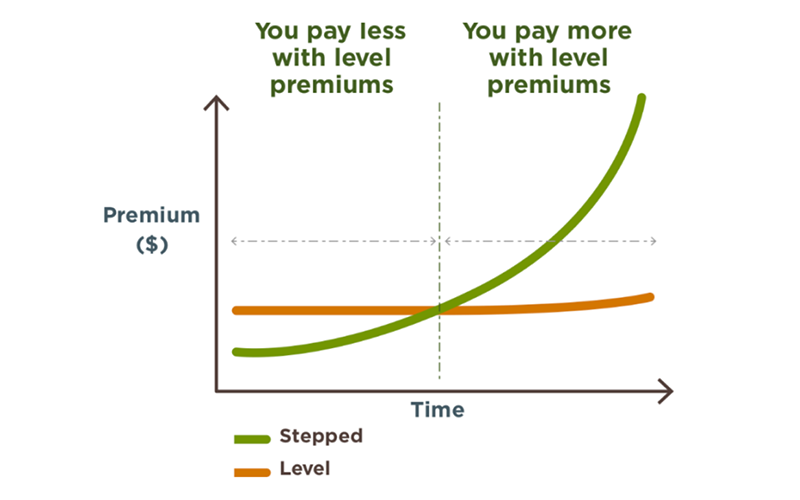
    Level premiums are calculated based on your age when the cover started, not at each anniversary, which means premiums are generally averaged out over a number of years. This means your cover is more expensive than ‘stepped premiums’ at the beginning of your policy, but generally gets cheaper (relative to stepped premiums) as your policy continues.

    It’s important to note that at policy anniversary the premium may still increase (even with level premiums), because age is just one factor that determines your premium. Other factors that impact premium (such as claims trends in Australian population) can result in a repricing of your insurance cover.

    When insurers reprice stepped or level premiums, they don’t do it for an individual policy within a specific group unless they do it for every policy in that group.

    Many life insurers in Australia have repriced level premiums in the past, so it’s important to talk to your financial adviser or your life insurer to understand your policy as well as any repricing activity that’s recently occurred, so you can make an informed decision.

    myth 5

    The above graph is for illustrative purposes only. This graph illustrates age-based premium increases for stepped against level for all covers. This premium comparison has been calculated, assuming all other factors affecting the premiums are excluded.
    Both stepped and level premiums can increase due to factors other than age.

    Myth # 6 – I’ll be stuck paying for cover I don’t need

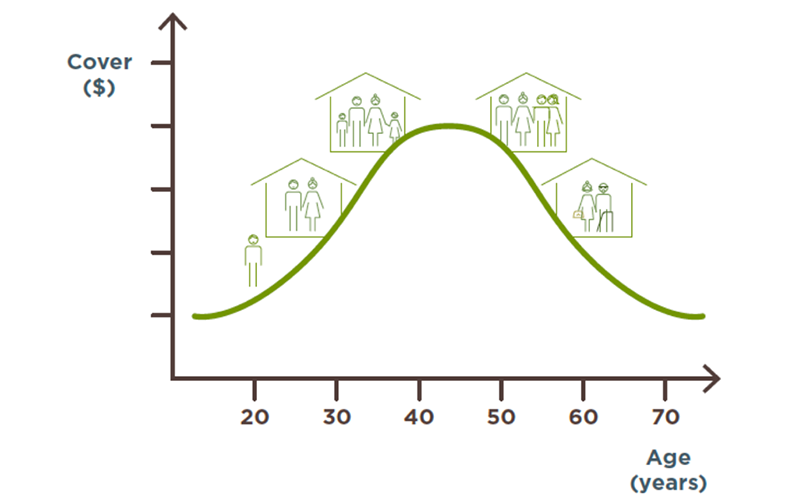
    Life insurance is designed to change as your life changes, as your cover needs can vary significantly over your lifetime.

    An example may be when taking out life insurance when getting married. You may want to increase your cover if you have children or increase your mortgage. But similarly you may want to reduce your cover if your children have grown up or you’ve paid down your debts.
    Your financial adviser can help you work out how much cover you need at any given time, to make sure you’re not paying for any cover you don’t need.

    myth 6

    Myth # 7 – The cover in my super is enough

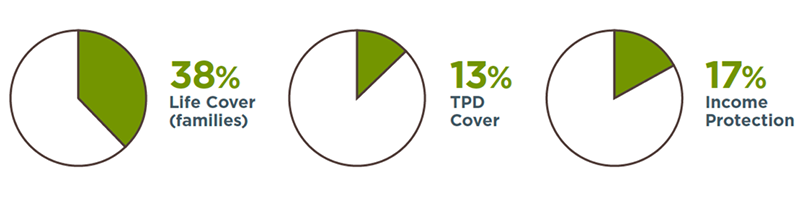
    Over 70% of Australian life insurance policies – more than 13.5 million separate policies – are held through superannuation funds*.

    While this cover is great to have, many of these policies only provide the minimum level of cover employers have to offer, which isn’t enough for most people.

    In fact, Rice Warner* estimates that the median level of cover in superannuation meets is only 60% of needs for life cover (or just 38% for families with children), 13% for TPD cover and 17% for income protection.[Insert Image]

    myth 7

    Myth # 8 – I’ll be covered by workers’ compensation

    Workers’ compensation provides some protection for work-related accidents or injuries.

    But it doesn’t cover most illnesses, nor does it cover anything that happens to you when you’re not at work. It’s worth checking your states workers compensation legislation.

    Even if you are covered by workers compensation, the benefits are typically capped in terms of the amount and duration of payments, which means the cover could fall well short of what you really need.

    Myth # 9 – Only the main breadwinner needs life insurance

    There’s no doubt insuring the breadwinner is vital for any family’s financial security.

    But if a non-working or lower income-earning partner became seriously ill or injured, their family would need a lot of assistance to replace their services within the home.

    Imagine a breadwinner had to reduce their working hours to look after their partner or young children, or employ outside help.

    Either option could prove very expensive, which is why both members of a couple should consider the various life insurance cover options available – regardless of their role.


    Want to know more?

    If you’d like to discuss any aspects covered and how it may apply to you, book an appointment with one of our planners or contact us on 02 9328 0876.


    Article by – Canstar | © Copyright 2019 CANSTAR Pty Limited

    General Disclaimer: This article contains information that is general in nature. It does not take into account the objectives, financial situation or needs of any particular person. You need to consider your financial situation and needs before making any decisions based on this information. Please seek personal financial advice prior to acting on this information.


    Australian's are a generous nation

    Australia is a generous nation

    Australian's are a generous nation

    Australia is a generous nation. We love to give gifts. It brings us joy.

    When we spend, we go big: $19.8 billion AUD is spent on gifts by Australians each year, or an average of $100 each month ($1,200 per year).

    That’s more than buying a $4 coffee every weekday, getting our shirts dry cleaned daily, or what we spend, on average, on mobile phone plans. Gen Y spend more on gifts than any other generation: $130 each month ($1,560 per year).

    Here’s what the average Australian adult spends on gifts for loved ones each year:

    • $437 for our spouse or partner,
    • $361 for each of our children,
    • $201 per parent, and
    • $115 for our pet.

    Women are more generous towards their spouses or partners than men ($454/ year compared to $419/year), but men are spending $22 more per month on gifts than women in general.

    Younger adults spend more than older adults (see table). Almost $20 billion spent on gifts each year


      Gen Z
    (18-24)
    Gen Y
    (25-39)
    Gen X
    (40-54)
    Boomers
    (55-73)
    Average gift spending per month $91 $130 $87 $89


    We find joy in giving

    Experts in psychology generally agree that the altruistic act of giving has neural and emotional benefits. These range from elevated activity in regions of the brain associated with pleasure, social connection, and trust, all the way through to lowering blood pressure and stress levels.

    So it’s a good thing most of us find joy in giving. Most Australians (85%) say they get more joy giving gifts to others than in receiving gifts themselves.

    Females find particular joy in giving (88% find greater joy in giving than receiving, compared to 83% of males).

    Older Australians gain the greatest joy: 90% of Baby Boomers say they get more joy in giving than receiving, as do 84% of Gen X, 84% of Gen Y and 78% of Gen Z.

    Gifts for our Pets

    74% of Australian pet owners buy gifts for their pet.

    Those who do spend an average of $115/year on gifts for their pet.  Pushing the average higher are Gen Ys who spend $121/year and Gen X who spend $142/year.

    Generous to a fault

    73% of Australian’s don’t budget for gifts!

    Disturbingly, a significant proportion of the $19.8 billion spent on gifts each year in Australia is not accounted for in household budgets. In fact, three in four of us (73%) do not have a budget allocation for gifts. Men are less likely than women to allocate a budget towards gift-giving (24% men cf. 31% women).
    Those least likely to budget for gifts are older families, couples and older singles, of whom 79% don’t have a budget allocation for gifts.

    Surprisingly, the vast majority of us are happy with the amount we spend on gifts. Just one in eight of us (13%) feel we spend too much on gifts, while most of us (81%) feel we spend about the right amount.

    The discrepancy between a high unplanned household spend and a satisfaction with that spend indicates an opportunity to improve our financial literacy and awareness of the benefits of budgeting, planning, and giving in a way that brings joy without debt or regret.

    How do we decide how much to spend?

    If we don’t budget or plan for gifts, how do we decide how much to spend?

    The top three decision-drivers that inform how much we choose to spend on a gift are:

    1. How close we are to the recipient (59% selected this)
    2. How special the occasion is (58%); and
    3. Our budget at the time (55%).

    The FPA “Gifts that Give” national survey of Australians reveals some truly fascinating insights into how we think, buy, plan and spend our money on those we love the most. Did you know Australia is a generous generation and spends nearly $20 billion a year on gifts? This 19-page report is a fascinating read and a great conversation starter with friends and families.

    Download the Goodness of Giving eBook.

    Download the full report – Gifts that Give.


    Does the report findings raise some questions on your gift-giving budgeting?

    Why not arrange to meet with one of our planners to do a budget review. Make a booking or call us on 02 9328 0876 to arrange a meeting.


    1 Assuming drycleaning fee of $15 for five shirts, 52 weeks per year. Australians spend an average of $77/month on mobile phone plans, according to Canstar Blue research.

    Aricle by FPA Gifts that Give Research Report

    General Disclaimer: This article contains information that is general in nature. It does not take into account the objectives, financial situation or needs of any particular person. You need to consider your financial situation and needs before making any decisions based on this information. Please seek personal financial advice prior to acting on this information.
     

    Record Low Interest rates

    Making the most of record-low interest rates

    Record Low Interest rates

    However, the low cash rate also means your money in the bank could be earning less interest.

    Why did the RBA cut rates?

    Rate cuts are a way for the RBA to help stimulate the economy. The idea is, when the RBA lowers the official cash rate, banks may follow suit and lower interest rates on the loans they provide. When rates are lower, you pay less interest on your debt, freeing up money for you to spend elsewhere. You may also be more likely to borrow more money. This increased spending has a ripple effect through the economy, giving it a boost.

    The RBA’s recent rate cut was due to concerns about the way the economy has been slowing down. In Australia, the downturn in the housing market as well as the drought have both played a role in the slowdown. Globally, fears about the US trade wars has led investors around the world to be more cautious.

    It’s important to note that when the RBA cuts the official rate, there’s no guarantee that the banks will do the same. For example, in recent times, some banks have only passed on part of the rate cut.

    Will interest rates stay low?

    Head of Investment Strategy and Economics and Chief Economist of AMP Capital Dr Shane Oliver says rate cuts are “…a bit like cockroaches”, adding, “If you see one there is normally another nearby.”1 He believes further rate cuts are on the cards for this year and next, which could see this low interest-rate environment lingering for some time.

    What could low interest rates mean for me?

    When it comes to interest rate cuts, there is good news and bad news, depending on your financial goals. With that in mind, it’s worth thinking about whether you need to make any changes to stay on track. Find out what low rates could mean for four common financial goals:

    1. Paying off debt

    If you have a variable rate loan, a rate cut can work in your favour, provided your lender passes on the cut.

    The major banks lowered their interest rates on variable loans, either partially or in full, following the June 2019 rate cut. That means those with variable loans may now enjoy lower interest repayments. Fixed-rate loans won’t change, as the rate has been locked in for an agreed time period.

    If you have a variable rate loan, the low interest-rate environment can provide a good opportunity to start clearing debt. One strategy to consider is to keep your loan repayments the same despite the rate cut, so that you pay off more of your loan, faster. Or, you may consider using the money that you save on repayments to invest elsewhere to help grow your wealth.

    It generally makes sense to pay off bad debt first (ie debt used to pay for day-to-day expenses like credit card debt that you do not get a tax deduction for in your tax return, rather than debt used to pay for an income-generating asset like an investment property). It also is usually a good idea to start with the debt with the highest interest rate first.

    If you have a fixed-rate loan, it may be a good time to crunch the numbers to see if refinancing is worthwhile to take advantage of the lower rates on offer. In addition to calculating how much money you could save on repayments, it’s important to factor in the break costs associated with the current loan, as well as any set-up fees associated with the new loan. It’s important to consider your particular circumstances and goals before deciding what’s right for you, so financial advice may help.

    2. Buying a property

    If you’re in the market to buy a property, a reduction in interest will probably be welcome news. That’s because lower rates will influence how much you can borrow and how much you can afford to repay on your loan.

    While it may be tempting to borrow more, keep in mind that interest rates will eventually increase and so will your repayments. It’s a good idea to check whether you can afford the home loan if rates were to go up.

    3. Increasing your savings

    A low-rate environment is generally bad news for savers with cash in the bank. With interest rates at record lows, the rates earned by some bank deposits are at their lowest level since the mid-1950s, prompting some investors to consider whether their money could be working harder for them elsewhere.

    With little interest to be earned by keeping money in the bank, alternative options such as income-generating shares that pay attractive dividends may be worth a look.

    Before making any changes, it’s important to understand the risks involved. Shares, for example, are much riskier than keeping money in the bank. But they do offer the potential for much higher returns than a cash deposit.

    Other options which may help your money to work harder for you include managed funds or property. Again, these investments carry more risk and can tie-up your cash for a period of time. Also be sure to understand any fees involved.

    We can help you find suitable options.

    4. Growing your super

    The recent interest rate cut is a timely reminder to review how your superannuation is invested. With earnings from cash deposits at record lows, it’s a good idea to check what portion of your super is invested in cash. Consider whether the amount of super you have in cash is still appropriate given the level of risk you’re comfortable with and the time you have left until you retire.

    Ultimately it comes down to what’s important to you, what stage you’re at in life and how much risk you’re willing to take on for potentially higher returns. If retirement is still a while away, you may consider taking on riskier, higher growth investment options like shares or property that have the potential to help grow your super balance over time. However, if you’re retiring soon, you may not be as willing to take on too much risk, as preserving your super balance may be a higher priority. Regular reviews of your super investments can help you to make sure you’re still on track to a comfortable retirement.

    We can help you make the most of this low interest-rate environment and stay on target to reach your goals.


    Did you know about SFP’s new Finance service?

    Why not arrange to meet with Leigh Morris our Senior Credit Advisor to review your current situation. Make a booking or call us on 02 9328 0876 to arrange a meeting.


    Aricle by – AMP Life Limited.

    General Disclaimer: This article contains information that is general in nature. It does not take into account the objectives, financial situation or needs of any particular person. You need to consider your financial situation and needs before making any decisions based on this information. Please seek personal financial advice prior to acting on this information.


    4 Gift-Giving Personalities

    Australia’s four gift-giving personalities

    4 Gift-Giving Personalities

    The FPA created a Gift-Giver Personality Quiz to help people identify their own gift-giving preferences, and those of others within their social networks.


    Heartfelt Gift-Giving

    Heartfelt Givers

    • Spend $103/per month on gifts
    • Least likely to bulk buy gifts (29%)
    • More likely to be female (57%)
    • Most likely to value the gift of seeing a financial planner (64%)


    Practical Gift-Giving

    Practical Givers

    • Spend $104/month on gifts
    • Most likely to budget for gifts (40%)
    • Highly value the gift of seeing a financial planner (60%)
    • Most likely to be older (66% are Gen X or Baby Boomers)


    Impulsive Gift-Giving

    Impulsive Givers

    • Spend the most on gifts at $112/month
    • More likely to be female (61%)
    • Least likely to budget for gifts (24%)
    • Highly likely to value the gift of seeing a financial planner (61%)


    Simple Gift-Giving

    Simple Givers

    • Spend the least on gifts at $85/month
    • Least likely to value the gift of seeing a financial planner (53%)
    • Unlikely to budget for gifts (25%)
    • Prefer to give cash or an easy gift such as wine or chocolate


    Discover your gift-giving personality

    Take FPA Gift-Giver Personality Quiz and discover detailed personality profiles with fascinating insights about buying behaviours, preferences and habits.

    The FPA “Gifts that Give” national survey of Australians reveals some truly fascinating insights into how we think, buy, plan and spend our money on those we love the most. Did you know Australia is a generous generation and spends nearly $20 billion a year on gifts? This 19-page report is a fascinating read and a great conversation starter with friends and families.

    Download the Goodness of Giving eBook.

    Download the full report – Gifts that Give.


    Would you like some help with reviewing your financial behaviour?

    Why not book a meeting with one of our finanical planners to review your saving and spending goals. Make a booking or call us on 02 9328 0876 to arrange a meeting.


    Aricle by FPA Gifts that Give Research Report & Money & Life

    General Disclaimer: This article contains information that is general in nature. It does not take into account the objectives, financial situation or needs of any particular person. You need to consider your financial situation and needs before making any decisions based on this information. Please seek personal financial advice prior to acting on this information.

     

    Why recession in Australia is unlikely

    Nine reasons why recession remains unlikely in Australia

    Why recession in Australia is unlikely

  • However, while the risks have gone up, recession remains unlikely: tax cuts should help growth in the current half year; the threat from falling property prices has receded; infrastructure spending is booming; the low $A is helping growth; the drag from falling mining investment is over; the current account is in surplus; there is scope for extra fiscal stimulus; population growth remains strong; and cyclical spending is low.
  • Introduction

    Australian economic growth has slowed to the weakest since the GFC. Talk of recession remains all the rage. And economists don’t have a great track record in predicting recessions globally – with an IMF study finding that of 153 recessions seen in 63 countries around the world between 1992 and 2014, economic forecasters only predicted five in April of the year before they started – so why should they pick one this time? As someone who forecast two of the last one recessions in Australia I am a bit wary. Perhaps the best way to predict recessions would be to forecast one every year and then you would have a perfect track record in predicting them! Some actually do this. But they are totally useless because they miss out on the 90% or so of the time that countries are not in recession and the positive lead this provides for share markets and other growth assets.

    Recessions come along when there is a shock to the system (usually high interest rates), invariably at a time when the economy is vulnerable after a period of excess (such as rapid growth in spending, debt or inflation). The shock causes a loss of confidence, lots of little spending decisions are delayed and excesses are unwound. But given the natural tendency of most economies to grow given population growth and new innovations, increasing economic diversity, counter cyclical economic policies and the rise of the more stable services sector recessions are relatively rare at around 10-12% of the time globally. In Australia the last one was 28 years ago.

    Why there has been no recession for 28 years

    The absence of an Australian recession – whether defined by two quarterly GDP contractions in a row or negative annual growth – for 28 years is instructive. Many forecast recessions at the time of the 1997-98 Asian crisis, 2000-2002 tech wreck, the GFC and from around 2012 as the mining investment boom ended. But it didn’t happen. There are seven reasons why:

    • economic reforms made the economy more flexible;
    • the floating of the $A has seen it fall whenever there is a major economic problem providing a shock absorber;
    • desynchronised cycles across industry sectors;
    • strong growth in China that helped through the GFC;
    • strong population growth; 
    • counter cyclical economic policy – like stimulus payments and monetary easing that helped in the GFC; and
    • good luck – which can never be ignored lest hubris set in!

    But is our luck running out?

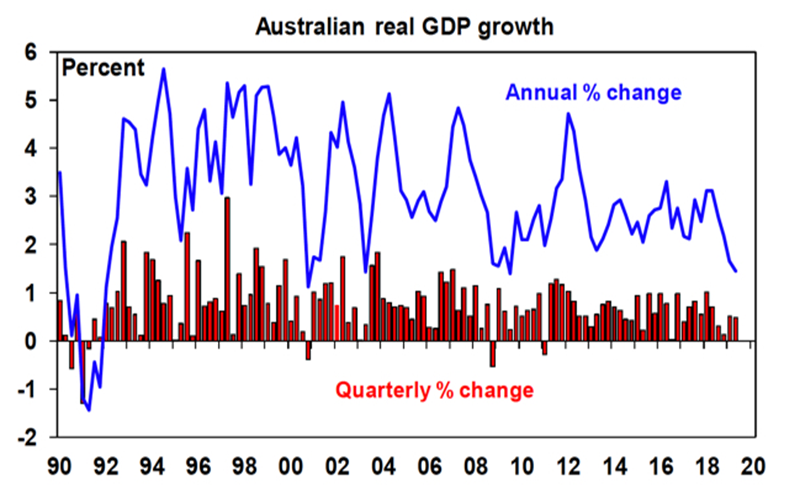
    June quarter GDP growth was just 0.5%. And annual growth has fallen to 1.4% which is the slowest since the GFC and below population growth of 1.6%. Housing and business investment fell, and consumer spending remains very weak. Were it not for public spending and net exports the economy would have gone backwards in the June quarter.

    Real Australian GDP Growth

    Source: ABS, AMP Capital

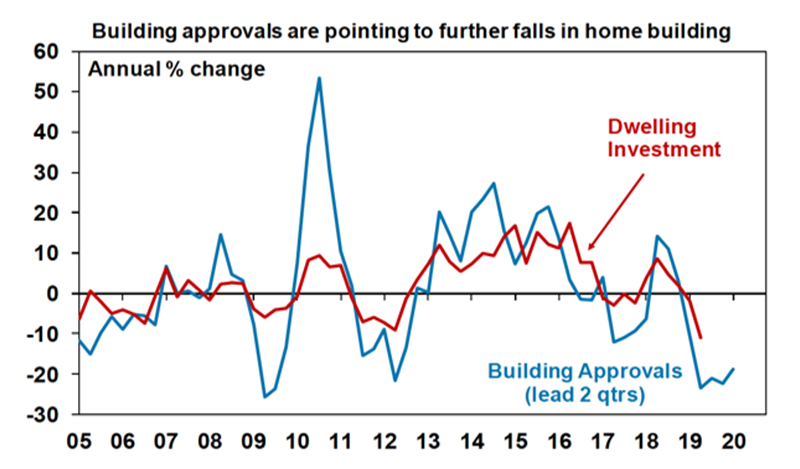
    Going forward, the housing downturn has further to run with building approvals pointing to a further fall in home building.

    Australian building approvals

    Source: ABS, AMP Capital

    This is likely to amount to a 0.5-0.6 percentage point pa direct detraction from growth. This along with low property turnover (less people moving) and lagged negative wealth effects from the earlier fall in house prices will all act as drags on consumer spending. In total the housing downturn is likely to detract around 1-1.2 percentage points from growth in the year ahead.

    The drought will likely also act as an ongoing drag on growth with a “mild” El Nino hanging around although this may be modest at around a 0.2 percentage point growth detraction. The threats to global growth from trade wars also suggests downside risks to export growth.
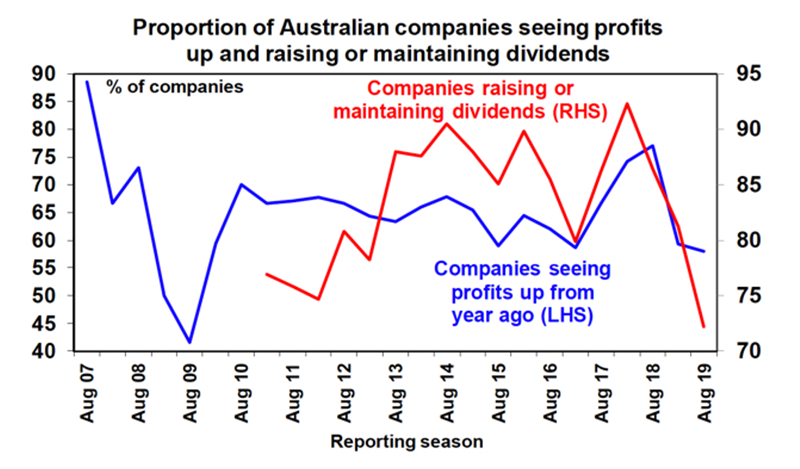
    The weakness in relation to the economy is clearly evident in soft profit results in the recent June half year profit reporting season. The ratio of upside surprise to downside was the weakest since 2009, only 58% of companies saw profits rise from a year ago and the proportion of companies raising or maintaining their dividends fell to the lowest since 2011 suggesting a lack of confidence. Earnings growth slowed to 1.3% and excluding resources stocks was around -2.4%.

    Australian companies seeing profit

    Source: AMP Capital

    Slow growth but probably not recession

    Since last year our view has been less upbeat on growth than the consensus and notably the RBA. This remains the case as the housing construction cycle turns down and weighs on consumer spending. As a result, it’s hard to see much progress in reducing high combined levels of unemployment and underemployment, and hence wages growth and inflation are likely to remain low. But there remains a bunch of positives that should help the economy avoid a recession even though growth will remain weak for a while yet. Here are nine.

    1. Rate cuts and tax cuts should provide some growth boost – while July retail sales were disappointing, the experience from the GFC stimulus payments is that the tax cuts will provide some lift to growth in the months ahead and various retailers have expressed optimism about this recently.
    2. The threat of crashing property prices looks to be receding – while it’s so far been on low volumes, buyer interest has returned to the Sydney and Melbourne markets and we never saw the much-feared surge in non-performing loans or forced selling. This has helped remove the threat of a debilitating negative wealth effect on consumer spending.
    3. Infrastructure spending is booming – recent state budgets saw the projected peak in infrastructure spending pushed out yet another year to 2020. And it’s likely states will seek to take even greater advantage of ultra-low long-term borrowing costs to further push out the peak in infrastructure spending.
    4. The low $A is helping to support the economy – the $A is down 39% from its 2011 high and is likely to fall further and this provides a boost to Australian businesses that compete internationally by making them more competitive.

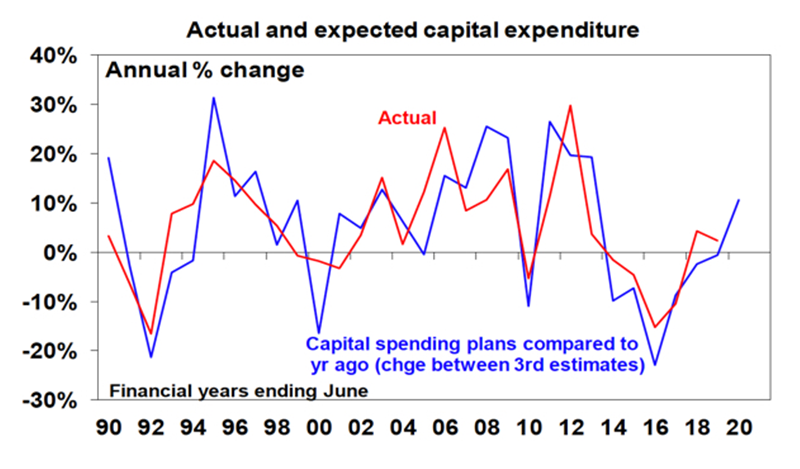
    Actual expected capital expenditure

    Source: ABS, AMP Capital

    1. The business investment outlook is slowly improving – the big drag on growth as mining investment fell back to more normal levels as a share of GDP is over and mining investment plans are rising. This is driving some pick-up in the outlook for overall business investment.

    1. Australia has a current account surplus – the June quarter saw the first current account surplus since 1975. The slide since then in iron ore and coal prices suggests it may not be sustained, but the reasons for the improvement are more than just commodity prices so the deficit is likely to be well below the norm of recent decades going forward. What’s more there has been a significant improvement in our foreign liabilities with a less short-term debt and a growing net equity position. This all means that our reliance on foreign capital inflow has declined. So much for the boiling frog!
    2. There is scope for extra fiscal stimulus – the Federal budget is nearly back in surplus and while we have had a long run of deficits our public finances are in good shape compared to the US, Europe and Japan. As a result, there is scope to provide more fiscal stimulus and this is probably more important than a narrow focus on the surplus.
    3. Population growth remains strong – Australia’s population growth at around 1.6% pa remains strong. Of course, strong population growth is not without issues and in terms of living standards it is economic growth per person (or per capita) that matters. But solid population growth also has significant benefits in terms of supporting demand growth, preventing lingering oversupply and keeping the economy dynamic. 

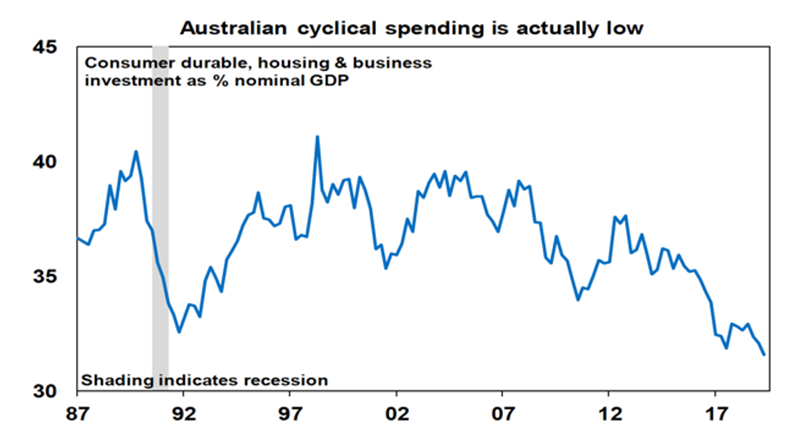
    1. Finally, cyclical spending (consumer durables, housing and business investment) as a share of GDP remains low – suggesting that apart from bits of the housing market there’s not a lot of excess in the economy that needs to be unwound.

    Australian cyclical spending low

    Source: Bloomberg, ABS, AMP Capital

    Concluding comment

    Our assessment remains that growth will remain soft and that the RBA will have to provide more stimulus – by taking the cash rate to around 0.5% and possibly consider unconventional monetary policy like quantitative easing. Ideally the latter should be combined with fiscal stimulus which would be fairer and more effective. While Australian growth is going through a rough patch with likely further to go, recession remains unlikely barring a significant global downturn.


    Have you set things up to weather this trend?

    If you need your personal situation reviewed by your SFP Planner or you don’t have a planner yet, get in contact with us on 02 9328 0876.


    Bill Bracey – Principal & Senior Financial Planner | Sydney Financial Planning


    This article was prepared by Dr Shane Oliver. Dr Shane Oliver who provides economic forecasts and analysis of key variables and issues affecting, or likely to affect, all asset markets. He also provides economic forecasts and analysis of key variables and issues affecting, or likely to affect, all asset markets.

    Important note: While every care has been taken in the preparation of this document, AMP Capital Investors Limited (ABN 59 001 777 591, AFSL 232497) and AMP Capital Funds Management Limited (ABN 15 159 557 721, AFSL 426455) make no representations or warranties as to the accuracy or completeness of any statement in it including, without limitation, any forecasts. Past performance is not a reliable indicator of future performance. This document has been prepared for the purpose of providing general information, without taking account of any particular investor’s objectives, financial situation or needs. An investor should, before making any investment decisions, consider the appropriateness of the information in this document, and seek professional advice, having regard to the investor’s objectives, financial situation and needs. This document is solely for the use of the party to whom it is provided.

    This article contains information that is general in nature. It does not take into account the objectives, financial situation or needs of any particular person. You need to consider your financial situation and needs before making any decisions based on this information.