Tag: Financial Advice

Re-designing your life

The Change – Staying on track after a Divorce

Re-designing your life

You firstly call your best friends for help and guidance. They give you some practical and emotional support, but most are not suited to help you.

After digesting the initial shock, in the next stage people go into self-preservation mode. It’s all about priorities here. My best advice is – see your financial planner. Their objective point of view will help you sort out your priorities in the order of – your children, yourself and your ex-partner.

‘Although I’m a financial planner myself, it wasn’t by accident that, I’ve had my own personal planner to ask for guidance and to assist me see things less emotionally ’.

The solutions are not always straight forward of course. One partner may gain a major asset like the family home but struggle to meet everyday costs because of the drop in household income. Conversely, separating finances may mean one partner taking on more debt to buy another house or car. Being the main determinant of building personal wealth and independence, the tremor of changes in your income may also affect the long term ability to meet life goals and aspirations.

Where there are children, considerations like meeting their future education needs, health care and other expenses, as well as the cost of holidays, excursions and visits to either parent or grandparents, all have to be discussed and agreed on.

Looking ahead

It’s true that the challenges may be considerable but with these challenges comes the opportunity to plan for a different future, a new future. Many people easily fall into the emotional trap of prolonged legal arguments and courts. The general rule here is – only go to a court if someone takes you. Initiating long and emotional court battles can cost you hundreds of thousands of dollars and years of your life you never get back. This is the time to build your new life, not lose whatever you have left.

Wills and estate plans may also have to be re-thought and re-written, while a review of the ownership of life insurance policies is essential. Property settlement might sound as though it just involves the house, but it also covers everything from investments, superannuation and trusts, right through to cars and companies.

With the best intentions you may think, “Don’t we just take half each?”, but the complexities of both life and the law mean that it may not be that simple, and you normally require the expertise of financial and legal professionals, working together to reach a clear understanding of the way forward.

By sitting down and talking with your financial planner you can tap into their experience. This will provide you with real support when the emotional challenges you face may be complex, and your life is taking a new direction.

blog content ybi helen 4

After meeting Helen from Your Best Interests TV show and, during filming of her story, I felt very privileged to be able to help her move on, so she could start to build a new wonderful life. Prior to meeting me, she was stuck in purgatory, neither going forward or backwards. Now she’s looking forward to the rest of her life, and feels she is in control of her life again. When I watched the first cut, I quietly sat with my wife. Then I cried. Not because my first TV performance was so bad. Rather because I felt proud to be a positive catalyst in the lives of this mother and her daughter.


Still have some questions?

If you want to discuss rebuilding your live after a life change such as divorce it pays to seek some professional advice. Call us to arrange an appointment with one of our advisors on 02 9328 0876.


Article by Bill Bracey | Principal & Senior Financial Planner

General Disclaimer: This article contains information that is general in nature. It does not take into account the objectives, financial situation or needs of any particular person. You need to consider your financial situation and needs before making any decisions based on this information. Please seek personal financial advice prior to acting on this information.

Re-designing lives for the better

We’re all about re-designing lives for better

Re-designing lives for the better

Your Best Interests (www.yourbestinterests.com.au) is about financial advice and the difference it makes to the lives of everyday Australians.

Sharing the real life stories of single Mum, Helen and her teenage daughter, Lauren and young widower, Lisa; Your Best Interests is a TV series that explores the real life challenges, concerns, hopes and dreams of these women as they come to terms with their very different life circumstances.

Helen’s Story

When Helen divorced, it was her teenage daughter, Lauren that urged her to seek financial help. Alone, with a home that needed renovating, a daughter to support and desire to travel, Helen couldn’t imagine how she’d ever be able to live the life she wanted. Watch how with the help of a professional financial adviser, she managed to change that with realistic plans for a future she didn’t think possible.

Your Best Interest - Helen

Working with Bill Bracey as their financial adviser, Helen and Lauren embark on a journey of discovery as they come to learn more about their personal priorities, managing money, new options and opportunities that open up as they re-build their lives and take control of their financial wellbeing.

Your Best Interest - Helen and Lauren

The program is produced by the Association of Financial Advisers (AFA), Australia’s oldest association representing financial advisers, who believe that great advice is in the best interests of more Australians.The show will screen on Channel 4Me (74) AND on the Business and Finance section of the 4Me website next Tuesday 30 June at 8pm AEST.

Also check out the link to the promo video – https://vimeo.com/album/3441676/video/130820167


Do you have some bigger goals you want to plan for?

It can really help to create a financial roadmap with the help of a professional. Why not call us to arrange an appointment on 02 9328 0876.


General Disclaimer: This article contains information that is general in nature. It does not take into account the objectives, financial situation or needs of any particular person. You need to consider your financial situation and needs before making any decisions based on this information. Please seek personal financial advice prior to acting on this information.

When is the right time to retire well?

Living retirement well: Living life on your own terms

When is the right time to retire well?

This is not to say that the initial adjustment to your new life stage won’t come with its challenges, most will go through stages of disorientation and disenchantment and experience a wide range of emotions and that’s normal. I encourage you to look for healthy ways to deal with those feelings. Do more of what you enjoy, keep the body moving, walk regularly, read, write, draw or paint, tap into your creative side. Talking with others who have already retired can be a big help also.

What’s the hardest part of retirement?

When I asked some of my clients what was the hardest part of retirement, for some it was coming to terms with budgeting tighter and the limited chance of making money compared with working life. For others it was a feeling of loss of purpose in their new life stage. Again, this is normal, and they went on to explain that this feeling passes as they replace their previous routines and colleagues with new pastimes and friends.

What’s the best part of retirement?

My clients have shared that the best part of retirement is the newfound freedom to pursue personal interests, spend more time with loved ones, and enjoy a slower pace of life. They also said it’s a time to focus on health and hobbies, build stronger relationships with family and friends (even making new ones), and to fulfill long-held bucket list dreams such as travel.

When’s the right time?

When we’re goal setting, we ask people at what age do they see or would like to see themselves retired.

Some say tomorrow, others say 60 or 65 and we set the target date to aspire towards. We then start putting in place strategies to ensure we have sufficient funds to achieve this goal. We come around to our 60 or 65th birthday and quite often we’re still enjoying our work, our health is good, and we aren’t ready to retire yet. This happens often.

Over the years I’ve observed the reality is retirement is a state of mind and reaching an age or date is not the trigger for entering the next stage of life. From what I’ve detected, the biggest determinant for retirement and readiness for change is the reducing capacity to tolerate living life on someone else’s terms. Some might say their “bulldust meter” is full, others have experienced close friends of family’s health suffer and this brings things into perspective and priorities change. Either way, when you know
you know.

Any regrets?

I asked some of my clients if they felt they retired at the right time. Most said yes, as we had discussed this at length many times in the lead up to prepare ourselves as best we can.A small number have returned to work (in a slower paced environment) as they crave the sense of purpose that work can bring, but most often than not, most people are happy with their decision.

Reach out to your financial planner if you’d like to chat further about these insights and retiring well.


Article by Gary Winwood-Smith
Senior Financial Planner | Director


Are you confident your retirement plan will support the life you want?

Talk to us about retirement strategies that provide freedom and peace of mind. Call 02 9328 0876 to arrange a meeting.


General Disclaimer: This article contains information that is general in nature. It does not take into account the objectives, financial situation or needs of any particular person. You need to consider your financial situation and needs before making any decisions based on this information. Please seek personal financial advice prior to acting on this information.


Is Investing a gift to your future self?

Investing in your future: Why it matters

Is Investing  a gift to your future self?

As a financial planner, I’ve seen time and again how early, consistent investing can transform lives. Let’s delve into the motivations behind investing, the benefits for your future self, and the peace of mind it brings to your current self.

Motivations for investing

Investing is more than just a financial strategy; it’s a commitment to your future.

Financial Independence: One of the primary reasons to invest is to achieve financial independence. By building a robust investment portfolio, you can create a steady stream of income that supports your lifestyle without relying solely on your job. This independence allows you to pursue passions, travel, or even retire early.

Security and Peace of Mind: Knowing that you have a financial cushion can provide immense peace of mind. Whether it’s an emergency fund for unexpected expenses or a retirement nest egg, having savings and investments ensures you’re prepared for life’s uncertainties.

Achieving Life Goals: Investing helps you reach significant milestones, such as buying a home, funding education, or starting a business. By setting aside money and watching it grow, you can turn your dreams into reality.

Benefits for your future self

Investing is a gift to your future self. Here’s how:

Compound Growth: The earlier you start investing, the more time your money has to grow through compound interest. This means your investments generate earnings, which are then reinvested to generate even more earnings. Over time, this compounding effect can lead to substantial wealth accumulation.

Retirement Planning: Investing early ensures you have enough
funds to enjoy a comfortable retirement. By consistently contributing to retirement accounts, you can build a sizable nest egg that supports you in your golden years.

Legacy Building: Investing over the long term allows you to leave a financial legacy for your loved ones or passion projects.

Peace of mind for your current self

While investing is about the future, it also benefits your present self:

Financial Discipline: Regularly setting aside money for investments instils financial discipline. This habit helps you manage your finances better, avoid unnecessary debt, and make informed spending decisions.

Reduced Stress: Knowing that you’re actively working towards your financial goals can reduce stress and anxiety. It provides a sense of control over your financial future, allowing you to focus on other aspects of your life.

Flexibility and Opportunities: Having investments gives you financial flexibility. It opens opportunities to take calculated risks, such as starting a new venture or making a career change, without jeopardising your financial stability.

We take from this then, that investing can be a powerful tool when leveraged over the longer term, it can help to secure your financial future and enhance your present life.
By understanding the motivations behind investing and the benefits it brings, you can make informed decisions that align with your goals. If you’re ready to take the next step, consider reaching out to your financial planner to discuss what strategy may work best for you.


Article by Steven Stolle
Financial Planner | Director


Does your financial plan include a long-term investing strategy?

Our team can help you create an investment approach that aligns with your goals. Call 02 9328 0876 to arrange meeting.


General Disclaimer: This article contains information that is general in nature. It does not take into account the objectives, financial situation or needs of any particular person. You need to consider your financial situation and needs before making any decisions based on this information. Please seek personal financial advice prior to acting on this information.


Upcoming changes to Aged Care fees

Upcoming changes to Aged Care fees

Upcoming changes to Aged Care fees

Proposed government reforms are increasing the fees people will have to pay across almost every front, and worse yet, they are now allowing facilities to keep a portion of the “refundable” accommodation deposits people make at entry into care. The overall impact of these changes means that people will pay more up front, pay more each day while in care, and get less back at the end. This can have serious consequences, and not only jeopardize your ability to pay your own way, but also means you’ll be leaving less behind for your family too.

While the government is spending an additional $2.2 Billion on aged care reforms, these are primarily aimed at trying to modify and strengthen the system by attracting new staff and funding the development of more appropriate systems. This is in response to the anticipated increase in demand for aged care services as our population ages. None of this funding, unfortunately, is being used to ease the burden on aged care recipients. In fact, the intent here is the exact opposite, with the changes to the fee systems being designed expressly to make “those who have more pay more”. Our preliminary testing and modelling shows that they have achieved just that; high net worth individuals in particular will be significantly impacted by these changes, although everyone will feel the bite at least somewhat.

However, it is not all bad news. These changes bring with them their own set of new considerations, and we at Sydney Financial Planning have been hard at work finding new solutions for people needing aged care. Our specialist aged care team have already identified strategies to minimize the impacts of the changes on our clients, and we are excited to begin implementing these new strategies in the coming year. In particular, we have focused on strategies aimed at preserving capital over the long term, ensuring that you and your family retain the wealth that you have worked so hard to build.

If you, or any of your loved ones, are considering aged care, our door is open. Aged care can be a stressful time, and the complicated mess of rules around it can just add to that stress. At Sydney Financial Planning, we navigate that maze for you, and provide the simplest, most effective outcomes to help you and your family through these difficult times. We encourage you to reach out for a friendly, no-obligation chat with one of our aged care specialists.


Article by James Middleton
Financial Planner


Do you know how the November aged care changes could affect your family?

Our Aged Care specialists can help you protect wealth and plan ahead. Call 02 9328 0876 to arrange a meeting.


General Disclaimer: This article contains information that is general in nature. It does not take into account the objectives, financial situation or needs of any particular person. You need to consider your financial situation and needs before making any decisions based on this information. Please seek personal financial advice prior to acting on this information.


What do clients value most in advice?

What clients really value: The enduring power of long-term financial guidance

What do clients value most in advice?

It shows up in a different way.
It’s in the quiet confidence clients develop when they understand the path they’re on.
It’s in the steady hand they feel guiding them through uncertainty.
It’s in the shift from “Will I be okay?” to “How do I live with more intention?”

Across countless conversations, review meetings, and long-standing relationships, clients describe the same outcomes – not in technical language, but in deeply personal terms:

– “I finally feel like I understand my financial world.”
– “I know where I’m going – and why.”
– “I trust the process now. I trust myself more.”

These reflections aren’t about emotional comfort alone. They point to something far more enduring: a sense of clarity, self-trust, and alignment with what matters most.

Yes, financial strategy matters – sound structure, risk management, and disciplined planning form the foundation. But over time, the greatest value of long-term advice is found in what it empowers people to become.

Here’s what we’ve observed:

1. More confident decision-makers

With consistent guidance, clients grow into their financial lives. They move from hesitation to informed action. Over time, they stop outsourcing all decisions and begin trusting their own judgement. That confidence is hard-earned – and life-changing. It transforms how people move through financial choices and life transitions alike.

2. More aligned with their values

Wealth on its own doesn’t create satisfaction. But when your money is structured around your values – family, freedom, contribution, legacy – it becomes a powerful tool for living well. Long-term advice helps bring that alignment into focus, translating your values into a lived financial strategy.

3. More intentional in how they live

When money is no longer a source of confusion or stress, it becomes something quieter – something that supports life, rather than controlling it. We see clients make clearer, calmer choices, less driven by reaction and more guided by intention. That’s when financial advice becomes a catalyst for a more focused, values-driven life.

4. More future-focused and legacy-minded

The longer the relationship continues, the more deeply clients begin thinking beyond themselves – about the kind of impact they want to make, the future they want to shape, and the values they want to pass on. At this stage, advice becomes not just strategic, but deeply personal.

At its best, long-term financial advice does more than guide a portfolio – it supports a life. It offers perspective, structure, and calm through every season. It helps people make wiser decisions, stay anchored to their values, and live with greater purpose.

A great adviser doesn’t just help someone make better financial decisions – they help them build confidence in their ability to navigate life’s transitions.

They help translate complexity into clarity, fear into perspective, and overwhelm into action.

As time goes on, that guidance becomes more than useful – it becomes transformational. That’s what meaningful advice delivers – not just over years, but over a lifetime.


Article by Michal Bodi
Senior Financial Planner | Partner


Are you getting the true value from your financial advice?

Speak with our Financial Planners about building clarity and confidence in your future. Call 02 9328 0876 to book a meeting today.


General Disclaimer: This article contains information that is general in nature. It does not take into account the objectives, financial situation or needs of any particular person. You need to consider your financial situation and needs before making any decisions based on this information. Please seek personal financial advice prior to acting on this information.


5 habits to become financially secure

5 habits to become financially secure

5 habits to become financially secure

Believe it or not, being secure financially doesn’t involve magic or an outrageous stroke of luck.

More often than not, it results from good habits, such as keeping track of your finances, cutting back on expenses, and planning ahead.

Here are five habits you can develop

That will help you become the awe of your friends and family!

1

Set Goals

It’s time to take control of your financial security and a great place to start is to identify short, medium, and long-term financial goals.

These might be saving for a family holiday, making additional contributions to your superannuation, paying off expensive credit card debt, or just keep it simple and save a set amount each pay-day.


2

Regular check-ups

Creating a budget is an incredibly important step to achieving your goals as you work towards your financial security.

Rest assured it’s easier than you think using a good budgeting tool. And there are plenty of helpful apps and websites out there to choose from. We tested a few and liked the simplicity of ASIC’s MoneySmart Budget planner.

  • Calculate your household’s monthly income: Look at your payslips or bank statements to see how much is going into your account on an average month.
  • Tally your monthly expenses: Check your bank statements, bills, and receipts to see how much you’re spending. Don’t forget to factor in the big ticket items you purchase less often.
  • Remember your goals: Make an allowance to put some of your income aside to achieve your goals. Can you afford to save 20% of your income or do you start a bit lower?
  • Crunch the numbers: You’ll now have a summary of how much you’re saving, or losing each month. Don’t forget to save a copy.
  • Find saving measures: Boost your savings, identify and cut back on unnecessary expenses. That might include take-away coffee, restaurants, or subscription services you rarely use.

The first few months of sticking to your budget will be the toughest, so start by setting a realistic budget. Sticking to consistent saving will mean that you can build up an amount that can be used for a significant goal, like paying off a car loan, or saving a deposit for your first home.


3

Optimise your bank accounts

Give your saving efforts a big boost with the checklist below:

  • Streamline banking – Get paid into an account that’s not accessible by debit card. Pay off your monthly essentials first, such as rent and utilities, then transfer your budgeted savings into a separate account.
    Finally, only put as much as you’ll need in a spending account. That’s this month’s budget.
  • Bank fees – How much are fees eating into your savings and spending accounts? If you don’t know, find out, then shop around for a better deal.
  • Credit cards – Tackle your outstanding credit card balance, check to see if you own any credit cards you no longer need. The sooner you can stop using them and pay off the balance the sooner you will have extra money to put towards your goals. Remember late payment fees and interest can really put a dent into your savings.


4

Track your spending

You need to keep your eye on the ball at all times. That’s because it’s one thing to create a budget and set financial goals, but entirely another to stick to them.

So set aside 15-30 minutes each week or fortnight to make sure you’re keeping on track. This regular review is also a good opportunity to identify any expenses you don’t really need. Your streamlined bank accounts should
make this very simple to track your progress.

Notice the spring in your step if you’ve stuck to your budget and saved towards your goals. Remember how good that feels!


5

Plan for the unexpected

Your income is fundamental to achieving your financial goals, so for financial security, you should be confident that you have adequate protection in place.

Ask yourself how quickly you would burn through your savings if you were unable to work for three to five months? Or even longer?

By having different types of insurance you can help protect yourself and your family when you need it the most.

Taking out the right cover for you means that you can be confident that if something unexpected did occur, your efforts to become financially secure are protected.


Would you like to explore options to help meet your financial goals?

Connect with one of our planners to review your current financial position, either book a virtual meeting or call us on 02 9328 0876.


Article by Sydney Financial Planning


General Disclaimer: This article contains information that is general in nature. It does not take into account the objectives, financial situation or needs of any particular person. You need to consider your financial situation and needs before making any decisions based on this information. Please seek personal financial advice prior to acting on this information.

Photo by Fuu J on Unsplash

August Economic Update 2020

Bill Bracey, the Principal and Senior Financial Planner at Sydney Financial Planning looks at a few statistics on what has happened with the economy so far and gives his insights into what’s to come.

Bill also shares with us his experience over the years supporting his clients who have come out on top because they have a financial plan for the long-term.


If you would like to speak with Bill and the team about your financial plan…

Get in touch to either book a virtual meeting or call us on 02 9328 0876.


Video by SFP – Bill Bracey | Senior Financial Planner


General Disclaimer: This article contains information that is general in nature. It does not take into account the objectives, financial situation or needs of any particular person. You need to consider your financial situation and needs before making any decisions based on this information. Please seek personal financial advice prior to acting on this information.


2019-20 Investment market reflections

2019-20 saw poor returns

2019-20 Investment market reflections

  • Key lessons for investors from the last financial year were to: maintain a well-diversified portfolio; timing market moves is hard; beware the crowd; turn down the noise; and don’t fight the Fed.
  • With coronavirus risks still high, investment markets may see more short-term volatility. But over the next 12 months returns from a well-diversified portfolio are likely to be constrained, but okay.

Introduction

The past financial year was poor for investors as coronavirus knocked economies into what is likely to be their biggest hit since the 1930s. Shares were hit hard, but the blow was softened by a strong rebound in the June quarter. This note reviews the last financial year and takes a look at the outlook.

Pre and post covid

The past financial year can effectively be divided into two halves. The period from July last year into early this year saw generally strong returns from shares and growth assets, as fear of recession faded helped by central bank easing and a truce in the US/China trade war and gave way to expectations of some improvement in global economic growth. Despite devastating bushfires and a subdued growth outlook even the Australian share market made it to a record high in February. Against this backdrop, returns from government bonds were subdued.

This now seems like it was a different world as it all started to fade and ultimately reverse as the coronavirus epidemic started to become a problem in China in January. Initially it was hoped it would be contained to China (which successfully controlled it allowing a reopening of its economy from March) but from late February the number of cases escalated in Europe then the US, Australia and ultimately emerging countries, resulting in severe lockdowns driving sharp economic contractions in economic activity. So, between 20th February and 23rd March share markets collapsed by around 35% dragging down commodity prices. This also saw the $US surge and the Australian dollar plunge to around $US0.55.

However, from late March shares staged a rebound driven by policy stimulus, a decline in new covid cases, economic reopening and a rebound in economic data. From their March lows to June highs global shares rose 40% & Australian shares rose 35% and commodity prices and the $A also rebounded.

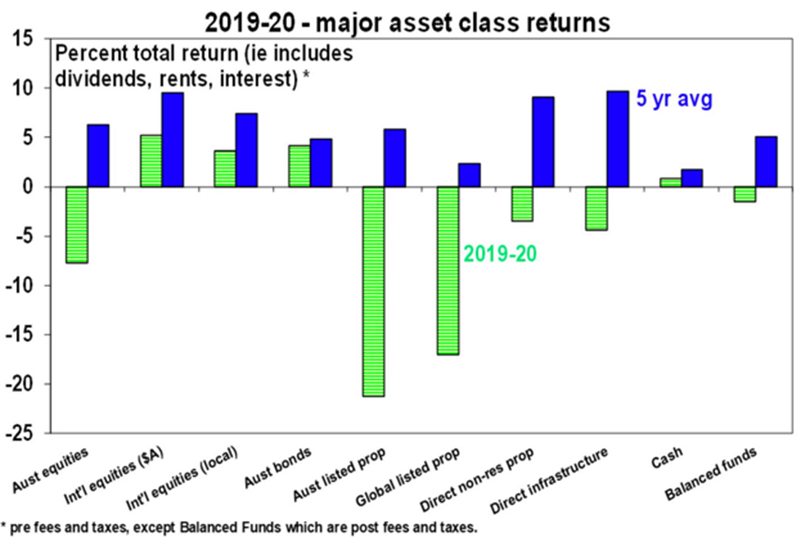
So, despite this wild ride, for the financial year as a whole global shares returned 5.2% in Australian dollar terms. This was led by the US share market which outperformed due to a heavy tech and health care exposure, a relatively low exposure to cyclical shares and massive Fed quantitative easing. Australian shares didn’t fare so well & still lost 7.7% for the financial year.

Cash and bank deposits had very low returns as the RBA cut the cash rate to 0.25% in March. But bonds had reasonable returns as plunging yields provided capital growth for investors. Despite the plunge in interest rates and bond yields, listed property saw double digit losses as the coronavirus driven slump in economic activity pushed up vacancies and depressed rents in retail and office properties. Returns on airports were similarly depressed weighing on direct infrastructure returns.

This all saw small negative returns for balanced growth superannuation funds of around -1.5% after fees and taxes. Of course, it would have been much worse were it not for the June quarter rebound in shares. The hit to super returns also followed several years of strong returns and the five-year average is just over 5% which is not so bad given (pre tax) bank deposit rates averaged around 2% and inflation averaged 1.5%.

2019-20 major asset class returns

Source: Thomson Reuters, AMP Capital

Like shares, Australian residential property had a roller coaster ride – first rising 10% on rate cuts and the Federal election before starting to slow as coronavirus hit.

Key lessons for investors from the last financial year

These include:

  • Maintain a well-diversified portfolio – while shares and listed property had a rough ride, bonds and exposure to global shares and foreign currency provided some stability. 
  • Timing markets is hard – while it always looks easy in hindsight, getting out in February at the top and then getting back in March at the low would have been very hard to time.
  • Beware the crowd at extremes – as is often the case shares hit bottom in March at a time of extreme investor pessimism.
  • Turn down the noise – the noise around coronavirus is at fever pitch making it very hard to maintain focus on long term investing, so the best thing is to turn it down a notch. 
  • Don’t fight the Fed – despite near zero interest rates and high public debt levels, policy stimulus can still be applied on a massive scale and still impacts investment markets.

The negatives

There are a bunch of threats which are likely to lead to a further correction in shares in the short term, ongoing bouts of volatility and constrained returns. Here are the big ones.

  • First, while some countries have got new coronavirus cases well down, it’s still on the rise globally particularly in emerging countries and the US and Victoria have seen a resurgence in cases. This is threatening a return to economically debilitating country wide lockdowns (as opposed to targeted measures). Even partial lockdowns will slow the recovery – eg, our rough estimate is that the new six-week lockdown of Melbourne, which accounts for about 20% of Australian GDP will knock nearly 1% off Australian GDP this quarter, which will slow the recovery (but not derail it as it should be offset by growth in other states). 
  • Second, the shutdowns will leave lasting collateral damage in terms of bankruptcies and higher unemployment as the embrace of technology has been sped up, companies cut costs and skills atrophy, all of which will weigh on growth.
  • Third, in Australia the main collateral risk is that the combination of high unemployment, a collapse in underlying housing demand on the back of a plunge in immigration and a depressed rental market drive a sharp collapse in home prices triggering negative wealth effects.
  • Fourth, the run up to the US election has the potential to drive increased share market volatility if it looks increasingly likely that Biden will win and raise taxes, and the risk is probably greater if President Trump decides he has nothing to lose and ramps up tensions with China and maybe Europe. With betting markets favouring a clean sweep by the Democrats some of the former is probably already priced, but an intensification of trade wars is probably not.
  • Finally, shares are expensive on traditional metrics like PEs.

The positives

However, there are a bunch of positives providing an offset.

  • First, several Asian countries have shown its possible to control the virus – notably China, South Korea, Taiwan and Japan. Maybe the SARS experience helps along with the culture of wearing masks. Surely, we can learn from them.
  • Second, progress is continuing to be made in terms of vaccines and treatments for coronavirus. I am a bit sceptical about a vaccine, but the latter may be contributing to lower death rates. If deaths remain low compared to the first wave there is less risk of a return to hard lockdowns (Victoria excepted!) and less self-isolation.
  • Third, policy makers remain committed to do whatever they can to support businesses, incomes and jobs with record levels of fiscal stimulus relative to GDP and massive monetary stimulus. This is different to normal recessions where it takes longer for policy makers to swing into action. To this end policy stimulus will be extended in the US and in Australia (with the Treasurer talking about another phase of income support and possibly bringing forward tax cuts). 
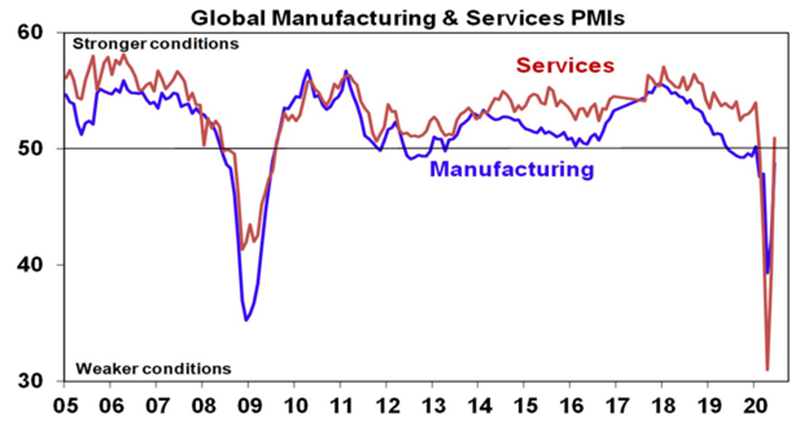
  • Fourth, a range of economic indicators have seen a Deep V rebound from shutdown lows starting in China and then in developed countries, suggesting significant pent up demand. This is most evident in business conditions PMIs but also in retail sales. On balance we see a gradual bumpy economic recovery from here. Australian GDP is expected to contract -4.5% this year and grow 4% next year.

2019 20 global manufactiring and service pmi

Source: Bloomberg, AMP Capital

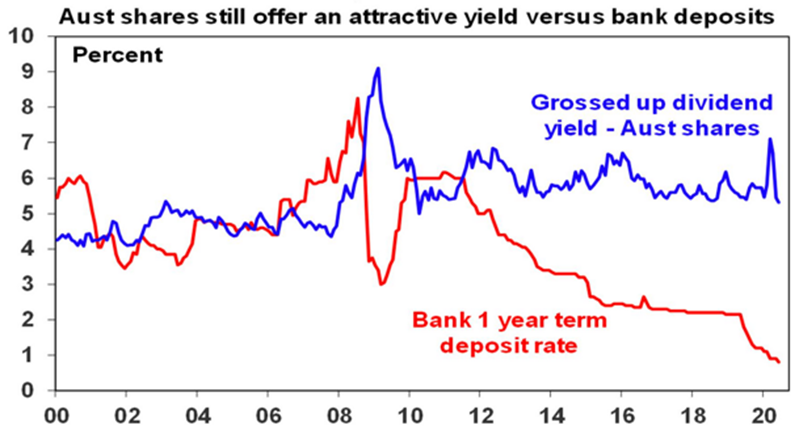
019 20 aus shares yeild vs bank deposits

Source: RBA; AMP Capital

  • Finally, the plunge in interest rates and bond yields have increased the present value of shares and other growth assets, which explains why price to earnings multiples are so high. Or looked at another way, shares remain attractive despite lower earnings and dividends because the alternatives like bank deposit rates are even less attractive.

What about the return outlook?

With coronavirus risks still high, investment markets may see more volatility. But over the next 12 months returns from a well-diversified portfolio are likely to be constrained but okay.

  • After a strong rally from March lows shares remain vulnerable to short term setbacks given uncertainties around coronavirus and US/China tensions. But on a 6 to 12-month view shares are expected to see reasonable returns helped by a pick-up in economic activity & massive policy stimulus. 
  • Cash and bank deposit returns are likely to be poor at less than 1% as the RBA is expected to keep the cash rate at 0.25%. Investors still need to think about what they really want: if it’s capital stability then stick with cash, but if it’s a decent income flow then consider the alternatives. 
  • Low starting point yields are likely to result in low returns from bonds once the dust settles from coronavirus.
  • Unlisted commercial property and infrastructure are ultimately likely to benefit from a resumption of the search for yield, but the hit to economic activity and hence rents from the virus will weigh heavily on near term returns. 
  • Home prices are expected to fall by around 5 to 10% into next year as higher unemployment, a stop to immigration and the weak rental market impact.
  • Although the $A is vulnerable to bouts of uncertainty about the global recovery and US/China tensions, a continuing rising trend is likely if the threat from coronavirus recedes.

Loans and guarantees are helpful but they leave businesses more indebted, whereas actual fiscal stimulus provides a direct boost. So actual fiscal support is a better measure and on this front Australia at 10.6% of GDP has provided by far the strongest fiscal stimulus of G20 countries. What’s more, Australia’s centrepiece JobKeeper wage subsidy is superior to approaches taken by many other countries as it keeps people “employed”, minimises confidence zapping negative headlines around unemployment, preserves the employer/employee relationship, keeps workers getting paid and provides a subsidy to struggling businesses. Unemployment is likely to rise to around 10% which is bad, but its far better than the 15% that would likely occur in the absence of JobKeeper or 20% or so unemployment in the US.

Things to keep an eye on

The key things to keep an eye on are: coronavirus hospitalisations and deaths, as a guide to the degree of isolation; global business conditions PMIs and unemployment; US election prospects; and Australian house prices.


Get help making sure your investment strategies that can ride the storm…

Speak with one of our Financial Planners, we’re here to help, either book a virtual meeting or get in contact with us on 02 9328 0876.


Article by AMP Capital


This article was prepared by Dr Shane Oliver. Dr Shane Oliver who provides economic forecasts and analysis of key variables and issues affecting, or likely to affect, all asset markets. He also provides economic forecasts and analysis of key variables and issues affecting, or likely to affect, all asset markets.

Important note: While every care has been taken in the preparation of this document, AMP Capital Investors Limited (ABN 59 001 777 591, AFSL 232497) and AMP Capital Funds Management Limited (ABN 15 159 557 721, AFSL 426455) make no representations or warranties as to the accuracy or completeness of any statement in it including, without limitation, any forecasts. Past performance is not a reliable indicator of future performance. This document has been prepared for the purpose of providing general information, without taking account of any particular investor’s objectives, financial situation or needs. An investor should, before making any investment decisions, consider the appropriateness of the information in this document, and seek professional advice, having regard to the investor’s objectives, financial situation and needs. This document is solely for the use of the party to whom it is provided.

General Disclaimer: This article contains information that is general in nature. It does not take into account the objectives, financial situation or needs of any particular person. You need to consider your financial situation and needs before making any decisions based on this information. Please seek personal financial advice prior to acting on this information.

The recession and your home loan

The recession and your home loan

The recession and your home loan

We are seeing a crisis that seems to be affecting all of us and the possibility of a recession has turned into a reality, but we have yet to see how much this recession is going to be affecting other aspects of our economy. Home loans are probably the biggest concern for many, and it makes sense that people want to protect their investment. With that said, here are some relevant and very useful moves that you can implement in order to help recession-proof your home loan.

Maximise emergency funds

There has never been a more crucial time for everyone to make an extra effort to save as much money as possible. Having six months’ worth of your salary in your emergency fund is a can be a great milestone and acts as your first line of defence when the chips are down.

Times are very unpredictable right now and we all need to make sure that a portion of our monthly earnings is going into our savings fund where possible.
This is probably the most essential tip that we can give to anyone right now. It’s a universal strategy that works for everyone regardless of their professional and their financial status.

Mortgage redraw and offset

As you may have seen in the news, certain lenders are now taking the additional repayments you’ve made out of redraw so they’re no longer accessible. These banks and lenders are inside their rights to do so but if you have that money set aside for emergencies it might be worth looking at an offset account.

An offset account sits beside your home loan and any money in the account offsets the interest on your loan. This is essential how redraw facility works but the difference is, bank and lenders don’t have access to remove money from the offset account.

Life insurance review

Be warned that insurances polices such as Income Protection do not cover you in case you lose your job or your business goes under.

Reviewing your current life insurance cover, insurance needs and premium costs to ensure they’re right for your individual needs. COVID-19 has shed new light on the need to be adequately covered but it’s also prudent to ensure you’re not over insured as the premium costs could be used towards building your emergency funds.

Final thoughts

These are times of uncertainty and we don’t know what could happen tomorrow in terms of our financial stability. The most important thing that we can all do is to ensure that we are covering all aspects of our finances to withstand this crisis with optimal results.

Keep in mind that factors such as the COVID-19 pandemic are temporary, but the rippling effect of a bad financial situation could be felt for years to come. That’s why, in times like these, it’s crucial you pay extra attention to your financial situation and avoid any unpleasant surprises without being prepared.

If you’d like to look at recession proofing your financial position, please feel free to contact us to see how we can help.

Stay safe!


Did you know about SFP’s Finance service?

Why not arrange to meet with our expert Leigh Morris our Senior Credit Advisor to review your situation. Make a booking or call us on 02 9328 0876 to arrange a meeting.


Article by Leigh Morris | Senior Credit Adviser & Director


General Disclaimer: This article contains information that is general in nature. It does not take into account the objectives, financial situation or needs of any particular person. You need to consider your financial situation and needs before making any decisions based on this information. Please seek personal financial advice prior to acting on this information.

Photo by Emre Can @ Pexel

Australia the lucky country

The lucky country…

Australia the lucky country

  • If, as a we expect, this results in a relatively stronger recovery for the Australian economy, then Australian assets should benefit relative to global assets.
  • Introduction

    Back in January when the bushfires were raging, I feared Australia’s luck had ran out. But right now, I thank god I live in The Lucky Country! Donald Horne’s original conception of the term in the 1964 book of the same name about Australia being run by “second rate people who share its luck” always seemed a bit too negative to me. Sometimes it may seem that way for a patch and yes mistakes are made, but when it really matters, I reckon we are led pretty well. Particularly in times of crisis. Think the 1980s when Hawke and Keating opened up and modernised the economy. Or through the GFC when a rapid policy response was a big reason Australia avoided recession. The response to the current crisis will likely also go down as a time when Australia rose to the occasion.

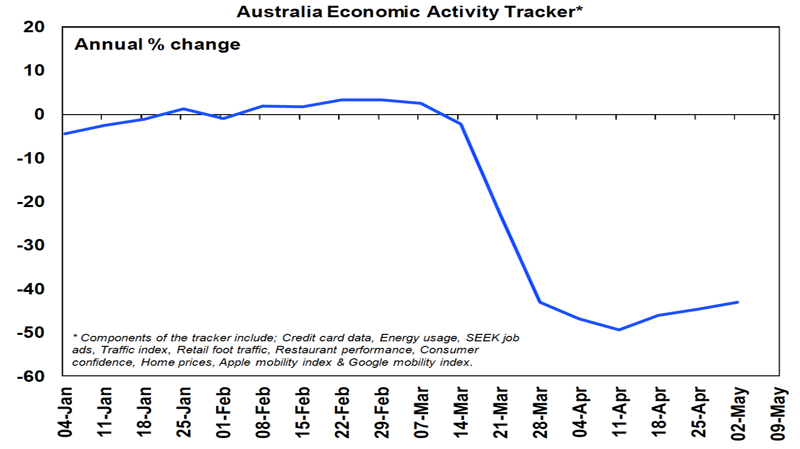
    Of course, we are still not out of the woods on coronavirus and there are some bad stats ahead on the economy. This is indicated by our Australian Economic Activity Tracker which is based on high frequency alternative data and is running down 40% on year ago levels, reflecting a preponderance of components most affected by the shutdown.

    Australian economic activity tracker

    Source: Bloomberg, AMP Capital

    The good news is that it is up from its early April low, but there is still bad news ahead of us in the official statistics. Unemployment likely spiked to around 10% last month which is the highest since the 20% seen during the Great Depression and official data to be released in the months ahead is likely to reflect a 10 to 15% contraction in the economy in the first half of the year, all of which risks further depressing confidence.

    But three things suggest Australia looks likely to come through this period of global misery relatively well compared to many other countries and this may mean the Australian economy contracts less and rebounds faster, ultimately supporting Australian asset classes relative to other countries’ assets.

    First, Australia has performed better than many countries in controlling coronavirus

    While things were bleak in late March, Australia’s success in “controlling” coronavirus (touch wood) stands out globally. After a rapid escalation in new cases, Australia imposed a shutdown around 22 March. New cases peaked in late March at over 500 a day and have since declined to less than 30 a day, albeit with a few clusters still causing problems. New cases may have peaked in the US but are still averaging around 29,000 per day.

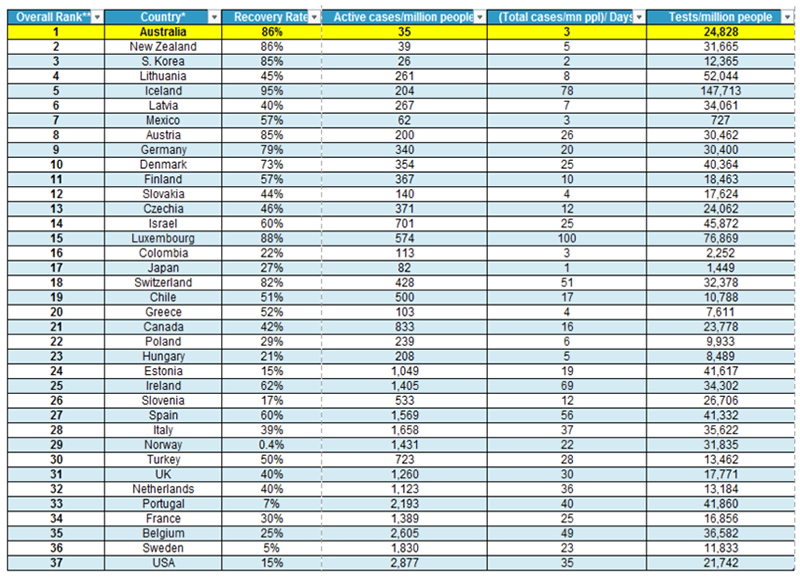
    Comparing OECD countries in how they are managing the coronavirus outbreak (based on recovery rates, active cases per capita, total cases per capita adjusted for the number of days since the first case and testing per capita) Australia ranks first, with NZ 2nd (guess where your next overseas holiday might be!) compared to Italy at 28th, the UK at 31st, Sweden at 36th and the US the worst performer in the OECD at 37th.

    Comparing OECD countries

    Source:Worldometer, AMP Capital

    Better weather, less congested living, a younger population and luck may have played a role, but the big driver looks to have been a public health response driven by expert medical advice as opposed to bravado or crackpot theories. And this has been backed up by Australians pulling together to do the right thing. By contrast Europe and the US have been marked by a slower response (eg lockdowns in Italy and Spain did not occur until new cases per million people were around 30, compared to around 12 in Australia). And Australia has achieved a similar virus outcome with a less stringent lockdown to New Zealand.

    Australia’s better record in containing the virus means two things. First, it has kept pressure off the health system so those who need hospitalisation can get it. As a result, Australia has managed to do a much better job of saving its own people than many other countries. Deaths per million people are around 3.9 in Australia, compared to 84 in Germany, 221 in the US, 280 in Sweden, 443 in the UK and 485 in Italy – that’s 124 times worse than Australia’s death rate! The value of saved lives swamps the cost to the economy from the shutdown.

    Coronavirus per million

    Source: Worldometer, AMP Capital

    It also provides Australia more scope to open the economy sooner and with greater confidence that a “second wave” of cases will be avoided – in contrast to the US where there is no clear downtrend in new cases. Indications from the Government are that a phased easing of the shutdown looks on track to start this month with most businesses running again by July.

    Second, Australia has seen a superior policy response

    Australian fiscal response g20

    Source: IMF, AMP Capital

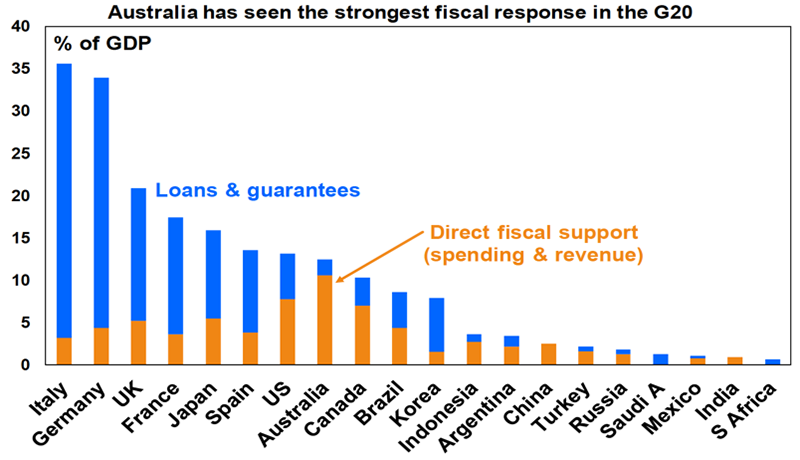
    The global government policy response to the economic threat posed by coronavirus shutdowns has been huge. See the next chart. However, in many countries it includes a large element of loans and debt guarantees as opposed to actual fiscal stimulus in the form of spending or tax cuts. For example, providing a loan (or a guarantee to enable a loan) to a business to help it survive the shutdown versus providing it with a wage subsidy.

    Loans and guarantees are helpful but they leave businesses more indebted, whereas actual fiscal stimulus provides a direct boost. So actual fiscal support is a better measure and on this front Australia at 10.6% of GDP has provided by far the strongest fiscal stimulus of G20 countries. What’s more, Australia’s centrepiece JobKeeper wage subsidy is superior to approaches taken by many other countries as it keeps people “employed”, minimises confidence zapping negative headlines around unemployment, preserves the employer/employee relationship, keeps workers getting paid and provides a subsidy to struggling businesses. Unemployment is likely to rise to around 10% which is bad, but its far better than the 15% that would likely occur in the absence of JobKeeper or 20% or so unemployment in the US.

    Third, Australia’s major trading partner is 2-3 months ahead of the rest of the world

    Finally, we may benefit from our biggest export market – China, which takes a third of our exports – being ahead of the global recovery curve by around 2-3 months and focused on infrastructure spending. This explains why prices for our key export – iron ore – are holding up relatively well compared to say the price of oil (of which we are a net importer).

    Implications for the Australian economy

    If, as appears likely, a phased easing of the lockdown starts this month, then April should prove to be the low point in economic activity and growth should return to the economy in the second half. This does not mean that things will quickly bounce back to “normal” – the easing of the lockdown will likely be gradual to minimise the risk of a “second wave”, some businesses will not reopen, uncertainty will linger, debt levels will be higher and business models will have to adapt to different ways of doing things. This may mean returning to the office on a rotational basis and shops & restaurants reopening but with distancing rules. Domestic travel may be back withing a few months, but international travel looks unlikely in the absence of a vaccine until next year (except to NZ). But it will still see a return to growth, albeit it may not be until end next year before economic activity returns to pre-virus levels.

    The combination of better success in controlling the virus with less risk of a second wave, better protection of the economy with a stronger policy response and Australia’s exposure to China make it likely that the Australian economy will contract less and recover faster than other comparable countries.

    While many fret that without tourism and immigration Australia can’t recover, this is not true. The travel ban has only accounted for a small part of the hit to the economy. Australia actually has a tourism trade deficit of 1% of GDP (we lose more from Australians going overseas than we gain from foreigners coming here) so a ban on international travel will actually boost GDP. However, we do have a 2% trade surplus in education, and this would be lost if foreign students can’t come. Similarly, immigration contributes just less than 1% to economic growth each year in Australia. However, this is all dwarfed by the 10 to 15% hit to economic activity which has mostly come from the domestic shutdown. And it could be argued that a workable testing and quarantine requirement could be introduced to allow students and immigrants to return on a 6-9 month timeframe.

    Risks to watch

    The main risks to watch for are: a “second wave” of coronavirus cases driving a new shutdown beyond the six month protection out to September provided by JobKeeper, increased JobSeeker and the bank debt payment holiday; the lockdown triggering a house price crash resulting in severe second round effects on the Australian economy – this is probably a much greater risk if the lockdown continues beyond September; and political tensions around the origin of Covid 19 damaging Australia’s trade relationship with China in some way.

    Concluding Comment

    It’s a great time to live in Australia. If we can control the spread of the virus, get our economy going before other trade competitors, and get as many people as we can back to work – our economy should right itself. The Chinese economy is recovering, and we can also benefit from that as we export our raw materials to China. Some positive news finally!


    Bill and the team at SFP.


    Get help making sure your investment strategies that can ride the storm…

    Speak with one of our Financial Planners, we’re here to help, either book a virtual meeting of get in contact with us on 02 9328 0876.


    This article was prepared by Dr Shane Oliver. Dr Shane Oliver who provides economic forecasts and analysis of key variables and issues affecting, or likely to affect, all asset markets. He also provides economic forecasts and analysis of key variables and issues affecting, or likely to affect, all asset markets.

    Important note: While every care has been taken in the preparation of this document, AMP Capital Investors Limited (ABN 59 001 777 591, AFSL 232497) and AMP Capital Funds Management Limited (ABN 15 159 557 721, AFSL 426455) make no representations or warranties as to the accuracy or completeness of any statement in it including, without limitation, any forecasts. Past performance is not a reliable indicator of future performance. This document has been prepared for the purpose of providing general information, without taking account of any particular investor’s objectives, financial situation or needs. An investor should, before making any investment decisions, consider the appropriateness of the information in this document, and seek professional advice, having regard to the investor’s objectives, financial situation and needs. This document is solely for the use of the party to whom it is provided.

    General Disclaimer: This article contains information that is general in nature. It does not take into account the objectives, financial situation or needs of any particular person. You need to consider your financial situation and needs before making any decisions based on this information. Please seek personal financial advice prior to acting on this information.

    How deep will Australia’s recession be?

    How deep will Australia’s recession be…

    How deep will Australia’s recession be?

    Introduction

    This is our 4th update since the COVID-19 crisis started. The feedback we are getting is that our SFP insights have been very welcomed, and they have represented a voice of reason in an ocean of fear. Sydney Financial Planning has been operating for 31 years. In 1991 during the recession we had to have, we were there to help guide our clients through this tough period. In 1991, 2001, 2008 and again today in 2020 when the financial markets fell dramatically, we continue to be here for you, guiding and advising you through a rough patch.

    Is this normal?

    Looking forward, is this just a normal recession we will go through or is it worse and deeper? Or is it short-lived? Will we get back to normal quickly? When will the financial markets return to normal?

    At the time of penning this article, the Australian Share Market has staged a
    staggering 20% recovery. So, congratulations to all our clients who did not panic. Congratulations to our clients who took our advice, and took advantage of this fantastic opportunity to buy in at a 40% discount.

    A great proportion of the working population has never known a recession in Australia, and others will be haunted by the last in the early 1990s. This time around, I think Australia is in for a different experience to what we’ve seen and known before – and that’s not entirely a bad thing.

    The Australian government has, rightly, sacrificed economic activity in the name of health in response to the COVID-19 crisis. It’s not alone in this, as you’d well know, major economies worldwide have done and are doing the same thing, albeit in different ways.

    An unfortunate victim in this is Australia’s almost 30-year run of economic growth as we are experiencing our first recession since 1991. The March quarter is most likely going to be negative, and the June quarter will see a big hit to economic activity thanks to the
    virus-driven shutdowns, possibly in the order of 10 percent. In other words, our economy will shrink considerably as this virus runs its course.

    Again, Australia won’t be alone in this, a global recession is likely as major powerhouses like the US and China factor in the huge economic hit of social distancing, isolation measures, and a virtual shutdown of regular activities, businesses, and services that are not essential.

    How will this affect me?

    There is a range of factors Australians will feel as we move through the recession period, and a big one will be how tough the jobs market is. There will be much higher unemployment, it will be harder to switch jobs, and it’s reasonable to expect more redundancies and terminations as the crisis continues.

    This leads to a loss in income and falling wages, which reduces the spending power of affected Australians. Compounding that, even for those who are holding on to their jobs, uncertainty will rise – people worry about the future, they worry about their income, they worry about their employment prospects. That will impact spending patterns, and how much people are willing to part with beyond the essentials.

    It’s worth pointing out some of the potential opportunities for our investors who are prepared to take a long-term view. For one, interest rates will be lower, the official cash rate is currently sitting at the all-time low of 0.25%. This will mean it’s cheaper to service a mortgage.

    The residential property market is also likely to take a hit, which could provide lower entry points for people who have struggled – particularly in cities like Sydney and Melbourne – with affordability. The same logic applies to shares. Although the market is currently more volatile, for those with a long-term outlook, there are opportunities to find value at a lower price point. This especially applies to all those reinvested dividends, if you’re in the accumulation stage.

    Finally, what we think will be different about the recession before us and those Australia has seen before, is that the current crisis is not the result of a bust after a boom. This is an enforced shutdown and a significant disruption – it was not caused by anything fundamental in the Australian economy. Because of that, we are positive that once the virus is under control, we can recover and reach a more normal functioning in a quicker way than we have before. Adding confidence to this is that government and financial support programs – notably the wage subsidy and debt payment holidays – have been applied early and aggressively and should help protect many businesses and individuals so that the economy can bounce back reasonably quickly once the virus is under control.

    Stay the course and keep healthy. This too shall pass.


    Advice team of Sydney Financial Planning


    Remember we are available to help you during this unprecedented time…

    If you have ANY questions please get in touch to speak with one of our Financial Planners we’re here to help, either book a virtual meeting of get in contact with us on 02 9328 0876.


    Article by Michal Bodi | Senior Financial Planner


    General Disclaimer: This article contains information that is general in nature. It does not take into account the objectives, financial situation or needs of any particular person. You need to consider your financial situation and needs before making any decisions based on this information. Please seek personal financial advice prior to acting on this information.

    Photo by Casey Horner on Unsplash


    Federal Government Stimulus Package 2020

    Further Federal Government stimulus package announced

    Federal Government Stimulus Package 2020

    The new measures include initiatives for individuals, households and businesses. Business initiatives include measures to both enhance cashflow and provide easier access to credit.
    Enabling legislation (where required) is expected to be introduced to Parliament in the sitting week commencing 23 March 2020.

    The proposed measures are briefly summarised below and will require passage of legislation and/or regulations to provide certainty as to the specifics of the proposals.

    Federal Budget: the Government has also announced that due to continuing uncertainty associated with the Coronavirus pandemic that the Federal Budget which was due to be handed down in May will be deferred until 6 October 2020.

    1. Measures to support individuals & households

    Proposed effective date: various, see below.

    Temporary early access to superannuation.

    Proposed effective date: 2019-20 and first quarter (approx.) 2020-21. Applications available from mid-April 2020.

    The Government recognises that immediate financial necessities may temporarily outweigh the stated purpose of superannuation as a retirement savings vehicle and will temporarily allow additional early access to super savings in prescribed circumstances.

    People who meet the below criteria will be allowed to access:

    • up to $10,000 of their super before 1 July 2020, and
    • up to an additional $10,000 in the three months starting from 1 July 2020 (timeframe is approximate and subject to legislation).

    Amounts released under these rules will be paid tax-free and will not affect Centrelink or DVA payments.

    Individuals eligible to apply for early release include:

    • Those who are unemployed; or
    • Those eligible to receive Jobseeker Payment, equivalent Youth Allowance, Parenting Payment, Special Benefit or Farm Household Allowance; or

    Those who on or after 1 January 2020:

    • Were made redundant; or
    • Had their working hours reduced by 20% or more; or
    • As a sole trader, their business was suspended or turnover decreased by at least 20%.

    Those eligible must apply to the ATO through the MyGov website and must self-certify that they meet the above requirements. The ATO will then process the application and issue a Determination to the applicant and their super fund.

    The super fund will be able to then pay the applicant directly. Those eligible will only be allowed one withdrawal application in each period (i.e. cannot ‘top-up’ by making a second request if an original withdrawal for less than $10,000 was made).

    Applications for early release of super under this measure are expected to commence from mid-April 2020, approval and benefit payment time frames have not been announced at the time of writing.

    Early release of super benefits under this measure will also be available to members of SMSFs.

    Accessing super benefits in times of market down-turns is usually not recommended as it may crystallise losses. However members who experience loss of employment or a significant decrease in income may find this measure provides immediate financial relief and the basis to re-build.

    Further details of this measure are available in this fact sheet released by Treasury.

    Support for retirees – temporary reduction in minimum pension drawdown requirements

    Proposed effective date: Financial years 2019-20 and 2020-21.

    Similar to measures that applied following the 2008 Global Financial Crisis, the Government has proposed a 50% reduction in the minimum income drawings required from account based pensions and similar products for the 2019-20 and 2020-21 income years.

    This measure is designed to allow those whose circumstances permit to reduce income payments from their superannuation based pensions or income streams so as to minimise the need to sell down assets in depressed markets.

    Those who have already taken 50% or more of the required minimum payment in the 2019-20 financial year could contact their fund and cease any further payments until 30 June (subject to passage of regulations/legislation).

    This measure is not compulsory. Individuals who need the income or simply do not wish to reduce their income payments need not take action.

    Superannuation pensioners who are funding their income requirements from a cash account may also decide to take no action.

    Details of this measure are available in this Fact Sheet released by Treasury.

    Support for retirees and income support recipients – further reduction in deeming rates

    Proposed effective date: 1 May 2020.

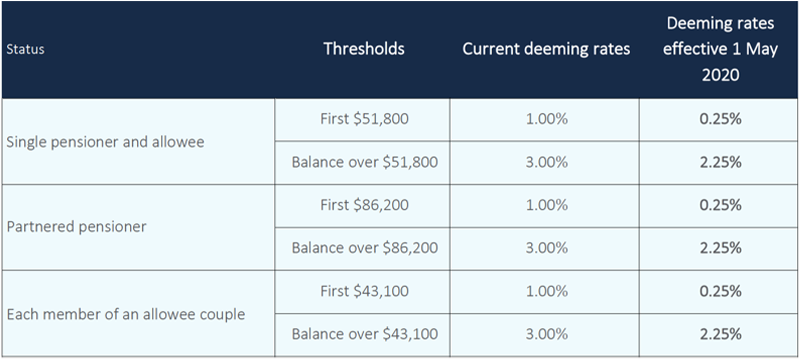
    Adding to the 12 March 2020 announcement, the Government has announced a further 0.25% reduction in deeming rates.

    This will mean that part-rate pensioners and allowees will have less income assessed from their financial investments. If a recipient is income tested, the effect of the reduced deeming rate may result in an increase in social security entitlements.

    Any increase in the amount of income support received due to the reduction in deeming rates will commence to flow through to clients’ bank accounts from 1 May 2020.

    The following table illustrates the new deeming rates:

    Table 1: Reduction in deeming rates
    sfp e16 001 reduction in deeming rates

    Payments to income support recipients (households)

    Proposed effective date: various, see below.

    The Government will now provide two payments of $750 to eligible social security, veteran and other income support recipients (including concession card holders). Each $750 payment is a set amount, regardless that the recipient may have multiple eligibility (e.g. be an income support recipient and concession card holder).

    The first payment will be made to those receiving eligible income support or other benefits as at 12 March 2020, or those who have applied for a benefit as at that date (or up to 13 April 2020) and are subsequently approved.

    The second payment will be available to those who are eligible income support recipients or concession card holders as at 10 July 2020 and will be paid automatically from 13 July 2020. However, those who are receiving a payment that is eligible to receive the Coronavirus supplement (see below) will not receive this second $750 payment.

    Each eligible person in a household can receive the payment (e.g. a pensioner couple would receive a total of $1,500 in each round of payments).

    The payments will be exempt from tax and not included in the income test for social security, veteran or Farm Household Allowance payments.

    Eligible recipients must be residing in Australia. For the first payment, eligible benefits include:

    • Age Pension
    • Disability Support Pension
    • Pension Concession Card
    • Carer Payment and Allowance
    • Commonwealth Seniors Health Card
    • Veteran and War Widow(er) payments
    • Veteran Gold Card
    • Youth Allowance
    • Newstart Allowance/Jobseeker payment
    • Farm Household Allowance
    • Family Tax Benefit
    • Parenting Payment
    • Austudy
    • Partner Allowance

    The first payment will be made from 31 March 2020 with 90% of payments expected to be made by mid-April 2020.

    The payment will be made automatically to income support recipients. Those whose only qualifying benefit is a concession card will be contacted to confirm bank account details.

    In addition, eligibility criteria for benefits such as Sickness Allowance and Youth Allowance or other study related payments will be relaxed where the recipient can demonstrate inability to work or lack of compliance is due to Coronavirus related causes.

    To be eligible for the second payment the person must be residing in Australia and receiving one of the payments or concession cards listed above except for payments which receive the Coronavirus supplement (see below).

    These excluded payments include: Jobseeker Payment, equivalent Youth Allowance, Parenting Payment, Special Benefit or Farm Household Allowance.

    The Government Fact Sheet on Payments to Households is available from Treasury.

    Enhanced income support for individuals

    Proposed effective date: 27 April 2020

    The Government is temporarily expanding eligibility to income support payments and establishing a new temporary ‘Coronavirus supplement’. The supplement will be paid at the fixed rate of $550 per fortnight for six months commencing 27 April 2020 and is in addition to existing income support payments.

    Those eligible for the supplement include existing and new recipients of the following payments:

    • The Jobseeker Payment (previously Newstart Allowance and other payments transitioning to the Jobseeker Payment);
    • Youth Allowance (YA) Jobseeker Payment;
    • Parenting Payment (partnered and single);
    • Farm Household Allowance; and
    • Special Benefit recipients.

    For the period of the Coronavirus supplement there will also be expanded access to the payments listed above.

    The Jobseeker payment (and YA Jobseeker payment) will be available to permanent employees who lose their jobs. These payments will also be available to sole traders, self-employed and contract or casual workers whose reduced income meets the income test criteria.

    Asset testing of Jobseeker payment, YA Jobseeker payment and Parenting Payment will be waived for the period of the supplement.

    The one week ordinary waiting period has already been waived and the Liquid Assets Waiting Period (LAWP) will also be waived for those eligible for the supplement. Those already serving a LAWP will have the remainder waived.

    Income maintenance periods and compensation preclusion periods will continue to apply. Claimants for the Jobseeker payment will have to certify that they are not receiving or eligible for paid employer leave or accessing income protection payments.

    At this time measures are also being taken to streamline the application process including reduced documentation requirements and relaxation of mutual obligation and study requirements where these are impacted by the Coronavirus.

    Details of this measure are available in this Fact Sheet released by Treasury.

    2. Measures to support small and medium size employers

    Proposed effective date: Various – see below

    With reference to the tax-free payment announced by the Government on 12 March 2020 to boost cash flow for small and medium size businesses.

    The Government has now indicated it will enhance that previously announced tax-free cash flow boosting payment. Instead of the previously announced $25,000 maximum, the government is to now provide up to $100,000 (minimum payment of $20,000) to eligible small and medium-sized businesses. Payments will now also be made to eligible not for-profits (NFPs including charities) that employ people.

    Small and medium-sized business entities (including NFPs/charities) with aggregated annual turnover under $50 million and that employ workers are eligible.

    The payments will only be available to active eligible employers established prior to 12 March 2020. However, charities which are registered with the Australian Charities and Not-for-profits Commission will be eligible regardless of when they were registered, subject to meeting other eligibility requirements. This recognises that new charities may be established in response to the Coronavirus pandemic.

    Under the enhanced arrangements, tax-free payments will be made in two stages.

    First stage

    Eligible businesses that withhold tax to the ATO on their employees’ salary and wages will under the first stage receive a payment equal to 100% (up from 50%) of the amount withheld, up to a maximum payment of $50,000.

    Eligible businesses that pay salary and wages will receive a minimum payment of $10,000 (up from $2,000) even if they are not required to withhold tax.
    The tax-free payment in this first stage will be delivered by the ATO as a credit in the activity statement system from 28 April 2020 upon businesses lodging eligible upcoming activity statements.

    Second stage

    In the second stage, additional payments will be made in the July – October 2020 period. To qualify for the additional second stage payments, the entity must continue to be active.

    Eligible entities will receive the additional payments equal to the total of all of the boosting cash flow for employers payment they received under the first stage. This means that eligible entities will receive at least $20,000 (2 x $10,000) minimum, up to a total of $100,000 (2 x $50,000) maximum combined under both payments.

    For monthly activity statement lodgers, the additional second stage payments will be delivered as an automatic credit in the activity statement system. This will be equal to a quarter of their total first stage Boosting Cash Flow for Employers payment and received following the lodgement of their June 2020, July 2020, August 2020 and September 2020 activity statements (up to a total of $50,000).

    For quarterly activity statement lodgers, the additional second stage payments will also be delivered as an automatic credit in the activity statement system. This will be equal to half of their total first stage Boosting Cash Flow for Employers payment and received following the lodgement of their June 2020 and September 2020 activity statements (up to a total of $50,000).

    Further details of this measure are available in this Fact Sheet released by Treasury.

    Other measures announced to support the cash flow needs of small and medium-sized business entities include:

    Under a ‘Coronavirus SME Guarantee Scheme’, the government will provide a guarantee of 50% to SME lenders to support new short-term unsecured loans to SMEs. The Scheme will guarantee up to $40 billion of new lending. According to the government, this will provide businesses with funding to meet cash flow needs by further enhancing lenders’ willingness and ability to provide credit.

    The government is also cutting red tape by providing a temporary exemption from responsible lending obligations for lenders providing credit to existing small business customers. This reform is aimed at helping small businesses get access to credit quickly and efficiently.

    As always I want to reiterate that myself and the team at SFP are here to answer ANY questions you may have during this time. Stay safe in these uncertain times, we’re in this together.


    Bill and the team at SFP.


    If you have ANY questions during this unprecedented time…

    Please get in touch to speak with your Financial Planner we’re here to help, either book a virtual meeting of get in contact with us on 02 9328 0876.


    Bill Bracey – Principal & Senior Financial Planner | Sydney Financial Planning


    General Disclaimer: This article contains information that is general in nature. It does not take into account the objectives, financial situation or needs of any particular person. You need to consider your financial situation and needs before making any decisions based on this information. Please seek personal financial advice prior to acting on this information.


    Financial stress keeping us awake

    Financial stress keeping you awake at night?

    Financial stress keeping us awake

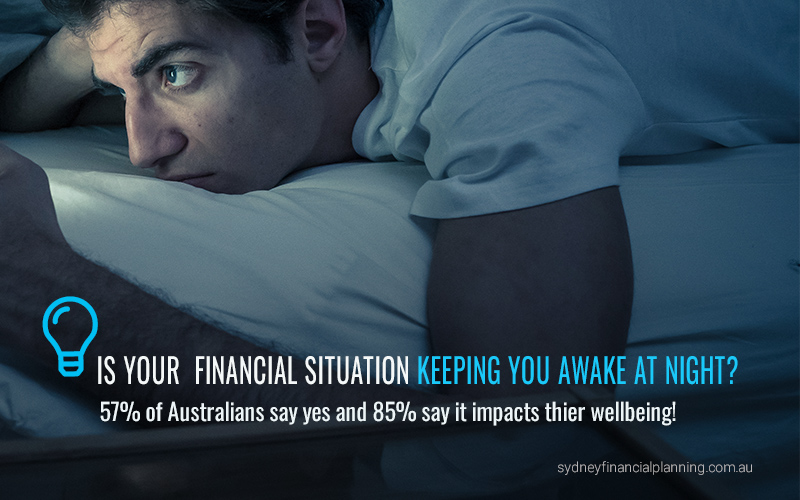
    According to the Financial Fitness Whitepaper, almost 57% of Australians are worried about their current financial situation and 85% say it impacts their wellbeing.1

    Generation Z AKA the iGen

    The youngest generation are most concerned about covering everyday expenses2, such as food and transport. According to the Australian Bureau of Statistics3, the cost of living continues to rise, which just adds to financial woes. Also, research produced by the Financial Planning Association4 notes that the ease of cashless transactions is hindering the youngest generation and those to come.

    Millennials

    Generation Y (millennials) are those who are doing it the toughest when it comes to financial stress. For many millennials, it’s work-related stress that keeps them up at night, as well as fears they won’t have enough money for retirement and pressure associated with property prices.5

    Generation X

    With worries about at least one financial issue at any given time, Generation X are losing sleep over the ability to pay living expenses and what the future holds financially.6

    Baby Boomers

    While many would believe Baby Boomers are the most well-off generation, they are struggling with the stress of health care and insurance bills, as well as retirement savings.2

    What to do

    Everyone suffers from it in some varying degree, but stress is one of the worst things for our health, especially our sleep. Poor sleep can lead to weight issues, poor concentration and productivity, and can create a greater risk of heart disease and stroke. It’s also linked to diabetes, depression and lower immunity. Sleep is important. Don’t let your financial stress affect your quality of life.

    Sorting through your financial stress is just one way you can get better quality sleep. We can help set up a financial plan, find ways to ease the tension and strategise for the future.


    Let us help you get better sleep and ease the stress.

    Speaking with one of our financial advisors is a good place to start. Make a booking or call us on 02 9328 0876 to arrange a meeting.


    1: Mortgagechoice.com.au. (2019). Financial Fitness Whitepaper. Available at: https://www.mortgagechoice.com.au/about-us/insights/financial-fitness-whitepaper-2019/ [Accessed 28 Oct. 2019].
    2: McDowell, E. (2019). Money problems are keeping every generation up at night — check out the biggest financial stressors for every age group. Business Insider Australia. Available at: https://www.businessinsider.com.au/biggest-financial-problems-facing-each-generation-2019-6 [Accessed 28 Oct. 2019].
    3: Abs.gov.au. (2016). Media Release – Inflation continues to be subdued (Media Release). [online] Available at: https://www.abs.gov.au/ausstats/abs@.nsf/lookup/6401.0Media Release1Dec 2016 [Accessed 28 Oct. 2019].
    4: Erem, C. (2018). The ‘invisible-money generation’ may be in financial trouble, says Financial Planning Association. Mozo.com.au. Available at: https://mozo.com.au/debit-cards/articles/the-invisible-money-generation-may-be-in-financial-trouble-says-financial-planning-association [Accessed 28 Oct. 2019].
    5: Banney, A. (2018). Financial stress keeping Australians awake at night. finder.com.au. Available at: https://www.finder.com.au/financial-stress-keeping-australians-awake-at-night [Accessed 28 Oct. 2019].
    6: https://s3.mapmyplan.com.au. (2015). The financial fitness of working Australians. Available at: https://s3.mapmyplan.com.au [Accessed 28 Oct. 2019].

    General Disclaimer: This article contains information that is general in nature. It does not take into account the objectives, financial situation or needs of any particular person. You need to consider your financial situation and needs before making any decisions based on this information. Please seek personal financial advice prior to acting on this information.

     

    Salary Sacrificing

    Everything you need to know about salary sacrificing

    Salary Sacrificing

    “What is salary sacrificing?”

    “Salary sacrificing (also known as salary packaging) is an arrangement between you and your employer, where you can use your pre-tax income to purchase some items or services. Your taxable income is therefore reduced and as a result, so is your tax bill. For many, it’s a win/win situation.1

    There are a lot of rules.

    But there are two key points to remember.

    1. Salary sacrificing depends on your employer and you both must agree on the arrangement.
    2. Arrangements must be made in advance – you cannot sacrifice money that you’ve already been paid.

    What to salary sacrifice for?

    The most common way to use a salary sacrifice arrangement is to boost your superannuation, buy electronics such as laptops and devices, purchase cars and even buy a new home.

    Superannuation – the contributed portion of your income will be taxed at a much lower rate (15% as opposed to 32.5% for an average weekly Australian wage of $1,238.30).2

    Buying a house – salary sacrificing through super is especially beneficial for first-home buyers who are now able to withdraw up to $30,000 plus earnings to purchase their first home. If you don’t use this towards your first home, any salary sacrificed contributions will have to stay in your super until you retire, or you can pay a special tax to access it sooner.3″

    “Purchasing a new car – the most popular way is a novated lease. Your employer takes the repayments and running costs out of your pre-tax income and you get to enjoy the car. Just make sure you’re buying a car within your means.3

    Purchasing devices – there are some rules to keep in mind, including the device must be portable and used primarily for work.4

    Is it worth it?

    Salary sacrificing is a useful tool that can help you achieve your financial goals, as long as you’re smart about it. Don’t purchase something you don’t necessarily need just because of the possible tax breaks. Making these decisions alone can be confusing, which is why it’s always a smart move to discuss your options with the experts: us.

    If you would like more information on salary sacrificing, feel free to get in touch with us anytime.”


    Interested in finding out your options?

    Speaking with one of our financial advisors would be a good place to start. Make a booking or call us on 02 9328 0876 to arrange a meeting.


    1: Australian Government Australian Securities & Investments Commission (2019). Available at: www.moneysmart.gov.au/managing-your-money/income-tax/salary-packaging [Accessed 28 Oct. 2019].
    2. Australian Government, Australian Taxation Office (2019). Salary sacrificing super. Available at: www.ato.gov.au/Individuals/Super/Growing-your-super/Adding-to-your-super/Salary-sacrificing-super [Accessed 28 Oct. 2019].
    3. Wright, P. (2019). A beginner’s guide to salary sacrificing your house, superannuation and car – ABC Life 3 Mar. Available at: www.abc.net.au/life/what-salary-packaging-is-and-how-it-works/10830070 [Accessed 28 Oct. 2019].
    4: Chapman, M. (2016). Five things you didn’t know you could salary sacrifice. Available at: https://www.moneymag.com.au/salary-sacrifice [Accessed 28 Oct. 2019].

    General Disclaimer: This article contains information that is general in nature. It does not take into account the objectives, financial situation or needs of any particular person. You need to consider your financial situation and needs before making any decisions based on this information. Please seek personal financial advice prior to acting on this information.


    Record Low Interest rates

    Making the most of record-low interest rates

    Record Low Interest rates

    However, the low cash rate also means your money in the bank could be earning less interest.

    Why did the RBA cut rates?

    Rate cuts are a way for the RBA to help stimulate the economy. The idea is, when the RBA lowers the official cash rate, banks may follow suit and lower interest rates on the loans they provide. When rates are lower, you pay less interest on your debt, freeing up money for you to spend elsewhere. You may also be more likely to borrow more money. This increased spending has a ripple effect through the economy, giving it a boost.

    The RBA’s recent rate cut was due to concerns about the way the economy has been slowing down. In Australia, the downturn in the housing market as well as the drought have both played a role in the slowdown. Globally, fears about the US trade wars has led investors around the world to be more cautious.

    It’s important to note that when the RBA cuts the official rate, there’s no guarantee that the banks will do the same. For example, in recent times, some banks have only passed on part of the rate cut.

    Will interest rates stay low?

    Head of Investment Strategy and Economics and Chief Economist of AMP Capital Dr Shane Oliver says rate cuts are “…a bit like cockroaches”, adding, “If you see one there is normally another nearby.”1 He believes further rate cuts are on the cards for this year and next, which could see this low interest-rate environment lingering for some time.

    What could low interest rates mean for me?

    When it comes to interest rate cuts, there is good news and bad news, depending on your financial goals. With that in mind, it’s worth thinking about whether you need to make any changes to stay on track. Find out what low rates could mean for four common financial goals:

    1. Paying off debt

    If you have a variable rate loan, a rate cut can work in your favour, provided your lender passes on the cut.

    The major banks lowered their interest rates on variable loans, either partially or in full, following the June 2019 rate cut. That means those with variable loans may now enjoy lower interest repayments. Fixed-rate loans won’t change, as the rate has been locked in for an agreed time period.

    If you have a variable rate loan, the low interest-rate environment can provide a good opportunity to start clearing debt. One strategy to consider is to keep your loan repayments the same despite the rate cut, so that you pay off more of your loan, faster. Or, you may consider using the money that you save on repayments to invest elsewhere to help grow your wealth.

    It generally makes sense to pay off bad debt first (ie debt used to pay for day-to-day expenses like credit card debt that you do not get a tax deduction for in your tax return, rather than debt used to pay for an income-generating asset like an investment property). It also is usually a good idea to start with the debt with the highest interest rate first.

    If you have a fixed-rate loan, it may be a good time to crunch the numbers to see if refinancing is worthwhile to take advantage of the lower rates on offer. In addition to calculating how much money you could save on repayments, it’s important to factor in the break costs associated with the current loan, as well as any set-up fees associated with the new loan. It’s important to consider your particular circumstances and goals before deciding what’s right for you, so financial advice may help.

    2. Buying a property

    If you’re in the market to buy a property, a reduction in interest will probably be welcome news. That’s because lower rates will influence how much you can borrow and how much you can afford to repay on your loan.

    While it may be tempting to borrow more, keep in mind that interest rates will eventually increase and so will your repayments. It’s a good idea to check whether you can afford the home loan if rates were to go up.

    3. Increasing your savings

    A low-rate environment is generally bad news for savers with cash in the bank. With interest rates at record lows, the rates earned by some bank deposits are at their lowest level since the mid-1950s, prompting some investors to consider whether their money could be working harder for them elsewhere.

    With little interest to be earned by keeping money in the bank, alternative options such as income-generating shares that pay attractive dividends may be worth a look.

    Before making any changes, it’s important to understand the risks involved. Shares, for example, are much riskier than keeping money in the bank. But they do offer the potential for much higher returns than a cash deposit.

    Other options which may help your money to work harder for you include managed funds or property. Again, these investments carry more risk and can tie-up your cash for a period of time. Also be sure to understand any fees involved.

    We can help you find suitable options.

    4. Growing your super

    The recent interest rate cut is a timely reminder to review how your superannuation is invested. With earnings from cash deposits at record lows, it’s a good idea to check what portion of your super is invested in cash. Consider whether the amount of super you have in cash is still appropriate given the level of risk you’re comfortable with and the time you have left until you retire.

    Ultimately it comes down to what’s important to you, what stage you’re at in life and how much risk you’re willing to take on for potentially higher returns. If retirement is still a while away, you may consider taking on riskier, higher growth investment options like shares or property that have the potential to help grow your super balance over time. However, if you’re retiring soon, you may not be as willing to take on too much risk, as preserving your super balance may be a higher priority. Regular reviews of your super investments can help you to make sure you’re still on track to a comfortable retirement.

    We can help you make the most of this low interest-rate environment and stay on target to reach your goals.


    Did you know about SFP’s new Finance service?

    Why not arrange to meet with Leigh Morris our Senior Credit Advisor to review your current situation. Make a booking or call us on 02 9328 0876 to arrange a meeting.


    Aricle by – AMP Life Limited.

    General Disclaimer: This article contains information that is general in nature. It does not take into account the objectives, financial situation or needs of any particular person. You need to consider your financial situation and needs before making any decisions based on this information. Please seek personal financial advice prior to acting on this information.

     

    When can I access my Super?

    When can I access my Super?

    When can I access my Super?

    Here is a high-level summary as to when super may be accessible to you. 

    When you retire (and have reached your preservation age)

    Typically, you can access your super when you’ve reached your preservation age and you retire. Find your preservation age in the table below. 

    Date of birth Preservation age
    Before 1 July 1960 55
    1 July 1960 – 30 June 1961 56
    1 July 1961 – 30 June 1962 57
    1 July 1962 – 30 June 1963 58
    1 July 1963 – 30 June 1964 59
    From 1 July 1964 60

    When you’re transitioning into retirement

    If you’ve reached your preservation age, you might wish to access a portion of your super through a transition to retirement income stream while continuing to work full-time, part-time or casually. While this may give you some financial flexibility, there will be things to consider, including that you’ll only be able to access up to 10% of your super savings each financial year. 

    When you reach age 60 and stop working (but aren’t retiring)

    If you’re aged 60 to 64 and stop working, even if you have no intention of retiring completely (for example, you may get another job elsewhere), you’re still considered retired for the purposes of accessing super. This means you can cash out the super you’ve accumulated up until that time even if you begin working again under a different employment arrangement.

    When you reach age 65 (even if you haven’t left the workforce)

    When you turn 65, you don’t have to retire or satisfy any special conditions to get full access to your super. You’re also not obligated to withdraw it, however depending on your circumstances, there may be some benefits in doing so. 

    Other instances where you may be able to access super

    While you generally cannot take your super until retirement, there are some specific circumstances where the law allows you to draw on your super early. These mainly relate to certain medical conditions or severe financial hardship, and you must meet eligibility criteria to apply. 

    Compassionate grounds

    You may be allowed to withdraw a certain amount of money from your super on compassionate grounds where you don’t have capacity to meet certain expenses. This may include things like certain medical-related expenses, funeral costs and mortgage repayments that will prevent you from losing your home. 

    Severe financial hardship

    If you’re under preservation age, have been receiving financial support payments from the government for 26 weeks continuously and can’t meet reasonable and immediate family living expenses, you may be able to withdraw between $1,000 and $10,000 from your super. This can only be done once in a 12-month period.  If you’ve already reached your preservation age (plus 39 weeks), have received financial support payments from the government for a cumulative period of 39 weeks since reaching your preservation age, and are not gainfully employed on a full-time or part-time basis, there is no limit on the amount that you may be able to withdraw under severe financial hardship. 

    Incapacity

    If you’re permanently or temporarily unable to work due to a physical or mental medical condition, you may be able to access super as a lump sum or via regular payments over a period of time. 

    Terminal medical condition

    If you’ve been appropriately diagnosed with a terminal illness that’s likely to result in your death within a two-year period, you could apply to access your super and there are no set limits on the amount you can withdraw. 

    Super benefits less than $200

    If you change employers and the balance of your super account is less than $200, or you have lost super that’s being held by a super fund or the Australian Taxation Office (ATO) that’s less than $200, you may be able to withdraw this money. 

    Leaving Australia

    If you’ve worked and earned super while visiting Australia on an eligible temporary visa, you can apply to have this super paid to you as a Departing Australia Superannuation Payment (DASP), but there are requirements and documentation you may need to provide. 

    What to keep in mind

    Depending on how much you have in super, it’s worth considering any implications of withdrawing this money, such as how the money may be taxed, and whether a withdrawal may affect Centrelink payments, such as the Age Pension. 


    Not sure if your meet some of the criteria?

    Having an financial planning expert review your unique situation is always a good stratgey . Make a booking or call us on 02 9328 0876 to arrange a meeting.


    Article by: ©AMP Life Limited. First published May 2019

    General Disclaimer: This article contains information that is general in nature. It does not take into account the objectives, financial situation or needs of any particular person. You need to consider your financial situation and needs before making any decisions based on this information. Please seek personal financial advice prior to acting on this information.

     

    Happy New Financial Year 2019!

     
    Bill discusses the effects on the stock market due to Trump’s trade war with China, the property market gaining momentum, and what to do (and what not to do) when interest rates are only 1%.


    Still have some questions?

    If you are seeking some financial advice in relation to your personal situation. Call us to arrange an appointment with one of our planners on 02 9328 0876.


    General Disclaimer: This video contains information that is general in nature. It does not take into account the objectives, financial situation or needs of any particular person. You need to consider your financial situation and needs before making any decisions based on this information. Please seek personal financial advice prior to acting on this information.

    The wisdom of investing

    The wisdom of ‘no change’ recommendation in investing

    The wisdom of investing

    This may sound pessimistic but unfortunately, it’s not an incorrect statement. It refers to our human behaviour when it comes to investing – the investor behaviour.

    The investor behaviour needs to be managed via the disciplined but simple recommendation of ‘no change’ which most of our clients have experienced for years. It’s simple but effective. It may sound repetitive and even boring, but without it we would all end up chasing the annual ‘The top 5 stocks to invest in 2019’ type of headlines (and end up broke).

    As huan beings, we are bound by a number of complex but natural preconceptions which literally stop us from acting rationally while investing throughout our lifetime. This set of biases basically prevents us from processing reality in a rational way and makes us incapable of executing and sustaining a successful investment strategy that can last a lifetime.

    The next thing that’s important to acknowledge is that these matters are cognitive in nature and therefore can’t be ‘fixed’ by investor education, as is so often suggested by media and Barefoot Investor type literature. We can’t overcome human nature by learning, just as we can’t change left-handed writing with psychotherapy. Understanding is an intellectual issue, and we’re all capable of that. However, processing it correctly and accepting it is an emotional issue which requires close partnership with an empathetic but tough loving, third party investment adviser.

    There are four main reasons for our inability sustain a successful investment strategy on our own:

    Physiological reason

    Fear is by far the biggest inhibitor of wealth building. We are all equipped with a processing centre of fear in our brain – the right amygdala. This fantastic piece of hardware used to help us process fear and anxiety when running away from a lion in the savannahs of Africa over 40,000 years ago. It instinctively guided us to stick together with our herd or to run away and save our skin. It was essential for our survival back then but it’s not doing us any favours now when facing the fear of capital markets. Whether it’s fear of loss when seeing our investments (temporarily) reducing in price or fear of missing out when seeing others making money (incorrectly branded as greed by media), it’s always fear. How we naturally respond to it contributes to our inability to deal with it the right way.

    Psychological reason

    Human beings all suffer from what’s called an asymmetric loss aversion, which simply means that losing money feels twice as bad as making money feels good. This, combined with our difficulty in distinguishing between a temporary market decline and a permanent loss, ensures casualties in every market correction. Together with the media fed thesis of ‘This time it’s different’, it enables the investor’s tortured psyche to escape not only from the pain of ‘loss’ but also from any obligation to continue investing rationally.

    Cultural reason

    This refers to our inability to distinguish between currency (medium of exchange for products and services) and money (stockpile of purchasing power). It’s culturally unavailable to our human mind that at just average inflation of 3% pa (the average rise in cost of living), what costs us $1 today will cost us $2.44 in 30 years’ time. The erosion of purchasing power will devalue every dollar we own by almost 60%. No one is paying attention to it on a daily basis (because we can’t) but it makes all the difference in the long run. It wisely forms the reasonable basis to invest our savings but our human mind just gets distracted.

    Perceptual reason

    What we perceive to be a good investment and the way we define risk and safety are fundamentally flawed. Our mind works completely fine when it comes to making every day financial decisions, but when it comes to investing (in shares) it never does. In all economic decisions we make regularly, when the price of something reduces (everything else being equal), we’re naturally drawn to it. Discounted prices offer good opportunities to get more value for money. The converse is also true – when the price of say business suits increases, we stop buying them and wait until the mid-year year sale. You know what I’m talking about when I say I feel extremely proud, I bought two suits and a shirt for a price of just one suit. It brings us pride and joy, and rightly so.                                                                        

    In relation to investments, when the price of an investment is rising, all the fundamentals tell us its value is reducing and the risk of investing in that asset is now higher so we should be more cautious. Conversely, when the investment prices temporarily fall (typically because of some imaginative doom and gloom prognosis), economic fundamentals tell us that the value of investing in those assets increases, the risk is reducing, and we should increase our appetite to buy more. Tragically, human nature makes us do exactly the opposite. We step up our purchases when markets rise (pretty close to the top) and we sell what we own when markets fall (pretty close to the bottom) and we keep doing it until we go broke. Our perception stands in the way of making the rational investment decisions.

    As I already mentioned at the start, this is a normal, human reaction and it has nothing to do with what we know. It has everything to do with what we feel and that’s why we all need a helping hand to stop us. Our human nature needs someone to stop it from essentially destroying us.

    Only your financial planner can do that for you and discourage you from making a wrong decision by so often saying, don’t make any changes or don’t react. In its pure essence, it’s the most important recommendation we make. Even if it means no change. It’s about the ability to stay patient and disciplined when others lose faith in what they’re doing. We call it the ‘Zen of Investing’ and it’s the only way to enjoy the benefits of the compound interest we all strive for.


    Does your investing behaviour need some professional support?

    Speaking with one of our financial planners could make all the difference. Make a booking or call us on 02 9328 0876 to arrange a meeting.


    Aricle by Michal Bodi

    General Disclaimer: Originally published by The Sydney Morning Herald on 13 October 2018. This article contains information that is general in nature. It does not take into account the objectives, financial situation or needs of any particular person. You need to consider your financial situation and needs before making any decisions based on this information. Please seek personal financial advice prior to acting on this information.

    Photo by Tyler Miligan on Unsplash