Tag: Financial Behaviour

How to lead a happier life

However, living a happy life doesn’t always come easy. Concerns about money, relationships and the future can often stand in the way of living the life you want. The good news is there are ways to take charge of your happiness.

Measuring happiness

It may sound simple – but what is happiness? How do we quantify happiness?

The World Happiness Report, published by the United Nations Sustainable Development Solutions Network, uses six key variables to determine a country’s happiness levels:

1. Income
2. Healthy life expectancy
3. Social support (having someone to count on in times of trouble)
4. Generosity
5. Freedom
6. Trust (measured by the absence of corruption in business and government)

Countries that rank highly in these six areas tend to have ‘happier’ populations, with individual’s reporting higher life satisfaction.i

Australia ranked highly in the World Happiness Report 2017, coming in equal ninth place with Sweden.i Norway was first, followed by Denmark, Iceland, Switzerland, Finland and the Netherlands.

Canada and New Zealand were just ahead of Australia, in seventh and eighth place, respectively. The US fell to 14th in 2016 (from third in 2007) due to reduced social support and increased corruption.i

So, as a country we’re doing well – but what about happiness on a personal level?

Achieving happiness each day doesn’t need to be an elusive goal. By building a sense of purpose, strong personal relationships and financial control, you could be well on your way to maximising your happiness.

A sense of purpose

Off the south coast of Japan lies Okinawa, an archipelago that boasts some of the longest living people in the world.ii Along with various other lifestyle factors, their pursuit of other goals lead to a sense of wellbeing and give more meaning to life.

Okinawans have a strong sense of purpose – what they call their ‘ikigai’.ii An ikigai is what drives you to get out of bed every day, your reason for being. It could be sharing your knowledge and skills with others, looking after your family, cooking delicious food, playing a sport or musical instrument, or advocating for others.

Finding an ikigai, whatever it might be, and trying to live it each day could increase your happiness.iii Ask yourself, what is my passion? How do I find meaning in life? When do I feel most at peace or energised?

Strong personal relationships

Enjoying close relationships with caring, supportive people is a key ingredient of wellbeing.iv Having someone by your side to share your thoughts, dreams and fears with, and who makes you feel loved and valued, can help you overcome the obstacles life throws your way. But where to start?

Think about who you reach out to – or have reached out to in the past – to connect and share with. Keep in touch with these people, and put in the effort to rekindle any relationships you’ve been too busy for lately.

Join a group or club. From book clubs to sports teams, bushwalking groups to community advocacy organisations, joining a team that shares your passions is a great way to form a deep connection with someone – and even live your ikigai at the same time!

Financial control

Financial stress affects nearly one in three people in Australia, according to new research from Core Data, commissioned by Australian start-up Financial Mindfulness.v

Importantly, Core Data’s research showed that experiences of financial stress was not confined to low-income households but felt more widely across different salary brackets.v These experiences of financial stress could include being unable to pay bills on time, afford a meal with friends or holiday, or raise sufficient funds in time for something important, among others.vi

So, perhaps minimising financial stress isn’t only about how much money you have – but how well you manage it.

While the idea of reviewing your finances and setting up a budget may provoke feelings of gloom, it could be an effective way to reduce your financial stress and increase your happiness.

If you need further assistance, we are here to offer guidance to help you to achieve your financial and life goals.

Reach out

Remember, it’s not possible to be happy all the time. Many other factors play a huge role in our happiness. If things are getting you down, support is available. Contact beyondblue or call Lifeline on 13 11 14.

By finding your purpose in life, forming strong connections with others and achieving a sense of control over your finances, you can hopefully take charge of creating and maintaining your own happiness. And remember, you’re already off to a good start simply by living in Australia.


Do you want more financial control of your life?

For more help and strategies on taking care of your financial plans, speak to one of our financial planners – to make an appointment, contact us on 02 9328 0876.


i United Nations Sustainable Development Solutions Network (2017), World Happiness Report 2017
ii National Geographic, Blue Zones, Okinawa, Japan
iii World Economic Forum, 9 Lessons from the world’s Blue Zones on living a long, healthy lite
iv Australian Psychological Society (2016), APS Compass for Lile Wellbeing Survey
v Financial Mindfulness, Personal financial stress devastating Australian lives
vi Australian Bureau of Statistics, 6560.0 Household Expensitures Survey, Australia: Sumarry of results 2015-2016

Article by AMP Life, First Published March 2018

General Disclaimer: This article contains information that is general in nature. It does not take into account the objectives, financial situation or needs of any particular person. You need to consider your financial situation and needs before making any decisions based on this information. Please seek personal financial advice prior to acting on this information.


Photo by Priscilla Du Preezk on Unsplash


How to deal with financial stress

These were the findings from the inaugural Financial Stress Index, compiled by global research firm CoreData on behalf of Aussie group, Financial Mindfulness, which indicated financial stress is not only being experienced by low-income households in 2017.i

Findings from the research

Statistics from the Financial Stress Index revealed the following about financially stressed Aussiesi

  • More than 66% felt money worries led to feelings of fear, anxiety and/or depression
  • More than 60% felt their physical health was affected by financial stress
  • About 75% said they argued about money with their partner or family
  • More than 70% said they had problems sleeping due to money concerns
  • Nearly nine out of 10 said they often avoided social functions due to financial stress.

What defines financial stress?

According to the Australian Bureau of Statistics, there are two financial stress indicators-these include financial-stress experiences and missing-out experiencesii

Examples of financial-stress experiences:

  • You’re unable to pay various bills on time
  • You spend more money than you receive
  • You can’t raise $2,000 in a week for something important
  • You seek assistance from friends, family or welfare and community groups.

Examples of missing-out experiences:

  • You’re not able to afford a night out once a fortnight
  • You can’t afford a week-long holiday once a year
  • You can’t afford friends or family over for a meal once a month
  • You aren’t able to cover any recreational activities.

Actions that could help turn things around

Create a budget

Writing down what you earn, owe and spend could help you to create a workable budget, and at the same time let you quickly identify areas where you could be saving.

Save a bit of money regularly

Even a small amount of cash deposited on a frequent basis could go a long way towards your savings goals. In fact, 41% of Aussies say they save just a little at a time_;;;

Pay cash and avoid credit card use

Credit cards are handy but they’ll often cost you as they typically charge high interest rates on top of the amount you’ve already taken out.

Put some emergency cash aside

This will help next time you bust your phone or need a last minute trip to the dentist. Plus, an emergency fund means you won’t have to rely on high interest borrowing options.

Talk money with your partner

One in two Aussie couples admit to arguing about moneyiv, so if you haven’t already, sit down and make sure you’re on the same page, and that both parties’ goals are being considered.

Call other providers

You more than likely have several product and service providers, and figures show you could save more than a grand annually on energy alone just by switching from the highest priced plan to the most competitive on the markeP

Consider the value of a back-up plan

Whether it’s life insurance, income protection (which provides up to 75% of your income if you can’t work due to illness or injury), or contents insurance to cover items that may be lost, damaged or stolen, there are a range of insurances that could help should the unexpected happen.

Care about your future income

The government’s Age Pension alone is unlikely to be able to cover a comfortable or even modest lifestyle in retirementvi, so putting a little extra into super could reduce the potential of further financial stress later on.

Where to go for assistance

If you or someone you know are feeling financially stressed, there is help and information available. We are always here to assist. Alternatively, visit the beyondblue website or phone Lifeline on 13 11 14.


Do you want more financial control of your life?

For more help and strategies on taking care of your financial plans, speak to one of our financial planners – to make an appointment, contact us on 02 9328 0876.


i CoreData / Financial Mindfulness Financial Stress Index – 2017 full press release
ii ABS – Household Expenditure Survey, Australia: Summary of Results, 2015-16
iii ASIC’s MoneySmart – How Australians Save Money table 1
iv Finder – Heated conversations: 1 in 2 Aussie couples argue about finances
v Mozo: Sick of high energy bills? Aussies willing to change providers could be saving over $1,000 a year
vi The ASFA Retirement Standard – June quarter 2017

Article by AMP Life, First Published January 2018

This article contains information that is general in nature. It does not take into account the objectives, financial situation or needs of any particular person. You need to consider your financial situation and needs before making any decisions based on this information.


How to Talk Money With Children – Part 2

Part 2: Children (9-12)

Australian parents have concerns about how their children will navigate their financial future. More than two in five (45%) are concerned their children will lack the skills they need tobe financially successful once they become independent.
FPA Share the Dream Report 2018

How can I teach my tween to make good choices with their pocket money?

Clinical child psychologist and mother of three, Emma Spencer is often asked how much pocket money children get. There’s no one-size-fits-all answer, so she shares how pocket money works in her home.


1

Never just give your kids money. That is my number one rule. There’s no lesson in just handing them money. They need to understand that money is earned, and certain things have to be paid for. I don’t encourage parents to just give out money. Instead, help your child understand that with work they can earn their own money.

2

Pocket money is “earned” money from parents, it’s not an “allowance”. In my mind, there is no difference between a tween’s pocket money and a teen’s income from a part-time job. Every family is different. In our household we have a list of basic daily chores, and also weekly and monthly age-appropriate chores for which the kids earn money.

3

Help your tween budget their pocket money. Give your tween a budget. With a budget, they can learn to plan, and hopefully, not spend money they don’t have.

In our rampant consumer culture, every toy has a use by date and every piece of tech built-in obsolescence, so you get conditioned to upgrade. A budget will help you have this conversation — try try talking about it over dinner.

4

Be sure your tweens understand that online and digital purchases are made with real money, and those choices need to be budgeted just the same.

5

Don’t share everything. I think it’s important that tweens be aware of the family budget. Let them be aware of household spending and the decisions being made, but don’t worry them with topics that create stress.

Tweens are already going through a very sensitive developmental stage with lots of pressure and changes. The last thing that they need is to worry about a possibly, negative family financial situation.


From piggy bank to online bank account

There will come a time in your child’s life when they’re ready to transition from the piggy bank to something more reflective of the way adults use money. The team at Banqer explains how to make invisible money tangible.

1

Show how ‘invisible’ money is real money. For example: If you’re paying $80 for an item, take your kids to the ATM, get the money out, and get them to watch you hand it over the counter. This will help them understand what $80 really means.

2

Include tweens in basic purchasing decisions. At the supermarket, talk about why you’re purchasing one product over another. At check out, let them use your paywave card. Then next time, lift the plastic mystique and let them pay in cash, so they develop an association between the card and physical money.

3

When you feel they’re ready, give your child a prepaid debit card designed for children under 18. It’s like a regular debit card, except you have ultimate control. You can transfer money, set an allowance, and receive notifications when they transact. You can also lock and unlock the card at any time.

Teach your children about spending with a debit card by asking them to imagine paying cash first.

4

Share your household incomings and outgoings to help your child understand adult financial responsibility. Ask them to help you create spreadsheet showing all of your household expenses, including those relating to the children, so they can get a sense of how money works in everyday life.

5

If you feel comfortable, add your household income to the spreadsheet and get your kids to do the maths to see how much is left over each month. No doubt it will be a big eye opener, not to mention it will give them an appreciation for the work you do.


Next month we will be covering the final age group Teens ages 13-18.

Download the eBook – How to Talk Money with Children PDF

Download the full report on research into raising the Invisible Money Generation – FPA Share the Dream PDF


Need some help on how to guide your teens be money wise?

Why not book an appointment or give us a call and arrange to speak with one of our advisors, contact us on 02 9328 0876.

Article by – FPA and Money & Life | www.moneyandlife.com.au

General Disclaimer: This article contains information that is general in nature. It does not take into account the objectives, financial situation or needs of any particular person. You need to consider your financial situation and needs before making any decisions based on this information. Please seek personal financial advice prior to acting on this information.


Photo by Annie Spratt on Unsplash


Talking Money with Kids 4-8

How to Talk Money With Children – Part 1

Talking Money with Kids 4-8

Part 1: Children (4-8)

Digital money is making it harder for children to grasp the value of real money, according to two thirds (66%) of Australian parents.
FPA Share the Dream Report 2018

The first five money lessons to teach kids

Teaching children about money can be a challenge, especially if you are pressed for time. So how do you pass on good financial values early on, no matter what? Clinical child psychologist Emma Spencer shares her advice.


1

Talk about where money comes from and how you earn it. At age three to five, children are mentally developed enough to start learning what money is for, where it comes from and why we need it. Explain the relationship between adults going to work and being able to buy things for the family.

2

Explain the difference between needs and wants. We live in a society where every new product is heavily marketed, creating temptation. It’s up to you to teach your children what is a necessity and what is a luxury—and to explain that even basic necessities need to be paid for.

3

Don’t mollycoddle your kids. You can’t shield them from reality and then expect them to go out and become resilient humans. If they run out of pocket money before the end of school holidays, don’t give them more.

Children need to be taught how to become independent. That won’t happen unless they learn to take responsibility for themselves.

4

Show good financial practices. When I go to the supermarket, I put my youngest in the shopping trolley and ask him to hold the money I will pay with.

Include your kids in tangible money activities because children learn by observing and imitating adults.

5

As early as four or five, explain financial concepts to help kids learn basic life skills. For example, let them sit down with you and watch you pay bills — in paper or online — and show them the family budget.

If you’re out shopping and you need to make a choice between two items, talk to your child about which one you are choosing and why.

Money talk is easier when it’s about everyday things!


How to introduce basic money concepts early

Children pick up basic financial concepts, such as value and exchange, as early as three years old. By age seven, many of their attitudes and habits are set.

Here are some practical exercises from the team at Banqer, to help your child grasp the value of money.

1

Give your child a piggy bank with sections for saving, spending, and sharing. Now set rules for each section. For instance, the sharing section could be where they draw funds to buy friends’ birthday presents. This will give kids the chance to experience and understand the different value that each option offers.

2

Now give your child a small amount of money to manage each week. Use a combination of notes and coins so they can learn about physical currency.

3

Carry cash and use it to pay for things occasionally. As an exercise to help children grasp how money works even when they can’t see it, show them an item and then show them the exact value of that item in cash.

You can say, “Today I am going to pay with this card, and it is exactly the same as if I were paying for it with this money”.

4

Talk about choices. Explain the reasons behind your financial choices so they develop an understanding of concepts like budgeting and saving, and can engage with the choices you’re making.

5

Have a family money jar and encourage your kids to make personal contributions. Explain that the money will pay for family outings like picnics, movies or holiday activities. This is a great exercise for learning the value of money. Also, your child will have much more appreciation for the things you do together as a family, if they feel they have contributed financially.


Next month we will be covering the next age group Tweens ages 9-12.

Download the eBook – How to Talk Money with Children PDF

Download the full report on research into raising the Invisible Money Generation – FPA Share the Dream PDF


Need some help on how to guide your kids be money wise?

Why not give us a call and arrange to speak with one of our advisors, contact us on 02 9328 0876.

Article by – FPA and Money & Life | www.moneyandlife.com.au

General Disclaimer: This article contains information that is general in nature. It does not take into account the objectives, financial situation or needs of any particular person. You need to consider your financial situation and needs before making any decisions based on this information. Please seek personal financial advice prior to acting on this information.


7 money personalities

Are you the friend that shouts more than what you can afford, or the one that’s happy with a handout because no one knows struggle street like you do?

When it comes to money and people’s behaviour, you may have a few labels or preferred ways of describing those nearest and dearest to you – and surprise surprise, they may do for you too.

I mean, how many times have you heard someone say so-and-so is stingy, or a show pony, or was born with a silver spoon in their mouth, or on the flip side, too generous for their own good?

If it’s something you’ve been thinking about, we’ve listed some common money personalities that may shed some light on where change, or consistency, may be of benefit to you.

Which personality type are you?

1. The scrooge

Generosity is not your strong suit and whether or not there’s a reason for it, you don’t like giving and you don’t like spending, unless maybe it’s on someone else’s credit card.

You might be under the assumption you’re doing it tougher than everyone else (whether that’s true or not) and may tend to favour people in your life who are financially beneficial to you, even if you’re a financial burden on them.

2. The gambler

You spend more than what you can afford and then spend the rest of the time trying to make ends meet. Whether it’s on the races, high-risk investments, designer labels or anything that drains you of cash, you tend to operate under a cloud of secrecy.

These behaviours can often be damaging to you and those around you due to a lack of financial security. If you do need assistance, the Gambling Helpline is available on 1800 858 858

3. The show pony

You buy only the best clothes, phones, accessories and even things you’ll never use as a status symbol. You host parties on your credit card and generally prioritise possessions over all else.

You’re more than likely racking up some debt in order to keep up with the Joneses, while you probably know a lot of scrooges who are more than happy to take whatever it is you’re willing to give.

4. The spoiled

You’re happy to sit back and relax as you’ve got your parents, a partner or an income coming from somewhere that ensures you’re able to live the lifestyle you’ve become accustomed to.

The situation however is probably stunting your ambition to do things for yourself, which may create issues down the track should no one be there to do it for you.

5. The enabler

You’re probably quite sensible when it comes to spending. You may even have quite a lot of cash stashed away which you’ve cautiously saved over the years. Your downfall however is associating with those who are often spoiled or scrooges – those who function on the back of your hard work.

You give them money and you even loan them money that you know they’ll never pay back. They resist being money smart because they know you’ll always have their back. And, despite the fact you may think you’re helping, you’re more than likely hindering their ability to help themselves.

6. The mentor

You’re often seen as the sensible one and your success generally comes down to hard work and not necessarily the biggest pay cheque.

You’ve always had a budget in place to ensure you live within your means. You pay your bills on time. You save for the future. You compare your providers every 12 months. And, you’ve even got a little left over to put toward the fun stuff.

7. The free spirit

You probably identify with a number of money personalities to a degree. Some days you’re a scrooge because you have to be, sometimes you’re a show pony when you’ve got cash to blow, and sometimes you lend money to people you shouldn’t.

You know you have the potential to be a mentor but you’re a bit of a procrastinator and not a massive fan of hard work. However, you’ve often wondered what financial success you could have if you did spend an afternoon sorting out your finances and mapping out things to do on your bucket list.

Knowing which personality or personalities you resonate with when it comes to money could help you to make better decisions around the way you spend and save, and potentially work with others.


Need a hand with your money matters?

For more help and strategies on identifying your money personality, speak to your financial planner at SFP. Or if you don’t have a planner yet book an appointment, contact us on 02 9328 0876.


Article by © AMP Life Limited. First published July 2018

This article contains information that is general in nature. It does not take into account the objectives, financial situation or needs of any particular person. You need to consider your financial situation and needs before making any decisions based on this information.


Delayed Gratification

Can delayed gratification help you with your finances?

Delayed Gratification

The “marshmallow test”

Instant gratification was first explored about 40 years ago by psychologist, Walter Mischel, in what has become known as the ‘marshmallow test’. This experiment tested children’s ability, or inability, to curb their urge to have one marshmallow immediately (instant gratification) rather than wait and receive two marshmallows, as promised to them, at a later time (delayed gratification).ii

This test still seems relevant today, so it’s not surprising that many of us choose to eat our marshmallow now, rather than wait, and possibly get a bigger reward at a later date.

In today’s materialistic, throwaway society, we’ve been bombarded with messages convincing us that instant gratification makes us feel better. Combine that with the pace of modern life giving us easy access to credit and rapid changes in technology, instant gratification is tempting us all.

But while instant gratification might make us feel good for a while, it may not help us achieve our longer term goals.

Delayed gratification has its own rewards

Delayed gratification, by exercising self­control, allows you to resist the urge to have an instant reward now with the aim of a better reward down the track.iii

For example, you could give up your daily coffee and put the money aside to save for your next holiday, go without sugary treats to help you lose weight, or contribute to your super to help you save for a comfortable retirement.

And while exercising self-control isn’t easy, resisting temptation can have its own rewards, such as imagining how you can indulge yourself once you’ve finally achieved your goal!

How to use delayed gratification to help with your finances

The next time you want to impulse-buy online or at the checkout, pause and think about whether you really need to spend the money now. Divert your impluse and think about what you could do with the money instead.

Some ways you could use delayed gratification to help achieve your longer term goals:

  • Save up enough money before making a purchase to avoid credit card debt or a personal loan. When you do run up a debt, make sure you can afford to pay it off when the bill comes in or try
    to pay it off as soon as possible.
  • If you invest in a term deposit, don’t get tempted to take it out before the maturity date. Savour the wait so you don’t lose the interest you’ve earned.
  • If you’re saving up a deposit to buy property, try to save up for a bigger deposit so you’ll potentially borrow less in future. Of course, this may mean you are vulnerable to future market or price changes.
  • Reinvest any dividends you might get from your shares to increase your total number of shares-this could potentially give you greater returns in the longer term.

Take control of your future

Exercising delayed gratification can help you to take control of many aspects of your life, so why not start with your finances?

Whether your goal is to be debt-free, save enough to buy a property or to have a comfortable retirement, we can help you. Call us for professional advice on how to achieve your financial goals.


Need some help getting started?

Whether your goal is to be debt-free, save enough to buy a property or to have a comfortable retirement, we can help you. Call us for professional advice on how to achieve your financial goals on 02 9328 0876.


Article by © AMP Life Limited.


i https://www.apa.org/helpcenter/willpower-gratification.pdf
ii https://www.apa.org/helpcenter/willpower-gratification.pdf
iii https://www.psychologytoday.com/basics/self-control


This article contains information that is general in nature. It does not take into account the objectives, financial situation or needs of any particular person. You need to consider your financial situation and needs before making any decisions based on this information.


Some things never change

Some things never change

Some things never change

Predicting future can be difficult and mostly impossible. Especially if one’s trying to predict things which are completely out of their hands. Like, entirely! But guess what, surprisingly (not really that surprising to the scholars of human behaviour), most predictions are made about exactly those – things that are out of our hands!

We’re in the third week of the New Year and the mainstream media are already saturated with headlines about market predictions, interest rate predictions etc..So I made my own list. However, the difference is, that these are about the one thing we can all fully control, if we choose to – our own behaviour.

I’m almost certain that my forecast won’t make the headlines because it doesn’t contain the information ‘the people want’. It’s not the sensational news or ‘the secret’ information that will bring them wealth. Well, actually it will, but not in the immediate form as they all expect.So without further ado, here are my top 5 behavioural predictions for this year (and in fact every year thereafter, since human behaviour just doesn’t change):

1 . We will keep looking for ‘the right’ product that will ‘save’ us.

Most corporations spend ridiculous amounts of money to employ top marketing agencies to sell their products. These behaviour wizards understand too well how the human brain works and create wonderful campaigns that simply fool us. They play to our basic emotions – fear and desire, but lately also pride, frustration and self-esteem. And the vast majority of the population will follow and buy whatever they’re selling, not realising, the new product won’t make any difference in their long term well-being – financial or emotional. They will happily keep chasing it, year and year again, with their super fund, insurance company, mortgage provider.

2. We will ignore the behavioural (please read boring) issues that actually make all the difference.

After more than a decade of professional practice, I’m yet to see a prospective client who will come to me asking for assistance with their patience, disciplined spending or emotional decision making. They all come asking to check if their super can be ‘’invested better’ (whatever that means) to deliver greater returns, or for better rates with their mortgage, or a cheaper insurance product. When I start explaining to them that it’s not the product that will deliver the outcomes they’re after and that it’s actually themselves who can do that via better money habits and mindful consideration of how they go about things, they get disappointed. Many don’t believe me. They continue pursuing the ‘whatever other crazy issues they’re convinced are important’ as everyone else, which will eventually drive them to the ground.

blog content spf quote the question

3. We will continue focusing on (out) performance.

The ‘timing and selection’ culture we live in is obsessed with being better than average. We were told by our parents we can be the best so we expect nothing less from the results of financial products we buy. Not realising that the consistently best performance can’t be delivered year in, year out, we allow ourselves to participate in the rat race we can never win. Most of us will not want to see that it doesn’t have to be that way. That the best product performance (or the outperformance) isn’t required to pay off our debts fast, educate our kids or retire early. Most of us will not accept that the only real outperformance is the one we can deliver ourselves via long term and disciplined planning, with the help of a third party coach, keeping an eye on our vulnerable money behaviour.

4. We’ll keep buying things we don’t need.

There is a considerable amount of research through books, movies and more about ‘how buying stuff does not make us happy’ (in the long term). Most of us just don’t want to (?) get the memo. It’s actually getting worse and more pathetic, with big companies now skipping parents and market directly to our children. And oh boy, do we all know what a kid’s shitty behaviour does to a parent who is tired, lacking sleep and just wants to have a quiet moment or just wants to pop into the grocery store to only buy milk. So what do we do? We give in. To our kids, to fashion, to our marketing and social media driven culture… but it’s so hard to save money these days, isn’t it…?

5. We won’t listen to financial advice professionals.

Less than 5% of the Australian population has a dedicated financial coach who overlooks their family’s finances and long term interest. How can we expect to get ahead, to live lives on our own terms, to get financially independent, to retire early or whatever the headlines we buy into say if we choose not to have hard conversations about the way we spend money? Well, because it’s easier and so much more exciting to look up stuff online or chat to our friends or read an article about the latest products and hottest suburbs to buy in right now. Therefore, we will continue to choose to not engage a financial advice professional because we’ll continue to justify it to ourselves – don’t you read the paper or watch a TV report about them? It makes us feel better to say that and we won’t have to look for anyone (and use our brain). So we’ll just continue to Google…

Well, there you go. My top five (although the list goes on). I’ll be delighted to check in again in December to see if they came true.

But I’m pretty bloody confident…because they do every year…


Need some help getting started?

If you’d like the prediction for your future to be different, maybe it’s time to look at your financial behaviour, we can help you – call us for professional advice on how to achieve a different future 02 9328 0876.


Article by Michal Bodi | Senior Financial Planner


General Disclaimer: This article contains information that is general in nature. It does not take into account the objectives, financial situation or needs of any particular person. You need to consider your financial situation and needs before making any decisions based on this information. Please seek personal financial advice prior to acting on this information.

No change, nothing changes

If you change nothing, nothing will change

No change, nothing changes

So I asked him if he wanted my help. It was obvious to me that all he needed to do was strengthen the base. He refused and laughed.

I left. About twenty minutes later I heard a frustrating cry. Then silence. Then he came out with his head down and asked me to help him.

I thought what a champion. He worked out he needed my help. But more importantly, he’s done something about it and asked for it. He figured that he simply had to change his attitude. Even though his pride was telling him otherwise, his desire to succeed has prevailed. I felt pride only a father can feel.

I think we all find ourselves in this situation from time to time. We want to move forward but something is holding us back. It could be fixed by a simple change of looking at the problem or an objective point of view. But we’re afraid to show our vulnerability. It might look like we failed.

But failure is never admitting that we are wrong and that we need to change our thinking. That’s called a progress. Failure is refusing change, getting stuck and not moving forward.

The liberating sentiment of change is one of the most rewarding feelings. But we need to allow ourselves to experience it first. We need to be prepared to put our hand up. Even if no one around has done it before, even if it means taking a step outside the herd.

If our desire to achieve something is strong enough, if we want to experience something new, our only option is to change the status quo. It’s our obligation.

And that’s when the magic happens. That new experience is worth every try.

When was the last time you allowed yourself to climb your wall of change? I’d be honoured to hear about it.


Need some help getting started?

Whether your goal is to be debt-free, save enough to buy a property or to have a comfortable retirement, we can help you. Call us for professional advice on how to achieve your goals on 02 9328 0876.


Article by Michal Bodi | Senior Financial Planner


General Disclaimer: This article contains information that is general in nature. It does not take into account the objectives, financial situation or needs of any particular person. You need to consider your financial situation and needs before making any decisions based on this information. Please seek personal financial advice prior to acting on this information.

Albert Einstein

Do you really want success?

Albert Einstein

By far the better question is: “what will make my life more valuable?”

This is the question we ask clients to consider as financial planners. It won’t necessarily be in these words. It may not even be in this one succinct question. But it will involve genuine conversations which, at their core, uncover the real motivators each of us have in our lives. And motivators are what get us out of bed each morning. 

Caution: there is no universal answer!

Our clients will have different measures of what will add value to their lives; spending more time with their families, doing volunteer work, getting into shape…again the list is endless.

The important thing to remember is that before you can truly move in a direction which helps you to become more complete – more “happy” – you have to articulate what makes your life more valuable, and whether you have enough of it. But what next?

After articulating what is valuable, we can assess where we are today, where we want to be tomorrow and finally, how we can get there. And guess what? It relates back to what we do every day – how we allocate our time, our money and our focus.

It seems contrived to say the financial planning process achieves this, but only after opening up and having these honest conversations with a neutral third party is there hope of finding the clarity needed to identify what truly matters. A financial planner isn’t the only professional who can do this, but they’re the only professionals qualified to give holistic advice to help you achieve what you want to achieve.

This is what a financial planner is:

An accountable professional who can add real value to your life…not just your bank account.

So, ask yourself:

  • Have I spoken to anyone about what I like about my life?
  • Have I had an honest discussion about what I want more of in my life?
  • Have I reviewed how I allocate my time, money and energy?
  • Do I maintain a plan for my life which helps me to achieve happiness?
  • Or am I hoping for the best, and achieving short term satisfaction from things that don’t add value to my life?

Most of us would answer yes to this final question without realising the first, small step to independence and happiness could be as simple as a candid discussion with a neutral third party.


Need some help getting started?

No matter your dreams, sometimes getting professional advice and a plan of action in place can be life changing. Why not call us for advice on how to achieve your goals on 02 9328 0876.


General Disclaimer: This article contains information that is general in nature. It does not take into account the objectives, financial situation or needs of any particular person. You need to consider your financial situation and needs before making any decisions based on this information. Please seek personal financial advice prior to acting on this information.


Courage to change

The fear of the new creates the average

Courage to change


I can’t even begin to tell you how incredibly proud I am of the people in the second group.

Why? Because it’s easier to keep doing what the crowd is doing, it’s safer not to stand out. It’s common to keep talking about the dreams you have forever, and letting the fear of the new hold you back.

But it takes courage to change set ways, to challenge the status quo, and to lead the way.

It’s true what people say – we really don’t know what we don’t know.  We can never improve our lives, create a life balance, achieve happiness or gain a competitive advantage if we’re not open to new ideas and not prepared to do something different.

There are moments when someone questions the way we do things, or even the direction we’re heading in.  And they’ll show us what would clearly be an improvement.  It might even be us, realising this on our own.  But how often do we actually do something about it?  How often do we take the first step and start working to change?

Yes, but … the famous words that justify and defend the status quo – no matter how average it is.  It’s easier to stick with what we’ve got, than to take that first step.

Procrastination is poison.  What a waste.


Do you need some help with the first step?

It can really help to create a financial roadmap with the help of a professional. Why not call us to arrange an appointment on 02 9328 0876.


Article by Michal Bodi | Senior Financial Planner

General Disclaimer: This article contains information that is general in nature. It does not take into account the objectives, financial situation or needs of any particular person. You need to consider your financial situation and needs before making any decisions based on this information. Please seek personal financial advice prior to acting on this information.


Top 5 Money Tips for Kids

Top 5 tips for teaching your children about money

Top 5 Money Tips for Kids

1. Start in preschool

They say old habits die hard, so the sooner you start talking to your children about money the sooner they can appreciate its value. From my experience the general thinking is, once a child becomes a teenager they are ready to start having money discussions. I believe this is too late.

I’m not saying you should sit your 2 year old down and start talking about the “rule of 72” or “pay yourself first”; rather introduce your child to the concept that money is valuable at the same time you do so with other concepts, such as right and wrong and cleaning up after themselves.  It pays to appreciate the value of money early.

2. Work for pocket money

Once your child understands the value of money we encourage our clients to introduce the concept of work for reward. Note that this is different to bribing your child by offering money to get them to do something. I’m talking about good old fashioned hard work in addition to those things we all have to do like tidy up after ourselves and keep our room clean. We encourage our clients to draw up a job chart of age appropriate “big ticket” chores such as washing the car, cleaning the bathroom, vacuuming, doing the dishes and mowing the lawn. We tick jobs off when they’re done and money then exchanges hands. Trading sweat for money reinforces the principle that money is earned and you need to work hard if you want more of it. Money doesn’t grow on trees.

3. Only empty half the bank

We have a rule at home that you can take up to half of the money out of your account to buy something you want – you have to leave the other half in there. This teaches kids that we don’t need to spend all the money we have saved on a single item. If we want to buy a new match box car for $5 we have to wait until we have saved $10 in our bank before we can take the money out. Rainy days happen for kids too!

4. Budget on holidays

Having a set amount of money to last over the holidays is a good way to show your kids how to spend money each day and make sure your money doesn’t run out. Helping your kids “average out” their pocket money introduces them to the concept of budgeting which will hold them in good stead for their adult lives.A budget each day keeps the holiday fun, yay!

5. Help teenagers get a job 

Helping your teenager apply for and find a casual or part time job whilst they’re still at school introduces them to valuable responsibilities and skills around employment that will benefit them later in life. This also provides kids with some independence and builds self-confidence and time management skills.We ask our clients to work with their child to draw up a spending budget for their pay. Setting goals for big ticket purchases reinforces the rules we have introduced earlier in life, like budgeting and only emptying half the savings account. Independent teenagers – not as dangerous as it sounds!

The Key to Success…

The above are just a few ways to successfully introduce good money habits to your children. Our clients have told us the key to their success is to be consistent and just do it! We concur: action and execution is what most often separates success from failure.


Don’t know where to start?

For more help and to take a fresh look at the way you’re managing your own money, speak to your financial adviser at SFP. Or if you don’t have an adviser yet, contact us on 02 9328 0876.


General Disclaimer: This article contains information that is general in nature. It does not take into account the objectives, financial situation or needs of any particular person. You need to consider your financial situation and needs before making any decisions based on this information. Please seek personal financial advice prior to acting on this information.

Day One!

It all starts with a single step. All you need to do is start

Day One!

How to stop procrastinating and start getting ahead

Why? Well, it’s got a lot to do with our personality, our ego, the fact that we’re so busy all the time and the actual process of admitting that what we’ve been doing is wrong. 

It can be especially difficult to change when we’re surrounded by same people with the same views as us. Why should I stand out?

Generations Y and Z…

Time is our most valuable asset and we’re all running out of it.For that very reason I would like to dedicate the next section to our sons and daughters, grandsons and granddaughters – the young people with still so much time on their hand.

When you’re young, it feels nice to have a first job, still live at home, spend the money on travelling and going out.

Let’s pause for a second and think about where you are at the moment

How much of your life have you already lived and how much you still have to live – a lifetime!!! What an opportunity…

What you may not fully realise day by day (because you just don’t) is that the time is on your side and you will never (ever) be in this position again. 

Use that competitive advantage! You don’t want to end up like the vast majority of adults – looking back in ten or more years’ time, realising what a massive opportunity you had… And you blew it!

What I’m talking about is the power of ‘doing’.

What can you do? You have two choices:

  1. Choice 1: Do nothing and spend every cent. This is what most of you will do. Just like everyone else (I thought you wanted to be different?)
  2. Choice 2: Start implementing tiny changes into your spending habits. Time is your best mate here. Time will do the rest, as long as you stay committed.

Remember, if you change nothing, nothing will change. The change doesn’t need to happen all at once. You can start with baby steps. 

One year later, you will definitely be in a better position than if you’d done nothing.

There are many ways to put money aside but here’s a fun example to start getting ahead – something that I call the reverse version of “The 52 week savings challenge”:

  1. You start with $52 that you put away in the first week – that is the biggest commitment you need to make. It gets easier from here.
  2. The next week it’s only $51. And as you continue, you decrease the money you put away, by a dollar every week, until you will end up with only a dollar contribution in the last week, a year later!

Over the course of the year, you will save exactly $1,378.

It’s a first step, it’s something. It can eventually give you that competitive advantage.

This can be used as a nice little deposit into an investment plan which can one day be converted into an investment property deposit. It will give you that competitive advantage.

It can be the difference between having to work every night to earn extra money for your ski trip compared to having a passive income to fund your travels so you can spend more time with your friends.


Is it One Day or Day One? all you need to do is start…

Do anything, just start…maybe it’s time to have an honest conversation about doing something about your future? Call us to arrange an appointment to speak with one of our advisors on 02 9328 0876.


General Advice Warning: This advice may not be suitable to you because it contains general advice that has not been tailored to your personal circumstances. Please seek personal financial advice prior to acting on this information.
Investment Performance: Past performance is not a reliable guide to future returns as future returns may differ from and be more or less volatile than past returns.

Life is here and now!

Rehearsal? Life is here and now!

Life is here and now!

From generation to generation, the answers haven’t changed much – fire fighter, doctor, movie star or sports champ. Few of us ever follow through on this earliest example of goal setting.

Flash forward to the final days of secondary school, and the same questions start to take on a more serious face. School grades, financial realities and the looming weight of adulthood seemingly reduce the options to a more realistic field.

Suddenly, that aspiring movie star or sports champ finds him or herself pouring coffees to fund studies, then attached to a mundane desk job and wondering how the best years disappeared.

Many of us treat the vast bulk of our life as a rehearsal for a time when the universes of health, wealth and happiness converge to form our idea of paradise at some point in an indeterminable future. But, as many of our Facebook friends remind us on a daily basis via myriad motivational JPEGs and messages, life is here and now and, like our day-to-day existence, needs a decent plan to deliver on our dreams.

Only after you have clearly identified what it is you want from your life can you make good decisions regarding money and the role you want it to play. Yes, money. It’s going to be mighty hard to climb your literal or metaphoric Mt Everest without a thorough financial plan.

Today is your life as much as tomorrow, and the best approach for achieving financial freedom is one that creates a balance between the two. At the same time, don’t aim for Mt Kosciusko when it’s Everest you really want. So let’s get started:

Review your current situation

You need to be honest with yourself about where you are now. To find out where you stand financially, draw up a budget showing income and outgoings. Once you know exactly what you spend each month, you can look at how to cut costs to create additional income.

Goals to live by

Set out your goals in writing. Most people find it helps to clarify whether they really want something. It is also part of the process involved in working out how to achieve it. Expect that there will be some compromises along the way; you might like the idea of saving up to buy a motorcycle and travelling around Australia, but your partner may be dreaming of buying a beach shack.

Understand exactly what is involved as you are deciding both the final outcome and the journey involved in getting there. In other words, your long-term goals determine how you will live your life today.

Be prepared for the unexpected

You may also need to adjust a goal to reflect what is happening in the outside world, or alter what you are doing to ensure your goal is reached as originally planned. To combat this you need to regularly review your strategy and monitor where things are headed, and also prepare for that rainy day when something unexpected happens.

At the heart of this process, never forget that time in your childhood when you dreamed of being that movie star or sports champ. With our help incorporating your goals into the financial planning process, you can still live out your dreams, whatever they may be.


Still have some questions?

If you want to discuss your financial future and plans one of our advisors, book a coffee or call us to arrange an appointment on 02 9328 0876.

This article contains information that is general in nature. It does not take into account the objectives, financial situation or needs of any particular person. You need to consider your financial situation and needs before making any decisions based on this information.

Re-designing your life

The Change – Staying on track after a Divorce

Re-designing your life

You firstly call your best friends for help and guidance. They give you some practical and emotional support, but most are not suited to help you.

After digesting the initial shock, in the next stage people go into self-preservation mode. It’s all about priorities here. My best advice is – see your financial planner. Their objective point of view will help you sort out your priorities in the order of – your children, yourself and your ex-partner.

‘Although I’m a financial planner myself, it wasn’t by accident that, I’ve had my own personal planner to ask for guidance and to assist me see things less emotionally ’.

The solutions are not always straight forward of course. One partner may gain a major asset like the family home but struggle to meet everyday costs because of the drop in household income. Conversely, separating finances may mean one partner taking on more debt to buy another house or car. Being the main determinant of building personal wealth and independence, the tremor of changes in your income may also affect the long term ability to meet life goals and aspirations.

Where there are children, considerations like meeting their future education needs, health care and other expenses, as well as the cost of holidays, excursions and visits to either parent or grandparents, all have to be discussed and agreed on.

Looking ahead

It’s true that the challenges may be considerable but with these challenges comes the opportunity to plan for a different future, a new future. Many people easily fall into the emotional trap of prolonged legal arguments and courts. The general rule here is – only go to a court if someone takes you. Initiating long and emotional court battles can cost you hundreds of thousands of dollars and years of your life you never get back. This is the time to build your new life, not lose whatever you have left.

Wills and estate plans may also have to be re-thought and re-written, while a review of the ownership of life insurance policies is essential. Property settlement might sound as though it just involves the house, but it also covers everything from investments, superannuation and trusts, right through to cars and companies.

With the best intentions you may think, “Don’t we just take half each?”, but the complexities of both life and the law mean that it may not be that simple, and you normally require the expertise of financial and legal professionals, working together to reach a clear understanding of the way forward.

By sitting down and talking with your financial planner you can tap into their experience. This will provide you with real support when the emotional challenges you face may be complex, and your life is taking a new direction.

blog content ybi helen 4

After meeting Helen from Your Best Interests TV show and, during filming of her story, I felt very privileged to be able to help her move on, so she could start to build a new wonderful life. Prior to meeting me, she was stuck in purgatory, neither going forward or backwards. Now she’s looking forward to the rest of her life, and feels she is in control of her life again. When I watched the first cut, I quietly sat with my wife. Then I cried. Not because my first TV performance was so bad. Rather because I felt proud to be a positive catalyst in the lives of this mother and her daughter.


Still have some questions?

If you want to discuss rebuilding your live after a life change such as divorce it pays to seek some professional advice. Call us to arrange an appointment with one of our advisors on 02 9328 0876.


Article by Bill Bracey | Principal & Senior Financial Planner

General Disclaimer: This article contains information that is general in nature. It does not take into account the objectives, financial situation or needs of any particular person. You need to consider your financial situation and needs before making any decisions based on this information. Please seek personal financial advice prior to acting on this information.

Why super and growth assets like shares really are long term investments

Common mistakes investors make – that you should avoid

Why super and growth assets like shares really are long term investments

  • The easiest way to avoid many of these mistakes is to have a long-term investment plan that aligns your financial goals with your risk tolerance.
  • Introduction

    In the confusing and often seemingly illogical world of investing, investors often make various mistakes that keep them from reaching their financial goals. This note takes a look at the nine most common mistakes.

    Mistake #1 – Crowd support indicates a sure thing

    “I will tell you how to become rich…Be fearful when others are greedy. Be greedy when others are fearful.” Warren Buffett, investor and CEO

    It’s normal to feel safer investing in an asset when your friends and neighbours are doing the same and media commentary is reinforcing the message that it’s the place to be. But “safety in numbers” is often doomed to failure. The trouble is that when everyone is bullish and has bought into an investment with general euphoria about it, it gets to a point where there is no one left to buy in the face of more positive supporting news but instead there are lots of people who can sell if the news turns sour. Of course, the opposite applies when everyone is pessimistic & bearish and have sold – it only takes a bit of good news to turn the value of the asset back up. So, the point of maximum opportunity is when the crowd is pessimistic (or fearful) and the point of maximum risk is when the crowd is euphoric (and greedy).

    Mistake #2 – Current returns are a guide to the future

    “Past performance is not a reliable indicator of future performance.” Standard disclaimer

    Faced with lots of information, investors often use simplifying assumptions, or rules, in order to process it. A common one of these is that “recent returns or the current state of the economy and investment markets are a guide to the future.” So tough economic conditions and recent poor returns are expected to continue and vice versa for good returns and good economic conditions. The problem with this is that when it’s combined with the “safety in numbers” mistake, it results in investors getting in at the wrong time (e.g. after an asset has already had strong gains) or getting out at the wrong time (e.g. when it is bottoming). In other words, buying high and selling low.

    This is pertinent now with shares providing strong gains over the last two years – with US shares up 56%, global shares up 49% and Australian shares up 25% – despite lots of worries about interest rates, recession, commercial property & US banks, wars, elections, etc. This has brought with it a temptation to conclude we are in a “new era” where macro problems don’t & various other share market plunges. Just because shares have had strong returns over the last two years – despite lots of worries – doesn’t mean that the cycle has been abolished and that there is nothing at all to worry about.

    Mistake #3 – “Experts” will tell you what will happen

    “Economists put decimal points in their forecasts to show that they have a sense of humour.” William Gillmore Simms, novelist and politician

    The reality is that no one has a perfect crystal ball. It’s well-known that forecasts as to where the share market, property market, and currencies will be at a particular time have a dismal track record, so they need to be treated with care. Usually the grander the forecast – calls for “new eras of permanent prosperity” or for “great crashes ahead” – the greater the need for scepticism as either they get the timing wrong or it’s dead wrong.

    Market prognosticators suffer from the same psychological biases as everyone else. And sometimes forecasts themselves can set in motion policy changes that make sure they don’t happen – such as rate cuts heading off sharp house price falls in the pandemic in 2020. The key value of investment experts is to provide an understanding of the issues around an investment and to put things in context. This can provide valuable information in terms of understanding the potential for an investment. But if forecasting was so easy, the forecasters would be rich and so would have retired!

    Mistake #4 – Shares can’t go up in a recession

    “It’s so good it’s bad, it’s so bad it’s good.” Anon

    A common lament around in second half 2020, after share markets rebounded from their late March 2020 pandemic low, was that, “the share market is crazy as the economy is in deep recession and earnings are collapsing!” Of course, shares kept rising into 2022, economies recovered, and earnings rebounded. The reality is that share markets are forward looking, so when economic data and profits are really weak, the market has already factored it in. History tells us that the best gains in stocks are usually made when the economic news is still poor, as stocks rebound from being undervalued and unloved, helped by falling interest rates. In other words, things are so bad they are actually good for investors! Of course, the opposite applies at market tops after a sustained economic recovery has left the economy overheated with no spare capacity and rising inflation and so the share market frets about rising rates. Hence things are so good they become bad! This seemingly perverse logic often trips up many investors.

    Mistake #5 – Letting a strongly held view get in the way

    “The aim is to make money, not to be right.” Ned Davis, investment analyst

    Many let their blind faith in a strongly held, often bearish, view – “there is too much debt”, “aging populations will destroy returns”, “a house price crash is imminent”, “a Trump victory will see shares crash”, etc – drive their investment decisions. This is easy to do as the human brain is wired to focus on the downside more than the upside, so we are easily attracted to doomsayers. They could be right one day but lose a lot of money in the interim. Giving too much attention to pessimists doesn’t pay for investors.


    Mistake #6 – Looking at your investments too much

    “Investing should be like watching paint dry or watching grass grow. If you want excitement…go to Las Vegas.” Paul Samuelson, economist

    Checking up on how your investments are doing is a good thing, surely? But the danger is that the more investors are exposed to news around their investments, the more they may see them falling. Whereas share markets have historically generated positive returns more than 60% of the time on a monthly basis and more than 70% of the time on a calendar year basis, day- to-day it’s close to 50/50 as to whether the share market will be up or down.
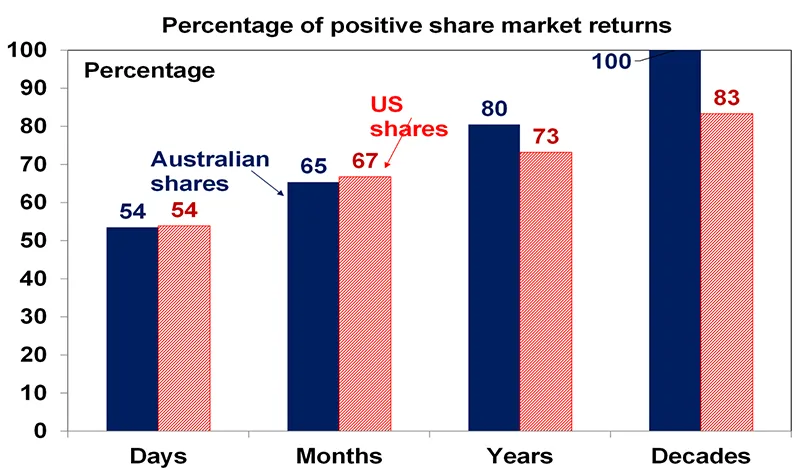
    Percentage of positive share market returns

    Daily & monthly data from 1995, data for years and decades from 1900. Source: Bloomberg, AMP

    Being exposed to this very short term “noise” and the chatter around it can cause investors to have a greater exposure to lower returning but safer investments that won’t grow wealth. The trick is to turn down the noise and have patience. Evidence shows that patient people make better investors because they can look beyond short-term noise and are less inclined to jump into one investment after another after they have already had their run.

    Mistake #7 – Making investing too complex

    “There seems to be a perverse human characteristic that makes easy things difficult.” Warren Buffett

    With the increasing ease of access to investment options, ways to put them together and information & processes to assess them, investing is getting more complex. But when you overcomplicate your investments, it can mean that you can’t see the wood for the trees. You can spend so much time focussing on this stock or ETF versus that stock or ETF or this fund manager versus that fund manager that you ignore the key driver of your portfolio’s risk and return which is how much you have in shares, bonds, real assets, cash, onshore versus offshore, etc. Or that you end up in things you don’t understand. Instead, it’s best to avoid the clutter, don’t fret the small stuff, keep it simple and don’t invest in things you don’t understand.

    Mistake #8 – Too conservative early in life

    “Compound interest is the eighth wonder of the world. He who understands it, earns it…he who doesn’t, pays it.” Albert Einstein, theoretical physicist

    Cash and bank deposits are low risk and fine for near term spending requirements and emergency funds, but they won’t build wealth over time.

    The chart below shows the value of $1 invested in various Australian assets since 1900 allowing for the reinvestment of interest and dividends along the way. That $1 would have grown to $955,656 if invested in shares but only to $263 if invested in cash. Despite periodic setbacks, shown with arrows (such as WWI, the Great Depression, WWII, stagflation in the 1970s, the 1987 share crash & the GFC), shares and other growth assets grow to much higher values over time thanks to their higher returns over the long term than cash and bonds and thanks to the magic of compound interest where higher returns build on higher returns through time.
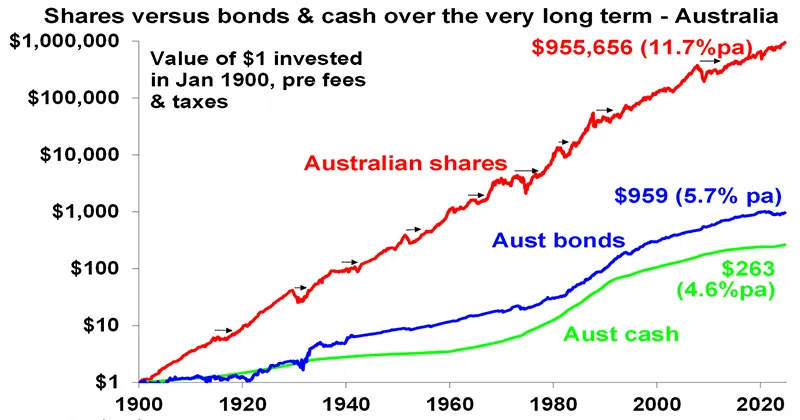
    Shares vs bonds cash over the very long term Australia

    Source: ASX. Bloomberg, RBA, AMP

    Not having enough in growth assets early in their career can be a problem for investors as it can make it harder to adequately fund retirement later in life as they miss out on the magic of compounding higher returns on higher returns through time in growth assets like shares and property. Fortunately, compulsory superannuation in Australia helps manage this – although early super withdrawal for various purposes (through the pandemic, for medical needs and as proposed for housing) may set this back for some. For example, a 30 year old who withdraws $20,000 from their super could have around $184,000 (or $74,000 in today’s dollars) less when they retire at age 67 based on assumptions in the ASIC MoneySmart Super Calculator.

    Mistake #9 – Trying to time the market

    “Far more money has been lost by investors in preparing for corrections, or anticipating corrections, than has been lost in the corrections themselves.” Peter Lynch, fund manager

    In the absence of a tried and tested process, trying to time the market, ie, selling before falls and buying ahead of gains is very difficult. Many of the mistakes referred to above kick in and it can be a sure way to destroy wealth. Perhaps the best example of this is a comparison of returns if the investor is fully invested in shares versus missing out on the best days. Of course, if you can avoid the worst days during a given period you will boost your returns. But this is very hard and many investors only get out after the bad returns occur, just in time to miss out on some of the best days and so hurt their returns. If you were fully invested in Australian shares from January 1995, you would have returned 9.5% pa (including dividends but not allowing for franking credits). But if by trying to time the market you miss the 10 best days the return falls to 7.5% pa. If you miss the 40 best days, it drops to just 3.5% pa. Hence, it’s time in the market that’s the key, not timing the market. The last two years provide a classic example of how hard it is to time markets – there has been a long worry list, so it’s been easy to be gloomy but timing markets on the back of this has been a loser as shares put in strong gains.


    Bill’s Conclusion

    At Sydney Financial Planning , we help coach clients on what to do and what to avoid.

    If you do not have a regular review with your Financial Planner, call us today.

    Bill Bracey
    CEO & Founder of Sydney Financial Planning


    Do your financial goals align with your risk tolerance?

    Arrange a meeting with one of our Financial Planners to help avoid common investment mistakes, either book a meeting or get in contact with us on 02 9328 0876.


    This article was prepared by Dr Shane Oliver with opening and closing summary by William Bracey – CEO & Senior Financial Planner from Sydney Financial Planning. Dr Shane Oliver who provides economic forecasts and analysis of key variables and issues affecting, or likely to affect, all asset markets. He also provides economic forecasts and analysis of key variables and issues affecting, or likely to affect, all asset markets.

    Sydney Financial Planning Pty Ltd (ABN 29 606 413 254), trading as Sydney Financial Planning & Illawarra Financial Planning is an Authorised Representative & Credit Representative of Charter Financial Planning Limited, Australian Financial Services Licensee and Australian Credit Licensee.

    This article contains information that is general in nature. It does not take into account the objectives, financial situation or needs of any particular person. You need to consider your financial situation and needs before making any decisions based on this information. If you decide to purchase or vary a financial product, your financial adviser, and other companies within the AMP Group may receive fees and other benefits. The fees will be a dollar amount and/or a percentage of either the premium you pay or the value of your investments. Please contact us if you want more information. If you no longer wish to receive direct marketing from us you may opt out by contacting Sydney Financial Planning . You may still receive direct marketing from AMP as a product issuer, bringing to your attention products, offerings or other information that may be relevant to you. If you no longer wish to receive this information you may opt out by contacting AMP on 1300 157 173.


    Improve your financial wellness

    7 tips to improve your financial wellness

    Improve your financial wellness

    This can be measured by the financial wellness index, which measures a person’s satisfaction with their current and future financial situation.

    Some days you might feel confident you can meet your needs within the boundaries of your current income, whereas other days you may feel like you don’t have nearly enough funds in order to do so.

    The truth is, you’re not alone. Nearly 2.5 million Aussies say they feel moderately to severely financially stressed, even though financial stress has been decreasing year-on-year in Australia.i

    Improving your financial wellbeing

    On a positive note, research identified that those who have been financially stressed in the past were often able to recover through changes to their behaviour and mindset.ii

    Here are some suggestions of things you could do (if you aren’t already) which may help you to improve how you feel financially.

    1. Create a budget that works for you

    When it comes to creating a budget, try jotting down into three categories – what money is coming in, what cash is required for the mandatory stuff (such as bills), and what dough might be left over (which you may want to put toward existing debts, savings or your social life).

    Writing up a budget may take an afternoon out of your diary, but it will help you to more easily identify where there’s room for movement. For instance, could you reduce what you’re spending on luxury items, subscription or streaming services, eating out or clothing?

    2. Consider rolling your debts into one

    If all the small debts you once had, have multiplied and grown into bigger debts – you could look to roll them into a single loan, and reduce what you pay in fees and interest.

    This could help you to save a significant amount of money (depending on what you owe) and make it easier to manage your repayments, as you’ll potentially only need to make one monthly repayment rather than having to juggle several.

    The main thing to ensure is you are paying less than what you are currently when it comes to interest rates, fees and charges, and that you’re disciplined about making your repayments.

    3. Try to save a bit of money regularly

    Even a small amount of cash deposited on a frequent basis could go a long way toward your savings goals, with a separate research report indicating the average savings target for Aussies is a bit over $11,000.iii

    Some tips people said helped them along the way was transferring spare funds into an actual savings account, setting up automatic transfers to their savings account (so they didn’t have to move money manually) and putting funds into an account which they couldn’t touch.iv

    4. Set aside some emergency cash

    With research showing that an emergency fund of between $4,000 and $5,000 is generally enough to cushion most working Aussies when it comes to unexpected expenses, it’s probably worth some thought.v

    An emergency stash of cash could give you peace of mind and reduce the need to apply for high-interest borrowing options should you be faced with a busted phone, car tyre, or bad landlord.

    5. Be open to talking money with your partner

    One in two Aussie couples admit to arguing about money,vi so if you haven’t already, it might be worth sitting down to ensure you’re on the same page and that both parties’ goals are being considered.

    6. See if you can get a better deal with your providers

    You more than likely have several product and service providers, and figures show you could save more than a grand annually on energy alone just by switching from the highest priced plan to the most competitive on the market.vii

    Again, this may take a couple of hours out of your day, but the savings you could potentially make may make a real difference to what you cough up throughout the year.

    7. Don’t be afraid to seek financial assistance

    If you are struggling to make repayments, you may be able to seek assistance from your providers by claiming financial hardship.

    All providers must consider reasonable requests to change their terms in instances where you may be suffering genuine financial difficulties and feel help would enable you to meet your repayments, possibly over a longer period.

    Of course it also helps to have an expert on your side and we are here to support you to achieve and maintain financial wellness.


    Need a hand with your financial wellness?

    For more help and strategies on identifying your feelings on financial wellness, speak to your financial planner at SFP. Or if you don’t have a planner yet let us arrange an appointment, contact us on 02 9328 0876.


    i, ii, v AMP’s 2018 Financial Wellness in the Australian Workplace Report, pages 7, 8, 14

    iii, iv MoneySmart – How Australians save money infographic

    vi Finder – Heated conversations: 1 in 2 Aussie couples argue about finances paragraph 1

    vii Mozo – Sick of high energy bills? Aussies willing to change providers could be saving over $1,000 a year paragraph 2

    Article by © AMP Life Limited. First published October 2019

    General Disclaimer: This article contains information that is general in nature. It does not take into account the objectives, financial situation or needs of any particular person. You need to consider your financial situation and needs before making any decisions based on this information. Please seek personal financial advice prior to acting on this information.


    Reboot retirement - consider what makes you happy

    Rebooting for retirement

    Reboot retirement - consider what makes you happy

    1. Think mind and body

    Without a clear idea of how you’ll spend your time, the initial euphoria of the untouched morning alarm can give way to anything from boredom to panic. Most of your 24 hours may be unstructured, so figure out how you’ll spend it wisely.

    You might try something new. Perhaps now is the time to keep bees, join a choir or learn archery. If you have a partner, remember to involve them in the planning. Even if they don’t fancy joining you on a skydive, they may see a chance to learn how to take better action pictures.

    Travel is near the top of many wish lists in retirement. If you don’t have the funds for a Caribbean cruise, there are a host of cheaper options around Australia and even beyond. And now you’ll have more time to spend, without worrying about annual leave quotas, or who’ll look after your business while you’re away.

    2. Have a purpose

    A rest is as good as a change. Although it’s great to have unstructured time to think and dream, boredom can be a damaging state of mind, particularly if it’s prolonged.

    If you’re already physically active, this can be a great time to extend yourself, embrace something new like yoga, or aqua aerobics. If you’re healthy but know you could improve, you might sign up for a sponsored cycle ride or walk to help a cause you care about.

    3. Catch up on what you’ve missed

    Many of us put off expanding our passions while we’re working because we don’t have time.

    If you’ve always wanted to read the classics, now might be your chance to explore the jewels of world literature. Reading is brain expanding and inexpensive. Books older than 70 years from the death of the author are out of copyright and therefore cheap in print or even free on your Kindle.

    4. Follow your heart, not the herd

    Many people downsize coming up to retirement. A smaller property usually means lower utility bills and maintenance.

    But it’s not for everyone. If your spare bedroom has the right natural light for your artist’s studio or you just love your lemon trees, you might be better off staying where you are and saving yourself the real estate fees and hassles.

    You’re facing a change in life, but you don’t have to change for change’s sake. Put yourself and your loved ones first.

    5. Listen to the voice of experience

    As with so many things in life, you can learn from experts. Talk to people you know who have already retired, and see what worked for them, and what they wish they’d put in place before they took the plunge.

    Consider what will make you happy in the years beyond work, so you can live the life you want. Finally,if you haven’t yet given these things serious thought yet, don’t panic. You’ve dealt with other changes in your life, this is just another one.

    Think of it as a new adventure. Let’s face it, you’ve earned it.


    Do you have a new adventure in mind?

    For more help and strategies on identifying what your retirement plans look like, speak to your financial planner at SFP. Call us to arrange an appointment, contact us on 02 9328 0876.


    Article by © AMP Life Limited. First published 10 October 2019

    General Disclaimer: This article contains information that is general in nature. It does not take into account the objectives, financial situation or needs of any particular person. You need to consider your financial situation and needs before making any decisions based on this information. Please seek personal financial advice prior to acting on this information.


    Financial stress keeping us awake

    Financial stress keeping you awake at night?

    Financial stress keeping us awake

    According to the Financial Fitness Whitepaper, almost 57% of Australians are worried about their current financial situation and 85% say it impacts their wellbeing.1

    Generation Z AKA the iGen

    The youngest generation are most concerned about covering everyday expenses2, such as food and transport. According to the Australian Bureau of Statistics3, the cost of living continues to rise, which just adds to financial woes. Also, research produced by the Financial Planning Association4 notes that the ease of cashless transactions is hindering the youngest generation and those to come.

    Millennials

    Generation Y (millennials) are those who are doing it the toughest when it comes to financial stress. For many millennials, it’s work-related stress that keeps them up at night, as well as fears they won’t have enough money for retirement and pressure associated with property prices.5

    Generation X

    With worries about at least one financial issue at any given time, Generation X are losing sleep over the ability to pay living expenses and what the future holds financially.6

    Baby Boomers

    While many would believe Baby Boomers are the most well-off generation, they are struggling with the stress of health care and insurance bills, as well as retirement savings.2

    What to do

    Everyone suffers from it in some varying degree, but stress is one of the worst things for our health, especially our sleep. Poor sleep can lead to weight issues, poor concentration and productivity, and can create a greater risk of heart disease and stroke. It’s also linked to diabetes, depression and lower immunity. Sleep is important. Don’t let your financial stress affect your quality of life.

    Sorting through your financial stress is just one way you can get better quality sleep. We can help set up a financial plan, find ways to ease the tension and strategise for the future.


    Let us help you get better sleep and ease the stress.

    Speaking with one of our financial advisors is a good place to start. Make a booking or call us on 02 9328 0876 to arrange a meeting.


    1: Mortgagechoice.com.au. (2019). Financial Fitness Whitepaper. Available at: https://www.mortgagechoice.com.au/about-us/insights/financial-fitness-whitepaper-2019/ [Accessed 28 Oct. 2019].
    2: McDowell, E. (2019). Money problems are keeping every generation up at night — check out the biggest financial stressors for every age group. Business Insider Australia. Available at: https://www.businessinsider.com.au/biggest-financial-problems-facing-each-generation-2019-6 [Accessed 28 Oct. 2019].
    3: Abs.gov.au. (2016). Media Release – Inflation continues to be subdued (Media Release). [online] Available at: https://www.abs.gov.au/ausstats/abs@.nsf/lookup/6401.0Media Release1Dec 2016 [Accessed 28 Oct. 2019].
    4: Erem, C. (2018). The ‘invisible-money generation’ may be in financial trouble, says Financial Planning Association. Mozo.com.au. Available at: https://mozo.com.au/debit-cards/articles/the-invisible-money-generation-may-be-in-financial-trouble-says-financial-planning-association [Accessed 28 Oct. 2019].
    5: Banney, A. (2018). Financial stress keeping Australians awake at night. finder.com.au. Available at: https://www.finder.com.au/financial-stress-keeping-australians-awake-at-night [Accessed 28 Oct. 2019].
    6: https://s3.mapmyplan.com.au. (2015). The financial fitness of working Australians. Available at: https://s3.mapmyplan.com.au [Accessed 28 Oct. 2019].

    General Disclaimer: This article contains information that is general in nature. It does not take into account the objectives, financial situation or needs of any particular person. You need to consider your financial situation and needs before making any decisions based on this information. Please seek personal financial advice prior to acting on this information.


    Australian's are a generous nation

    Australia is a generous nation

    Australian's are a generous nation

    Australia is a generous nation. We love to give gifts. It brings us joy.

    When we spend, we go big: $19.8 billion AUD is spent on gifts by Australians each year, or an average of $100 each month ($1,200 per year).

    That’s more than buying a $4 coffee every weekday, getting our shirts dry cleaned daily, or what we spend, on average, on mobile phone plans. Gen Y spend more on gifts than any other generation: $130 each month ($1,560 per year).

    Here’s what the average Australian adult spends on gifts for loved ones each year:

    • $437 for our spouse or partner,
    • $361 for each of our children,
    • $201 per parent, and
    • $115 for our pet.

    Women are more generous towards their spouses or partners than men ($454/ year compared to $419/year), but men are spending $22 more per month on gifts than women in general.

    Younger adults spend more than older adults (see table). Almost $20 billion spent on gifts each year


      Gen Z
    (18-24)
    Gen Y
    (25-39)
    Gen X
    (40-54)
    Boomers
    (55-73)
    Average gift spending per month $91 $130 $87 $89


    We find joy in giving

    Experts in psychology generally agree that the altruistic act of giving has neural and emotional benefits. These range from elevated activity in regions of the brain associated with pleasure, social connection, and trust, all the way through to lowering blood pressure and stress levels.

    So it’s a good thing most of us find joy in giving. Most Australians (85%) say they get more joy giving gifts to others than in receiving gifts themselves.

    Females find particular joy in giving (88% find greater joy in giving than receiving, compared to 83% of males).

    Older Australians gain the greatest joy: 90% of Baby Boomers say they get more joy in giving than receiving, as do 84% of Gen X, 84% of Gen Y and 78% of Gen Z.

    Gifts for our Pets

    74% of Australian pet owners buy gifts for their pet.

    Those who do spend an average of $115/year on gifts for their pet.  Pushing the average higher are Gen Ys who spend $121/year and Gen X who spend $142/year.

    Generous to a fault

    73% of Australian’s don’t budget for gifts!

    Disturbingly, a significant proportion of the $19.8 billion spent on gifts each year in Australia is not accounted for in household budgets. In fact, three in four of us (73%) do not have a budget allocation for gifts. Men are less likely than women to allocate a budget towards gift-giving (24% men cf. 31% women).
    Those least likely to budget for gifts are older families, couples and older singles, of whom 79% don’t have a budget allocation for gifts.

    Surprisingly, the vast majority of us are happy with the amount we spend on gifts. Just one in eight of us (13%) feel we spend too much on gifts, while most of us (81%) feel we spend about the right amount.

    The discrepancy between a high unplanned household spend and a satisfaction with that spend indicates an opportunity to improve our financial literacy and awareness of the benefits of budgeting, planning, and giving in a way that brings joy without debt or regret.

    How do we decide how much to spend?

    If we don’t budget or plan for gifts, how do we decide how much to spend?

    The top three decision-drivers that inform how much we choose to spend on a gift are:

    1. How close we are to the recipient (59% selected this)
    2. How special the occasion is (58%); and
    3. Our budget at the time (55%).

    The FPA “Gifts that Give” national survey of Australians reveals some truly fascinating insights into how we think, buy, plan and spend our money on those we love the most. Did you know Australia is a generous generation and spends nearly $20 billion a year on gifts? This 19-page report is a fascinating read and a great conversation starter with friends and families.

    Download the Goodness of Giving eBook.

    Download the full report – Gifts that Give.


    Does the report findings raise some questions on your gift-giving budgeting?

    Why not arrange to meet with one of our planners to do a budget review. Make a booking or call us on 02 9328 0876 to arrange a meeting.


    1 Assuming drycleaning fee of $15 for five shirts, 52 weeks per year. Australians spend an average of $77/month on mobile phone plans, according to Canstar Blue research.

    Aricle by FPA Gifts that Give Research Report

    General Disclaimer: This article contains information that is general in nature. It does not take into account the objectives, financial situation or needs of any particular person. You need to consider your financial situation and needs before making any decisions based on this information. Please seek personal financial advice prior to acting on this information.