Tag: Financial Behaviour

Pocket money for kids?

Pocket money for kids?

Pocket money for kids?

Instead, try this.

Split the money for them into three pockets:

Spend pocket (40%)

Spend as usual now (lollies, toys etc.), pay for anything immediate. The key here is to allow them to buy whatever they want with this money. They are in charge of it. If they spend it all at once, they will have none left. Slowly introduce the basic save-spend conversation. Kids will learn the spending fundamentals fast.

TIP: Point out to them that once the money is spent, it’s gone forever. 

Save pocket (30%)

Save for something big in the shorter timeframe, spend later.
Teaches them the concept of saving and having more to spend in near future. A more advanced version of this allows them to spend only half of what they saved, always keeping some money in the account.

TIP: Good old piggy works a treat here. Can be placed in their room. Point out to them that if they resist the temptation of spending all now, they will benefit from having visibly more later.

Invest pocket (30%)

Put away and invest to benefit from in 10 + years’ time (ideally buy and hold and never sell). This account should only allow only type of one transaction – buy.  It can form an education plan, a property deposit plan or anything long term.

TIP: Must be set up as Automatic Direct Debit. Point out to them that every dollar saved and invested will produce income for as long as we keep it.

This approach teaches kids to split their income purposely for different reasons, just like the grown-ups do when they get paid. Don’t get lost in options, the key is to pick one you can stick with or seek our professional advice


Maybe your re-evaluating your own saving habits?

Speaking with a financial planner and reviewing your own financial behaviour to better guide your kids may help. Make a booking or call us on 02 9328 0876 to arrange a meeting.


Article by Michal Bodi | Senior Financial Planner


General Disclaimer: This article contains information that is general in nature. It does not take into account the objectives, financial situation or needs of any particular person. You need to consider your financial situation and needs before making any decisions based on this information. Please seek personal financial advice prior to acting on this information.


 

Be aware of your money biases

Be aware of your money biases

Be aware of your money biases

Six cognitive biases that influence how we save, spend and invest money

We like to think we’re rational beings. But the reality is that a lot of our daily behaviour is influenced by our subconscious. 

Behavioural scientists have looked at the way human beings are wired and discovered some ‘cognitive biases’ that influence our everyday behaviour.i 

Here are a few of their insights into how our minds work. 

1. We tend to discount the future

We value immediate rewards over rewards in the distant future. This tendency to want instant gratification is hard wired from birth. Studies have shown that children find it hard to stop themselves eating a treat even when a bigger and better treat is offered for those who wait for a few minutes. And ‘discounting the future’ doesn’t stop when you reach adulthood. It could explain why it’s hard to get too excited about saving for your retirement in your 20s. But the earlier you start planning, the more you’ll be able to put away. 

2. We tend to feel the pain of a loss more than the pleasure of a gain

You can see an extreme example of this sort of behaviour at the casino when gamblers chase their losses. This ‘loss aversion’ can also manifest itself in continuing to commit to a poor investment because you’ve already put a lot of money into it. It can help to think long term and avoid focusing on short-term fluctuations in the value of your investments. 

3. We tend to follow the herd

Much as we like to think of ourselves as independent human beings, we tend to look to others for affirmation. Think about the rush to secure seats for the concert when you know that everyone else is using the online booking system. This sort of ‘herd mentality’ can work in a positive way. When it comes to money, this ‘herd mentality’ can manifest itself after stock market downturns, when investors start panicking and selling up, even though rationally this will crystallise their losses. It can help to shut out daily market noise and focus on long-term goals. 

4. We tend to think things are more likely to happen than they are

You can see this in the popularity of lotteries around the world. While the chances of winning are infinitesimal, the winners get a lot of publicity, which makes us think it’s more likely to happen. But at least the lottery is relatively harmless. Thanks to the global mass media, this ‘availability bias’ often focuses on bad events like kidnapping, plane crashes or stock market downturns. Investors who experience a market crash like the GFC over-estimate the chances of the same thing happening again, even though statistically it’s unlikely. It can lead to people saving for retirement changing their investment preferences to lower risk investments, even though this may not be in their best interests as their long-term returns struggle to keep pace with inflation. 

5. We tend to favour recent reference points when making decisions

This ‘anchoring bias’ can make it easy to overspend in shopping malls. When you first see a pair of shoes for $200 and then a similar pair for $150 it’s easy to anchor on the first amount and perceive $150 as a great bargain. And these days it doesn’t stop when you leave the mall—online shopping means plenty more opportunities for that anchor to embed itself and end up in an unwanted purchase. To counter this, try setting your own ‘base price’ before you set out shopping and stick to it. You can also see anchoring in practice when investors rush in to buy stocks that have just plunged in value without looking at the underlying performance of the company. They have made the mistake of anchoring the recent high point in their mind. 

6. We tend to be a bit lazy

We tend to stick with current plans rather than change if it’s too much hassle. This is probably why so many of us stay with our utility providers rather than shopping around for a better deal. If you find yourself suffering from ‘status quo bias’, try making a start with one area of the household finances—say, your electricity bill—to make it more manageable, rather than trying to tackle everything at once. 


Do you need help to put a saving strategy together?

Speaking with one of our financial advisors would be a good place to start. Make a booking or call us on 02 9328 0876 to arrange a meeting.


i Source: Thinking, Fast and Slow by Daniel Kahneman; Nudge: Improving Decisions About Health, Wealth, and Happiness by Richard Thaler and Cass Sunstein; Predictably Irrational: The Hidden Forces That Shape Our Decisions by Dan Ariely.

Article by: ©AMP Life Limited. First published March 2019

General Disclaimer: This article contains information that is general in nature. It does not take into account the objectives, financial situation or needs of any particular person. You need to consider your financial situation and needs before making any decisions based on this information. Please seek personal financial advice prior to acting on this information.


Day One - Budgeting

How to turn One Day to Day One – Budgeting

Day One - Budgeting

We’ve heard it all before. It’s not that we don’t want to take control of our money. I mean it makes sense – we all work so hard for it, it would make sense to know what happens to it once it hits our bank account. Even better if it went to all the right places. 

But the reality is, it JUST GETS TOO HARD!!!

That is all true, but…you don’t have to go from zero to 100 in one day. You can just start somewhere basic, get used to it, then move on once you’re comfortable. Doing something is always better than doing nothing. 

Here’s something you can do today, 5 simple steps:

Step 1 – think about all the reasons why you think you should get in charge of your money

Would it mean more cash for travelling? Would it make you less stressed? Maybe more fun money for going out? Maybe just have a regular cash reserve so you don’t have to dip into your credit card every time? Maybe it’s time to finally start paying off some debts…?

Whatever it is, you need to be clear on these reasons. Once you have the clarity, write it all down. (make sure you don’t skip this step, writing down is an important step).

Step 2 – think about all the stuff you just wrote down

 Rate all the reasons based on their importance. Are some of them more important than others? What would it mean to never achieve some of them? How would it make you feel? 

Step 3 – time to pause and think.

 You’ve just articulated all the reasons why you want to be in control, and how bad you’d feel if you never got there. It’s time to ask yourself – What have I done about it so far?

Step 4 – if the answer to the last question is ‘Not much’, what do you think you should do now?

Are you really going to change something after reading an article like this? That’s right. Knowing we should do something doesn’t mean we actually end up doing it. It’s human nature. Well, if you won’t change something, nothing will change. You know you won’t do it alone.

Step 5 – Ask for help

Asking for help isn’t a weakness. It’s called being smart and doing something different to people around us. It’s the only way not to end up like everyone else around us.

Procrastinating, getting distracted, being busy – it’s all human but it all stands in your way to move ahead. It’s ok to ask for help, it’s ok to talk to a third-party financial expert. They’re not going to bite your head off and I can promise you one thing – you’ll know you when you find the right one. You’ll look back one day and go ‘what took me so long!?’.

If you change nothing, nothing will change. Change ONE DAY… to DAY ONE!


Do you need some help with creating a new day one?

Send us a message if you want to ask anything. Make a booking or call us on 02 9328 0876 to arrange a meeting.


Article by Michal Bodi | Senior Financial Planner

General Disclaimer: This article contains information that is general in nature. It does not take into account the objectives, financial situation or needs of any particular person. You need to consider your financial situation and needs before making any decisions based on this information. Please seek personal financial advice prior to acting on this information.

10 ways to enjoy summer without spending a fortune

If you’ve been saving for something big or are just cringing at the thought of how you’ll keep your budget intact over summer, don’t freak out yet. There are plenty of ways you can still have fun without spending all your savings or racking up serious debt on your credit card.

How to take on summer without spending a fortune

1

Diarise your upcoming events

Knowing what’s happening and how much you’re likely to fork out will help you to manage your cash and allocate what you need for each occasion.

2

Take turns entertaining at home

This can significantly reduce the money you and your mates spend on eating out, particularly if everyone is happy to bring their favourite signature dish, juice of choice or fruit sorbet when temperatures are running high.

3

Make the most of the warm weather

Hit the beach, head to the local playground, or pack a picnic basket and enjoy a barbecue at a nearby park. It won’t involve entry fees and depending where you go, you could load up the fishing rods or even a footy for a friendly game.

4

Look out for meal and beverage specials

There are plenty of places where you can find two-for-one offers and other great deals. Websites like TheHappiestHour can give you some ideas and you may even find some new alfresco venues you haven’t been to along the way.

5

Travel smart

Carpool, get a lift, catch public transport, or ride a bike. Too many Taxis and Ubers can drain funds, particularly if you’re not keeping a record of how often you use them.

6

Cut accommodation costs

Bunk with mates, house-sit, swap accommodation, volunteer your skills for a place to stay, or have a staycation where you check out attractions close to home.

7

Search for holiday deals online

Look at comparison websites for flights, accommodation and transport. Doing your homework can often mean more spending money in your pocket.

8

Stick to using cash as much as possible

When you pay in cash, there’s no risk of you having to pay added interest charges. Plus, leaving your cards at home means you’re less likely to go over your budget as you can’t say—I’ll just take out another $100.

9

Trade with friends

If you’ve got more outings than outfits lined up, rather than hit the shops, borrow something from a mate. It doesn’t have to stop with clothes either. You could exchange homes for the week, swap movies, or trade sporting gear like bikes and fishing rods.

10

Research free events

Look up what’s on in your local area. There are often a variety of things happening over summer, such as food and wine festivals, street fairs and markets.

Whatever your agenda over summer, it’s important to have a realistic plan when it comes to your money. Give yourself some room for movement and still aim to avoid that financial hangover.


Is it time to get some extra help with your money mangement?

Why not book an appointment to discuss your situation with one of our advisors, contact us on 02 9328 0876.


Article by – © AMP Life Limited.

Love and money? It’s not about control

Our approach to managing household finances can make a big difference to the health of a relationship. Thankfully, the old line about “I earn the money. She spends it” no longer has relevance in modern relationships. Today’s lifestyles, housing commitments and our career ambitions mean that in many households both adults work, each making a valuable contribution to overall income.

Yet the question of who controls the purse strings continues to throw up some interesting responses. There’s no shortage of research on this issue, and the general gist is that the majority of men say they make the financial decisions in a household while the majority of women believe they control the money. Confusing, right?

Harness the power of two

The thing is, the real issue shouldn’t be who controls the cash but rather how you manage your finances as a couple.

This is an area where there are plenty of variations, and there’s no right or wrong approach. Some couples like to maintain almost entirely separate financial lives by only pooling money where necessary to pay the mortgage or rent and other shared bills. Others maintain a joint account, pooling most or part of each individual pay packet to cover household expenses, and holding only a limited quantity of cash in individual accounts to cover personal spending like hobbies or treats.

Exactly how you run your system is entirely a matter of choice, and it is a case of determining what works best for you and your partner. Maintaining multiple bank accounts can mean paying more in bank fees though this can be a small price to pay if it gives you both a degree of financial independence – this in itself can be a relationship saver.

Know what works for you

There is virtually no limit to the options available to divide and share a household’s combined income and expenses. What matters is that you take the time to devise a system that works for you. Be prepared to fine-tune your approach, or scrap it altogether, if it isn’t living up to expectations. The whole point of the exercise is to work as a team.

At the very least, both parties of a couple should know where household money is being spent. Having a clear idea of your combined financial position could stand you in good stead – and help you avoid unpleasant surprises if the relationship ever hits the rocks.

In our experience though, working together to achieve shared financial goals can really strengthen a relationship over time.

Contact us for a tailored plan of action that can help you and your spouse or partner achieve financial harmony – and harness the power of two.


Need some help getting started?

Why not book an appointment to discuss any aspects or questions on setting up your financial lives together, contact us on 02 9328 0876.


Article by – Paul Clitheroe AM
Paul Clitheroe AM, co-founder and Executive Director of ipac securities limited, Chairman of the Australian Government Financial Literacy Board and Chief Commentator for Money magazine.

General Disclaimer: This article contains information that is general in nature. It does not take into account the objectives, financial situation or needs of any particular person. You need to consider your financial situation and needs before making any decisions based on this information. Please seek personal financial advice prior to acting on this information.
 

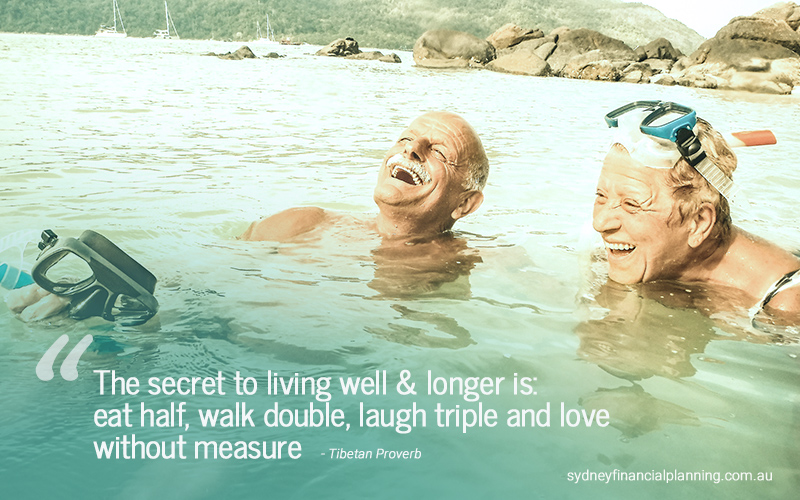
Lessons from the blue zones: secrets of a long life

We explore how to live longer and uncover the Blue Zones’ secrets of a long life.

There are five global hotspots where researchers have identified that people live longer, healthier lives than the rest of us. Known as the Blue Zones they are:

  • Okinawa, Japan
  • Sardinia, Italy
  • Nicoya, Costa Rica
  • Ikaria, Greece
  • Loma Linda, California.

What’s their secret?

These communities each have a high rate of residents over 100 years old, suffer less of the diseases that commonly affect people in other parts of the developed world, and enjoy more years of healthy life.

The formula for these fountains of youth appears to be the following nine lifestyle habits. While some are obvious, others might surprise you…i


1

Move:

We all know exercise is good for us, but this isn’t about pumping iron or running marathons. It’s about staying active through regular, everyday movements like doing the housework, gardening and walking.

2

Have a sense of purpose:

It could be anything, but knowing why you get out of bed in the morning is identified as a contributor to a healthier life and can add up to seven years to your life expectancy.

3

Reduce stress:

It isn’t that Blue Zone residents don’t experience stress, it’s about what they do to relieve it. While their methods range from prayer to napping to practicing mindfulness, what’s common is that they prioritise stress relief.

4

Eat less:

Instead of overindulging, Blue Zone residents stop eating before they’re full. They also eat their smallest meal by early evening, and don’t eat for the rest of the day.

5

Eat less meat:

This one comes as no real surprise given the links between meat consumption and cancer, but most of the Blue Zone residents are semi-vegetarian, favouring beans, legumes, fruit and vegetables over meats.

6

Drink alcohol:

Blue Zone researchers found it’s ok to drink regularly, as long as it’s in moderation (1-2 glasses a day), and alcohol is consumed with friends and/or food.

7

Spirituality or religion:

It seems the sense of belonging to a faith or belief-based community – regardless of the belief – is beneficial to health. Research shows that attending faith-based services four times per month can add from four to 14 years to your life expectancy.

8

Put family first:

Blue Zone residents commit to a life partner – which can add up to three years to life expectancy, and have a strong sense of family, from caring for their aging relatives to nurturing their children.

9

Have a tribe:

Be it your family or friends, having a social circle that combats loneliness and encourages good habits such as being active, positive and not smoking is good for longevity.

Funding a long and happy retirement

Living longer means you might need more money to fund your retirement or you may need to stretch the money you have further. If you’re worried you might outlast your money we can help you to maximize your wealth and manage your finances accordingly.

Whatever your agenda over summer, it’s important to have a realistic plan when it comes to your money. Give yourself some room for movement and still aim to avoid that financial hangover.


Are you worried you might outlast your money?

We are always here to help and can review your personal situation with you. Make a booking with one of our financial planners or call us on 02 9328 0876.

i https://www.bluezones.com/2016/11/power-9/

Article by AMP Life Limited

General Disclaimer: This article contains information that is general in nature. It does not take into account the objectives, financial situation or needs of any particular person. You need to consider your financial situation and needs before making any decisions based on this information. Please seek personal financial advice prior to acting on this information.