Tag: Financial Planning

Get more from your salary or bonus

Smart super strategies for this EOFY
Get more from your salary or bonus

1. Add to your super – and claim a tax deduction

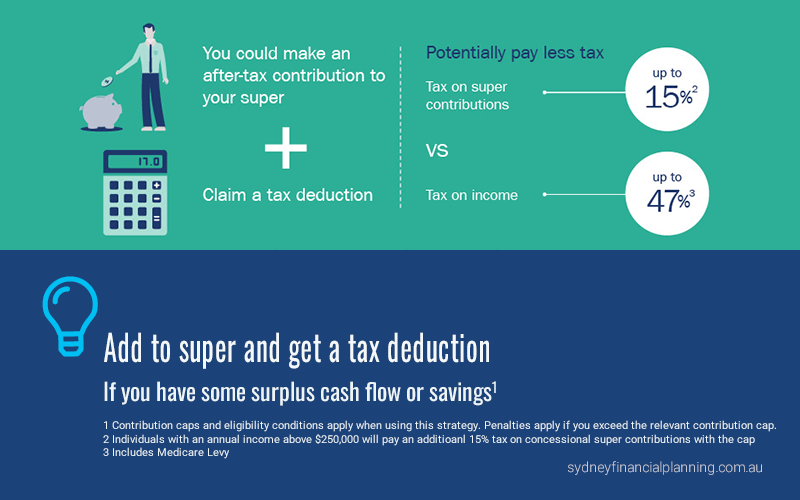
If you contribute some of your after-tax income or savings into super, you may be eligible to claim a tax deduction. This means you’ll reduce your taxable income for this financial year – and potentially pay less tax. And at the same time, you’ll be boosting your super balance.

How it works

The contribution is generally taxed at up to 15% in the fund (or up to 30% if your income from certain sources is $250,000 or more). Depending on your circumstances, this is potentially a lower rate than your marginal tax rate, which could be up to 47% (including the Medicare Levy) – which could save you up to 32%. Once you’ve made the contribution to your super, you need to send a valid ‘Notice of Intent’ to your super fund, and receive an acknowledgement from them, before you complete your tax return, start a pension,or withdraw or rollover the money.

Keep in mind that personal deductible contributions count towards your concessional contribution cap, which is $27,500 for the 2021/22 financial year. However, you may be able to contribute more than that without penalty if you didn’t use the your entire concessional cap in financial years since 1 July 2018 and are eligible to make ‘catch-up’ contributions.

Concessional contributions also include all employer contributions, including Superannuation Guarantee and salary sacrifice. Other eligibility rules may also apply so speak to your financial adviser for more information.

2. Get more from your salary or a bonus

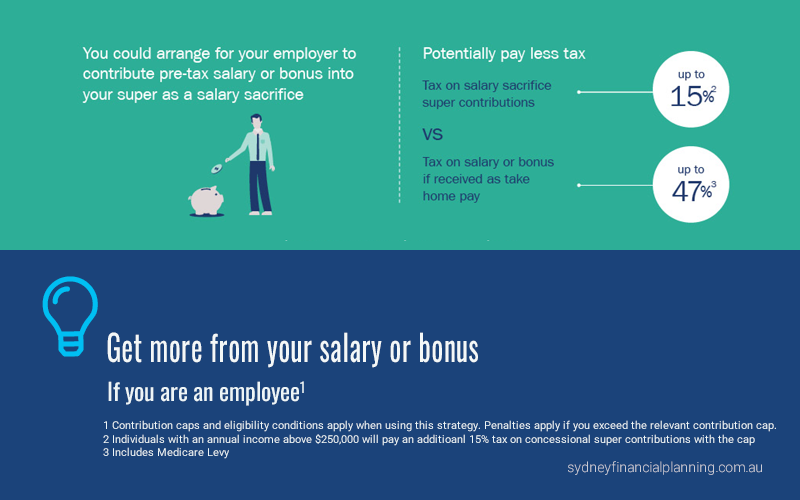
If you’re an employee, you may be able to arrange for your employer to direct some of your pre-tax salary or a bonus into your super as a ‘salary sacrifice’ contribution.

Again, you’ll potentially pay less tax on this money than if you received it as take-home pay – generally 15% for those earning under $250,000 pa, compared with up to 47% (including Medicare Levy).

How it works

Ask your employer if they offer salary sacrifice. If they do, it can be a great way to help grow your super tax-effectively because the contributions are made from your pre-tax pay – before you get a chance to spend it on other things.

You can only salary sacrifice amounts that you’re not yet entitled to receive. This includes both your regular salary, and any entitlement to a bonus.

Remember salary sacrifice contributions count towards your concessional contribution cap, along with any superannuation guarantee contributions from your employer and personal deductible contributions. Also, you may be able to make catch up (extra) contributions if your concessional contributions were less than the annual concessional cap since 1 July 2018.

3. Convert your savings into super savings

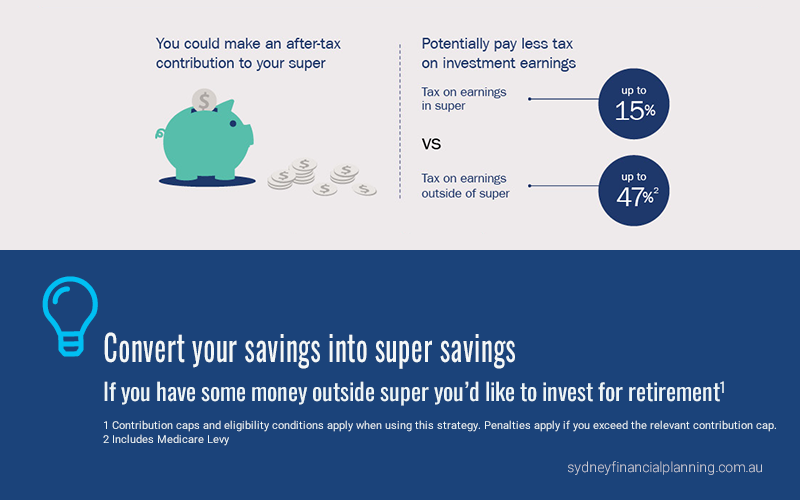
Another way to invest more in your super is with some of your after-tax income or savings, by making a personal non-concessional contribution.

Although these contributions don’t reduce your taxable income for the year, you can still benefit from the low tax rate of up to 15% that’s paid in super on investment earnings. This tax rate may be lower than what you’d pay if you held the money in other investments outside super.

How it works

Before you consider this strategy, make sure you’ll stay under your non-concessional contribution (NCC) cap, which in 2021/22 is $110,000 – or up to $330,000 if you meet certain conditions. That’s because after-tax contributions count as non-concessional contributions – and penalties apply if you exceed the cap.

Also, to use this strategy in 2021/22, your total super balance (TSB) must have been under $1.7 million on 30 June 2021.

If you’re 67–74, you’ll also need to meet the work test (or be eligible to apply the ‘work test exemption) to make NCCs this financial year. The work test will be removed for NCCs from 1 July.

Remember, once you’ve put any money into your super fund, you won’t be able to access it until you reach your preservation age or meet other ‘conditions of release’. For more information, visit the ATO website at ato.gov.au.

4. Get a super top-up from the Government

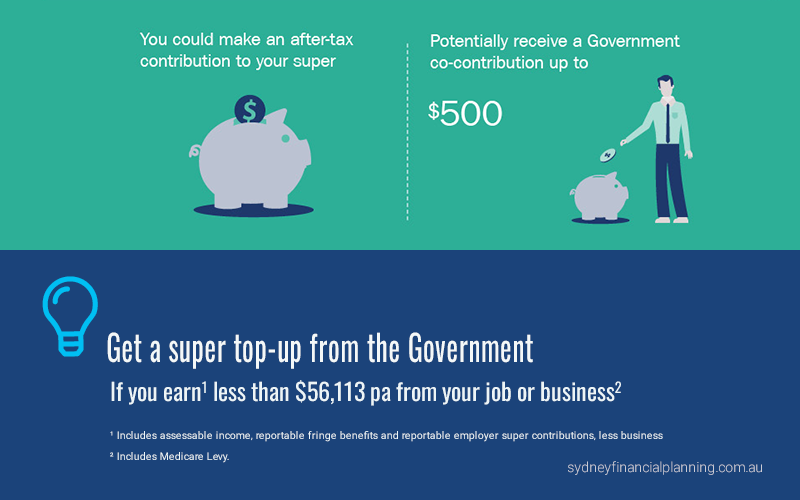
If you earn less than $56,113 in the 2021/22 financial year, and at least 10% is from your job or a business, you may want to consider making an aftertax super contribution. If you do, the

Government may make a ‘co-contribution’ of up to $500 into your super account.

How it works

The maximum co-contribution is available if you contribute $1,000 and earn $41,112 pa or less. You may receive a lower amount if you contribute less than $1,000 and/or earn between $41,113 and $56,112 pa.

Be aware that earnings include assessable income, reportable fringe benefits and reportable employer super contributions. Other conditions also apply – your financial adviser can run you through them.

5. Boost your spouse’s super and reduce your tax

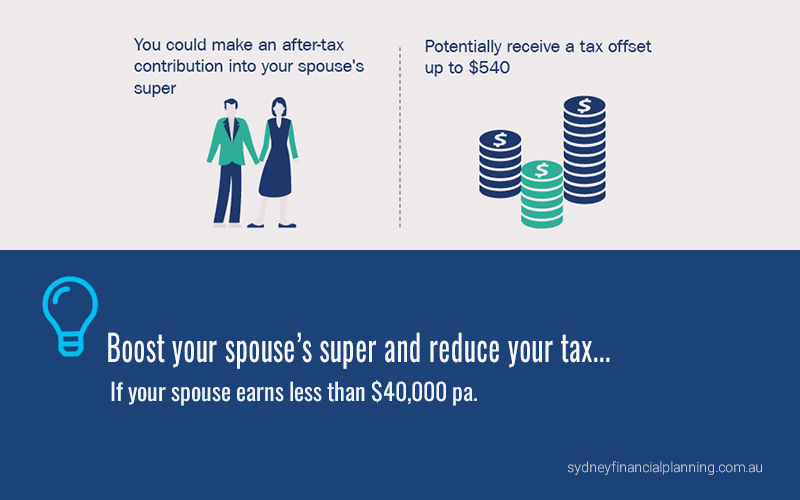
If your spouse is not working or earns a low income, you may want to consider making an after-tax contribution into their super account. This strategy could potentially benefit you both: your spouse’s super account gets a boost and you may qualify for a tax offset of up to $540.

How it works

You may be able to get the full offset if you contribute $3,000 and your spouse earns $37,000 or less pa (including their assessable income, reportable fringe benefits and reportable employer super contributions).

A lower tax offset may be available if you contribute less than $3,000, or your spouse earns between $37,000 and $40,000 pa.

Need advice?

You’ll need to meet certain eligibility conditions before benefitting from any of these strategies. If you’re thinking about investing more in super before 30 June, talk to us. We can help you decide which strategies are appropriate for you.


If you aren’t sure how to proceed or if you meet the specific criteria…

Speak with one of our Financial Planners about the best approach for your circumstances asap, either book a meeting or get in contact with us on 02 9328 0876.

1 Individuals with income above $250,000 pa will pay an additional 15% tax on personal deductible and other concessional super contributions.

2 Includes Medicare Levy.

General Disclaimer: While every care has been taken in the preparation of this document, Sydney Financial Planning and Charter FP make no representations or warranties as to the accuracy or completeness of any statement in it.This article contains information that is general in nature. It does not take into account the objectives, financial situation or needs of any particular person. You need to consider your financial situation and needs before making any decisions based on this information. Please seek personal financial advice prior to acting on this information.

 

Topping up super with ‘catch-up’ contributions

Topping up super with ‘catch-up’ contributions

Topping up super with ‘catch-up’ contributions

Depending on your circumstances, this could help you to maximise tax-effective super contributions and invest more for retirement.

How does the strategy work?

If your concessional contributions (CCs) in a financial year are below the annual CC cap, you’re able to accrue these unused amounts and carry them forward. This applies to unused cap amounts since 1 July 2018 and can be carried forward for up to five years. This means if you meet certain eligibility rules, you’ll be able to make larger CCs in a later financial year.

This may give you greater flexibility to make larger CCs when your circumstances allow. This may be helpful if, for example, you have irregular employment income, fluctuating income or have had time out of the workforce.

What’s the benefit?

The amount you contribute is generally taxed at the concessional rate of up to 15%1. Once contributed, any earnings are also taxed at a concessional rate of 15%, rather than your marginal rate, which could be up to 47%2. Depending on your circumstances, this strategy could result in a tax saving of up to 32% and enable you to increase your super savings.

Key conditions

To be eligible to utilise your carried forward unused CCs by making a catch-up contribution you must:

  • have a ‘total superannuation balance’3 below $500,000 on the prior 30 June
  • be under 75 and meet the work test rules (or be eligible to apply the work test exemption) if you’re aged 67 to 74, and
  • have unused CC cap amounts accrued from one of the five prior financial years (but not before 2018/19).

Accruing unused CC cap amounts

The first financial year you could accrue unused CCs was in 2018/19. Unused CC amounts can be carried forward for up to five years before they expire.

Seek advice

Your financial adviser can help determine whether this strategy is right for you. They can also help you to work out what your available carried forward unused CC balance4 is and how much you’re eligible to contribute. Additional tax and other penalties may apply if you make contributions that exceed your available cap.

To work out your carried forward amounts, you need to confirm the total amount of CCs you have made in each financial year since 1 July 2018. You can access information about your contributions by logging on to my.gov.au. Information displayed might not be up to date, so it is also important to keep accurate contributions records and enquire directly to your super fund before contributing.

Case Study

In 2018/19 and 2019/20, Fatima made CCs of $15,000, which was $10,000 less than the annual CC cap of $25,000.

Fatima took 12 months maternity leave from 1 July 2020 and didn’t make any CCs in FY 2020/21.

From 1 July 2021, Fatima returns to full-time work where her employer contributions (CCs) total $15,000 in 2021/22. This is $12,500 less than the annual cap that applies in this financial year ($27,500).

Fatima receives an inheritance of $35,000 in 2021/22 that she wants to contribute to super. The table below shows how she can carry forward unused CCs to make catch up contributions in 2021/22 in later years.

Financial year

Annual CC cap amount

Total CC cap including any carried forward CCs

CCs made

Unused CCs that may be carried forward

2018/19 $25,000 $25,000 $15,000 $10,000
2019/20 $25,000 $35,000 $15,000 $20,000
2020/21 $25,000 $45,000 $0 $45,000
2021/22 $27,500 $72,500 $50,000 $22,500

Other key considerations

  • It’s important to check your total CCs for the financial year from all sources before adjusting your contribution strategy. CCs include:
    • contributions made for you by your employer as well as an estimate of any further employer contributions for the year
    • salary sacrifice contributions, and
    • personal contributions that you claim a tax deduction for.
  • For personal deductible contributions, you need to lodge a ‘Notice of Intent’ form and receive an acknowledgement from the superfund before certain timeframes, and alsobefore starting a pension, withdrawal or rollover.
  • If you are not eligible to make catch-up CCs, tax penalties apply if you exceed the annual CC cap of $27,500 in FY 2021/22.
  • You can’t access super until you meet certain conditions.


If you aren’t sure how to proceed or if you meet the specific criteria…

Speak with one of our Financial Planners about the best approach for your circumstances asap, either book a meeting or get in contact with us on 02 9328 0876.


1 Individuals with income from certain sources above $250,000 in FY 2021/22 will pay an additional 15% tax on salary sacrifice, personal deductible and other CCs within your cap.

2 Includes Medicare levy.

3 Your ‘total superannuation balance’ includes all of your super accumulation interests and amounts held in superannuation income stream products. For more information, visit ato.gov.au, and check your total super balance by logging into my.gov.au.

4 You can also obtain this information by logging into my.gov.au


General Disclaimer: While every care has been taken in the preparation of this document, Sydney Financial Planning and Charter FP make no representations or warranties as to the accuracy or completeness of any statement in it.This article contains information that is general in nature. It does not take into account the objectives, financial situation or needs of any particular person. You need to consider your financial situation and needs before making any decisions based on this information. Please seek personal financial advice prior to acting on this information.

Top-up your super with help from the Government

Top-up your super with help from the Government

Top-up your super with help from the Government

How does the strategy work?

If you earn¹ less than $56,112 pa (of which at least 10% is from eligible employment or carrying on a business) and you make personal after-tax super contributions, the Government may also contribute into your super account. This additional super contribution, which is known as a co-contribution, could make a significant difference to the value of your retirement savings over time. To qualify for a co-contribution, you will need to meet a range of conditions, but as a general rule:

  • the maximum co-contribution of $500 is available if you contribute $1,000 and earn $41,112 or less
  • a reduced amount may be received if you contribute less than $1,000 and/or earn between $41,113 and $56,112, and
  • you will not be eligible for a co-contribution if you earn $56,113 or more.

The Australian Taxation Office (ATO) will determine whether you qualify based on the data received from your super fund and the information contained in your tax return for that financial year.

As a result, there can be a time lag between when you make your personal after-tax super contribution and when the Government pays the co‑contribution.

If you’re eligible for the co-contribution, you can nominate which fund you would like to receive the payment.

Alternatively, if you don’t make a nomination and you have more than one account, the ATO will pay the money into one of your funds based on set criteria.

Note: Some funds or superannuation interests may not be able to receive co-contributions. This includes unfunded public sector schemes, defined benefit interests, traditional policies (such as endowment or whole of life) and insurance only superannuation interests.

Other key considerations

  • You can’t access super until you meet certain conditions.
  • You may want to consider other ways to contribute to super, such as salary sacrifice or personal deductible contributions.

Seek advice

A financial adviser can help you determine whether you should make personal super contributions and assess whether you will qualify for a Government co-contribution.

Case Study

Ryan, aged 40, is employed and earns $35,000 pa. He wants to build his retirement savings and can afford to invest $1,000 a year.

After speaking to a financial adviser, he decides to use the $1,000 to make a personal after-tax super contribution.

By using this strategy, he’ll qualify for a cocontribution of $500 and the investment earnings will be taxed at a maximum rate of 15%.

Conversely, if he invests the money outside super each year (in a managed fund, for example), he will not qualify for a cocontribution and the earnings will be taxable at his marginal rate of 21%


Details

Receive pay rise as after-tax salary

Sacrifice pay rise into super

Amount invested $1,000 $1,000
Plus co-contribution Nil $500
Total investment $1,000 $1,500
Tax rate payable on investment earnings 21%2 15%


Next steps

Contribution rules and eligibility criteria for catch up CCs are complex. This guide is not designed to provide comprehensive information about how the rules work or apply to you. It is important that you speak with your financial adviser, your registered tax agent and visit the ato.gov.au for more information.


If you aren’t sure how to proceed or if you meet the specific criteria…

Speak with one of our Financial Planners about the best approach for your circumstances asap, either book a meeting or get in contact with us on 02 9328 0876.


1Includes assessable income, reportable fringe benefits and reportable employer super contributions, less business deductions and assessable First Home Super Saver amounts. Other conditions apply.

2 Includes Medicare Levy.


General Disclaimer: While every care has been taken in the preparation of this document, Sydney Financial Planning and Charter FP make no representations or warranties as to the accuracy or completeness of any statement in it.This article contains information that is general in nature. It does not take into account the objectives, financial situation or needs of any particular person. You need to consider your financial situation and needs before making any decisions based on this information. Please seek personal financial advice prior to acting on this information.
Sacrifice pre-tax salary into super

Sacrifice pre-tax salary into super

Sacrifice pre-tax salary into super

How does the strategy work?

With this strategy, known as salary sacrifice, you need to arrange for your employer to contribute some of your pre‑tax salary, wages or bonus directly into your super fund.

The amount you contribute will generally be taxed at the concessional rate of 15%1, not your marginal rate which could be up to 47%2. Depending on your circumstances, this strategy could reduce the tax you pay on your salary, wages or bonus by up to 32%.

Also, by paying less tax, you can make a larger after-tax investment for your retirement, as the case study on the opposite page illustrates.

What income can be salary sacrificed?

  • You can only sacrifice income that relates to future employment and entitlements that have not been accrued.
  • With salary and wages, the arrangement needs to be in place before you perform the work that entitles you to the salary or wages.
  • With a bonus, the arrangement needs to be made before the bonus entitlement is determined.
  • The arrangement, which should be documented and signed by you and your employer, should include details such as the amount to be sacrificed into super and the frequency of the contributions.

Other key considerations

  • Salary sacrifice contributions count towards the ‘concessional contribution’ cap. This capis $27,500 in FY 2021/22, or may be higherif you didn’t contribute your full concessionalcontribution cap since 1 July 2018 and areeligible to make ‘catch-up’ contributions. Tax implications and penalties apply if you exceed your cap.
  • You can’t access super until you meet certain conditions.
  • Another way you may be able to grow your super tax-effectively is to make personal deductible contributions (see opposite page).

Seek advice

A financial adviser can help you determine whether salary sacrifice suits your needs and circumstances.

Case Study

William, aged 45, was recently promoted and has received a pay rise of $5,000, bringing his total salary to $90,000 pa.

He plans to retire in 20 years and wants to use his pay rise to boost his retirement savings..

After speaking to a financial adviser, he decides to sacrifice the extra $5,000 into super each year.

By using this strategy, he’ll save on tax and have an extra $975 in the first year to invest into super, when compared to receiving the $5,000 as after-tax salary (see Table 1).

If he continued to salary sacrifice this amount into super, this could lead to William having an additional $150,394 in his super after 20 years (see Table 2).


Table 1. After-tax income vs salary sacrifice

Details

Receive pay rise as after-tax salary

Sacrifice pay rise into super

Personal super contribution $5,000 $5,000
Less income tax at 34.5%3 ($1,725) (N/A)
Less 15% contributions tax (N/A) ($750)
Net amount $3,275 $4,250
Additional amount in super 21%2 $975


Table 2. Super balances4

Year

No salary sacrifice

Salary sacrifice into super

Difference

Year 5 $279,725 $304,029 $24,304
Year 10 $416,168 $472,072 $55,904
Year 15 $593,558 $690,543 $96,985
Year 20 $824,183 $974,577 $150,394

Personal Deductible Contributions

Like salary sacrifice, making a personal super contribution and claiming a tax deduction may enable you to boost your super tax-effectively. There are, however, a range of issues you should consider before deciding to use this strategy.

Your financial adviser can help you determine whether you should consider making personal deductible contributions instead of (or in addition to) salary sacrifice.

You may also want to ask your financial adviser for a copy of our super strategy card, called ‘Make tax-deductible super contributions’.


If you aren’t sure how to proceed or if you meet the specific criteria…

Speak with one of our Financial Planners about the best approach for your circumstances asap, either book a meeting or get in contact with us on 02 9328 0876.

1 Individuals with income above $250,000 pa will pay an additional 15% tax on personal deductible and other concessional super contributions.

2 Includes Medicare Levy.

3 Includes Medicare Levy. Based on FY 2021/22 tax rates.

4 Assumptions: A 20-year comparison based on contribution of $5,000 pa of pre-tax salary on top of compulsory superannuation guarantee. Super investments earn a total return of 6.34% pa, balances shown at the end of 5/10/15/20 year periods. All figures are after income tax of 15% in super and capital gains tax (including discounting). These rates are assumed to remain constant over the investment period. William’s salary of $90,000 pa is indexed to CPI. Difference does not take into account money potentially invested outside super if pay rise received as after tax salary.

General Disclaimer: While every care has been taken in the preparation of this document, Sydney Financial Planning and Charter FP make no representations or warranties as to the accuracy or completeness of any statement in it.This article contains information that is general in nature. It does not take into account the objectives, financial situation or needs of any particular person. You need to consider your financial situation and needs before making any decisions based on this information. Please seek personal financial advice prior to acting on this information.


5 useful charts on investing

5 useful charts on investing in times of uncertainty like the present

5 useful charts on investing

  • Here are another five great charts to help illuminate those basic principles: the importance of time in the market versus timing; the case to look less at your investments; the relationship between risk and return; the value of diversification; & the role of property.
  • Introduction

    Successful investing can be really hard in times like the present when share markets are down sharply & very volatile on the back of uncertainty around inflation, rising interest rates and the war in Ukraine. I will be the first to admit that my crystal ball is even hazier than normal in times like the present. As the US economist JK Galbraith once said “there are two types of economists – those that don’t know and those that don’t know they don’t know.” And this is certainly an environment where much is unknown. But the basic principles of investing are simple and timeless and can be particularly useful to bear in mind in times like this. This note continues our updated series that began with “Five great charts on investing”.

    Chart #1 Time in versus timing

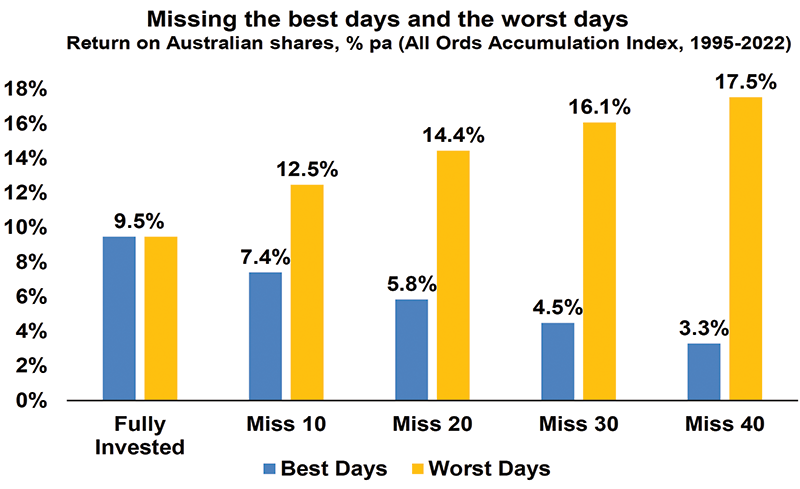
    In times of uncertainty its temping to try and time the market, ie to sell ahead of falls & buy in anticipation of gains. But without a proven asset allocation or stock picking process, trying to time the market is very difficult. A good way to demonstrate this is with a comparison of returns if an investor is fully invested in shares versus missing out on the best (or worst) days. The next chart shows that if you were fully invested in Australian shares from January 1995, you would have returned 9.5%pa (including dividends but not allowing for franking credits, tax and fees).

    Best and worst days 001

    Source: Bloomberg, AMP

    If by trying to time the market you avoided the 10 worst days (yellow bars), you would have boosted your return to 12.5% pa. If you avoided the 40 worst days, it would have been boosted to 17.5% pa. But this is very hard to do, and many investors only get out after the bad returns have occurred, just in time to miss some of the best days and so end up damaging their longer term returns. For example, if by trying to time the market you miss the 10 best days (blue bars), the return falls to 7.4% pa. If you miss the 40 best days, it drops to just 3.3% pa. Hence the old cliché that “it’s time in that matters, not timing”.

    Key message: market timing is great if you can get it right, but without a process the risk of getting it wrong is very high and, if so, it can destroy your longer-term returns.

    Chart #2 Look less

    Percentage of positive share market 001

    Daily and monthly data from 1995, data for years and decades from 1900.
    Source: Bloomberg, RBA, ASX, AMP

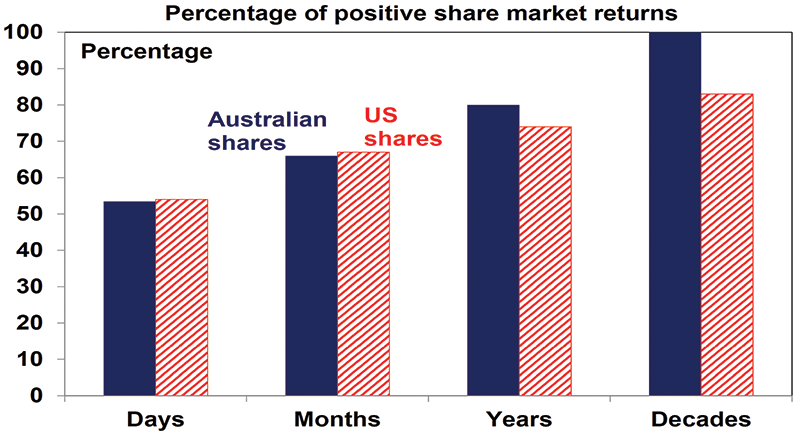
    If you look at the daily movements in the share market, they are down almost as much as they are up, with only just over 50% of days seeing positive gains. See the next chart for Australian and US shares. So day by day, it’s pretty much a coin toss as to whether you will get good news or bad news. But if you only look monthly and allow for dividends, the historical experience tells us you will only get bad news around a third of the time. Looking only on a calendar year basis, data back to 1900 indicates the probability of a loss slides to just 20% in Australian shares and 26% for US shares. And if you go all the way out to once a decade, since 1900 positive returns have been seen 100% of the time for Australian shares and 82% for US shares.

    Chart #3 Risk and return

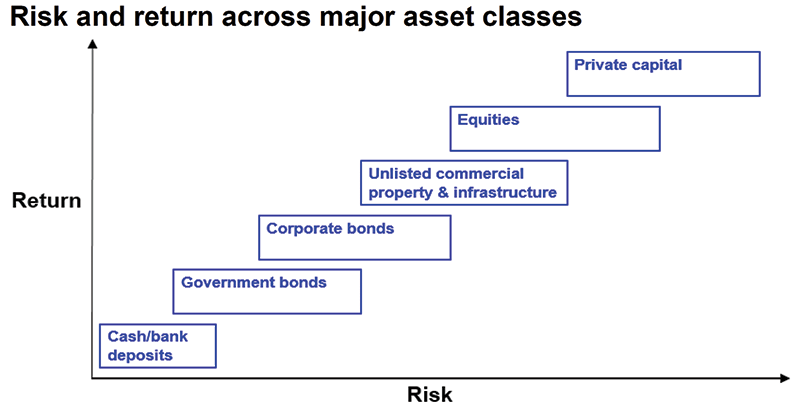
    This chart is basic to investing. Each asset class has its own risk (in terms of volatility and risk of loss) and return characteristics. Put simply: the higher the risk of an asset, the higher the return you will likely achieve over the long term and vice versa. The next chart shows a stylised version of this. Starting with cash, it’s well known that its very low risk but so is its return potential. Government bonds usually offer higher returns but their value can move around a bit in the short term (although major developed countries have not defaulted on their bonds). Corporate debt has a higher return potential again but a higher risk of default. Unlisted or directly held commercial property and infrastructure offer a higher return again but they come with higher risk and are less liquid and can be less able to be diversified (except via say a managed fund).

    Equities can offer another step up in return, but this is because they come with higher risk as they are subject to share market volatility and individual companies can go bankrupt wiping out share holder capital. Beyond this, private equity entails more risk again & so tends to command an even higher return premium. Each step up involves more risk, and this is compensated for with more long-term return. Of course, this neat relationship may not hold in the short-term – eg, government bonds have had worse returns over the last 12 months than shares. And its hard to place “crypto currencies” on the chart – they are very volatile but have not been around long enough to have confidence their long-term returns will compensate for this.

    Risk return major assett classes 001

    Source: AMP

    Key message: Investors need to allow for the risk (and liquidity) and return characteristics of each asset. Those who don’t mind short-term risk (and illiquidity in the case of unlisted assets) can take advantage of the higher returns growth assets offer over long periods. The key is that there is no free lunch.

    Chart #4 Diversification

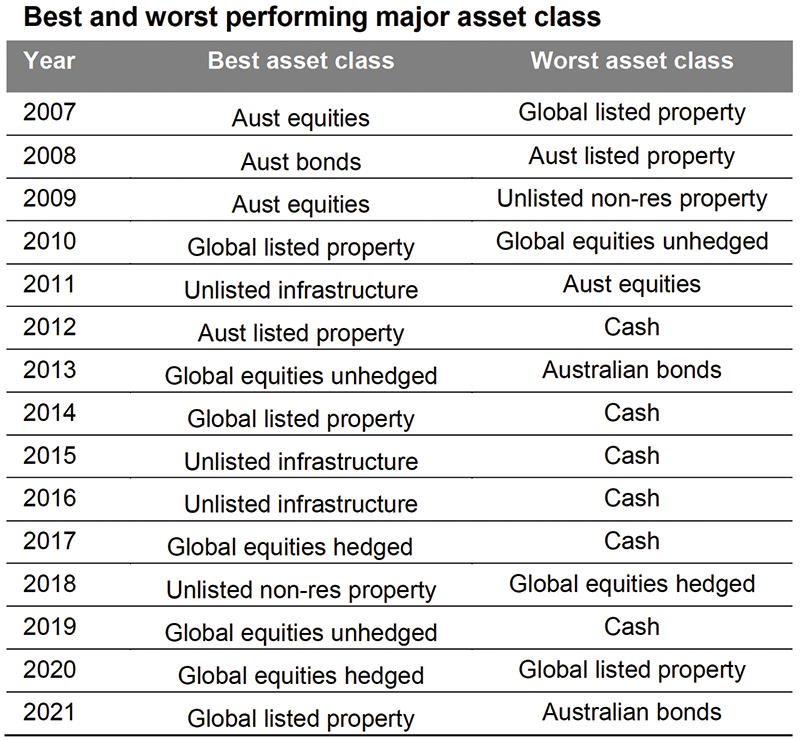
    But this not the end of the story. The next table shows the best and worst performing asset class in each year over the last 15.

    Risk best worst performing major assett class 001

    Source: Reuters, Bloomberg, AMP

    It can be seen that the best performing asset each year can vary dramatically, and that last year’s top performer is no guide to the year ahead. So, it makes sense to have a combination of asset classes in your portfolio. This particularly applies to assets that are lowly correlated, ie that don’t just move in lock step with each other. For example, global and Australian shares tend to move together during extreme events. But bonds and shares tend to diverge when crises hit threatening recession – as we saw in the GFC when shares fell but bonds rallied. So there is a case to have bonds in a portfolio to help stabilise returns. Of course, this doesn’t always work, eg like now when inflation is the key danger, highlighting the case for cash & real assets like unlisted commercial property and infrastructure too.

    Key message: diversification is also a bit like the magic of compound interest. Having a well-diversified exposure means your portfolio won’t be as volatile.

    Chart #5 Residential property has a role

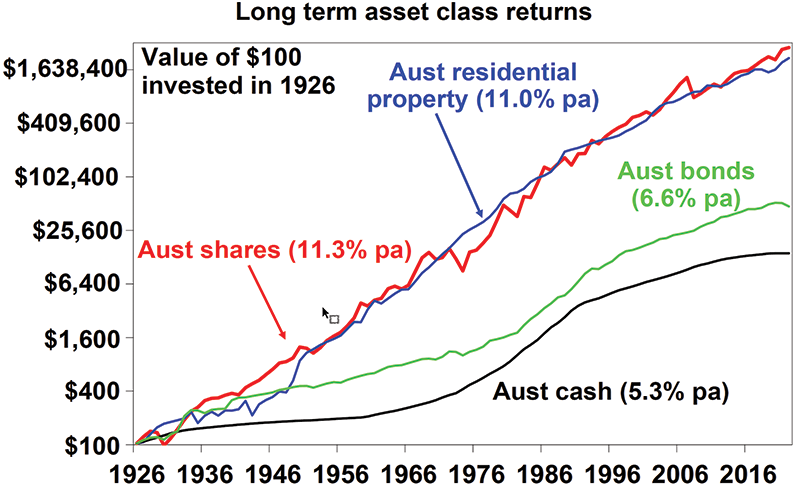
    Chart #1 in the first edition in this Five Charts series highlighted the power of compound interest, with a comparison showing the value of $1 invested in various Australian asset classes back in 1900 and what it would be worth today. Unfortunately, I do not have monthly data for Australian residential property returns back that far but I do have them on an annual basis back to 1926 and this is shown in the next chart starting with a $100 investment.

    Long term assett class returns 001

    Source: ABS, REIA, RBA, ASX, AMP

    Again it can be seen that over very long periods the power of compounding works wonders for shares compared to bonds and cash. But it can also be seen to work well for Australian residential property with an average total return (capital growth plus net rental income) of 11% pa, which is similar to that for shares. All of which highlights, along with the diversification benefits of a real asset like property, the case to have it in a well-diversified portfolio along with listed assets like shares, bonds and cash. The key is to allow for the different “risks” experienced by property versus shares. Property prices are less volatile than share prices as they are not traded on share markets and so are not as subject to the whims of investors and movements in their values tend to relate more to movements in the real economy. But residential property takes longer to buy and sell and it’s harder to diversify as you can’t easily have exposure to hundreds or thousands of properties exposed to different sectors and countries like you can with shares. So, there are trade-offs between residential property and shares.

    Key message: given their long-term returns and diversification benefits, there is a key role for residential property in your investment portfolio – putting aside the current threat to the housing market from poor affordability and rising interest rates.

    Closing commentary

    So following on from our SFP insights over the past 6 months, where we keep you up to date on whats going on in Financial Markets and what to expect moving forward. As we suggested in our last 3 newsletters we will experienced market volatility in the short term and that is currently occurring. For some unadvised people that’s scary, for the well advised SFP clients they know volatility although unpleasant in the short term, is a normal part of financial markets and if they require better long term return, they need to hold growth assets like shares and property.

    When these asset prices fall it can be a wonderful time to buy at a discounted rate, rather than pay for over valued assets.

    Many of our clients have taken advantage of this and invested while these a discount is offered, rather than paying over priced assets. And as I continually say, that’s how the rich get richer, sadly they buy quality assets at a reduced price from unadvised people who panic. Sad for the seller, good for the buyer who knows value and buys quality at a lower price.

    Advice that stands the test of time!

    Bill Bracey – CEO and Founder
    Sydney Financial Planning


    Is your portfolio well positioned for long-term returns and benefits?

    Speak with one of our Financial Planners about the best approach for your circumstances, either book a meeting or get in contact with us on 02 9328 0876.


    This article was prepared by William Bracey and Dr Shane Oliver. Dr Shane Oliver who provides economic forecasts and analysis of key variables and issues affecting, or likely to affect, all asset markets. He also provides economic forecasts and analysis of key variables and issues affecting, or likely to affect, all asset markets.

    Important note: While every care has been taken in the preparation of this document, AMP Capital Investors Limited (ABN 59 001 777 591, AFSL 232497) and AMP Capital Funds Management Limited (ABN 15 159 557 721, AFSL 426455) make no representations or warranties as to the accuracy or completeness of any statement in it including, without limitation, any forecasts. Past performance is not a reliable indicator of future performance. This document has been prepared for the purpose of providing general information, without taking account of any particular investor’s objectives, financial situation or needs. An investor should, before making any investment decisions, consider the appropriateness of the information in this document, and seek professional advice, having regard to the investor’s objectives, financial situation and needs. This document is solely for the use of the party to whom it is provided.

    General Disclaimer: This article contains information that is general in nature. It does not take into account the objectives, financial situation or needs of any particular person. You need to consider your financial situation and needs before making any decisions based on this information. Please seek personal financial advice prior to acting on this information.
    Splitting your super contributions to your spouse

    Splitting your super contributions to your spouse

    Splitting your super contributions to your spouse

    How does the strategy work?

    You may be able to split (transfer) eligible concessional contributions (CCs) that you’ve made or received to your spouse’s super account.

    Eligible CCs include employer super contributions and personal super contributions for which you have claimed a tax deduction.

    Contribution splitting can be a great way to increase your spouse’s super savings particularly where they, for example:

    • are not working
    • have had time out of the workforce, or
    • have a lower super balance.

    What’s the benefit?

    In addition to boosting your spouse’s retirement savings, there may be other benefits depending on your specific circumstances.

    Help to cover insurance premiums

    Contribution splitting can help to pay your spouse’s insurance premiums for policies held inside super. This may be beneficial during times where your spouse has reduced their working hours or is out of the workforce and their contributions have reduced.

    Maximise tax-free retirement savings

    A limit applies to how much super can be transferred into ‘retirement phase’ income streams, where investment earnings are taxed at 0%. Contribution splitting may help you take better advantage of these limits as a couple and maximise the total amount you can hold tax-effectively when you retire.

    Maximise Age Pension

    If you have a younger spouse who is under their Age Pension age, contribution splitting may help to improve your Centrelink entitlements. Superannuation held in the ‘accumulation phase’ is not assessed for social security purposes until the account holder reaches their Age Pension age. Splitting super to your younger spouse may therefore reduce the assets assessed when your entitlement is calculated, potentially increasing your Age Pension entitlement.

    What contributions can be split?

    Only eligible CCs can be split to your spouse, such as superannuation guarantee (SG), salary sacrifice and personal deductible contributions. Non-concessional or ‘after-tax’ contributions cannot be split.

    Generally, the maximum amount that can be split is the lesser of:

    • 85% of your CCs for the year (after taking into account 15% contributions tax), or
    • your CC cap for the financial year.

    The CC cap was $25,000 in 2020/21 and is $27,500 in 2021/22. However, if you’re eligible to make larger CCs in a financial year using the ‘catch-up’ contribution rule, your applicable CC cap may be higher.1

    You can generally only split CCs made in the previous financial year. Also, you need to request to split your CCs in writing to the trustee of your super fund within 12 months after the end of the financial year the CCs were made to your super fund (unless you’re going to roll over your balance or close your account).

    For more information on catch-up contributions, ask your financial adviser for a copy of our ‘Top up your super with ‘catchup’ contributions’ super strategy card.

    Case study

    Lucy would like to split some of her eligible CCs made during 2020/21 to her husband Luke’s (age 40) super fund.

    In FY 2020/21, her employer contributed $20,000 to her super fund and her CC cap was $25,000. The maximum amount that Lucy can split to Luke is the lesser of:

    • $17,000 (85% of the $20,000 contributed by her employer), and
    • $25,000 (her CC cap in 2020/21).

    Lucy elects to split $15,000 of her CCs to Luke’s super fund and submits the contribution splitting application form to her fund in 2021/22.

    Her super fund transfers $15,000 to Luke’s super fund. This won’t reduce Lucy’s CCs for the financial year and the transfer won’t be assessed as a contribution against Luke’s contribution caps.

    Note: If Lucy was eligible to make larger CCs in 2020/21 using the ‘catch-up’ contribution rule, her CC cap may be greater than $25,000. This may increase the maximum amount of contributions she could potentially split to Luke if she made larger CCs in that financial year.

    Is your spouse eligible?

    To be eligible to split your super to your spouse, they must be either:

    • under their ‘preservation age’2, or
    • between their preservation age and under 65 and declare they are not currently retired for superannuation purposes.

    Once your spouse reaches age 65, they are no longer eligible to receive a contribution split from your super.

    Other key considerations

    Contribution splitting may be used by married couples, de facto partners and same sex couples.

    Contributions split to your spouse:

    • will form part of the taxable component of your spouse’s super account
    • don’t count towards their CC cap, as they have already counted towards your CC cap in the year the contributions were made to your account.
    • The split amount is fully preserved in the receiving spouse’s account and they can’t access their super until they meet certain conditions.
    • Where a personal deductible contribution forms part or all of the amount to be split, a Notice of Intent to claim a tax deduction must be lodged and acknowledged by the super fund prior to the contribution split being processed.
    • If you’re intending to rollover or withdraw your entire benefit and you wish to split CCs made in the same financial year or from the previous financial year, the split must be completed prior to the rollover or withdrawal request being processed.
    • It’s not compulsory for a super fund to offer contribution splitting. You will need to check with your fund to see if they allow it.

    Seek advice

    Your financial adviser can help determine whether this strategy is right for you. This includes working out whether your spouse is eligible to receive a contributions split from your super and how much you’re eligible to split.

    Where your CCs in a financial year have exceeded your available cap, the excess amounts cannot be split to your spouse and additional tax and other penalties may apply.

    We recommend you consult with a registered tax agent.

    You will need to confirm the total amount of CCs in the previous financial year. You can access information about your contributions by logging on to my.gov.au. Information displayed might not be up to date, so it’s also important to keep accurate contributions records and enquire directly to your super fund before requesting to split.


    If you aren’t sure how to proceed or if you meet the specific criteria…

    Speak with one of our Financial Planners about the best approach for your circumstances asap, either book a meeting or get in contact with us on 02 9328 0876.

    1 Individuals with income above $250,000 pa will pay an additional 15% tax on personal deductible and other concessional super contributions.
    2 Includes Medicare Levy.
    3 Includes Medicare Levy. Based on FY 2021/22 tax rates.
    4 Assumptions: A 20-year comparison based on contribution of $5,000 pa of pre-tax salary on top of compulsory superannuation guarantee. Super investments earn a total return of 6.34% pa, balances shown at the end of 5/10/15/20 year periods. All figures are after income tax of 15% in super and capital gains tax (including discounting). These rates are assumed to remain constant over the investment period. William’s salary of $90,000 pa is indexed to CPI. Difference does not take into account money potentially invested outside super if pay rise received as after tax salary.

    General Disclaimer: While every care has been taken in the preparation of this document, Sydney Financial Planning and Charter FP make no representations or warranties as to the accuracy or completeness of any statement in it.This article contains information that is general in nature. It does not take into account the objectives, financial situation or needs of any particular person. You need to consider your financial situation and needs before making any decisions based on this information. Please seek personal financial advice prior to acting on this information.

    tax deduction for your super contribution

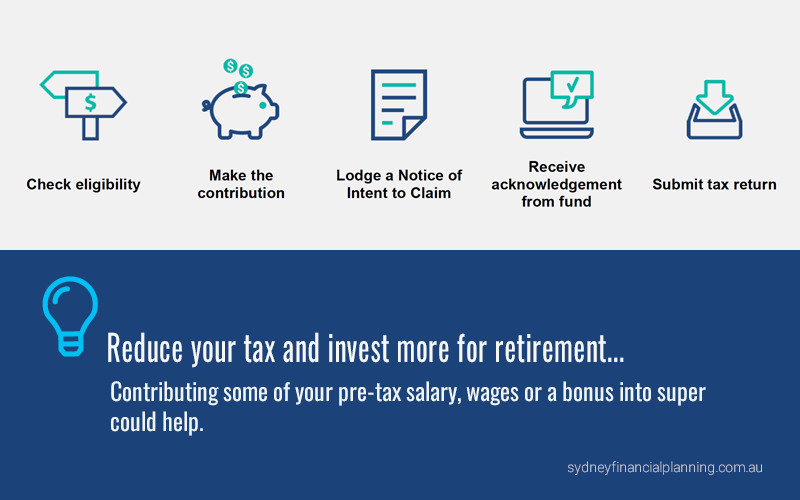
    Steps to claiming a tax deduction for your super contribution

    tax deduction for your super contribution

    What are personal deductible contributions? 

    A personal deductible contribution (PDC) is a voluntary contribution that you make to super on your own behalf and claim a tax deduction in your tax return. These contributions are made with after-tax money, such as your take-home pay or other funds that you might have in savings, such as a bank account. PDCs are generally taxed in the super fund at up to 15%1, instead of your marginal tax rate which could be up to 47%2.

    Caps apply which limit the total amount you’re able to contribute to super. Personal contributions ordinarily count towards your non-concessional contribution (NCC) cap. However, if you follow the steps below and claim a tax deduction for some or all of your personal contributions, these amounts will instead count towards your concessional contribution (CC) cap. To find out whether you could benefit from this strategy, you should speak to a financial adviser and a registered tax agent.

    Overview on the steps

    Step 1:

    Check your contribution eligibility and CC cap

    step1 check eligility 001

    Details:

    Ensure that directing savings to super is right for you and you are eligible to contribute.
    The amount that can be contributed with concessional tax treatment is limited by the CC cap. The general CC cap is $27,500 in 2021/22 and 2022/23.

    Your personal CC cap might be higher if you haven’t fully utilised your CC cap each year since 1 July 2018. In this case, you may be eligible to make ‘catch-up concessional contributions’ where certain conditions are met. See ato.gov.au for more information.

    Other considerations:

    Eligibility to contribute – age limits
    If you’re 67-74 at the time you make the contribution, you’ll need to have met a work test for the financial year, or be eligible to apply the work-test exemption.
    You cannot make a PDC if you’re aged 75 or older3.

    Consider all CCs and timing
    Consider what other CCs have been made during the financial year as well as those you’re likely to receive from all sources including employer
    contributions and salary sacrifice. It’s important to also consider possible changes to CCs such as additional employer contributions due to a salary increase or bonuses.

    If you’re not able to accurately predict your CCs from other sources, you can wait until closer to the end of financial year to make your PDC. You can make more than one personal contribution throughout the year, but be sure to follow all of the steps below to make sure you’re able to claim a deduction for each contribution.

    1 If you’re a high income earner and have income from certain sources of more than $250,000 pa, you’ll need to pay an additional 15% tax on your CCs within your CC cap. This is called Division 293 tax. If you’re liable, you’ll receive a notice from the ATO.
    2 Includes Medicare levy
    3 Contributions must be received no later than 28 days after the month in which you turn 75. Limitations can also apply to other types of contributions, Refer to ato.gov.au for more information.


    Step 2:

    Make a personal contribution

    step2 make contributions 001

    Details:

    Once you’ve worked with your financial adviser to confirm that a PDC is right for you, it’s time to make your personal contribution to your super fund.

    Be mindful of your fund’s requirements and timeframes.

    Other considerations:

    Check cut off dates
    If you’re contributing right at the end of the financial year, it is important to check cut-off dates with your super fund to make sure that your contribution is received and allocated to the right financial year.

    A contribution is generally ‘made’ when it is received by your super fund which can be different to when you have actioned your contribution (such as via electronic transfer). Therefore, it is important to ensure there is sufficient time for your super fund to receive the contribution in the financial year which you want the contribution to be made.

    Check BPay codes
    It is also important to check your contribution payment options with your super fund, making sure if you’re using BPay for example, that you use the correct BPay code. Even though a PDC is a CC, you’re making a personal contribution to super which will usually have a different BPay code.


    Step 3:

    Lodge a Notice of Intent to claim form with your super fund

    step3 lodge notice 001

    Details:

    The Notice of Intent form notifies your fund that you are going to claim a deduction for all or part of the personal contributions that you’ve made to super.

    Tax law requires that this form is lodged within certain timeframes. If you don’t meet this requirement, your notice will be invalid and you’ll be ineligible to claim a tax deduction. Unfortunately your fund has no discretion to waive this requirement.

    Other considerations:

    Important timing requirements
    You must lodge the form with your super fund before the earlier of:

    • the day you submit your tax return for the financial year, or
    • the end of the following financial year.

    For example, for PDCs made in the 2021/22 financial year, you must submit the Notice of Intent to your super fund either before you lodge your tax return for 2021/22, or by 30 June 2023, whichever occurs first.


    Step 4:

    Receive acknowledgement from the fund

    step4 receive acknowledgement 001

    Details:

    Your super fund will send you an acknowledgement to confirm that they have received your Notice of Intent form.

    Other considerations:

    Seek tax advice
    An ackowledgement only confirms reciept of a valid Notice of Intent and is not a subsitiute for tax advice. You will need to seek advice from your registered tax agent to claim the deduction in your tax return.

    Ensure that you file this letter as you may wish to provide it to your registered tax agent when your tax return is being prepared.


    Step 5:

    Submit your tax return

    step5 submit tax return 001

    Details:

    Only after your Notice of Intent is submitted and acknowledgement received should you complete your tax return.

    Other considerations:

    If you’re late in submitting your tax return
    Remember that if for some reason you don’t complete your 2021/22 tax return before 30 June 2023, you’ll still need to make sure your Notice of Intent has been submitted before this date or you won’t be eligibile to claim the deduction.


    Step 6:

    Make sure steps 3 and 4 are completed before rolling over or withdrawing funds

    step6 make sure 001

    Details:

    You need to ensure you’ve lodged your Notice of Intent and received acknowledgement before you withdraw or rollover some or all of the funds in your super account. This may occur in the same financial year as making the contribution.

    If you don’t lodge your Notice of Intent first, you may only be entitled to a:

    • partial deduction (if you withdraw or rollover part of your balance), or
    • no deduction if you’ve rolled over or withdrawn the full balance.

    Other considerations:

    If you completed a partial rollover or withdrawal before lodging your Notice of Intent
    You’ll need to seek advice from your financial adviser or registered tax agent to determine the reduced amount that you’re able to claim a deduction for. You must submit a valid Notice of Intent for this amount. Your super fund is not a registered tax agent and cannot do this for you.

    If you submit a Notice of Intent for the full value of the personal contribution after a parital rollover or withdrawal occurs, the notice is invalid, and you’ll need to follow the above steps to resubmit a valid notice.

    Be aware that an automatic rollover that is established to rollover funds periodically to pay for insurance premiums in another super account is a considered a partial rollover. You must ensure that a Notice of Intent is lodged and ackowledged for any contributions made before the rollover occurs during the financial year.


    Step 7:

    Make sure steps 3 and 4 are completed before you commence an income stream during the year

    step7 make sure 001

    Details:

    If you commence an income stream with any of your account balance before lodging your Notice of Intent and receiving the acknowledgment, you won’t be eligible to claim any deduction for a personal contribution made to the fund during the financial year.

    Other considerations:

    No discretion available
    Once an income stream has commenced using any of the account balance, there is no action that can be taken to rectify this and tax law states that any subsequent notice is invalid. Unfortunately the super fund and the ATO have no discretion to accept a Notice of Intent after the income stream has commenced.


    Other important considerations

    Change in circumstances

    If your circumstances change after you’ve lodged a valid Notice of Intent, you may be able to submit another form to:

    • vary down the amount you intend to claim a deduction for (including to nil), or
    • notify your fund that you intend to claim a deduction for additional contributions.

    Time limits and other requirements apply. This is a complex area and you should seek advice from your financial adviser and/or registered tax agent. ATO denies deduction When you lodge your tax return, you include the value of the deduction for your superannuation contributions that you wish to claim.

    However, the ATO will assess your tax return and, in limited situations, may deny your entitlement to the deduction as permitted under the legislation. Generally, this will arise if you don’t have sufficient assessable income to offset the deduction you are claiming after allowing for other tax deductions.

    If the ATO denies your deduction, certain steps must be followed which are similar to varying the amount claimed as a tax deduction (see change in circumstances). However, as time limits and other requirements apply, you should seek advice from your financial planner and/or registered tax agent.

    If you want to make a PDC and split some of your contributions with your spouse

    If eligible, you may be able to split some of your CCs, including PDCs, with your spouse. Generally, you’ll need to wait to lodge a contribution splitting application with your fund until after the end of the financial year in which the contribution was made (unless you’re going to rollover your entire balance to another fund, or withdraw your balance in full, during the financial year). However, you’ll need to make sure that your Notice of Intent has been lodged and acknowledged before lodging your splitting application.

    Next steps

    Contribution rules and eligibility criteria for catch up CCs are complex. This guide is not designed to provide comprehensive information about how the rules work or apply to you. It is important that you speak with your financial adviser, your registered tax agent and visit the ato.gov.au for more information.


    If you aren’t sure how to proceed or if you meet the specific criteria…

    Speak with one of our Financial Planners about the best approach for your circumstances asap, either book a meeting or get in contact with us on 02 9328 0876.


    General Disclaimer: While every care has been taken in the preparation of this document, Sydney Financial Planning and Charter FP make no representations or warranties as to the accuracy or completeness of any statement in it.This article contains information that is general in nature. It does not take into account the objectives, financial situation or needs of any particular person. You need to consider your financial situation and needs before making any decisions based on this information. Please seek personal financial advice prior to acting on this information.

     

    Australian's are a generous nation

    Australia is a generous nation

    Australian's are a generous nation

    Australia is a generous nation. We love to give gifts. It brings us joy.

    When we spend, we go big: $19.8 billion AUD is spent on gifts by Australians each year, or an average of $100 each month ($1,200 per year).

    That’s more than buying a $4 coffee every weekday, getting our shirts dry cleaned daily, or what we spend, on average, on mobile phone plans. Gen Y spend more on gifts than any other generation: $130 each month ($1,560 per year).

    Here’s what the average Australian adult spends on gifts for loved ones each year:

    • $437 for our spouse or partner,
    • $361 for each of our children,
    • $201 per parent, and
    • $115 for our pet.

    Women are more generous towards their spouses or partners than men ($454/ year compared to $419/year), but men are spending $22 more per month on gifts than women in general.

    Younger adults spend more than older adults (see table). Almost $20 billion spent on gifts each year


      Gen Z
    (18-24)
    Gen Y
    (25-39)
    Gen X
    (40-54)
    Boomers
    (55-73)
    Average gift spending per month $91 $130 $87 $89


    We find joy in giving

    Experts in psychology generally agree that the altruistic act of giving has neural and emotional benefits. These range from elevated activity in regions of the brain associated with pleasure, social connection, and trust, all the way through to lowering blood pressure and stress levels.

    So it’s a good thing most of us find joy in giving. Most Australians (85%) say they get more joy giving gifts to others than in receiving gifts themselves.

    Females find particular joy in giving (88% find greater joy in giving than receiving, compared to 83% of males).

    Older Australians gain the greatest joy: 90% of Baby Boomers say they get more joy in giving than receiving, as do 84% of Gen X, 84% of Gen Y and 78% of Gen Z.

    Gifts for our Pets

    74% of Australian pet owners buy gifts for their pet.

    Those who do spend an average of $115/year on gifts for their pet.  Pushing the average higher are Gen Ys who spend $121/year and Gen X who spend $142/year.

    Generous to a fault

    73% of Australian’s don’t budget for gifts!

    Disturbingly, a significant proportion of the $19.8 billion spent on gifts each year in Australia is not accounted for in household budgets. In fact, three in four of us (73%) do not have a budget allocation for gifts. Men are less likely than women to allocate a budget towards gift-giving (24% men cf. 31% women).
    Those least likely to budget for gifts are older families, couples and older singles, of whom 79% don’t have a budget allocation for gifts.

    Surprisingly, the vast majority of us are happy with the amount we spend on gifts. Just one in eight of us (13%) feel we spend too much on gifts, while most of us (81%) feel we spend about the right amount.

    The discrepancy between a high unplanned household spend and a satisfaction with that spend indicates an opportunity to improve our financial literacy and awareness of the benefits of budgeting, planning, and giving in a way that brings joy without debt or regret.

    How do we decide how much to spend?

    If we don’t budget or plan for gifts, how do we decide how much to spend?

    The top three decision-drivers that inform how much we choose to spend on a gift are:

    1. How close we are to the recipient (59% selected this)
    2. How special the occasion is (58%); and
    3. Our budget at the time (55%).

    The FPA “Gifts that Give” national survey of Australians reveals some truly fascinating insights into how we think, buy, plan and spend our money on those we love the most. Did you know Australia is a generous generation and spends nearly $20 billion a year on gifts? This 19-page report is a fascinating read and a great conversation starter with friends and families.

    Download the Goodness of Giving eBook.

    Download the full report – Gifts that Give.


    Does the report findings raise some questions on your gift-giving budgeting?

    Why not arrange to meet with one of our planners to do a budget review. Make a booking or call us on 02 9328 0876 to arrange a meeting.


    1 Assuming drycleaning fee of $15 for five shirts, 52 weeks per year. Australians spend an average of $77/month on mobile phone plans, according to Canstar Blue research.

    Aricle by FPA Gifts that Give Research Report

    General Disclaimer: This article contains information that is general in nature. It does not take into account the objectives, financial situation or needs of any particular person. You need to consider your financial situation and needs before making any decisions based on this information. Please seek personal financial advice prior to acting on this information.
     

    4 Gift-Giving Personalities

    Australia’s four gift-giving personalities

    4 Gift-Giving Personalities

    The FPA created a Gift-Giver Personality Quiz to help people identify their own gift-giving preferences, and those of others within their social networks.


    Heartfelt Gift-Giving

    Heartfelt Givers

    • Spend $103/per month on gifts
    • Least likely to bulk buy gifts (29%)
    • More likely to be female (57%)
    • Most likely to value the gift of seeing a financial planner (64%)


    Practical Gift-Giving

    Practical Givers

    • Spend $104/month on gifts
    • Most likely to budget for gifts (40%)
    • Highly value the gift of seeing a financial planner (60%)
    • Most likely to be older (66% are Gen X or Baby Boomers)


    Impulsive Gift-Giving

    Impulsive Givers

    • Spend the most on gifts at $112/month
    • More likely to be female (61%)
    • Least likely to budget for gifts (24%)
    • Highly likely to value the gift of seeing a financial planner (61%)


    Simple Gift-Giving

    Simple Givers

    • Spend the least on gifts at $85/month
    • Least likely to value the gift of seeing a financial planner (53%)
    • Unlikely to budget for gifts (25%)
    • Prefer to give cash or an easy gift such as wine or chocolate


    Discover your gift-giving personality

    Take FPA Gift-Giver Personality Quiz and discover detailed personality profiles with fascinating insights about buying behaviours, preferences and habits.

    The FPA “Gifts that Give” national survey of Australians reveals some truly fascinating insights into how we think, buy, plan and spend our money on those we love the most. Did you know Australia is a generous generation and spends nearly $20 billion a year on gifts? This 19-page report is a fascinating read and a great conversation starter with friends and families.

    Download the Goodness of Giving eBook.

    Download the full report – Gifts that Give.


    Would you like some help with reviewing your financial behaviour?

    Why not book a meeting with one of our finanical planners to review your saving and spending goals. Make a booking or call us on 02 9328 0876 to arrange a meeting.


    Aricle by FPA Gifts that Give Research Report & Money & Life

    General Disclaimer: This article contains information that is general in nature. It does not take into account the objectives, financial situation or needs of any particular person. You need to consider your financial situation and needs before making any decisions based on this information. Please seek personal financial advice prior to acting on this information.
     

    How to play catch up with your super

    How to play catch up with your super

    How to play catch up with your super

    Putting more money into the tax-friendly framework of superannuation to help you enjoy a fulfilling retirement… it’s one of those things that seems like a no brainer, especially with the benefit of hindsight. 

    In a recent report Australians in retirement said that making extra super contributions was the most common change they would make if they could have their time again. 

    So the theory’s all well and good. But back in the real world it’s not always so easy. 

    There are times in our lives when it may be hard to free up the funds for super.

    • When you’re taking time off work to care for a newborn baby
    • When you’re looking after elderly relatives
    • When you’re concentrating on reducing the mortgage, paying the bills and simply putting food on the table.

    But there may be other times when you have more capacity to direct some money into super. 

    The good news is that new legislation means you may be able to put more into super at a concessional rate of tax. 

    But first, a reminder about the super taxation rules. 

    What are concessional contributions?

    Concessional contributions into super get special tax treatment. For most of us, that means you’ll pay less tax on your super contributions than you do on your income. 

    Concessional contributions can generally be made two ways.

    • By you through personal deductible super contributions.
    • By your employer through salary sacrifice or super guarantee (SG) payments.

    There’s a cap on how much can be put into your super at the concessional tax rate each year. The cap has fluctuated over the years but at the moment it’s $25,000. 

    Until recently, your cap was reset every year – so if you didn’t put the full $25,000 into super you lost your entitlement to any unused amount. But if you’re eligible, you can now carry forward any unused amount for up to five years.

    Who is eligible to make catch up concessional contributions?

    It’s a good idea to be across the rules so that you can plan ahead.

    • The ability to make a catch-up concessional contribution applies to people whose total superannuation balance was less than $500,000 on 30 June of the previous financial year.
    • The five-year carry-forward period started on 1 July 2018 so the 2019-20 financial year is the first one when you can actually make extra concessional contributions using any unused super contribution cap.
    • Work test rules still apply for people aged 65 or over.
    • The usual notice requirements continue to apply for personal deductible contributions.
    • Unused amounts can be carried forward regardless of your total superannuation balance but expire after five years.


    How to boost your super in the lead-up to retirement – Ashlea’s story

    Ashlea knows she needs to save for a comfortable retirement. But right at the moment she’s paying for the kids’ education and then there’s the mortgage to cover. It’s not the right time. So Ashlea makes do with her employer’s SG payments of $5,000 a year. 

    Fast forward three years and things have changed. Ashlea’s youngest daughter has just graduated from high school, she’s chipped away at the mortgage on the family home and she’s secured a promotion at work so she’s earning more income. It’s the right time to start playing catch-up with her super. 

    Until recently, Ashlea would generally have been limited to the $25,000 concessional contribution cap. But now she can use her unused cap amounts from previous years to put more into her retirement savings. 

    She could put as much as $85,000 into her super as concessional contributions—that’s her unused cap amounts from the previous three years added to the current year cap. 

    She decides to make a personal tax deductible super contribution of $45,000 on top of her $5,000 SG payment so this means she still has $35,000 in unused contributions that will roll over to the following year. 

    However, if her extra payments take her super over the $500,000 threshold, she wouldn’t be able to use the unused concessional contribution amounts in future years unless her balance falls below $500,000 again. Please see the table below. 

      2018-19 2019-20 2020-21 2021-22
    SG payment $5,000 $5,000 $5,000 $5,000
    Extra 
    contributions
    $0 $0 $0 $45,000
    Total 
    concessional 
    contributions
    $5,000 $5,000 $5,000 $50,000
      2018-19 2019-20 2020-21 2021-22
    Unused cap 
    rolled over
    $20,000 $40,000 $60,000 $35,000


    The new rules could prove particularly useful for anyone who’s spent time out of the workforce to catch up with their super, as well as people approaching retirement wanting to maximise their retirement savings and minimise their tax.

    What other ways can you boost your super?

    There are plenty of other ways to boost your retirement savings.

    • You can make super contributions to a lower earning spouse and receive a tax offset.
    • You can receive a government co-contributions if you earn below a certain amount.
    • You can contribute up to $100,000 to your super as a non-concessional after-tax contribution. If you’re under 65, you can bring forward two years of this cap, allowing you to contribute a total of $300,000 at a time.


    What does your retirement savings look like?

    For more help and to take a fresh look at the way you can have the retiremnt you imagine, speak to your financial adviser at SFP, book a coffee or call us on 02 9328 0876.


    Article by AMP Life Limited

    General Disclaimer: This article contains information that is general in nature. It does not take into account the objectives, financial situation or needs of any particular person. You need to consider your financial situation and needs before making any decisions based on this information. Please seek personal financial advice prior to acting on this information.
     

    New year financial goals

    Take control of your finances now for the new financial year

    New year financial goals

    And if you didn’t set any goals – or if you have strayed off track – this is the perfect time to get organised, write a checklist and stick with it! 

    Don’t wait until 1 July to start. Kick off now with these practical tips: 

    1

    Set some goals

    Think about what you want to achieve this financial year. Is it to save for something special, to curb your spending or to reduce your debts? Once you know what you’re aiming for you can set and achieve your goals.


    2

    Understand where your money goes

    If you’re running out of money before payday, or you’d just like to get a better understanding of where your money goes, it’s probably a good idea to start tracking your spending.

    3

    Set a budget

    Get serious about managing your budget.

    If you don’t already have a budget, now’s a good time to set one. Use AMPs budget calculator to work out your expenditure and find out how much you could put aside each payday.

    4

    Get your super sorted

    Find out if you have any lost super and how you can consolidate it to avoid paying multiple fees. Or read about how you can boost your super and possibly lower your tax bill.

    5

    Consolidate your debt

    Now might be the time to get rid of extra credit cards and opt for a single card with a lower interest rate and less fees. See Canstar for a comparison of credit cards.

    If you have a home loan, consider increasing your loan amount and using the extra money to pay off your other debts. A home loan usually has a lower interest rate than debts such as credit cards, so this will help you to avoid paying higher interest rates.

    If you don’t have a home loan, consider getting a personal loan at a lower interest rate to help you pay off your debts sooner.

    6

    See where you can make savings on big ticket items

    Take advantage of end of financial year sales to buy big ticket items, such as cars, whitegoods or furniture. And be sure to do your research on products and prices, shop around and don’t be afraid to bargain.

    Make sure you get the best rates available on your frequent bills such as insurance and energy. Use comparison websites, such as comparethemarket.com.au to compare product benefits and costs and check Canstar to see how your interest rates and financial products stack up.

    7

    Commit to better money habit

    Resolve to curb any costly bad habits that can drain your finances, such as paying for things that you can do yourself. Do you really need to outsource house cleaning or washing the car?


    What else should you think about?

    Working on your finances can be a bit daunting at any time, not just when the new financial year is drawing close. So if you’d like help with working out your financial goals contact us today for some help.

    Do you find it hard to stay on track?

    Speaking with one of our financial advisors would be a good place to start. Make a booking or call us on 02 9328 0876 to arrange a meeting.


    Source:© AMP Life Limited. First published May 2019

    General Disclaimer: This article contains information that is general in nature. It does not take into account the objectives, financial situation or needs of any particular person. You need to consider your financial situation and needs before making any decisions based on this information. Please seek personal financial advice prior to acting on this information.
     

    Planning is key to getting ahead financially

    Planning is the key to making it financially

    Planning is key to getting ahead financially


    A study by comparison site Finder found paying off the mortgage is the financial milestone 74% of Australians value most. 

    Having enough in super to retire comfortably comes a close second for 59% of us, and one in three people see the ability to jet-set overseas each year as a sign of financial achievement. 

    These are all reasonable goals, and definitely a lot more sensible than owning a sports car, which 5% of people say indicates financial success (for the record, cars are a dreadful investment!).

    A plan of action

    No matter what your financial goals look like, you’ve got a far better chance of achieving them with a plan of action in place. 

    Let’s say for instance, that you’re keen on paying off your mortgage early. It’s a smart strategy that will leave plenty of spare cash to devote to overseas travel. And it can be done.

    Start with your loan

    The trick is to plan how you’ll get there with clear steps you can stick with over time. A good starting point is to check the rate you’re paying. The average variable rate is currently 5.3% – that’s a terrible rate when you consider there are plenty of loans costing less than 4%. 

    If you’re sure your loan is competitive, one of the easiest yet most effective strategies to be mortgage–free sooner is to pay a bit extra off your loan each month. 

    On a mortgage of $400,000 with a rate of 4.0%, tipping just $20 more into the loan each week could see you clear the slate 18 months ahead of schedule and pocket savings of $17,217 on overall interest.

    Grow your super

    If you’re keen to grow your super, talk to the boss about contributing to your fund through salary sacrifice. This is where part of your before-tax wage or salary is paid into your super rather than receiving it as cash in hand. 

    Before-tax contributions are taxed at just 15%, which is below the personal tax rate of most workers, so salary sacrifice can be a very tax-friendly way to boost retirement savings. Chances are, after a few pay days you won’t notice the difference in your pay cheque but it can have a valuable impact on your final nest egg.

    Think about your money milestones

    The start of the new financial year is a good time to think about the money milestones that matter to you – from building a portfolio of investments to starting a successful business or being able to retire early. Don’t just nut out some goals though, think about how you will achieve them, and start putting plans in place to make it all happen.


    We can help – It’s an area where good advice can pay off!

    We will work with you to prioritise goals, and develop a roadmap of action that helps you work through your personal bucket list. Make a booking with one of our financial planners or call us on 02 9328 0876.

    Article by Paul Clitheroe AM – Co-founder and Executive Director of ipac securities limited, Chairman of the Australian Government Financial Literacy Board and Chief Commentator for Money magazine.

    General Disclaimer: This article contains information that is general in nature. It does not take into account the objectives, financial situation or needs of any particular person. You need to consider your financial situation and needs before making any decisions based on this information. Please seek personal financial advice prior to acting on this information.
     

    Holiday budgeting tips – How to avoid a travel debt hangover

    What a trip…you’re not going to kiss the tarmac or anything but it’s good to be home! You post the final selfie to Instagram on your mobile but as you flick back to the home screen you notice your banking app. A nagging thought disturbs your post-holiday reverie. 

    You haven’t logged on since you left Australia. But it was all so slick. The days of sewing travellers’ cheques into your pants and wiring FedEx cheques around the world are long gone. Even the little Thai fishing village had a workable ATM that pumped out baht. And pretty much everywhere accepted your credit card. Luckily you extended the limit before you left, all it took was a few clicks. You also vaguely remember setting a daily budget…that didn’t last long. But hey, you’re not in Rome every day of the year. 

    Hang on though…you did hit it pretty hard in London’s West End. And then there were the five days at the Airbnb near Lake Como. After all, if it’s good enough for George and Amal, it’s good enough for you. Come to think of it, the previous week scooting up and down the French Riviera wasn’t cheap. And way back at the start of the trip those Sangrias in Barcelona kept on coming… 

    Slowly your heart sinks and you close the screen down, hastily shoving the phone back in your pocket. It can wait another hour at least, at least until you’ve got home and brewed a strong cup of coffee. 

    You’ve heard of jetlag, now brace yourself for debt-lag

    We know how to avoid jetlag. Stay hydrated, get as much sleep as possible and go easy on the complimentary inflight beverages. 

    But what about debt-lag? You don’t want to arrive back home with a spring in your step but a hole in your wallet. 

    And it doesn’t have to be the trip of a lifetime. Even if it’s just the annual family holiday down the coast, it’s all too easy to let your spending get out of control. 

    Here are a few tips you might want to consider that could help you avoid a travel debt hangover. 

    Budgeting tips before you go…

    • Pre-pay the big-ticket items. Look for good deals and pay in advance for flights, accommodation and tours. The more you can pay for before you go, the less you’ll have to pay for at short notice with a potentially hefty local mark-up.
    • Do your homework on fees and charges. You may want to give yourself a choice of how to pay—a debit card with lower fees, a pre-paid travel card so there are no surprises and a credit card for emergencies.
    • Work out your holiday budget. Think about how much you’re willing to spend—it could help to set a daily limit and an overall limit (and stick to it!). Sometimes your choices about where to travel and where to stay can have a knock-on effect. If you’re based on a resort island or in a small hotel room with no kitchen facilities it could be difficult to source reasonably priced groceries and save money on food.

    …budgeting tips while you’re travelling…

    • Keep track of how much you’re spending. If you’re good at budgeting, there’s no reason to let things slide just because you’re on holiday. And if you’re not so good at budgeting, a holiday could be the ideal time to start getting into the right habits.
    • Use the right card. Pre-loaded travel cards are getting more popular and mean you don’t have to stress about the exchange rate. Credit cards are convenient but represent temptation. If you’re going to use credit, make sure your card is appropriate for travelling. Some cards charge an international transaction fee as well as not giving you any control over your exchange rate.
    • Make smart choices. Sometimes local merchants will give you the choice of paying in the local currency or Australian dollars. Converting to Aussie dollars could cost you more as you may not get a favourable exchange rate.

    …and budgeting tips when you get back

    • Pay off your credit card as soon as you can. Be wary of minimum repayments—this only drags out the debt for longer and increases the overall interest charges. If you can cut back in other areas you could potentially pay off your credit card debt earlier and avoid paying interest.

    If you’re looking at budgeting for a holiday, we can help you manage your money more effectively.


    Do you need help budgeting for a holiday?

    Speak with one of our financial advisers on better ways to manage your money, book a coffee or contact us on 02 9328 0876.


    Get ready for the first year of retirement

    Some of the changes may include; preparing mentally for the shift to not working full-time, adjusting to not getting a regular salary, ensuring your money can last for about 30 years and keeping your mind and body active. 

    Three paths

    Researcher Professor Robert Atchley identified a number of ways people react to leaving work permanently and split the period immediately after paid employment into three paths: 

    • the “honeymoon” path, for people who dive into many of the fun activities they did not have time for previously, especially travel
    • the “immediate retirement routine” path, which covers people who had full and active schedules outside their employment that flow into busy lives soon after retirement
    • the “rest and relaxation” path, taken by people who choose to do very little in their early retirement after very busy careers with limited time to themselves

    What to consider

    The phase before actual retirement, Professor Atchley says, usually involves disengagement from the workplace and planning for what lies ahead. 

    If possible, you should use this period to transition into retirement by reducing your working hours or by changing your workload over time. Speak to your adviser about a Transition to Retirement strategy that could see you reduce your working hours, but not necessarily your income.  You should also determine what sort of retirement you want, using the three paths as a guide, and try to plan ahead for your lifestyle adjustment during the first year of transition.  If you know what you want, you will be able to take stock of your finances and take advantage of final opportunities to boost your superannuation if there are gaps in your savings plans. Remember, your retirement funds may need to last 30 years. 

    Make your life satisfying

    A study by the Australian Institute of Family Studies shows there is little change in life satisfaction for both men and women in the year immediately following retirement as they adjust to their new circumstances but thereafter, it improves for both sexes.  Once you have ensured that your savings are on track for retirement, you should start thinking about how you will handle the loss of the worker role and what you can do to improve your life satisfaction.  Will you be one of the “honeymoon” phasers, or will you fall into an “immediate retirement routine”?  It may help to try new things before you retire to decide if they will be right for you, such as hiring a caravan for a short jaunt before buying one for a big trip. If you are considering a sea change or tree change, rent in the area you fancy before making the final leap. 

    Be fit and healthy

    Recent research suggests you need to be fit to retire to age well. Try getting into an exercise routine before you retire that you will be willing to continue when work no longer dominates your life.The health benefits of regular exercise cannot be overstated as it keeps you mentally fit and helps you ward off disease and disability, even if you start late in life. And try to do more than just exercise, such as being careful with your diet, as it will increase your health and wellbeing.

    We’re here to help

    Now might be a good time to review your finances and boost your super. If you would like help with planning for your retirement, make a time for a chat with us.

    What does your retirement look like?

    For more help and to take a fresh look at the way you can have the retiremnt you imagine, speak to your financial adviser at SFP, book a coffee or call us on 02 9328 0876.


    Article by AMP Life Limited

    General Disclaimer: This article contains information that is general in nature. It does not take into account the objectives, financial situation or needs of any particular person. You need to consider your financial situation and needs before making any decisions based on this information. Please seek personal financial advice prior to acting on this information.