Tag: Investing

Australian House Prices

Will Australian House Prices Crash?

Australian House Prices

This year I’m using help from a friend, Dr Shane Oliver, someone who I highly respect and been following for over 20 years. He’s also an individual with a great track record. Generally people who last in this industry get it right a lot. Clients put their money with winners not losers. I would highly recommend you read this article as I think he’s got it right.

Key points:

  • Talk of a property crash is likely to ramp up again with signs that the Sydney and Melbourne property markets are cooling. But the Australian property market is a lot more complicated than the crash calls suggest.
  • We continue to expect a 5-10% downswing in Sydney and Melbourne property prices but a crash is unlikely and other capital cities will perform better.
  • It remains a time for property investors to exercise caution and focus on laggard or higher-yielding markets.

Introduction

A common narrative on the Australian housing market is that it’s in a giant speculative bubble propelled by tax breaks, low interest rates and “liar loans” that have led to massive mortgage stress and that it’s all about to go bust, bringing down the banks and the economy with it. Recent signs of price falls – notably in Sydney – have added interest to such a view.

The trouble is we have been hearing the same for years. Calls for a property crash have been pumped out repeatedly since early last decade. In 2004, The Economist magazine described Australia as “America’s ugly sister” thanks in part to a “borrowing binge” and soaring property prices. At the time, the OECD estimated Australian housing was 51.8% overvalued. Property crash calls were wheeled out repeatedly after the Global Financial Crisis (GFC) with one commentator losing a high-profile bet that prices could fall up to 40% and having to walk to the summit of Mount Kosciuszko as a result. In 2010, a US newspaper, The Philadelphia Trumpet, warned “Pay close attention Australia. Los Angelification (referring to a 40% slump in LA home prices around the GFC) is coming to a city near you.” At the same time, a US fund manager was labelling Australian housing as a “time bomb”. Similar calls were made last year by a hedge fund researcher and a hedge fund: “The Australian property market is on the verge of blowing up on a spectacular scale…The feed-through effects will be immense… the economy will go into recession.” Over the years these crash calls have even made it on to 60 Minutes and Four Corners.

The basic facts on Australian property are well known:

  • It’s expensive relative to income, rents, its long-term trend (see the next chart) and by global standards.
  • Affordability is poor – price to income ratios are very high and it’s a lot harder to save a sufficient deposit.
  • The surge in prices has seen a surge in debt that has taken our household debt to income ratio to the high end of OECD countries, which exposes Australia to financial instability should households decide to cut their level of debt.
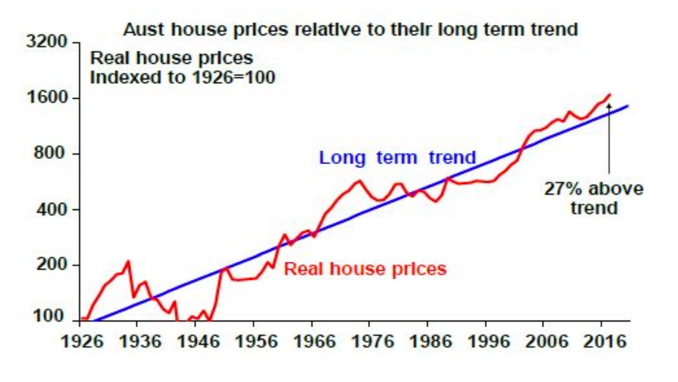
Australian house prices

Source: ABS, AMP Capital


These things arguably make residential property Australia’s Achilles heel. But as I have learned over the last 15 years, it’s a lot more complicated than the crash calls suggest.

First, it’s dangerous to generalise

While it’s common to refer to “the Australian property market”, only Sydney and Melbourne have seen sustained and rapid price gains in recent years. On CoreLogic data over the last five years dwelling prices have risen at an average annualised rate of 11.4% per annum (pa) in Sydney and 9.4% pa in Melbourne but prices in Brisbane, Adelaide, Hobart and Canberra have risen by a benign 3 to 5% pa and prices have fallen in Perth and Darwin.
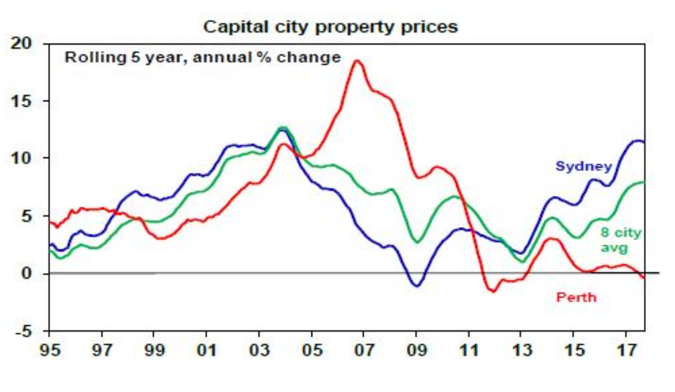
graph - capital city property prices

Source: CoreLogic, AMP Capital

Australian cites basically swing around the national average with prices in one or two cities surging for a few years and then underperforming as poor affordability forces demand into other cities. This can be seen in the next chart with Sydney leading the cycle over the last 20 years and Perth lagging.


Second, supply has not kept up with demand

Thanks mostly to an increase in net immigration, population growth since mid-last decade has averaged 368,000 people pa compared to 218,000 pa over the decade to 2005, which requires roughly an extra 55,000 homes per year.

Unfortunately, the supply of dwellings did not keep pace with the surge in population growth (see the next chart) so a massive shortfall built up driving high home prices. Thanks to the recent surge in unit supply this is now being worked off. But there is no broad based oversupply problem.

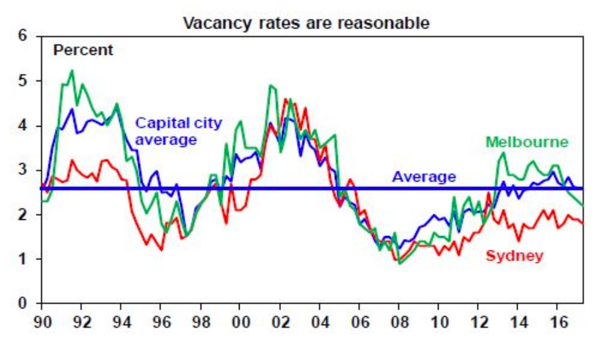
Consistent with this, average capital city vacancy rates are around long-term average levels, are low in Sydney and are falling in Melbourne (helped by surging population growth).
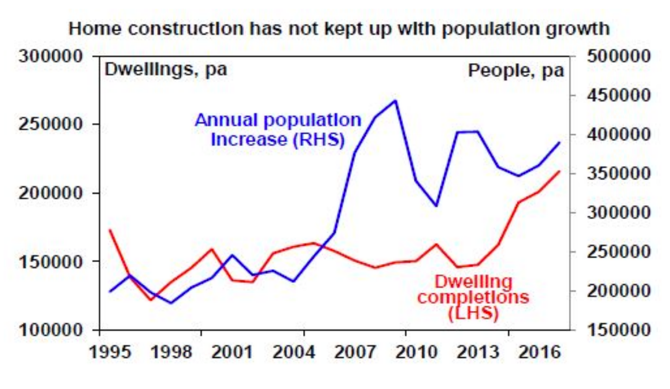
 

home construction not keeping up

Source: ABS, AMP Capital

Vacancy rates are reasonable

Source: Real Estate Institute of Australia, AMP Capital


Third, lending standards have been improving

For all the talk about “liar loans”, Australia has not seen anything like the deterioration in lending standards other countries saw prior to the GFC. Interest-only loans had been growing excessively but are not comparable to so-called NINJA (no income, no job, no asset) sub-prime and low-doc loans that surged in the US prior to the GFC. Interest-only and high loan to valuation loans have also been falling lately. And much of the increase in debt has gone to older, wealthier Australians, who are better able to service their loans.
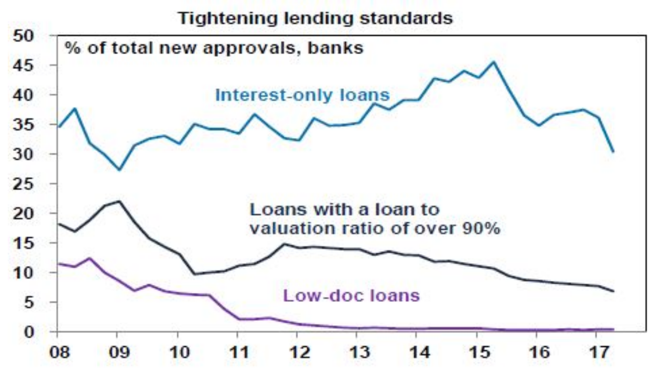
sfp e4 graph 5

Source: APRA, AMP Capital


Yes, I know various surveys report high levels of mortgage stress. But we heard the same continuously last decade from the Fujitsu Mortgage Stress Survey and yet there was no crash. By contrast, RBA research shows that while getting into the housing market is hard “those who make it are doing ok” and bad debts and arrears are low. Finally, debt interest payments relative to income are running around 30% below 2008 peak levels thanks to low interest rates. Sure, rates will eventually start to rise again but they will need to rise by around 2% to take the debt interest to income ratio back to the 2008 high.


Fourth, the importance of tax breaks is exaggerated

A range of additional factors like tax breaks and foreign buyers have played a role but their importance is often exaggerated relative to the supply shortfall. While there is a case to reduce the capital gains tax discount (to remove a distortion in the tax system), negative gearing has long been a feature of the Australian tax system and if it’s the main driver of home price increases as some claim then what happened in Perth and Darwin? Similarly, foreign buying has been concentrated in certain areas and so cannot explain high prices generally, particularly with foreign buying restricted to new properties.

Finally, the conditions for a crash are not in place

To get a housing crash – say a 20% average fall or more – we probably need much higher unemployment, much higher interest rates and/or a big oversupply. But it’s hard to see these.

    • There is no sign of recession and jobs data remains strong.
    • The RBA is likely to start raising interest rates next year, but it knows households are now moresensitive to higher rates & will move only verygradually – like in the US – and won’t hike by more than it needs to to keep inflation on target.
    • Property oversupply will become a risk if the current construction boom continues for several years but with approvals to build new homes slowing this looksunlikely.

Don’t get me wrong, none of this is to say that excessive house prices and debt levels are not posing a risk for Australia. But it’s a lot more complicated than commonly portrayed.

So where are we now?

That said, we continue to expect a slowing in the Sydney and Melbourne property markets, with evidence mounting that APRA’s measures to slow lending to investors and interest-only buyers (along with other measures, eg to slow foreign buying) are impacting. This is particularly the case in Sydney where price growth has stalled and auction clearance rates have fallen to near 60%. Expect prices to fall 5-10% (maybe less in Melbourne given strong population growth) over the next two years. This is like what occurred around 2005, 2008-09 & 2012.
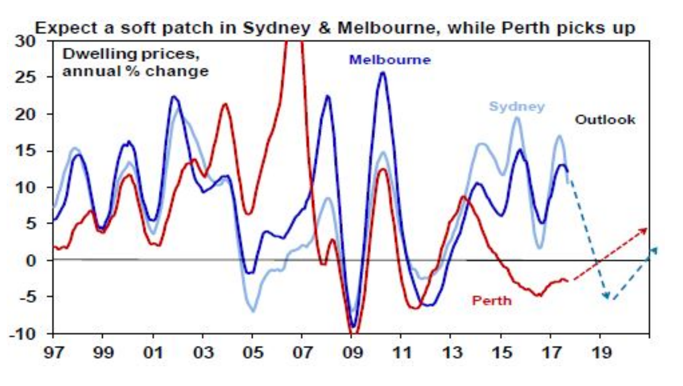
sfp e4 graph 6

Source: CoreLogic, AMP Capital


By contrast, Perth and Darwin home prices are likely close to the bottom as mining investment is near the bottom. Hobart and increasingly Brisbane and Adelaide are likely to benefit from flow on or “refugee” demand from Sydney and Melbourne having lagged for many years.

Implications for investors

Housing has a long-term role to play in investment portfolios, but the combination of the strong gains in the last few years in Sydney and Melbourne, vulnerabilities around high household debt levels as official interest rates eventually start to rise and low net rental yields mean investors need to be careful. Sydney and Melbourne are least attractive in the short term. Best to focus on those cities and regional areas that have been left behind and where rental yields are higher. So there you have it. Let’s see if we got it right next year.

Concluding comment

So there you have it. Let’s see if we got it right next year.


Bill Bracey FChFP
Principal Sydney Financial Planning
Authorised Representative Charter Financial Planning


Still have some questions?

If you want to discuss any cocerns or implications on your property investing with one of our advisors. Call us to arrange an appointment on 02 9328 0876.


This main article was prepared by Dr Shane Oliver. Dr Shane Oliver, Head of Investment Strategy and Economics and Chief Economist at AMP Capital is responsible for AMP Capital’s diversified investment funds. He also provides economic forecasts and analysis of key variables and issues affecting, or likely to affect, all asset markets.

General Disclaimer: This article contains information that is general in nature. It does not take into account the objectives, financial situation or needs of any particular person. You need to consider your financial situation and needs before making any decisions based on this information. Please seek personal financial advice prior to acting on this information.

Important note: While every care has been taken in the preparation of this document, AMP Capital Investors Limited (ABN 59 001 777 591, AFSL 232497) and AMP Capital Funds Management Limited (ABN 15 159 557 721, AFSL 426455) make no representations or warranties as to the accuracy or completeness of any statement in it including, without limitation, any forecasts. Past performance is not a reliable indicator of future performance. This document has been prepared for the purpose of providing general information, without taking account of any particular investor’s objectives, financial situation or needs. An investor should, before making any investment decisions, consider the appropriateness of the information in this document, and seek professional advice, having regard to the investor’s objectives, financial situation and needs. This document is solely for the use of the party to whom it is provided.


Wealth Building Tips

Wealth building tips x 4

Wealth Building Tips

We all have to start somewhere right? Some people are trying to build wealth from ground zero, while others may have been gifted with a head start from the likes of an inheritance. Either way, the following four tips apply to everybody, regardless of where you currently are in your financial journey. 

1. Spend less than you earn

You will hear plenty of professionals, institutions and the press talking about ways to boost your investment returns. At the same time, there are always apparent experts warning you to stay away from the stock market, or suggesting that property is immune from risk. Ultimately, boosting your return and the art of timing the market are neither important – at least, when you’re starting out. Instead, you should focus on your money habits and spending less than you earn – no other factors will have a greater impact.   Sydney Financial Planning has written an entire blog on ways to spend less than you earn.

2. Get some structure. How is your money being invested?

‘Asset allocation’ is financial lingo for how your money is divided up between cash, fixed interest, shares and property. Years of research, wisdom and countless professionals suggest that 90% of the investment return an investor will receive is dependent on their asset allocation i.e. how much of your money is in shares, property or cash and fixed interest. Past performance suggests that shares and property have a higher rate of return than cash, term deposits and fixed interest. Obviously though, shares and property carry a higher risk. If time is on your side (at least 7 – 10 years) it might be worth restructuring your asset allocation – an investor who holds a higher allocation to shares and property should outperform an investor that has less allocation to shares and property. 

 3. Stick to your plan – Time in the market as opposed to timing the market

There will be times when you will want to steer away from the plan. For example, when the market is going well, people generally want to be more aggressive and more subdued when the market is down. Many investors give into temptations which are sometimes based on emotions as opposed to sound strategy and planning. The danger of acting on emotions is that often it leads to buying high and selling low, which if repeated will lead to failure. To avoid this, block out the media noise and stick to your plan. Don’t let the news of the day change your mind! 

4. The 8th Wonder of the World – Compound Interest 

Let’s assume you would like to be save a million dollars by age 65. Using a flat rate of 6% in the figures below, these are the monthly contributions you would need to make based on the age you start saving:
         Age 25: $499.64 per month
         Age 35: $990.55 per month
         Age 45: $2,153.54 per month
         Age 55: $6,071.69 per month   

The message is simple. The earlier you start, the easier it is to build wealth. Even small amounts that are regularly invested can transform into large sums over time. Be warned though; compound interest can also work against you when you have debt. It is amazing to see that over a 30 year mortgage term, you generally pay (depending on interest rates) up to 3 times the amount originally borrowed. By making extra repayments (however small), you can save significant amount of penny’s over time.


You love this concept, but have a few more questions?

We are always here to help guide you on your financial journey. Contact us for advice on how to get started or have your current wealth situation reviewed, call us on 02 9328 0876.


General Disclaimer: This article contains information that is general in nature. It does not take into account the objectives, financial situation or needs of any particular person. You need to consider your financial situation and needs before making any decisions based on this information. Please seek personal financial advice prior to acting on this information.

When in doubt - kick it out!

When in doubt…kick it out!

When in doubt - kick it out!

Not just a soft kick either. Preferably boot it out as hard as you can. The method to his madness allowed you (and the team) to regroup, take time to set your formation and get ready to go again. Sure you might have lost possession and some ground but you’re not behind on the scoreboard and you’re still in the game. I often think of this in the context of investing. Just like soccer, investing is full of high emotion and decision making is too often clouded by stress.

When you’re investing in the share market and your portfolio drops 4% in one day, or 30% over one year it’s not uncommon to lose your head and start to question your investment game plan. Common sense might not always prevail and a knee jerk reaction can quickly follow.

The level headed question we need to be asking ourselves is, “is this recent correction a temporary setback or is there something more serious going on that requires a change in our game plan?” In times of nervousness and high emotion it’s often good to reflect and put things in context.

If we think about what’s happening with a clear mind, we could view a share price reduction as a great opportunity to accumulate more shares at attractive prices and for retirees this might highlight the importance of maintaining cash and other defensive assets in our investment portfolios to ensure we don’t have to sell and take a loss. The biggest challenge we all face in times of high emotion and stress is whether we have the presence of mind to see this not as a crisis but rather as an opportunity. Warren Buffet sums it up well by saying “be fearful when others are greedy and greedy when others are fearful”.

Coming back to my soccer coach again (who’s as equally wise as Warren Buffet), when share markets correct and it feels like the opposition is bearing down on us and we need to make a quick decision under stress, kick the ball out! Take a deep breath, rally the troops and get back on with the game plan. Easier said than done I know. That’s why we all need a coach or an adviser to remind us of the bigger picture. If you find yourself thinking, should I be doing something different and be changing my investments we encourage you to contact your adviser to regroup and talk about your investment game plan.


Are you ready to kick something out?

We are always here to help guide you on your financial journey. Contact us for advice on how to get started or have your current situation reviewed, call us on 02 9328 0876.


Article by Gary Winwood-Smith | Partner & Senior Financial Planner


General Disclaimer: This article contains information that is general in nature. It does not take into account the objectives, financial situation or needs of any particular person. You need to consider your financial situation and needs before making any decisions based on this information. Please seek personal financial advice prior to acting on this information.

Zen of a market crash

Zen of a market crash

Zen of a market crash

The mainstream media loves a “crash”, but let’s think through what actually happens…

What I’d like you to get out of this blog post is to love market corrections … welcome them, see why they have to happen, how little they mean in the long run and how much advantage you have over them – if you only process them the right way.”

The difference between the mind of a victim and the mind of an opportunist

First of all, let’s start calling things by their real names.

A crash is something definite, irreversible. Planes crash … cars crash. Markets don’t crash… markets correct. Their permanent growth is randomly interrupted by temporary declines. (Please notice the use of the adjective temporary). These happen often for no apparent reason, we can’t predict exactly when they happen and why? And guess what?! We don’t have to.

Let me tell you a story…There is an old Zen parable that speaks of two monks; sitting on a hill, watching a flapping pennant in the wind.

The first monk says: ‘The pennant is moving, the wind is not moving’.

The other monk says: ‘No, it’s the wind that is moving, the pennant is not moving’.

A third monk happens to walk by and he overhears the conversation.  He turns his head and says to his friends: ‘The pennant is not moving…the wind is not moving. Your minds are moving….’

This parable precisely describes what happens during a market correction.


You see, what actually happens in the market itself is infinitely less important than the following two things: 

‘How surprised people get’ and ‘What they think is going on’.

And although the market correction is not predictable or controllable in any scientific way, these two things influence the way your ‘mind moves’ and are both totally predictable and controllable and I will argue also avoidable.

1. The element of surprise

It wasn’t that the market went down 50% between 2008 and 2009 that mattered.  What really mattered was how it surprised many… how unprepared and shocked many people were when it happened.

We, humans, love fairy tales.  When we experience good time, we want it to last.  Sometimes, we want it so badly, that soon, we start believing that it’s not going to stop.

When we look at the events prior to the GFC (or the Great Panic), a few years of consistent and smooth double digit returns in the market, we simply slipped into this state of a false comfort.  The minute you bought into this fiction of the ‘new era’ and you presumed that the market would only go up from that point onwards, there was no way you’d be ready for the market to come down 50%.

Of course, the market didn’t go down any more or less for you than it did for anybody else. The difference was – it caught you by surprise, which prevented you from dealing with it calmly, making sense of it all and having a ‘battle plan’ (which is largely a psychological battle plan) for waiting out the correction.

2. What do you think is going on?

It doesn’t matter how strong the wind is blowing and it doesn’t matter how much the pennant is flapping… What do YOU think is going on?

  • If you think it’s the end of the world, you’re going to panic and sell.
  • If you think, this time is different than the last correction and that it won’t go up again, you’re going to panic and sell again.
  • If you think the market will just keep ‘crashing’ down, or it will take a hundred years for it to recover, you’re going to panic and sell!
  • If you think that something so major happened in the economy that the market cycle has been repealed and the companies will stop making profits from now on, you’re going to panic and sell.


All this has nothing to do with the wind and it has nothing to do with the pennant…this is just ‘your mind moving’.

I think you might begin to understand by now, that rather than studying corrections, we should focus on how people process the idea of a correction (and from my perspective of a financial coach, how passionately they’re coached).

Simply because this is what’s going to make all the difference. These are all the behavioural variables and therefore are all variables under our control.

But you need to recognise it and your financial (investment) adviser needs to recognise it.

Otherwise, all will be lost.


Still have questions or concerns?

It can really help to seek the help of a professional to discuss the best investment strategies for you. Why not call us to arrange an appointment on 02 9328 0876.


Article by Michal Bodi | Senior Financial Planner

Photo by Brooke Lark on Unsplash


General Disclaimer: This article contains information that is general in nature. It does not take into account the objectives, financial situation or needs of any particular person. You need to consider your financial situation and needs before making any decisions based on this information. Please seek personal financial advice prior to acting on this information.

Self Managaged Super Funds

Super…should you do it yourself?

Self Managaged Super Funds


So it’s expected that many of you would be very concerned with how your super is run.  Furthermore, an increasing number of us who want even more control over our super are transferring from larger funds into self-managed super funds (SMSF).

An SMSF has a maximum of four members and is primarily designed for business owners and their families.  However, SMSFs are not generally recommended as a cost-effective option if you have less than $250,000 of super assets.


Major advantages of SMSFs include: 

  • greater control over the structure of the fund and types of investments;
  • potential savings on management fees; and
  • the opportunity to make the best use of the tax environment.

Don’t be a slave to your super fund!

Despite its growing popularity, many only find out after starting one just how much time and work is involved in running an SMSF.  The penalties for not complying with SMSF regulations are severe.

Fortunately, there are SMSF services available that allow you to run your SMSF without having to perform all the time-consuming administrative activities.  For example, you can use a professional administration service, while having your own accountant look after some of the fund’s compliance and reporting, and have a real estate agent to manage your property in super.

Is it really necessary to have an SMSF super fund?

For most of us, probably not!  After many years advising clients and their SMSFs, direct property ownership is perhaps the significant motivator in deciding to have one; for example, if you have business property and wish to have it transferred to super, or you wish to invest in residential property via super.  There are many other reasons to have an SMSF, but the majority of us will in the end find out that a ‘normal’ super fund would be adequate in facilitating our retirement plans.

Managing your own superannuation fund can provide you with greater flexibility, greater control and a more cost-effective way to manage your investments in retirement.  But it’s not for everyone…  so make sure you consult an experienced financial planner before deciding on whether an SMSF would be right for you.


Still have some questions?

If you want to discuss your superannuation options with one of our advisors. Call us to arrange an appointment on 02 9328 0876.


General Disclaimer: This article contains information that is general in nature. It does not take into account the objectives, financial situation or needs of any particular person. You need to consider your financial situation and needs before making any decisions based on this information. Please seek personal financial advice prior to acting on this information.

Simple doesn't mean easy

Simple…Doesn’t Mean Easy

Simple doesn't mean easy


The short answer is no. The longer answer would be:

In times of market volatility (nervousness and high emotion) it’s often good to reflect and put things in context. In Nov 2007, the Australian share market was at its all-time high. In 2009 it fell 54%. Since then, the ASX200 returned to almost 6000,recouping almost 80% of the lost ground. Today the Australian share market currently sits around the 5000 mark. 

Ok, so what does it all mean and what do I have to do?  The answer is not much, except remembering the conversations about investing with your financial planner.

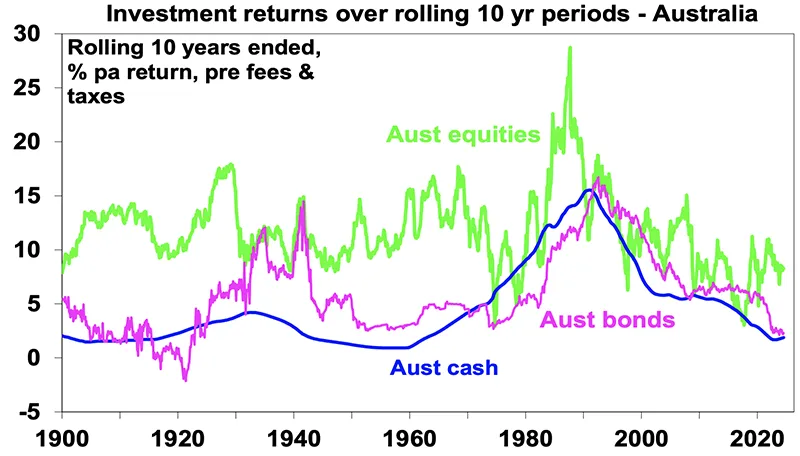
These ups and downs (or the volatility as the experts call it) are absolutely normal. They’re organic and we want them to happen. If we didn’t want this volatility in the first place, we’d simply always keep your money in cash. But that wouldn’t be that great either as after inflation there would be nothing left. Therefore, the volatility is good!  It’s there for the same reason as the premium returns we get from investing in great businesses in Australia and overseas (also called shares). We have to accept it and appreciate it.

For those people in accumulation phase, still working and contributing into super/investments (let’s call this group – the buyers) this presents a great value opportunity to accumulate more at attractive prices. Just picture going to a fruit market, having same amount of money in your pocket as yesterday and seeing lower prices. As a buyer, you’re getting more value for your money. Happy days.

For those people who finished investing new money – in retirement phase (let’s call this group – the receivers) – we need to remember that the income they receive from their portfolio is not paid based on its value (or what the portfolio is worth) but the number of units they hold. And although the volatility impacts on the first, it doesn’t have any impact on the latter.

It also highlights the importance of maintaining cash (one or two years’ worth) in your retirement income portfolios to help weather the volatility and not forcing you to sell.

Finally, the share market, just like us, is emotional. There are no good or bad markets. There’s just the market. And Mr Market has a bad temper sometimes. The best we can do is to leave him alone and not try to control it. Or as your financial coach will always tell you, let’s take a step back and think about why we’re investing in the first place. This is the main reason you hired them – to put things in perspective and to stop you from making bad decisions with your money.


Still have some questions?

If you want to discuss your investment strategy with one of our advisors. Call us to arrange an appointment on 02 9328 0876.


Article by Michal Bodi | Senior Financial Planner


General Disclaimer: This article contains information that is general in nature. It does not take into account the objectives, financial situation or needs of any particular person. You need to consider your financial situation and needs before making any decisions based on this information. Please seek personal financial advice prior to acting on this information.

Can your portfolio weather the oil shock?

Shares down on the oil shock – 5 key charts for investors to keep in mind

Can your portfolio weather the oil shock?

  • Predicting how this will all unfold is hard. The key is to stay focussed on the basic principles of successful investing.
  • These five charts focus on principles of investing critical in times like now: the power of compound interest; don’t get blown off by the cycle; the roller coaster of investor emotion; the wall of worry; and market timing is hard.
  • Introduction

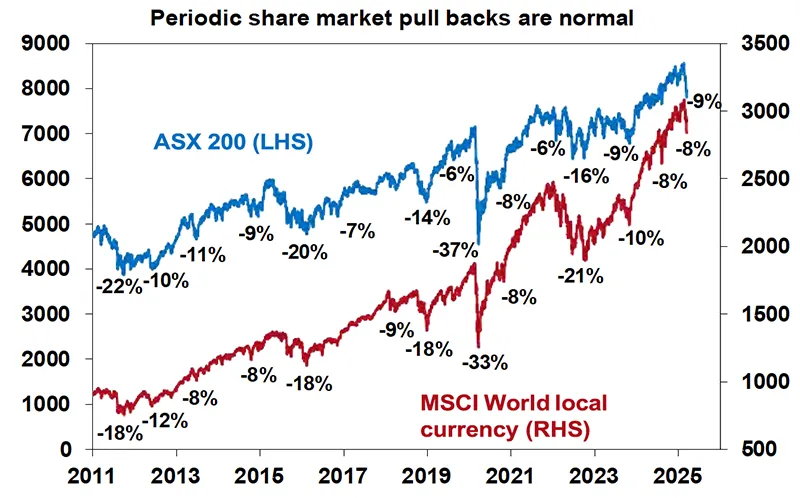
    Most of the time share markets are relatively calm, but periodically they tumble and generate headlines like “billions wiped off share market.” Sometimes it ends quickly and the market heads back up again. But every so often share markets keep falling for a while. Sometimes the falls are foreseeable (usually after a run of strong gains), but rarely are they forecastable (which requires a call as to timing and magnitude). And now with the US and Israel waging War on Iran its happening again with falls gathering pace as the War drags on. From their record highs earlier this year 7%, Japanese shares have fallen 13%, Eurozone shares are down 11% and Australian shares are down 9%.

    While the details regarding the current plunge differ from past falls, from the point of view of basic investment principles, it’s hard to say anything new. Which is why this note may sound familiar with “5 key charts for investors to keep in mind”.

    The current state of the War and flow on to markets

    We are now into the fourth week of the War with no clear sign of an end – despite President Trump’s frequent reassurances that the end is near.

    • A problem is Trump indicated regime change was a goal – along with a group of military objectives – and killing of Iran’s leaders and musing about replicating the Venezuelan model appear to confirm this.
    • So, Iran took the long-predicted response of attacking regional oil and gas infrastructure and effectively closing the Strait of Hormuz.
    • Which in turn has potentially created the biggest oil & energy shock in history given 20% of world oil and gas flows through the Strait.
    • This in turn has led to a surge in oil and gas prices which in turn has seen bond yields rise on inflation fears, the expected profile for official central bank interest rates rise sharply and shares fall on fears of higher inflation and rates and weaker growth and profits.
    • By declaring that the War would be over “very soon” on 9 March and that he was considering “winding down” the War on 20 March, both after sharp oil price rises, Trump has signalled he can’t bear the full economic and political costs of the War. So just like his TACO back down on tariffs last year, many assume he will do the same this time which is why the rise in oil prices and fall in shares has so far been relatively mild.  For example, global oil prices are up “just” 90% from their January low (compared to three or four fold increases in the 1970s oil shocks which were arguably smaller) and US shares have only fallen 7% and Australian shares 9% which are both much smaller than last year’s tariff related slump and the falls around the 2022 inflation and interest rate scare.
    • But the Iranian leadership shows no sign of waving a white flag and in fighting for survival wants to inflict maximum economic and political pain on Trump – which they know they can do by restricting oil supplies. So this makes it harder to him to do a TACO.
    • There are various workarounds to the Strait blockage – Saudia Arabia’s pipeline to the Red Sea, stockpile releases, US naval escorts, Iran letting non-enemy ships through, etc – but its unclear they are enough or will work. Eg the US doesn’t have the capacity to defend every tanker. If Iran lets too many ships pass it weakens its leverage. And the US may not like the idea of Iran deciding who goes through.
    • Right now, despite lots of confusing comments from Trump the risk is more escalation – with a consideration of using troops and now threatening to obliterate Iran’s power plants. Iran is threatening more retaliation against energy infrastructure in response.
    • Past oil price shocks unfolded over months as the impact became clearer – four months in 1973-74 when oil prices rose four-fold and over more than a year in 1979-80 when oil prices rose three-fold. So, it’s still early days.
    • So, the threat of stagflation remains and it’s at a time of various other threats to shares around AI, private credit & stretched valuations.
    • Current average capital city petrol prices in Australia of around $2.45 will if sustained add 1.5% to inflation taking it above 5% and add $114 a month to the household petrol bill which along with increasing risks of fuel shortages will lead to a big hit to economic activity.

    Our base case is that the War and oil shock will be relatively short as Iran will not be able to keep the Strait closed indefinitely and Trump will look for an off ramp as political pressure builds ahead of the midterms. But it could still go on for weeks yet and so could still see oil prices rise more in the interim say to $US150. We continue to see the risk of a 15% or so correction in shares this year but the size of the threat means there is a high risk it may be deeper. Trying to work out how all this plays out is not easy. But looking at shares around major geopolitical events, the typical playout is for a sharp fall of around 8% but then a recovery over the next 12 months of around 14%. Of course, there are wide ranges around this. Given the uncertainty now is a critical time to stick to basic principles of investing. So, this note revisits five key charts investors should keep in mind.

    Chart #1 The power of compound interest

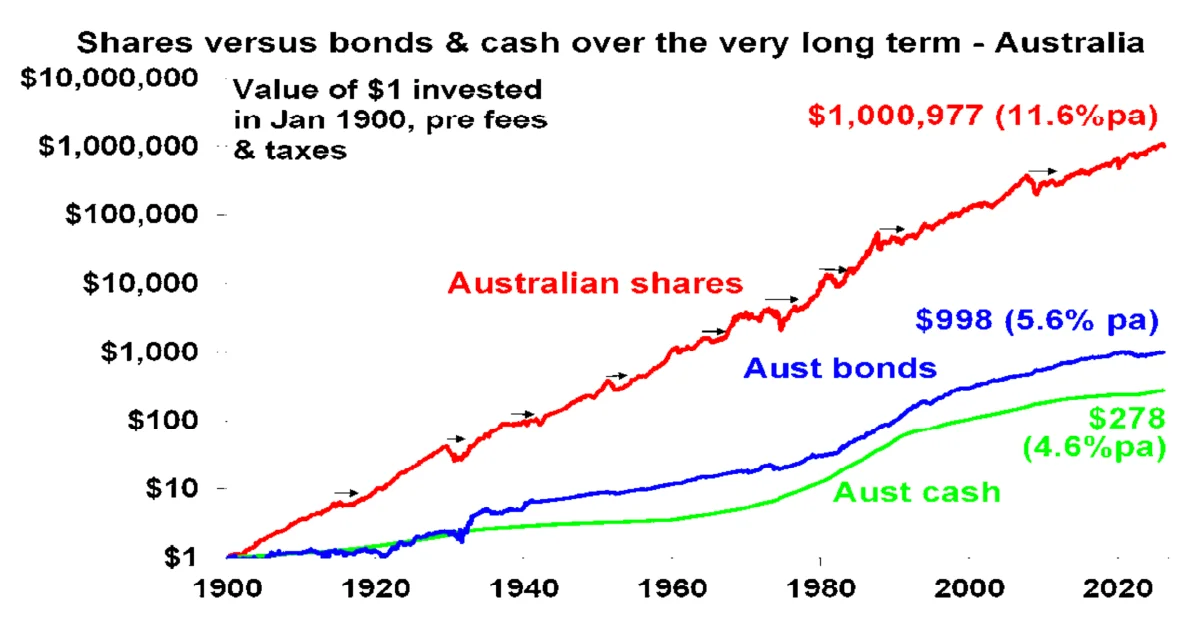
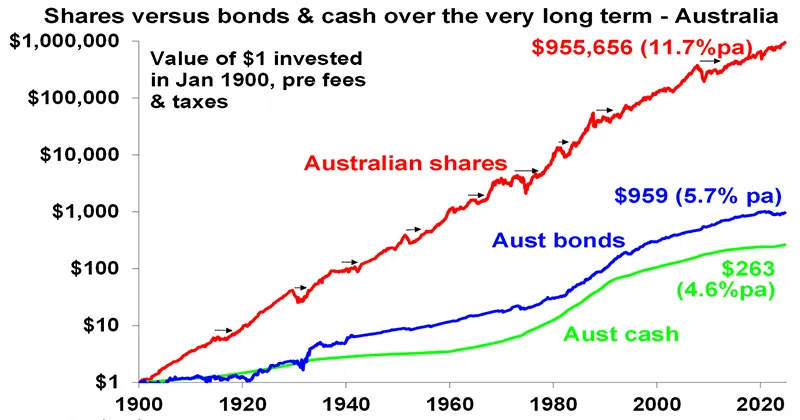
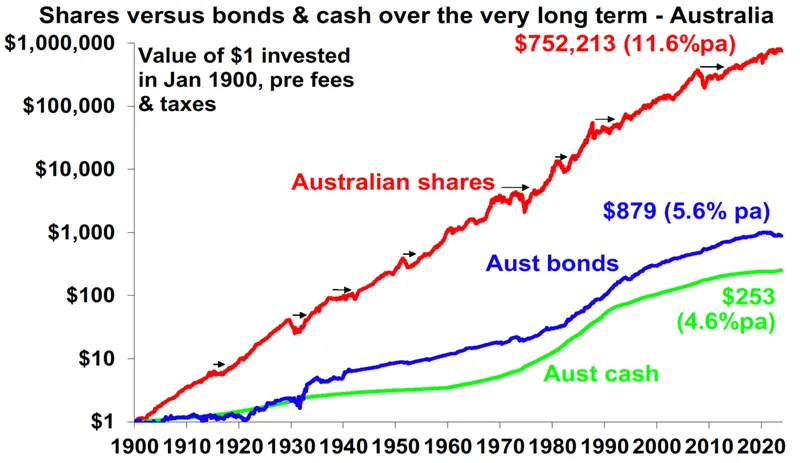
    This chart shows the value of $1 invested in various Australian assets in 1900 allowing for the reinvestment of dividends & interest along the way.

    Chart 1 shares vs bonds cash over long term australia

    Includes dividends. Source: ABN-Amro Global Investment Returns Yearbook, Bloomberg, AMP

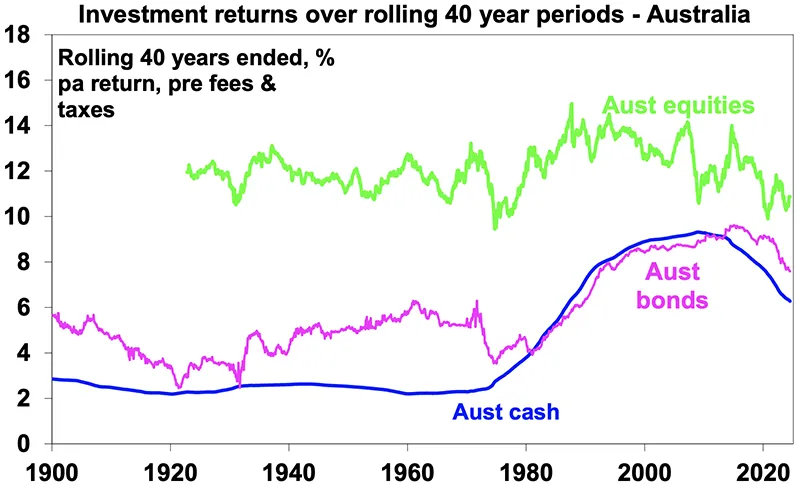
    That $1 would have grown to $278 if invested in cash, to $998 if invested in bonds and to $1,000,977 if invested in shares up till now. While the average return since 1900 is only double that on shares versus bond, the huge difference between shares and bonds owes to the impact of compounding – or earning returns on top of returns over time. So, any return earned in one period is added to the original investment so that it all earns a return in the next period. And so on. Which means higher average returns over time compound into much higher end point values. Key message: to grow wealth, we must have exposure to growth assets like shares and property that provide higher long term average returns.


    Chart #2 – Don’t get blown off by cyclical fluctuations in shares

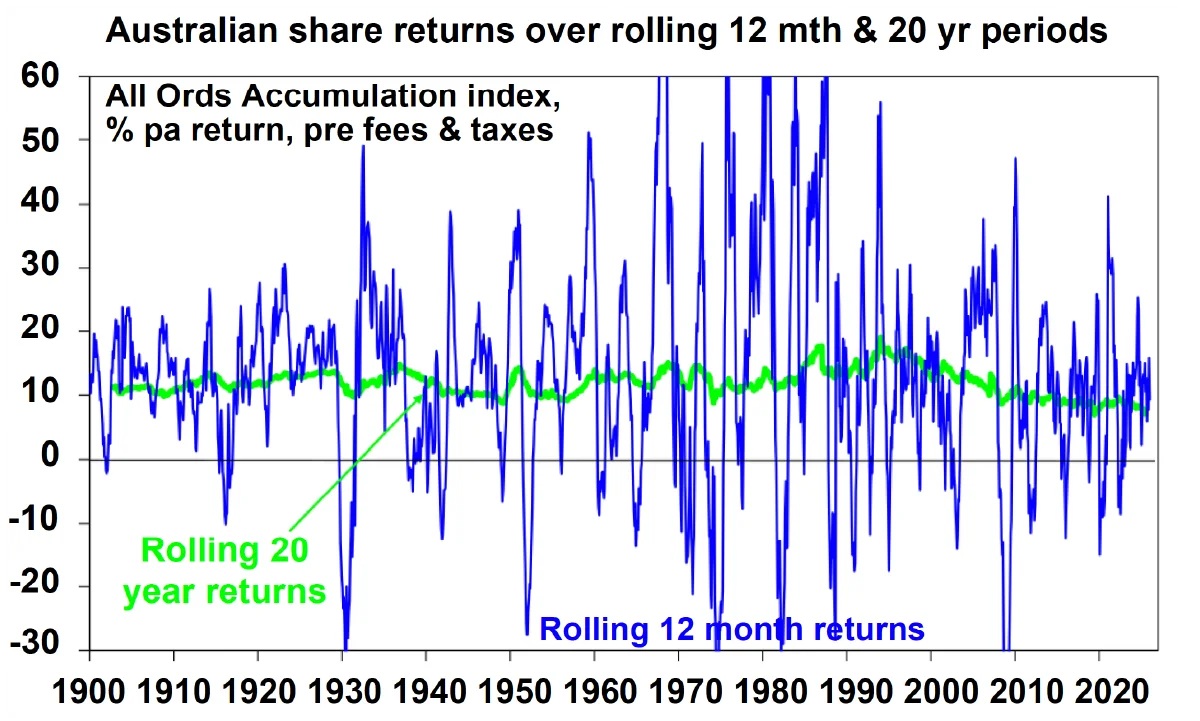
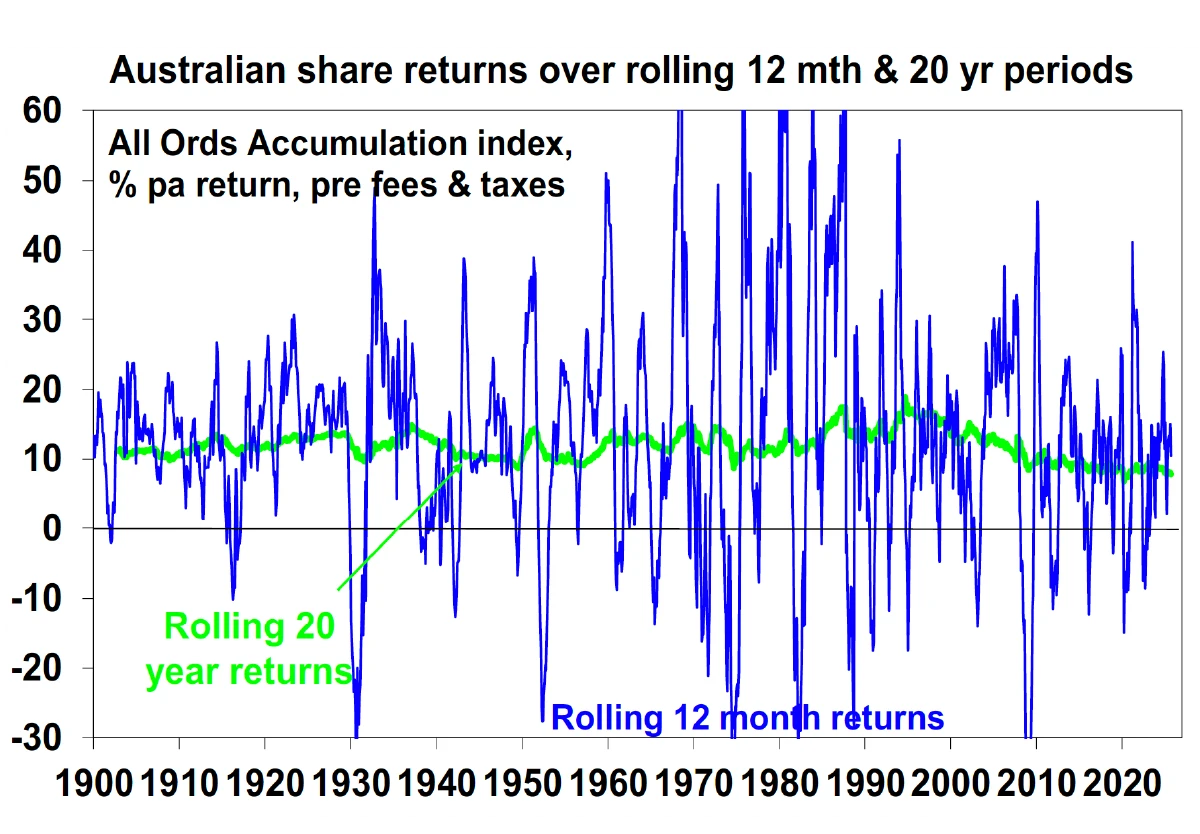
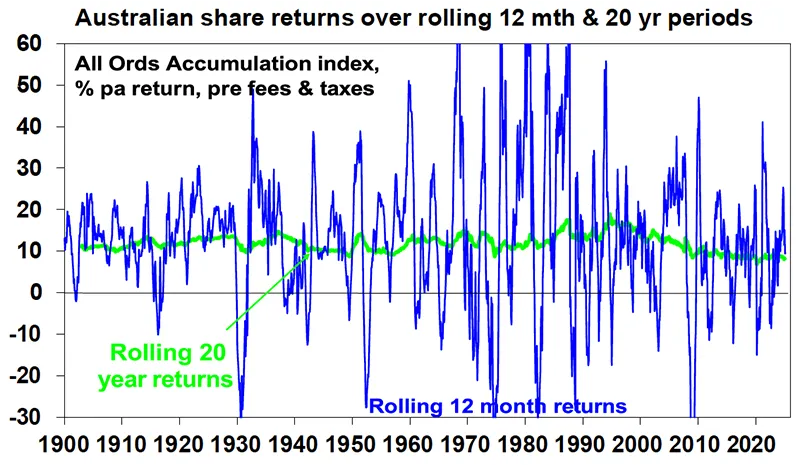
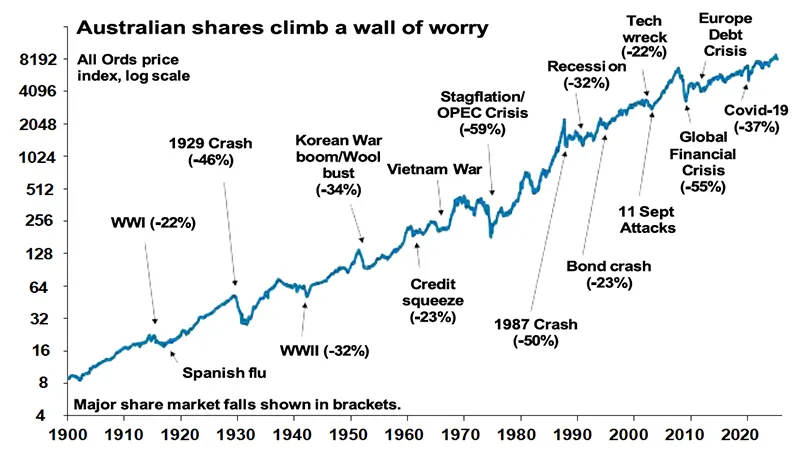
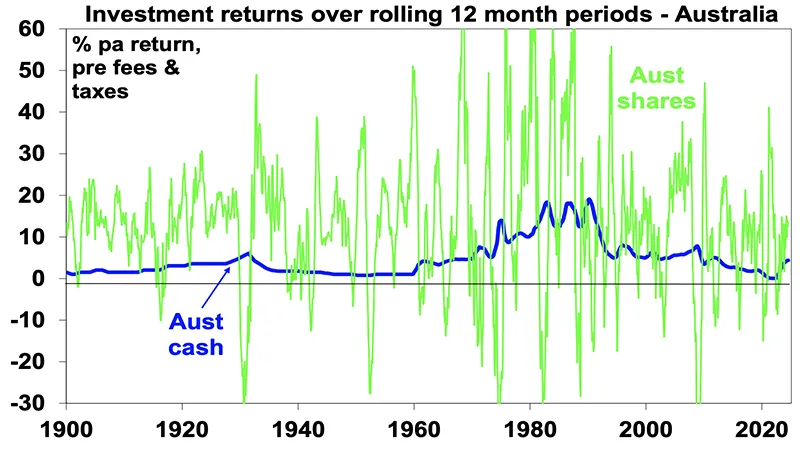
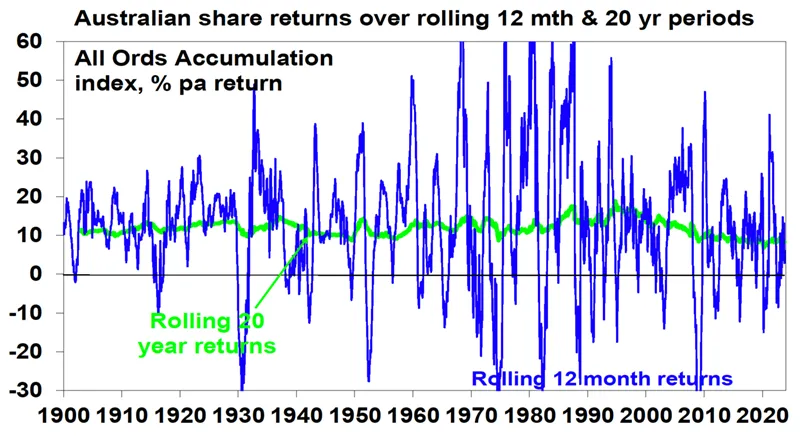
    The trouble is that shares can have lots of setbacks, eg, see the arrows on the previous chart. Even annual returns are highly volatile, but longer-term returns tend to be solid and relatively smooth. Since 1900, for Australian shares roughly two years out of ten have had negative returns but there are no negative returns over rolling 20-year periods.

    Chart 2 - Australian share returns over rolling 12 month and 20 year periods

    Source: Bloomberg, AMP

    Understanding that these periodic setbacks are just an inevitable part of investing is important in being able to stay the course. Key message: big short-term swings in shares are normal but the longer the horizon, the greater the chance your investments meet their goals.

    Chart #3 Beware the roller coaster of investor emotion

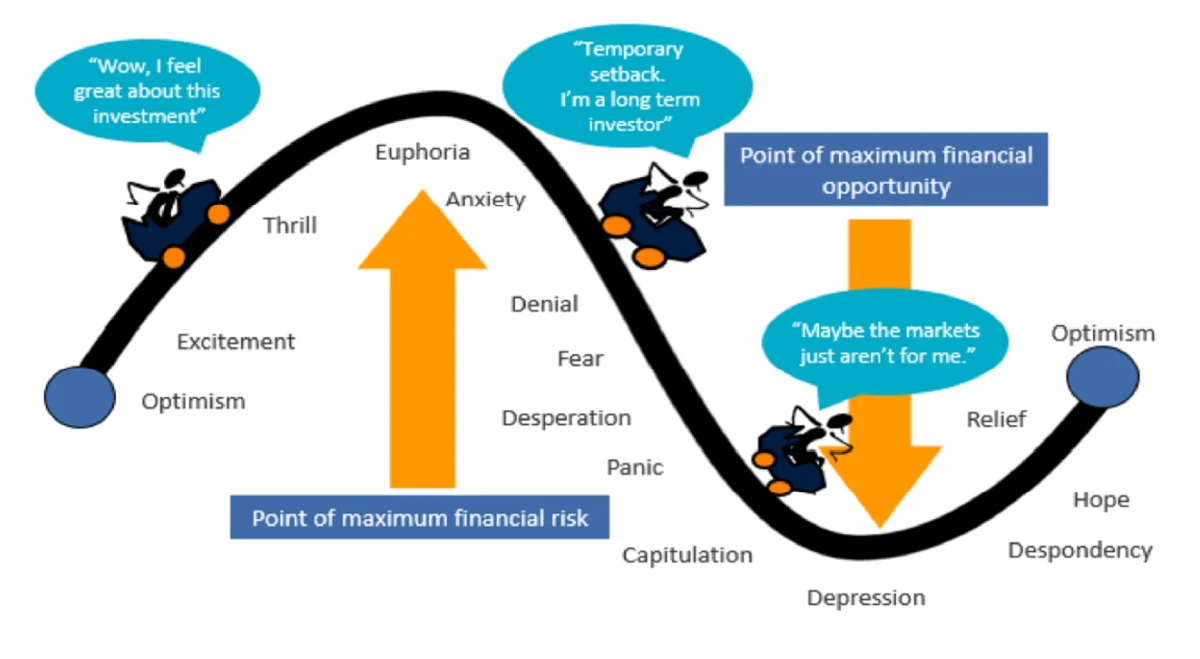
    Investment markets move more than can be justified by moves in their fundamentals, because investor emotion plays a huge part. The next chart shows the roller coaster that investor emotion traces through the course of an investment cycle. Once a cyclical bull market turns into a bear market, euphoria gives way to ultimately depression at which point the asset class is under loved and undervalued and everyone who is going to sell has – and it becomes vulnerable to good (or less bad) news. This is the point of maximum opportunity for investors to buy into an asset at depressed prices. Once the cycle turns up again, depression gives way to hope and eventually euphoria. This is the point of maximum risk.

    Chart 3 the roller coaster of investor emotion

    Source: Russell Investments, AMP

    Key message: investor emotion plays a huge role in driving swings in markets. The key for investors is not to get sucked into this emotional roller coaster. Of course, this is easier said than done, so many investors end up getting wrong footed – by buying at the top when everyone is bullish and selling at the bottom when everyone is bearish (like in April last year on US tariffs, or maybe soon on worries about the oil supplies).

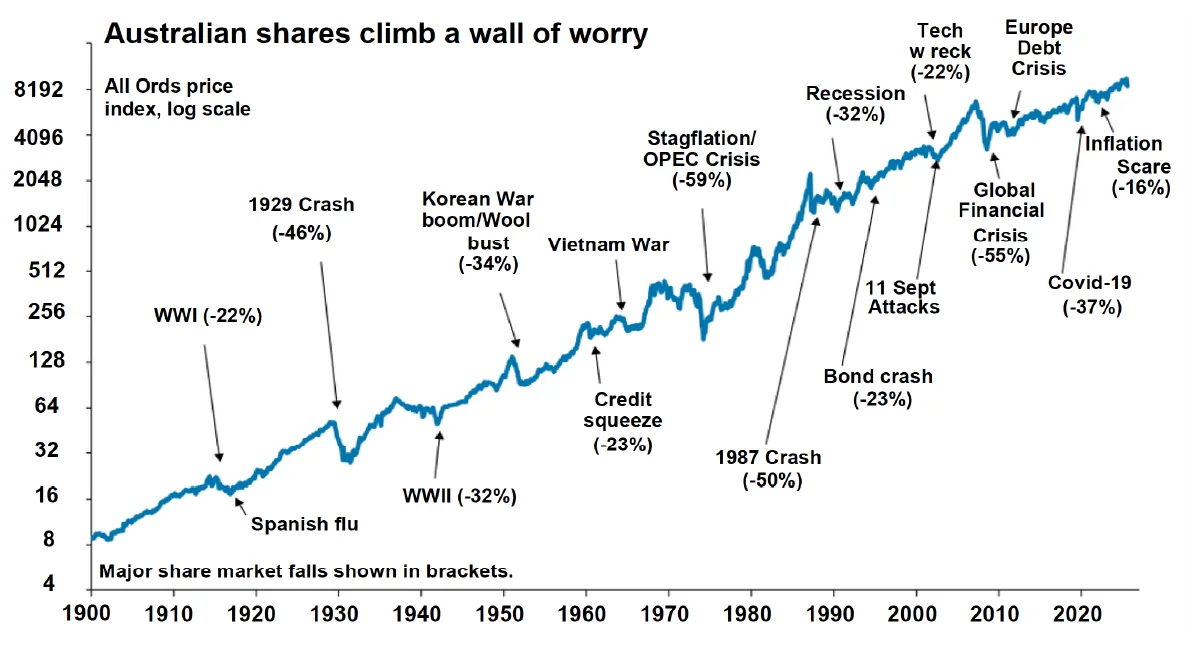
    Chart #4 The wall of worry

    There is always something for investors to worry about. And this has certainly been the case since Trump returned with his contradictory and confusing utterances. But the global economy has had plenty of worries, but it got over them with Australian shares returning 11.6% per annum since 1900, in a broad rising trend, and US shares returning 10% pa.

    Key message: worries are normal around the economy and investments and sometimes they become intense – like now. But they eventually pass.

    Chart 4 Australian shares climb a wall of worry

    This shows the All Ords price index while the first chart included dividends. Source: ASX, AMP

    Chart #5 Timing markets is hard

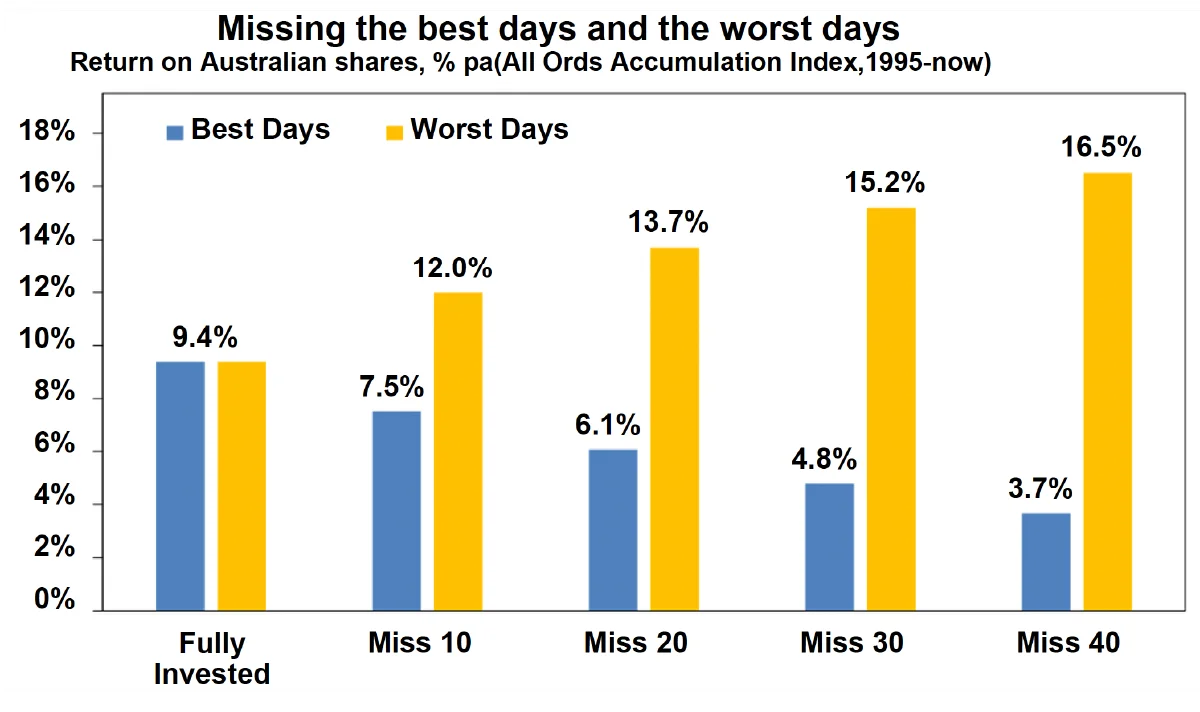
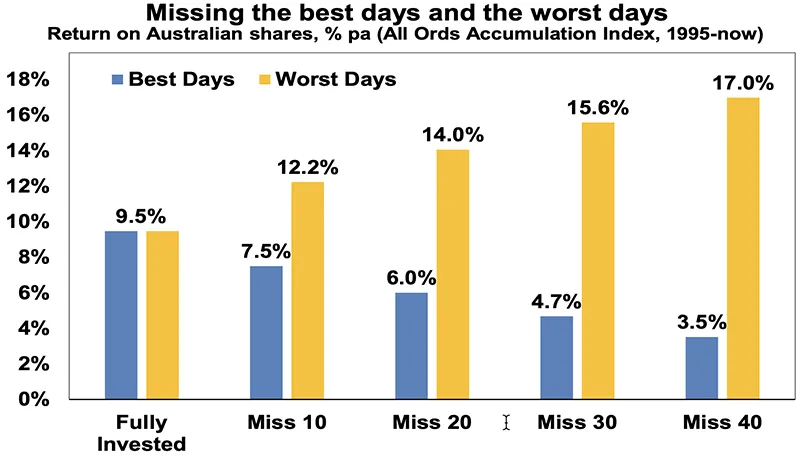
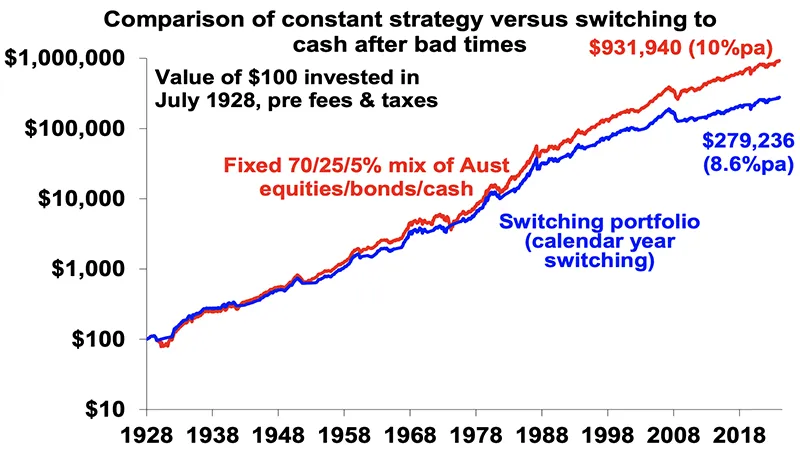
    With the benefit of hindsight many swings in markets around things like the GFC and the 2022 inflation surge look inevitable and so it’s natural to think about switching between say cash and shares within your super fund to anticipate market moves. But trying to time the market is difficult. A good way to demonstrate this is with a comparison of returns if an investor is fully invested in shares versus missing out on the best (or worst) days. The next chart shows that if you were fully invested in Australian shares from January 1995, you would have returned 9.4% pa.

    sfp insight ed07 2026 05 missing the best and worst days

    Jan 1995 to Feb 2026 & includes dividends but not taxes & fees. Source: Bloomberg, AMP

    If by trying to time the market you avoided the 10 worst days (yellow bars), you would have boosted your return to 12% pa. And if you avoided the 40 worst days, it would have been 16.5% pa! But many investors only get out after bad days & miss some of the best days. If by trying to time things you miss the 40 best days (blue bars), the return falls to 3.7% pa.

    Key message: trying to time the share market is not easy. For most – whether as a super fund member or an investor outside super – it’s best to stick to an appropriate well thought out long term investment strategy.


    Dr Shane Oliver
    Head of Investment Strategy and Chief Economist


    Worried about how oil shocks affect your investments?

    Speak with our Financial Planners about protecting your portfolio during market volatility and staying focused on long-term goals. To book a meeting get in contact with us on 02 9328 0876.


    This article was prepared by Dr Shane Oliver with opening and closing summary by William Bracey – CEO & Senior Financial Planner from Sydney Financial Planning. Dr Shane Oliver who provides economic forecasts and analysis of key variables and issues affecting, or likely to affect, all asset markets. He also provides economic forecasts and analysis of key variables and issues affecting, or likely to affect, all asset markets.

    Sydney Financial Planning Pty Ltd (ABN 29 606 413 254), trading as Sydney Financial Planning & Illawarra Financial Planning is an Authorised Representative & Credit Representative of Charter Financial Planning Limited, Australian Financial Services Licensee and Australian Credit Licensee.

    This article contains information that is general in nature. It does not take into account the objectives, financial situation or needs of any particular person. You need to consider your financial situation and needs before making any decisions based on this information. If you decide to purchase or vary a financial product, your financial adviser, and other companies within the AMP Group may receive fees and other benefits. The fees will be a dollar amount and/or a percentage of either the premium you pay or the value of your investments. Please contact us if you want more information. If you no longer wish to receive direct marketing from us you may opt out by contacting Sydney Financial Planning . You may still receive direct marketing from AMP as a product issuer, bringing to your attention products, offerings or other information that may be relevant to you. If you no longer wish to receive this information you may opt out by contacting AMP on 1300 157 173.

    Are we entering a market downturn?

    The outlook for Australian shares

    Are we entering a market downturn?

  • We see more upside in Australian shares supported by the return of profit growth. And its underperformance over the last 16 years is getting long in the tooth..
  • But rich valuations, a more hawkish RBA and global risks suggest it will be a bumpy ride.
  • What happens after the Iran/Middle East attacks?
  • Introduction

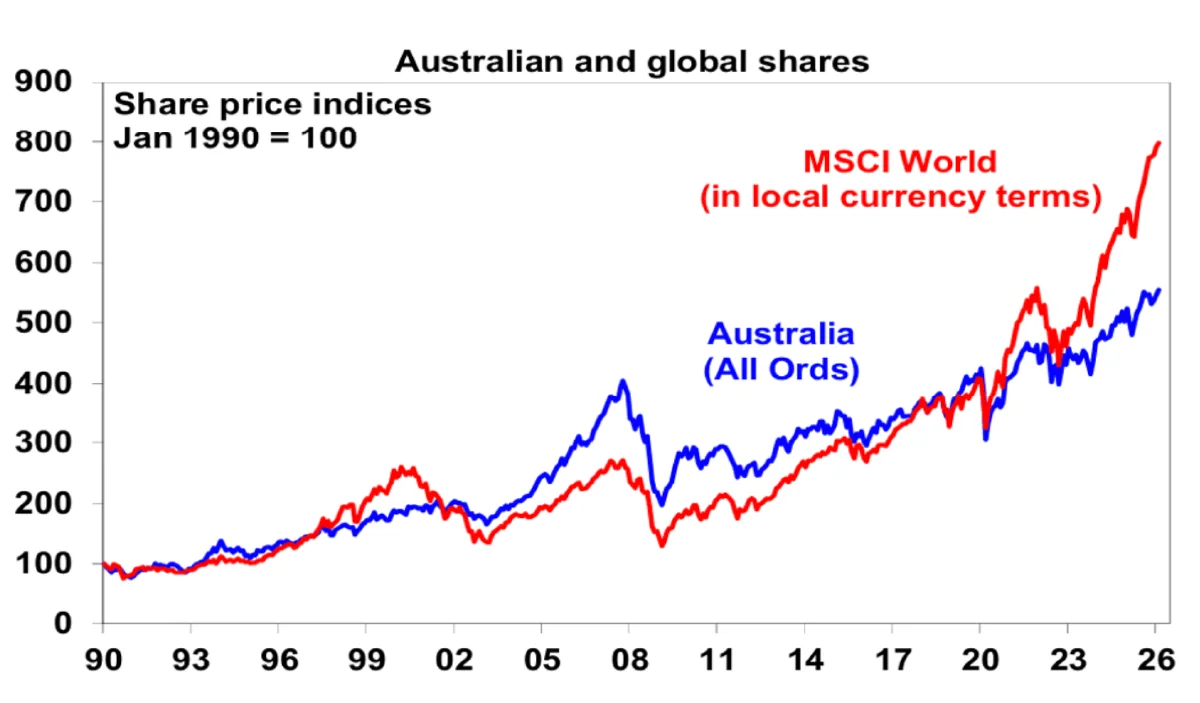
    Australian shares have had a strong start to 2026 with the ASX 200 up 3.3% and flirting with a new record high. The local market has also outperformed US shares which are down 0.1% and global shares which are up 1.6%. However, this could just be noise and follows a significant underperformance against US and global shares since 2009. So, can the gains continue and is the 16 year structural underperformance finally over?

    Source: Bloomberg, AMP

    Australian shares in a long-term context

    To get a handle on the future, it’s first useful to understand the past and here some key points on the performance of Australian shares:

    • Over the very long-term Australian shares have been a strong performer. Since 1900 Australian shares have returned 11.6% per annum once dividends are allowed for versus 10.1% pa for US shares.
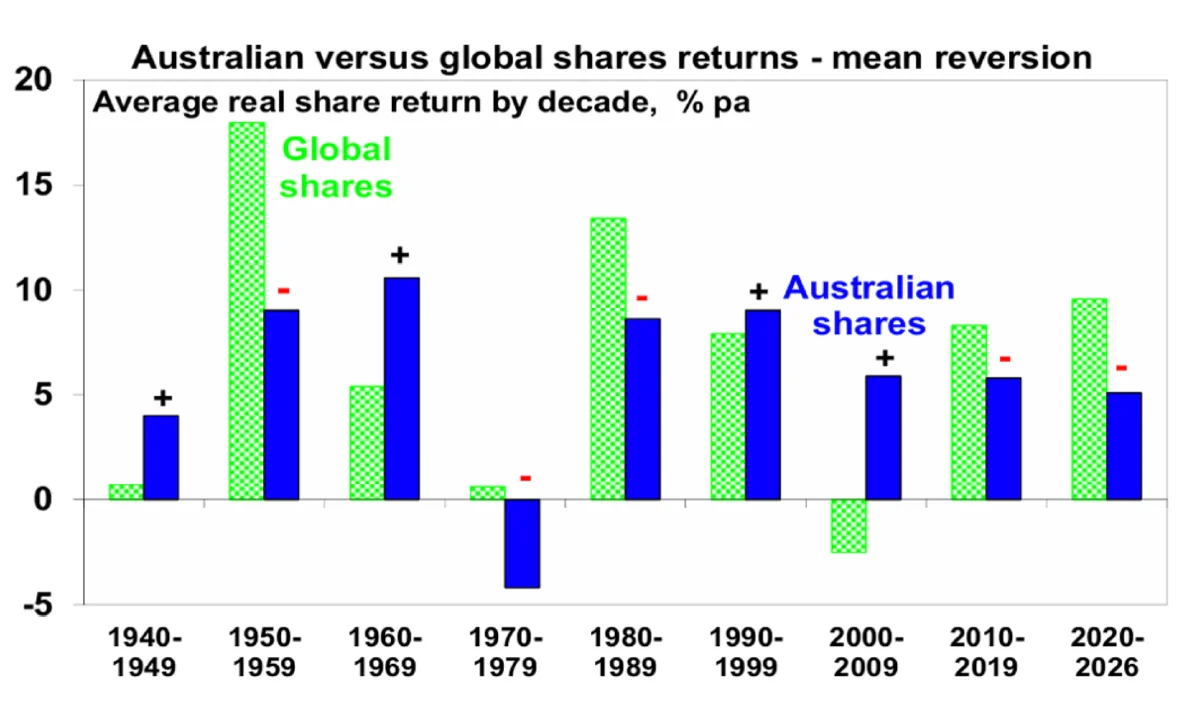
    • However, Australian shares go through periods of relative out & underperformance or “mean reversion”. This can be seen in the next chart. Australian shares outperformed in the 1940s (indicated by a +), unperformed in the 1950s (indicated by a ), outperformed in the 1960s resources boom years, underperformed in the high inflation 1970s and 80s, outperformed in the 1990s (although Australia underperformed in the second half of the 1990s when the tech boom raged), outperformed dramatically in the resources boom of the 2000s and underperformed in the 2010s and this decade so far.

    sfp insight ed06 2026 australian vs global shares return mean

    Includes dividends. Source: ABN-Amro Global Investment Returns Yearbook, Bloomberg, AMP

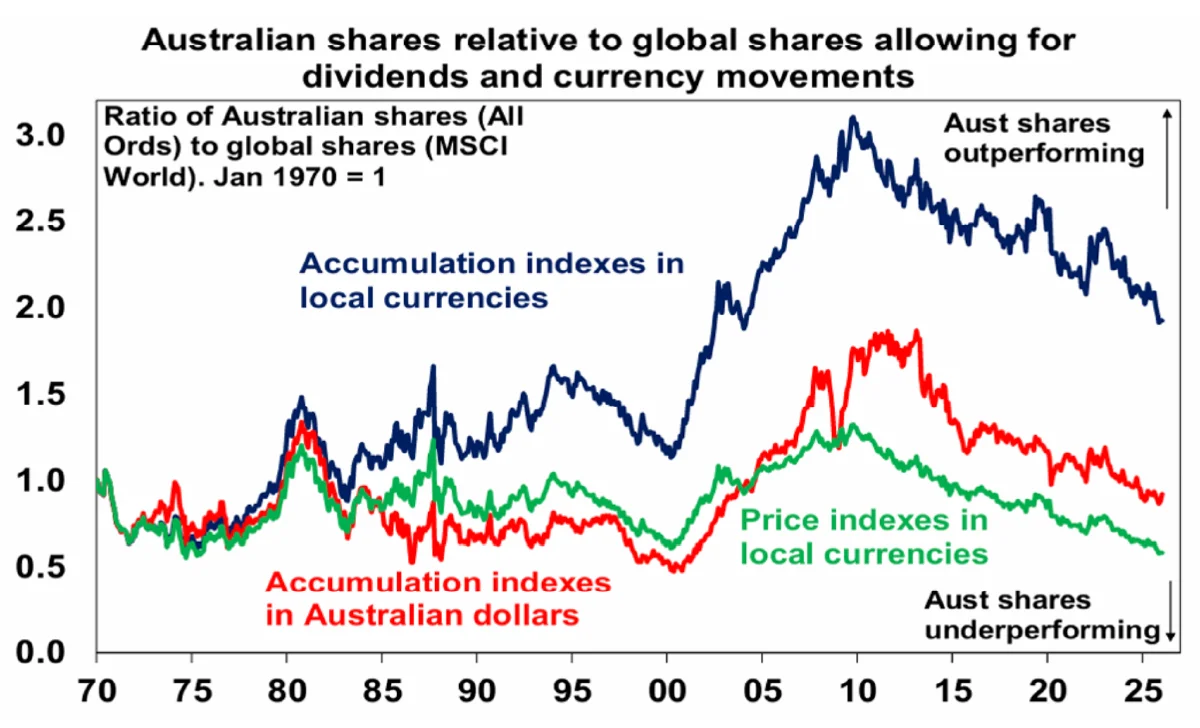
    • The more recent swings in relative performance can be seen more starkly in the next chart. It compares the relative performance of Australian to global shares since 1970 in terms of: relative share prices in local currency terms (green line); relative total returns ie with dividends added in (blue line); and relative total returns with global shares in Australian dollars (red line). A rising ratio means Australian outperformance and vice versa.

    •  As Australian shares pay high dividend yields (3.3% currently) versus global shares (1.5%), dividends should be included in comparisons of Australian & global share returns. So, the focus should be on the blue line (comparing total returns) or the red line which compares total returns in $As, and not the green line which only looks at share prices.
    sfp insight ed06 2026 aus shares relative to global dividends currency movement

    Source: Bloomberg, AMP


    Several things stand out.

    • First, as noted earlier, over long periods of time and when dividends are allowed for Australian shares have performed well versus global shares. Since 1970 Australian shares have returned (capital growth plus dividends) 10.2% per annum versus 8.9% pa for global shares in local currency terms. However, the falling $A over this period has enhanced the return from global shares to 10.4% pa but its not that different to the return from Australian shares.
    • Second, the swings in the relative performance of Australian shares are apparent if dividends and currency moves are allowed for or not.
    • Finally, since October 2009, Australian shares have seen a long run of underperformance. Over that period, they have returned 8.5% pa compared to 11.8% pa from global shares in local currencies or 12.9% pa from global shares in Australian dollar terms (as the $A fell).

    Why has Australia underperformed since 2009?

    The underperformance of Australian shares since 2009 reflects a combination of: payback for the huge mining boom related outperformance of the 2000s; the slump in commodity prices from 2011; the lagged impact of the surge in the $A above parity against the $US into 2011; relatively tighter monetary policy in Australia for much of the post GFC period; fears that higher post pandemic interest rates will hit Australia harder due to more indebted households and Australia’s expensive property market; worries about the slowing Chinese economy; and a low exposure to tech stocks – with tech stocks propelling US shares in the pandemic and more recently with AI excitement.

    Five reasons Australia’s underperformance may be at or close to over

    There have been several occasions over the last few years where it looked like the relative underperformance of Australian shares may be ending  – such as around 2018-19 and 2022 – only to see it resume taking the ratios in the previous chart to new lows for this cycle. But there are now several positives for the Australian share market suggesting at least more upside on a 12 month view and possibly some relative outperformance.

    1. Mean reversion – the historical experience tells us that after a lengthy period of underperformance the local share market eventually bottoms and outperforms for a few years. This may now be due after more than 16 years of underperformance.
    2. Rotation from tech to non-tech shares – global investors appear to be rotating away from tech shares on the back of concerns about stretched valuations, excessive capex related to AI and worries that AI will decimate software businesses (ie “tech eating itself”). This will work against the tech heavy US share market (and was evident in the global relative underperformance of US shares last year) and may benefit the Australian share market. As we saw in the tech wreck of 2000-03 Australia’s low tech exposure turned out to positive for Australian shares and helped kick of a long period of outperformance.
    3. A new super cycle in commodities – the commodity price slump from their 2008-2011 highs looks to be over with commodities embarking on a new super cycle bull market driven by constrained supply after low levels of investment and electrification and rising defence spending driving increased demand for metals. This will benefit Australia’s resource stocks. Iron ore is likely to feature less this time around partly reflecting slowing urbanisation in China and its property slump. But it’s worth noting that copper is now a bigger contributor to BHP’s earnings than iron ore.
    4. Artificial Intelligence could add to demand for commodities – North American research provider the Bank Credit Analyst has posited that if AI driven robotics effectively boosts the supply of labour and drives a surge in global GDP, then the value of other factors of production like land and natural resources will soar. So, Australia might turn out to be a big long-term beneficiary of the AI revolution.
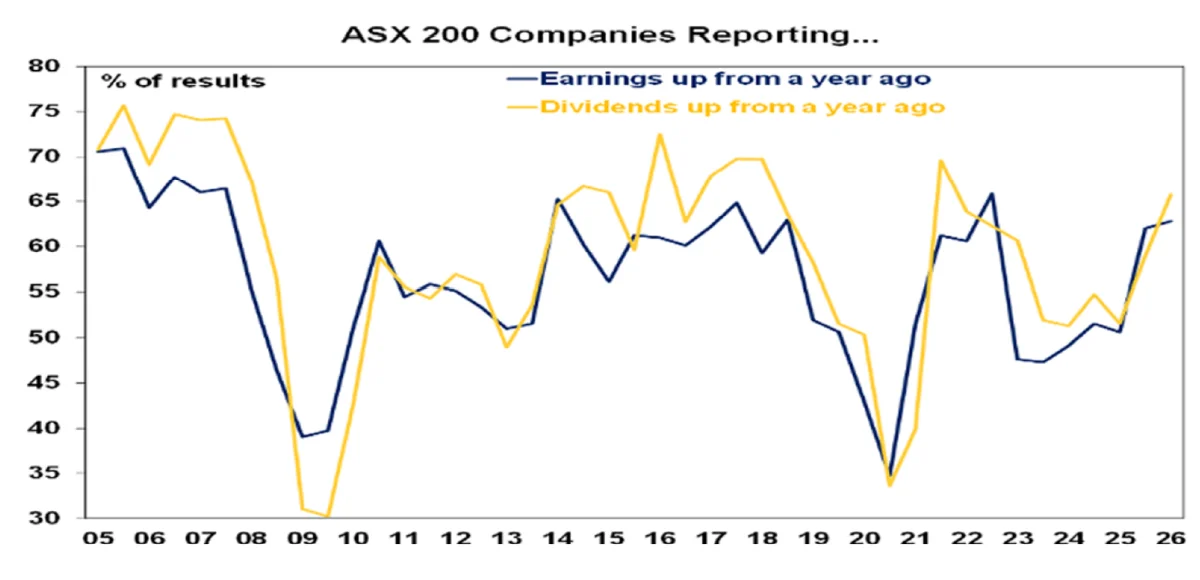
    5. Company profits are rising again in Australia – this is the key driver in the near term. After three years of falls listed company profits are turning up with the latest profits reporting season confirming this:  upside surprises have been surpassing downside surprises by almost two to one which is the strongest since 2021 and more companies are reporting profits and dividends up on a year ago compared to what was occurring in 2023 and 2024.

    What happens now, after the Iran/Middle East attacks? 

    The risks

    Oil and gas prices rise, leading to higher inflation worldwide, followed by higher interest rates globally. This generally results in slower economic growth around the world. Hopefully, this is a short, sharp event, and Iran is free and able to rebuild its economy and develop friendly relationships with its trading partners. In that case, oil prices would fall, inflation would ease, and economies would grow. 

    However, if the conflict were to escalate into a prolonged war, it would place significant strain on the global economy. 

    The upside

    The upside is that tensions in the Middle East ease, stability returns, oil prices fall, interest rates come down, and global economic growth strengthens. 

    ASX 200 companies reporting

    Source: Bloomberg, AMP

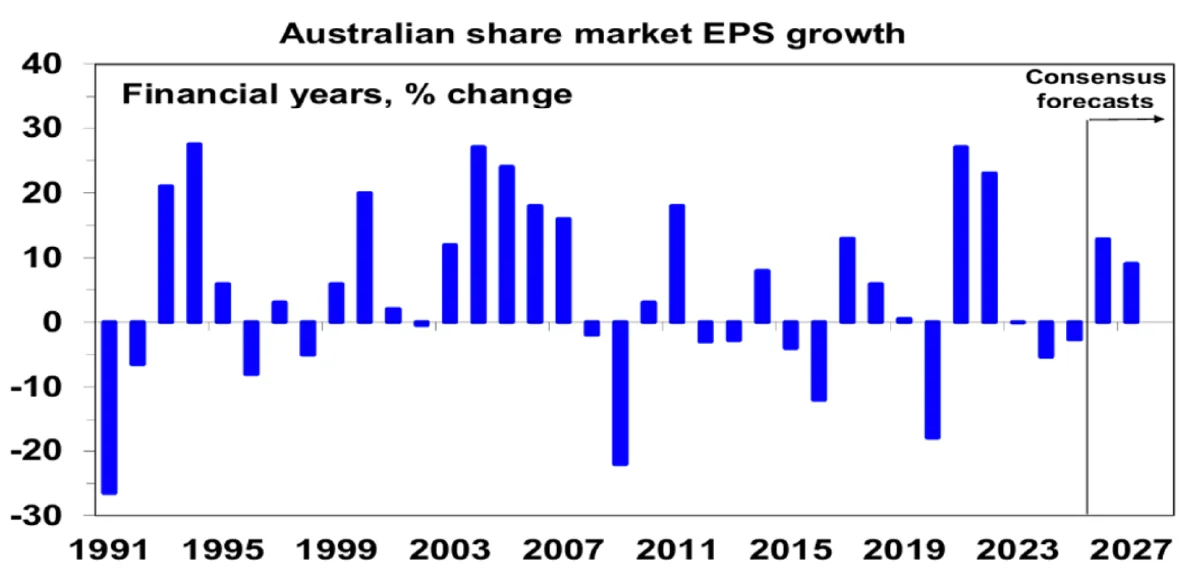
    Consensus earnings expectations for this year have risen to 13%.

    Australian share market eps growth

    Source: UBS, Bloomberg, AMP

    But it’s unlikely to be smooth sailing

    There are three key threats or constraints for Australian shares:

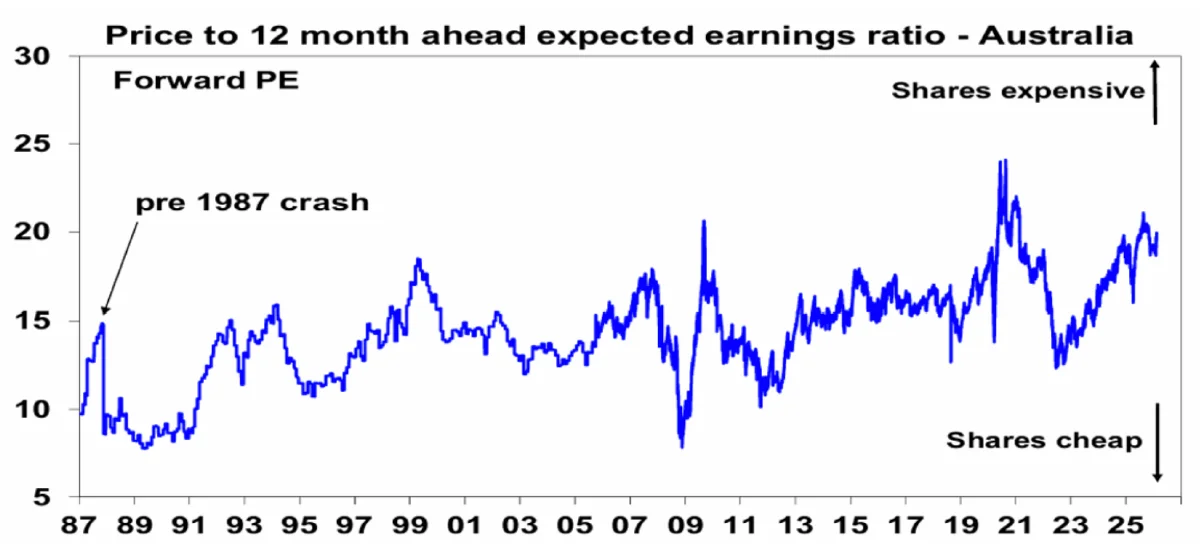
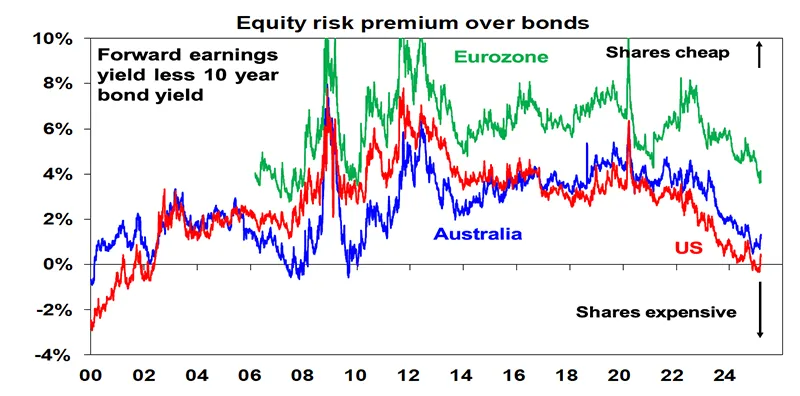
    1. Valuations are rich with the forward PE of 20 times well above its norm of 15 times and the absence of a risk premium over bonds.
    2. The RBA’s hawkish bias with the high risk of more rate hikes could threaten the Australian economic and profit growth outlook.
    Price to 12 month ahead expected earnings ratio - Australia

    Source: Bloomberg, AMP

    1. Global uncertainty around tech shares, US policies and geopolitics. As we have seen in the past, big ructions in US tech shares can have a flow on to Australian shares even if we have a low exposure to tech stocks. While the US Supreme Court has provided confidence that legal constraints remain on President Trump and Trump is now more politically constrained with the midterms this year, his replacement tariff strategy has ramped up the uncertainty around US trade policy. Finally, the high probability of another US strike on Iran risks a spike in oil prices should Iran decide to be uncooperative.


    In closing

    Being an avid share investor for over 50 years and a financial planner for almost 40 years, I’ve learnt that trying to predict investment returns short-term is a guess at best. But what I know with great certainty is what investment returns will be over the medium to long term, as long as you are well-diversified and your portfolio is well managed and aligned with your goals. The outlook for Australian shares remains positive. As good companies keep increasing their profits, the share market goes up. When the market underperforms, it represents better value. I never like paying full price! We will see what happens with AI stocks getting way overvalued; they have come back to earth at some point. Uncertainty always affects valuations. COVID was a good example; the ASX is now 71% higher than in March 2020, and that doesn’t include dividends.

    It will be a bumpy ride forward, but if you build this into a broader portfolio of assets advised by Sydney Financial Planning, the benefits are clear. It’s easy for me to look back as I’ve been doing this for a long time – helping clients build wealth and live a better life, so I have greater wisdom and a grey hair to match.


    Bill Bracey
    CEO & Founder of Sydney Financial Planning


    Want to maximise your Australian share opportunities?

    Speak with our Financial Planners about optimising your Australian equity exposure for 2026 and beyond. To book a meeting get in contact with us on 02 9328 0876.


    This article was prepared by Dr Shane Oliver with opening and closing summary by William Bracey – CEO & Senior Financial Planner from Sydney Financial Planning. Dr Shane Oliver who provides economic forecasts and analysis of key variables and issues affecting, or likely to affect, all asset markets. He also provides economic forecasts and analysis of key variables and issues affecting, or likely to affect, all asset markets.

    Sydney Financial Planning Pty Ltd (ABN 29 606 413 254), trading as Sydney Financial Planning & Illawarra Financial Planning is an Authorised Representative & Credit Representative of Charter Financial Planning Limited, Australian Financial Services Licensee and Australian Credit Licensee.

    This article contains information that is general in nature. It does not take into account the objectives, financial situation or needs of any particular person. You need to consider your financial situation and needs before making any decisions based on this information. If you decide to purchase or vary a financial product, your financial adviser, and other companies within the AMP Group may receive fees and other benefits. The fees will be a dollar amount and/or a percentage of either the premium you pay or the value of your investments. Please contact us if you want more information. If you no longer wish to receive direct marketing from us you may opt out by contacting Sydney Financial Planning . You may still receive direct marketing from AMP as a product issuer, bringing to your attention products, offerings or other information that may be relevant to you. If you no longer wish to receive this information you may opt out by contacting AMP on 1300 157 173.

    Three key cycles every investor should understand right now

    Investment cycles – what are they and why you need to be aware of them

    Three key cycles every investor should understand right now

  • Of particular importance are the long-term cycles which are often driven by waves of innovation and the 3–5 year business cycle. Lately we have been in the benign phase of the business cycle and may have be entering a weaker and more constrained phase of the long-term cycle.
  • Periods of poor returns invariably give way to great returns and vice versa. The key is to not get thrown by them.
  •  

    “The stock market is the story of cycles and of the human behaviour that is responsible for overreactions in both directions.”
    Seth Klarman( hedge fund manager and investor).

    “History doesn’t repeat but it rhymes.”
    Often attributed to Mark Twain.

    Introduction

    Whether it be the cycle of day and night, seasons, tides, the weather, fertility cycles, birth and death, etc, cycles are integral to life. And so too for economies and investment markets. Some are regular, some just rhyme. Despite attempts to end or subdue them via economic policy and regulation they live on. Usually when we declare investment cycles dead, they come back to bite us. Sometimes they bring much joy to investors, but they can also bring much angst. But what are they? What causes them? And why do investors need to be aware of them? This is particularly relevant after several years of great investment returns.

    Cycles in cycles

    Cycles in investment markets invariably refer to swings between good and bad returns. They usually take their lead from fundamental economic & financial developments but are magnified by waves of investor optimism and pessimism. There are three cycles of particular relevance.

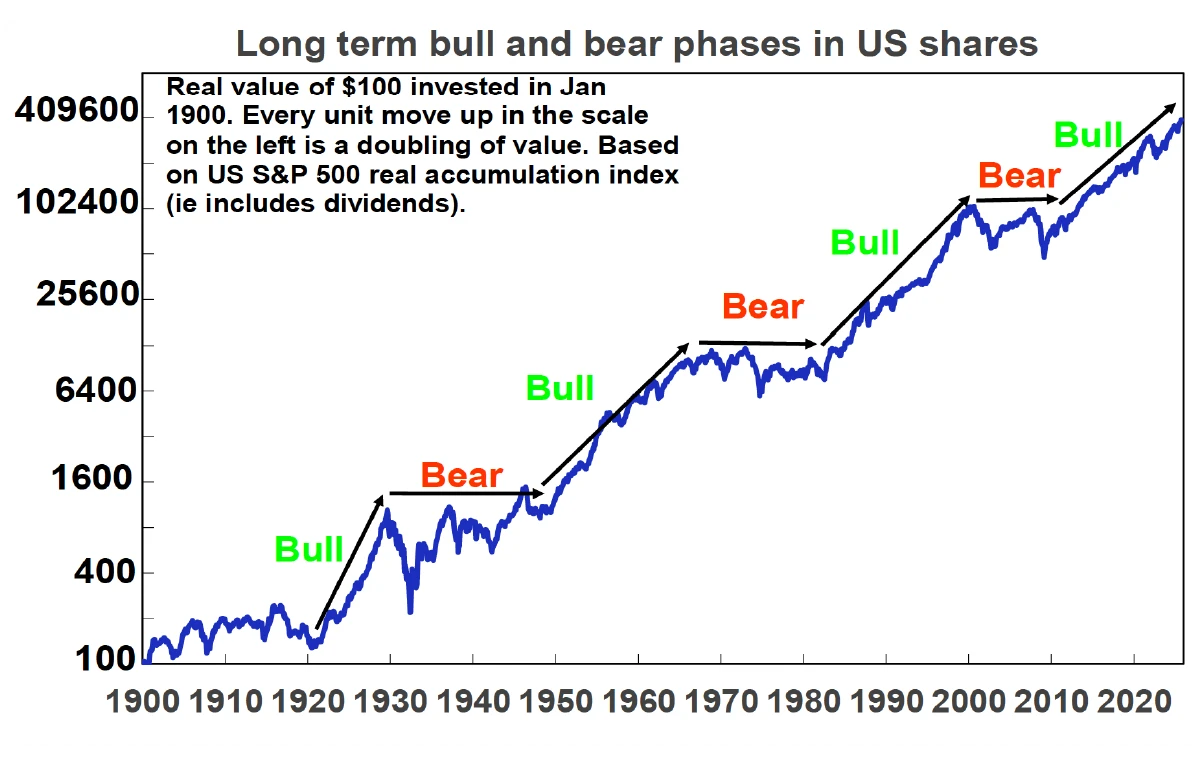
    Long term or secular cycles – share markets go through long term or secular bull and bear phases, often lasting between 10 to 20 years. This is most clearly evident in the US share market and illustrated by the next chart.

    Source: Bloomberg, R.Shiller, AMP

    It shows the cumulative real value of $100 invested in 1900. Secular bull markets – or 10-20 year periods where the trend in shares is up – can be seen in the 1920s, 1950s and 60s, the 1980s and 90s and over the past decade. In between in the 1930s and 1940s, 1970s and 2000s are secular bear markets – which are long periods where shares have poor and volatile returns.

    Secular bull and bear phases are often related to what is known as Kondratiev waves, which take their lead from waves of technological innovation. Starting in the 1780s, water power, textiles and iron drove the first industrial revolution; steam, rail and steel drove the second industrial revolution; electricity, chemicals and the internal combustion engine drove a third Kondratiev wave into the 1920s; petro chemicals, electronics and aviation drove a fourth in the 1950s and 1960s; the IT revolution helped drive a fifth wave in the 1990s and another spurt more recently with digital media and artificial intelligence. These were associated with secular bull markets in the 1920s, the 1950s & 60s, the 1980s & 90s and over the last decade, with the move to lower interest rates and associated speculation also playing big roles in the last two.

    At the end of each long-term upswing, share markets reached overvalued extremes and investors had become excessively exposed as optimism that good times would roll on forever reached extremes. This left shares vulnerable as excesses such as too much debt (1930s and 2000s), excessive inflation (1970s) and excessive speculation in tech shares and then housing in the late 1990s and 2000s became overwhelming, giving way to economic weakness and secular bear markets.

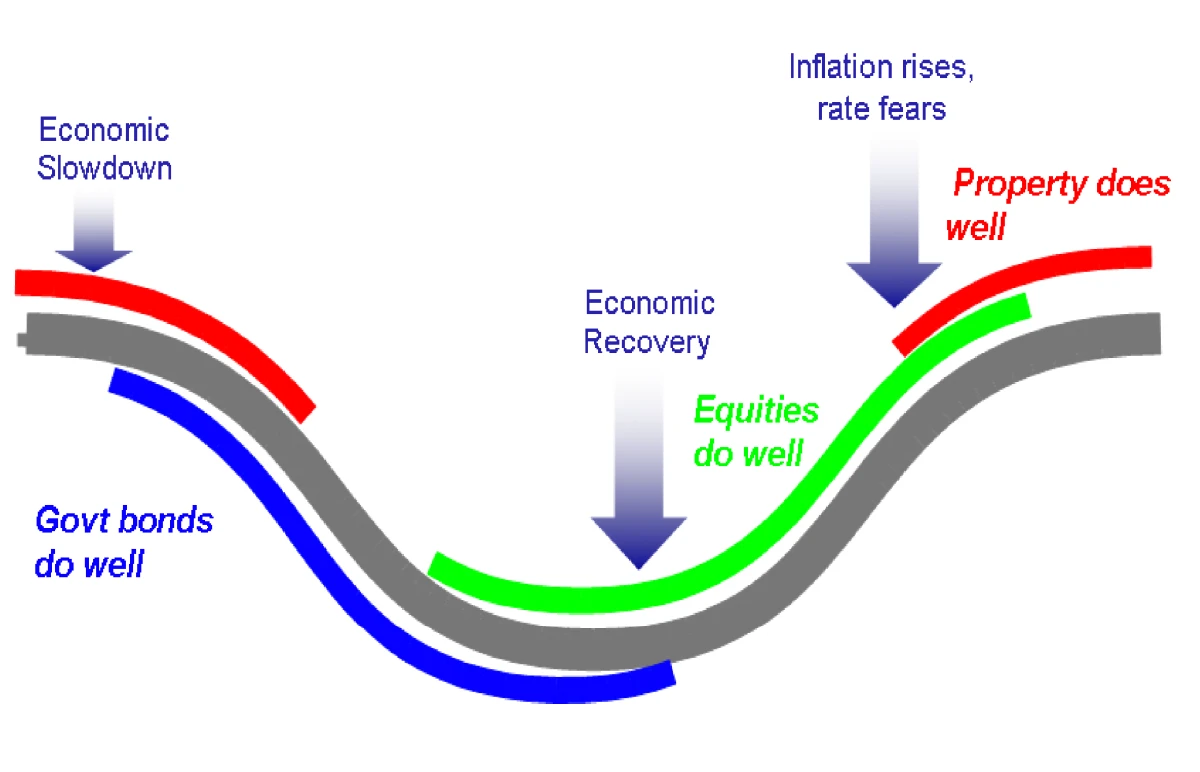
    The business cycle – this is the best-known economic cycle and has a duration of 3 to 5 years. It tends to relate to the standard economic cycle where after a few years of economic expansion, inflation or other imbalances build up which results in monetary tightening, which leads to a downturn or recession, then falling inflation and monetary easing, which then sets the scene for the next expansion. It tends to underpin a 3 to 5 year cycle in investment markets with the stylised link to share markets, property and government bonds shown in the next chart. Shares tend to lead the business cycle – bottoming several months before an economic trough and vice versa at the top. Property markets tend to be more coincident.

    The standard 3 to 5 year investment cycle

    Standard 3-5 year investment cycle

    Source: AMP

    In terms of actual share market fluctuations, the 3-5 year investment cycle is evident in the swings in rolling 12-month changes in Australian share prices. Periods of poor returns are invariably followed by periods of strong returns (and vice versa) but trying to time this can be very hard. See the next chart.

    Australian share returns rolling 12 month & 20 year periods

    Source: ASX, Bloomberg, AMP

    Short term sentiment cycles – within the 3 to 5 year investment cycle there are also short-term swings (weekly, monthly) between overbought and oversold for things like shares and currencies driven by swings in investor sentiment, but which can relate to the tendency for economic data to run through hot and cold periods, particularly relative to market expectations. They can often give rise to corrections in share markets, with say 5 to 20% falls.

    Some observations

    There are several points to note regarding investment cycles:

    • No two cycles are the same and their duration can vary so they don’t operate to precise years, despite claims by some to the contrary. But they do have common features, usually being set off by economic or financial developments and accentuated by swings in investor sentiment which can push them to extremes from which a reversal can occur. As such, while history doesn’t repeat, it rhymes.
    • There are cycles within cycles. For example, even though US shares were in long-term secular bear markets in the 1970s and 2000s they still saw periodic cyclical swings in economies and share markets.
    • When several cycles combine the impact can be huge. For example, a business cycle downturn in 000 coincided with an end to the secular boom of the 1980s and 1990s and saw 50% falls in global shares in the period 2000 to 2003.
    • Despite various attempts to smooth them out (via economic policies and regulation) or declare them dead, cycles live on.
    • Cycles can be self-limiting as economic downturns lead to lower inventories, pent up demand and lower interest rates, which sow the seeds of recoveries. Share slumps result in cheap shares which entice bargain hunters and sow the seeds of a new bull market.
    • Investment cycles provide opportunities for investors to vary their asset allocation through the cycle, e.g. buying more shares into downturns and cutting exposure into upswings.
    • But timing investment cycles is difficult. No one rings the bell at the top or bottom. And given the psychological tendency of individual investors to project recent market moves into the future (referred to as “recency bias”) and find safety in what the crowd of other investors are doing, the main risk is that investors, in seeking to time investment cycles, end up wrong footed by selling after big falls and buying after big gains. So, for most investors it’s important to be aware of cycles and understand that they are normal, but then to take a long-term approach to investing that looks through them and makes the most of the compounding of returns over long periods.

    Where are we now?

    We are currently in a reasonably positive phase of the 3-5 year investment cycle as inflation has cooled from its 2022 high which has enabled central banks, including the Fed and RBA, to cut rates and provide a boost to economic growth. Sometimes this is referred to as “goldilocks” i.e. not too hot and not too cold. This has been reflected in strong gains in share markets over the last three years. However, President Trump’s tariffs have complicated the normal cyclical pattern by boosting US inflation and depressing employment and imparting downside risks for the US economy. And shares have had three years now of strong returns resulting in stretched valuations particularly with signs that key large cap US stocks, often referred to as the Magnificent Seven (Apple, Microsoft, Alphabet, Meta, Amazon, Nvidia and Tesla), may be becoming a bit bubbly. All of which are warning of a pullback in shares which would not be out of line with their normal volatility as evident in the previous chart, before receiving a further boost from lower interest rates.

    While AI developments remain very promising, we may be entering a weaker more constrained phase of the long-term investment cycle reflecting less favourable economic policy and demographic trends which may make the world more inflation prone.

    Other cycles of relevance

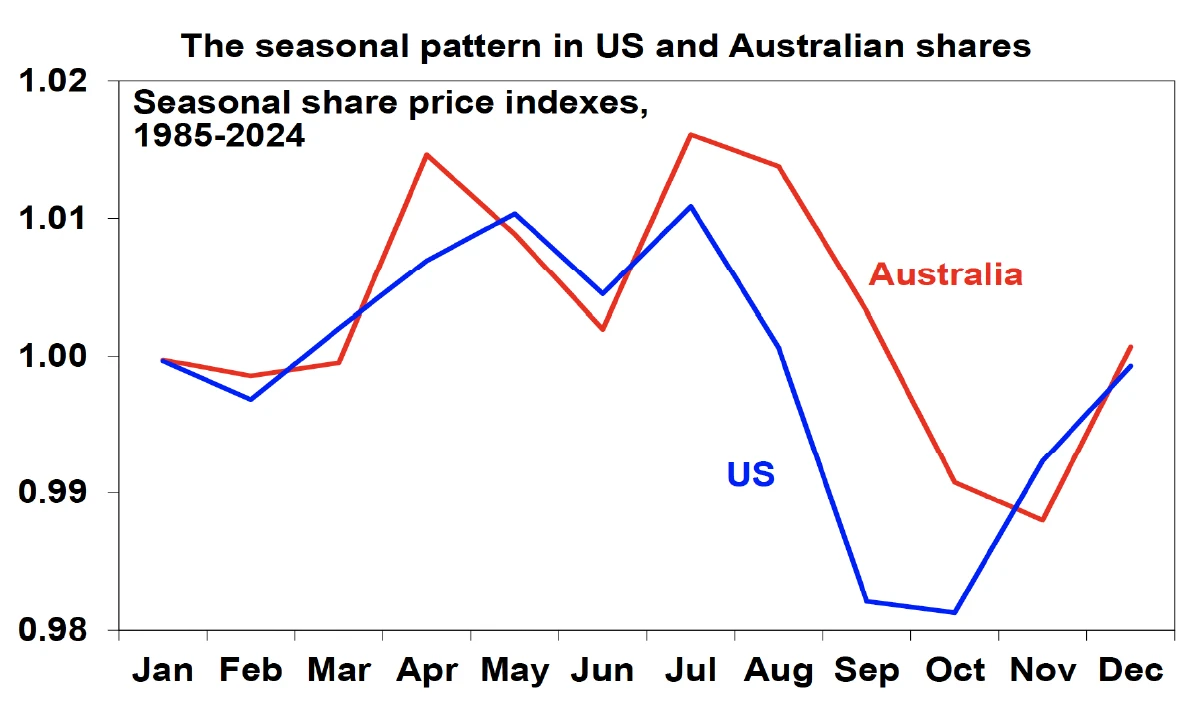
    Seasonal patterns – There is a well-known seasonal pattern in shares that sees strength from November reflecting the ending of US tax loss selling, a wind down in equity raisings, new year cheer and the reinvestment of bonuses which continues after a brief pause around February into mid-year, before weakness from around May to October, particularly in August and September. Right now, we are nearing a seasonally strong period, although it’s a bit complicated by not having seen the normal seasonal weakness in August and September in the US.

    Seasonal patterns in us and aus shares

    Source: Bloomberg, AMP

    Political cycles – these are less relevant in countries with an irregular political cycle like Australia. However, the US has a precise four-year federal political cycle, and this has given rise to a fairly regular pattern. This sees near average share market returns in the first year after a Presidential election, well below average returns in the second (or midterm election) year, but above average returns in the third year (as the President seeks to stimulate the economy), and average returns in the fourth year. In fact, since 1950 the US share market has experienced an average top to bottom fall in the mid-term election year of 17%. So next year could be a bit rougher for US shares and this could flow to Australian shares.

    In closing

    I have been following investment cycles for about 40 years now, and they can indicate future trends. But I have also learned, more importantly, that trying to time the market is nearly impossible. That’s
    why it is so important to have an investment strategy and financial plan in place and regular reviews by your financial planner.

    Please call our office on 02 9328 0876 if you need a review or if you have a friend or family member who needs financial advice.


    Bill Bracey
    CEO & Founder of Sydney Financial Planning


    Is your investment strategy prepared for market cycles?

    Speak with our Financial Planners about navigating market cycles and protecting your portfolio through economic shifts. To book a meeting get in contact with us on 02 9328 0876.


    This article was prepared by Dr Shane Oliver with opening and closing summary by William Bracey – CEO & Senior Financial Planner from Sydney Financial Planning. Dr Shane Oliver who provides economic forecasts and analysis of key variables and issues affecting, or likely to affect, all asset markets. He also provides economic forecasts and analysis of key variables and issues affecting, or likely to affect, all asset markets.

    Sydney Financial Planning Pty Ltd (ABN 29 606 413 254), trading as Sydney Financial Planning & Illawarra Financial Planning is an Authorised Representative & Credit Representative of Charter Financial Planning Limited, Australian Financial Services Licensee and Australian Credit Licensee.

    This article contains information that is general in nature. It does not take into account the objectives, financial situation or needs of any particular person. You need to consider your financial situation and needs before making any decisions based on this information. If you decide to purchase or vary a financial product, your financial adviser, and other companies within the AMP Group may receive fees and other benefits. The fees will be a dollar amount and/or a percentage of either the premium you pay or the value of your investments. Please contact us if you want more information. If you no longer wish to receive direct marketing from us you may opt out by contacting Sydney Financial Planning . You may still receive direct marketing from AMP as a product issuer, bringing to your attention products, offerings or other information that may be relevant to you. If you no longer wish to receive this information you may opt out by contacting AMP on 1300 157 173.

    When is the right time to retire well?

    Living retirement well: Living life on your own terms

    When is the right time to retire well?

    This is not to say that the initial adjustment to your new life stage won’t come with its challenges, most will go through stages of disorientation and disenchantment and experience a wide range of emotions and that’s normal. I encourage you to look for healthy ways to deal with those feelings. Do more of what you enjoy, keep the body moving, walk regularly, read, write, draw or paint, tap into your creative side. Talking with others who have already retired can be a big help also.

    What’s the hardest part of retirement?

    When I asked some of my clients what was the hardest part of retirement, for some it was coming to terms with budgeting tighter and the limited chance of making money compared with working life. For others it was a feeling of loss of purpose in their new life stage. Again, this is normal, and they went on to explain that this feeling passes as they replace their previous routines and colleagues with new pastimes and friends.

    What’s the best part of retirement?

    My clients have shared that the best part of retirement is the newfound freedom to pursue personal interests, spend more time with loved ones, and enjoy a slower pace of life. They also said it’s a time to focus on health and hobbies, build stronger relationships with family and friends (even making new ones), and to fulfill long-held bucket list dreams such as travel.

    When’s the right time?

    When we’re goal setting, we ask people at what age do they see or would like to see themselves retired.

    Some say tomorrow, others say 60 or 65 and we set the target date to aspire towards. We then start putting in place strategies to ensure we have sufficient funds to achieve this goal. We come around to our 60 or 65th birthday and quite often we’re still enjoying our work, our health is good, and we aren’t ready to retire yet. This happens often.

    Over the years I’ve observed the reality is retirement is a state of mind and reaching an age or date is not the trigger for entering the next stage of life. From what I’ve detected, the biggest determinant for retirement and readiness for change is the reducing capacity to tolerate living life on someone else’s terms. Some might say their “bulldust meter” is full, others have experienced close friends of family’s health suffer and this brings things into perspective and priorities change. Either way, when you know
    you know.

    Any regrets?

    I asked some of my clients if they felt they retired at the right time. Most said yes, as we had discussed this at length many times in the lead up to prepare ourselves as best we can.A small number have returned to work (in a slower paced environment) as they crave the sense of purpose that work can bring, but most often than not, most people are happy with their decision.

    Reach out to your financial planner if you’d like to chat further about these insights and retiring well.


    Article by Gary Winwood-Smith
    Senior Financial Planner | Director


    Are you confident your retirement plan will support the life you want?

    Talk to us about retirement strategies that provide freedom and peace of mind. Call 02 9328 0876 to arrange a meeting.


    General Disclaimer: This article contains information that is general in nature. It does not take into account the objectives, financial situation or needs of any particular person. You need to consider your financial situation and needs before making any decisions based on this information. Please seek personal financial advice prior to acting on this information.


    Is Investing a gift to your future self?

    Investing in your future: Why it matters

    Is Investing  a gift to your future self?

    As a financial planner, I’ve seen time and again how early, consistent investing can transform lives. Let’s delve into the motivations behind investing, the benefits for your future self, and the peace of mind it brings to your current self.

    Motivations for investing

    Investing is more than just a financial strategy; it’s a commitment to your future.

    Financial Independence: One of the primary reasons to invest is to achieve financial independence. By building a robust investment portfolio, you can create a steady stream of income that supports your lifestyle without relying solely on your job. This independence allows you to pursue passions, travel, or even retire early.

    Security and Peace of Mind: Knowing that you have a financial cushion can provide immense peace of mind. Whether it’s an emergency fund for unexpected expenses or a retirement nest egg, having savings and investments ensures you’re prepared for life’s uncertainties.

    Achieving Life Goals: Investing helps you reach significant milestones, such as buying a home, funding education, or starting a business. By setting aside money and watching it grow, you can turn your dreams into reality.

    Benefits for your future self

    Investing is a gift to your future self. Here’s how:

    Compound Growth: The earlier you start investing, the more time your money has to grow through compound interest. This means your investments generate earnings, which are then reinvested to generate even more earnings. Over time, this compounding effect can lead to substantial wealth accumulation.

    Retirement Planning: Investing early ensures you have enough
    funds to enjoy a comfortable retirement. By consistently contributing to retirement accounts, you can build a sizable nest egg that supports you in your golden years.

    Legacy Building: Investing over the long term allows you to leave a financial legacy for your loved ones or passion projects.

    Peace of mind for your current self

    While investing is about the future, it also benefits your present self:

    Financial Discipline: Regularly setting aside money for investments instils financial discipline. This habit helps you manage your finances better, avoid unnecessary debt, and make informed spending decisions.

    Reduced Stress: Knowing that you’re actively working towards your financial goals can reduce stress and anxiety. It provides a sense of control over your financial future, allowing you to focus on other aspects of your life.

    Flexibility and Opportunities: Having investments gives you financial flexibility. It opens opportunities to take calculated risks, such as starting a new venture or making a career change, without jeopardising your financial stability.

    We take from this then, that investing can be a powerful tool when leveraged over the longer term, it can help to secure your financial future and enhance your present life.
    By understanding the motivations behind investing and the benefits it brings, you can make informed decisions that align with your goals. If you’re ready to take the next step, consider reaching out to your financial planner to discuss what strategy may work best for you.


    Article by Steven Stolle
    Financial Planner | Director


    Does your financial plan include a long-term investing strategy?

    Our team can help you create an investment approach that aligns with your goals. Call 02 9328 0876 to arrange meeting.


    General Disclaimer: This article contains information that is general in nature. It does not take into account the objectives, financial situation or needs of any particular person. You need to consider your financial situation and needs before making any decisions based on this information. Please seek personal financial advice prior to acting on this information.


    Upcoming changes to Aged Care fees

    Upcoming changes to Aged Care fees

    Upcoming changes to Aged Care fees

    Proposed government reforms are increasing the fees people will have to pay across almost every front, and worse yet, they are now allowing facilities to keep a portion of the “refundable” accommodation deposits people make at entry into care. The overall impact of these changes means that people will pay more up front, pay more each day while in care, and get less back at the end. This can have serious consequences, and not only jeopardize your ability to pay your own way, but also means you’ll be leaving less behind for your family too.

    While the government is spending an additional $2.2 Billion on aged care reforms, these are primarily aimed at trying to modify and strengthen the system by attracting new staff and funding the development of more appropriate systems. This is in response to the anticipated increase in demand for aged care services as our population ages. None of this funding, unfortunately, is being used to ease the burden on aged care recipients. In fact, the intent here is the exact opposite, with the changes to the fee systems being designed expressly to make “those who have more pay more”. Our preliminary testing and modelling shows that they have achieved just that; high net worth individuals in particular will be significantly impacted by these changes, although everyone will feel the bite at least somewhat.

    However, it is not all bad news. These changes bring with them their own set of new considerations, and we at Sydney Financial Planning have been hard at work finding new solutions for people needing aged care. Our specialist aged care team have already identified strategies to minimize the impacts of the changes on our clients, and we are excited to begin implementing these new strategies in the coming year. In particular, we have focused on strategies aimed at preserving capital over the long term, ensuring that you and your family retain the wealth that you have worked so hard to build.

    If you, or any of your loved ones, are considering aged care, our door is open. Aged care can be a stressful time, and the complicated mess of rules around it can just add to that stress. At Sydney Financial Planning, we navigate that maze for you, and provide the simplest, most effective outcomes to help you and your family through these difficult times. We encourage you to reach out for a friendly, no-obligation chat with one of our aged care specialists.


    Article by James Middleton
    Financial Planner


    Do you know how the November aged care changes could affect your family?

    Our Aged Care specialists can help you protect wealth and plan ahead. Call 02 9328 0876 to arrange a meeting.


    General Disclaimer: This article contains information that is general in nature. It does not take into account the objectives, financial situation or needs of any particular person. You need to consider your financial situation and needs before making any decisions based on this information. Please seek personal financial advice prior to acting on this information.


    What do clients value most in advice?

    What clients really value: The enduring power of long-term financial guidance

    What do clients value most in advice?

    It shows up in a different way.
    It’s in the quiet confidence clients develop when they understand the path they’re on.
    It’s in the steady hand they feel guiding them through uncertainty.
    It’s in the shift from “Will I be okay?” to “How do I live with more intention?”

    Across countless conversations, review meetings, and long-standing relationships, clients describe the same outcomes – not in technical language, but in deeply personal terms:

    – “I finally feel like I understand my financial world.”
    – “I know where I’m going – and why.”
    – “I trust the process now. I trust myself more.”

    These reflections aren’t about emotional comfort alone. They point to something far more enduring: a sense of clarity, self-trust, and alignment with what matters most.

    Yes, financial strategy matters – sound structure, risk management, and disciplined planning form the foundation. But over time, the greatest value of long-term advice is found in what it empowers people to become.

    Here’s what we’ve observed:

    1. More confident decision-makers

    With consistent guidance, clients grow into their financial lives. They move from hesitation to informed action. Over time, they stop outsourcing all decisions and begin trusting their own judgement. That confidence is hard-earned – and life-changing. It transforms how people move through financial choices and life transitions alike.

    2. More aligned with their values

    Wealth on its own doesn’t create satisfaction. But when your money is structured around your values – family, freedom, contribution, legacy – it becomes a powerful tool for living well. Long-term advice helps bring that alignment into focus, translating your values into a lived financial strategy.

    3. More intentional in how they live

    When money is no longer a source of confusion or stress, it becomes something quieter – something that supports life, rather than controlling it. We see clients make clearer, calmer choices, less driven by reaction and more guided by intention. That’s when financial advice becomes a catalyst for a more focused, values-driven life.

    4. More future-focused and legacy-minded

    The longer the relationship continues, the more deeply clients begin thinking beyond themselves – about the kind of impact they want to make, the future they want to shape, and the values they want to pass on. At this stage, advice becomes not just strategic, but deeply personal.

    At its best, long-term financial advice does more than guide a portfolio – it supports a life. It offers perspective, structure, and calm through every season. It helps people make wiser decisions, stay anchored to their values, and live with greater purpose.

    A great adviser doesn’t just help someone make better financial decisions – they help them build confidence in their ability to navigate life’s transitions.

    They help translate complexity into clarity, fear into perspective, and overwhelm into action.

    As time goes on, that guidance becomes more than useful – it becomes transformational. That’s what meaningful advice delivers – not just over years, but over a lifetime.


    Article by Michal Bodi
    Senior Financial Planner | Partner


    Are you getting the true value from your financial advice?

    Speak with our Financial Planners about building clarity and confidence in your future. Call 02 9328 0876 to book a meeting today.


    General Disclaimer: This article contains information that is general in nature. It does not take into account the objectives, financial situation or needs of any particular person. You need to consider your financial situation and needs before making any decisions based on this information. Please seek personal financial advice prior to acting on this information.


    Share market falls - seven key things for investors to bear in mind

    Share market falls – seven key things for investors to bear in mind

    Share market falls - seven key things for investors to bear in mind

  • It’s still too early to say markets have bottomed and we continue to see a high risk of a 15% plus correction, although calendar year returns should still be okay.
  • This will weigh on short term super fund returns but follows two years of very strong returns.
  • Key things for investors to bear in mind are that: share pullbacks are healthy and normal; in the absence of a recession a deep and long bear market should be avoided; selling shares after a fall locks in a loss and timing markets is hard; share pullbacks provide opportunities for investors to buy them more cheaply; shares still offer an attractive income flow; and to avoid getting thrown off a long-terminvestment strategy it’s best to turn down the noise.
  • Introduction

    Much of the time share markets are relatively calm and so don’t generate a lot of attention. But periodically they tumble and generate headlines like “billions wiped off share market” and “biggest share plunge since…” Sometimes it ends quickly and the market heads back up again and is forgotten about. But every so often share markets keep falling for a while. Sometimes the falls are foreseeable (usually after a run of strong gains), but rarely are they forecastable (which requires a call as to timing and magnitude) despite many claiming otherwise. In my career, I have seen many periodic share market tumbles and so they are nothing new.

    And now it’s happening again with share markets falling from record highs just a few weeks ago. From their all-time highs to their lows in February US shares have fallen 9%, global shares have fallen 8% and Australian shares have fallen nearly 9%. Always the drivers are slightly different. But as Mark Twain is said to have said “history doesn’t repeat but it rhymes”, and so it is with share market falls. This means that from the point of basic investment principles, it’s hard to say anything new. Which is why this note may sound familiar with “key things for investors to keep in mind”, but at times like this they are worth reiterating.

    What’s driving the plunge in share markets

    The key drivers of the fall in shares are a combination:

    • Stretched valuations after a relatively calm year last year with strong returns. The strong gains in share markets after the inflation driven weakness of 2022 and still relatively elevated bond yields left US shares offering no risk premium over bonds (as measured by the gap between the forward earnings yields and 10 year bond yields).Australian shares were not much better. This left shares vulnerable to bad news. The equity risk premiums have improved a bit with recent falls but still remain low.

    Source: Bloomberg, AMP

    • While investor sentiment was not seeing the euphoria often evidentat major share market tops, there was a bit of speculative froth evident in the huge gains in the Magnificent Seven stocks (Apple,Microsoft, Amazon, Alphabet, Meta, Nvidia and Tesla). These had accounted for nearly two thirds of US share market gains in 2023 and over 50% in 2024 taking them to roughly 35% of the S&P 500’s market capitalisation. Their huge gains left them vulnerable to a pullback with DeepSeek’s apparent success weighing on Nvidia and Telsashares plunging more than 50% since their January high partly owing to signs of a buyer backlash against Elon Musk. This heavy reliance on a handful of shares added to the US share markets vulnerability.
    • Another bout of sticky US inflation saw expectations for Fed rate cuts this year wound back a few weeks ago.
    • But the trigger for the pullback has really come from the frenetic and often contradictory policy announcements from the White House around tariffs, public sector cutbacks and US relations with allies. This has contributed to a run of weaker US economic data, fears ofrecession and desire by investors for a higher risk premium fromshares. Those fears intensified after Trump and members of his team seemed to not rule out a recession with Trump talking about a“period of transition” and saying that he is not worried about falls inthe share market and Treasury Secretary Bessent talking about 6-12months of pain and “a detox period” (presumably from government).
    • As always, the most speculative “assets” are getting hit the hardest and this includes tech stocks (with the Magnificent Seven down 20% and Nasdaq down 14%) and Bitcoin (which has fallen 23%).

    Share markets are oversold and so may see a short-term bounce. But our assessment is that increasing uncertainty and stretched valuations mean there is a high risk of further falls in shares. At some point economic weakness and its impact on support for Trump and Republican politicians along with share market falls – with Trump ultimately seeing share gains as a key performance indicator – will put pressure him to reverse course and focus on more positive policies. But we are likely not at that point yet. So, we continue to see a high likelihood of a 15% plus correction in shares before more positive forces around Trump’s tax cuts and deregulation and more Fed rate cuts get the upper hand.

    Key things for investors to bear in mind

    First, while they unfold differently, periodic share market corrections and occasional bear markets (which are usually defined as falls greater than 20%) are a normal part of investing in shares. 

    See the next chart.

    Periodic share market pull backs are normal

    Source: Bloomberg, AMP

    And, as can be seen in the next chart rolling 12 month returns from shares have regularly gone through negative periods.

    sfp ed2 03 2025 aus share returns over rolling 12 mth 20 yr 001

    Source: ASX, Bloomberg, AMP

     But while the falls can be painful, they are healthy as they help limit excessive risk taking. Related to this, shares climb a wall of worry over many years with numerous events dragging them down periodically (next chart), but with the long-term trend ultimately up and providing higher returns than other more stable assets. As can be seen in the previous chart, the rolling 20-year return from Australian shares has been relatively stable and solid. Which is why super funds have a relatively high exposure to shares along with other growth assets. Bouts of volatility are the price we pay for the higher longer-term returns from shares compared to more defensive assets like cash and government bonds. 

    Australian shares climb wall of worry

    Source: ASX, AMP

    Second, historically, the main driver of whether we see a correction (a fall of say 5% to 15%) or even a mild bear market with say a 20% or so decline that turns around relatively quickly like we saw in 2015-2016 in Australia – which may be called a “gummy bear market” – as opposed to a major “grizzly” bear market (like that seen in the mid-1970s or the global financial crisis when shares fell by around 55%) is whether we see a recession or not – notably in the US, as the US share market tends to lead most major global markets. 

    While Trump’s policies and the noise around them has increased the risk of a US/global recession our base case is that it will be narrowly avoided as Trump pulls back under political pressure and signs of weaker growth enable the Fed to start easing again and other global central banks including the RBA continue to cut rates. But recession is now a more significant risk so it’s too early to say share have bottomed. Of course, short-term forecasting is fraught with difficulty and should not be the basis for a long-term investment strategy, so it’s better to stick to long term investment principles.

    Third, selling shares or switching to a more conservative superannuation investment strategy whenever shares fall sharply just turns a paper loss into a real loss with no hope of recovery. Even if you get out and miss a further fall, the risk is that you won’t feel confident to get back in until long after the market has fully recovered. The best way to guard against deciding to sell on the basis of emotion after falls in markets is to adopt an appropriate long-term strategy and stick to it.

    Fourth, when shares fall, they’re cheaper and offer higher long-term return prospects. So, the key is to look for opportunities’ pullbacks provide. It’s impossible to time the bottom but one way to do it is to “average in” over time. Fortunately, the Australian superannuation system does just that by regularly putting money into shares for employees (via their super) taking advantage of the fact they are cheaper.

    Fifth, while share prices have fallen dividends have not. While the rebound in interest rates since 2022 reduced the yield advantage shares had over cash it’s likely now starting to wide again with the RBA starting to cut interest rates and likely to do more. 54% of companies raised their dividends compared to a year ago in the just completed December half earnings reporting season so the income flow from a well-diversified portfolio is likely to remain attractive.

    Australian shares grossed up dividends yield vs bank deposit rate

    Source: RBA, Bloomberg, AMP

    Sixth, shares and other related assets often bottom at the point of maximum bearishness, i.e. just when you and everyone else feel most negative towards them. So, the trick is to buck the crowd. “Be fearful when others are greedy. Be greedy when others are fearful,” as Warren Buffett has said.

    Finally, turn down the noise. At times of uncertainty like now, the flow of negative news reaches a fever pitch. This makes it harder to stick to your long-term financial plan and investment strategy. But remember, like all quality assets, they recover over time. When they get cheaper, they can represent great value. This fact is quickly forgotten by the media and the masses.

    As I’ve stated many times before, that’s how the rich get richer and the poor sell what they think are distressed assets at low prices to the rich, who can afford to buy low and hold quality assets.

    The great news is, if you’re reading this, you are in great hands as you are being advised by Sydney Financial Planning. If you start to get wobbly knees, please call us to review your strategy/plan. We have normally built this in, so you can prosper. The value of this advice and having a trusted relationship with an experienced team during times like this is what we call the Value of Advice.

    Bill Bracey
    CEO & Founder of Sydney Financial Planning


    Are you ready to take advantage of investment opportunities?

    Arrange a meeting with one of our Financial Planners to get the right investment decisions in place, either book a meeting or get in contact with us on 02 9328 0876.


    This article was prepared by Dr Shane Oliver with opening and closing summary by William Bracey – CEO & Senior Financial Planner from Sydney Financial Planning. Dr Shane Oliver who provides economic forecasts and analysis of key variables and issues affecting, or likely to affect, all asset markets. He also provides economic forecasts and analysis of key variables and issues affecting, or likely to affect, all asset markets.

    Sydney Financial Planning Pty Ltd (ABN 29 606 413 254), trading as Sydney Financial Planning & Illawarra Financial Planning is an Authorised Representative & Credit Representative of Charter Financial Planning Limited, Australian Financial Services Licensee and Australian Credit Licensee.

    This article contains information that is general in nature. It does not take into account the objectives, financial situation or needs of any particular person. You need to consider your financial situation and needs before making any decisions based on this information. If you decide to purchase or vary a financial product, your financial adviser, and other companies within the AMP Group may receive fees and other benefits. The fees will be a dollar amount and/or a percentage of either the premium you pay or the value of your investments. Please contact us if you want more information. If you no longer wish to receive direct marketing from us you may opt out by contacting Sydney Financial Planning . You may still receive direct marketing from AMP as a product issuer, bringing to your attention products, offerings or other information that may be relevant to you. If you no longer wish to receive this information you may opt out by contacting AMP on 1300 157 173.

    Goldilocks stayed for 2024, but what’s in store for investors in 2025?

    Goldilocks stayed for 2024, but what’s in store for investors in 2025?

    Goldilocks stayed for 2024, but what’s in store for investors in 2025?

  • 2025 is likely to see positive returns, but after the surprisingcalm of 2024, it’s likely to be far more volatile (expect a 15%or so correction along the way) and more constrained.
  • Expect the RBA cash rate to fall to 3.6%, the ASX 200 to riseto 8800 and balanced super funds to return around 6%.
  • Australian home prices will likely see further softness aheadof rate cuts providing a boost in the second half of 2025.

  • Key things to keep an eye on are: interest rates; recessionrisk; a potential trade war; and the Australian consumer.
  • Another year of Goldilocks in 2024…

    2024 was like a rerun of 2023 with lots of angst but it turned out okay. Key big picture themes of relevance for investors were:

    1. Stronger than feared growth. Yet again the much feared recessionfailed to materialise. Despite the monetary tightening of 2022 and 2023 and China’s property collapse, global growth in 2024 remained just above 3%. In Australia, despite a “per capita recession”, economic growth remained positive albeit at only around 1% helped by strong population growth, stronger than expected growth in public spending and labour hoarding offsetting severe mortgage pain for some.
    2. Global divergence. Within emerging countries, India grew around 6.5%, China grew around 4.8% (which is slow for China) but South America and the Middle East only grew around 2%. And within developed countries, US growth remained strong at around 2.8% but growth was just 0.8% in Europe and around 0.3% in Japan.
    1. Further disinflation. Inflation in major countries has fallen sharply from peaks of 8 to 11% in 2022 to around 2 to 3% in 2024. Australia lagged on the way up and is doing the same on the way down.
    2. Falling interest rates. It took longer to get there & rates didn’t fall as much as expected at the start of the year but most major central bank started to cut their policy rates. The RBA should start early in 2025.
    3. Geopolitical threats were not as worrying as feared. In particular, the conflict in Israel widened to include Lebanon and missile exchanges with Iran but didn’t impact oil supplies and the oil price was little changed, the Cold War with China didn’t produce any majordisruptions and Donald Trump’s re-election boosted US shares.

    Global inflation graph

    Source: Bloomberg, AMP

    …resulted in strong returns for investors

    There were a few bumps along the way for shares – notably with an inflation scare in April and a growth scare into August – but they were relatively minor (with brief falls in shares off less than 10%). For diversified investors 2024 was another strong year.

    Investment returns for major asset classes

    Total return %, pre fees and tax 2023 actual 2024 actual* 2025 forecast
    Global shares (in Aust dollars) 23.3 27.9 7.0
    Global shares (in local currency) 23.2 23.6 7.0
    Asian shares (in local currency) 3.4 14.4 6.0
    Emerging mkt shares (local currency) 9.9 11.8 6.0
    Australian shares 12.4 15.1 7.0
    Global bonds (hedged into $A) 5.3 3.1 4.0
    Australian bonds 5.3 2.4 4.0
    Global real estate investment trusts 7.4 9.7 9.0
    Aust real estate investment trusts 17.6 26.0 6.0
    Unlisted non-res property, estimate -5.0 -6.0 2.0
    Unlisted infrastructure, estimate 5.0 6.5 7.0
    Aust residential property, estimate 9.5 8.0 4.0
    Cash 3.9 4.1 4.0
    Avg balanced super fund, ex fees and tax 9.3 11.8 6.0

    * Year to date to Nov. Source: Bloomberg, Morningstar, REIA, CoreLogic, AMP


    • Global shares had a strong year as rates fell, albeit less than expected, and profits were stronger than expected.
    • US shares outperformed reflecting its stronger economy, tech exposure and a boost from Trump’ s re-election promising US friendly policies. By contrast non-US shares underperformed, particularlyEurozone shares which weren’t helped by French politicaluncertainty. Chinese shares got a boost from more stimulus.
    • Australian shares did well in anticipation of stronger profits and rate cuts ahead but underperformed with China worries and no rate cut.
    • Government bond returns were constrained by smaller than expected rate cuts and worries about Trump’s policies driving higher inflation.
    • Real estate investment trusts saw solid returns in anticipation of better commercial property returns ahead.
    • Unlisted assets were constrained by the valuation effect of high bond yields with office property seeing losses from reduced space demand.
    • Australian home prices rose with the housing shortfall, but “high” rates saw gains stall into year end with prices falling in several cities.
    • The $A fell but mainly against the $US, with the latter rising on Trump’s tax cut, deregulation and tariff plans.
    • Reflecting all this, balanced super funds had very strong returns forthe second year in a row. They were roughly double our expectations!

    The key threats for 2025

    Just as was the case for 2024 the worry list for 2025 is long and maybe even more threatening given the uncertainty Trump’s policies pose:

    • Share valuations are less attractive, with the key US share markettrading on a 26 times forward PE and the earnings yield bond yield gap is negative. Australia is not so bad at 20 times but it’s not cheap.
    • Uncertainty remains around how much the Fed, the RBA and some other central banks will cut rates as core inflation is still not at target.
    • Bond yields could continue to rise on the back of Trump’s tax cut and tariff policies, placing pressure on shares.
    • The risk of recession remains, particularly in the US if rising bond yields prevent a recovery in manufacturing and housing and in Australia if the RBA leaves rates too high for too long.
    • A global trade war in response to Trump’s threatened tariffs could add to this risk particularly in Europe and Asia.
    • Risks for the Chinese economy are high and could be amplified as Trump ramps up tariffs & if Chinese policy stimulus remains modest. There are signs of bottoming in China’s property market though.
    • Geopolitical risk is high: “maximum pressure” from Trump to resolve the war in Ukraine and Iran’s nuclear aims could see the Ukraine and Middle East wars getting worse before they get better threatening higher oil prices; similarly tensions with China could escalate; politicaluncertainty will likely be high in Europe with issues around the French budget and another potential election and a German election in the first half (although the latter is likely to be benign with the centre right Christian Democrats likely to “win”); and the Australian election is due by May although it’s unlikely to lead to a radical change in economicpolicy but does run the risk of even more public spending.

    These considerations point to at least a high risk of increased volatility after the relative calm of 2024.

    Reasons for optimism in 2025

    However, despite these worries there are several grounds for optimism. First, inflation is likely to continue to trend down as labour markets are continuing to ease, demand growth is still slowing and commodity prices are in a mild downtrend from their 2022 high.

    Second, central banks are likely to continue cutting interest rates. This is likely to range from the Fed which will become more gradual and cut to around 3.75% to the ECB which is likely to cut to 1.5% (partly to offset the negative impact of a possible trade war and political uncertainty in France). This is expected to include the RBA where quarterly trimmed mean inflation is likely to soon drop to around 0.6-0.7%qoq (or 2.4-2.8% annualised), enabling it to possibly start cutting in February but by May at the latest taking the cash rate down to 3.6% by year end.

    Third, global growth is likely to slow in 2025 but only to just below 3% with US growth around 2.5% helped by optimism on Trump’s policies, Chinese growth around 5% with more stimulus offsetting a potential trade war with the US and Japanese and European growth around 1%. Global growth is likely to strengthen in the second half helped by rate cuts. Australian growth is likely to edge up to 1.8% helped by rising real wages, tax cuts & rate cuts and this should see profit growth return.

     Fourthly, if recession does occur it’s likely to be mild as most countries including Australia have not seen a spending boom that needs to be unwound and traditionally makes recessions deep. And the Chinese government is likely to continue to do just enough to keep growth around the 5% level. Currently global business conditions surveys are still around levels consistent with okay global growth.

    Global composite PMI vs world GDP

    PMIs are surveys of business conditions and confidence. Source: Bloomberg, IMF, AMP

    Finally, while Trump’s policies will create a lot of uncertainty and disruption as he uses tariffs and other things as part of a maximum pressure strategy to negotiate better outcomes for the US his first term as President tells us he ultimately wants to see shares up, not down. He was also elected on a mandate to get the cost of living down for Americans, not to push it up. This could ultimately mean more of a focus on his tax and efficiency policies as opposed to his populist measures like tariffs.

    Implications for investors

    In the absence of a tried and tested process, trying to time the market, ie, selling before falls and buying ahead of gains is very difficult. Many of the mistakes referred to above kick in and it can be a sure way to destroy wealth. Perhaps the best example of this is a comparison of returns if the investor is fully invested in shares versus missing out on the best days. Of course, if you can avoid the worst days during a given period you will boost your returns. But this is very hard and many investors only get out after the bad returns occur, just in time to miss out on some of the best days and so hurt their returns. If you were fully invested in Australian shares from January 1995, you would have returned 9.5% pa (including dividends but not allowing for franking credits). But if by trying to time the market you miss the 10 best days the return falls to 7.5% pa. If you miss the 40 best days, it drops to just 3.5% pa. Hence, it’s time in the market that’s the key, not timing the market. The last two years provide a classic example of how hard it is to time markets – there has been a long worry list, so it’s been easy to be gloomy but timing markets on the back of this has been a loser as shares put in strong gains.

    Just as trees don’t grow to the sky, 20% plus returns from global shares are not sustainable. So, we expect good investment returns over 2025, but it will likely be a rougher and more constrained ride than in 2024.

    • Global and Australian shares are expected to return a far more constrained 7% in the year ahead. Stretched valuations after twostrong years, the ongoing risk of recession, the likelihood of a globaltrade war and ongoing geopolitical issues will likely make for a volatile ride in 2025 with a 15% correction somewhere along the way highlylikely. But central banks still cutting rates with the RBA joining in andprospects for stronger growth later in the year supporting profits should still see okay investment returns.
    • Expect the ASX 200 to end 2025 at around 8,800 points.
    • Bonds are likely to provide returns around running yield or a bit more, as inflation slows to target, and central banks cut rates.
    • Unlisted commercial property returns are likely to start to improve next year as office prices have already had sharp falls in response to the lagged impact of high bond yields and working from home.
    • Australian home prices are likely to see further weakness over the next six months as high interest rates constrain demand and unemployment rises. Lower interest rates should help from mid-yearthough and we see average home prices rising by around 3% in 2025.

    The main things to keep an eye on are: interest rates; recession risk; a likely trade war; China’s property market; and the Australian consumer.

    Conclusion

    We wish all our clients a Merry Christmas and hope you take time to rest from our busy lives. Last Christmas, I warned of extra volatility, but great news—I was wrong! This year, we still expect some volatility. However, as interest rates decrease to stimulate a slowing economy, financial markets usually rise. As always, stick to the strategy we’ve built for you and ride the ups and downs, as over time, the ups outweigh the downs.

    We look forward to guiding you through 2025 and beyond!

    Bill Bracey
    CEO & Founder of Sydney Financial Planning


    What investment strategies are right for you?

    Arrange a meeting with one of our Financial Planners to help avoid common investment mistakes, either book a meeting or get in contact with us on 02 9328 0876.


    This article was prepared by Dr Shane Oliver with opening and closing summary by William Bracey – CEO & Senior Financial Planner from Sydney Financial Planning. Dr Shane Oliver who provides economic forecasts and analysis of key variables and issues affecting, or likely to affect, all asset markets. He also provides economic forecasts and analysis of key variables and issues affecting, or likely to affect, all asset markets.

    Sydney Financial Planning Pty Ltd (ABN 29 606 413 254), trading as Sydney Financial Planning & Illawarra Financial Planning is an Authorised Representative & Credit Representative of Charter Financial Planning Limited, Australian Financial Services Licensee and Australian Credit Licensee.

    This article contains information that is general in nature. It does not take into account the objectives, financial situation or needs of any particular person. You need to consider your financial situation and needs before making any decisions based on this information. If you decide to purchase or vary a financial product, your financial adviser, and other companies within the AMP Group may receive fees and other benefits. The fees will be a dollar amount and/or a percentage of either the premium you pay or the value of your investments. Please contact us if you want more information. If you no longer wish to receive direct marketing from us you may opt out by contacting Sydney Financial Planning . You may still receive direct marketing from AMP as a product issuer, bringing to your attention products, offerings or other information that may be relevant to you. If you no longer wish to receive this information you may opt out by contacting AMP on 1300 157 173.

    Why super and growth assets like shares really are long term investments

    Common mistakes investors make – that you should avoid

    Why super and growth assets like shares really are long term investments

  • The easiest way to avoid many of these mistakes is to have a long-term investment plan that aligns your financial goals with your risk tolerance.
  • Introduction

    In the confusing and often seemingly illogical world of investing, investors often make various mistakes that keep them from reaching their financial goals. This note takes a look at the nine most common mistakes.

    Mistake #1 – Crowd support indicates a sure thing

    “I will tell you how to become rich…Be fearful when others are greedy. Be greedy when others are fearful.” Warren Buffett, investor and CEO

    It’s normal to feel safer investing in an asset when your friends and neighbours are doing the same and media commentary is reinforcing the message that it’s the place to be. But “safety in numbers” is often doomed to failure. The trouble is that when everyone is bullish and has bought into an investment with general euphoria about it, it gets to a point where there is no one left to buy in the face of more positive supporting news but instead there are lots of people who can sell if the news turns sour. Of course, the opposite applies when everyone is pessimistic & bearish and have sold – it only takes a bit of good news to turn the value of the asset back up. So, the point of maximum opportunity is when the crowd is pessimistic (or fearful) and the point of maximum risk is when the crowd is euphoric (and greedy).

    Mistake #2 – Current returns are a guide to the future

    “Past performance is not a reliable indicator of future performance.” Standard disclaimer

    Faced with lots of information, investors often use simplifying assumptions, or rules, in order to process it. A common one of these is that “recent returns or the current state of the economy and investment markets are a guide to the future.” So tough economic conditions and recent poor returns are expected to continue and vice versa for good returns and good economic conditions. The problem with this is that when it’s combined with the “safety in numbers” mistake, it results in investors getting in at the wrong time (e.g. after an asset has already had strong gains) or getting out at the wrong time (e.g. when it is bottoming). In other words, buying high and selling low.

    This is pertinent now with shares providing strong gains over the last two years – with US shares up 56%, global shares up 49% and Australian shares up 25% – despite lots of worries about interest rates, recession, commercial property & US banks, wars, elections, etc. This has brought with it a temptation to conclude we are in a “new era” where macro problems don’t & various other share market plunges. Just because shares have had strong returns over the last two years – despite lots of worries – doesn’t mean that the cycle has been abolished and that there is nothing at all to worry about.

    Mistake #3 – “Experts” will tell you what will happen

    “Economists put decimal points in their forecasts to show that they have a sense of humour.” William Gillmore Simms, novelist and politician

    The reality is that no one has a perfect crystal ball. It’s well-known that forecasts as to where the share market, property market, and currencies will be at a particular time have a dismal track record, so they need to be treated with care. Usually the grander the forecast – calls for “new eras of permanent prosperity” or for “great crashes ahead” – the greater the need for scepticism as either they get the timing wrong or it’s dead wrong.

    Market prognosticators suffer from the same psychological biases as everyone else. And sometimes forecasts themselves can set in motion policy changes that make sure they don’t happen – such as rate cuts heading off sharp house price falls in the pandemic in 2020. The key value of investment experts is to provide an understanding of the issues around an investment and to put things in context. This can provide valuable information in terms of understanding the potential for an investment. But if forecasting was so easy, the forecasters would be rich and so would have retired!

    Mistake #4 – Shares can’t go up in a recession

    “It’s so good it’s bad, it’s so bad it’s good.” Anon

    A common lament around in second half 2020, after share markets rebounded from their late March 2020 pandemic low, was that, “the share market is crazy as the economy is in deep recession and earnings are collapsing!” Of course, shares kept rising into 2022, economies recovered, and earnings rebounded. The reality is that share markets are forward looking, so when economic data and profits are really weak, the market has already factored it in. History tells us that the best gains in stocks are usually made when the economic news is still poor, as stocks rebound from being undervalued and unloved, helped by falling interest rates. In other words, things are so bad they are actually good for investors! Of course, the opposite applies at market tops after a sustained economic recovery has left the economy overheated with no spare capacity and rising inflation and so the share market frets about rising rates. Hence things are so good they become bad! This seemingly perverse logic often trips up many investors.

    Mistake #5 – Letting a strongly held view get in the way

    “The aim is to make money, not to be right.” Ned Davis, investment analyst

    Many let their blind faith in a strongly held, often bearish, view – “there is too much debt”, “aging populations will destroy returns”, “a house price crash is imminent”, “a Trump victory will see shares crash”, etc – drive their investment decisions. This is easy to do as the human brain is wired to focus on the downside more than the upside, so we are easily attracted to doomsayers. They could be right one day but lose a lot of money in the interim. Giving too much attention to pessimists doesn’t pay for investors.


    Mistake #6 – Looking at your investments too much

    “Investing should be like watching paint dry or watching grass grow. If you want excitement…go to Las Vegas.” Paul Samuelson, economist

    Checking up on how your investments are doing is a good thing, surely? But the danger is that the more investors are exposed to news around their investments, the more they may see them falling. Whereas share markets have historically generated positive returns more than 60% of the time on a monthly basis and more than 70% of the time on a calendar year basis, day- to-day it’s close to 50/50 as to whether the share market will be up or down.

    Percentage of positive share market returns

    Daily & monthly data from 1995, data for years and decades from 1900. Source: Bloomberg, AMP

    Being exposed to this very short term “noise” and the chatter around it can cause investors to have a greater exposure to lower returning but safer investments that won’t grow wealth. The trick is to turn down the noise and have patience. Evidence shows that patient people make better investors because they can look beyond short-term noise and are less inclined to jump into one investment after another after they have already had their run.

    Mistake #7 – Making investing too complex

    “There seems to be a perverse human characteristic that makes easy things difficult.” Warren Buffett

    With the increasing ease of access to investment options, ways to put them together and information & processes to assess them, investing is getting more complex. But when you overcomplicate your investments, it can mean that you can’t see the wood for the trees. You can spend so much time focussing on this stock or ETF versus that stock or ETF or this fund manager versus that fund manager that you ignore the key driver of your portfolio’s risk and return which is how much you have in shares, bonds, real assets, cash, onshore versus offshore, etc. Or that you end up in things you don’t understand. Instead, it’s best to avoid the clutter, don’t fret the small stuff, keep it simple and don’t invest in things you don’t understand.

    Mistake #8 – Too conservative early in life

    “Compound interest is the eighth wonder of the world. He who understands it, earns it…he who doesn’t, pays it.” Albert Einstein, theoretical physicist

    Cash and bank deposits are low risk and fine for near term spending requirements and emergency funds, but they won’t build wealth over time.

    The chart below shows the value of $1 invested in various Australian assets since 1900 allowing for the reinvestment of interest and dividends along the way. That $1 would have grown to $955,656 if invested in shares but only to $263 if invested in cash. Despite periodic setbacks, shown with arrows (such as WWI, the Great Depression, WWII, stagflation in the 1970s, the 1987 share crash & the GFC), shares and other growth assets grow to much higher values over time thanks to their higher returns over the long term than cash and bonds and thanks to the magic of compound interest where higher returns build on higher returns through time.

    Shares vs bonds cash over the very long term Australia

    Source: ASX. Bloomberg, RBA, AMP

    Not having enough in growth assets early in their career can be a problem for investors as it can make it harder to adequately fund retirement later in life as they miss out on the magic of compounding higher returns on higher returns through time in growth assets like shares and property. Fortunately, compulsory superannuation in Australia helps manage this – although early super withdrawal for various purposes (through the pandemic, for medical needs and as proposed for housing) may set this back for some. For example, a 30 year old who withdraws $20,000 from their super could have around $184,000 (or $74,000 in today’s dollars) less when they retire at age 67 based on assumptions in the ASIC MoneySmart Super Calculator.

    Mistake #9 – Trying to time the market

    “Far more money has been lost by investors in preparing for corrections, or anticipating corrections, than has been lost in the corrections themselves.” Peter Lynch, fund manager

    In the absence of a tried and tested process, trying to time the market, ie, selling before falls and buying ahead of gains is very difficult. Many of the mistakes referred to above kick in and it can be a sure way to destroy wealth. Perhaps the best example of this is a comparison of returns if the investor is fully invested in shares versus missing out on the best days. Of course, if you can avoid the worst days during a given period you will boost your returns. But this is very hard and many investors only get out after the bad returns occur, just in time to miss out on some of the best days and so hurt their returns. If you were fully invested in Australian shares from January 1995, you would have returned 9.5% pa (including dividends but not allowing for franking credits). But if by trying to time the market you miss the 10 best days the return falls to 7.5% pa. If you miss the 40 best days, it drops to just 3.5% pa. Hence, it’s time in the market that’s the key, not timing the market. The last two years provide a classic example of how hard it is to time markets – there has been a long worry list, so it’s been easy to be gloomy but timing markets on the back of this has been a loser as shares put in strong gains.


    Bill’s Conclusion

    At Sydney Financial Planning , we help coach clients on what to do and what to avoid.

    If you do not have a regular review with your Financial Planner, call us today.

    Bill Bracey
    CEO & Founder of Sydney Financial Planning


    Do your financial goals align with your risk tolerance?

    Arrange a meeting with one of our Financial Planners to help avoid common investment mistakes, either book a meeting or get in contact with us on 02 9328 0876.


    This article was prepared by Dr Shane Oliver with opening and closing summary by William Bracey – CEO & Senior Financial Planner from Sydney Financial Planning. Dr Shane Oliver who provides economic forecasts and analysis of key variables and issues affecting, or likely to affect, all asset markets. He also provides economic forecasts and analysis of key variables and issues affecting, or likely to affect, all asset markets.

    Sydney Financial Planning Pty Ltd (ABN 29 606 413 254), trading as Sydney Financial Planning & Illawarra Financial Planning is an Authorised Representative & Credit Representative of Charter Financial Planning Limited, Australian Financial Services Licensee and Australian Credit Licensee.

    This article contains information that is general in nature. It does not take into account the objectives, financial situation or needs of any particular person. You need to consider your financial situation and needs before making any decisions based on this information. If you decide to purchase or vary a financial product, your financial adviser, and other companies within the AMP Group may receive fees and other benefits. The fees will be a dollar amount and/or a percentage of either the premium you pay or the value of your investments. Please contact us if you want more information. If you no longer wish to receive direct marketing from us you may opt out by contacting Sydney Financial Planning . You may still receive direct marketing from AMP as a product issuer, bringing to your attention products, offerings or other information that may be relevant to you. If you no longer wish to receive this information you may opt out by contacting AMP on 1300 157 173.

    Why super and growth assets like shares really are long term investments

    Why super and growth assets like shares really are long term investments

    Why super and growth assets like shares really are long term investments

  • The best approach is to simply recognise that occasional sharp falls in share markets and hence super funds are normal and that investing in both is a long-term investment.
  • Introduction

    “Aussie share market loses $100bn in bloodbath”

    Two weeks ago, there were lots of headlines like that after share markets fell sharply in response to US recession fears. But such headlines are nothing new. After such falls, the usual questions are: What caused the fall? What’s the outlook? And what does it mean for superannuation? The correct answer to the latter should be something like: “Nothing really, as super is a long-term investment and share market volatility is normal”.

    But that can seem like marketing spin. However, the reality is that – except for those who are into trading – shares and superannuation really are long-term investments. Here’s why.

    Super funds, shares & the power of compound interest

    Superannuation seeks to provide maximum risk-adjusted funds, within reason, for use in retirement. So typical super funds have a bias towards shares and other growth assets, and some exposure to defensive assets like bonds and cash in order to avoid excessive short-term volatility. This approach seeks to take advantage of the power of compound interest. The next chart shows the value of a $100 investment in Australian cash, bonds, shares and residential property from 1926 assuming any interest, dividends and rents are reinvested on the way, and their annual returns. As return series for commercial property and infrastructure only go back a few decades I have used residential property as a proxy.

    long term asset class returns 001

    Source: ASX, Bloomberg, RBA, REIA, AMP

    Because shares and property provide higher returns over long periods the value of an investment in them compounds to a much higher amount over time. So, it makes sense to have a decent exposure to them. The higher return from shares and other growth assets reflects compensation for their greater risk (seen in volatility & illiquidity) versus cash & bonds.

    But investors don’t have 100 years?

    Of course, we don’t have one hundred years to save for retirement. In fact, our natural tendency is to think very short term. And this is where the problem starts. On a day-to-day basis shares are down almost as much as they are up. See the next chart. So, day-to-day, it’s pretty much a coin toss as to whether you will get good news or bad when you tune in for the nightly finance update.

    But if you just look monthly and allow for dividends, the historical experience tells us you will only get bad news around a third of the time. And if you only look each year, you will only get negative news 20% of the time for Australian shares and 27% of the time for US shares. And if you look just once a decade, positive returns have been seen 100% of the time for Australian shares and 82% for US shares. So, while it’s hard given the bombardment of financial news these days it makes sense to look at your returns less because then are you more likely to get positive news and less likely to make rash decisions or end up adopting an investment strategy that it too cautious.

    percentage of positive share market returns 001

    Source: ASX, Bloomberg, RBA, REIA, AMP

    This can also be demonstrated in the following charts. On a rolling 12 month ended basis the returns from shares bounce around all over the place versus cash & bonds.

    However, over rolling ten-year periods, shares have invariably done better, although there have been some periods where returns from bonds and cash have done better, albeit briefly.

    12 months investment returns aus

    Source: ASX, Bloomberg, RBA, AMP

    10 year investment returns aus

    Source: ASX, Bloomberg, RBA, AMP

    Pushing the horizon out to rolling 20-year periods, returns from shares have almost always done even better, although a surge in cash and bond returns after the very high interest rates of the late 1970s/1980s saw the gap narrow for a while. Over rolling 40-year periods – the working years of a typical person – shares have always done better.

    40 year investment returns 001

    Source: ASX, Bloomberg, RBA, AMP

    This is consistent with the basic proposition that higher short-term volatility from shares (often around periods of falling profits & a risk that companies go bust) is rewarded over the long term with higher returns.

    But why not try and time short-term market moves?

    The temptation to do this is immense. With the benefit of hindsight many swings in markets like the tech boom and bust, the GFC and the plunge and rebound in shares around the COVID pandemic look inevitable and hence forecastable and so it’s natural to think “why not give it a go?” by switching between cash and shares within your super to anticipate market moves. Fair enough. But without a tried and tested market timing process, trying to time the market is difficult. A good way to demonstrate this is with a comparison of returns if an investor is fully invested in shares versus missing out on the best (or worst) days. The next chart shows that if you were fully invested in Australian shares from January 1995, you would have returned 9.5% pa (with dividends but not allowing for franking credits, tax and fees).

    If by trying to time the market you avoided the 10 worst days (yellow bars), you would have boosted your return to 12.2% pa. And if you avoided the 40 worst days, it would have been boosted to 17% pa! But this is really hard, and many investors only get out after the bad returns have occurred, just in time to miss some of the best days. For example, if by trying to time the market you miss the 10 best days (blue bars), the return falls to 7.5% pa. If you miss the 40 best days, it drops to just 3.5% pa.

    Missing the best and worst days

    Source: Bloomberg, AMP

    The following chart shows the difficulties of short-term timing in another way. It shows the cumulative return of two portfolios.

    • A fixed balanced mix of 70 per cent Australian equities, 25 per cent bonds and five per cent cash;
    • A “switching portfolio” which starts off with the above but moves 100 per cent into cash after any negative calendar year in the balanced portfolio & doesn’t move back until after the balanced portfolio has a calendar year of positive returns. We have assumed a two-month lag.

    Comparison of constant strategy

    Source: ASX, Bloomberg, RBA, AMP

    Over the long run the switching portfolio produces an average return of 8.6% pa versus 10% pa for the balanced mix. From a $100 investment in 1928 the switching portfolio would have grown to $279,236, but the constant mix would have ended more than 3 times bigger at $931,940.

    Key messages

    First, while shares and growth assets have periods of short-term underperformance versus cash & bonds they provide superior long-term returns. So, it makes sense for super to have a high exposure to them.

    Second, switching to cash after a bad patch is not the best strategy for maximising wealth over time. In fact, it can just lock in losses.

    Third, the less you look at your investments the less you will be disappointed. This reduces the chance of selling at the wrong time.

    The best approach is to recognise that super and shares are long-term investments and adopt a long-term strategy to suit your circumstances – in terms of your age, income, wealth and risk tolerance.

    Finally, anything that cuts your super balance early on can cut your super at retirement a lot. Eg, a $20,000 withdrawal from super at age 30 – say for a dental expense – can cut your super at age 67 by around $74,000 (in today’s dollars) due to the loss of compounding returns on that amount (using the assumptions in the ASIC MoneySmart Super calculator).

    Bill Bracey
    CEO & Founder of Sydney Financial Planning


    Does your wealth creation strategy have the right mix of growth & assets?

    Speak with one of our Financial Planners about the best approach for your circumstances, either book a meeting or get in contact with us on 02 9328 0876.


    This article was prepared by Dr Shane Oliver with opening and closing summary by William Bracey – CEO & Senior Financial Planner from Sydney Financial Planning. Dr Shane Oliver who provides economic forecasts and analysis of key variables and issues affecting, or likely to affect, all asset markets. He also provides economic forecasts and analysis of key variables and issues affecting, or likely to affect, all asset markets.

    Sydney Financial Planning Pty Ltd (ABN 29 606 413 254), trading as Sydney Financial Planning & Illawarra Financial Planning is an Authorised Representative & Credit Representative of Charter Financial Planning Limited, Australian Financial Services Licensee and Australian Credit Licensee.

    This article contains information that is general in nature. It does not take into account the objectives, financial situation or needs of any particular person. You need to consider your financial situation and needs before making any decisions based on this information. If you decide to purchase or vary a financial product, your financial adviser, and other companies within the AMP Group may receive fees and other benefits. The fees will be a dollar amount and/or a percentage of either the premium you pay or the value of your investments. Please contact us if you want more information. If you no longer wish to receive direct marketing from us you may opt out by contacting Sydney Financial Planning . You may still receive direct marketing from AMP as a product issuer, bringing to your attention products, offerings or other information that may be relevant to you. If you no longer wish to receive this information you may opt out by contacting AMP on 1300 157 173.

    Comparison of constant strategy

    Source: ASX, Bloomberg, RBA, AMP

    Over the long run the switching portfolio produces an average return of 8.6% pa versus 10% pa for the balanced mix. From a $100 investment in 1928 the switching portfolio would have grown to $279,236, but the constant mix would have ended more than 3 times bigger at $931,940.

    Key messages

    First, while shares and growth assets have periods of short-term underperformance versus cash & bonds they provide superior long-term returns. So, it makes sense for super to have a high exposure to them.

    Second, switching to cash after a bad patch is not the best strategy for maximising wealth over time. In fact, it can just lock in losses.

    Third, the less you look at your investments the less you will be disappointed. This reduces the chance of selling at the wrong time.


    The best approach is to recognise that super and shares are long-term investments and adopt a long-term strategy to suit your circumstances – in terms of your age, income, wealth and risk tolerance.

    Finally, anything that cuts your super balance early on can cut your super at retirement a lot. Eg, a $20,000 withdrawal from super at age 30 – say for a dental expense – can cut your super at age 67 by around $74,000 (in today’s dollars) due to the loss of compounding returns on that amount (using the assumptions in the ASIC MoneySmart Super calculator).

    Bill Bracey
    CEO & Founder of Sydney Financial Planning


    Does your wealth creation strategy have the right mix of growth & assets?

    Speak with one of our Financial Planners about the best approach for your circumstances, either book a meeting or get in contact with us on 02 9328 0876.


    This article was prepared by Dr Shane Oliver with opening and closing summary by William Bracey – CEO & Senior Financial Planner from Sydney Financial Planning. Dr Shane Oliver who provides economic forecasts and analysis of key variables and issues affecting, or likely to affect, all asset markets. He also provides economic forecasts and analysis of key variables and issues affecting, or likely to affect, all asset markets.

    Sydney Financial Planning Pty Ltd (ABN 29 606 413 254), trading as Sydney Financial Planning & Illawarra Financial Planning is an Authorised Representative & Credit Representative of Charter Financial Planning Limited, Australian Financial Services Licensee and Australian Credit Licensee.

    This article contains information that is general in nature. It does not take into account the objectives, financial situation or needs of any particular person. You need to consider your financial situation and needs before making any decisions based on this information. If you decide to purchase or vary a financial product, your financial adviser, and other companies within the AMP Group may receive fees and other benefits. The fees will be a dollar amount and/or a percentage of either the premium you pay or the value of your investments. Please contact us if you want more information. If you no longer wish to receive direct marketing from us you may opt out by contacting Sydney Financial Planning . You may still receive direct marketing from AMP as a product issuer, bringing to your attention products, offerings or other information that may be relevant to you. If you no longer wish to receive this information you may opt out by contacting AMP on 1300 157 173.

    Recession fears & share market falls

    Recession fears & share market falls – what it means for the RBA & investors?

    Recession fears & share market falls

  • The RBA should be considering cutting interest rates.
  • Share market volatility is here but the best approach for most investors is to stick to a long-term strategy.
  • Introduction

    Share markets have seen big falls on the back of rising recession fears. For the last two years there has been constant fears of a recession – or a contraction in economic activity – on the back of central bank rate hikes. With it failing to materialise and inflation falling enabling central banks to pivot to rate cuts many thought it would be avoided, and shares surged to record highs into July. However, recession fears are now back with a vengeance, particularly in the US, so share markets have fallen sharply from their highs – with the key direction setting US share market down 8.5% and global shares off 8.9% and Australian shares having a 5.7% fall from its high last week. The following week the share markets fully recovered and did a complete turnaround recovering all losses. Volatility!

    More US recession indicators flashing red

    The basic argument for recession over the last two years is that the most rapid monetary tightening in major countries in decades and cost-of-living pressures would depress spending driving a recession. Indeed, the Eurozone, UK and Japan have seen growth stall or arguably have had mild recessions over the last 18 months and Australia is already in a “per capita recession” (with falling GDP per person) even though GDP has still been rising. But the US economy has been robust, and this has kept the key direction setting US share market strong until recently. However, while the US economy has been stronger than expected, the risk of recession never fully went away, with key indicators highlighting ongoing recession risk. In particular:

    • The US yield curve which is a guide to whether monetary policy is tight or loose has been flashing red, with short term interest rates above long-term rates, since 2022. And while this has given false signals it has preceded all US recessions over the last 60 years. It’s still inverted and so its recession signal remains.
    • The US leading economic index – which combines things like building permits & confidence – has had a fall consistent with past recessions.

    US yield curve

    Shading shows recessions defined by the US National Bureau of Economic Research. Source: Bloomberg, AMP

    There is nothing new here. And with global growth running around average levels, business conditions indicators remaining solid and US growth still strong many concluded the recession indicators just got it wrong. However, the resilience in economic growth could have just been due to (what Milton Friedman long ago called) the “long and variable lags” with which monetary policy impacts economic activity. And the impact of rate hikes was stretched out this time by the reopening boost from the pandemic, household saving buffers built up in the pandemic and strong labour markets partly reflecting a shortage of workers.

    These supports are now fading. Weakening US jobs data suggest that it may indeed have been long lags at work. US job openings and people quitting for new jobs have been falling for some time now. Initially this may have been benign as slowing labour demand just pushed down job openings (and wages growth) but with unemployment remaining low.

    US job opening and quits

    Source: Bloomberg, AMP

    However, now falling labour demand is showing up in higher unemployment. Historically, small increases in US unemployment tend to be benign but once it goes beyond 0.5 percentage points it tends to keep rising and become associated with a recession as higher unemployment leads to lower spending in the economy.

    Based on this a US economist named Claudia Sahm observed that whenever the 3-month moving average of the unemployment rate rises by 0.5% above its prior 12 month low a recession has been underway. This has become known as the Sahm Rule and it was triggered by July jobs data in the US on Friday with unemployment spiking to 4.3%, up from a low of 3.4%. It can be seen at work in the next chart. It has a perfect track record, but relationships that work in the past don’t always work in the future and it may have been distorted by a lumpy 420,000 rise in the labour supply in July.

    That said it’s hard to ignore and suggests along with the still inverted US yield curve and the slump in the US leading indicator that recession risk is now very high in the US. Which is why share markets have plunged and the US money market is now back to allowing nearly 5 rate cuts this year. Recall it was expecting nearly 7 cuts early this year, so it’s almost gone full circle!

    US unemployment rate recessions

    Shading shows recessions as defined by the US NBER. Source: Bloomberg, AMP

    What about Australia?

    Leading indicators of Australian economic growth have not been as weak as those in the US. However, there are several reasons for concern that Australia may follow the US. We put the risk of recession here at 50%:

    • Interest rates have gone up by more in Australia than in the US as measured by the mortgage rates people actually pay.
    • Household debt servicing costs are now at a record share of household income in Australia (which is not the case in the US), and Australia has far more overvalued housing than in the US.
    • Australian real household spending has slowed to a crawl.
    • The boost to Australian economic growth from record population growth looks set to slow over the year ahead by at least one percentage point. This will more than offset the boost from tax cuts.

    Australian employment vs jobs leading indicator

    Source: ABS, AMP

    • Like in the US job vacancies have been falling here for two years and this will likely soon feed through to a sharp slowdown in jobs growth and rise in unemployment which is already up to 4.1% from 3.5%.
    • US recession will drag down global growth which will mean less demand for our exports and indirectly impact via confidence.

    Have central banks, including the RBA, got it wrong?

    The global monetary policy easing cycle is now underway. However, while lower interest rates are good for shares, this is less so initially in a recession and share markets are signalling increasing concern central banks may have left it too late. Central banks, including the RBA, may not have allowed enough for the “long and variable lags” with which rate hikes impact growth and inflation and so overtightened or left rates too high. This has likely been made worse by the pause in progress getting inflation down over the last six months in the US and then in Australia. Because central banks never know when they have raised rates enough to control inflation they often go too far – resulting in recession. This was the case prior to recessions in Australia in the early 1980s and 1990s. While the RBA still faces inflation that’s too high, given the US experience it should now be giving consideration to a cut in interest rates as it now risks much higher unemployment and inflation falling below target.

    What will recession mean for Australians?

    A recession normally sees higher unemployment – the early 1980s and 1990s recessions saw a 5 percentage point rise, less job security, lower wages bargaining power, a fall in living standards and low confidence. Recessions eventually also mean lower growth in the cost of living and often lead to lower levels of immigration and less household formation which could take pressure off rents and home prices.

    What would be the impact on shares?

    Recessions in Australia and the US have tended to be associated with bear markets in shares, ie, 20% or more falls, as they drive a slump in profits. The next chart shows the Australian share market and falls in it against US recessions. Shares are vulnerable now as valuations are stretched, investor sentiment has been high, geopolitical risk is high with the US election and escalating problems in the Middle East and August and September are often rough months. So, it’s likely too early to buy the dip!

    Equity bear markets recession

    Shading shows recessions as defined by the US NBER. Source: ASX, Bloomberg, AMP


    Bill’s Conclusion

    Over the past 18 months, my previous newsletters have highlighted the expectation of increased volatility. We are witnessing it now. Two weeks ago, Warren Buffett sold half of his Apple shares, causing the US share market to drop by 5% over a few days. It then fully recovered as the nervous investors sold, and the smart money bought at a 5% discount. I never like paying full price for anything, and neither should you.

    Be prepared for more volatility as our economy starts to slow down, with elections coming up in the US soon and in Australia next year. Interest rates will need to decrease to stimulate the economy. This is beneficial for the share market because, as interest rates go down, share markets generally go up. However, lower interest rates indicate a slowing economy, which is evident in Australia, the US, and China.

    In conclusion, be aware that we are heading for increased volatility. Remember, don’t panic; instead, look for opportunities to buy at lower prices. As an advised client, your portfolio has been prepared for such outcomes.

    Volatility is a normal, but uncomfortable, it’s part of the economic cycle. The key is not to try to time the market but to maintain a well-managed, well-diversified, and well-advised strategy and portfolio.

    Be sure to consult with your adviser!

    Remember “Be fearful when others are greedy and be greedy when others are fearful.” – Warren Buffet aged 93

    Still the smartest investor I look up to.

    Bill Bracey
    CEO & Founder of Sydney Financial Planning


    Will your investment strategy weather the expected volatility?

    Speak with one of our Financial Planners about the best approach for your circumstances, either book a meeting or get in contact with us on 02 9328 0876.


    This article was prepared by Dr Shane Oliver with opening and closing summary by William Bracey – CEO & Senior Financial Planner from Sydney Financial Planning. Dr Shane Oliver who provides economic forecasts and analysis of key variables and issues affecting, or likely to affect, all asset markets. He also provides economic forecasts and analysis of key variables and issues affecting, or likely to affect, all asset markets.

    Sydney Financial Planning Pty Ltd (ABN 29 606 413 254), trading as Sydney Financial Planning & Illawarra Financial Planning is an Authorised Representative & Credit Representative of Charter Financial Planning Limited, Australian Financial Services Licensee and Australian Credit Licensee.

    This article contains information that is general in nature. It does not take into account the objectives, financial situation or needs of any particular person. You need to consider your financial situation and needs before making any decisions based on this information. If you decide to purchase or vary a financial product, your financial adviser, and other companies within the AMP Group may receive fees and other benefits. The fees will be a dollar amount and/or a percentage of either the premium you pay or the value of your investments. Please contact us if you want more information. If you no longer wish to receive direct marketing from us you may opt out by contacting Sydney Financial Planning . You may still receive direct marketing from AMP as a product issuer, bringing to your attention products, offerings or other information that may be relevant to you. If you no longer wish to receive this information you may opt out by contacting AMP on 1300 157 173.

    2024 – a list of lists regarding the macro investment outlook

    2024 – a list of lists regarding the macro investment outlook

    2024 – a list of lists regarding the macro investment outlook

  • 2024 is likely to see positive returns helped by falling rates but they are likely to be more constrained and volatile given risks around the timing of rate cuts, recession risks and geopolitics. The risk of recession in Australia is around 40%.
  • We expect the RBA to cut the cash rate later in the year and as such expect the ASX and balanced super funds to rise off the back of this. Australian residential property prices are likely to soften ahead of support from rate cuts.
  • The key things to watch are: inflation and rates; the risk of recession; China; US politics; and the Australian consumer.
  • Introduction

    Happy New Year, it’s the 35th year I’ve been sending this opening year economic outlook, each additional year of experience providing me greater perspective on how investment markets behave and what successful clients need to do to build wealth.

    Simply put, clients need the right financial plan and strategy, holding only quality assets, coupled with the right Financial Planning firm who deliver on their promises, who coach you to ride the storms out and provide a yearly review to measure and acknowledge progress and reset for the following year.

    This time last year, I warned clients to expect higher volatility, and we sure got that right! I also noted that once interest rates start to fall share markets will rebound, then later followed by the property market. Sounds easy, but you need to hold your nerve!

    Now its slowly starting, these things take time to flow through, there is always volatility, but it will reduce in time. Those who don’t have a trusted financial planner to guide them through the cycles never seem to build wealth, as they continue to make terrible emotional financial decisions that destroys wealth.

    After poor returns in 2022 on the back of high and rising inflation, a surge in interest rates, the invasion of Ukraine and recession worries, 2023 was a far better year for investors as inflation fell and investment markets anticipated lower interest rates ahead. This saw average balanced growth superannuation funds return around 9.5% more than making up for the 4.8% loss in 2022, as both shares and bonds rallied. Over the last five years, they returned around 7.5% pa, which exceeded inflation.

    Balanced growth superannuation fund returns

    Source: Mercer Investment Consulting, Morningstar, AMP

    Can the rebound continue or will markets have a rough year? Here is a simple point form summary of key insights and views on the outlook.

    Five key themes from 2023

    • Stronger than feared growth. Despite fears recession was inevitable, on the back of rate hikes, it’s been avoided so far, helped by saving buffers, reopening boosts and some labour hoarding.
    • Disinflation. Inflation across major countries fell from peaks of 8 to 11% in 2022 to around 3 to 5% as supply pressure and demand eased.
    • Peak interest rates. Most major central bank policy rates look to have peaked and this probably includes the RBA’s cash rate.
    • Geopolitical threats proved not to be as worrying as feared.
    • Artificial intelligence hit the big time after the launch of Chat GPT. Thishelped tech stocks (mostly US) tech stocks reverse their 2022 slump.

    Five lessons for investors from 2023

    • Monetary policy still works in controlling inflation – the lags may be long and variable but this time was not really different. Of course, an easing in supply chain disruptions helped and there is still a way to go.
    • Don’t ignore population growth – a surge in immigration played a big role in pushing home prices back up and avoiding recession in Australia.
    • Timing markets is hard – it was easy to be gloomy a year ago with a long worry list and shares plunging into October but timing markets on the back of this was a loser as shares surged, putting in strong returns.
    • Geopolitics matters – but it’s hard to predict (eg, Hamas’ attacks on Israel) and the impact can often be less than feared, with the world learning to live with the war in Ukraine and the Israel/Hamas war not (yet) causing a surge in oil prices.
    • Turn down the noise – investors are being hit with often irrelevant, low quality & conflicting information which boosts uncertainty. The key is to turn down the noise and stick to a long-term strategy.

    The three big worries for 2024

    • Inflation is still too high and its decline is likely to remain bumpy – so central banks could still have another hawkish turn and even if not there is a high risk that rate cuts may come later than markets expect.
    • The risk of recession is high. It’s hard to see the biggest rate hiking cycle since the 1980s not having a major impact and the risks are already evident in tighter US lending standards, falling lending in Europe and stalling consumer spending in Australia. Risks around the Chinese economy and property sector also remain high.
    • Geopolitical risk is high: with half the world’s population seeing elections including the US, EU & India; the US Government could have a shutdown starting 19 January & could have another divisive Biden v Trump presidential election; the result of Taiwan’s 13 January election could see an easing or an escalation of tensions with China depending who wins; the war in Ukraine is continuing; and there is a high risk the Israel/Hamas war could spread, threatening oil supplies, particularly with Iran’s proxy Houthi rebels disrupting Red Sea shipping.

    Four reasons for optimism

    • Inflation has eased sharply to around 3% in major industrial countries and around 5% in Australia and is likely to continue to fall as: supply chain pressures have eased; demand is cooling; and labour markets are easing. This includes in Australia which lagged US inflation on the way up and is just doing so again on the way down.
    • We expect the ECB to start cutting rates in March, followed by the Fed and BoC in the June quarter. While there is still a high risk of one more hike in Australia in February, falling inflation should head this off so our base case is that the RBA has peaked ahead of rate cuts from June, taking the cash rate down to 3.6% by year end. Just as rate hikes were bad for shares in 2022, rate cuts should ultimately be positive.
    • While recession is a high risk and markets are no longer priced for it, if it does occur it should be mild: most countries have not seen a spending boom that needs to be unwound; in Australia consumer spending, housing investment and business investment are not running at excessive levels relative to GDP; and Chinese growth is soft and property sector risks are high, but it’s likely to target roughly 5% GDP growth again and back this up with fiscal stimulus if need be.
    • Finally, while there’s lots of geopolitical risks they may not turn out so badly: the US has a strong incentive to avoid an escalation in the Israel/Hamas war; the Ukraine war could turn into a frozen conflict; & elections won’t necessarily go in an adverse direction for markets. In relation to the US, the presidential election year normally sees average share returns and Trump could falter before the election.

    Key views on markets for 2024

    Easing inflation pressures, central banks moving to cut rates and prospects for stronger growth in 2025 should make for okay returns in 2024. However, with growth still slowing, shares historically tending to fall during the initial phase of rate cuts, a very high risk of recession and investors and share market valuations no longer positioned for recession, it’s likely to be a rougher and more constrained ride than in 2023. We expect balanced growth super funds to return positively and in line with benchmarks this year.

    • Global shares are expected to return positively and in line with benchmarks. The first half could be rough as growth weakens, but shares should ultimately benefit from rate cuts and lower bond yields and the anticipation of stronger growth later in the year and in 2025.
    • Australian shares are likely to outperform global shares, after underperforming in 2023 helped by somewhat more attractive valuations. A recession could threaten this though so it’s hard to have a strong view. Expect the ASX 200 to end 2024 well ahead of the start of the year.
    • Bonds are likely to provide returns around running yield or a bit more, as inflation slows, and central banks cut rates.
    • Unlisted commercial property returns are likely to be negative again due to the lagged impact of high bond yields & working from home.
    • Australian home prices are likely to fall slightly as high rates hit demand & unemployment rises. The supply shortfall should prevent a sharper fall & expect a wide dispersion. Rate cuts will help later in the year.
    • Cash and bank deposits are expected to provide returns of over 4%.
    • A rising trend in the $A is likely taking it above $US0.70, due to a fall in the overvalued $US and the Fed cutting rates more than the RBA.

    Five points on Bitcoin

    • Bitcoin rose 157% through 2023.
    • However, this followed a 64% fall in 2022, so it remains very volatile.
    • It and other crypto currencies remain highly geared to US shares and expectations for interest rates – explaining its sharp fall in 2022 when shares fell and rates rose and rebound with shares in 2023.
    • Bitcoin is yet to find a clear use (beyond as something to speculate in) making it very hard to value fundamentally – unlike, say, property which provides rents and shares which provide earnings. Recent gains owe partly to excitement around this year’s “halving” (in the amount of Bitcoin that miners receive) and anticipation of an exchange traded fund that can invest in Bitcoin – rather than developments in its use.
    • There is value in blockchain technology (for decentralised finance, contracts, etc) which is positive for cryptocurrencies like Ethereum, but this is hard to value.

    Five things to watch

    • Inflation – if it fails to continue falling as we expect, central banks will be more hawkish than we are allowing for, risking deep recession.
    • Recession – a mild recession should be manageable but a deep recession will mean significant downside in shares.
      So far global business conditions PMIs are soft but consistent with okay growth.

    Global Composite PMI vs world GDP

    Source: Bloomberg, IMF, AMP

    • The Chinese economy – China’s property sector is continuing to struggle and without measures to support consumers this could hurt its economy with a flow on to demand for Australian exports.
    • Geopolitics – the key risks relate to Taiwan, a possible expansion of the Israel/Hamas war and the US Presidential election.
    • The Australian consumer – consumer spending has slowed sharply and risks stalling as a result of cost-of-living pressures, high interest rates and higher unemployment.

    Nine things investors should remember

    • Make the most of compound interest to grow wealth. Saving regularly in growth assets can grow wealth significantly over long periods.
    • Using the “rule of 72”, it will take 16 years to double an asset’s value if it returns 4.5% pa (ie, 72/4.5) but only 9 yrs if the asset returns 8% pa.
    • Don’t get thrown off by the cycle. Falls in asset markets can throw investors of a well-considered strategy, destroying potential wealth.
    • Invest for the long-term. Given the difficulty in timing market moves, for most it’s best to get a long-term plan that suits your wealth, age and risk tolerance and stick to it.
    • Diversify. Don’t put all your eggs in one basket.
    • Turn down the noise. This is critical with the information overload coming from social and mainstream media, with plenty of clickbait.
    • Buy low, sell high. The cheaper you buy an asset, the higher its prospective return will likely be and vice versa.
    • Avoid the crowd at extremes. Don’t get sucked into euphoria or doom and gloom around an asset.
    • Focus on investments you understand offering sustainable cash flow. If it looks dodgy, hard to understand or has to be justified by odd valuations or lots of debt, then stay away. There is no free lunch!
    • Seek advice. Investing can get complicated and its often hard to stick to a long-term investment strategy on your own.

    Closing Summary

    So, in closing its remains critically important to continue to review your strategy every year, as everything in the world continues to change, you just may not be able to see it from where you are.

    Make sure when we reach out to you via our new Calendly review booking system you lock in a meeting time.

    Time will not stand still, nor will your wealth creation strategy needs.

    Bill Bracey
    CEO and Founder


    Will your wealth creation strategy stand the test of time?

    Speak with one of our Financial Planners about the best approach for your circumstances, either book a meeting or get in contact with us on 02 9328 0876.


    This article was prepared by Dr Shane Oliver with opening and closing summary by William Bracey – CEO & Senior Financial Planner from Sydney Financial Planning. Dr Shane Oliver who provides economic forecasts and analysis of key variables and issues affecting, or likely to affect, all asset markets. He also provides economic forecasts and analysis of key variables and issues affecting, or likely to affect, all asset markets.

    Sydney Financial Planning Pty Ltd (ABN 29 606 413 254), trading as Sydney Financial Planning & Illawarra Financial Planning is an Authorised Representative & Credit Representative of Charter Financial Planning Limited, Australian Financial Services Licensee and Australian Credit Licensee.

    This article contains information that is general in nature. It does not take into account the objectives, financial situation or needs of any particular person. You need to consider your financial situation and needs before making any decisions based on this information. If you decide to purchase or vary a financial product, your financial adviser, and other companies within the AMP Group may receive fees and other benefits. The fees will be a dollar amount and/or a percentage of either the premium you pay or the value of your investments. Please contact us if you want more information. If you no longer wish to receive direct marketing from us you may opt out by contacting Sydney Financial Planning . You may still receive direct marketing from AMP as a product issuer, bringing to your attention products, offerings or other information that may be relevant to you. If you no longer wish to receive this information you may opt out by contacting AMP on 1300 157 173.

    Uncertainty & volatile world markets a review of 2023

    2023 the year in review

    Uncertainty & volatile world markets a review of 2023

  • 2024 is likely more of the same with increasing concern around slowing economic growth and risk of a recession. A new economic cycle maybe on the horizon.
  • Keeping focused on the key principles for successful investing is critical more now than ever and we thought it timely to remind you of this.
  • Yearly wrap up

    With the year coming to a close, we thought it timely to write to you summarising 2023 and looking forward to what could be on the horizon for 2024.

    At the same time last year, we wrote and forewarned that financial markets would be especially volatile over the next 12 months. This turned out to be spot on, contributed to by several influences – War in Europe, a worldwide problem of inflation resulting in higher interest rates for longer than anyone thought, resulting in slowing economic growth worldwide. With all of this extreme volatility, we understand that it can be difficult to hold our nerve and continue to take a long-term approach. We acknowledge and appreciate your steadfast commitment to staying the course.

    Looking forward to 2024, and for the same reasons as 2023, we see continued high levels of volatility in share markets. However, once higher interest rates take full effect and significantly slow the economy further, we expect the Reserve Bank will be forced to reduce interest rates, starting a new economic cycle. This should stimulate investment markets, however, this next economic cycle could be a little while off yet.

    All of this uncertainty makes it hard for investors to stay focused and avoid silly mistakes. Uncertainty is magnified by perennial predictions of a crash and then periodically by talk of the next best thing that’s going to make us rich.

    Keys to successful investing

    It would be nice if the investment world was neat and predictable, but it’s well known for sucking investors in during good times and spitting them out during bad times. If anything, it’s getting harder reflecting a surge in the flow of information and opinion. This has been magnified by social media where everyone is vying for attention and the best way to get this is via headlines of impending crises. This all adds to investor uncertainty and erratic investment decisions.

    With all this in mind, we thought it timely to remind our clients of the key investment principles to follow in order to continue to be successful and help weather through this period of high uncertainty.

    The nine key things are: make the most of compound interest; don’t get thrown off by the cycle; invest for the long term; diversify; turn down the noise; buy low and sell high; beware of the crowd; focus on investments offering a sustainable cash flow; and objective leadership via your annual progress meeting.

    1. Make the most of the power of compound interest

    Making the most of compound interest – which refers to the way returns compound on past returns for an investor over long periods – is the most important thing an investor needs to do if they want to build wealth. It works best for growth assets. The next chart shows the value of one dollar invested in 1900 in Australian cash, bonds and equities with interest and dividends reinvested along the way, before fees and taxes.

    That one dollar would be worth $253 today if it had been invested in cash. But if it had been invested in bonds it would be worth $879 and if it was allocated to shares it would be worth $752,213. Although the average return on shares (11.6% pa) is just double that on bonds (5.9% pa), the magic of compounding higher returns leads to a substantially higher balance. The same applies to other growth assets like property.

    So, the best way to build wealth is to take advantage of the power of compound interest and have a decent exposure to growth assets. Of course, there is no free lunch and the price for higher returns is higher volatility but the impact of compounding returns from growth assets is huge over long periods.

    Shares vs bonds and cash over the very long term - Australia

    Source: ASX, Bloomberg, RBA, AMP

    The volatility set off by the pandemic and now flowing from high inflation and interest rate increases does nothing to change this, any more than previous setbacks (highlighted with arrows) like WW1, the Great Depression, the 1973-74 bear market, the 1987 crash or the GFC did. The likely end of the secular decline in inflation and interest rates over the last few decades which super charged investment returns means average returns over the next decade or so will be somewhat more constrained than we have become used to. But shares offering a dividend yield of 4% (5% or more with franking credits) should still provide superior medium-term returns and hence grow wealth better than bonds where the 10-year yield is 4.50% pa. Unfortunately making the most of the magic of compounding returns can be one of the hardest things to do.


    2. Don’t get thrown off by the cycle

    This is often because investment markets go through cyclical swings. All eventually set up their own reversal – eg, as falls make shares cheap and low interest rates help them rebound. But the outcome is extreme volatility in short-term returns as evident in the next chart which shows the pattern of rolling 12 month ended returns in Australian shares (compared to rolling 20 year ended returns).

    Australian share return over rolling 12 mth & 20 yr periods

    Source: ASX, Bloomberg, RBA, AMP

    The trouble is that cycles can throw investors off a well thought out investment strategy that aims to take advantage of the power of compounding longer-term returns. But cycles also create opportunities. Looked at in a long term context, the 20%
    or so plunge in share seen into October last year was just another cyclical swing, after which markets rebounded.

    The key is not to get thrown off when markets plunge.

    3. Invest for the long term

    Looking back, it always looks obvious as to why things happened and dips in investment markets look like great buying opportunities. But looking forward the future is shrouded in uncertainty. And no-one has a perfect crystal ball. As JK Galbraith observed “there are two kinds of forecasters: those who don’t know, and those who don’t know they don’t know.” Usually the grander the forecast the greater the need for scepticism as such calls invariably get the timing wrong or are dead wrong. If getting markets right were easy, then the prognosticators would be mega rich and would have stopped doing it. Related to this many get it wrong by letting blind faith – eg, “there is too much debt” – get in the way of good decisions. They may be right one day, but an investor can lose a lot in the interim. The problem is that it’s not getting easier as the world is getting noisier. This has all been evident through the pandemic and its high inflation aftermath with all sorts of forecasts as to where markets would go, most of which provided little help in actually getting the big swings right. Given the difficulty in getting market moves right in the short-term, for most it’s best to get a long-term plan that suits your level of wealth, age, tolerance of volatility, and stick to it. Focus on the green 20-year return line in the previous chart rather than short term swings.

    4. Diversify

    Don’t put all your eggs in one basket. Having a well-diversified portfolio will provide a much smoother ride. For example, global and Australian shares provide similar returns over the very long term but go through long periods of relative out and underperformance (eg, Australian shares outperformed in the mining boom years but global shares have outperformed since). Similarly listed assets (like shares) and unlisted assets (like property) often perform differently through the cycle. The key is to have a mix of investments.

    5. Turn down the noise

    After having worked out a strategy that’s right for you, it’s important to turn down the noise on the information flow and prognosticating babble and stay focussed. The trouble is that the digital world is driving an explosion in information and opinions about economies and investments. But much of this information and opinion is of poor quality.

    As “bad news sells” there has always been pressure to put the negative news on the front page of newspapers but there was hopefully some balance in the rest of the paper. In a digital world each story can be tracked via clicks so the pressure to run with sensationalised and often bad news headlines is magnified. This has gone into hyperdrive since the pandemic – with a massively stepped up flow of economic information. This may be of use in providing timely information on how the economy is travelling but it’s also added immensely to the flow of information and often it’s contradictory. The heightened uncertainty is leading to shorter investment horizons which in turn can add to the risk that you could be thrown off well thought out investment strategies.

    The key is to turn down the volume on all this noise. This also means keeping your investment strategy relatively simple. So don’t waste too much time on individual shares or funds as it’s your high-level asset allocation that will mainly drive the return and volatility you will get.

    Percentage of positive share market returns

    Source: Bloomberg, AMP

    Here are several tips to help turn down the noise:

    • Put the worries in context – there have been plenty of worries over the last century and yet long-term investment returns have been fine.
    • Recognise it’s normal for markets to swing around in the short term.
    • Focus on only a few reliable news services and turn off all “notifications” on your smart device.
    • Don’t check your investments so regularly – on a day-to-day basis it’s a coin toss as to whether the share market will rise or fall but the longer you stretch it out between looking at your investments the more likely you will get positive news. See the chart – Percentage of positive share market returns.

    6. Buy low, sell high

    The cheaper you buy an asset (or the higher its yield), the higher its prospective return will likely be and vice versa, all other things being equal. So as far as possible it makes sense to buy when markets are down and sell when they are up. Unfortunately, many do the opposite, ie, selling after a collapse and buying after a big rally…which just has the effect of destroying wealth even though it might feel good at the time in the midst of a panic (or euphoria). Again, turn down the noise!

    7. Beware the crowd at extremes

    It often feels safe to be in a crowd and at times the investment crowd can be right. However, at extremes the crowd is invariably wrong – whether it’s at market highs like in the late 1990s tech boom or market lows like in March. The problem with crowds is that eventually everyone who wants to buy in a boom (or sell in a bust) will do so and then the only way is down (or up after crowd panics). As Warren Buffet has said the key is to “be fearful when others are greedy and greedy when others are fearful”.

    8. Focus on investments with sustainable cash flow

    If it looks dodgy, hard to understand or has to be based on obscure valuation measures then it’s best to stay away. Most cryptocurrency “investments” are a classic example of this. If an investment looks too good to be true it probably is.

    By contrast, assets that generate sustainable cash flows (profits, rents, interest) and don’t rely on excessive gearing or financial engineering are more likely to deliver.

    9. Annual progress meeting

    We are all susceptible to psychological traps like the tendency to over-react to current investment market conditions, or to pay more attention to information and opinion that confirms our own views. The increasing complexity of investing makes avoiding these traps anything but easy. We passionately believe the ongoing yearly progress meeting led by an objective 3rd party council is the key to ensuring our clients stay focused and clear on their unique personal goals and strategies. This meeting and service is absolutely critical to ensuring we can continue to build and protect our clients wealth.

    Looking ahead to 2024

    In closing, we appreciate your unwavering commitment to your personal plan throughout 2023. Whilst we expect more volatility and uncertainty in 2024 we encourage you to keep these timeless investment principles in mind and we look forward to continued success and meeting with you at your next annual progress meeting.

    Merry Christmas and best wishes for 2024

    Bill Bracey and the team at Sydney Financial Planning


    Is your long-term investment strategy ready to weather the expected volatility?

    Speak with one of our Financial Planners about the best approach for your circumstances, either book a meeting or get in contact with us on 02 9328 0876.


    This article was prepared by Dr Shane Oliver with opening and closing summary by William Bracey – CEO & Senior Financial Planner from Sydney Financial Planning. Dr Shane Oliver who provides economic forecasts and analysis of key variables and issues affecting, or likely to affect, all asset markets. He also provides economic forecasts and analysis of key variables and issues affecting, or likely to affect, all asset markets.

    Sydney Financial Planning Pty Ltd (ABN 29 606 413 254), trading as Sydney Financial Planning & Illawarra Financial Planning is an Authorised Representative & Credit Representative of Charter Financial Planning Limited, Australian Financial Services Licensee and Australian Credit Licensee.

    This article contains information that is general in nature. It does not take into account the objectives, financial situation or needs of any particular person. You need to consider your financial situation and needs before making any decisions based on this information. If you decide to purchase or vary a financial product, your financial adviser, and other companies within the AMP Group may receive fees and other benefits. The fees will be a dollar amount and/or a percentage of either the premium you pay or the value of your investments. Please contact us if you want more information.
    If you no longer wish to receive direct marketing from us you may opt out by contacting Sydney Financial Planning . You may still receive direct marketing from AMP as a product issuer, bringing to your attention products, offerings or other information that may be relevant to you. If you no longer wish to receive this information you may opt out by contacting AMP on 1300 157 173.