Tag: Money Management

Managing your money

Managing your money – Budgeting in plain English

Managing your money

Do you need a budget?

A budget allows you to see how much money is coming in and going out. It helps you ensure there is enough money to cover your expenses and is an effective way to make sure you are not spending more than you can afford. More importantly, a budget can help you work out how much of your income you can put towards saving for your future, without impacting your everyday needs.

Everyone can benefit from having a budget. The purpose of a budget is not to make you go without or to force you to save. It simply allows you to manage your money in a more controlled and effective way and to understand where you are spending your money.

How do you start a budget?

Write down your normal income and expenses over the period of a month. Income can be grouped into categories such as work and income you receive from investments or other sources. Similarly, expenses can be grouped into categories such as food, clothes, entertainment and so on. This makes it easy to see exactly where your money is being spent.

A budget can help you decide what you want to spend your money on, and how much you can save.

Making your budget work

This step-by-step guide will help you build a budget that works best for you. If you have combined expenses with a partner, it is important that you work it out together.


13

Choose a timeframe

You could choose a weekly, fortnightly or monthly timeframe for your budget. Many people choose to budget on a period that matches their pay period, which makes it easier to match regular expenses with the money coming in.

2

Workout your total income

It is important to know exactly how much income you receive. This influences how much you can spend. Include any income you receive from investments, investment properties, work and any other sources.

3

Calculate your expenses

Document all your expenses, including amounts you pay towards debt. Having a clear picture of where your money is going allows you to calculate how much you can afford to save. It also helps you identify areas where you may be spending too much.4

4

Work out your surface deficit

Subtract your total expenses from your total income. If your income is greater than your expenses you will have a ‘surplus’. If your expenses are more than your income you will have a ‘deficit’.

5

Double check

  • Does your budget reflect what is actually happening?
  • Is it realistic?

If you think your budget is not quite right, then make alterations so it is accurate.

6

Track and update

Keep track of your expenses and your income, and if anything changes, update your budget. If something unexpected comes up, add this to your budget, and see if you are able to get back on track without disruption or delay. Most importantly, review your budget thoroughly at least twice a year. This will help you maintain control of your money and prevent you running into unnecessary cash flow problems.

Sticking to your budget

Be realistic

If your budget is too strict, it will be harder for you to stick to it.

Spend less than you earn

If you have a cash deficit, review your expenses and cut back where you can.

Include your goals

If you are planning an expensive holiday (or other savings goal such as home renovations or a new car), include these expenses in your budget and start saving.

Review your progress

Check how much is left in the bank each month and how much you have spent. Compare this with your budget to see how you have fared. If your budget differs from reality, you may need to make some adjustments.

Reward yourself

Managing your money in an effective way takes practice. When you are comfortable that your budget is accurate and you are able to stick to it, reward your hard work and treat yourself!

What if the unexpected happens?

Life always has a way of throw-fluiding us surprises. The financial consequences of these should not be understated. Try to keep a buffer in your budget so that when this does happen you will be able to minimise any financial strain.

Remember, if something does happen that turns your budget upside down – don’t panic. Staying calm and working out how to manage unexpected circumstances is the best way to regain control of the situation.


Looking for some help with your money management?

It really helps to get a professional perspective on things, why not arrange to meet with one of our advisors to discuss your situation. Call us to arrange an appointment on 02 9328 0876.


Photo by Rawpixel on Unsplash


General Disclaimer: This article contains information that is general in nature. It does not take into account the objectives, financial situation or needs of any particular person. You need to consider your financial situation and needs before making any decisions based on this information. Please seek personal financial advice prior to acting on this information.

Boss of your Own Money

Be the boss of your cash

Boss of your Own Money

Well, often changing how you spend the money you have now, can help you start to save that extra cash.

It all comes down to your cashflow.

Your cashflow is the amount of money that’s coming in and going out of your bank account at any point in time. It’s not a measure of your wealth, but whether there’s enough cash available to meet your expenses, with some left over. If your cashflow isn’t in check, you might find it difficult to pay your bills on time, or end up relying on credit.

The first step to a more positive cashflow is to become clear on the incomings and outgoings of your money. Understanding and managing your money well now, will help set you up for the future.
A well-managed cashflow and budget can help you:

  • Feel in control of your money and more financially confident overall
  • Feel secure about meeting your expenses, and paying off your debts
  • Save time and money
  • Start saving for other goals
  • Stop focussing on your day to day money, and start planning for your future.

Health check your cashflow

There are a few telling signs that can point to whether your cashflow is working for you. Answer yes or no to the questions below to see how healthy your day to day money is.

Do you:

  • Feel in control of your money and financially confident overall?
  • Feel secure about meeting your expenses, and paying off your debts?
  • Have a solid, workable budget?
  • Focus on how your money can help you in the future, rather than worrying about today?
  • Have a growing savings account?
  • Feel as though you don’t need to think about your money much?
  • Have bank accounts set up so they’re easy to manage?

Answering yes to all these questions means your cashflow is probably in a healthy position. And now would be a good time to start thinking about how you can save towards your goals and building wealth in other ways.

Answering no to any of these questions is ok too, because it’s a great opportunity to get your money working smarter and harder for you. Some things you can do include – setting some goals, writing a budget and making sure you have a good system in place to manage your money. There are plenty of apps and online services available that can help with this.

We’re here to help

Our job is to help you build wealth for the long term, and often getting your cash in order is the first step to growing your wealth. We can help you take a fresh look at the way you’re managing your money, and help you find new ways to save on costs and time.

Getting a clear picture of what’s happening with your money will also help you feel more confident about your finances overall. So you can stop juggling bills, and start saving for future goals.


Don’t know where to start?

For more help and to take a fresh look at the way your managing your money, speak to your financial adviser at SFP. Or if you don’t have an adviser yet, contact us on 02 9328 0876.

Photo by Brooke Lark on Unsplash


General Disclaimer: This article contains information that is general in nature. It does not take into account the objectives, financial situation or needs of any particular person. You need to consider your financial situation and needs before making any decisions based on this information. Please seek personal financial advice prior to acting on this information.

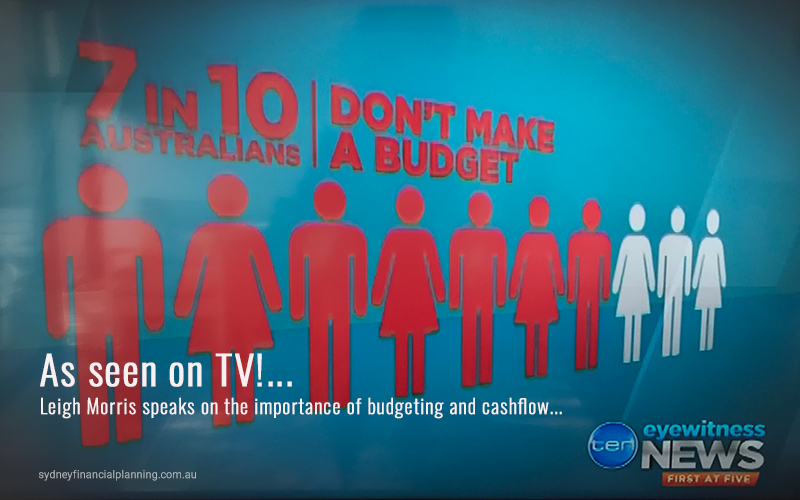
Leigh Morris speaks on budgeting

Leigh Morris speaks on budgeting – Channel 10 News

Leigh Morris speaks on budgeting


If you are looking for advise on how to get on top of budgeting and planning for your financial future, contact us to arrange to speak with one of our Planners.


Have some bigger goals you want to plan for?

It can really help to create a financial roadmap and budget with the help of a professional. Why not call us to arrange an appointment on 02 9328 0876.


General Disclaimer: This article contains information that is general in nature. It does not take into account the objectives, financial situation or needs of any particular person. You need to consider your financial situation and needs before making any decisions based on this information. Please seek personal financial advice prior to acting on this information.

Savvy Spending

Be savvy with your spending this Christmas

Savvy Spending

Take control of your spending so you can enjoy quality time with friends and family.

Here are some easy ways to spread Christmas cheer without burning a hole in your pocket. 

  • Create a budget for your seasonal shopping. Segment your spending into smaller categories such as presents, food, decorations, travel and donations. Important household expenses should be a key priority. You don’t want to miss a payment on your mortgage, insurance, or car. These should be taken care of first before you splash your cash.
  • Make a list and check it twice. Write a list of the people you need to buy for and what you intend to buy them. This will give you a good indication of what you can and can’t afford. Don’t forget those that look after you during the year such as your local barista, dry cleaner, gardener etc. A little can go a long way.  
  • Spare a thought for those less fortunate by volunteering time if monetary gifts aren’t an option or a donation isn’t enough.  
  • Get in early. Don’t get caught out making panic purchases at the eleventh hour because you’ve put off buying gifts and supplies. Spread your spending over the month(s) by shopping early, and make sure you tick items off your list as you go.  
  • Try to avoid using your credit card and resist the temptation of spending beyond your means. Credit card interest rates can add 20% on top of the purchase price if you don’t meet the due date on your credit card statement.  
  • Shop with cash and only go into a store if you have your list with you. This will help keep your budget in check and eliminate unnecessary spending.  
  • We all have our favourite shops. Make sure you follow them on social media and subscribe to their email alerts so you can be the first to know when they have a sale or special offer.  
  • If you can send a gift digitally such as a card, e-book or gift voucher, then do it. This will keep your postage costs down, especially if you have friends and family overseas.  
  • If you’re Christmas shopping online, be frugal. Before you start, google your way to a discount or coupon codes that you can use at the checkout.  
  • Want versus need. Sure, we all love a bit of splurging and spoiling, but if you find yourself second-guessing a purchase at the checkout, chances are you already know it belongs back on the shelf. This is also a great question to ask yourself when buying for kids – don’t go over the top on expensive gifts they have a short life span, buy them something constructive and long lasting.
  • Don’t be roped in with store card discount offers or special options to pay over a longer period of time. Whilst these offers may seem like a deal, they could end up costing you over time. Remember: If it sounds too good to be true, it probably is!  
  • Great presents don’t have to be pricey. If you’re an exceptional cook or home brewer, whip up a batch of tasty treats.
  • Start a new tradition with a family Secret Santa! This way everyone gets a gift and nobody breaks the bank. A great idea for the adults in the family.  
  • Minimise meal costs by asking everyone to bring a plate of food and a bottle of wine.  
  • Ditch the expensive wrapping paper and gift bag. Replace them with handmade gift decorations – get the kids on the job.  
  • Recycle your gifts. If the red wine your neighbour bought you doesn’t tickle your fancy, re-gift it to someone who would appreciate it. Don’t let these gifts go to waste.  
  • If you’ve accumulated frequent flyer or rewards points over the year, now is a great time to redeem them for trips, accommodation and gifts.  

The Christmas-New Year period should be relaxing and enjoyable rather than financially stressful. The easiest way to alleviate any financial pressure is to plan in advance and work within a budget.


Make your Christmas fun – not a financial burden?

It can really help to create a financial roadmap with the help of a professional. Why not call us to arrange an appointment on 02 9328 0876.


General Disclaimer: This article contains information that is general in nature. It does not take into account the objectives, financial situation or needs of any particular person. You need to consider your financial situation and needs before making any decisions based on this information. Please seek personal financial advice prior to acting on this information.

Why super and growth assets like shares really are long term investments

Common mistakes investors make – that you should avoid

Why super and growth assets like shares really are long term investments

  • The easiest way to avoid many of these mistakes is to have a long-term investment plan that aligns your financial goals with your risk tolerance.
  • Introduction

    In the confusing and often seemingly illogical world of investing, investors often make various mistakes that keep them from reaching their financial goals. This note takes a look at the nine most common mistakes.

    Mistake #1 – Crowd support indicates a sure thing

    “I will tell you how to become rich…Be fearful when others are greedy. Be greedy when others are fearful.” Warren Buffett, investor and CEO

    It’s normal to feel safer investing in an asset when your friends and neighbours are doing the same and media commentary is reinforcing the message that it’s the place to be. But “safety in numbers” is often doomed to failure. The trouble is that when everyone is bullish and has bought into an investment with general euphoria about it, it gets to a point where there is no one left to buy in the face of more positive supporting news but instead there are lots of people who can sell if the news turns sour. Of course, the opposite applies when everyone is pessimistic & bearish and have sold – it only takes a bit of good news to turn the value of the asset back up. So, the point of maximum opportunity is when the crowd is pessimistic (or fearful) and the point of maximum risk is when the crowd is euphoric (and greedy).

    Mistake #2 – Current returns are a guide to the future

    “Past performance is not a reliable indicator of future performance.” Standard disclaimer

    Faced with lots of information, investors often use simplifying assumptions, or rules, in order to process it. A common one of these is that “recent returns or the current state of the economy and investment markets are a guide to the future.” So tough economic conditions and recent poor returns are expected to continue and vice versa for good returns and good economic conditions. The problem with this is that when it’s combined with the “safety in numbers” mistake, it results in investors getting in at the wrong time (e.g. after an asset has already had strong gains) or getting out at the wrong time (e.g. when it is bottoming). In other words, buying high and selling low.

    This is pertinent now with shares providing strong gains over the last two years – with US shares up 56%, global shares up 49% and Australian shares up 25% – despite lots of worries about interest rates, recession, commercial property & US banks, wars, elections, etc. This has brought with it a temptation to conclude we are in a “new era” where macro problems don’t & various other share market plunges. Just because shares have had strong returns over the last two years – despite lots of worries – doesn’t mean that the cycle has been abolished and that there is nothing at all to worry about.

    Mistake #3 – “Experts” will tell you what will happen

    “Economists put decimal points in their forecasts to show that they have a sense of humour.” William Gillmore Simms, novelist and politician

    The reality is that no one has a perfect crystal ball. It’s well-known that forecasts as to where the share market, property market, and currencies will be at a particular time have a dismal track record, so they need to be treated with care. Usually the grander the forecast – calls for “new eras of permanent prosperity” or for “great crashes ahead” – the greater the need for scepticism as either they get the timing wrong or it’s dead wrong.

    Market prognosticators suffer from the same psychological biases as everyone else. And sometimes forecasts themselves can set in motion policy changes that make sure they don’t happen – such as rate cuts heading off sharp house price falls in the pandemic in 2020. The key value of investment experts is to provide an understanding of the issues around an investment and to put things in context. This can provide valuable information in terms of understanding the potential for an investment. But if forecasting was so easy, the forecasters would be rich and so would have retired!

    Mistake #4 – Shares can’t go up in a recession

    “It’s so good it’s bad, it’s so bad it’s good.” Anon

    A common lament around in second half 2020, after share markets rebounded from their late March 2020 pandemic low, was that, “the share market is crazy as the economy is in deep recession and earnings are collapsing!” Of course, shares kept rising into 2022, economies recovered, and earnings rebounded. The reality is that share markets are forward looking, so when economic data and profits are really weak, the market has already factored it in. History tells us that the best gains in stocks are usually made when the economic news is still poor, as stocks rebound from being undervalued and unloved, helped by falling interest rates. In other words, things are so bad they are actually good for investors! Of course, the opposite applies at market tops after a sustained economic recovery has left the economy overheated with no spare capacity and rising inflation and so the share market frets about rising rates. Hence things are so good they become bad! This seemingly perverse logic often trips up many investors.

    Mistake #5 – Letting a strongly held view get in the way

    “The aim is to make money, not to be right.” Ned Davis, investment analyst

    Many let their blind faith in a strongly held, often bearish, view – “there is too much debt”, “aging populations will destroy returns”, “a house price crash is imminent”, “a Trump victory will see shares crash”, etc – drive their investment decisions. This is easy to do as the human brain is wired to focus on the downside more than the upside, so we are easily attracted to doomsayers. They could be right one day but lose a lot of money in the interim. Giving too much attention to pessimists doesn’t pay for investors.


    Mistake #6 – Looking at your investments too much

    “Investing should be like watching paint dry or watching grass grow. If you want excitement…go to Las Vegas.” Paul Samuelson, economist

    Checking up on how your investments are doing is a good thing, surely? But the danger is that the more investors are exposed to news around their investments, the more they may see them falling. Whereas share markets have historically generated positive returns more than 60% of the time on a monthly basis and more than 70% of the time on a calendar year basis, day- to-day it’s close to 50/50 as to whether the share market will be up or down.
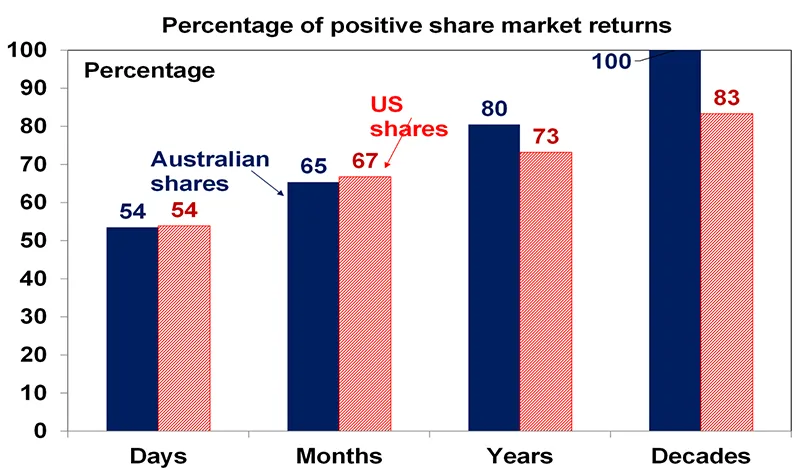
    Percentage of positive share market returns

    Daily & monthly data from 1995, data for years and decades from 1900. Source: Bloomberg, AMP

    Being exposed to this very short term “noise” and the chatter around it can cause investors to have a greater exposure to lower returning but safer investments that won’t grow wealth. The trick is to turn down the noise and have patience. Evidence shows that patient people make better investors because they can look beyond short-term noise and are less inclined to jump into one investment after another after they have already had their run.

    Mistake #7 – Making investing too complex

    “There seems to be a perverse human characteristic that makes easy things difficult.” Warren Buffett

    With the increasing ease of access to investment options, ways to put them together and information & processes to assess them, investing is getting more complex. But when you overcomplicate your investments, it can mean that you can’t see the wood for the trees. You can spend so much time focussing on this stock or ETF versus that stock or ETF or this fund manager versus that fund manager that you ignore the key driver of your portfolio’s risk and return which is how much you have in shares, bonds, real assets, cash, onshore versus offshore, etc. Or that you end up in things you don’t understand. Instead, it’s best to avoid the clutter, don’t fret the small stuff, keep it simple and don’t invest in things you don’t understand.

    Mistake #8 – Too conservative early in life

    “Compound interest is the eighth wonder of the world. He who understands it, earns it…he who doesn’t, pays it.” Albert Einstein, theoretical physicist

    Cash and bank deposits are low risk and fine for near term spending requirements and emergency funds, but they won’t build wealth over time.

    The chart below shows the value of $1 invested in various Australian assets since 1900 allowing for the reinvestment of interest and dividends along the way. That $1 would have grown to $955,656 if invested in shares but only to $263 if invested in cash. Despite periodic setbacks, shown with arrows (such as WWI, the Great Depression, WWII, stagflation in the 1970s, the 1987 share crash & the GFC), shares and other growth assets grow to much higher values over time thanks to their higher returns over the long term than cash and bonds and thanks to the magic of compound interest where higher returns build on higher returns through time.
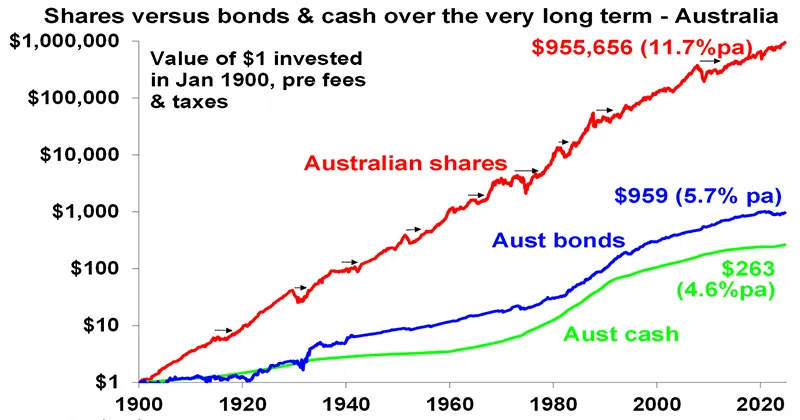
    Shares vs bonds cash over the very long term Australia

    Source: ASX. Bloomberg, RBA, AMP

    Not having enough in growth assets early in their career can be a problem for investors as it can make it harder to adequately fund retirement later in life as they miss out on the magic of compounding higher returns on higher returns through time in growth assets like shares and property. Fortunately, compulsory superannuation in Australia helps manage this – although early super withdrawal for various purposes (through the pandemic, for medical needs and as proposed for housing) may set this back for some. For example, a 30 year old who withdraws $20,000 from their super could have around $184,000 (or $74,000 in today’s dollars) less when they retire at age 67 based on assumptions in the ASIC MoneySmart Super Calculator.

    Mistake #9 – Trying to time the market

    “Far more money has been lost by investors in preparing for corrections, or anticipating corrections, than has been lost in the corrections themselves.” Peter Lynch, fund manager

    In the absence of a tried and tested process, trying to time the market, ie, selling before falls and buying ahead of gains is very difficult. Many of the mistakes referred to above kick in and it can be a sure way to destroy wealth. Perhaps the best example of this is a comparison of returns if the investor is fully invested in shares versus missing out on the best days. Of course, if you can avoid the worst days during a given period you will boost your returns. But this is very hard and many investors only get out after the bad returns occur, just in time to miss out on some of the best days and so hurt their returns. If you were fully invested in Australian shares from January 1995, you would have returned 9.5% pa (including dividends but not allowing for franking credits). But if by trying to time the market you miss the 10 best days the return falls to 7.5% pa. If you miss the 40 best days, it drops to just 3.5% pa. Hence, it’s time in the market that’s the key, not timing the market. The last two years provide a classic example of how hard it is to time markets – there has been a long worry list, so it’s been easy to be gloomy but timing markets on the back of this has been a loser as shares put in strong gains.


    Bill’s Conclusion

    At Sydney Financial Planning , we help coach clients on what to do and what to avoid.

    If you do not have a regular review with your Financial Planner, call us today.

    Bill Bracey
    CEO & Founder of Sydney Financial Planning


    Do your financial goals align with your risk tolerance?

    Arrange a meeting with one of our Financial Planners to help avoid common investment mistakes, either book a meeting or get in contact with us on 02 9328 0876.


    This article was prepared by Dr Shane Oliver with opening and closing summary by William Bracey – CEO & Senior Financial Planner from Sydney Financial Planning. Dr Shane Oliver who provides economic forecasts and analysis of key variables and issues affecting, or likely to affect, all asset markets. He also provides economic forecasts and analysis of key variables and issues affecting, or likely to affect, all asset markets.

    Sydney Financial Planning Pty Ltd (ABN 29 606 413 254), trading as Sydney Financial Planning & Illawarra Financial Planning is an Authorised Representative & Credit Representative of Charter Financial Planning Limited, Australian Financial Services Licensee and Australian Credit Licensee.

    This article contains information that is general in nature. It does not take into account the objectives, financial situation or needs of any particular person. You need to consider your financial situation and needs before making any decisions based on this information. If you decide to purchase or vary a financial product, your financial adviser, and other companies within the AMP Group may receive fees and other benefits. The fees will be a dollar amount and/or a percentage of either the premium you pay or the value of your investments. Please contact us if you want more information. If you no longer wish to receive direct marketing from us you may opt out by contacting Sydney Financial Planning . You may still receive direct marketing from AMP as a product issuer, bringing to your attention products, offerings or other information that may be relevant to you. If you no longer wish to receive this information you may opt out by contacting AMP on 1300 157 173.


    The recession and your home loan

    The recession and your home loan

    The recession and your home loan

    We are seeing a crisis that seems to be affecting all of us and the possibility of a recession has turned into a reality, but we have yet to see how much this recession is going to be affecting other aspects of our economy. Home loans are probably the biggest concern for many, and it makes sense that people want to protect their investment. With that said, here are some relevant and very useful moves that you can implement in order to help recession-proof your home loan.

    Maximise emergency funds

    There has never been a more crucial time for everyone to make an extra effort to save as much money as possible. Having six months’ worth of your salary in your emergency fund is a can be a great milestone and acts as your first line of defence when the chips are down.

    Times are very unpredictable right now and we all need to make sure that a portion of our monthly earnings is going into our savings fund where possible.
    This is probably the most essential tip that we can give to anyone right now. It’s a universal strategy that works for everyone regardless of their professional and their financial status.

    Mortgage redraw and offset

    As you may have seen in the news, certain lenders are now taking the additional repayments you’ve made out of redraw so they’re no longer accessible. These banks and lenders are inside their rights to do so but if you have that money set aside for emergencies it might be worth looking at an offset account.

    An offset account sits beside your home loan and any money in the account offsets the interest on your loan. This is essential how redraw facility works but the difference is, bank and lenders don’t have access to remove money from the offset account.

    Life insurance review

    Be warned that insurances polices such as Income Protection do not cover you in case you lose your job or your business goes under.

    Reviewing your current life insurance cover, insurance needs and premium costs to ensure they’re right for your individual needs. COVID-19 has shed new light on the need to be adequately covered but it’s also prudent to ensure you’re not over insured as the premium costs could be used towards building your emergency funds.

    Final thoughts

    These are times of uncertainty and we don’t know what could happen tomorrow in terms of our financial stability. The most important thing that we can all do is to ensure that we are covering all aspects of our finances to withstand this crisis with optimal results.

    Keep in mind that factors such as the COVID-19 pandemic are temporary, but the rippling effect of a bad financial situation could be felt for years to come. That’s why, in times like these, it’s crucial you pay extra attention to your financial situation and avoid any unpleasant surprises without being prepared.

    If you’d like to look at recession proofing your financial position, please feel free to contact us to see how we can help.

    Stay safe!


    Did you know about SFP’s Finance service?

    Why not arrange to meet with our expert Leigh Morris our Senior Credit Advisor to review your situation. Make a booking or call us on 02 9328 0876 to arrange a meeting.


    Article by Leigh Morris | Senior Credit Adviser & Director


    General Disclaimer: This article contains information that is general in nature. It does not take into account the objectives, financial situation or needs of any particular person. You need to consider your financial situation and needs before making any decisions based on this information. Please seek personal financial advice prior to acting on this information.

    Photo by Emre Can @ Pexel

    Improve your financial wellness

    7 tips to improve your financial wellness

    Improve your financial wellness

    This can be measured by the financial wellness index, which measures a person’s satisfaction with their current and future financial situation.

    Some days you might feel confident you can meet your needs within the boundaries of your current income, whereas other days you may feel like you don’t have nearly enough funds in order to do so.

    The truth is, you’re not alone. Nearly 2.5 million Aussies say they feel moderately to severely financially stressed, even though financial stress has been decreasing year-on-year in Australia.i

    Improving your financial wellbeing

    On a positive note, research identified that those who have been financially stressed in the past were often able to recover through changes to their behaviour and mindset.ii

    Here are some suggestions of things you could do (if you aren’t already) which may help you to improve how you feel financially.

    1. Create a budget that works for you

    When it comes to creating a budget, try jotting down into three categories – what money is coming in, what cash is required for the mandatory stuff (such as bills), and what dough might be left over (which you may want to put toward existing debts, savings or your social life).

    Writing up a budget may take an afternoon out of your diary, but it will help you to more easily identify where there’s room for movement. For instance, could you reduce what you’re spending on luxury items, subscription or streaming services, eating out or clothing?

    2. Consider rolling your debts into one

    If all the small debts you once had, have multiplied and grown into bigger debts – you could look to roll them into a single loan, and reduce what you pay in fees and interest.

    This could help you to save a significant amount of money (depending on what you owe) and make it easier to manage your repayments, as you’ll potentially only need to make one monthly repayment rather than having to juggle several.

    The main thing to ensure is you are paying less than what you are currently when it comes to interest rates, fees and charges, and that you’re disciplined about making your repayments.

    3. Try to save a bit of money regularly

    Even a small amount of cash deposited on a frequent basis could go a long way toward your savings goals, with a separate research report indicating the average savings target for Aussies is a bit over $11,000.iii

    Some tips people said helped them along the way was transferring spare funds into an actual savings account, setting up automatic transfers to their savings account (so they didn’t have to move money manually) and putting funds into an account which they couldn’t touch.iv

    4. Set aside some emergency cash

    With research showing that an emergency fund of between $4,000 and $5,000 is generally enough to cushion most working Aussies when it comes to unexpected expenses, it’s probably worth some thought.v

    An emergency stash of cash could give you peace of mind and reduce the need to apply for high-interest borrowing options should you be faced with a busted phone, car tyre, or bad landlord.

    5. Be open to talking money with your partner

    One in two Aussie couples admit to arguing about money,vi so if you haven’t already, it might be worth sitting down to ensure you’re on the same page and that both parties’ goals are being considered.

    6. See if you can get a better deal with your providers

    You more than likely have several product and service providers, and figures show you could save more than a grand annually on energy alone just by switching from the highest priced plan to the most competitive on the market.vii

    Again, this may take a couple of hours out of your day, but the savings you could potentially make may make a real difference to what you cough up throughout the year.

    7. Don’t be afraid to seek financial assistance

    If you are struggling to make repayments, you may be able to seek assistance from your providers by claiming financial hardship.

    All providers must consider reasonable requests to change their terms in instances where you may be suffering genuine financial difficulties and feel help would enable you to meet your repayments, possibly over a longer period.

    Of course it also helps to have an expert on your side and we are here to support you to achieve and maintain financial wellness.


    Need a hand with your financial wellness?

    For more help and strategies on identifying your feelings on financial wellness, speak to your financial planner at SFP. Or if you don’t have a planner yet let us arrange an appointment, contact us on 02 9328 0876.


    i, ii, v AMP’s 2018 Financial Wellness in the Australian Workplace Report, pages 7, 8, 14

    iii, iv MoneySmart – How Australians save money infographic

    vi Finder – Heated conversations: 1 in 2 Aussie couples argue about finances paragraph 1

    vii Mozo – Sick of high energy bills? Aussies willing to change providers could be saving over $1,000 a year paragraph 2

    Article by © AMP Life Limited. First published October 2019

    General Disclaimer: This article contains information that is general in nature. It does not take into account the objectives, financial situation or needs of any particular person. You need to consider your financial situation and needs before making any decisions based on this information. Please seek personal financial advice prior to acting on this information.


    Reboot retirement - consider what makes you happy

    Rebooting for retirement

    Reboot retirement - consider what makes you happy

    1. Think mind and body

    Without a clear idea of how you’ll spend your time, the initial euphoria of the untouched morning alarm can give way to anything from boredom to panic. Most of your 24 hours may be unstructured, so figure out how you’ll spend it wisely.

    You might try something new. Perhaps now is the time to keep bees, join a choir or learn archery. If you have a partner, remember to involve them in the planning. Even if they don’t fancy joining you on a skydive, they may see a chance to learn how to take better action pictures.

    Travel is near the top of many wish lists in retirement. If you don’t have the funds for a Caribbean cruise, there are a host of cheaper options around Australia and even beyond. And now you’ll have more time to spend, without worrying about annual leave quotas, or who’ll look after your business while you’re away.

    2. Have a purpose

    A rest is as good as a change. Although it’s great to have unstructured time to think and dream, boredom can be a damaging state of mind, particularly if it’s prolonged.

    If you’re already physically active, this can be a great time to extend yourself, embrace something new like yoga, or aqua aerobics. If you’re healthy but know you could improve, you might sign up for a sponsored cycle ride or walk to help a cause you care about.

    3. Catch up on what you’ve missed

    Many of us put off expanding our passions while we’re working because we don’t have time.

    If you’ve always wanted to read the classics, now might be your chance to explore the jewels of world literature. Reading is brain expanding and inexpensive. Books older than 70 years from the death of the author are out of copyright and therefore cheap in print or even free on your Kindle.

    4. Follow your heart, not the herd

    Many people downsize coming up to retirement. A smaller property usually means lower utility bills and maintenance.

    But it’s not for everyone. If your spare bedroom has the right natural light for your artist’s studio or you just love your lemon trees, you might be better off staying where you are and saving yourself the real estate fees and hassles.

    You’re facing a change in life, but you don’t have to change for change’s sake. Put yourself and your loved ones first.

    5. Listen to the voice of experience

    As with so many things in life, you can learn from experts. Talk to people you know who have already retired, and see what worked for them, and what they wish they’d put in place before they took the plunge.

    Consider what will make you happy in the years beyond work, so you can live the life you want. Finally,if you haven’t yet given these things serious thought yet, don’t panic. You’ve dealt with other changes in your life, this is just another one.

    Think of it as a new adventure. Let’s face it, you’ve earned it.


    Do you have a new adventure in mind?

    For more help and strategies on identifying what your retirement plans look like, speak to your financial planner at SFP. Call us to arrange an appointment, contact us on 02 9328 0876.


    Article by © AMP Life Limited. First published 10 October 2019

    General Disclaimer: This article contains information that is general in nature. It does not take into account the objectives, financial situation or needs of any particular person. You need to consider your financial situation and needs before making any decisions based on this information. Please seek personal financial advice prior to acting on this information.


    Australian's are a generous nation

    Australia is a generous nation

    Australian's are a generous nation

    Australia is a generous nation. We love to give gifts. It brings us joy.

    When we spend, we go big: $19.8 billion AUD is spent on gifts by Australians each year, or an average of $100 each month ($1,200 per year).

    That’s more than buying a $4 coffee every weekday, getting our shirts dry cleaned daily, or what we spend, on average, on mobile phone plans. Gen Y spend more on gifts than any other generation: $130 each month ($1,560 per year).

    Here’s what the average Australian adult spends on gifts for loved ones each year:

    • $437 for our spouse or partner,
    • $361 for each of our children,
    • $201 per parent, and
    • $115 for our pet.

    Women are more generous towards their spouses or partners than men ($454/ year compared to $419/year), but men are spending $22 more per month on gifts than women in general.

    Younger adults spend more than older adults (see table). Almost $20 billion spent on gifts each year


      Gen Z
    (18-24)
    Gen Y
    (25-39)
    Gen X
    (40-54)
    Boomers
    (55-73)
    Average gift spending per month $91 $130 $87 $89


    We find joy in giving

    Experts in psychology generally agree that the altruistic act of giving has neural and emotional benefits. These range from elevated activity in regions of the brain associated with pleasure, social connection, and trust, all the way through to lowering blood pressure and stress levels.

    So it’s a good thing most of us find joy in giving. Most Australians (85%) say they get more joy giving gifts to others than in receiving gifts themselves.

    Females find particular joy in giving (88% find greater joy in giving than receiving, compared to 83% of males).

    Older Australians gain the greatest joy: 90% of Baby Boomers say they get more joy in giving than receiving, as do 84% of Gen X, 84% of Gen Y and 78% of Gen Z.

    Gifts for our Pets

    74% of Australian pet owners buy gifts for their pet.

    Those who do spend an average of $115/year on gifts for their pet.  Pushing the average higher are Gen Ys who spend $121/year and Gen X who spend $142/year.

    Generous to a fault

    73% of Australian’s don’t budget for gifts!

    Disturbingly, a significant proportion of the $19.8 billion spent on gifts each year in Australia is not accounted for in household budgets. In fact, three in four of us (73%) do not have a budget allocation for gifts. Men are less likely than women to allocate a budget towards gift-giving (24% men cf. 31% women).
    Those least likely to budget for gifts are older families, couples and older singles, of whom 79% don’t have a budget allocation for gifts.

    Surprisingly, the vast majority of us are happy with the amount we spend on gifts. Just one in eight of us (13%) feel we spend too much on gifts, while most of us (81%) feel we spend about the right amount.

    The discrepancy between a high unplanned household spend and a satisfaction with that spend indicates an opportunity to improve our financial literacy and awareness of the benefits of budgeting, planning, and giving in a way that brings joy without debt or regret.

    How do we decide how much to spend?

    If we don’t budget or plan for gifts, how do we decide how much to spend?

    The top three decision-drivers that inform how much we choose to spend on a gift are:

    1. How close we are to the recipient (59% selected this)
    2. How special the occasion is (58%); and
    3. Our budget at the time (55%).

    The FPA “Gifts that Give” national survey of Australians reveals some truly fascinating insights into how we think, buy, plan and spend our money on those we love the most. Did you know Australia is a generous generation and spends nearly $20 billion a year on gifts? This 19-page report is a fascinating read and a great conversation starter with friends and families.

    Download the Goodness of Giving eBook.

    Download the full report – Gifts that Give.


    Does the report findings raise some questions on your gift-giving budgeting?

    Why not arrange to meet with one of our planners to do a budget review. Make a booking or call us on 02 9328 0876 to arrange a meeting.


    1 Assuming drycleaning fee of $15 for five shirts, 52 weeks per year. Australians spend an average of $77/month on mobile phone plans, according to Canstar Blue research.

    Aricle by FPA Gifts that Give Research Report

    General Disclaimer: This article contains information that is general in nature. It does not take into account the objectives, financial situation or needs of any particular person. You need to consider your financial situation and needs before making any decisions based on this information. Please seek personal financial advice prior to acting on this information.


    When can I access my Super?

    When can I access my Super?

    When can I access my Super?

    Here is a high-level summary as to when super may be accessible to you. 

    When you retire (and have reached your preservation age)

    Typically, you can access your super when you’ve reached your preservation age and you retire. Find your preservation age in the table below. 

    Date of birth Preservation age
    Before 1 July 1960 55
    1 July 1960 – 30 June 1961 56
    1 July 1961 – 30 June 1962 57
    1 July 1962 – 30 June 1963 58
    1 July 1963 – 30 June 1964 59
    From 1 July 1964 60

    When you’re transitioning into retirement

    If you’ve reached your preservation age, you might wish to access a portion of your super through a transition to retirement income stream while continuing to work full-time, part-time or casually. While this may give you some financial flexibility, there will be things to consider, including that you’ll only be able to access up to 10% of your super savings each financial year. 

    When you reach age 60 and stop working (but aren’t retiring)

    If you’re aged 60 to 64 and stop working, even if you have no intention of retiring completely (for example, you may get another job elsewhere), you’re still considered retired for the purposes of accessing super. This means you can cash out the super you’ve accumulated up until that time even if you begin working again under a different employment arrangement.

    When you reach age 65 (even if you haven’t left the workforce)

    When you turn 65, you don’t have to retire or satisfy any special conditions to get full access to your super. You’re also not obligated to withdraw it, however depending on your circumstances, there may be some benefits in doing so. 

    Other instances where you may be able to access super

    While you generally cannot take your super until retirement, there are some specific circumstances where the law allows you to draw on your super early. These mainly relate to certain medical conditions or severe financial hardship, and you must meet eligibility criteria to apply. 

    Compassionate grounds

    You may be allowed to withdraw a certain amount of money from your super on compassionate grounds where you don’t have capacity to meet certain expenses. This may include things like certain medical-related expenses, funeral costs and mortgage repayments that will prevent you from losing your home. 

    Severe financial hardship

    If you’re under preservation age, have been receiving financial support payments from the government for 26 weeks continuously and can’t meet reasonable and immediate family living expenses, you may be able to withdraw between $1,000 and $10,000 from your super. This can only be done once in a 12-month period.  If you’ve already reached your preservation age (plus 39 weeks), have received financial support payments from the government for a cumulative period of 39 weeks since reaching your preservation age, and are not gainfully employed on a full-time or part-time basis, there is no limit on the amount that you may be able to withdraw under severe financial hardship. 

    Incapacity

    If you’re permanently or temporarily unable to work due to a physical or mental medical condition, you may be able to access super as a lump sum or via regular payments over a period of time. 

    Terminal medical condition

    If you’ve been appropriately diagnosed with a terminal illness that’s likely to result in your death within a two-year period, you could apply to access your super and there are no set limits on the amount you can withdraw. 

    Super benefits less than $200

    If you change employers and the balance of your super account is less than $200, or you have lost super that’s being held by a super fund or the Australian Taxation Office (ATO) that’s less than $200, you may be able to withdraw this money. 

    Leaving Australia

    If you’ve worked and earned super while visiting Australia on an eligible temporary visa, you can apply to have this super paid to you as a Departing Australia Superannuation Payment (DASP), but there are requirements and documentation you may need to provide. 

    What to keep in mind

    Depending on how much you have in super, it’s worth considering any implications of withdrawing this money, such as how the money may be taxed, and whether a withdrawal may affect Centrelink payments, such as the Age Pension. 


    Not sure if your meet some of the criteria?

    Having an financial planning expert review your unique situation is always a good stratgey . Make a booking or call us on 02 9328 0876 to arrange a meeting.


    Article by: ©AMP Life Limited. First published May 2019

    General Disclaimer: This article contains information that is general in nature. It does not take into account the objectives, financial situation or needs of any particular person. You need to consider your financial situation and needs before making any decisions based on this information. Please seek personal financial advice prior to acting on this information.