Tag: Property

Auction Time

Ready, set…auction!

Auction Time

Before you consider bidding use our tips to make sure you’re prepared and know what to expect.


Step 1:

Work out the costs

Working out how much you can afford to repay on a home loan plus all the associated costs of buying a property – like stamp duty – is the first step.

Of course, buying at auction means the final purchase price remains unknown until the hammer falls. But a defined financial limit means you’ll know when to stop bidding.

Use a home loan calculator and speak to a financial planner to understand all the costs of buying a property.

Step 2:

Arrange finance

Make sure you’re ready to bid. That means knowing exactly how much you can borrow comfortably because your lender has assessed your situation and approved a specific amount.

Visit your lender before you start looking for a property and arrange pre-approval so you’re set to go. With an approved home loan you can benefit from competitive interest rates and terms, plus the convenience of pre-approval.

Step 3:

Do your research

It can take time to find the right house. Researching the area will give you an idea of prices for similar properties.

Attend auctions in the area so you understand the strategies agents use and what to expect.

Before buying at auction, make sure the property is solid – arrange building and pest inspections. And read the contract, certificate of title and section statement so you understand what you’d be buying.

If possible, ask a solicitor to look over the paperwork with you.

Step 4:

Ready, set … auction!

Before the auction, decide who’ll bid for the property-speak with the real estate agent. You can ask someone to bid on your behalf; they may need to sign a proxy form.

If the reserve price-the minimum the seller will accept – is reached and you’re the winning bidder you’ll have to sign a contract of sale and pay 10% deposit immediately after auction. Ask the agent how you’ll need to provide the deposit. Will you need a personal cheque book?

If the reserve price isn’t reached but you are the highest bidder, the agent may negotiate with you and the seller afterwards.

Step 5:

Be prepared to walk away

If your heart’s set on a particular property, it can be difficult watching someone outbid you. But it’s better to walk away without a property than with a debt larger than you can repay.

Remember your financial limits and stick to them. You’ll avoid paying more than you can afford – or than a property may be worth – and stay out of the emotional charge an auction can create.

Making the decision to buy or not to buy can be complex, so it’s important to talk to your financial adviser before you take the plunge.


Need some help to get started?

For more advice and strategies on getting into the property market, speak to your adviser at SFP. Or if you don’t have an adviser yet let us arrange an appointment, contact us on 02 9328 0876.


This article contains information that is general in nature. It does not take into account the objectives, financial situation or needs of any particular person. You need to consider your financial situation and needs before making any decisions based on this information.


Get on the Property Ladder

3 ways to get your feet on the property ladder

Get on the Property Ladder

So it can be tough to put together a deposit, especially when you’re starting out. It’s a far cry from back in your parents’ day, when it seemed to be easier to achieve the great Australian dream of owning a home.

But while it’s easy to focus on the downside, there are reasons to be cheerful. Interest rates today are at record lows, compared with the 17% that your parents might have been paying off as recently as 1990.ii And credit is more readily available, with more competition among lenders.

So getting approval for a loan might be easier. But you still need to put a deposit together and cover the repayments. Here are three more creative ways to get your foot on the property ladder.

1. Go in together

Buying a property with a bunch of mates or family can be a good way of pooling your resources.

  • You can save a deposit more quickly.
  • You can share up-front costs, like stamp duty.
  • You can borrow more and buy a better home.
  • You can avoid paying mortgage insurance, if you can raise a 20% deposit.

But you need to go into a co-ownership arrangement with your eyes wide open. Think about what would happen if one of you wants to sell up or can’t make a repayment. Watertight legal commitments can reduce the risks if things go pear-shaped.

  • Establish the right co-ownership structure—stipulating whether you are ‘joint tenants’ or ‘tenants in common’ can make a big difference down the track.
  • Set up a co-ownership agreement to cover all the potential financial pitfalls.
  • Make sure your will is in order so that if anything happens to you, your share in the property will go to the people you want it to.

2. Buy an investment property

Back in the day, an investment property was something you turned your mind to later in life once you were firmly established in your family home. But renting out an investment property is an increasingly attractive way for younger Australians to get into the housing market while continuing to live with their parents or renting somewhere else cheaper.

You’ll need to make the finances work.

  • If the income you receive from your investment property is greater than your loan repayments, interest and other costs, you’ll be receiving a regular boost to your cash flow.
  • If the income you receive from your investment property is less than your loan repayments, interest and other costs, you’ll be making a loss. That loss reduces your taxable income and, in turn, your tax bill. The higher the rate of tax you’re paying, the more tax you can save in deductions. This is what’s known as negative gearing and means your investment needs to gain enough in value during the time you hold it to offset the losses you make along the way. Negative gearing can be a risky strategy, particularly if your situation changes and you can’t service the debt as easily.

And you’ll need to do your homework.

  • Buy in the right area—somewhere with decent transport links and close to schools and amenities will attract tenants and future buyers for both rental income and capital growth.
  • Shop around for the best home loan – don’t be afraid to ask lenders for a better rate.
  • Get the right type of loan—think about which type of loan suits you. Choose between a fixed or variable interest rate—or a split between the two.

Make sure your will is in order so that if anything happens to you, your share in the property will go to the people you want it to.

3. Invest in indirect property

Bricks and mortar isn’t the only option. You can invest in commercial or residential property through your super or a managed fund to generate a regular income and potential capital growth without the hassle and expense of maintaining a home.


For more information on getting on the ladder…

It can really help to create a financial roadmap with the help of a professional. Why not call us to arrange an appointment on 02 9328 0876.

i: 2014 Demographia Housing Affordability Survey – www.macrobusiness.com.au/2014/01/2014-demographia-housing-affordability-survey
ii: Reserve Bank of Australia – www.rba.gov.au/statistics/cash-rate/cash-rate-1990-1996.html

General Disclaimer: This article contains information that is general in nature. It does not take into account the objectives, financial situation or needs of any particular person. You need to consider your financial situation and needs before making any decisions based on this information. Please seek personal financial advice prior to acting on this information.


Photo by Jessica Castro on Unsplash

Australian House Prices

Will Australian House Prices Crash?

Australian House Prices

This year I’m using help from a friend, Dr Shane Oliver, someone who I highly respect and been following for over 20 years. He’s also an individual with a great track record. Generally people who last in this industry get it right a lot. Clients put their money with winners not losers. I would highly recommend you read this article as I think he’s got it right.

Key points:

  • Talk of a property crash is likely to ramp up again with signs that the Sydney and Melbourne property markets are cooling. But the Australian property market is a lot more complicated than the crash calls suggest.
  • We continue to expect a 5-10% downswing in Sydney and Melbourne property prices but a crash is unlikely and other capital cities will perform better.
  • It remains a time for property investors to exercise caution and focus on laggard or higher-yielding markets.

Introduction

A common narrative on the Australian housing market is that it’s in a giant speculative bubble propelled by tax breaks, low interest rates and “liar loans” that have led to massive mortgage stress and that it’s all about to go bust, bringing down the banks and the economy with it. Recent signs of price falls – notably in Sydney – have added interest to such a view.

The trouble is we have been hearing the same for years. Calls for a property crash have been pumped out repeatedly since early last decade. In 2004, The Economist magazine described Australia as “America’s ugly sister” thanks in part to a “borrowing binge” and soaring property prices. At the time, the OECD estimated Australian housing was 51.8% overvalued. Property crash calls were wheeled out repeatedly after the Global Financial Crisis (GFC) with one commentator losing a high-profile bet that prices could fall up to 40% and having to walk to the summit of Mount Kosciuszko as a result. In 2010, a US newspaper, The Philadelphia Trumpet, warned “Pay close attention Australia. Los Angelification (referring to a 40% slump in LA home prices around the GFC) is coming to a city near you.” At the same time, a US fund manager was labelling Australian housing as a “time bomb”. Similar calls were made last year by a hedge fund researcher and a hedge fund: “The Australian property market is on the verge of blowing up on a spectacular scale…The feed-through effects will be immense… the economy will go into recession.” Over the years these crash calls have even made it on to 60 Minutes and Four Corners.

The basic facts on Australian property are well known:

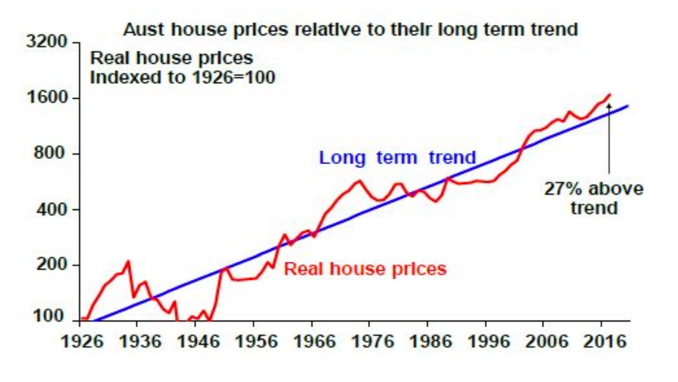
  • It’s expensive relative to income, rents, its long-term trend (see the next chart) and by global standards.
  • Affordability is poor – price to income ratios are very high and it’s a lot harder to save a sufficient deposit.
  • The surge in prices has seen a surge in debt that has taken our household debt to income ratio to the high end of OECD countries, which exposes Australia to financial instability should households decide to cut their level of debt.

Australian house prices

Source: ABS, AMP Capital


These things arguably make residential property Australia’s Achilles heel. But as I have learned over the last 15 years, it’s a lot more complicated than the crash calls suggest.

First, it’s dangerous to generalise

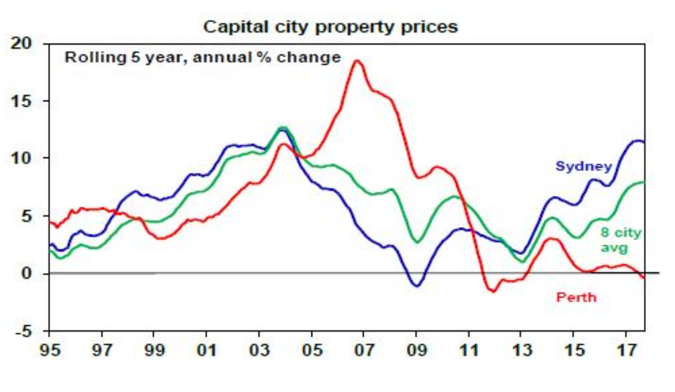
While it’s common to refer to “the Australian property market”, only Sydney and Melbourne have seen sustained and rapid price gains in recent years. On CoreLogic data over the last five years dwelling prices have risen at an average annualised rate of 11.4% per annum (pa) in Sydney and 9.4% pa in Melbourne but prices in Brisbane, Adelaide, Hobart and Canberra have risen by a benign 3 to 5% pa and prices have fallen in Perth and Darwin.

graph - capital city property prices

Source: CoreLogic, AMP Capital

Australian cites basically swing around the national average with prices in one or two cities surging for a few years and then underperforming as poor affordability forces demand into other cities. This can be seen in the next chart with Sydney leading the cycle over the last 20 years and Perth lagging.


Second, supply has not kept up with demand

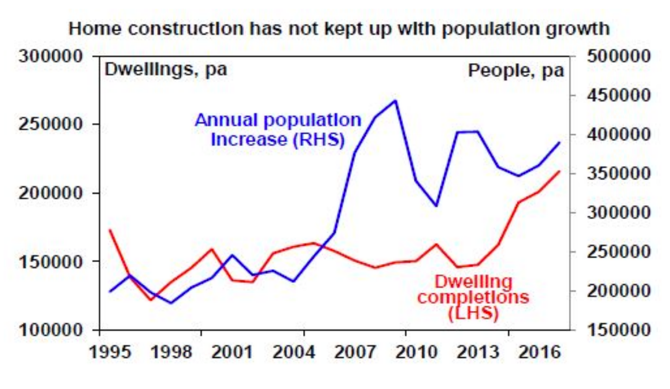
Thanks mostly to an increase in net immigration, population growth since mid-last decade has averaged 368,000 people pa compared to 218,000 pa over the decade to 2005, which requires roughly an extra 55,000 homes per year.

Unfortunately, the supply of dwellings did not keep pace with the surge in population growth (see the next chart) so a massive shortfall built up driving high home prices. Thanks to the recent surge in unit supply this is now being worked off. But there is no broad based oversupply problem.

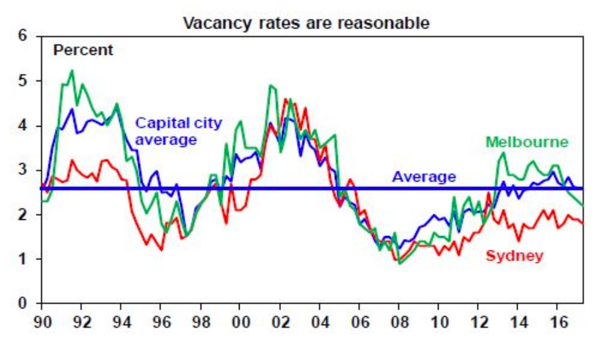
Consistent with this, average capital city vacancy rates are around long-term average levels, are low in Sydney and are falling in Melbourne (helped by surging population growth).


home construction not keeping up

Source: ABS, AMP Capital

Vacancy rates are reasonable

Source: Real Estate Institute of Australia, AMP Capital


Third, lending standards have been improving

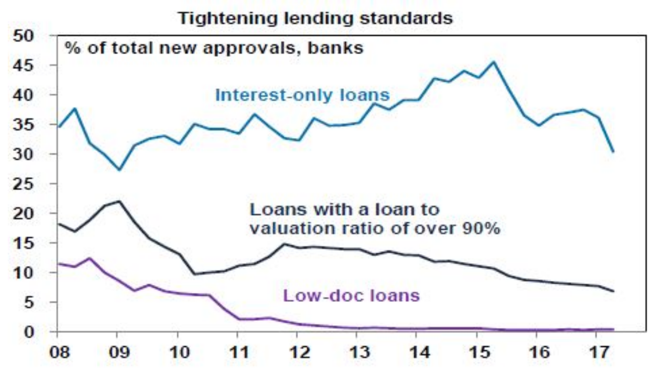
For all the talk about “liar loans”, Australia has not seen anything like the deterioration in lending standards other countries saw prior to the GFC. Interest-only loans had been growing excessively but are not comparable to so-called NINJA (no income, no job, no asset) sub-prime and low-doc loans that surged in the US prior to the GFC. Interest-only and high loan to valuation loans have also been falling lately. And much of the increase in debt has gone to older, wealthier Australians, who are better able to service their loans.

sfp e4 graph 5

Source: APRA, AMP Capital


Yes, I know various surveys report high levels of mortgage stress. But we heard the same continuously last decade from the Fujitsu Mortgage Stress Survey and yet there was no crash. By contrast, RBA research shows that while getting into the housing market is hard “those who make it are doing ok” and bad debts and arrears are low. Finally, debt interest payments relative to income are running around 30% below 2008 peak levels thanks to low interest rates. Sure, rates will eventually start to rise again but they will need to rise by around 2% to take the debt interest to income ratio back to the 2008 high.


Fourth, the importance of tax breaks is exaggerated

A range of additional factors like tax breaks and foreign buyers have played a role but their importance is often exaggerated relative to the supply shortfall. While there is a case to reduce the capital gains tax discount (to remove a distortion in the tax system), negative gearing has long been a feature of the Australian tax system and if it’s the main driver of home price increases as some claim then what happened in Perth and Darwin? Similarly, foreign buying has been concentrated in certain areas and so cannot explain high prices generally, particularly with foreign buying restricted to new properties.

Finally, the conditions for a crash are not in place

To get a housing crash – say a 20% average fall or more – we probably need much higher unemployment, much higher interest rates and/or a big oversupply. But it’s hard to see these.

    • There is no sign of recession and jobs data remains strong.
    • The RBA is likely to start raising interest rates next year, but it knows households are now moresensitive to higher rates & will move only verygradually – like in the US – and won’t hike by more than it needs to to keep inflation on target.
    • Property oversupply will become a risk if the current construction boom continues for several years but with approvals to build new homes slowing this looksunlikely.

Don’t get me wrong, none of this is to say that excessive house prices and debt levels are not posing a risk for Australia. But it’s a lot more complicated than commonly portrayed.

So where are we now?

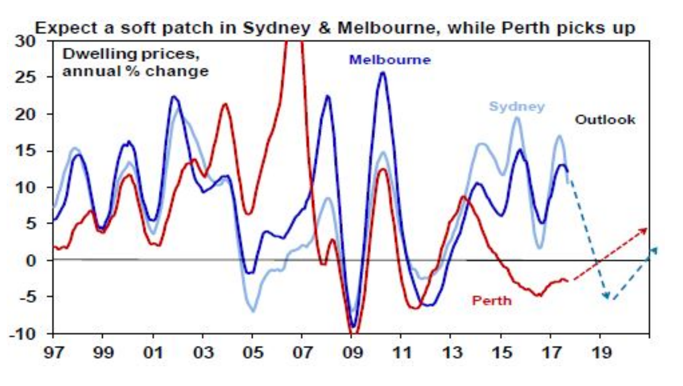
That said, we continue to expect a slowing in the Sydney and Melbourne property markets, with evidence mounting that APRA’s measures to slow lending to investors and interest-only buyers (along with other measures, eg to slow foreign buying) are impacting. This is particularly the case in Sydney where price growth has stalled and auction clearance rates have fallen to near 60%. Expect prices to fall 5-10% (maybe less in Melbourne given strong population growth) over the next two years. This is like what occurred around 2005, 2008-09 & 2012.

sfp e4 graph 6

Source: CoreLogic, AMP Capital


By contrast, Perth and Darwin home prices are likely close to the bottom as mining investment is near the bottom. Hobart and increasingly Brisbane and Adelaide are likely to benefit from flow on or “refugee” demand from Sydney and Melbourne having lagged for many years.

Implications for investors

Housing has a long-term role to play in investment portfolios, but the combination of the strong gains in the last few years in Sydney and Melbourne, vulnerabilities around high household debt levels as official interest rates eventually start to rise and low net rental yields mean investors need to be careful. Sydney and Melbourne are least attractive in the short term. Best to focus on those cities and regional areas that have been left behind and where rental yields are higher. So there you have it. Let’s see if we got it right next year.

Concluding comment

So there you have it. Let’s see if we got it right next year.


Bill Bracey FChFP
Principal Sydney Financial Planning
Authorised Representative Charter Financial Planning


Still have some questions?

If you want to discuss any cocerns or implications on your property investing with one of our advisors. Call us to arrange an appointment on 02 9328 0876.


This main article was prepared by Dr Shane Oliver. Dr Shane Oliver, Head of Investment Strategy and Economics and Chief Economist at AMP Capital is responsible for AMP Capital’s diversified investment funds. He also provides economic forecasts and analysis of key variables and issues affecting, or likely to affect, all asset markets.

General Disclaimer: This article contains information that is general in nature. It does not take into account the objectives, financial situation or needs of any particular person. You need to consider your financial situation and needs before making any decisions based on this information. Please seek personal financial advice prior to acting on this information.

Important note: While every care has been taken in the preparation of this document, AMP Capital Investors Limited (ABN 59 001 777 591, AFSL 232497) and AMP Capital Funds Management Limited (ABN 15 159 557 721, AFSL 426455) make no representations or warranties as to the accuracy or completeness of any statement in it including, without limitation, any forecasts. Past performance is not a reliable indicator of future performance. This document has been prepared for the purpose of providing general information, without taking account of any particular investor’s objectives, financial situation or needs. An investor should, before making any investment decisions, consider the appropriateness of the information in this document, and seek professional advice, having regard to the investor’s objectives, financial situation and needs. This document is solely for the use of the party to whom it is provided.

Relief for NSW first home buyers

Relief for NSW first home buyers

Relief for NSW first home buyers

First home buyers face many hurdles when entering the housing market with affordability being the number one barrier. The state government has responded to the astronomical house prices, lack of supply, and heavy competition from foreign investors by developing policies that aim to alleviate some of the burdens for first home buyers. The new policies were recently announced by Premier Gladys Berejiklian and will take effect from 1 July 2017. The package of policies will include grants and concessions, increased investment into housing supply and acceleration of the delivery of infrastructure to support growing communities.

Below is a breakdown of the package and perks for first home buyers:

  • Abolish stamp duty on all homes up to $650,000
  • Give stamp duty relief for homes up to $800,000
  • Provide a $10,000 grant for builders of new homes up to $750,000 and purchasers of new homes up to $600,000
  • Abolish insurance duty on lenders’ mortgage insurance
  • Ensure foreign investors pay higher duties (4%) and land taxes (2%)
  • Investors no longer allowed to defer stamp duty payments on off-the-plan purchases
  • $3b infrastructure funding to boost housing supply.

NSW will scrap stamp duty for first home buyers on new and existing homes up to $650,000 and a proportioned discount will be applied for homes up to $800,000. This could see first home buyers reap a five figure savings on stamp duty alone.

Those who choose to build a new property valued up to $750,000 along with anybody purchasing a new property worth up to $600,000 will be eligible for a $10,000 grant.

Insurance duty on lenders’ mortgage insurance (LMI) has been abolished.  Typically, banks and financial institutions will require you to have a 20% deposit in order to borrow money to purchase your home; however, LMI is an alternative option where lenders may allow you to borrow the same amount with a smaller deposit than would otherwise be required. Luckily for first home buyers, the insurance duty attached to LMI has been waived. 

To minimise competition from investors, the NSW government has doubled the stamp duty surcharge for off-shore investors from 2% to 4% and land tax has also increased from 0.75% to 2%. Furthermore, the concession to delay payment of stamp duty from 3 to 15 months after settlement on off-the-plan purchases is no longer available for investors, both domestic and international.

The NSW government also hopes to improve housing affordability by increasing housing supply, including the acceleration of rezoning and building infrastructure such as roads, schools and utilities that can facilitate development. 

Increasing housing supply is only possible if there is adequate infrastructure to service new homes and support communities. The NSW Government will inject $3 billion into infrastructure funding to accelerate the delivery of housing, ensuring that works which support housing are prioritised and in locations in alignment with government planning and housing demand.


You think you qualify? but have a few more questions…

If you are considering buying or moving, or to simply find out if you are eligible for the first home buyers concessions and exemptions. Contact us for advice on how to get started or have your current situation reviewed, call us on 02 9328 0876.


General Disclaimer: This article contains information that is general in nature. It does not take into account the objectives, financial situation or needs of any particular person. You need to consider your financial situation and needs before making any decisions based on this information. Please seek personal financial advice prior to acting on this information.

Is Downsizing right for you?

Is downsizing right for you?

Is Downsizing right for you?

At first glance, it would seem that downsizing is a popular choice amongst older Australians. However recent research (Downsizers and Other Movers – The Housing Options Choices and Dilemmas of Older Australiansi) highlights that only 9% of 50+ year olds moved to a smaller home in the period 2006-2011. We explore some of the issues to consider when reviewing your housing needs. 

So why do we downsize?

Of those surveyed for research, ‘Lifestyle preference’ was the number one reason for downsizing, with ‘Retirement’ and ‘Financial gain’ coming in fourth and sixth place respectively. However, with the recent announcements during the Federal Budget, we now see another major reason to downsize. An opportunity has been presented to those aged 65 or more to downsize their home in return for super incentives and tax breaks.  “The measure reduces a barrier to downsizing for older people. Encouraging downsizing may enable more effective use of the housing stock by freeing up larger homes for younger, growing families,” Treasurer Scott Morrison said.

Making the most of your space

Another belief explored in the research findings, is that older people are under-utilising family homes, so downsizing would seem like a sensible step. However – when questioned – 91% regarded their (mostly three or more bedroom) dwellings as suitable for the needs of their household. While 86% had one or more ‘spare’ bedrooms, close to 75% of those had temporary residents requiring the use of that bedroom – that being an adult child, grandchild or other relative. 

And it seems that after retirement, we could actually need more room, not less. As we spend more time at home, an office or hobby room is a common requirement. For couples, each having their own personal space was considered important. Even if your grown-up children have long flown the nest, many come back for weekend visits, so a spare bedroom can be a necessity. 

Time to move on

But what if you feel that downsizing is right for you? A big driver for those that do opt for a smaller home is the inability to maintain the current family house and/or garden. This can also be compounded by the loss of a partner, relationship breakdown or ill health, all of which would make it harder to continue with the up keep of a larger property. 33% of those who downsized said reducing living costs was the main reason for moving. 

Downsizing certainly can mean a lesser financial burden for some, but it’s important to take into consideration other costs such as removalists and stamp duty – which 11% of downsizers included as a ‘difficulty’ of the moving process. There may also be implications on the age pension, so it’s important to make sure you are fully informed. Another important factor is that with many Australian suburbs dominated by large family homes, finding a suitable place may mean moving to a different area. It could mean moving further away from friends, family and your support network. Something we tend to rely on more heavily as we get older. 

Seeking professional financial advice is something currently only 14% of downsizers do. But it could make a significant difference. Deciding whether to stay put or sell up is complicated. Talk to us today before you make the big decision. Using contemporary financial modelling tools, we can model a range of “what if” scenarios to equip you with the information you need to make the right decision for your circumstances. 


Not sure if you should downsize?

If you want to discuss your options and retirement plans one of our advisors to make sure – call us to arrange an appointment on 02 9328 0876.

i Judd, B., Liu, E., Easthope, H. & Bridge, C. 2014, ‘Downsizers and Other Movers: The Housing Options, Choices and Dilemmas of Older Australians’, Three Days of Creativity and Diversity, vol. 35, pp. 129-38. 

General Disclaimer: This article contains information that is general in nature. It does not take into account the objectives, financial situation or needs of any particular person. You need to consider your financial situation and needs before making any decisions based on this information. Please seek personal financial advice prior to acting on this information.

What is happening with the supply of new homes in Australia?

What is happening with the supply of new homes in Australia?

What is happening with the supply of new homes in Australia?

  • The Labor government is arguably dedicating more time and expenditure on housing incentives to states and territories than any other government in recent history.
  • However, productivity challenges in construction – particularly in housing, overregulation and labour and material shortages – are preventing housing supply from lifting enough to meet demand.
  • Introduction

    Most economists agree that to make real progress on housing affordability, the key is to lift housing supply. The Federal government has an aim to build 1.2 million, new, well-located homes over five years.

    There has been more focus on housing in the current term of government than any before. We look at how housing supply has responded to the various policy initiatives and incentives in this SFP Insights.

    Housing demand and supply in Australia

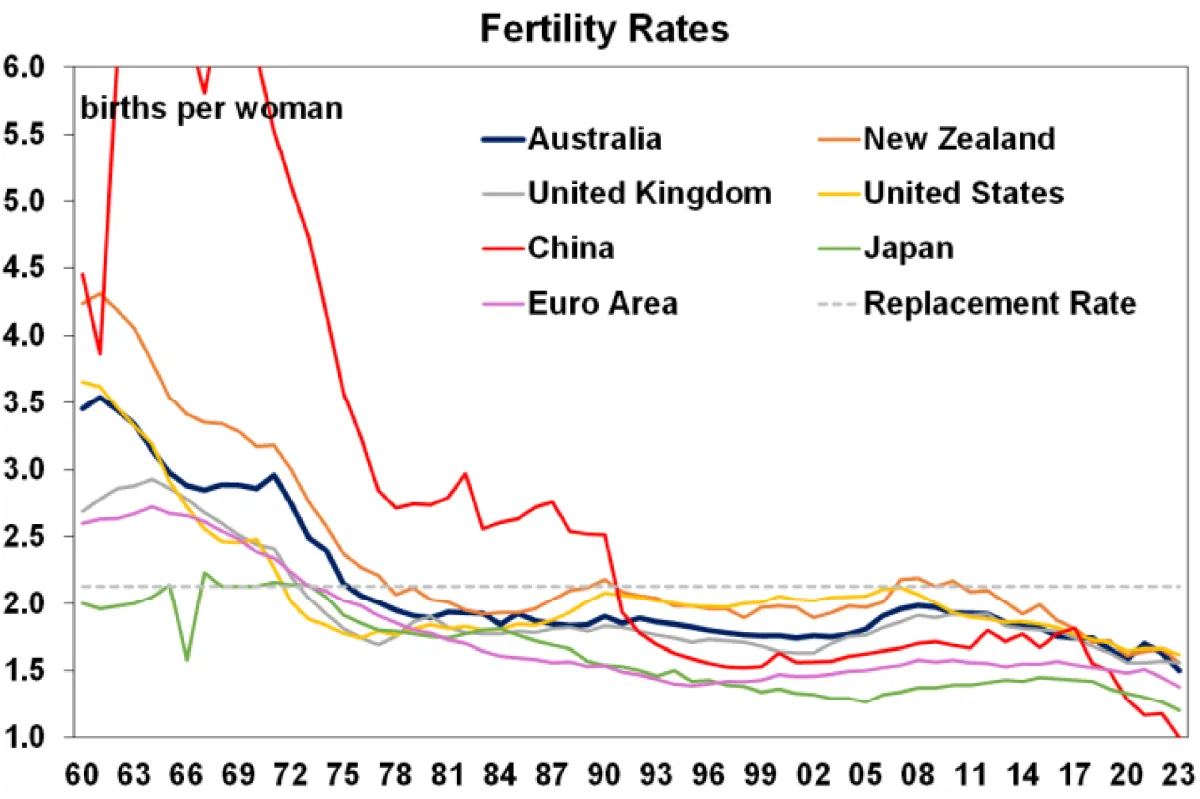
    The demand for housing is determined quite simply by how fast the population grows, which is the combination of natural increase and net migration. Australia’s birth rate has declined to below replacement rate over recent decades (see the chart below), but it is still in line with OECD peers.

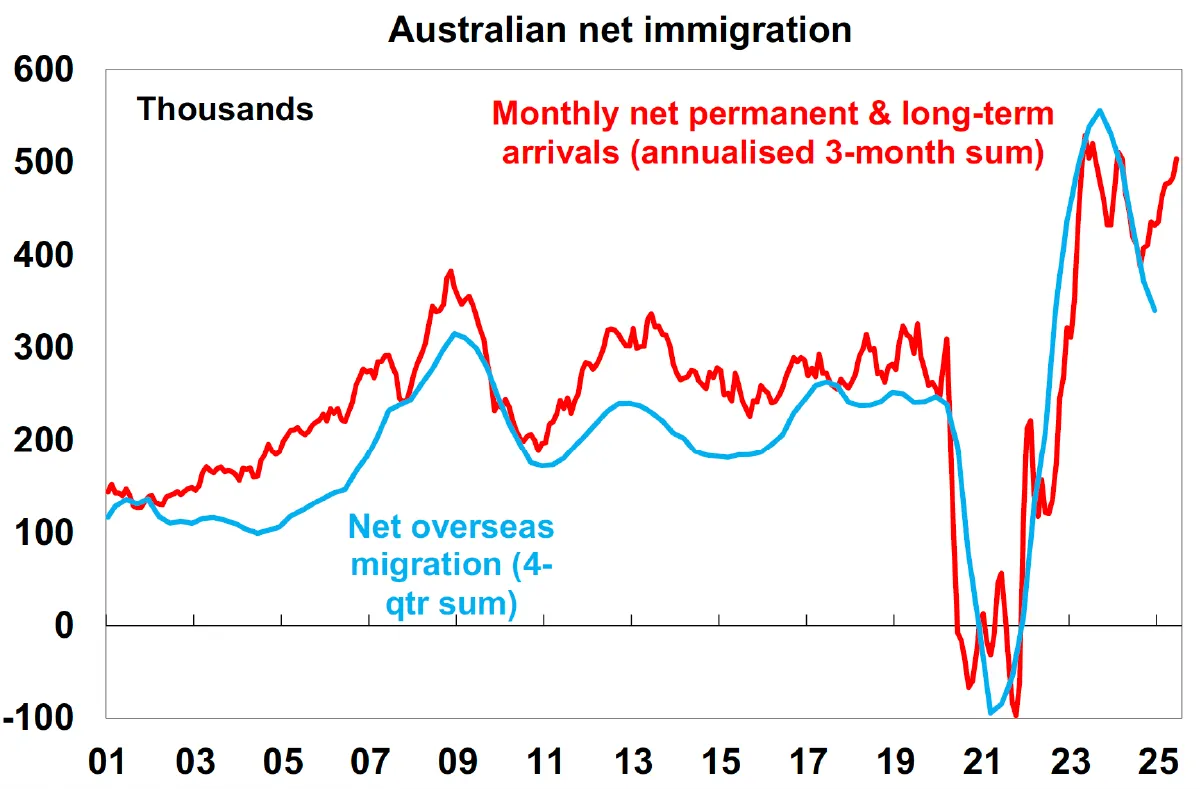
    To offset this low level of natural increase, net migration plays a larger role in bringing in working-age immigrants. Net overseas migration (permanent and long term arrivals minus departures) is accounting for a growing share of Australia’s population increase. Over the 12 months to December, 76% of our population growth (446,000 people or 1.7% over the year) was from net overseas migration, not quite a record high, but near enough!

    Global fertility rates

    Source: World Bank, AMP


    [Australian Population Growth]

    Source: ABS, AMP

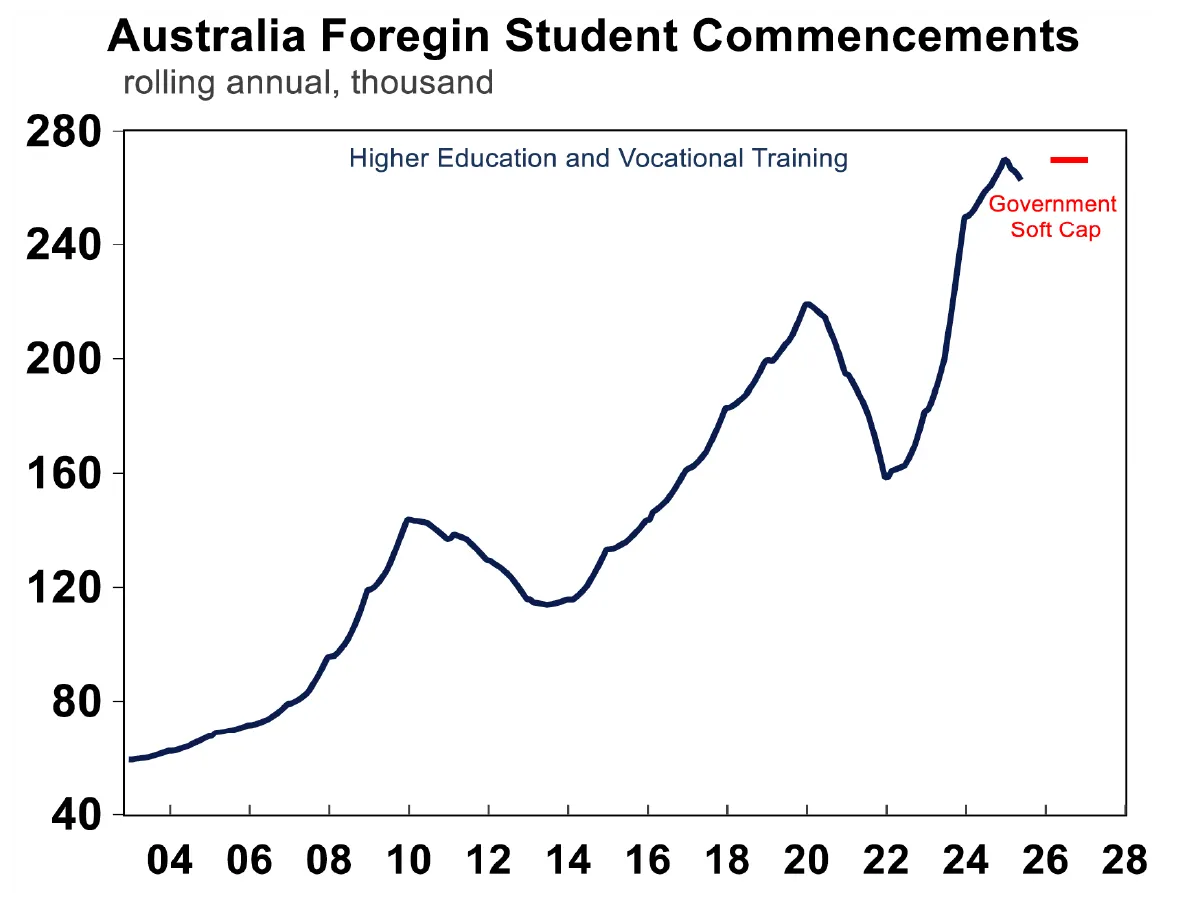
    To respond to concerns about high rents and ever increasing home prices the Labor government in 2024 set a cap of 270,000 student commencements (including higher education and vocational students).

    There was a lot of anger from education providers around this cap (as international students are a big source of income for tertiary education providers and are in the top 5 exports for Australia). That’s despite the fact that the cap still keeps student commencements at all-time highs (see the chart below). In reality it was a “soft cap” because they are not legally enforceable as the Senate rejected the proposal for formal caps, so once an education provider reaches 80% of its target number, student visa applications go into a visa “slow processing lane”. In 2026, the “cap” will be lifted to 295,000.

    On net migration, the Treasury was estimating that net migration would rise by 335,000 in 24-25 and 260,000 in 25-26. These levels are likely to be breached, with current monthly arrival/departure data trending backup again towards 500,000! (see the chart below).


    Australian Foreign Student Commencements

    Source: Macrobond, Department of Education, AMP

    Australian Net Immigration Graph

    Source: ABS, Macquarie Macro Strategy, AMP

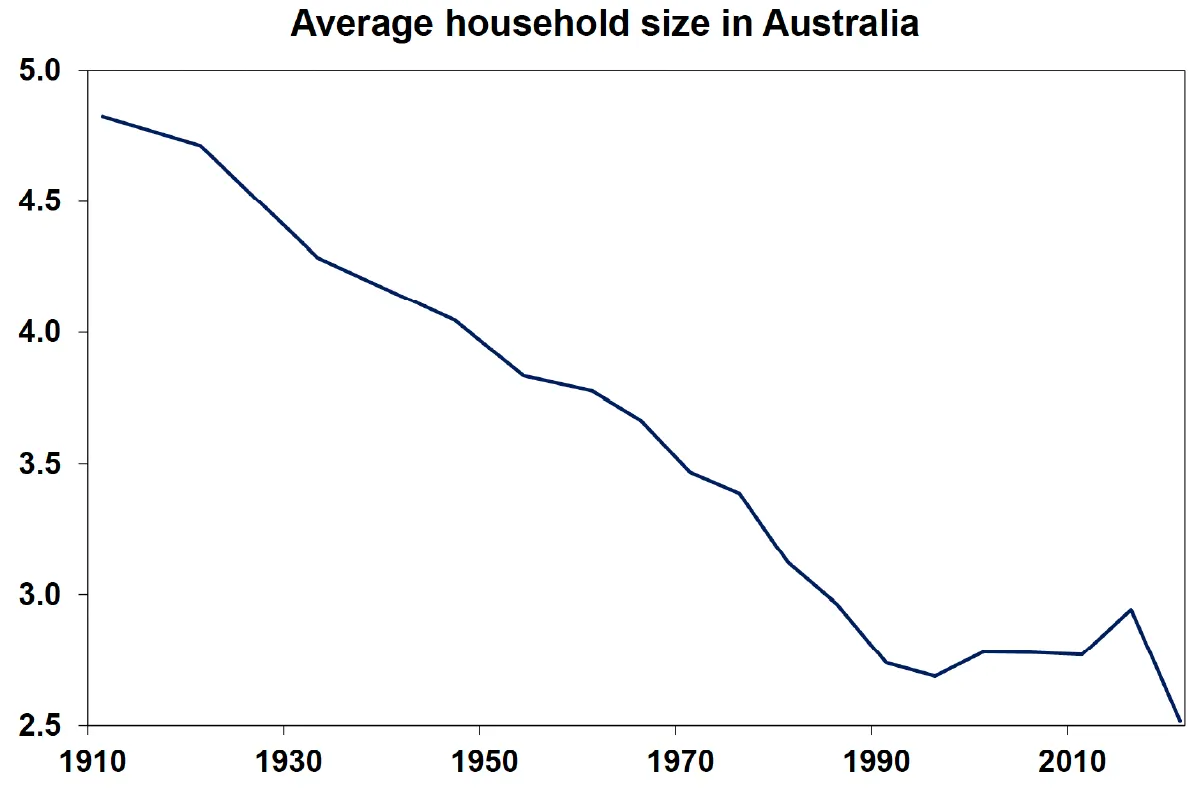
    The size of the average household is also important in demand estimates, and it is guesstimated because of the delay in receiving the numbers from the census. In Australia, the average number of people per household has declined from 2.9 persons in 1983 to a little below 2.5 persons in 2022 and going back even further from 4.8 persons per house in 1911. The number of people per household rose in the initial phase of the pandemic and then started declining in 2021 as individuals opted for more living space. The 2025 ABS Census will provide us with another update on household living space. If the size of the household has fallen by more than our assumption in recent years after the pandemic, then there may be a larger level of dwelling undersupply.

    Average Household Size Australia

    Source: ABS, RBA, AMP

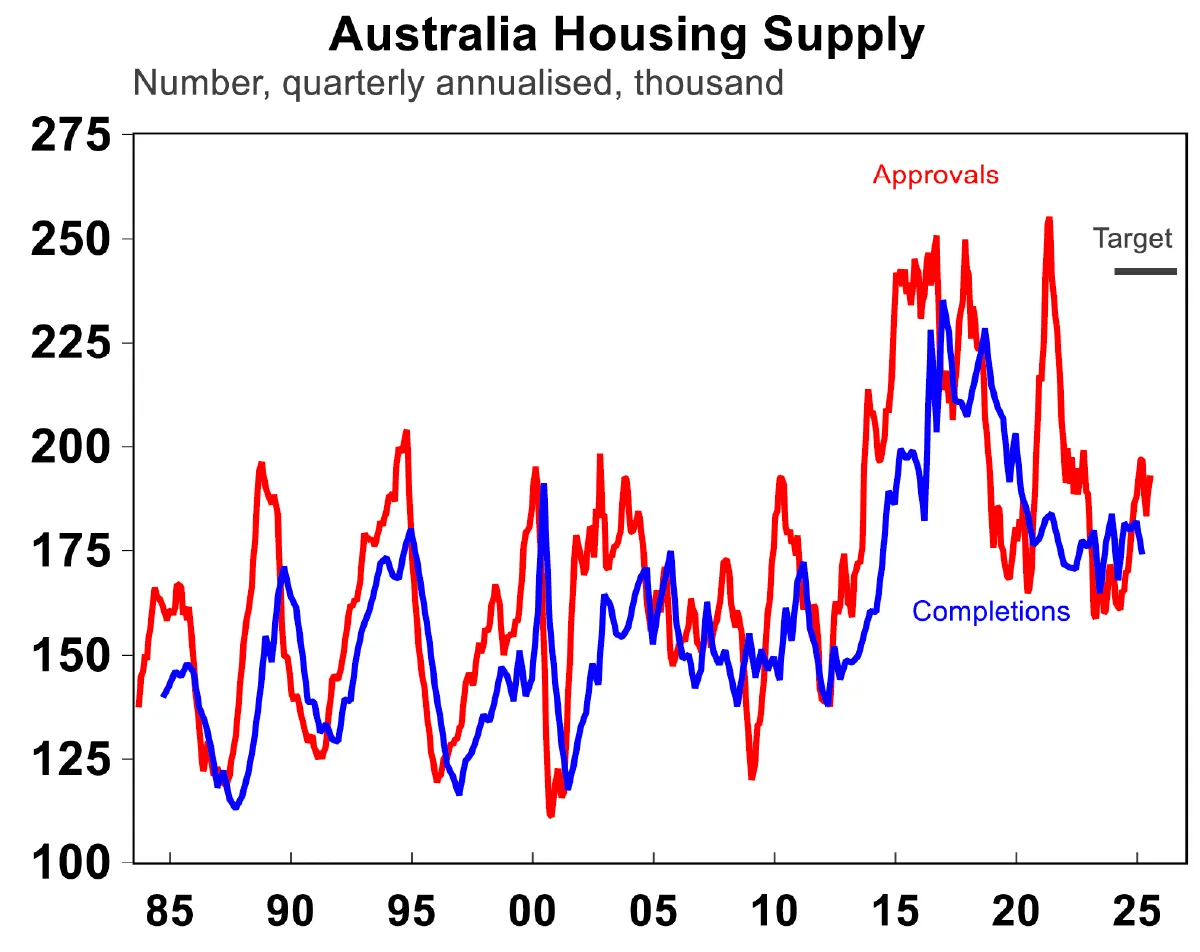
    Australian Housing Supply

    Source: Macrobond, AMP

    The impact of natural increase, net migration and household size means that our estimate is that demand for housing in Australia will average at just under 180,000 for the next few years.

    Housing supply is determined by the completion of homes, after taking into account demolitions, conversions and vacant properties (which do not add to new supply). The June housing completions figures are not out yet, but should be running at over 180K, based on building approval figures.

    While this would be a lift from recent quarter, it is still below the government’s targeted levels, which are closer to 240,000. Supply has been challenged in Australia because of poor productivity growth in construction, development delays, slow land release, too much regulation and labour and material shortages. While it would be good to see supply running at close to 240,000 per year in the next few years, this will be challenging in the current environment. Our forecasts are for housing completions to average at 190,000 per year, which is a lift of around 10,000 from where we saw supply a year ago.

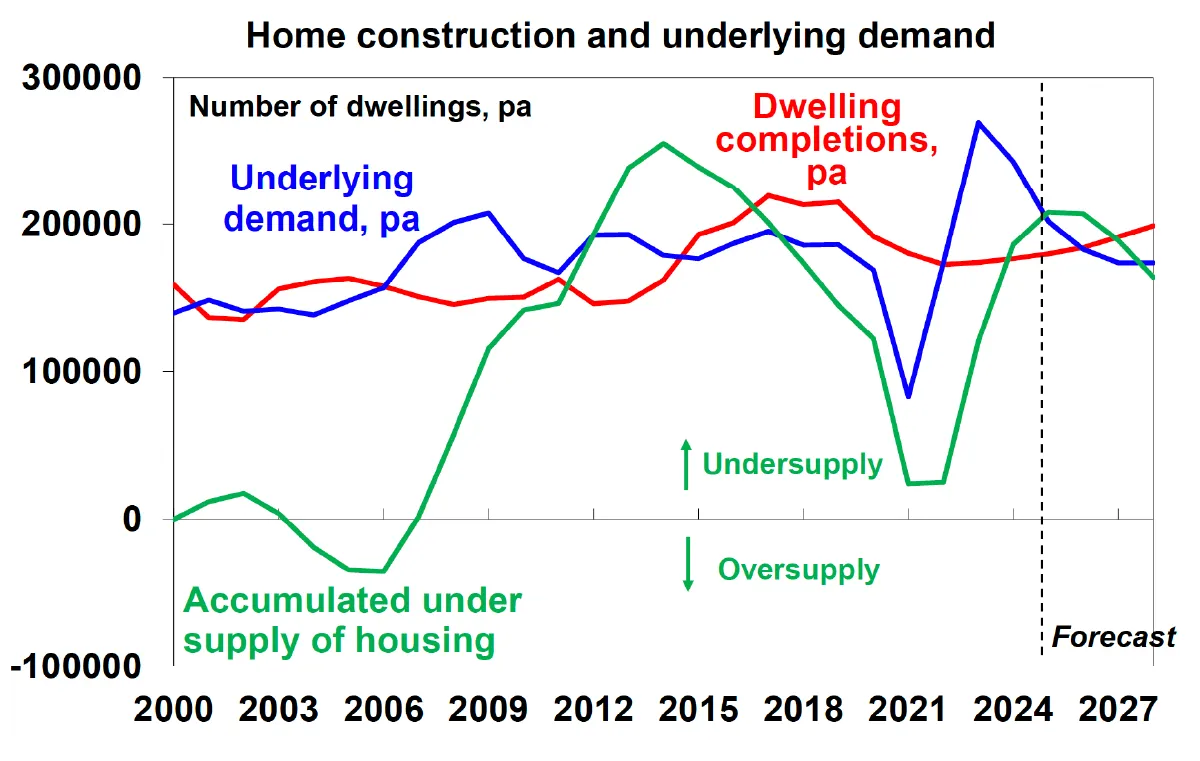
    In Australia, demand for housing started running noticeably above supply from 2006 until 2015. This is when the issue of housing undersupply started. Home price growth was strong over this period, although slowed significantly during the GFC.

    Supply started running above demand from 2015-2022 thanks to significant multi-density construction which helped to alleviate the housing undersupply. However, poor levels of construction in recent years and a catch up in population growth has mean that demand has (again) far outstripped supply, leading to an increase in accumulated housing undersupply. On our estimates, the shortage of dwellings is at least 200,000 (see the chart below).


    Home Construction Underlying Demand

    Source: ABS, AMP

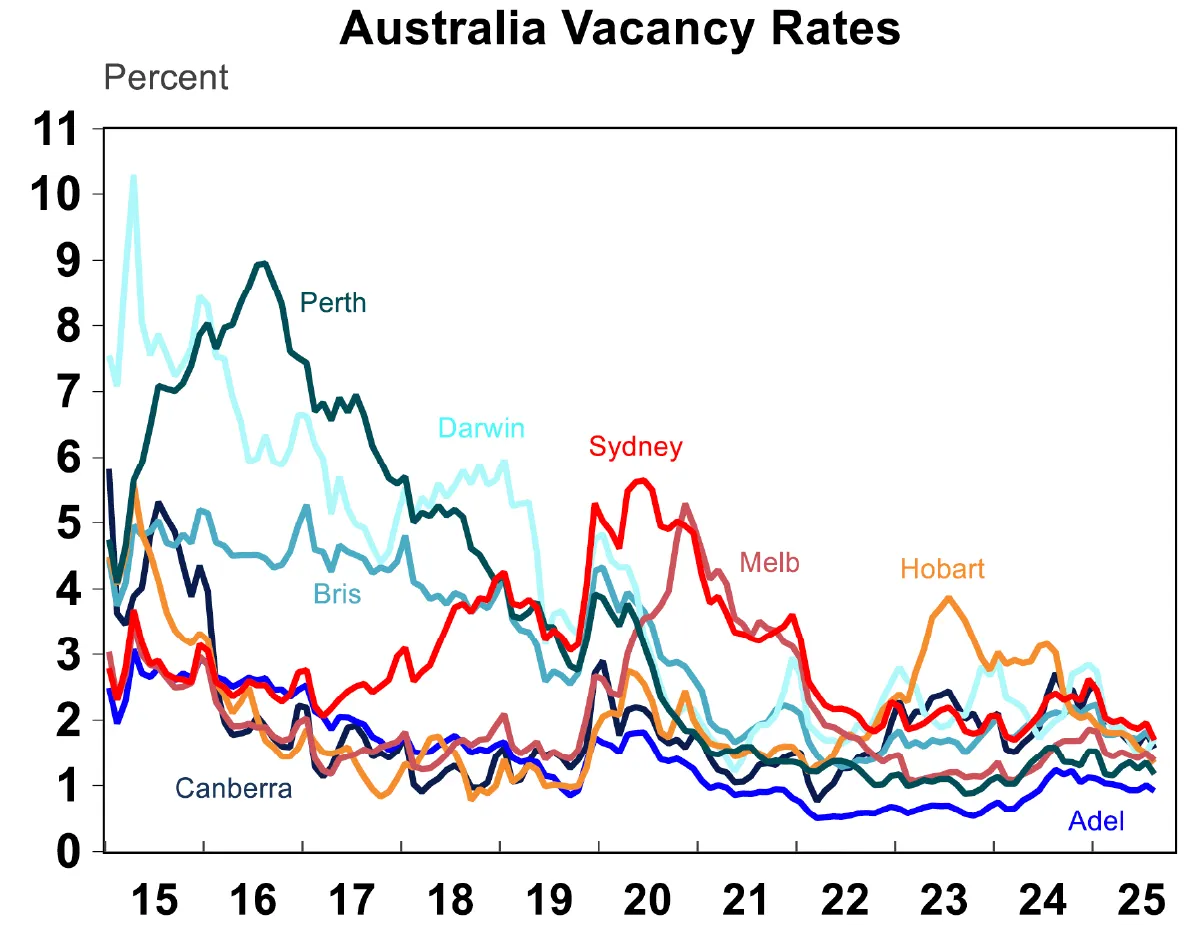
    Australian Vacancy Rates

    Source: Macrobond, Cotality, AMP

    Other indicators of the low supply of homes are in the vacancy rates which are all in a very tight range, at under 2%, a record low for the capital cities.

    Productivity in construction

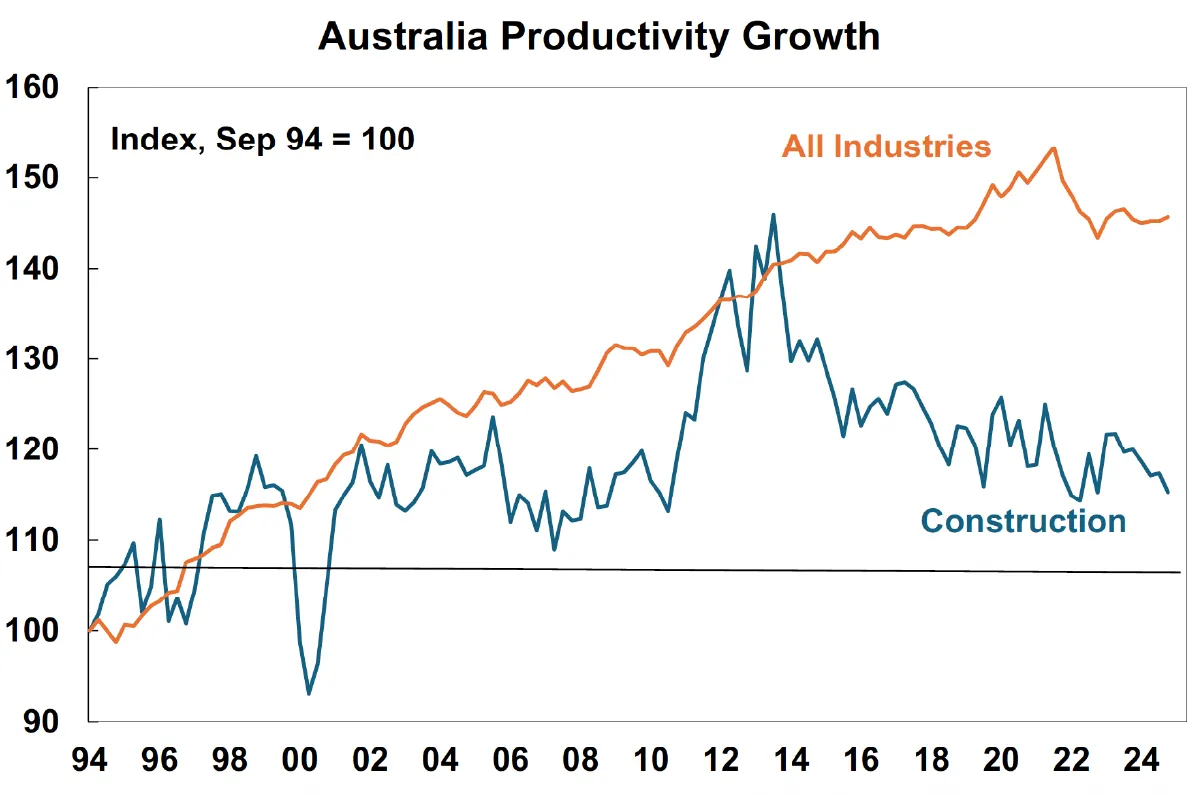
    Productivity has been a hot topic in recent months, partly because of the Treasurer’s Economic Reform Round-table but mostly because of the dismal level of productivity growth in Australia (labour productivity has averaged at 0.3% per year over the last decade)! But productivity in construction has had one of lowest levels of performance across all industries. Labour productivity in construction has grown by just 15% since 1994, compared to the average of 46% – see the chart below.

    Australian Productivity Growth

    Source: ABS, AMP

    The Productivity Commission found that productivity was particularly weak in house and apartment construction. The number of dwellings completed per hour worked for housing construction worked has declined by 53% over the past 30 years. Accounting for quality and size improvements, it is down by 12%. In contrast, total labour productivity has increased by 49% over this period. CEDA and the Productivity Commission have noted numerous factors contributing to this including: the small size of firms (due to tax incentives) leading to a problem with scale and ability to invest and regulatory burden with development, planning and construction rules (CEDA gives the example that a development application for a 3-storey block of apartments in Sydney in 1967 was 12 pages long and these days it would be hundreds if not thousand pages long due to extensive structural, environmental, traffic and heritage assessments.

    Unless productivity improves in construction, Australia will not be able to meet its goals for housing supply. Hopefully we are on the right path to alleviating some of the roadblocks following the productivity round table,
    but it will take time to work its way through the economy. Thegovernment’s decision to freeze the National Construction Code until mid-2029 (excluding essential safety and quality changes) is a good first step. Other measures in the near-term to speed up construction could be to speed up and simplify approvals could be to use AI to fast-track the multi-stage approval process.

    Government initiatives to increase housing supply

    Arguably, the Labor government has paid housing affordability more attention than any other recent government, probably because the issue of housing affordability has now reached an even more critical point with home price growth surging by 19% since the 2023 post-pandemic low. Younger age groups are trending up again as a share of the population, after a downtrend since the 1980’s (see the chart below) and is close to the share of the population aged over 55 now.

    The Federal government has the national housing policy responsibility and the coordination between the states and territories. The state governments are the ones that need to deliver housing and homelessness services. The National Housing Accord signed in 2024 is an agreement to build 1.2million homes over the 5 years from mid-2024 until mid-2029, providing multiple payments state and territory governments to meet supply goals. Additionally, there has been more funding allocated for social and affordable housing in the Budget, build-to-rent housing (housing that is specifically built for those wanting to rent although this is only a few thousand homes a year), expansion in the Help to Buy scheme, where the government takes an equity share for buyers with a small deposit as well as the recently expanded Home Guarantee scheme for First Home Buyers that allows first home buyers to buy a property with only a 5% deposit, avoiding lenders mortgage insurance.

    Although the impacts of the first home buyer scheme are mixed. In the short-term, it may add to demand in the new purchasing market but in the longer-term, it may help to lift supply as demand for dwellings increase.

    Implications for investors

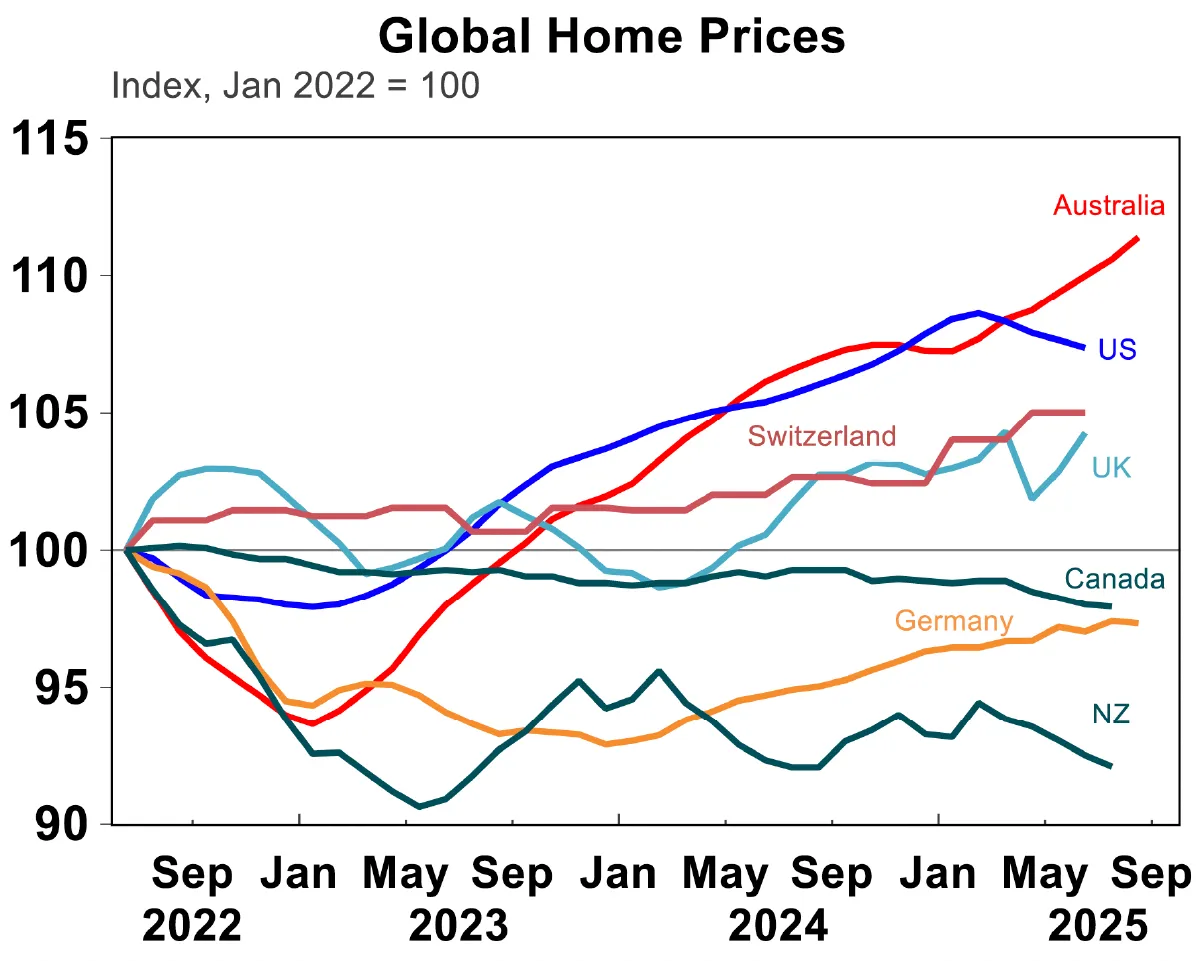
    The problems with Australia’s housing supply continues to put upward pressure on home prices, making Australia’s high home prices even higher and exacerbating affordability problems. Australia’s home price-to-annual wages ratio remains around a record high at nearly 14 times (which means that a median home is worth approximately 14 years of average wages), doubling from ~5 prior to 2000 and above our global peers. In Australia, home prices continued to accelerate in recent years, despite higher interest rates. This is in contrast to neighbouring countries where home price growth has been much slower, or even contracting like Canada, Germany and New Zealand since 2022 and is now turning down in the US.

    Global Home Prices

    Source: Microbond, Bloomberg, AMP

    Home prices are likely to have another strong year of growth as supplyis unable to catch up with demand in the short-term, the RBA continuesto cut interest rates and first home buyer incentives increase demand. We expect national home price growth to be 7% in 2025 and 8-10% growthin 2026. This means that the home price-to-income ratio will continue torise, as home prices outpace incomes.

    Closing Summary

    Economics 101 – “The law of supply and demand” In Sydney housing, there is an undersupply and still an excess of demand. The cost of living and building costs are sadly making it harder for most people to buy a home. Clearly, it’s tougher now than when I bought my first home in 1988 for $300,000. Until supply catches up with demand, prices will continue to rise – especially as interest rates come down.

    But as the economy slows, fewer people will be able to afford to buy. This will be the tipping point. We’re not there yet! So, expect prices to rise again in the medium term until we reach that tipping point.


    Bill Bracey
    CEO & Founder of Sydney Financial Planning


    Is your investment strategy prepared for rising property prices?

    Speak with our Financial Planners about positioning your portfolio for housing market trends, to book a meeting get in contact with us on 02 9328 0876.


    This article was prepared by Dr Shane Oliver with opening and closing summary by William Bracey – CEO & Senior Financial Planner from Sydney Financial Planning. Dr Shane Oliver who provides economic forecasts and analysis of key variables and issues affecting, or likely to affect, all asset markets. He also provides economic forecasts and analysis of key variables and issues affecting, or likely to affect, all asset markets.

    Sydney Financial Planning Pty Ltd (ABN 29 606 413 254), trading as Sydney Financial Planning & Illawarra Financial Planning is an Authorised Representative & Credit Representative of Charter Financial Planning Limited, Australian Financial Services Licensee and Australian Credit Licensee.

    This article contains information that is general in nature. It does not take into account the objectives, financial situation or needs of any particular person. You need to consider your financial situation and needs before making any decisions based on this information. If you decide to purchase or vary a financial product, your financial adviser, and other companies within the AMP Group may receive fees and other benefits. The fees will be a dollar amount and/or a percentage of either the premium you pay or the value of your investments. Please contact us if you want more information. If you no longer wish to receive direct marketing from us you may opt out by contacting Sydney Financial Planning . You may still receive direct marketing from AMP as a product issuer, bringing to your attention products, offerings or other information that may be relevant to you. If you no longer wish to receive this information you may opt out by contacting AMP on 1300 157 173.

    Uncertainty & volatile world markets a review of 2023

    2023 the year in review

    Uncertainty & volatile world markets a review of 2023

  • 2024 is likely more of the same with increasing concern around slowing economic growth and risk of a recession. A new economic cycle maybe on the horizon.
  • Keeping focused on the key principles for successful investing is critical more now than ever and we thought it timely to remind you of this.
  • Yearly wrap up

    With the year coming to a close, we thought it timely to write to you summarising 2023 and looking forward to what could be on the horizon for 2024.

    At the same time last year, we wrote and forewarned that financial markets would be especially volatile over the next 12 months. This turned out to be spot on, contributed to by several influences – War in Europe, a worldwide problem of inflation resulting in higher interest rates for longer than anyone thought, resulting in slowing economic growth worldwide. With all of this extreme volatility, we understand that it can be difficult to hold our nerve and continue to take a long-term approach. We acknowledge and appreciate your steadfast commitment to staying the course.

    Looking forward to 2024, and for the same reasons as 2023, we see continued high levels of volatility in share markets. However, once higher interest rates take full effect and significantly slow the economy further, we expect the Reserve Bank will be forced to reduce interest rates, starting a new economic cycle. This should stimulate investment markets, however, this next economic cycle could be a little while off yet.

    All of this uncertainty makes it hard for investors to stay focused and avoid silly mistakes. Uncertainty is magnified by perennial predictions of a crash and then periodically by talk of the next best thing that’s going to make us rich.

    Keys to successful investing

    It would be nice if the investment world was neat and predictable, but it’s well known for sucking investors in during good times and spitting them out during bad times. If anything, it’s getting harder reflecting a surge in the flow of information and opinion. This has been magnified by social media where everyone is vying for attention and the best way to get this is via headlines of impending crises. This all adds to investor uncertainty and erratic investment decisions.

    With all this in mind, we thought it timely to remind our clients of the key investment principles to follow in order to continue to be successful and help weather through this period of high uncertainty.

    The nine key things are: make the most of compound interest; don’t get thrown off by the cycle; invest for the long term; diversify; turn down the noise; buy low and sell high; beware of the crowd; focus on investments offering a sustainable cash flow; and objective leadership via your annual progress meeting.

    1. Make the most of the power of compound interest

    Making the most of compound interest – which refers to the way returns compound on past returns for an investor over long periods – is the most important thing an investor needs to do if they want to build wealth. It works best for growth assets. The next chart shows the value of one dollar invested in 1900 in Australian cash, bonds and equities with interest and dividends reinvested along the way, before fees and taxes.

    That one dollar would be worth $253 today if it had been invested in cash. But if it had been invested in bonds it would be worth $879 and if it was allocated to shares it would be worth $752,213. Although the average return on shares (11.6% pa) is just double that on bonds (5.9% pa), the magic of compounding higher returns leads to a substantially higher balance. The same applies to other growth assets like property.

    So, the best way to build wealth is to take advantage of the power of compound interest and have a decent exposure to growth assets. Of course, there is no free lunch and the price for higher returns is higher volatility but the impact of compounding returns from growth assets is huge over long periods.
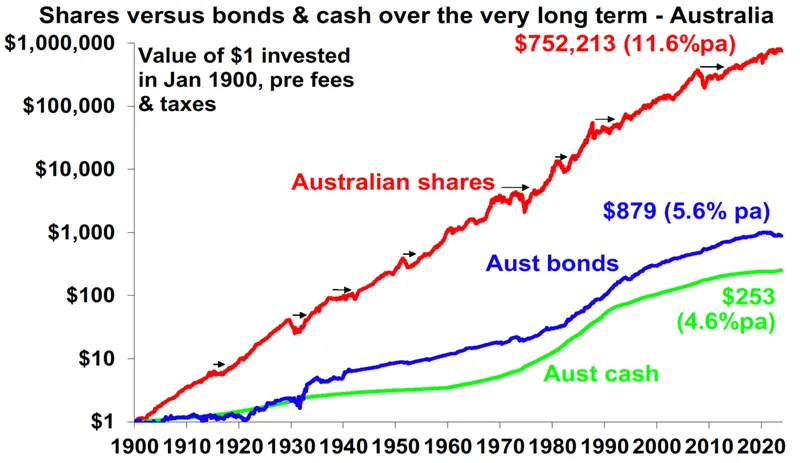
    Shares vs bonds and cash over the very long term - Australia

    Source: ASX, Bloomberg, RBA, AMP

    The volatility set off by the pandemic and now flowing from high inflation and interest rate increases does nothing to change this, any more than previous setbacks (highlighted with arrows) like WW1, the Great Depression, the 1973-74 bear market, the 1987 crash or the GFC did. The likely end of the secular decline in inflation and interest rates over the last few decades which super charged investment returns means average returns over the next decade or so will be somewhat more constrained than we have become used to. But shares offering a dividend yield of 4% (5% or more with franking credits) should still provide superior medium-term returns and hence grow wealth better than bonds where the 10-year yield is 4.50% pa. Unfortunately making the most of the magic of compounding returns can be one of the hardest things to do.


    2. Don’t get thrown off by the cycle

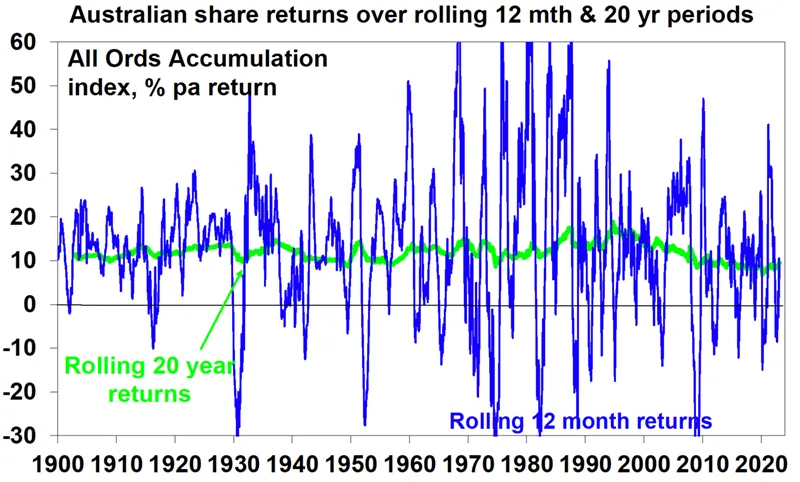
    This is often because investment markets go through cyclical swings. All eventually set up their own reversal – eg, as falls make shares cheap and low interest rates help them rebound. But the outcome is extreme volatility in short-term returns as evident in the next chart which shows the pattern of rolling 12 month ended returns in Australian shares (compared to rolling 20 year ended returns).
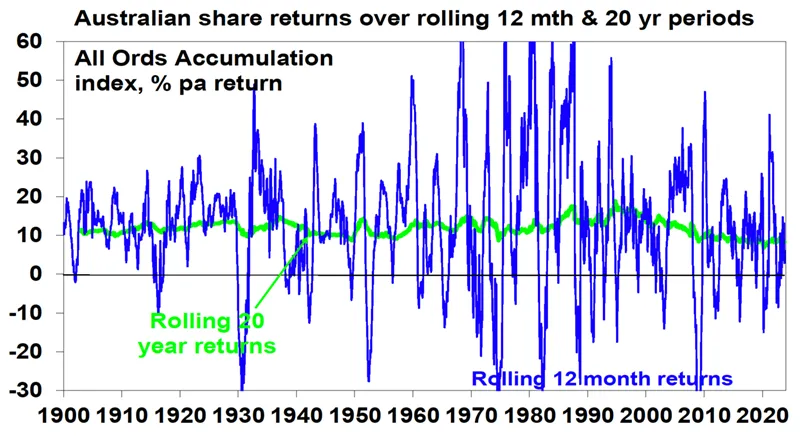
    Australian share return over rolling 12 mth & 20 yr periods

    Source: ASX, Bloomberg, RBA, AMP

    The trouble is that cycles can throw investors off a well thought out investment strategy that aims to take advantage of the power of compounding longer-term returns. But cycles also create opportunities. Looked at in a long term context, the 20%
    or so plunge in share seen into October last year was just another cyclical swing, after which markets rebounded.

    The key is not to get thrown off when markets plunge.

    3. Invest for the long term

    Looking back, it always looks obvious as to why things happened and dips in investment markets look like great buying opportunities. But looking forward the future is shrouded in uncertainty. And no-one has a perfect crystal ball. As JK Galbraith observed “there are two kinds of forecasters: those who don’t know, and those who don’t know they don’t know.” Usually the grander the forecast the greater the need for scepticism as such calls invariably get the timing wrong or are dead wrong. If getting markets right were easy, then the prognosticators would be mega rich and would have stopped doing it. Related to this many get it wrong by letting blind faith – eg, “there is too much debt” – get in the way of good decisions. They may be right one day, but an investor can lose a lot in the interim. The problem is that it’s not getting easier as the world is getting noisier. This has all been evident through the pandemic and its high inflation aftermath with all sorts of forecasts as to where markets would go, most of which provided little help in actually getting the big swings right. Given the difficulty in getting market moves right in the short-term, for most it’s best to get a long-term plan that suits your level of wealth, age, tolerance of volatility, and stick to it. Focus on the green 20-year return line in the previous chart rather than short term swings.

    4. Diversify

    Don’t put all your eggs in one basket. Having a well-diversified portfolio will provide a much smoother ride. For example, global and Australian shares provide similar returns over the very long term but go through long periods of relative out and underperformance (eg, Australian shares outperformed in the mining boom years but global shares have outperformed since). Similarly listed assets (like shares) and unlisted assets (like property) often perform differently through the cycle. The key is to have a mix of investments.

    5. Turn down the noise

    After having worked out a strategy that’s right for you, it’s important to turn down the noise on the information flow and prognosticating babble and stay focussed. The trouble is that the digital world is driving an explosion in information and opinions about economies and investments. But much of this information and opinion is of poor quality.

    As “bad news sells” there has always been pressure to put the negative news on the front page of newspapers but there was hopefully some balance in the rest of the paper. In a digital world each story can be tracked via clicks so the pressure to run with sensationalised and often bad news headlines is magnified. This has gone into hyperdrive since the pandemic – with a massively stepped up flow of economic information. This may be of use in providing timely information on how the economy is travelling but it’s also added immensely to the flow of information and often it’s contradictory. The heightened uncertainty is leading to shorter investment horizons which in turn can add to the risk that you could be thrown off well thought out investment strategies.

    The key is to turn down the volume on all this noise. This also means keeping your investment strategy relatively simple. So don’t waste too much time on individual shares or funds as it’s your high-level asset allocation that will mainly drive the return and volatility you will get.
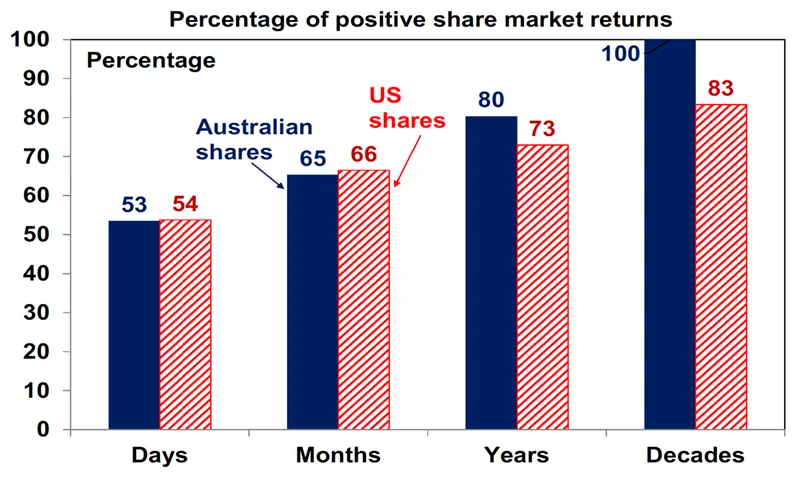
    Percentage of positive share market returns

    Source: Bloomberg, AMP

    Here are several tips to help turn down the noise:

    • Put the worries in context – there have been plenty of worries over the last century and yet long-term investment returns have been fine.
    • Recognise it’s normal for markets to swing around in the short term.
    • Focus on only a few reliable news services and turn off all “notifications” on your smart device.
    • Don’t check your investments so regularly – on a day-to-day basis it’s a coin toss as to whether the share market will rise or fall but the longer you stretch it out between looking at your investments the more likely you will get positive news. See the chart – Percentage of positive share market returns.

    6. Buy low, sell high

    The cheaper you buy an asset (or the higher its yield), the higher its prospective return will likely be and vice versa, all other things being equal. So as far as possible it makes sense to buy when markets are down and sell when they are up. Unfortunately, many do the opposite, ie, selling after a collapse and buying after a big rally…which just has the effect of destroying wealth even though it might feel good at the time in the midst of a panic (or euphoria). Again, turn down the noise!

    7. Beware the crowd at extremes

    It often feels safe to be in a crowd and at times the investment crowd can be right. However, at extremes the crowd is invariably wrong – whether it’s at market highs like in the late 1990s tech boom or market lows like in March. The problem with crowds is that eventually everyone who wants to buy in a boom (or sell in a bust) will do so and then the only way is down (or up after crowd panics). As Warren Buffet has said the key is to “be fearful when others are greedy and greedy when others are fearful”.

    8. Focus on investments with sustainable cash flow

    If it looks dodgy, hard to understand or has to be based on obscure valuation measures then it’s best to stay away. Most cryptocurrency “investments” are a classic example of this. If an investment looks too good to be true it probably is.

    By contrast, assets that generate sustainable cash flows (profits, rents, interest) and don’t rely on excessive gearing or financial engineering are more likely to deliver.

    9. Annual progress meeting

    We are all susceptible to psychological traps like the tendency to over-react to current investment market conditions, or to pay more attention to information and opinion that confirms our own views. The increasing complexity of investing makes avoiding these traps anything but easy. We passionately believe the ongoing yearly progress meeting led by an objective 3rd party council is the key to ensuring our clients stay focused and clear on their unique personal goals and strategies. This meeting and service is absolutely critical to ensuring we can continue to build and protect our clients wealth.

    Looking ahead to 2024

    In closing, we appreciate your unwavering commitment to your personal plan throughout 2023. Whilst we expect more volatility and uncertainty in 2024 we encourage you to keep these timeless investment principles in mind and we look forward to continued success and meeting with you at your next annual progress meeting.

    Merry Christmas and best wishes for 2024

    Bill Bracey and the team at Sydney Financial Planning


    Is your long-term investment strategy ready to weather the expected volatility?

    Speak with one of our Financial Planners about the best approach for your circumstances, either book a meeting or get in contact with us on 02 9328 0876.


    This article was prepared by Dr Shane Oliver with opening and closing summary by William Bracey – CEO & Senior Financial Planner from Sydney Financial Planning. Dr Shane Oliver who provides economic forecasts and analysis of key variables and issues affecting, or likely to affect, all asset markets. He also provides economic forecasts and analysis of key variables and issues affecting, or likely to affect, all asset markets.

    Sydney Financial Planning Pty Ltd (ABN 29 606 413 254), trading as Sydney Financial Planning & Illawarra Financial Planning is an Authorised Representative & Credit Representative of Charter Financial Planning Limited, Australian Financial Services Licensee and Australian Credit Licensee.

    This article contains information that is general in nature. It does not take into account the objectives, financial situation or needs of any particular person. You need to consider your financial situation and needs before making any decisions based on this information. If you decide to purchase or vary a financial product, your financial adviser, and other companies within the AMP Group may receive fees and other benefits. The fees will be a dollar amount and/or a percentage of either the premium you pay or the value of your investments. Please contact us if you want more information.
    If you no longer wish to receive direct marketing from us you may opt out by contacting Sydney Financial Planning . You may still receive direct marketing from AMP as a product issuer, bringing to your attention products, offerings or other information that may be relevant to you. If you no longer wish to receive this information you may opt out by contacting AMP on 1300 157 173.


    Recession & volatile world markets

    Volatile world markets

    Recession & volatile world markets

    You are not alone! Last year I forewarned the continuing volatility of the financial markets and Australian housing market. Currently, the average house prices fall is approximately 10%. We still feel that some suburbs may fall a little further, though there seems to be some leveling off overall. The concern is that as some people come out of a 2-year fixed term mortgage at 2% and go to a new variable rate of above 5%, the increase may be unaffordable and force them to sell. Time will tell.

    The Australian and worlds stock market prices are showing signs of recovery after a wild ride caused by the increased interest rates, inflation, supply shortages and uncertainty thanks to Mr Putin.
    Most leading economists now see the world slowing due to high interest rates and believe we will enter a period of recession worldwide. Yes, the R word! Australia may see a softer landing but still never nice, Europe a hard landing, and the USA a moderate recession. How will all these events affect my portfolio that is managed by Sydney Financial Planning?

    Well, as we go into a recession the worlds governments will need to stimulate the economy. In Australia like in other countries, they will begin to lower interest rates probably later this year or early next year. We will enter this next economic cycle and as interest rates fall it will stimulate growth assets. Typically, shares first, followed in time by property, but this may take some time to turn.

    From a historical point, a similar cycle occurred in 1973-74 due the OPEC oil crisis, where the price of oil doubled. The share markets and property both fell heavily, then when the oil price came down, the interest rates went down quickly as the world went into recession and the Australian share market went up over 60 % in one year.

    I’m not suggesting a huge share price uplift next year, but many past economic cycles have shown us this trend is what typically happens next.


    Source: Bloomberg, AMP Capital

    Here we are again, finding ourselves having to navigate through volatility for reasons out of everyone’s control. However, there are variables we can control – these include having a plan and regular guidance helping us stick to it, and investing only in quality assets, managed by quality fund managers. That is something we can choose to do, that is also something that stands the test of time. Remember only the patient will get rewarded.

    In summary, still expect volatility (that never goes away and it’s completely normal and organic), interest rates will start to go down again and when they do enjoy the upward cycle. In the meantime, take advantage of this uncertainty as it provides rare buying opportunities at lower prices, helping you build wealth and securing your future.

    Please feel free to call your financial planner or our mortgage broker from SFP Home Finance and we can review your situation and advise you for your future.

    Bill Bracey
    Founder & Managing Director


    Not sure how to take advantage of this volatile market and rare opportunity?

    Speak with one of our Financial Planners about the best approach for your circumstances, either book a meeting or get in contact with us on 02 9328 0876.


    General Disclaimer: This article contains information that is general in nature. It does not take into account the objectives, financial situation or needs of any particular person. You need to consider your financial situation and needs before making any decisions based on this information. Please seek personal financial advice prior to acting on this information.

    How life insurance can help when buying a home

    How life insurance can help when buying a home

    How life insurance can help when buying a home

    In the lead up to buying your first home there are many factors to take into consideration. Not only do you need to work out where you want to live and what you would like to buy but what you are able to afford. Many people will meet with a mortgage broker or bank to determine their financial position and borrowing capacity. At this point in time it is also important to consider the protections you have in place to cover the potential mortgage if you were unable to make the repayments.

    Do I need life insurance to buy a house?

    As with everything in life, it depends on your personal and family circumstances. Although it is not required when buying a house, life insurance often plays an extremely important role when it comes to securing your family’s future.

    Regardless of whether you’re purchasing your first home, buying a new home to accommodate your growing family, purchasing an investment property or holiday home, or even downsizing as you approach retirement, buying property is a significant financial responsibility, which for most will be an ongoing mortgage commitment.

    Life insurance can provide peace of mind that you have financial assistance to help cover your mortgage and the financial responsibilities that come with owning a home, whatever may happen.

    Should I buy life insurance before moving into my home?

    Searching for and buying a new home is a busy and emotionally-charged time.

    With so much going on it can be tempting to delay purchasing life insurance until after you’re set up in your new home or have finalised arrangements around your new investment property.

    But just because you’re not living in your new home or are yet to move tenants in, it doesn’t mean you’re not financially responsible for it and should consider how to ensure you’re financially protected.

    If you already have life insurance in place, it is important to review your policy and ensure that it provides you with enough cover if your debt has increased. When reviewing your cover, it is worth looking at the level of cover you have in place, the waiting period, the benefit period and what you are covered for.

    What is the difference between lenders’ mortgage insurance and life insurance?

    You might have heard of the term lenders’ mortgage insurance (LMI) before and wondered how it differs from life insurance. The main difference is that LMI protects the lender, whereas life insurance protects the individual who holds the policy.

    As it stands, generally most people need to have at least 20% of the purchase price as a deposit to avoid paying LMI when taking out a loan.”

    For example, if you have less than a 20% deposit (or haven’t been accepted for the federal government’s First Home Loan Deposit Scheme), you may have to pay between $2,500 and $10,000 in LMI.

    While you are responsible for paying for LMI, it’s designed to protect the lender, not you and your family.

    Therefore, if you default on your loan and the sale of your property doesn’t equal the unpaid value of the mortgage, lenders can generally claim on the LMI policy to make up the shortfall.

    This is vastly different from life insurance. With Life Insurance you can receive a lump sum payment which could help your family pay off the mortgage and other necessities if you were to pass away. And when coupled with other insurance products, you can help protect against accidents or illnesses that might result in you falling behind on your mortgage payments or other financial commitments. Therefore, reducing the chances of you defaulting on your payments and allowing you to keep your property.

    What types of life insurance should I consider when buying a home?

    There are four main types of life insurance that people buying a home generally consider, including:

    Income Protection Insurance: Provides you with monthly payments of up to 75% of your monthly income to help you to continue living your life, which you may choose to put towards covering part or all of your mortgage repayments depending on your circumstances.

    Life Insurance: Protects your family’s future and gives them options if you are no longer around with a lump sum payment which could be used to cover the ongoing costs and commitments that come with owning a home.
    Total Permanent Disability Insurance: Gives you options to help you live a better quality of life if you are permanently disabled and can’t work. This can help ensure a disability doesn’t prevent you from covering the expenses relating to your home. It can also allow you to use this lump sum payment to make modifications to your home if this was required from your illness or injury.

    Recovery Insurance: If you claim on recovery insurance, it provides you with a lump sum payment. This allows you to focus on your recovery and rehabilitation, rather than financial pressures, such as paying for your mortgage.
    If you’d like to explore some options to help meet your financial goals or review your current financial measures that in place, reach out and get in contact with us.

    Any advice is general in nature only and has been prepared without considering your needs, objectives or financial situation. Before acting on it you should consider its appropriateness for you, having regard to those factors.”


    Need some help exploring your options?

    Our experienced planners can review your individual sitation, get in touch, either book an appointment or contact us on 02 9328 0876.


    General Disclaimer: This article contains information that is general in nature. It does not take into account the objectives, financial situation or needs of any particular person. You need to consider your financial situation and needs before making any decisions based on this information. Please seek personal financial advice prior to acting on this information.


    Photo by Kelli McClintock on Unsplash

    The recession and your home loan

    The recession and your home loan

    The recession and your home loan

    We are seeing a crisis that seems to be affecting all of us and the possibility of a recession has turned into a reality, but we have yet to see how much this recession is going to be affecting other aspects of our economy. Home loans are probably the biggest concern for many, and it makes sense that people want to protect their investment. With that said, here are some relevant and very useful moves that you can implement in order to help recession-proof your home loan.

    Maximise emergency funds

    There has never been a more crucial time for everyone to make an extra effort to save as much money as possible. Having six months’ worth of your salary in your emergency fund is a can be a great milestone and acts as your first line of defence when the chips are down.

    Times are very unpredictable right now and we all need to make sure that a portion of our monthly earnings is going into our savings fund where possible.
    This is probably the most essential tip that we can give to anyone right now. It’s a universal strategy that works for everyone regardless of their professional and their financial status.

    Mortgage redraw and offset

    As you may have seen in the news, certain lenders are now taking the additional repayments you’ve made out of redraw so they’re no longer accessible. These banks and lenders are inside their rights to do so but if you have that money set aside for emergencies it might be worth looking at an offset account.

    An offset account sits beside your home loan and any money in the account offsets the interest on your loan. This is essential how redraw facility works but the difference is, bank and lenders don’t have access to remove money from the offset account.

    Life insurance review

    Be warned that insurances polices such as Income Protection do not cover you in case you lose your job or your business goes under.

    Reviewing your current life insurance cover, insurance needs and premium costs to ensure they’re right for your individual needs. COVID-19 has shed new light on the need to be adequately covered but it’s also prudent to ensure you’re not over insured as the premium costs could be used towards building your emergency funds.

    Final thoughts

    These are times of uncertainty and we don’t know what could happen tomorrow in terms of our financial stability. The most important thing that we can all do is to ensure that we are covering all aspects of our finances to withstand this crisis with optimal results.

    Keep in mind that factors such as the COVID-19 pandemic are temporary, but the rippling effect of a bad financial situation could be felt for years to come. That’s why, in times like these, it’s crucial you pay extra attention to your financial situation and avoid any unpleasant surprises without being prepared.

    If you’d like to look at recession proofing your financial position, please feel free to contact us to see how we can help.

    Stay safe!


    Did you know about SFP’s Finance service?

    Why not arrange to meet with our expert Leigh Morris our Senior Credit Advisor to review your situation. Make a booking or call us on 02 9328 0876 to arrange a meeting.


    Article by Leigh Morris | Senior Credit Adviser & Director


    General Disclaimer: This article contains information that is general in nature. It does not take into account the objectives, financial situation or needs of any particular person. You need to consider your financial situation and needs before making any decisions based on this information. Please seek personal financial advice prior to acting on this information.

    Photo by Emre Can @ Pexel

    Investment Properties 2020

    Sydney rental yields at new low

    Investment Properties 2020

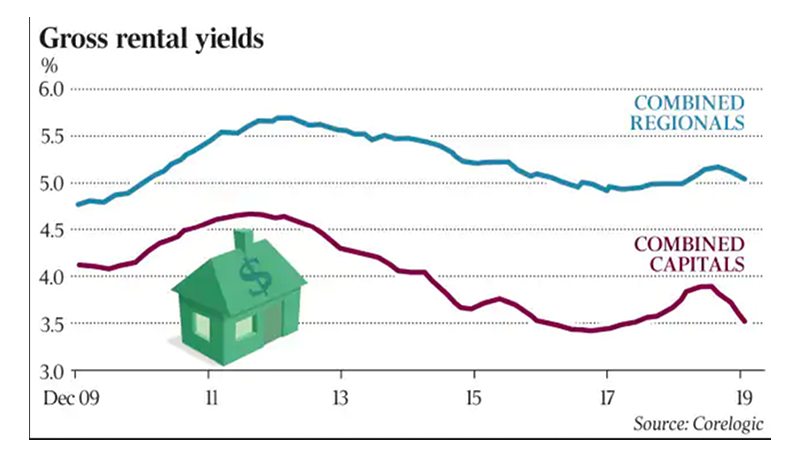
    Sydney rents dropped over December, forcing yields down to a record low of 3 per cent, according to property researcher CoreLogic. Melbourne rents managed growth of 1.4 per cent but this did not stop yields falling to 3.3 per cent, while looking likely to hit 2017 lows of 3.1 per cent this year.

    Nationally rents grew 1.2 per cent on an annualised basis, but the increase in property prices saw yields fall 0.2 per cent to 3.8 per cent through 2019.

    CoreLogic’s head of research, Tim Lawless, said investors needed to be strategic going forward.

    “It all depends on your investment philosophy,” he said. “Inherent scarcity and demand in blue-chip suburbs offer good capital gains but lower yield profiles.”

    Financial planner William Bracey told The Australian, investors needed to moderate their expectations around returns from residential property.

    gross rental yeilds 2020

    He said continually growing house prices and increased supply in the marketplace had made the 5 per cent yields that were taken for granted in the 1980s and 1990s now unattainable.

    “It’s not just prices going up, but there is also a lot more stock on the market,” Mr Bracey said.

    “Without a shortage, people now have choices. Therefore, it’s a pressure on yields because people aren’t going to pay as high rents.”

    Mr Bracey suggested alternative investment options.

    “People are always chasing yield but it’s just not there, certainly not in residential,” he said. “But interestingly enough, commercial real estate is still holding up okay.

    “Generally speaking, commercial property prices have held and the yields have held reasonably well. For argument’s sake, in a well diversified commercial property fund, you may be getting 5 per cent or 6 per cent yield.”

    Outside of the major cities, the tight rental market of Hobart was one of the strongest in the country, with investors benefiting from relatively affordable property and strong housing demand. Rents grew 6 per cent over the year, while yields rose to 5.1 per cent.

    Darwin and Perth also grew to offer returns of 5.9 per cent and 4.3 per cent respectively. Adelaide (4.4 per cent) and Brisbane (4.5 per cent) yields held through 2019.

    Independent economist Andrew Wilson said that while investors had been generally sluggish to get back into the market with tight lending acting as a barrier to entry, the fertile economic environment still made residential property a sound investment.

    “We have a low yield economy at the moment and I think more investors generally will be looking at property given the potential for capital growth and what remains still a tax positive environment, in terms of those tax policies including negative gearing, tax depreciation to discounts on capital gains. You would expect to see more invested in the market,” Mr Wilson said.


    Still have some questions?

    If you want to discuss your property portfolio or investment property with one of our planners. Call us to arrange an appointment on 02 9328 0876.


    Article by Mackenzie Scott | The Australian

    Copyright The Australian – First Published in the Australian 03 January 2020 – https://www.theaustralian.com.au/business/property/sydney-rental-yields-at-new-low/news-story

    Mackenzie Scott is a property and general news reporter based in Brisbane. Prior to joining The Australian in 2018, she was the editorial coordinator at NewsMediaWorks, covering media and publishing, and editor at travel and lifestyle website Xplore Sydney.

    General Disclaimer: This article contains information that is general in nature. It does not take into account the objectives, financial situation or needs of any particular person. You need to consider your financial situation and needs before making any decisions based on this information. Please seek personal financial advice prior to acting on this information.

    Record Low Interest rates

    Making the most of record-low interest rates

    Record Low Interest rates

    However, the low cash rate also means your money in the bank could be earning less interest.

    Why did the RBA cut rates?

    Rate cuts are a way for the RBA to help stimulate the economy. The idea is, when the RBA lowers the official cash rate, banks may follow suit and lower interest rates on the loans they provide. When rates are lower, you pay less interest on your debt, freeing up money for you to spend elsewhere. You may also be more likely to borrow more money. This increased spending has a ripple effect through the economy, giving it a boost.

    The RBA’s recent rate cut was due to concerns about the way the economy has been slowing down. In Australia, the downturn in the housing market as well as the drought have both played a role in the slowdown. Globally, fears about the US trade wars has led investors around the world to be more cautious.

    It’s important to note that when the RBA cuts the official rate, there’s no guarantee that the banks will do the same. For example, in recent times, some banks have only passed on part of the rate cut.

    Will interest rates stay low?

    Head of Investment Strategy and Economics and Chief Economist of AMP Capital Dr Shane Oliver says rate cuts are “…a bit like cockroaches”, adding, “If you see one there is normally another nearby.”1 He believes further rate cuts are on the cards for this year and next, which could see this low interest-rate environment lingering for some time.

    What could low interest rates mean for me?

    When it comes to interest rate cuts, there is good news and bad news, depending on your financial goals. With that in mind, it’s worth thinking about whether you need to make any changes to stay on track. Find out what low rates could mean for four common financial goals:

    1. Paying off debt

    If you have a variable rate loan, a rate cut can work in your favour, provided your lender passes on the cut.

    The major banks lowered their interest rates on variable loans, either partially or in full, following the June 2019 rate cut. That means those with variable loans may now enjoy lower interest repayments. Fixed-rate loans won’t change, as the rate has been locked in for an agreed time period.

    If you have a variable rate loan, the low interest-rate environment can provide a good opportunity to start clearing debt. One strategy to consider is to keep your loan repayments the same despite the rate cut, so that you pay off more of your loan, faster. Or, you may consider using the money that you save on repayments to invest elsewhere to help grow your wealth.

    It generally makes sense to pay off bad debt first (ie debt used to pay for day-to-day expenses like credit card debt that you do not get a tax deduction for in your tax return, rather than debt used to pay for an income-generating asset like an investment property). It also is usually a good idea to start with the debt with the highest interest rate first.

    If you have a fixed-rate loan, it may be a good time to crunch the numbers to see if refinancing is worthwhile to take advantage of the lower rates on offer. In addition to calculating how much money you could save on repayments, it’s important to factor in the break costs associated with the current loan, as well as any set-up fees associated with the new loan. It’s important to consider your particular circumstances and goals before deciding what’s right for you, so financial advice may help.

    2. Buying a property

    If you’re in the market to buy a property, a reduction in interest will probably be welcome news. That’s because lower rates will influence how much you can borrow and how much you can afford to repay on your loan.

    While it may be tempting to borrow more, keep in mind that interest rates will eventually increase and so will your repayments. It’s a good idea to check whether you can afford the home loan if rates were to go up.

    3. Increasing your savings

    A low-rate environment is generally bad news for savers with cash in the bank. With interest rates at record lows, the rates earned by some bank deposits are at their lowest level since the mid-1950s, prompting some investors to consider whether their money could be working harder for them elsewhere.

    With little interest to be earned by keeping money in the bank, alternative options such as income-generating shares that pay attractive dividends may be worth a look.

    Before making any changes, it’s important to understand the risks involved. Shares, for example, are much riskier than keeping money in the bank. But they do offer the potential for much higher returns than a cash deposit.

    Other options which may help your money to work harder for you include managed funds or property. Again, these investments carry more risk and can tie-up your cash for a period of time. Also be sure to understand any fees involved.

    We can help you find suitable options.

    4. Growing your super

    The recent interest rate cut is a timely reminder to review how your superannuation is invested. With earnings from cash deposits at record lows, it’s a good idea to check what portion of your super is invested in cash. Consider whether the amount of super you have in cash is still appropriate given the level of risk you’re comfortable with and the time you have left until you retire.

    Ultimately it comes down to what’s important to you, what stage you’re at in life and how much risk you’re willing to take on for potentially higher returns. If retirement is still a while away, you may consider taking on riskier, higher growth investment options like shares or property that have the potential to help grow your super balance over time. However, if you’re retiring soon, you may not be as willing to take on too much risk, as preserving your super balance may be a higher priority. Regular reviews of your super investments can help you to make sure you’re still on track to a comfortable retirement.

    We can help you make the most of this low interest-rate environment and stay on target to reach your goals.


    Did you know about SFP’s new Finance service?

    Why not arrange to meet with Leigh Morris our Senior Credit Advisor to review your current situation. Make a booking or call us on 02 9328 0876 to arrange a meeting.


    Aricle by – AMP Life Limited.

    General Disclaimer: This article contains information that is general in nature. It does not take into account the objectives, financial situation or needs of any particular person. You need to consider your financial situation and needs before making any decisions based on this information. Please seek personal financial advice prior to acting on this information.


    Does your property present well?

    Fussy buyers snub houses that don’t present well

    Does your property present well?

    When property prices boomed, buyers would look past the 1970s bathroom and the untidy garden, but with prices coming down, those looking to sell need to go the extra mile if they are to maximise the sale price.

    As prices move down and buyers become more fussy, real estate agents and buyers’ advocates say vendors risk not getting the price they want by not putting in the effort to present their property well. Scrimping on fixing-up the front fence or giving the property a lick of paint can mean the property is passed by.

    “Buyers are very fussy at the moment. I’ve seen buyers not want to buy a property over the smallest things like a feature wall that you could paint over a weekend,” says Peggy Willcox, the founder of Mooney Real Estate in Penrith in Sydney’s west.

    Bradley Willmott, the founder of Pursuit Property Advisory in South Melbourne, says the market has changed.

    Willmott, who represents both vendors and buyers, but never on the same property, says: “If a [property] is not spot-on, buyers will keep looking because there are more out there.”

    Looking for something bigger

    Nolan Singh, 36, a finance director and his wife Mandy Singh, 37, who works in human resources are selling their four-bedroom house in Jordan Springs, north of Penrith in Sydney’s west by private treaty, through Mooney Real Estate in Penrith.

    They are looking to buy a larger house in the same area, not only because of their growing family of three boys – Tristan, 13, Ethan, 11, Jaiden, 9, but because the family hosts a lot of visitors from overseas.

    “The house is big enough, but we would like to have something even bigger and we would like to have a swimming pool,” Nolan Singh says.

    The house is only a few years old and the couple has not had to do that much to prepare it for sale. Singh repaired the post box, re-stained the deck, cut the grass and hedges and fertilised the lawn.

    The couple took the opportunity to throw away things they didn’t need to declutter the main rooms, such as lounge room, and store everything else into the garage.

    Spruce-up to get an edge in “lumpy” market

    Christine Roughead, who is semi-retired and works in human services policy, is selling her terrace in Richmond in inner Melbourne where she has lived in for 27 years.

    “I bought it as an unrenovated terrace and had it renovated in 2000,” she says.

    “The kitchen and bathroom are in really good shape; I had to update the appliances within the last 18 months anyway with a new oven and dishwasher.” She describes the property market as “lumpy”.

    Roughhead is selling her house by private treaty. “It could take longer to sell or it could be quicker,” she says. Roughhead is working with vendors’ advocate Bradley Willmott who gave her some tips on how to present the house, which is being sold by agency Whitefox.

    “I have only had to make some cosmetic changes like having the inside and outside painted,” she says.

    Roughhead is moving to another terrace in inner Melbourne with a little bit more land as she intends to spend more time in the garden as she transitions to full retirement.

    Willmott says it is important to make the house appeal to as broad a market as possible. Almost every house needs a coat of paint on the inside and outside, he says.

    “[Inside] it’s important for colours to be neutral so that potential buyers can more easily imagine putting their stamp on the property with their own furnishings,” he says. The focus should be on decluttering of the key interior spaces, like the living room, he says.

    Alan Yeung, a property consultant at Location Property Group in Sydney’s St Leonards, says making a house feel like a home is very important. “This might include having some bread toasting or coffee brewing when potential buyers come to view a property.


    If you are considering selling your property, give us a call to see how it could impact your finances.

    Speaking with one of our financial planners could make all the difference. Make a booking or call us on 02 9328 0876 to arrange a meeting.


    Aricle by John Collett

    General Disclaimer: Originally published by The Sydney Morning Herald on 13 October 2018. This article contains information that is general in nature. It does not take into account the objectives, financial situation or needs of any particular person. You need to consider your financial situation and needs before making any decisions based on this information. Please seek personal financial advice prior to acting on this information.


    Investing in a Holiday House

    Investing in a holiday home

    Investing in a Holiday House

    And you start thinking: “If we had our own place, we could go there all year ‘round and instead of contributing to someone else’s financial future we could be contributing to our own”. 

    It’s a tempting thought.

    That was then…this is now

    In days gone by, a second home by the sea might only have been a glorified shack with an outside loo, but it was an integral part of the Aussie dream. And it was pretty cheap so it didn’t break the bank. 

    But fast forward to the present day and you’d be hard pressed to find many cheap and cheerful beach shacks anywhere near a major city. 

    These days, a holiday house is a major financial investment that’s got to work over the long term. And if you’re like most Australians, any major financial investment becomes an emotional investment too. 

    The great dream…

    • It’ll be great for the kids –they will love it and the memories will last a lifetime!
    • It’ll be great for your sense of freedom – you can transform it into the holiday home of your dreams!
    • It’ll be great for cash flow – you could receive a regular income from tenants.
    • It’ll be great for your tax bill – your tax deductions will mount up.
    • It’ll be a great way to make money over time – you could be looking at a decent capital gain if the value of your holiday home increases.

    …versus the reality

    Before turning your dream into a reality, you should ask yourself what owning a holiday home will really be like. 

    • Do you want to go on holiday to the same place every year? Young kids will enjoy the routine. But think about when the kids are older and looking for more cultural experiences.
    • Will you be able to improve the property? Many holiday homes are part of a body corporate, so you may not be able to renovate or redecorate easily the value of your property could be affected by other owners.
    • How easy will it be to attract tenants? Unlike a permanent rental, occupancy rates can fluctuate throughout the year, depending on school holidays, long weekends, public holidays and summer. Plus external factors can also affect bookings, like economic downturns and the high Aussie dollar. So you should ask yourself how attractive the property will be to prospective holiday makers: Is it within driving distance of a major city? Is there a nearby airport? Is there an oversupply of similar properties in the area?
    • What are the running costs? Although many of these are tax-deductible, your rental income could be swallowed up by:
      • cleaning costs every time a tenant leaves
      • body corporate fees
      • agents’ fees
      • marketing costs
      • utility bills
      • general upkeep
      • What sort of capital gain could you be looking at? Holiday regions can be the first to suffer and the last to recover when the market turns. So it’s best to do your homework, buy in the right area and hold onto the property for long enough. And don’t forget about stamp duty when you buy the property and capital gains tax when you sell.

    A holiday home isn’t for everyone. If all you’re worried about is your return, there may be better ways to invest your money – a city apartment with a permanent tenant or Australian shares with franked dividends are just a couple of examples.

    But if you’re looking for a family getaway that will leave your kids with wonderful memories, plus the opportunity to reduce your tax bill, receive some ongoing income and benefit from a potential long-term capital gain, a holiday home could be for you.

    Making the decision to buy or not to buy can be complex, so it’s important to talk to your financial adviser or mortgage broker before you take the plunge.

    Are you considering investing in a holiday home?

    Speaking with one of our financial advisors would be a good place to start. Make a booking or call us on 02 9328 0876 to arrange a meeting.

    General Disclaimer: This article contains information that is general in nature. It does not take into account the objectives, financial situation or needs of any particular person. You need to consider your financial situation and needs before making any decisions based on this information. Please seek personal financial advice prior to acting on this information.


    3 Big Mistakes Made by First-Time Home Buyers in Australia

    As you may have noticed, buying a home isn’t a simple process. It can easily the biggest financial transaction you’ll be involved in, and much bigger than buying a car or even starting a business.

    Buying your first home, in particular, can be tricky. Once you’ve been through it the first time, it gets easier – you won’t feel so nervous about buying your second property in years to come.

    There are, however, a few things most young people get wrong when buying a house for the first time. Let’s see what they are and what to do about it.

    Mistake #1: Searching for a house first and a loan later.

    Buying your first home? Then forget about the home searching for a while, focus on getting prequalified for a mortgage first. It’s only when you’re prequalified for a mortgage that you know you have enough cash on hand to pay for the home purchase.

    The problem is most young people do the opposite – they just look for a house within a particular price range and then think about qualifying for a mortgage. That’s not the way to do it. The lender considers your credit worthiness and credit history, your current employment status and other factors and only then takes a decision on the loan.

    When you get prequalified for the mortgage, buying a new home becomes a financial move, and allows you to think objectively. The last thing you want is to get too emotional about the whole thing. Just treat it as a business deal and keep a level head.

    Mistake #2: Not considering other expenses apart from the mortgage payments.

    One mistake first time home buyers make is to assume that just because they can afford the mortgage payments, that is all there is to it. No, the mortgage payments are only a part of your expenditure on the house.

    You should consider other costs such as stamp duty, strata levies, property tax, home insurance payments, water and electric bills, internet bills and so on. Make a detailed assessment of your various expenses on the house vs. what you can afford before buying the house.

    Mistake #3: Thinking you don’t need professional help.

    If you’re a first time home buyer who is new to the game, you can’t do it all by yourself. You need help from an experienced real estate agent, a professional loan officer or mortgage broker you can trust and perhaps a lawyer who specializes in real estate deals.

    It’s not really a good idea to venture out into the home buying process alone. You need support and guidance from proper professionals, people who know their stuff and can guide you through everything related to buying your first house, from applying for a mortgage to searching for a house in the right neighbourhood.


    Need some help getting started?

    If you’re looking to buy or just wanting to understand the process and get organised, get in contact today for an initial chat on 02 9328 0876.


    Article by Leigh Morris | Mortgage Broker & Financial Planner

    General Disclaimer: This article contains information that is general in nature. It does not take into account the objectives, financial situation or needs of any particular person. You need to consider your financial situation and needs before making any decisions based on this information. Please seek personal financial advice prior to acting on this information.