Tag: Retirement Strategies

Reboot retirement - consider what makes you happy

Rebooting for retirement
Reboot retirement - consider what makes you happy

1. Think mind and body

Without a clear idea of how you’ll spend your time, the initial euphoria of the untouched morning alarm can give way to anything from boredom to panic. Most of your 24 hours may be unstructured, so figure out how you’ll spend it wisely.

You might try something new. Perhaps now is the time to keep bees, join a choir or learn archery. If you have a partner, remember to involve them in the planning. Even if they don’t fancy joining you on a skydive, they may see a chance to learn how to take better action pictures.

Travel is near the top of many wish lists in retirement. If you don’t have the funds for a Caribbean cruise, there are a host of cheaper options around Australia and even beyond. And now you’ll have more time to spend, without worrying about annual leave quotas, or who’ll look after your business while you’re away.

2. Have a purpose

A rest is as good as a change. Although it’s great to have unstructured time to think and dream, boredom can be a damaging state of mind, particularly if it’s prolonged.

If you’re already physically active, this can be a great time to extend yourself, embrace something new like yoga, or aqua aerobics. If you’re healthy but know you could improve, you might sign up for a sponsored cycle ride or walk to help a cause you care about.

3. Catch up on what you’ve missed

Many of us put off expanding our passions while we’re working because we don’t have time.

If you’ve always wanted to read the classics, now might be your chance to explore the jewels of world literature. Reading is brain expanding and inexpensive. Books older than 70 years from the death of the author are out of copyright and therefore cheap in print or even free on your Kindle.

4. Follow your heart, not the herd

Many people downsize coming up to retirement. A smaller property usually means lower utility bills and maintenance.

But it’s not for everyone. If your spare bedroom has the right natural light for your artist’s studio or you just love your lemon trees, you might be better off staying where you are and saving yourself the real estate fees and hassles.

You’re facing a change in life, but you don’t have to change for change’s sake. Put yourself and your loved ones first.

5. Listen to the voice of experience

As with so many things in life, you can learn from experts. Talk to people you know who have already retired, and see what worked for them, and what they wish they’d put in place before they took the plunge.

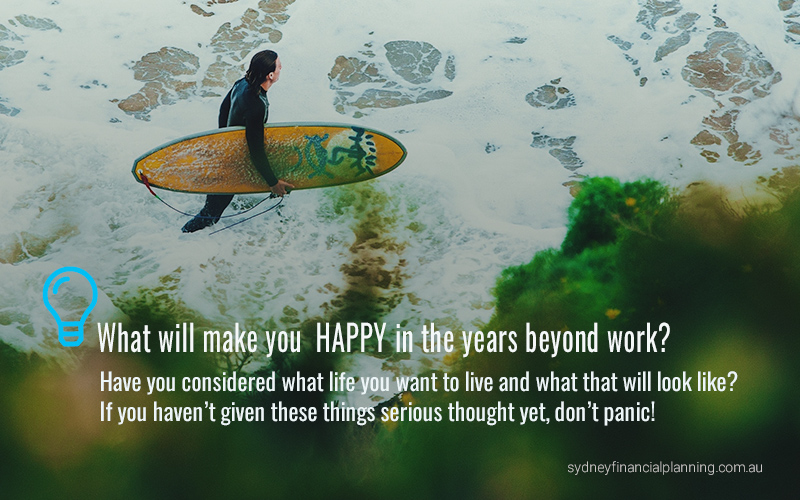
Consider what will make you happy in the years beyond work, so you can live the life you want. Finally,if you haven’t yet given these things serious thought yet, don’t panic. You’ve dealt with other changes in your life, this is just another one.

Think of it as a new adventure. Let’s face it, you’ve earned it.


Do you have a new adventure in mind?

For more help and strategies on identifying what your retirement plans look like, speak to your financial planner at SFP. Call us to arrange an appointment, contact us on 02 9328 0876.


Article by © AMP Life Limited. First published 10 October 2019

General Disclaimer: This article contains information that is general in nature. It does not take into account the objectives, financial situation or needs of any particular person. You need to consider your financial situation and needs before making any decisions based on this information. Please seek personal financial advice prior to acting on this information.




When can I access my Super?

When can I access my Super?

When can I access my Super?

Here is a high-level summary as to when super may be accessible to you. 

When you retire (and have reached your preservation age)

Typically, you can access your super when you’ve reached your preservation age and you retire. Find your preservation age in the table below. 

Date of birth Preservation age
Before 1 July 1960 55
1 July 1960 – 30 June 1961 56
1 July 1961 – 30 June 1962 57
1 July 1962 – 30 June 1963 58
1 July 1963 – 30 June 1964 59
From 1 July 1964 60

When you’re transitioning into retirement

If you’ve reached your preservation age, you might wish to access a portion of your super through a transition to retirement income stream while continuing to work full-time, part-time or casually. While this may give you some financial flexibility, there will be things to consider, including that you’ll only be able to access up to 10% of your super savings each financial year. 

When you reach age 60 and stop working (but aren’t retiring)

If you’re aged 60 to 64 and stop working, even if you have no intention of retiring completely (for example, you may get another job elsewhere), you’re still considered retired for the purposes of accessing super. This means you can cash out the super you’ve accumulated up until that time even if you begin working again under a different employment arrangement.

When you reach age 65 (even if you haven’t left the workforce)

When you turn 65, you don’t have to retire or satisfy any special conditions to get full access to your super. You’re also not obligated to withdraw it, however depending on your circumstances, there may be some benefits in doing so. 

Other instances where you may be able to access super

While you generally cannot take your super until retirement, there are some specific circumstances where the law allows you to draw on your super early. These mainly relate to certain medical conditions or severe financial hardship, and you must meet eligibility criteria to apply. 

Compassionate grounds

You may be allowed to withdraw a certain amount of money from your super on compassionate grounds where you don’t have capacity to meet certain expenses. This may include things like certain medical-related expenses, funeral costs and mortgage repayments that will prevent you from losing your home. 

Severe financial hardship

If you’re under preservation age, have been receiving financial support payments from the government for 26 weeks continuously and can’t meet reasonable and immediate family living expenses, you may be able to withdraw between $1,000 and $10,000 from your super. This can only be done once in a 12-month period.  If you’ve already reached your preservation age (plus 39 weeks), have received financial support payments from the government for a cumulative period of 39 weeks since reaching your preservation age, and are not gainfully employed on a full-time or part-time basis, there is no limit on the amount that you may be able to withdraw under severe financial hardship. 

Incapacity

If you’re permanently or temporarily unable to work due to a physical or mental medical condition, you may be able to access super as a lump sum or via regular payments over a period of time. 

Terminal medical condition

If you’ve been appropriately diagnosed with a terminal illness that’s likely to result in your death within a two-year period, you could apply to access your super and there are no set limits on the amount you can withdraw. 

Super benefits less than $200

If you change employers and the balance of your super account is less than $200, or you have lost super that’s being held by a super fund or the Australian Taxation Office (ATO) that’s less than $200, you may be able to withdraw this money. 

Leaving Australia

If you’ve worked and earned super while visiting Australia on an eligible temporary visa, you can apply to have this super paid to you as a Departing Australia Superannuation Payment (DASP), but there are requirements and documentation you may need to provide. 

What to keep in mind

Depending on how much you have in super, it’s worth considering any implications of withdrawing this money, such as how the money may be taxed, and whether a withdrawal may affect Centrelink payments, such as the Age Pension. 


Not sure if your meet some of the criteria?

Having an financial planning expert review your unique situation is always a good stratgey . Make a booking or call us on 02 9328 0876 to arrange a meeting.


Article by: ©AMP Life Limited. First published May 2019

General Disclaimer: This article contains information that is general in nature. It does not take into account the objectives, financial situation or needs of any particular person. You need to consider your financial situation and needs before making any decisions based on this information. Please seek personal financial advice prior to acting on this information.


Make the most of superannuation tax benefits

Make the most of superannuation – tax deductible personal contributions

Make the most of superannuation tax benefits

However, due to the current contribution caps and rules, this also means that planning ahead over the longer term is the most effective  way to maximise the potential benefits of super. Particularly worth noting, are the recent changes which allow for the ability to claim tax deductions on personal super contributions.

The concessional contribution cap of $25,000 applies to everyone, regardless of their age or superannuation balance. The ‘less than 10 per cent employment income’ rule no longer applies when looking to claim a tax deduction for personal superannuation contributions. Broadly, anyone who is eligible to contribute to super can claim a tax deduction for their personal contribution (other conditions apply, talk to your adviser). Keep in mind the 9.5% SG contribution from your employer is counted in this amount.

How this might benefit you in practice

Clients who already make salary sacrifice contributions may be asking, “what’s the big fuss around personal tax-deductible contributions”?  In the end it creates the same tax effective outcome whether you choose to do this regularly via employer salary sacrifice or “ad hoc” via personal lump sum contributions. While this is true, there can be some advantages for people in the following circumstances:

  • Flexibility to calculate capacity and “top up” towards end of financial year: It has been challenging for employees with “lumpy” incomes to salary sacrifice in the past – it’s hard to determine how much your employer will contribute for the year (as it’s hard to project the amount of income for the year). The new super arrangements simplify this situation – you now have the flexibility to top-up concessional super contributions (up to the $25,000 cap) towards the end of the financial year. This offers more certainty around income and super contributions for the year to date.  
  • Won’t reduce your SGC: The salary sacrifice contribution is classified as an employer contribution, and some employers simply include your salary sacrifice contributions to reduce or eliminate their SG obligation (proposed legislation is currently being drafted to eliminate this practice).
  • Employer doesn’t offer salary sacrifice: Some employees are not offered salary sacrifice arrangements all together. You can now effectively “salary sacrifice” by making voluntary personal contributions and then claiming these personal super contributions as a tax deduction in your tax return.
  • You now control the timing: The control, including the timing of when salary sacrifice contributions are made, is effectively in the hands of the employer. Unlike compulsory SG contributions (which must be remitted to the employee’s super fund no later than 28 days after the end of the relevant quarter), no such time frame exists for salary sacrifice contributions. This makes the employee reliant on the employer to do this in a timely fashion. In contrast, making regular personal contributions or one-off contributions towards the end of the financial year (you can choose whether or not to claim a tax deduction at that time), may allow people to take greater control of their super contribution strategy.
  • Easier to sacrifice bonuses: The need for an effective agreement to be in place with your employer prior to the salary/income being earned which reduces flexibility and can make it difficult to sacrifice bonuses or extra income.
  • Save interest in the meantime: Tax deductible contributions could also be combined with other strategies like keeping these “provisioned” contributions aside in your offset account in the meantime, which can reduce the cost of your loan.
  • Accrue any unused amounts from 2018/19: Beginning in 2018–19, a person can start  to accrue unused amounts of concessional contributions cap and carry-forward these unused amounts. Provided your total superannuation balance prior 30 June is under $500,000, the first year a person can make additional concessional contributions from their accrued unused amounts is in the 2019–20 financial year.

Important reminder around admin and claiming a tax deduction.

The ‘paperwork’ requirements to qualify for a deduction for a personal superannuation contribution have not changed. The member must complete a valid Notice of Intention (NOI) to claim a tax deduction and lodge this with their super fund.

To be eligible to claim a tax deduction for a personal contribution, clients must notify the super fund of their intention to claim a tax deduction using the NOI and receive an acknowledgement from the fund by whichever of the following dates occurs first:

  • before they lodge their income tax return for the income year in which the contribution was made
  • by the end of the income year following the income year in which the contribution was made

Personal super contributions that the ATO allows as a tax deduction in the individual’s tax return will count towards their concessional contribution cap.
If employer super contributions are also received, clients will need to make sure these are taken into account when determining how much to claim as a personal tax deduction.

Also requiring consideration is the individual’s tax-free threshold: effectively $21,594 in 2018–19. Clients who bring their taxable income below these thresholds by making salary sacrifice and/or personal deductible contributions will find that they are paying contributions tax (15%) in the super fund when they could be paying zero tax personally. The amount of personal contributions that can be claimed as a tax deduction is also limited to the member’s taxable income, i.e. taxable income cannot be reduced below zero.


We encourage you not to leave things to the last minute. Super contributions are generally allocated and count towards a client’s contribution cap in the year in which they are received by the fund. Clients need to accordingly allow several business days for contributions made by BPAY® or similar methods to reach the fund.

Business owners should also consult their accountant or business advisor to consider other taxation and reporting matters, such as finalising trust distributions, claiming asset write-offs and the amount of personal super contribution to claim a tax deduction for.


Need some help to get started?

For more help and strategies on taking care of your super contributions, speak to your planner at SFP. Or if you don’t have a planner yet let us arrange an appointment, contact us on 02 9328 0876.


Article by Sydney Financial Planning

General Disclaimer: This article contains information that is general in nature. It does not take into account the objectives, financial situation or needs of any particular person. You need to consider your financial situation and needs before making any decisions based on this information. Please seek personal financial advice prior to acting on this information.

 

Is Aged Care Factored into Your Future?

Most older Aussies prefer home care over a nursing home

Is Aged Care Factored into Your Future?

According to a recent study by McCrindle, nearly 90% of Australians aged 50 and over said they’d prefer to live out their days in their own home, even though most admitted to not having given much thought to what support they’d need in order to do so.i

We look at some of the findings that came out of the research as well as what aged care options are available, so that you might be more informed around what avenues are available to you and your loved ones.

Preparation and planning are lacking

In a national survey of more than 1,000 Aussies aged 50 and over, responses revealed the following:i

  • 46% of older Aussies haven’t discussed their wishes around their future care with anyone
  • 75% haven’t taken any steps to ensure they’ll receive their preferred means of future care
  • Around 40% aren’t confident they or the government will be able to sufficiently fund their care needs, with only 9% having a secure financial or savings plan in place
  • 30% have been involved in organising care for a parent in the past, but admit they had to make decisions quickly and with limited information.

Why conversations need to be had

Today there are more than 3.8 million Australians aged 65 and older (compared to 1.7 million 30 years ago), with that number expected to increase to 7.5 million in three decade’s time.i

Australia’s ageing population indicates that it’s not just older people who need to prepare for future aged care needs, but all Australians, who need to talk to their families, while prioritising finances and ensuring they’re informed about the services available.

In-home care the fastest growing sector

Over a ten-year period, the number of people receiving aged care in Australia grew from 189,000 to 249,000, with in-home care the fastest growing sector within the care industry, outperforming growth in residential care by five to one.i

Staying at home is a priority for many older Australians, with 74% indicating they’d likely use in-home care services and 82% saying they’d be prepared to pay for such services to live at home for longer.i

With 33% of older Aussies not aware that the government funds certain in-home care services, the research highlighted that there was a need for more awareness around aged care support.i

Aged care options available

More than 50% of Aussies over age 45 have previously or are currently dealing with aged care services for themselves, or on someone else’s behalf, which is why considering your options in aged care earlier rather than later could provide you or a loved one with greater flexibility.i

Each aged care service available in Australia has eligibility criteria and an assessment process which can be organised through the government’s My Aged Care initiative.

Keep in mind that the costs of different aged care services vary and may depend on income and assets, as assessed by the Department of Human Services or the Department of Veterans’ Affairs.

Help in your own home

If you’re generally able to manage, but require some assistance, there are various home-care packages available that may help with things such as:

  • getting dressed,
  • catching transport,
  • cooking,
  • making modifications to your home, as well as a range of other things.

Short-term help

  • After-hospital (transition) care – If you’ve been in hospital but need assistance while you recover, this type of service can be provided in your own home or ‘live-in’ setting.
  • Short-term restorative care – This provides a range of services to help prevent or slow down difficulties with completing everyday tasks. It aims to delay or reverse the need to enter long- term care.
  • Respite care – This service provides support for you and your primary carer when your carer has other duties to attend to, or when they’re on holiday.


Residential aged care

This is where you live in full-service residences and receive ongoing care and support. If it’s the best option for you, it’s a good idea to research and visit several homes to find the right place for you.


Need help understanding your options?

Speaking with one of our professional planners can help you put plans in place that match your wishes. Make a booking or call us on 02 9328 0876 to arrange a meeting.


Aricle by John Collett

General Disclaimer: Originally published by The Sydney Morning Herald on 13 October 2018. This article contains information that is general in nature. It does not take into account the objectives, financial situation or needs of any particular person. You need to consider your financial situation and needs before making any decisions based on this information. Please seek personal financial advice prior to acting on this information.


Get ready for the first year of retirement

Some of the changes may include; preparing mentally for the shift to not working full-time, adjusting to not getting a regular salary, ensuring your money can last for about 30 years and keeping your mind and body active. 

Three paths

Researcher Professor Robert Atchley identified a number of ways people react to leaving work permanently and split the period immediately after paid employment into three paths: 

  • the “honeymoon” path, for people who dive into many of the fun activities they did not have time for previously, especially travel
  • the “immediate retirement routine” path, which covers people who had full and active schedules outside their employment that flow into busy lives soon after retirement
  • the “rest and relaxation” path, taken by people who choose to do very little in their early retirement after very busy careers with limited time to themselves

What to consider

The phase before actual retirement, Professor Atchley says, usually involves disengagement from the workplace and planning for what lies ahead. 

If possible, you should use this period to transition into retirement by reducing your working hours or by changing your workload over time. Speak to your adviser about a Transition to Retirement strategy that could see you reduce your working hours, but not necessarily your income.  You should also determine what sort of retirement you want, using the three paths as a guide, and try to plan ahead for your lifestyle adjustment during the first year of transition.  If you know what you want, you will be able to take stock of your finances and take advantage of final opportunities to boost your superannuation if there are gaps in your savings plans. Remember, your retirement funds may need to last 30 years. 

Make your life satisfying

A study by the Australian Institute of Family Studies shows there is little change in life satisfaction for both men and women in the year immediately following retirement as they adjust to their new circumstances but thereafter, it improves for both sexes.  Once you have ensured that your savings are on track for retirement, you should start thinking about how you will handle the loss of the worker role and what you can do to improve your life satisfaction.  Will you be one of the “honeymoon” phasers, or will you fall into an “immediate retirement routine”?  It may help to try new things before you retire to decide if they will be right for you, such as hiring a caravan for a short jaunt before buying one for a big trip. If you are considering a sea change or tree change, rent in the area you fancy before making the final leap. 

Be fit and healthy

Recent research suggests you need to be fit to retire to age well. Try getting into an exercise routine before you retire that you will be willing to continue when work no longer dominates your life.The health benefits of regular exercise cannot be overstated as it keeps you mentally fit and helps you ward off disease and disability, even if you start late in life. And try to do more than just exercise, such as being careful with your diet, as it will increase your health and wellbeing.

We’re here to help

Now might be a good time to review your finances and boost your super. If you would like help with planning for your retirement, make a time for a chat with us.

What does your retirement look like?

For more help and to take a fresh look at the way you can have the retiremnt you imagine, speak to your financial adviser at SFP, book a coffee or call us on 02 9328 0876.


Article by AMP Life Limited

General Disclaimer: This article contains information that is general in nature. It does not take into account the objectives, financial situation or needs of any particular person. You need to consider your financial situation and needs before making any decisions based on this information. Please seek personal financial advice prior to acting on this information.

 

Would you like to retire by 40?

And with the age at which you can access your super and age pension creeping up—not to mention the increasing cost of living—you might be steeling yourself for a longer working life.

The stats don’t lie—Australians are staying in the workforce for longer and any thoughts of retiring early are becoming a distant dream for many of us.i 

But there’s a growing movement of younger Australians who believe that by following the right set of rules, it’s possible to achieve early retirement. 

Popularised by US-based blogger Peter Adeney, better known as Mr Money Mustache, the Financial Independence, Retire Early movement looks more closely at what makes us happy.ii

Changing your spending and saving habits

FIRE is all about following an extremely frugal lifestyle with the aim of retiring as early as your 40s…or even your 30s! 

At the core of the FIRE philosophy is changing your attitude towards spending and saving. 

But FIRE is more than just following a budget. It’s a whole-of-life movement that inspires fervent belief in its followers. 

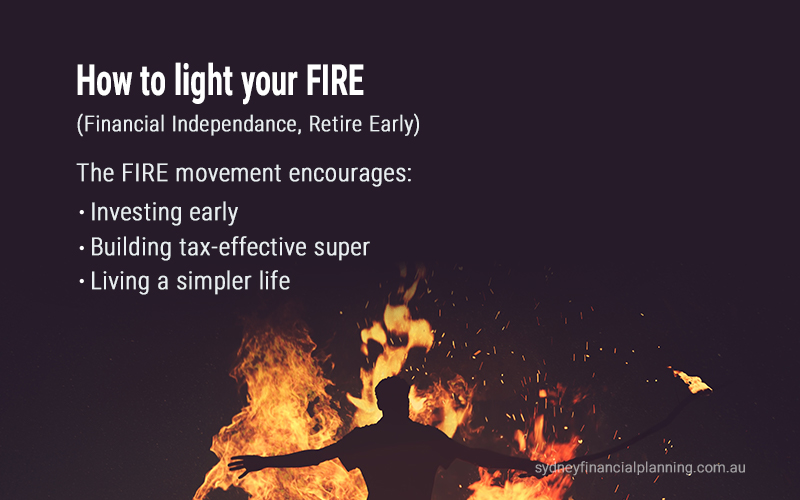
The FIRE movement encourages its followers to build up seven levels of financial safety by:

  • investing in property
  • investing in dividend-yielding assets 
  • building tax-effective super 
  • working part-time 
  • taking full advantage of social security 
  • looking for entrepreneurial work opportunities 
  • adjusting their lifestyle to live a simpler life.

When it comes to saving, every little bit counts

Like any movement, FIRE inspires some committed followers and some of the lifestyle advice can seem a little extreme—churning credit cards to access freebies, living in a truck to avoid rent and even sifting through bins outside restaurants for free food. 

Now, if the thought of going without your daily latte…not to mention movie outings, fine dining and regular holidays…sounds like a living nightmare, then perhaps FIRE isn’t for you. 

But if this sounds too much like hard work, don’t worry. You don’t have to be quite so committed. You could consider making some simple changes to your daily habits to reduce your spending and boost your savings.

  • Understand your money habits. 
  • Make a list of where you could cut back to reduce your waste. 
  • Cycle all or part of the way to work and save on transport costs. 
  • Shop around for the best deal on utilities like gas, electricity and water. 
  • Entertain at home—a monthly Netflix subscription costs less than a single movie ticket.

How to light your FIRE and retire on your terms

Once you’ve ramped up your savings, you could think about being a little more savvy with your money.

  • Bring your super together into one account to avoid paying more than one set of fees. 
  • Look at ways to save and invest your money to increase your potential returns. 
  • Consider investing in property…but watch out for aggressive gearing, especially if interest rates change.

You may not retire quite as early as the more committed FIRE followers. But you may just put yourself in the box seat to retire on your own terms. 

And along the way, you might find yourself reappraising your attitude towards money and happiness. 


Need help starting your FIRE?

For more help and to take a fresh look at the way your managing your money, speak to your financial adviser at SFP, or contact us on 02 9328 0876.

Australian Bureau of Statistics – Retirement and Retirement Intentions, Australia 
ii https://www.mrmoneymustache.com/about/ 

Article by AMP Life Limited

General Disclaimer: This article contains information that is general in nature. It does not take into account the objectives, financial situation or needs of any particular person. You need to consider your financial situation and needs before making any decisions based on this information. Please seek personal financial advice prior to acting on this information.


Photo by Mohamed Nohassi on Unsplash