Tag: Superannuation

How does your super compare?

How does your super balance compare?

How does your super compare?

How does your super compare?

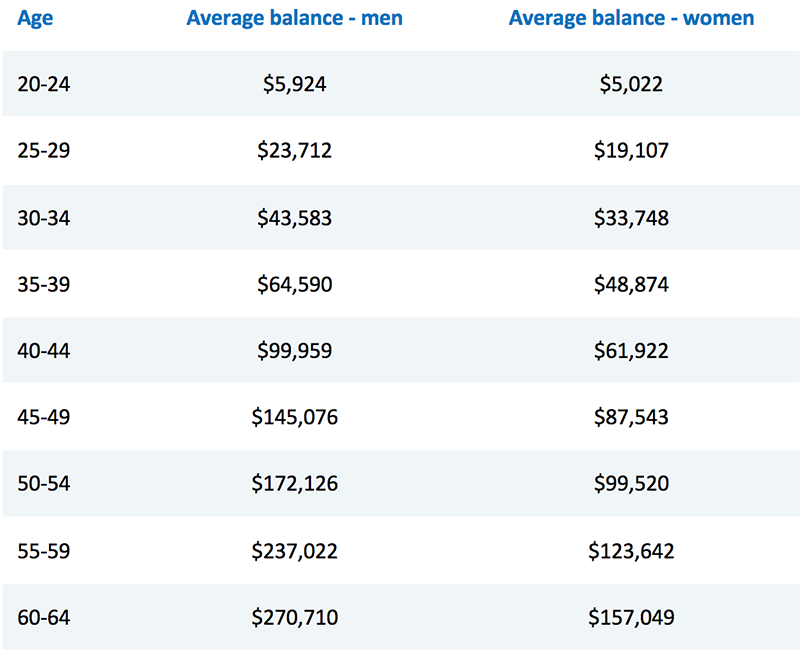
The table below shows the average super balances for Australian men and women of different ages (excluding those with no super) so you can compare your balance to others your age.   

blog content 2018 compare super

Source: Association of Superannuation Funds of Australia, Superannuation account balances by age and gender 2015-16, October 2017, pg. 9.

Does your super stack up?

If your balance looks low, there could be a number of reasons why your super is lagging your peers, such as taking time out of the workforce to study, travel, raise children, care for older relatives, or being out of work, working part-time, or earning a lower wage than others your age.

As the figures show, these issues particularly affect women, as they have lower super balances than men across all age groups.

Will your super be enough to retire on?

Even if your balance is above others of your age, will it be enough for a comfortable retirement?

The Association of Superannuation Funds of Australia (ASFA) says that “many people will still retire with inadequate superannuation savings to fund the lifestyle they want in retirement” and that “most people retiring in the next few years will rely partially or substantially on the Age Pension for some or all of their retirement as they have inadequate super savings”.1

The ASFA Retirement Standard estimates singles will need retirement savings of $545,000 for a comfortable retirement, while couples will need combined retirement savings of $640,000.2

These are lump sums required for a comfortable retirement assuming that the retiree/s will draw down all their capital and receive a part Age Pension. This simply means that the above balances will run out of money at average life expectancy (while people are still dependent on government benefits!!!)

This raises two important questions:

1. What if you (or one of you if you have a partner) will live longer than the average person?

In order to have $60,000 of annual reliable passive income (required by an average couple in NSW to live a comfortable lifestyle5) for life, our estimates show a couple would need approximately $1,340,000 of savings in total.6

2. What if your expenses are different to those of the average people?

Averages quoted by ASFA are great to start a good and relevant discussion. The next step would be work on your own individual retirement budget. Everyone’s circumstances are different, everyone’s retirement plan will look different. What will yours look like? What’s your personal retirement number?

Ways to boost your super

  • Firstly, search for lost super. Money belonging to you might be sitting in an account you’ve forgotten about.
  • Secondly, if you have super with multiple funds, think about consolidating them into one account and you could save on fees and charges that could be eating into your balance. However, you’ll need to check for exit or termination fees, and ensure that your insurance cover isn’t affected.
  • And thirdly, you could consider changing how your super is invested, for example, by switching it into a more growth-focused investment option. Just bear in mind that returns are not guaranteed and that a big part of successful investing is about understanding what you own in your portfolio and why. To change your investment option, contact your planner.

Once you’ve got your super sorted with these quick wins, you can consider ways to boost your balance, including:

  • Salary sacrificing: you can contribute extra cash into your super from your before-tax salary and it will only be taxed at 15%3, rather than at your usual marginal tax rate. However, make sure your total super contributions (including any your employer makes on your behalf) don’t exceed $25,000 per year. One of the best way to reduce tax if you’re an employee.
  • Personal tax-deductible contributions: if your employer doesn’t offer salary sacrifice, you’re unemployed, self-employed or don’t want to salary sacrifice, you can make a personal tax-deductible contribution to your super, which is also taxed at 15%, and subject to the $25,000 per year limit.
  • After-tax contributions: (also known as non-concessional contributions): There’s a $100,000 limit per financial year on the amount of after-tax contributions you can make. If you are under age 65, you can also ‘bring forward’ the next two years’ worth of after-tax contributions and make up to $300,000 contribution in a financial year.4
  • Spouse contributions: if your partner is out of work, a stay-at-home parent, working part-time or earning less than $40,000, adding to their super could benefit you both financially.
  • Contribution splitting: you can split your super contributions between you and your partner. A great way to close the gender super gap.
  • Government contributions: if you’re a low or middle-income earner, you may be eligible for contributions from the government or tax-offsets when you add after-tax money to your super.


Too many options? Need more help?

For more help and to ensure you’re on track for a comfortable retirement, speak to your financial adviser at SFP. If you don’t have an adviser, contact us on 02 9328 0876.


1 Association of Superannuation Funds of Australia, Superannuation account balances by age and gender 2015-16, October 2017, pg. 7.
2 Association of Superannuation Funds of Australia, ASFA Retirement Standard, pg. 4.
3 Or 30% if you earn $250,000 a year or more.
4 Providing your total super balance at 30 June 2017 is less than $1.4 million.
5 ASFA retirement standards – Detailed budget breakdown 
6 SFP’s estimate of required funds in today’s dollars, assuming a withdrawal rate of 4.5% pa, and income returns of 5% pa.

General Disclaimer: This article contains information that is general in nature. It does not take into account the objectives, financial situation or needs of any particular person. You need to consider your financial situation and needs before making any decisions based on this information. Please seek personal financial advice prior to acting on this information.


Photo by Nick Fewings on Unsplash

Tax Tips

Five handy tax tips you should know

Tax Tips

 You’re probably well aware you can claim a tax deduction for general work-related expenses. But did you know you may be able to claim if:

  1. You take a course or study. You may be able to claim a portion of self-education expenses if it’s related to your ability to earn an income.
  2. You travel to inspect your investment property. You may be able to claim for expenses like pest control fees, body corporate, rates, utility bills, advertising and marketing costs. Be aware, from 1 July 2017 this opportunity will no longer be available.
  3. You belong to a union. You may be able to claim your union fees as a deduction.
  4. You wear a uniform for work. You may be able to claim for buying and cleaning a uniform that you need to wear for work.
  5. You work from home. You may be able to claim for running costs such as heating, cooling, lighting and cleaning, and even interest on any loans for work equipment, like a home computer. But you must keep detailed records—check out the ATO’s guide to home office expenses. 

Working out your tax deductions can be complex. Your tax accountant can help you work out what you can and cannot claim. 

Five ways to boost your super at tax time

There are plenty of ways to benefit from super’s favourable tax treatment, regardless of how much you earn and how old you are. 

  1. You can claim up to $500 in government co-contributions if you’re a low to middle income earner and you make after-tax contributions of up to $1,000 to your super.
  2.   You can receive a tax offset of up to $540 if your spouse is a low-income earner and you contribute up to $3,000 in after-tax contributions towards their super.
  3.   You can contribute up to $30,000 in before-tax contributions to your super at the ‘concessional’ tax rate of 15% (or 30% tax if you earn more than $300,000 pa in 2016-17) —or $35,000 if you’re aged 50 or over. It’s important to note that concessional contributions will be reduced to just $25,000 for everybody during the 2017-18 financial year regardless of your age.
  4. You can contribute up to $180,000 a year (or up to $540,000 before 1 July 2017 if you’re eligible to use the ‘bring-forward’ rules) in after-tax contributions. Since this is from your after-tax income the full contribution reaches your super account, and no tax is deducted when the contribution reaches your super fund.
  5.   You can start a transition to retirement strategy once you’ve reached your super preservation age (the age at which you can access your super)—this can allow you to draw up to 10% of your super as a pension. 

So, as the end of the financial year approaches, now is the time to ensure you are fully aware of all the tax deductions you can claim, as well as taking advantage of investing in super, before major changes take affect.


Still have some questions?

Contact us before June 30 so we can help with strategies to make your money work for you. Call us to arrange an appointment on 02 9328 0876.


General Disclaimer: This article contains information that is general in nature. It does not take into account the objectives, financial situation or needs of any particular person. You need to consider your financial situation and needs before making any decisions based on this information. Please seek personal financial advice prior to acting on this information.

Spouse contributions: Win/Win!

Spouse contributions: Win/Win!

Spouse contributions: Win/Win!

Building a nest egg is crucial to funding yourselves through retirement. If your spouse is a low-income earner or taking a breather from the 9-5 grind, there’s a fair chance their super contributions are pretty seldom. By contributing into your partner’s superannuation account, you could be eligible for a tax rebate.

The Criteria:

  • You must be married or in a de facto relationship which includes same-sex couples and you must be living together
  • Contributions must be after-tax (non-concessional)
  • Both must be Australian residents
  • The recipient must be under the age of 65, however, if they are aged between 65 and 69 they must meet work test requirements
  • For the current financial year (2016-17), the receiving spouse’s income must be  $10,800 or less for you to qualify for the full tax offset and less than $13,800 for you to receive a partial tax offset

The Benefits:

  • You can claim an 18% tax offset for your after-tax contributions (capped at $540)
  • To redeem the maximum $540 rebate you need to contribute a minimum of $3,000 into your partner’s super fund
  • If their income exceeds $10,800, you’re still eligible for a partial tax offset. However, once their income reaches $13,800, you’ll no longer be eligible, but you can still make contributions on their behalf
  • Bear in mind, any contributions you make will count towards your partner’s non-concessional contributions cap. The current limit is $180,000 per year.

NB: From 1 July 2017 the government will increase access to the spouse contributions tax offset by raising the lower income threshold from $10,800 ($13,800 cut off) to $37,000 ($40,000 cut off).  Another thing to be aware of is the reduction of the non-concessional contributions cap from $180,000 to $100,000 per year from 1 July 2017.

The Warnings:

  • If either of you exceed the super cap limits, additional tax and penalties may apply
  • The value of your’s and your partner’s investment in super can fluctuate. Before making contributions, make sure you both understand the associated risks linked to your investment options
  • Generally speaking, you’ll need to have reached your preservation age, which will be between 55 and 60 before you can access your super.


Rules around spouse contributions can be complex so it’s a good idea to check with us to ensure the approach you and your partner take is the right one.


With the June 30 deadline looming, we’re here to help…

It’s important that you talk to us about your situation so we can help you take full advantage of any opportunities. Call us to arrange a meeting with one of our planning team on 02 9328 0876.

General Disclaimer: This article contains information that is general in nature. It does not take into account the objectives, financial situation or needs of any particular person. You need to consider your financial situation and needs before making any decisions based on this information. Please seek personal financial advice prior to acting on this information.

Making the most of change

Ch-ch-changes

Making the most of change

Recent super reforms, particularly the changes to non-concessional contributions (NCC’s), present a timely opportunity for you to capitalise on current superannuation laws before 30 June 2017.

The changes

From 1 July 2017 several key changes will come into play including but not limited to the following:

  • the NCC cap will be lowered from $180,000 to $100,000.
  • the bring forward amount will be reduced from $540,000 to $300,000.
  • individuals whose total super balance is above $1.6 million will no longer be eligible to make NCC’s. This may be particularly relevant for those who have a transition to retirement (TTR) arrangement.
  • the concessional contributions (before tax) cap will decrease to $25,000 per year for everyone.
  • the high income threshold will be lowered from $300,000 to $250,000. Anyone earning $250,000 or more will pay 30% tax on their contributions.

The opportunities 

Depending on your personal circumstances, you may be able to reap the maximum benefits available to you right now by making some adjustments to your financial plan. Here are a few effective strategies that that may or may not apply to you:

  • If you are turning 50 and over: you could contribute an extra $10,000 (before-tax) this financial year, before the cap is reduced to $25,000 from 1 July 2017.
  • If you are turning 49 or under: you could contribute an extra $5,000 (before-tax) this financial year, before the cap is reduced to $25,000 from 1 July 2017.
  • If you are under age 65: you could bring forward three years’ worth of after-tax super contributions up to a maximum of $540,000. This is significantly higher than the $300,000 limit that will apply from 1 July 2017.
  • Do you have a term deposit that you want to cash in? Have you made some money from the recent sale of your house or investment property? Maybe you’ve received an inheritance from a family member? It’s worth considering contributing these proceeds into your superannuation account before the 30 June deadline to make the most of the NCC caps.
  • If you are earning between $250,000 and $300,000 pa (inclusive of super contributions): you could seek to make the most of your concessional contributions this financial year (up to $30,000 or $35,000 depending on your age, without paying the additional 15% tax that will be imposed from 1 July 2017).

The benefits

What are the benefits of getting in early?

  • Greater accumulated superannuation balance to enjoy in retirement tax free.
  • One off opportunity to restructure existing assets to take advantage of the upcoming changes in legislation.
  • Boost your knowledge and understanding around superannuation.

We’ve covered some of the main points here but there are other changes that may also affect you. It’s likely you’ll have questions about the best course of action in the lead up to the changes and after they take effect. Now is a good time to contact us and set up a time to come in so we can look ahead and put plans in place to help you make the most of your money.

Important reminder

If you contribute more than the contribution caps, you may have to pay extra tax. Also, once your funds are invested in super, you need to meet a condition of release such as retirement and reaching preservation age, to get access to the funds. The value of your investment in super can go up and down. Before making extra contributions to your super, make sure you understand and are comfortable with any risks associated with your chosen investment option.


Still have some questions?

If you want to find out how these changes could impact you before making any financial decisions, arrange to speak with one of our advisors. Call us to arrange an appointment on 02 9328 0876.


General Disclaimer: This article contains information that is general in nature. It does not take into account the objectives, financial situation or needs of any particular person. You need to consider your financial situation and needs before making any decisions based on this information. Please seek personal financial advice prior to acting on this information.

Super Basics

Back to basics

Super Basics

Effectively, Superannuation is a way to fund your retirement. It’s an investment vehicle and a means of saving for your future. Within your superannuation fund, you can have a portfolio of shares, property, cash and a variety of other investments. Superannuation is appealing because of its lenient tax treatment when you’re working (accumulation phase) as well as when you’ve hit retirement (pension phase).

The notion is backed by the government who have made it mandatory for all Australian employers to pay ‘super’ to their workers – this is what’s known as ‘super guarantee’.

There are many ways to build your super balance and the easiest way is through the super guarantee scheme.  For the current financial year (FY16/17), the general super guarantee percentage is 9.5% of normal earnings.

If your total salary is $70,000 inclusive of super than $6,073 (9.5%) of your salary will be contributed into your super fund leaving you with a net salary of $63,927.

In addition to the super guarantee concept, you can choose to make personal contributions. There are various ways to make personal contributions:

  • Salary sacrifice
    your employer pays part of your salary directly into your super fund instead of your bank account
  • Non concessional contributions (NCC)
    After-tax income that you deposit into your super fund
  • Spouse contributions
    Depositing money into your partners super fund may entitle you to a tax offset

One of the most common questions is ‘how much money will I need before I can retire?’

The answer is dependent upon the lifestyle you choose to lead, the age at which you retire, your outgoings, and income producing options i.e. working part-time in retirement etc.


Our experienced team of financial advisers can help you get your super sorted and put you on the right path to financial success. Reach out today by submitting a meeting request or call us to arrange an appointment for your preferred time and date on 02 9328 0876.


Is your super working well for you?

Our experienced team of financial advisers can help you get your super sorted and put you on the right path to financial success. To arrange an appointment call us on 02 9328 0876.


Self Managaged Super Funds

Super…should you do it yourself?

Self Managaged Super Funds


So it’s expected that many of you would be very concerned with how your super is run.  Furthermore, an increasing number of us who want even more control over our super are transferring from larger funds into self-managed super funds (SMSF).

An SMSF has a maximum of four members and is primarily designed for business owners and their families.  However, SMSFs are not generally recommended as a cost-effective option if you have less than $250,000 of super assets.


Major advantages of SMSFs include: 

  • greater control over the structure of the fund and types of investments;
  • potential savings on management fees; and
  • the opportunity to make the best use of the tax environment.

Don’t be a slave to your super fund!

Despite its growing popularity, many only find out after starting one just how much time and work is involved in running an SMSF.  The penalties for not complying with SMSF regulations are severe.

Fortunately, there are SMSF services available that allow you to run your SMSF without having to perform all the time-consuming administrative activities.  For example, you can use a professional administration service, while having your own accountant look after some of the fund’s compliance and reporting, and have a real estate agent to manage your property in super.

Is it really necessary to have an SMSF super fund?

For most of us, probably not!  After many years advising clients and their SMSFs, direct property ownership is perhaps the significant motivator in deciding to have one; for example, if you have business property and wish to have it transferred to super, or you wish to invest in residential property via super.  There are many other reasons to have an SMSF, but the majority of us will in the end find out that a ‘normal’ super fund would be adequate in facilitating our retirement plans.

Managing your own superannuation fund can provide you with greater flexibility, greater control and a more cost-effective way to manage your investments in retirement.  But it’s not for everyone…  so make sure you consult an experienced financial planner before deciding on whether an SMSF would be right for you.


Still have some questions?

If you want to discuss your superannuation options with one of our advisors. Call us to arrange an appointment on 02 9328 0876.


General Disclaimer: This article contains information that is general in nature. It does not take into account the objectives, financial situation or needs of any particular person. You need to consider your financial situation and needs before making any decisions based on this information. Please seek personal financial advice prior to acting on this information.

Forgotten Fortune

Dig up your forgotten fortune

Forgotten Fortune

That may be about to change with Google Earth technology that Tamworth man Jeff Harris and three mates are now using to cross-match with sketches in Lasseter’s original diary.

Like Mr Harris, we are all fascinated by the search for untold wealth. Hordes of us queued up recently to buy Oz Lotto tickets in a draw worth more than $100 million.

Yet Australians are sitting on a gold mine of unclaimed money well beyond the scale of anything Lasseter could have dreamed.

The amount of superannuation alone that is waiting to be claimed is a massive $17.4 billion. There’s also $330 million in forgotten or unclaimed bank accounts, $295 million in unclaimed shares and $52 million in unclaimed life insurance policies.

If you have ever moved house or changed jobs, you could be among millions of Australian workers and retirees with lost super. Forgetting to update address details with a fund or switching funds when they change jobs are the most common reasons why

Australians misplace their super

Some workers also fall victim to unscrupulous employers who make late super payments or don’t pay at all. If the law catches up with them, the late funds may be paid into accounts that have been closed and then the money is held by the Australian Taxation Office (ATO).

However, there are several mechanisms available to Australian workers to help them retain or regain funds that are rightfully theirs.

From 1 January 2012, super funds have used members’ tax file numbers to help consolidate their accounts, whether they are in the same fund or across multiple funds. Once accounts are located, members have the option of rolling their super into a single account.

The ATO operates a free online tool called SuperSeeker, which is a secure, convenient service to help you track your super. It can be found at www.ato.gov.au/superseeker.

Don’t forget that you may also be entitled to some of the $677 million unclaimed in shares, bank accounts and the investment portion of life insurance policies.

Check out www.moneysmart.gov.au, a website operated by the Australian Securities and Investments Commission that will help you discover if you are entitled to misplaced or forgotten investments.

You could be entitled if you have forgotten about an old bank account. Or, in the case of life insurance policies (particularly with Whole of Life Policies taken out in the 1980s and 1990s), you may have overlooked a lump sum amount payable at the time of death or after the policy holder reached a certain age.

Whole of Life policies are no longer available, but Australians who once bought them are sometimes entitled not just to the face value of the policy, but also the cash value made up of dividend earnings. These can be withdrawn at any time.

If only Lasseter had modern day tools like Google Earth back in the early 1900s, he may have been able to locate untold riches as easily as SuperSeeker and MoneySmart can help people recoup unclaimed wealth today.


Still have some questions?

Or you need help in locating and consolidating your super. Call us to arrange an appointment with one of our advisors on 02 9328 0876.


Responsible Investing

Responsible investing is more than buying green

Responsible Investing

Ethical, socially responsible, sustainable: call it what you will, but investing with a conscience has moved to centre stage in the wake of the financial crisis as returns of the top ethical funds have kept pace, and in some cases, outpaced the market.

What is considered an ethical fund?

Managers of ethical funds use a variety of approaches to select stocks. Negative screening is used to weed out companies involved in armaments, tobacco, gambling, uranium, old growth logging, poor mining practices or questionable environment, social and governance (ESG) practices. Other funds look for sustainable-themed investments in areas such as clean energy, green technology or sustainable agriculture. In addition, positive or ‘best in sector’ screening allows investment in companies that perform well relative to their peers in their attempts to integrate ESG issues into their businesses.

Ethics back on the radar

The financial crisis of 2008 revealed failures of corporate governance and ethics on a global scale. At the same time, global population growth dramatically increased the need for clean fuel, clean water, food and other resources. As a result, governments, investors, employees and the community are demanding companies incorporate ESG issues into their business alongside the drive for profits. It is not just about being ‘green’ for the sake of it. Both the Financial Services Council and the Australian Council of Superannuation Investors advocate that companies which score highly on these measures are less risky and more likely to thrive in the challenging times ahead. This is because governments reward companies that make products and services perceived as being beneficial for society. Conversely, they penalise companies with unsustainable business models by imposing taxes and other forms of regulation, effectively reducing demand. One example of this is the regulation around carbon emissions, which adversely impact manufacturers relying too heavily on coal for energy.

Cigarettes are another obvious target. Governments heavily tax tobacco, ban advertising and even restrict smoking in public places. You don’t find governments regulating the sale of apples in the same way; either the crunchy or the computer type! Community activism can also bring about changes in corporate actions. As traditional energy sources become harder to find, non-conventional gas and oil exploration has become big business, even in Australia. A new technology to extract oil and gas from previously unreachable shale rock is known as ‘fracking’. Using high pressure water to fracture rock deep in the ground to release oil and gas, fracking has generated strong community opposition because of concerns about damage to water catchments and farmlands. The power of local communities has forced some Australian energy companies to put on hold their exploration applications that rely on fracking.

Large conglomerates blur the line

So is it as simple as black or white? Can a company be described as ethical or not? Sometimes in the case of large conglomerates, it can be hard to tell which side of ethical a company falls on. Woolworths, an Australian fresh food and grocery icon, sells liquor, cigarettes and controls over 11,000 pokies machines across the country. Its major competitor Coles also sells these so-called unethical products, while Coles’ parent company Wesfarmers has extensive investments in coal minesi.

Shades of grey

It’s difficult to know where to draw the line as it seems ethics will always be a subjective field; most people agree it’s probably an ethical spectrum. While the definition of ethical companies might not be clear, ethics, social responsibility and sustainability are integral to doing business in the 21st century. Companies that get it right and investors who back them are likely to be winners in the investment stakes. If some recent investment returns are any guide, they already are.


Still have some questions?

If you want to discuss your super investment strategies why not book an appointment with one of our advisors. Call us to arrange an appointment on 02 9328 0876.


i The examples of Woolworths and Wesfarmers are for illustrative purposes only and do not constitute an investment recommendation, positive or negative in nature.

This article contains information that is general in nature. It does not take into account the objectives, financial situation or needs of any particular person. You need to consider your financial situation and needs before making any decisions based on this information.


Is Investing a gift to your future self?

Investing in your future: Why it matters

Is Investing  a gift to your future self?

As a financial planner, I’ve seen time and again how early, consistent investing can transform lives. Let’s delve into the motivations behind investing, the benefits for your future self, and the peace of mind it brings to your current self.

Motivations for investing

Investing is more than just a financial strategy; it’s a commitment to your future.

Financial Independence: One of the primary reasons to invest is to achieve financial independence. By building a robust investment portfolio, you can create a steady stream of income that supports your lifestyle without relying solely on your job. This independence allows you to pursue passions, travel, or even retire early.

Security and Peace of Mind: Knowing that you have a financial cushion can provide immense peace of mind. Whether it’s an emergency fund for unexpected expenses or a retirement nest egg, having savings and investments ensures you’re prepared for life’s uncertainties.

Achieving Life Goals: Investing helps you reach significant milestones, such as buying a home, funding education, or starting a business. By setting aside money and watching it grow, you can turn your dreams into reality.

Benefits for your future self

Investing is a gift to your future self. Here’s how:

Compound Growth: The earlier you start investing, the more time your money has to grow through compound interest. This means your investments generate earnings, which are then reinvested to generate even more earnings. Over time, this compounding effect can lead to substantial wealth accumulation.

Retirement Planning: Investing early ensures you have enough
funds to enjoy a comfortable retirement. By consistently contributing to retirement accounts, you can build a sizable nest egg that supports you in your golden years.

Legacy Building: Investing over the long term allows you to leave a financial legacy for your loved ones or passion projects.

Peace of mind for your current self

While investing is about the future, it also benefits your present self:

Financial Discipline: Regularly setting aside money for investments instils financial discipline. This habit helps you manage your finances better, avoid unnecessary debt, and make informed spending decisions.

Reduced Stress: Knowing that you’re actively working towards your financial goals can reduce stress and anxiety. It provides a sense of control over your financial future, allowing you to focus on other aspects of your life.

Flexibility and Opportunities: Having investments gives you financial flexibility. It opens opportunities to take calculated risks, such as starting a new venture or making a career change, without jeopardising your financial stability.

We take from this then, that investing can be a powerful tool when leveraged over the longer term, it can help to secure your financial future and enhance your present life.
By understanding the motivations behind investing and the benefits it brings, you can make informed decisions that align with your goals. If you’re ready to take the next step, consider reaching out to your financial planner to discuss what strategy may work best for you.


Article by Steven Stolle
Financial Planner | Director


Does your financial plan include a long-term investing strategy?

Our team can help you create an investment approach that aligns with your goals. Call 02 9328 0876 to arrange meeting.


General Disclaimer: This article contains information that is general in nature. It does not take into account the objectives, financial situation or needs of any particular person. You need to consider your financial situation and needs before making any decisions based on this information. Please seek personal financial advice prior to acting on this information.


Why super and growth assets like shares really are long term investments

Common mistakes investors make – that you should avoid

Why super and growth assets like shares really are long term investments

  • The easiest way to avoid many of these mistakes is to have a long-term investment plan that aligns your financial goals with your risk tolerance.
  • Introduction

    In the confusing and often seemingly illogical world of investing, investors often make various mistakes that keep them from reaching their financial goals. This note takes a look at the nine most common mistakes.

    Mistake #1 – Crowd support indicates a sure thing

    “I will tell you how to become rich…Be fearful when others are greedy. Be greedy when others are fearful.” Warren Buffett, investor and CEO

    It’s normal to feel safer investing in an asset when your friends and neighbours are doing the same and media commentary is reinforcing the message that it’s the place to be. But “safety in numbers” is often doomed to failure. The trouble is that when everyone is bullish and has bought into an investment with general euphoria about it, it gets to a point where there is no one left to buy in the face of more positive supporting news but instead there are lots of people who can sell if the news turns sour. Of course, the opposite applies when everyone is pessimistic & bearish and have sold – it only takes a bit of good news to turn the value of the asset back up. So, the point of maximum opportunity is when the crowd is pessimistic (or fearful) and the point of maximum risk is when the crowd is euphoric (and greedy).

    Mistake #2 – Current returns are a guide to the future

    “Past performance is not a reliable indicator of future performance.” Standard disclaimer

    Faced with lots of information, investors often use simplifying assumptions, or rules, in order to process it. A common one of these is that “recent returns or the current state of the economy and investment markets are a guide to the future.” So tough economic conditions and recent poor returns are expected to continue and vice versa for good returns and good economic conditions. The problem with this is that when it’s combined with the “safety in numbers” mistake, it results in investors getting in at the wrong time (e.g. after an asset has already had strong gains) or getting out at the wrong time (e.g. when it is bottoming). In other words, buying high and selling low.

    This is pertinent now with shares providing strong gains over the last two years – with US shares up 56%, global shares up 49% and Australian shares up 25% – despite lots of worries about interest rates, recession, commercial property & US banks, wars, elections, etc. This has brought with it a temptation to conclude we are in a “new era” where macro problems don’t & various other share market plunges. Just because shares have had strong returns over the last two years – despite lots of worries – doesn’t mean that the cycle has been abolished and that there is nothing at all to worry about.

    Mistake #3 – “Experts” will tell you what will happen

    “Economists put decimal points in their forecasts to show that they have a sense of humour.” William Gillmore Simms, novelist and politician

    The reality is that no one has a perfect crystal ball. It’s well-known that forecasts as to where the share market, property market, and currencies will be at a particular time have a dismal track record, so they need to be treated with care. Usually the grander the forecast – calls for “new eras of permanent prosperity” or for “great crashes ahead” – the greater the need for scepticism as either they get the timing wrong or it’s dead wrong.

    Market prognosticators suffer from the same psychological biases as everyone else. And sometimes forecasts themselves can set in motion policy changes that make sure they don’t happen – such as rate cuts heading off sharp house price falls in the pandemic in 2020. The key value of investment experts is to provide an understanding of the issues around an investment and to put things in context. This can provide valuable information in terms of understanding the potential for an investment. But if forecasting was so easy, the forecasters would be rich and so would have retired!

    Mistake #4 – Shares can’t go up in a recession

    “It’s so good it’s bad, it’s so bad it’s good.” Anon

    A common lament around in second half 2020, after share markets rebounded from their late March 2020 pandemic low, was that, “the share market is crazy as the economy is in deep recession and earnings are collapsing!” Of course, shares kept rising into 2022, economies recovered, and earnings rebounded. The reality is that share markets are forward looking, so when economic data and profits are really weak, the market has already factored it in. History tells us that the best gains in stocks are usually made when the economic news is still poor, as stocks rebound from being undervalued and unloved, helped by falling interest rates. In other words, things are so bad they are actually good for investors! Of course, the opposite applies at market tops after a sustained economic recovery has left the economy overheated with no spare capacity and rising inflation and so the share market frets about rising rates. Hence things are so good they become bad! This seemingly perverse logic often trips up many investors.

    Mistake #5 – Letting a strongly held view get in the way

    “The aim is to make money, not to be right.” Ned Davis, investment analyst

    Many let their blind faith in a strongly held, often bearish, view – “there is too much debt”, “aging populations will destroy returns”, “a house price crash is imminent”, “a Trump victory will see shares crash”, etc – drive their investment decisions. This is easy to do as the human brain is wired to focus on the downside more than the upside, so we are easily attracted to doomsayers. They could be right one day but lose a lot of money in the interim. Giving too much attention to pessimists doesn’t pay for investors.


    Mistake #6 – Looking at your investments too much

    “Investing should be like watching paint dry or watching grass grow. If you want excitement…go to Las Vegas.” Paul Samuelson, economist

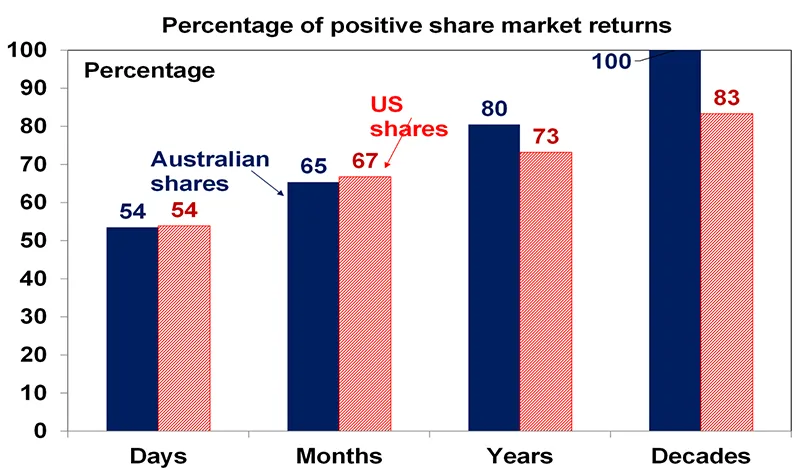
    Checking up on how your investments are doing is a good thing, surely? But the danger is that the more investors are exposed to news around their investments, the more they may see them falling. Whereas share markets have historically generated positive returns more than 60% of the time on a monthly basis and more than 70% of the time on a calendar year basis, day- to-day it’s close to 50/50 as to whether the share market will be up or down.

    Percentage of positive share market returns

    Daily & monthly data from 1995, data for years and decades from 1900. Source: Bloomberg, AMP

    Being exposed to this very short term “noise” and the chatter around it can cause investors to have a greater exposure to lower returning but safer investments that won’t grow wealth. The trick is to turn down the noise and have patience. Evidence shows that patient people make better investors because they can look beyond short-term noise and are less inclined to jump into one investment after another after they have already had their run.

    Mistake #7 – Making investing too complex

    “There seems to be a perverse human characteristic that makes easy things difficult.” Warren Buffett

    With the increasing ease of access to investment options, ways to put them together and information & processes to assess them, investing is getting more complex. But when you overcomplicate your investments, it can mean that you can’t see the wood for the trees. You can spend so much time focussing on this stock or ETF versus that stock or ETF or this fund manager versus that fund manager that you ignore the key driver of your portfolio’s risk and return which is how much you have in shares, bonds, real assets, cash, onshore versus offshore, etc. Or that you end up in things you don’t understand. Instead, it’s best to avoid the clutter, don’t fret the small stuff, keep it simple and don’t invest in things you don’t understand.

    Mistake #8 – Too conservative early in life

    “Compound interest is the eighth wonder of the world. He who understands it, earns it…he who doesn’t, pays it.” Albert Einstein, theoretical physicist

    Cash and bank deposits are low risk and fine for near term spending requirements and emergency funds, but they won’t build wealth over time.

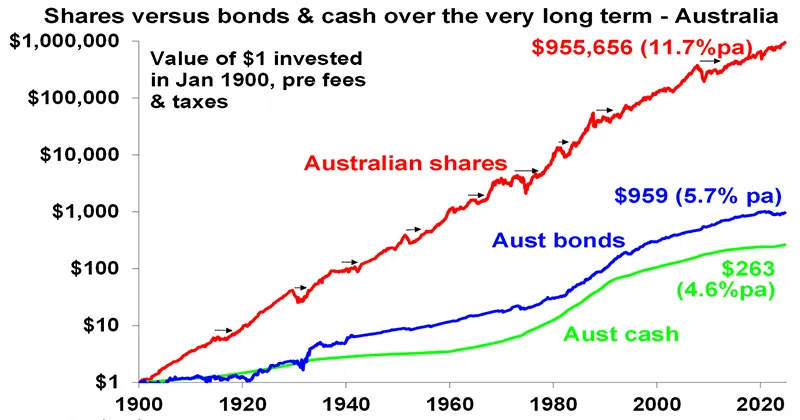
    The chart below shows the value of $1 invested in various Australian assets since 1900 allowing for the reinvestment of interest and dividends along the way. That $1 would have grown to $955,656 if invested in shares but only to $263 if invested in cash. Despite periodic setbacks, shown with arrows (such as WWI, the Great Depression, WWII, stagflation in the 1970s, the 1987 share crash & the GFC), shares and other growth assets grow to much higher values over time thanks to their higher returns over the long term than cash and bonds and thanks to the magic of compound interest where higher returns build on higher returns through time.

    Shares vs bonds cash over the very long term Australia

    Source: ASX. Bloomberg, RBA, AMP

    Not having enough in growth assets early in their career can be a problem for investors as it can make it harder to adequately fund retirement later in life as they miss out on the magic of compounding higher returns on higher returns through time in growth assets like shares and property. Fortunately, compulsory superannuation in Australia helps manage this – although early super withdrawal for various purposes (through the pandemic, for medical needs and as proposed for housing) may set this back for some. For example, a 30 year old who withdraws $20,000 from their super could have around $184,000 (or $74,000 in today’s dollars) less when they retire at age 67 based on assumptions in the ASIC MoneySmart Super Calculator.

    Mistake #9 – Trying to time the market

    “Far more money has been lost by investors in preparing for corrections, or anticipating corrections, than has been lost in the corrections themselves.” Peter Lynch, fund manager

    In the absence of a tried and tested process, trying to time the market, ie, selling before falls and buying ahead of gains is very difficult. Many of the mistakes referred to above kick in and it can be a sure way to destroy wealth. Perhaps the best example of this is a comparison of returns if the investor is fully invested in shares versus missing out on the best days. Of course, if you can avoid the worst days during a given period you will boost your returns. But this is very hard and many investors only get out after the bad returns occur, just in time to miss out on some of the best days and so hurt their returns. If you were fully invested in Australian shares from January 1995, you would have returned 9.5% pa (including dividends but not allowing for franking credits). But if by trying to time the market you miss the 10 best days the return falls to 7.5% pa. If you miss the 40 best days, it drops to just 3.5% pa. Hence, it’s time in the market that’s the key, not timing the market. The last two years provide a classic example of how hard it is to time markets – there has been a long worry list, so it’s been easy to be gloomy but timing markets on the back of this has been a loser as shares put in strong gains.


    Bill’s Conclusion

    At Sydney Financial Planning , we help coach clients on what to do and what to avoid.

    If you do not have a regular review with your Financial Planner, call us today.

    Bill Bracey
    CEO & Founder of Sydney Financial Planning


    Do your financial goals align with your risk tolerance?

    Arrange a meeting with one of our Financial Planners to help avoid common investment mistakes, either book a meeting or get in contact with us on 02 9328 0876.


    This article was prepared by Dr Shane Oliver with opening and closing summary by William Bracey – CEO & Senior Financial Planner from Sydney Financial Planning. Dr Shane Oliver who provides economic forecasts and analysis of key variables and issues affecting, or likely to affect, all asset markets. He also provides economic forecasts and analysis of key variables and issues affecting, or likely to affect, all asset markets.

    Sydney Financial Planning Pty Ltd (ABN 29 606 413 254), trading as Sydney Financial Planning & Illawarra Financial Planning is an Authorised Representative & Credit Representative of Charter Financial Planning Limited, Australian Financial Services Licensee and Australian Credit Licensee.

    This article contains information that is general in nature. It does not take into account the objectives, financial situation or needs of any particular person. You need to consider your financial situation and needs before making any decisions based on this information. If you decide to purchase or vary a financial product, your financial adviser, and other companies within the AMP Group may receive fees and other benefits. The fees will be a dollar amount and/or a percentage of either the premium you pay or the value of your investments. Please contact us if you want more information. If you no longer wish to receive direct marketing from us you may opt out by contacting Sydney Financial Planning . You may still receive direct marketing from AMP as a product issuer, bringing to your attention products, offerings or other information that may be relevant to you. If you no longer wish to receive this information you may opt out by contacting AMP on 1300 157 173.

    Why super and growth assets like shares really are long term investments

    Why super and growth assets like shares really are long term investments

    Why super and growth assets like shares really are long term investments

  • The best approach is to simply recognise that occasional sharp falls in share markets and hence super funds are normal and that investing in both is a long-term investment.
  • Introduction

    “Aussie share market loses $100bn in bloodbath”

    Two weeks ago, there were lots of headlines like that after share markets fell sharply in response to US recession fears. But such headlines are nothing new. After such falls, the usual questions are: What caused the fall? What’s the outlook? And what does it mean for superannuation? The correct answer to the latter should be something like: “Nothing really, as super is a long-term investment and share market volatility is normal”.

    But that can seem like marketing spin. However, the reality is that – except for those who are into trading – shares and superannuation really are long-term investments. Here’s why.

    Super funds, shares & the power of compound interest

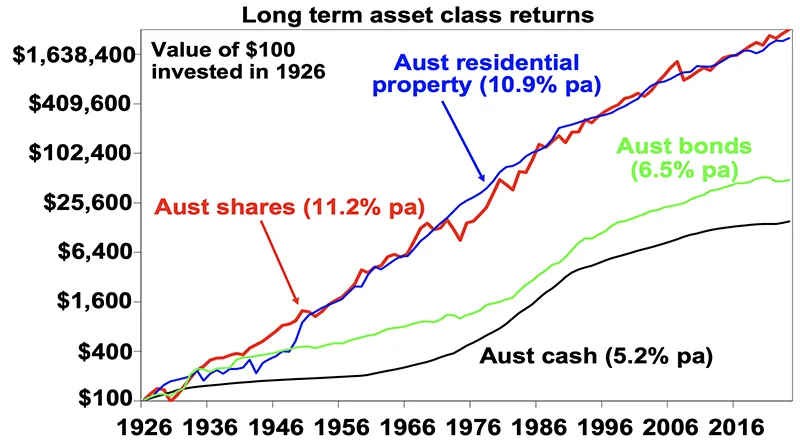
    Superannuation seeks to provide maximum risk-adjusted funds, within reason, for use in retirement. So typical super funds have a bias towards shares and other growth assets, and some exposure to defensive assets like bonds and cash in order to avoid excessive short-term volatility. This approach seeks to take advantage of the power of compound interest. The next chart shows the value of a $100 investment in Australian cash, bonds, shares and residential property from 1926 assuming any interest, dividends and rents are reinvested on the way, and their annual returns. As return series for commercial property and infrastructure only go back a few decades I have used residential property as a proxy.
    long term asset class returns 001

    Source: ASX, Bloomberg, RBA, REIA, AMP

    Because shares and property provide higher returns over long periods the value of an investment in them compounds to a much higher amount over time. So, it makes sense to have a decent exposure to them. The higher return from shares and other growth assets reflects compensation for their greater risk (seen in volatility & illiquidity) versus cash & bonds.

    But investors don’t have 100 years?

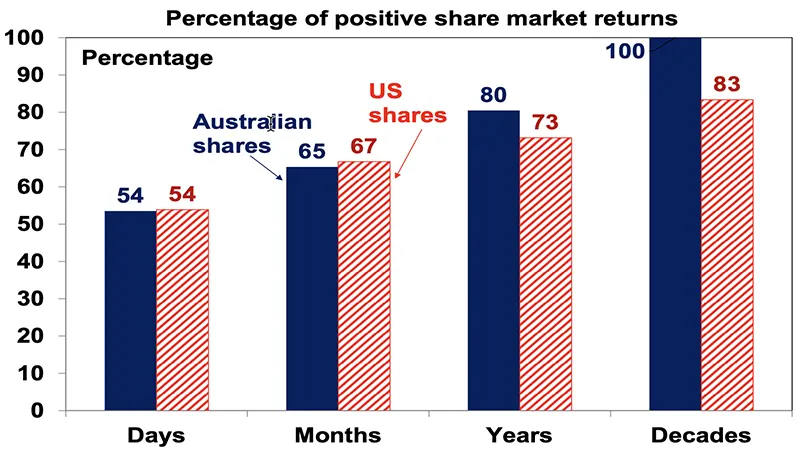
    Of course, we don’t have one hundred years to save for retirement. In fact, our natural tendency is to think very short term. And this is where the problem starts. On a day-to-day basis shares are down almost as much as they are up. See the next chart. So, day-to-day, it’s pretty much a coin toss as to whether you will get good news or bad when you tune in for the nightly finance update.

    But if you just look monthly and allow for dividends, the historical experience tells us you will only get bad news around a third of the time. And if you only look each year, you will only get negative news 20% of the time for Australian shares and 27% of the time for US shares. And if you look just once a decade, positive returns have been seen 100% of the time for Australian shares and 82% for US shares. So, while it’s hard given the bombardment of financial news these days it makes sense to look at your returns less because then are you more likely to get positive news and less likely to make rash decisions or end up adopting an investment strategy that it too cautious.
    percentage of positive share market returns 001

    Source: ASX, Bloomberg, RBA, REIA, AMP

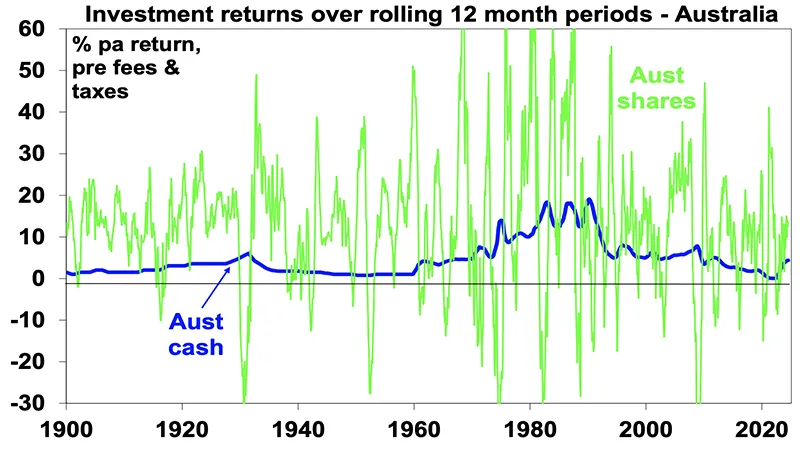
    This can also be demonstrated in the following charts. On a rolling 12 month ended basis the returns from shares bounce around all over the place versus cash & bonds.

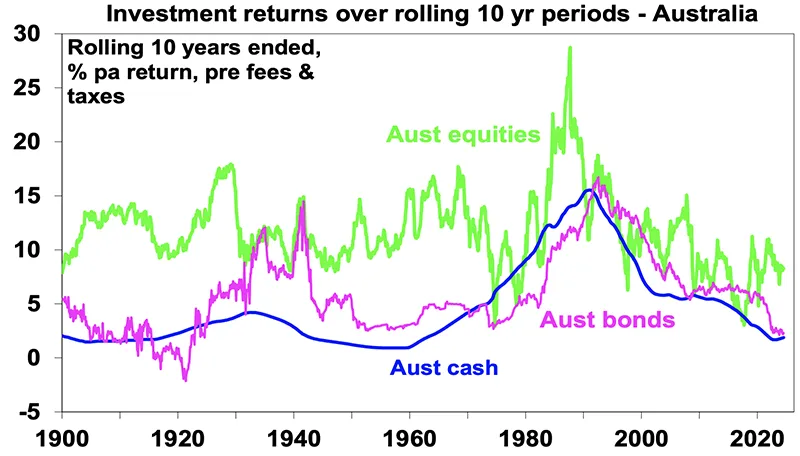
    However, over rolling ten-year periods, shares have invariably done better, although there have been some periods where returns from bonds and cash have done better, albeit briefly.
    12 months investment returns aus

    Source: ASX, Bloomberg, RBA, AMP

    10 year investment returns aus

    Source: ASX, Bloomberg, RBA, AMP

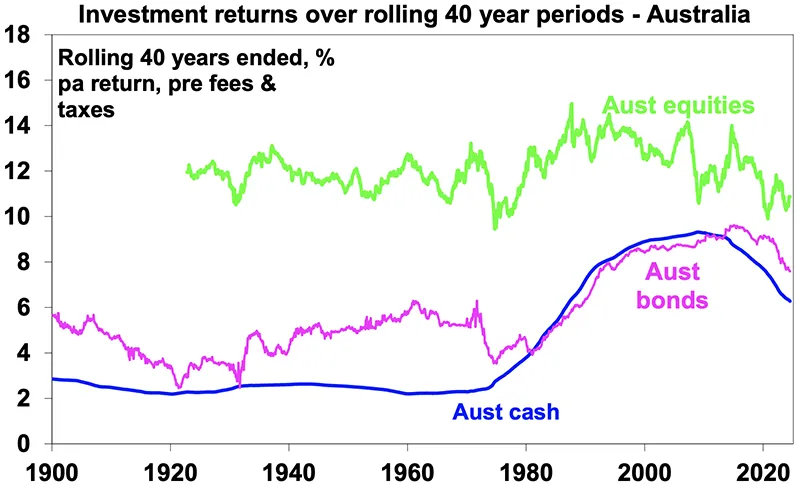
    Pushing the horizon out to rolling 20-year periods, returns from shares have almost always done even better, although a surge in cash and bond returns after the very high interest rates of the late 1970s/1980s saw the gap narrow for a while. Over rolling 40-year periods – the working years of a typical person – shares have always done better.
    40 year investment returns 001

    Source: ASX, Bloomberg, RBA, AMP

    This is consistent with the basic proposition that higher short-term volatility from shares (often around periods of falling profits & a risk that companies go bust) is rewarded over the long term with higher returns.

    But why not try and time short-term market moves?

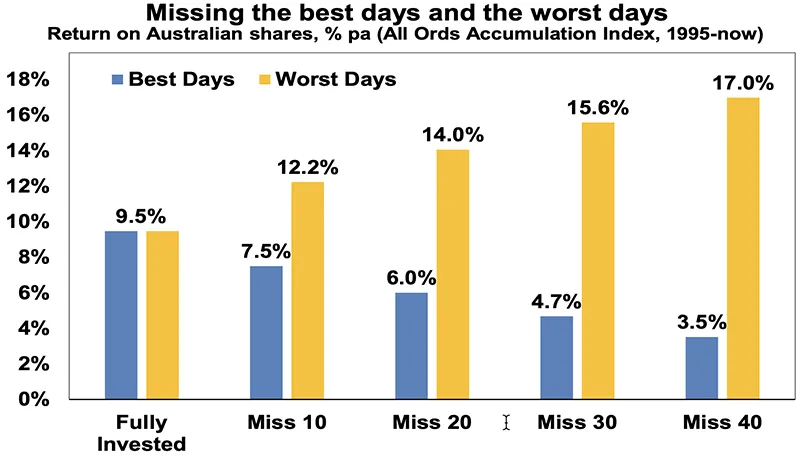
    The temptation to do this is immense. With the benefit of hindsight many swings in markets like the tech boom and bust, the GFC and the plunge and rebound in shares around the COVID pandemic look inevitable and hence forecastable and so it’s natural to think “why not give it a go?” by switching between cash and shares within your super to anticipate market moves. Fair enough. But without a tried and tested market timing process, trying to time the market is difficult. A good way to demonstrate this is with a comparison of returns if an investor is fully invested in shares versus missing out on the best (or worst) days. The next chart shows that if you were fully invested in Australian shares from January 1995, you would have returned 9.5% pa (with dividends but not allowing for franking credits, tax and fees).

    If by trying to time the market you avoided the 10 worst days (yellow bars), you would have boosted your return to 12.2% pa. And if you avoided the 40 worst days, it would have been boosted to 17% pa! But this is really hard, and many investors only get out after the bad returns have occurred, just in time to miss some of the best days. For example, if by trying to time the market you miss the 10 best days (blue bars), the return falls to 7.5% pa. If you miss the 40 best days, it drops to just 3.5% pa.
    Missing the best and worst days

    Source: Bloomberg, AMP

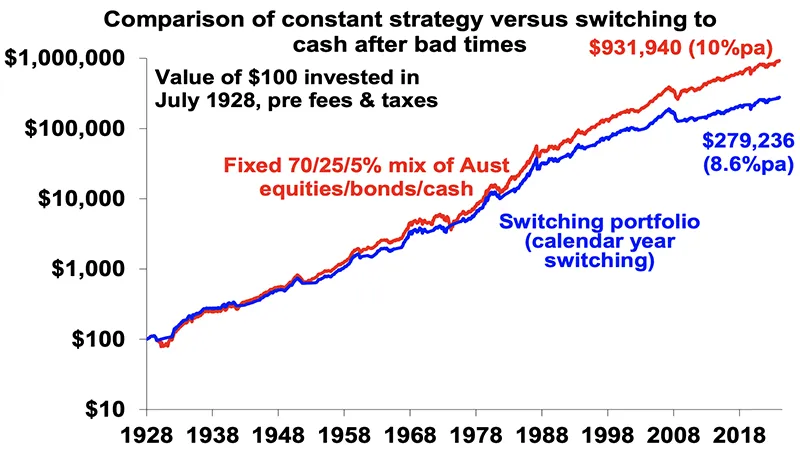
    The following chart shows the difficulties of short-term timing in another way. It shows the cumulative return of two portfolios.

    • A fixed balanced mix of 70 per cent Australian equities, 25 per cent bonds and five per cent cash;
    • A “switching portfolio” which starts off with the above but moves 100 per cent into cash after any negative calendar year in the balanced portfolio & doesn’t move back until after the balanced portfolio has a calendar year of positive returns. We have assumed a two-month lag.
    Comparison of constant strategy

    Source: ASX, Bloomberg, RBA, AMP

    Over the long run the switching portfolio produces an average return of 8.6% pa versus 10% pa for the balanced mix. From a $100 investment in 1928 the switching portfolio would have grown to $279,236, but the constant mix would have ended more than 3 times bigger at $931,940.

    Key messages

    First, while shares and growth assets have periods of short-term underperformance versus cash & bonds they provide superior long-term returns. So, it makes sense for super to have a high exposure to them.

    Second, switching to cash after a bad patch is not the best strategy for maximising wealth over time. In fact, it can just lock in losses.

    Third, the less you look at your investments the less you will be disappointed. This reduces the chance of selling at the wrong time.

    The best approach is to recognise that super and shares are long-term investments and adopt a long-term strategy to suit your circumstances – in terms of your age, income, wealth and risk tolerance.

    Finally, anything that cuts your super balance early on can cut your super at retirement a lot. Eg, a $20,000 withdrawal from super at age 30 – say for a dental expense – can cut your super at age 67 by around $74,000 (in today’s dollars) due to the loss of compounding returns on that amount (using the assumptions in the ASIC MoneySmart Super calculator).

    Bill Bracey
    CEO & Founder of Sydney Financial Planning


    Does your wealth creation strategy have the right mix of growth & assets?

    Speak with one of our Financial Planners about the best approach for your circumstances, either book a meeting or get in contact with us on 02 9328 0876.


    This article was prepared by Dr Shane Oliver with opening and closing summary by William Bracey – CEO & Senior Financial Planner from Sydney Financial Planning. Dr Shane Oliver who provides economic forecasts and analysis of key variables and issues affecting, or likely to affect, all asset markets. He also provides economic forecasts and analysis of key variables and issues affecting, or likely to affect, all asset markets.

    Sydney Financial Planning Pty Ltd (ABN 29 606 413 254), trading as Sydney Financial Planning & Illawarra Financial Planning is an Authorised Representative & Credit Representative of Charter Financial Planning Limited, Australian Financial Services Licensee and Australian Credit Licensee.

    This article contains information that is general in nature. It does not take into account the objectives, financial situation or needs of any particular person. You need to consider your financial situation and needs before making any decisions based on this information. If you decide to purchase or vary a financial product, your financial adviser, and other companies within the AMP Group may receive fees and other benefits. The fees will be a dollar amount and/or a percentage of either the premium you pay or the value of your investments. Please contact us if you want more information. If you no longer wish to receive direct marketing from us you may opt out by contacting Sydney Financial Planning . You may still receive direct marketing from AMP as a product issuer, bringing to your attention products, offerings or other information that may be relevant to you. If you no longer wish to receive this information you may opt out by contacting AMP on 1300 157 173.

    Comparison of constant strategy

    Source: ASX, Bloomberg, RBA, AMP

    Over the long run the switching portfolio produces an average return of 8.6% pa versus 10% pa for the balanced mix. From a $100 investment in 1928 the switching portfolio would have grown to $279,236, but the constant mix would have ended more than 3 times bigger at $931,940.

    Key messages

    First, while shares and growth assets have periods of short-term underperformance versus cash & bonds they provide superior long-term returns. So, it makes sense for super to have a high exposure to them.

    Second, switching to cash after a bad patch is not the best strategy for maximising wealth over time. In fact, it can just lock in losses.

    Third, the less you look at your investments the less you will be disappointed. This reduces the chance of selling at the wrong time.

    The best approach is to recognise that super and shares are long-term investments and adopt a long-term strategy to suit your circumstances – in terms of your age, income, wealth and risk tolerance.

    Finally, anything that cuts your super balance early on can cut your super at retirement a lot. Eg, a $20,000 withdrawal from super at age 30 – say for a dental expense – can cut your super at age 67 by around $74,000 (in today’s dollars) due to the loss of compounding returns on that amount (using the assumptions in the ASIC MoneySmart Super calculator).

    Bill Bracey
    CEO & Founder of Sydney Financial Planning


    Does your wealth creation strategy have the right mix of growth & assets?

    Speak with one of our Financial Planners about the best approach for your circumstances, either book a meeting or get in contact with us on 02 9328 0876.


    This article was prepared by Dr Shane Oliver with opening and closing summary by William Bracey – CEO & Senior Financial Planner from Sydney Financial Planning. Dr Shane Oliver who provides economic forecasts and analysis of key variables and issues affecting, or likely to affect, all asset markets. He also provides economic forecasts and analysis of key variables and issues affecting, or likely to affect, all asset markets.

    Sydney Financial Planning Pty Ltd (ABN 29 606 413 254), trading as Sydney Financial Planning & Illawarra Financial Planning is an Authorised Representative & Credit Representative of Charter Financial Planning Limited, Australian Financial Services Licensee and Australian Credit Licensee.

    This article contains information that is general in nature. It does not take into account the objectives, financial situation or needs of any particular person. You need to consider your financial situation and needs before making any decisions based on this information. If you decide to purchase or vary a financial product, your financial adviser, and other companies within the AMP Group may receive fees and other benefits. The fees will be a dollar amount and/or a percentage of either the premium you pay or the value of your investments. Please contact us if you want more information. If you no longer wish to receive direct marketing from us you may opt out by contacting Sydney Financial Planning . You may still receive direct marketing from AMP as a product issuer, bringing to your attention products, offerings or other information that may be relevant to you. If you no longer wish to receive this information you may opt out by contacting AMP on 1300 157 173.


    Cashflow remains king

    Cashflow remains king

    Cashflow remains king

    Both are equally important, and if I had a dollar for each time I had a discussion with a client about how much is enough cash in a portfolio, I’d be a wealthy man.

    Today’s challenging periods have reminded us why it remains so critical our clients maintain a cash reverse and have a sound understanding of their cashflow positions (both personally and within their investment accounts).

    Over the last few years our clients have avoided selling growth assets in a downmarket and we want to keep it this way for as long as we can. We’ve managed to do this by putting in place cash reserves for our retired clients so they can continue to meet their pension payments and by putting in personal cash reserves to meet any unexpected expenses and avoid the need to make withdrawals from their investment accounts at an unfavorable time and at a discount. Our accumulators have been maintaining cash at bank to support any disruptions to their employment income.

    So back to the question, how much cash is enough? Everyone has a safety blanket number, however when determining cash allocations for our clients it really depends on their life stage. Accumulators may only need to hold 2% – 5% of cash in their portfolio’s whereas retired clients will need to hold much more than this.

    Min cash holdings for our retired clients can range from 1 – 3 years pension payments. The biggest trade off being the low return generated by cash exaggerated by interest rates being at an all-time low. A high cash allocation will have a larger drag on the long term return of your investment portfolio and ultimately impact the longevity of the account. So generally speaking, the higher the account balance the less cash allocation necessary (as a % of account balance).

    The Government has continued to help people preserve cash positions by reducing the minimum pension requirements by 50% for retirees drawing from their accountbased pensions again for the 2022/23 financial year. The minimums are:

    Age

    Normal Rate

    New rate for 2022/23

    Under 65 4.00% 2.00%
    65-74 5.00% 2.50%
    75-79 6.00% 3.00%
    80-84   7.00% 3.50%
    85-89 9.00%  4.50%
    90-94 11.00% 5.50%
    95 and over 14.00% 7.00%


    With limited opportunity for travel and a reduction in discretionary spending we’ve seen many of our clients requiring less cash to meet their living expenses. This has provided us with an opportunity to reduce payments to our pension clients over the past 12-24 months.

    However, with inflation looming we expect to see an increasing pressure on the need to increase pension payments as the cost of living increases over the next 12 -24 months.

    How can we better manage our cash positions in our investment portfolio’s going forward?

    Most of our clients have been fortunate to save more in their personal bank accounts which will help to fund travel and discretionary spending as the world continues to open up post covid. This will alleviate pressure on making large increases to pension payments in the short term. We have prepared and factored a risking cost of living into your financial plan and investment portfolios as our financial modelling allows for a CPI increase in pension payments annually.

    For our retired clients, or those transitioning to retirement its prudent to review the cashflow within your pension account. This is the cornerstone conversation at all our review meetings. Money in (distributions from our investments) and money out determine our cashflow position with pension payments making up the bulk of money going out. If there’s an opportunity to hold or even reduce your pension payments this coming year before we see significant inflation, we will be discussing this with you at your annual review meeting.

    Do you have the right amount of cash reserves?

    Speak with one of our Investment and retirement specialist about the best strategy for your circumstances, either book a meeting or get in contact with us on 02 9328 0876.


    Article by Gary Winwood-Smith | Senior Financial Planner

    General Disclaimer: While every care has been taken in the preparation of this document, Sydney Financial Planning and Charter FP make no representations or warranties as to the accuracy or completeness of any statement in it.This article contains information that is general in nature. It does not take into account the objectives, financial situation or needs of any particular person. You need to consider your financial situation and needs before making any decisions based on this information. Please seek personal financial advice prior to acting on this information.


    Get more from your salary or bonus

    Smart super strategies for this EOFY

    Get more from your salary or bonus

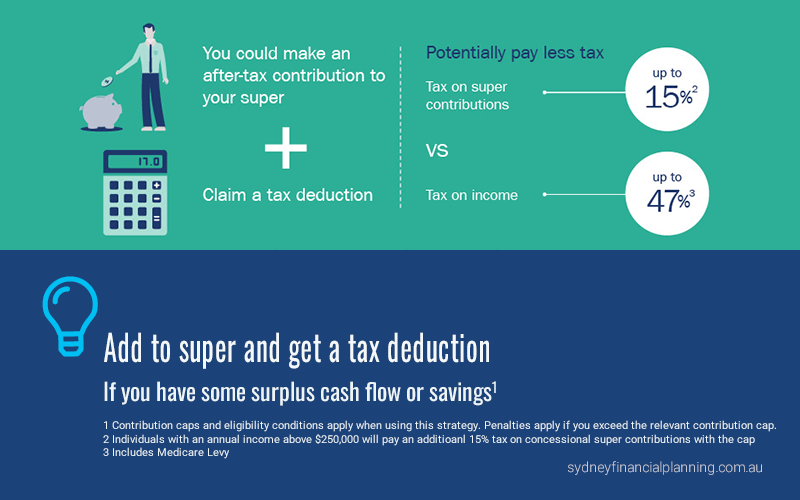
    1. Add to your super – and claim a tax deduction

    If you contribute some of your after-tax income or savings into super, you may be eligible to claim a tax deduction. This means you’ll reduce your taxable income for this financial year – and potentially pay less tax. And at the same time, you’ll be boosting your super balance.

    How it works

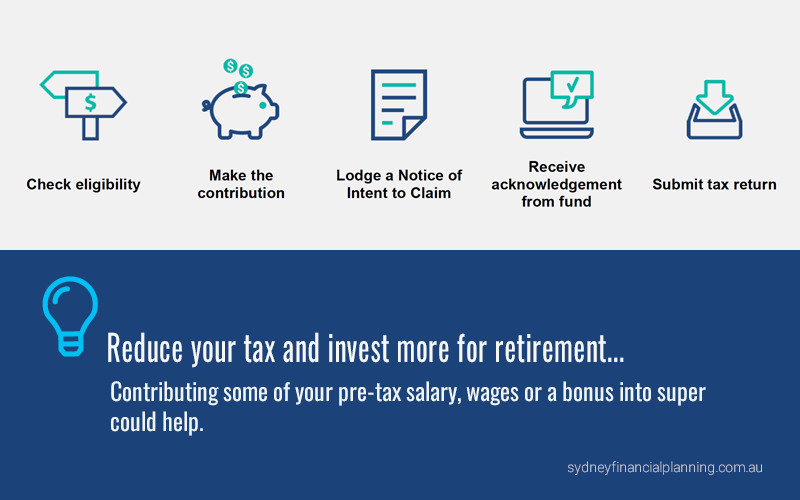
    The contribution is generally taxed at up to 15% in the fund (or up to 30% if your income from certain sources is $250,000 or more). Depending on your circumstances, this is potentially a lower rate than your marginal tax rate, which could be up to 47% (including the Medicare Levy) – which could save you up to 32%. Once you’ve made the contribution to your super, you need to send a valid ‘Notice of Intent’ to your super fund, and receive an acknowledgement from them, before you complete your tax return, start a pension,or withdraw or rollover the money.

    Keep in mind that personal deductible contributions count towards your concessional contribution cap, which is $27,500 for the 2021/22 financial year. However, you may be able to contribute more than that without penalty if you didn’t use the your entire concessional cap in financial years since 1 July 2018 and are eligible to make ‘catch-up’ contributions.

    Concessional contributions also include all employer contributions, including Superannuation Guarantee and salary sacrifice. Other eligibility rules may also apply so speak to your financial adviser for more information.

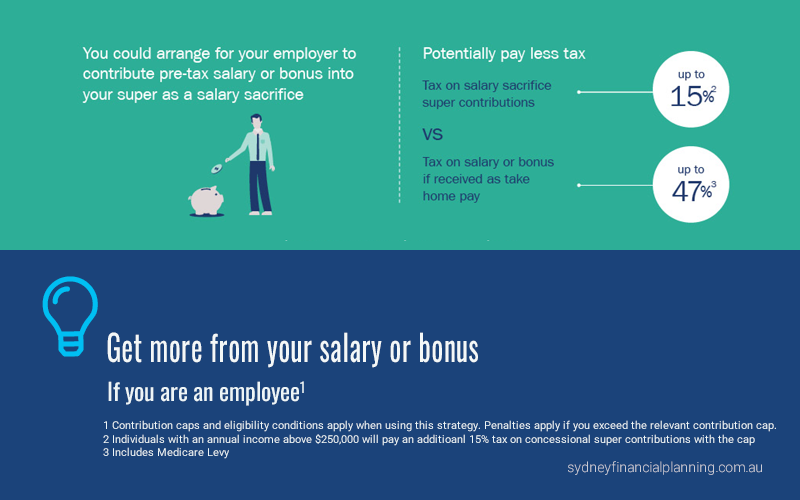
    2. Get more from your salary or a bonus

    If you’re an employee, you may be able to arrange for your employer to direct some of your pre-tax salary or a bonus into your super as a ‘salary sacrifice’ contribution.

    Again, you’ll potentially pay less tax on this money than if you received it as take-home pay – generally 15% for those earning under $250,000 pa, compared with up to 47% (including Medicare Levy).

    How it works

    Ask your employer if they offer salary sacrifice. If they do, it can be a great way to help grow your super tax-effectively because the contributions are made from your pre-tax pay – before you get a chance to spend it on other things.

    You can only salary sacrifice amounts that you’re not yet entitled to receive. This includes both your regular salary, and any entitlement to a bonus.

    Remember salary sacrifice contributions count towards your concessional contribution cap, along with any superannuation guarantee contributions from your employer and personal deductible contributions. Also, you may be able to make catch up (extra) contributions if your concessional contributions were less than the annual concessional cap since 1 July 2018.

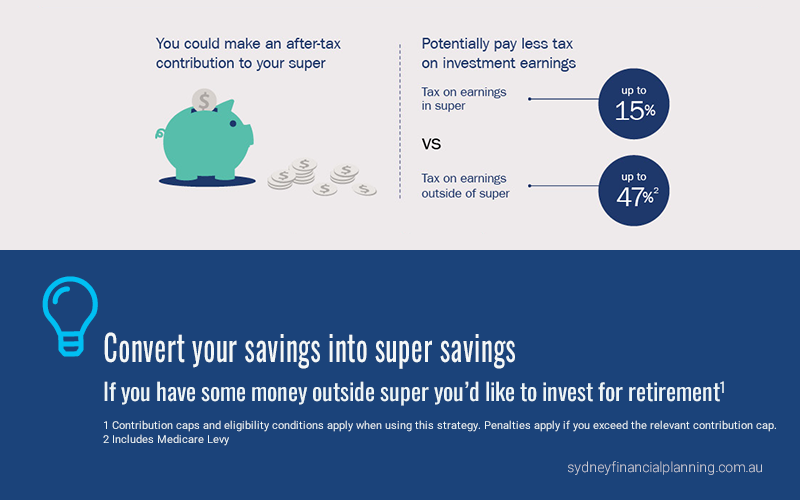
    3. Convert your savings into super savings
    Another way to invest more in your super is with some of your after-tax income or savings, by making a personal non-concessional contribution.

    Although these contributions don’t reduce your taxable income for the year, you can still benefit from the low tax rate of up to 15% that’s paid in super on investment earnings. This tax rate may be lower than what you’d pay if you held the money in other investments outside super.

    How it works

    Before you consider this strategy, make sure you’ll stay under your non-concessional contribution (NCC) cap, which in 2021/22 is $110,000 – or up to $330,000 if you meet certain conditions. That’s because after-tax contributions count as non-concessional contributions – and penalties apply if you exceed the cap.

    Also, to use this strategy in 2021/22, your total super balance (TSB) must have been under $1.7 million on 30 June 2021.

    If you’re 67–74, you’ll also need to meet the work test (or be eligible to apply the ‘work test exemption) to make NCCs this financial year. The work test will be removed for NCCs from 1 July.

    Remember, once you’ve put any money into your super fund, you won’t be able to access it until you reach your preservation age or meet other ‘conditions of release’. For more information, visit the ATO website at ato.gov.au.

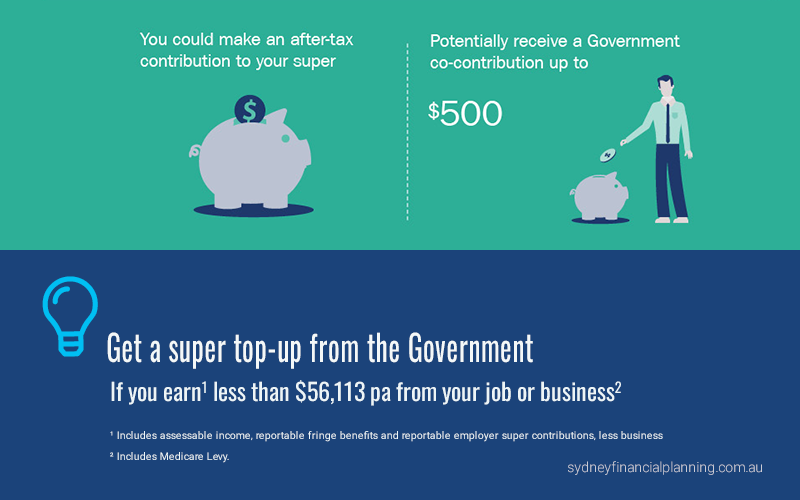
    4. Get a super top-up from the Government

    If you earn less than $56,113 in the 2021/22 financial year, and at least 10% is from your job or a business, you may want to consider making an aftertax super contribution. If you do, the

    Government may make a ‘co-contribution’ of up to $500 into your super account.

    How it works

    The maximum co-contribution is available if you contribute $1,000 and earn $41,112 pa or less. You may receive a lower amount if you contribute less than $1,000 and/or earn between $41,113 and $56,112 pa.

    Be aware that earnings include assessable income, reportable fringe benefits and reportable employer super contributions. Other conditions also apply – your financial adviser can run you through them.

    5. Boost your spouse’s super and reduce your tax

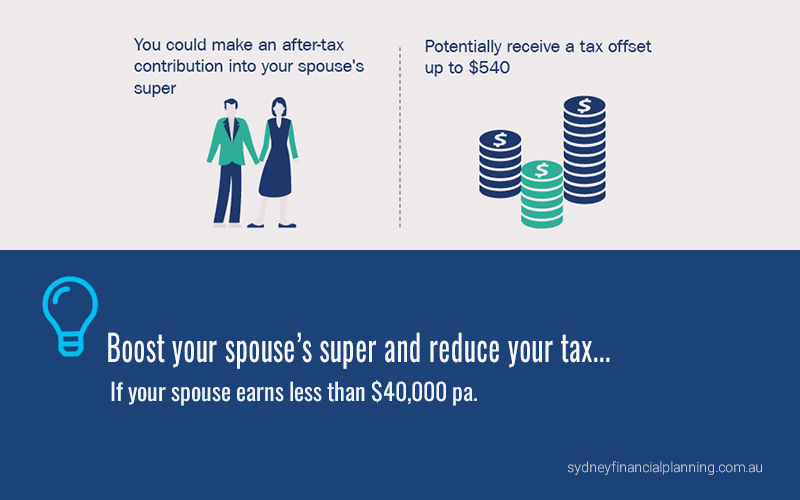
    If your spouse is not working or earns a low income, you may want to consider making an after-tax contribution into their super account. This strategy could potentially benefit you both: your spouse’s super account gets a boost and you may qualify for a tax offset of up to $540.

    How it works

    You may be able to get the full offset if you contribute $3,000 and your spouse earns $37,000 or less pa (including their assessable income, reportable fringe benefits and reportable employer super contributions).

    A lower tax offset may be available if you contribute less than $3,000, or your spouse earns between $37,000 and $40,000 pa.

    Need advice?

    You’ll need to meet certain eligibility conditions before benefitting from any of these strategies. If you’re thinking about investing more in super before 30 June, talk to us. We can help you decide which strategies are appropriate for you.


    If you aren’t sure how to proceed or if you meet the specific criteria…

    Speak with one of our Financial Planners about the best approach for your circumstances asap, either book a meeting or get in contact with us on 02 9328 0876.

    1 Individuals with income above $250,000 pa will pay an additional 15% tax on personal deductible and other concessional super contributions.

    2 Includes Medicare Levy.

    General Disclaimer: While every care has been taken in the preparation of this document, Sydney Financial Planning and Charter FP make no representations or warranties as to the accuracy or completeness of any statement in it.This article contains information that is general in nature. It does not take into account the objectives, financial situation or needs of any particular person. You need to consider your financial situation and needs before making any decisions based on this information. Please seek personal financial advice prior to acting on this information.


    Topping up super with ‘catch-up’ contributions

    Topping up super with ‘catch-up’ contributions

    Topping up super with ‘catch-up’ contributions

    Depending on your circumstances, this could help you to maximise tax-effective super contributions and invest more for retirement.

    How does the strategy work?

    If your concessional contributions (CCs) in a financial year are below the annual CC cap, you’re able to accrue these unused amounts and carry them forward. This applies to unused cap amounts since 1 July 2018 and can be carried forward for up to five years. This means if you meet certain eligibility rules, you’ll be able to make larger CCs in a later financial year.

    This may give you greater flexibility to make larger CCs when your circumstances allow. This may be helpful if, for example, you have irregular employment income, fluctuating income or have had time out of the workforce.

    What’s the benefit?

    The amount you contribute is generally taxed at the concessional rate of up to 15%1. Once contributed, any earnings are also taxed at a concessional rate of 15%, rather than your marginal rate, which could be up to 47%2. Depending on your circumstances, this strategy could result in a tax saving of up to 32% and enable you to increase your super savings.

    Key conditions

    To be eligible to utilise your carried forward unused CCs by making a catch-up contribution you must:

    • have a ‘total superannuation balance’3 below $500,000 on the prior 30 June
    • be under 75 and meet the work test rules (or be eligible to apply the work test exemption) if you’re aged 67 to 74, and
    • have unused CC cap amounts accrued from one of the five prior financial years (but not before 2018/19).

    Accruing unused CC cap amounts

    The first financial year you could accrue unused CCs was in 2018/19. Unused CC amounts can be carried forward for up to five years before they expire.

    Seek advice

    Your financial adviser can help determine whether this strategy is right for you. They can also help you to work out what your available carried forward unused CC balance4 is and how much you’re eligible to contribute. Additional tax and other penalties may apply if you make contributions that exceed your available cap.

    To work out your carried forward amounts, you need to confirm the total amount of CCs you have made in each financial year since 1 July 2018. You can access information about your contributions by logging on to my.gov.au. Information displayed might not be up to date, so it is also important to keep accurate contributions records and enquire directly to your super fund before contributing.

    Case Study

    In 2018/19 and 2019/20, Fatima made CCs of $15,000, which was $10,000 less than the annual CC cap of $25,000.

    Fatima took 12 months maternity leave from 1 July 2020 and didn’t make any CCs in FY 2020/21.

    From 1 July 2021, Fatima returns to full-time work where her employer contributions (CCs) total $15,000 in 2021/22. This is $12,500 less than the annual cap that applies in this financial year ($27,500).

    Fatima receives an inheritance of $35,000 in 2021/22 that she wants to contribute to super. The table below shows how she can carry forward unused CCs to make catch up contributions in 2021/22 in later years.

    Financial year

    Annual CC cap amount

    Total CC cap including any carried forward CCs

    CCs made

    Unused CCs that may be carried forward

    2018/19 $25,000 $25,000 $15,000 $10,000
    2019/20 $25,000 $35,000 $15,000 $20,000
    2020/21 $25,000 $45,000 $0 $45,000
    2021/22 $27,500 $72,500 $50,000 $22,500

    Other key considerations

    • It’s important to check your total CCs for the financial year from all sources before adjusting your contribution strategy. CCs include:
      • contributions made for you by your employer as well as an estimate of any further employer contributions for the year
      • salary sacrifice contributions, and
      • personal contributions that you claim a tax deduction for.
    • For personal deductible contributions, you need to lodge a ‘Notice of Intent’ form and receive an acknowledgement from the superfund before certain timeframes, and alsobefore starting a pension, withdrawal or rollover.
    • If you are not eligible to make catch-up CCs, tax penalties apply if you exceed the annual CC cap of $27,500 in FY 2021/22.
    • You can’t access super until you meet certain conditions.


    If you aren’t sure how to proceed or if you meet the specific criteria…

    Speak with one of our Financial Planners about the best approach for your circumstances asap, either book a meeting or get in contact with us on 02 9328 0876.


    1 Individuals with income from certain sources above $250,000 in FY 2021/22 will pay an additional 15% tax on salary sacrifice, personal deductible and other CCs within your cap.

    2 Includes Medicare levy.

    3 Your ‘total superannuation balance’ includes all of your super accumulation interests and amounts held in superannuation income stream products. For more information, visit ato.gov.au, and check your total super balance by logging into my.gov.au.

    4 You can also obtain this information by logging into my.gov.au


    General Disclaimer: While every care has been taken in the preparation of this document, Sydney Financial Planning and Charter FP make no representations or warranties as to the accuracy or completeness of any statement in it.This article contains information that is general in nature. It does not take into account the objectives, financial situation or needs of any particular person. You need to consider your financial situation and needs before making any decisions based on this information. Please seek personal financial advice prior to acting on this information.

    Top-up your super with help from the Government

    Top-up your super with help from the Government

    Top-up your super with help from the Government

    How does the strategy work?

    If you earn¹ less than $56,112 pa (of which at least 10% is from eligible employment or carrying on a business) and you make personal after-tax super contributions, the Government may also contribute into your super account. This additional super contribution, which is known as a co-contribution, could make a significant difference to the value of your retirement savings over time. To qualify for a co-contribution, you will need to meet a range of conditions, but as a general rule:

    • the maximum co-contribution of $500 is available if you contribute $1,000 and earn $41,112 or less
    • a reduced amount may be received if you contribute less than $1,000 and/or earn between $41,113 and $56,112, and
    • you will not be eligible for a co-contribution if you earn $56,113 or more.

    The Australian Taxation Office (ATO) will determine whether you qualify based on the data received from your super fund and the information contained in your tax return for that financial year.

    As a result, there can be a time lag between when you make your personal after-tax super contribution and when the Government pays the co‑contribution.

    If you’re eligible for the co-contribution, you can nominate which fund you would like to receive the payment.

    Alternatively, if you don’t make a nomination and you have more than one account, the ATO will pay the money into one of your funds based on set criteria.

    Note: Some funds or superannuation interests may not be able to receive co-contributions. This includes unfunded public sector schemes, defined benefit interests, traditional policies (such as endowment or whole of life) and insurance only superannuation interests.

    Other key considerations

    • You can’t access super until you meet certain conditions.
    • You may want to consider other ways to contribute to super, such as salary sacrifice or personal deductible contributions.

    Seek advice

    A financial adviser can help you determine whether you should make personal super contributions and assess whether you will qualify for a Government co-contribution.

    Case Study

    Ryan, aged 40, is employed and earns $35,000 pa. He wants to build his retirement savings and can afford to invest $1,000 a year.

    After speaking to a financial adviser, he decides to use the $1,000 to make a personal after-tax super contribution.

    By using this strategy, he’ll qualify for a cocontribution of $500 and the investment earnings will be taxed at a maximum rate of 15%.

    Conversely, if he invests the money outside super each year (in a managed fund, for example), he will not qualify for a cocontribution and the earnings will be taxable at his marginal rate of 21%


    Details

    Receive pay rise as after-tax salary

    Sacrifice pay rise into super

    Amount invested $1,000 $1,000
    Plus co-contribution Nil $500
    Total investment $1,000 $1,500
    Tax rate payable on investment earnings 21%2 15%


    Next steps

    Contribution rules and eligibility criteria for catch up CCs are complex. This guide is not designed to provide comprehensive information about how the rules work or apply to you. It is important that you speak with your financial adviser, your registered tax agent and visit the ato.gov.au for more information.


    If you aren’t sure how to proceed or if you meet the specific criteria…

    Speak with one of our Financial Planners about the best approach for your circumstances asap, either book a meeting or get in contact with us on 02 9328 0876.


    1Includes assessable income, reportable fringe benefits and reportable employer super contributions, less business deductions and assessable First Home Super Saver amounts. Other conditions apply.

    2 Includes Medicare Levy.


    General Disclaimer: While every care has been taken in the preparation of this document, Sydney Financial Planning and Charter FP make no representations or warranties as to the accuracy or completeness of any statement in it.This article contains information that is general in nature. It does not take into account the objectives, financial situation or needs of any particular person. You need to consider your financial situation and needs before making any decisions based on this information. Please seek personal financial advice prior to acting on this information.

    Sacrifice pre-tax salary into super

    Sacrifice pre-tax salary into super

    Sacrifice pre-tax salary into super

    How does the strategy work?

    With this strategy, known as salary sacrifice, you need to arrange for your employer to contribute some of your pre‑tax salary, wages or bonus directly into your super fund.

    The amount you contribute will generally be taxed at the concessional rate of 15%1, not your marginal rate which could be up to 47%2. Depending on your circumstances, this strategy could reduce the tax you pay on your salary, wages or bonus by up to 32%.

    Also, by paying less tax, you can make a larger after-tax investment for your retirement, as the case study on the opposite page illustrates.

    What income can be salary sacrificed?

    • You can only sacrifice income that relates to future employment and entitlements that have not been accrued.
    • With salary and wages, the arrangement needs to be in place before you perform the work that entitles you to the salary or wages.
    • With a bonus, the arrangement needs to be made before the bonus entitlement is determined.
    • The arrangement, which should be documented and signed by you and your employer, should include details such as the amount to be sacrificed into super and the frequency of the contributions.

    Other key considerations

    • Salary sacrifice contributions count towards the ‘concessional contribution’ cap. This capis $27,500 in FY 2021/22, or may be higherif you didn’t contribute your full concessionalcontribution cap since 1 July 2018 and areeligible to make ‘catch-up’ contributions. Tax implications and penalties apply if you exceed your cap.
    • You can’t access super until you meet certain conditions.
    • Another way you may be able to grow your super tax-effectively is to make personal deductible contributions (see opposite page).

    Seek advice

    A financial adviser can help you determine whether salary sacrifice suits your needs and circumstances.

    Case Study

    William, aged 45, was recently promoted and has received a pay rise of $5,000, bringing his total salary to $90,000 pa.

    He plans to retire in 20 years and wants to use his pay rise to boost his retirement savings..

    After speaking to a financial adviser, he decides to sacrifice the extra $5,000 into super each year.

    By using this strategy, he’ll save on tax and have an extra $975 in the first year to invest into super, when compared to receiving the $5,000 as after-tax salary (see Table 1).

    If he continued to salary sacrifice this amount into super, this could lead to William having an additional $150,394 in his super after 20 years (see Table 2).


    Table 1. After-tax income vs salary sacrifice

    Details

    Receive pay rise as after-tax salary

    Sacrifice pay rise into super

    Personal super contribution $5,000 $5,000
    Less income tax at 34.5%3 ($1,725) (N/A)
    Less 15% contributions tax (N/A) ($750)
    Net amount $3,275 $4,250
    Additional amount in super 21%2 $975


    Table 2. Super balances4

    Year

    No salary sacrifice

    Salary sacrifice into super

    Difference

    Year 5 $279,725 $304,029 $24,304
    Year 10 $416,168 $472,072 $55,904
    Year 15 $593,558 $690,543 $96,985
    Year 20 $824,183 $974,577 $150,394

    Personal Deductible Contributions

    Like salary sacrifice, making a personal super contribution and claiming a tax deduction may enable you to boost your super tax-effectively. There are, however, a range of issues you should consider before deciding to use this strategy.

    Your financial adviser can help you determine whether you should consider making personal deductible contributions instead of (or in addition to) salary sacrifice.

    You may also want to ask your financial adviser for a copy of our super strategy card, called ‘Make tax-deductible super contributions’.


    If you aren’t sure how to proceed or if you meet the specific criteria…

    Speak with one of our Financial Planners about the best approach for your circumstances asap, either book a meeting or get in contact with us on 02 9328 0876.

    1 Individuals with income above $250,000 pa will pay an additional 15% tax on personal deductible and other concessional super contributions.

    2 Includes Medicare Levy.

    3 Includes Medicare Levy. Based on FY 2021/22 tax rates.

    4 Assumptions: A 20-year comparison based on contribution of $5,000 pa of pre-tax salary on top of compulsory superannuation guarantee. Super investments earn a total return of 6.34% pa, balances shown at the end of 5/10/15/20 year periods. All figures are after income tax of 15% in super and capital gains tax (including discounting). These rates are assumed to remain constant over the investment period. William’s salary of $90,000 pa is indexed to CPI. Difference does not take into account money potentially invested outside super if pay rise received as after tax salary.

    General Disclaimer: While every care has been taken in the preparation of this document, Sydney Financial Planning and Charter FP make no representations or warranties as to the accuracy or completeness of any statement in it.This article contains information that is general in nature. It does not take into account the objectives, financial situation or needs of any particular person. You need to consider your financial situation and needs before making any decisions based on this information. Please seek personal financial advice prior to acting on this information.


    Splitting your super contributions to your spouse

    Splitting your super contributions to your spouse

    Splitting your super contributions to your spouse

    How does the strategy work?

    You may be able to split (transfer) eligible concessional contributions (CCs) that you’ve made or received to your spouse’s super account.

    Eligible CCs include employer super contributions and personal super contributions for which you have claimed a tax deduction.

    Contribution splitting can be a great way to increase your spouse’s super savings particularly where they, for example:

    • are not working
    • have had time out of the workforce, or
    • have a lower super balance.

    What’s the benefit?

    In addition to boosting your spouse’s retirement savings, there may be other benefits depending on your specific circumstances.

    Help to cover insurance premiums

    Contribution splitting can help to pay your spouse’s insurance premiums for policies held inside super. This may be beneficial during times where your spouse has reduced their working hours or is out of the workforce and their contributions have reduced.

    Maximise tax-free retirement savings

    A limit applies to how much super can be transferred into ‘retirement phase’ income streams, where investment earnings are taxed at 0%. Contribution splitting may help you take better advantage of these limits as a couple and maximise the total amount you can hold tax-effectively when you retire.

    Maximise Age Pension

    If you have a younger spouse who is under their Age Pension age, contribution splitting may help to improve your Centrelink entitlements. Superannuation held in the ‘accumulation phase’ is not assessed for social security purposes until the account holder reaches their Age Pension age. Splitting super to your younger spouse may therefore reduce the assets assessed when your entitlement is calculated, potentially increasing your Age Pension entitlement.

    What contributions can be split?

    Only eligible CCs can be split to your spouse, such as superannuation guarantee (SG), salary sacrifice and personal deductible contributions. Non-concessional or ‘after-tax’ contributions cannot be split.

    Generally, the maximum amount that can be split is the lesser of:

    • 85% of your CCs for the year (after taking into account 15% contributions tax), or
    • your CC cap for the financial year.

    The CC cap was $25,000 in 2020/21 and is $27,500 in 2021/22. However, if you’re eligible to make larger CCs in a financial year using the ‘catch-up’ contribution rule, your applicable CC cap may be higher.1

    You can generally only split CCs made in the previous financial year. Also, you need to request to split your CCs in writing to the trustee of your super fund within 12 months after the end of the financial year the CCs were made to your super fund (unless you’re going to roll over your balance or close your account).

    For more information on catch-up contributions, ask your financial adviser for a copy of our ‘Top up your super with ‘catchup’ contributions’ super strategy card.

    Case study

    Lucy would like to split some of her eligible CCs made during 2020/21 to her husband Luke’s (age 40) super fund.

    In FY 2020/21, her employer contributed $20,000 to her super fund and her CC cap was $25,000. The maximum amount that Lucy can split to Luke is the lesser of:

    • $17,000 (85% of the $20,000 contributed by her employer), and
    • $25,000 (her CC cap in 2020/21).

    Lucy elects to split $15,000 of her CCs to Luke’s super fund and submits the contribution splitting application form to her fund in 2021/22.

    Her super fund transfers $15,000 to Luke’s super fund. This won’t reduce Lucy’s CCs for the financial year and the transfer won’t be assessed as a contribution against Luke’s contribution caps.

    Note: If Lucy was eligible to make larger CCs in 2020/21 using the ‘catch-up’ contribution rule, her CC cap may be greater than $25,000. This may increase the maximum amount of contributions she could potentially split to Luke if she made larger CCs in that financial year.

    Is your spouse eligible?

    To be eligible to split your super to your spouse, they must be either:

    • under their ‘preservation age’2, or
    • between their preservation age and under 65 and declare they are not currently retired for superannuation purposes.

    Once your spouse reaches age 65, they are no longer eligible to receive a contribution split from your super.

    Other key considerations

    Contribution splitting may be used by married couples, de facto partners and same sex couples.

    Contributions split to your spouse:

    • will form part of the taxable component of your spouse’s super account
    • don’t count towards their CC cap, as they have already counted towards your CC cap in the year the contributions were made to your account.
    • The split amount is fully preserved in the receiving spouse’s account and they can’t access their super until they meet certain conditions.
    • Where a personal deductible contribution forms part or all of the amount to be split, a Notice of Intent to claim a tax deduction must be lodged and acknowledged by the super fund prior to the contribution split being processed.
    • If you’re intending to rollover or withdraw your entire benefit and you wish to split CCs made in the same financial year or from the previous financial year, the split must be completed prior to the rollover or withdrawal request being processed.
    • It’s not compulsory for a super fund to offer contribution splitting. You will need to check with your fund to see if they allow it.

    Seek advice

    Your financial adviser can help determine whether this strategy is right for you. This includes working out whether your spouse is eligible to receive a contributions split from your super and how much you’re eligible to split.

    Where your CCs in a financial year have exceeded your available cap, the excess amounts cannot be split to your spouse and additional tax and other penalties may apply.

    We recommend you consult with a registered tax agent.

    You will need to confirm the total amount of CCs in the previous financial year. You can access information about your contributions by logging on to my.gov.au. Information displayed might not be up to date, so it’s also important to keep accurate contributions records and enquire directly to your super fund before requesting to split.


    If you aren’t sure how to proceed or if you meet the specific criteria…

    Speak with one of our Financial Planners about the best approach for your circumstances asap, either book a meeting or get in contact with us on 02 9328 0876.

    1 Individuals with income above $250,000 pa will pay an additional 15% tax on personal deductible and other concessional super contributions.
    2 Includes Medicare Levy.
    3 Includes Medicare Levy. Based on FY 2021/22 tax rates.
    4 Assumptions: A 20-year comparison based on contribution of $5,000 pa of pre-tax salary on top of compulsory superannuation guarantee. Super investments earn a total return of 6.34% pa, balances shown at the end of 5/10/15/20 year periods. All figures are after income tax of 15% in super and capital gains tax (including discounting). These rates are assumed to remain constant over the investment period. William’s salary of $90,000 pa is indexed to CPI. Difference does not take into account money potentially invested outside super if pay rise received as after tax salary.

    General Disclaimer: While every care has been taken in the preparation of this document, Sydney Financial Planning and Charter FP make no representations or warranties as to the accuracy or completeness of any statement in it.This article contains information that is general in nature. It does not take into account the objectives, financial situation or needs of any particular person. You need to consider your financial situation and needs before making any decisions based on this information. Please seek personal financial advice prior to acting on this information.

    tax deduction for your super contribution

    Steps to claiming a tax deduction for your super contribution

    tax deduction for your super contribution

    What are personal deductible contributions? 

    A personal deductible contribution (PDC) is a voluntary contribution that you make to super on your own behalf and claim a tax deduction in your tax return. These contributions are made with after-tax money, such as your take-home pay or other funds that you might have in savings, such as a bank account. PDCs are generally taxed in the super fund at up to 15%1, instead of your marginal tax rate which could be up to 47%2.

    Caps apply which limit the total amount you’re able to contribute to super. Personal contributions ordinarily count towards your non-concessional contribution (NCC) cap. However, if you follow the steps below and claim a tax deduction for some or all of your personal contributions, these amounts will instead count towards your concessional contribution (CC) cap. To find out whether you could benefit from this strategy, you should speak to a financial adviser and a registered tax agent.

    Overview on the steps

    Step 1:

    Check your contribution eligibility and CC cap

    step1 check eligility 001

    Details:

    Ensure that directing savings to super is right for you and you are eligible to contribute.
    The amount that can be contributed with concessional tax treatment is limited by the CC cap. The general CC cap is $27,500 in 2021/22 and 2022/23.

    Your personal CC cap might be higher if you haven’t fully utilised your CC cap each year since 1 July 2018. In this case, you may be eligible to make ‘catch-up concessional contributions’ where certain conditions are met. See ato.gov.au for more information.

    Other considerations:

    Eligibility to contribute – age limits
    If you’re 67-74 at the time you make the contribution, you’ll need to have met a work test for the financial year, or be eligible to apply the work-test exemption.
    You cannot make a PDC if you’re aged 75 or older3.

    Consider all CCs and timing
    Consider what other CCs have been made during the financial year as well as those you’re likely to receive from all sources including employer
    contributions and salary sacrifice. It’s important to also consider possible changes to CCs such as additional employer contributions due to a salary increase or bonuses.

    If you’re not able to accurately predict your CCs from other sources, you can wait until closer to the end of financial year to make your PDC. You can make more than one personal contribution throughout the year, but be sure to follow all of the steps below to make sure you’re able to claim a deduction for each contribution.

    1 If you’re a high income earner and have income from certain sources of more than $250,000 pa, you’ll need to pay an additional 15% tax on your CCs within your CC cap. This is called Division 293 tax. If you’re liable, you’ll receive a notice from the ATO.
    2 Includes Medicare levy
    3 Contributions must be received no later than 28 days after the month in which you turn 75. Limitations can also apply to other types of contributions, Refer to ato.gov.au for more information.


    Step 2:

    Make a personal contribution

    step2 make contributions 001

    Details:

    Once you’ve worked with your financial adviser to confirm that a PDC is right for you, it’s time to make your personal contribution to your super fund.

    Be mindful of your fund’s requirements and timeframes.

    Other considerations:

    Check cut off dates
    If you’re contributing right at the end of the financial year, it is important to check cut-off dates with your super fund to make sure that your contribution is received and allocated to the right financial year.

    A contribution is generally ‘made’ when it is received by your super fund which can be different to when you have actioned your contribution (such as via electronic transfer). Therefore, it is important to ensure there is sufficient time for your super fund to receive the contribution in the financial year which you want the contribution to be made.

    Check BPay codes
    It is also important to check your contribution payment options with your super fund, making sure if you’re using BPay for example, that you use the correct BPay code. Even though a PDC is a CC, you’re making a personal contribution to super which will usually have a different BPay code.


    Step 3:

    Lodge a Notice of Intent to claim form with your super fund

    step3 lodge notice 001

    Details:

    The Notice of Intent form notifies your fund that you are going to claim a deduction for all or part of the personal contributions that you’ve made to super.

    Tax law requires that this form is lodged within certain timeframes. If you don’t meet this requirement, your notice will be invalid and you’ll be ineligible to claim a tax deduction. Unfortunately your fund has no discretion to waive this requirement.

    Other considerations:

    Important timing requirements
    You must lodge the form with your super fund before the earlier of:

    • the day you submit your tax return for the financial year, or
    • the end of the following financial year.

    For example, for PDCs made in the 2021/22 financial year, you must submit the Notice of Intent to your super fund either before you lodge your tax return for 2021/22, or by 30 June 2023, whichever occurs first.


    Step 4:

    Receive acknowledgement from the fund

    step4 receive acknowledgement 001

    Details:

    Your super fund will send you an acknowledgement to confirm that they have received your Notice of Intent form.

    Other considerations:

    Seek tax advice
    An ackowledgement only confirms reciept of a valid Notice of Intent and is not a subsitiute for tax advice. You will need to seek advice from your registered tax agent to claim the deduction in your tax return.

    Ensure that you file this letter as you may wish to provide it to your registered tax agent when your tax return is being prepared.


    Step 5:

    Submit your tax return

    step5 submit tax return 001

    Details:

    Only after your Notice of Intent is submitted and acknowledgement received should you complete your tax return.

    Other considerations:

    If you’re late in submitting your tax return
    Remember that if for some reason you don’t complete your 2021/22 tax return before 30 June 2023, you’ll still need to make sure your Notice of Intent has been submitted before this date or you won’t be eligibile to claim the deduction.


    Step 6:

    Make sure steps 3 and 4 are completed before rolling over or withdrawing funds

    step6 make sure 001

    Details:

    You need to ensure you’ve lodged your Notice of Intent and received acknowledgement before you withdraw or rollover some or all of the funds in your super account. This may occur in the same financial year as making the contribution.

    If you don’t lodge your Notice of Intent first, you may only be entitled to a:

    • partial deduction (if you withdraw or rollover part of your balance), or
    • no deduction if you’ve rolled over or withdrawn the full balance.

    Other considerations:

    If you completed a partial rollover or withdrawal before lodging your Notice of Intent
    You’ll need to seek advice from your financial adviser or registered tax agent to determine the reduced amount that you’re able to claim a deduction for. You must submit a valid Notice of Intent for this amount. Your super fund is not a registered tax agent and cannot do this for you.

    If you submit a Notice of Intent for the full value of the personal contribution after a parital rollover or withdrawal occurs, the notice is invalid, and you’ll need to follow the above steps to resubmit a valid notice.

    Be aware that an automatic rollover that is established to rollover funds periodically to pay for insurance premiums in another super account is a considered a partial rollover. You must ensure that a Notice of Intent is lodged and ackowledged for any contributions made before the rollover occurs during the financial year.


    Step 7:

    Make sure steps 3 and 4 are completed before you commence an income stream during the year

    step7 make sure 001

    Details:

    If you commence an income stream with any of your account balance before lodging your Notice of Intent and receiving the acknowledgment, you won’t be eligible to claim any deduction for a personal contribution made to the fund during the financial year.

    Other considerations:

    No discretion available
    Once an income stream has commenced using any of the account balance, there is no action that can be taken to rectify this and tax law states that any subsequent notice is invalid. Unfortunately the super fund and the ATO have no discretion to accept a Notice of Intent after the income stream has commenced.


    Other important considerations

    Change in circumstances

    If your circumstances change after you’ve lodged a valid Notice of Intent, you may be able to submit another form to:

    • vary down the amount you intend to claim a deduction for (including to nil), or
    • notify your fund that you intend to claim a deduction for additional contributions.

    Time limits and other requirements apply. This is a complex area and you should seek advice from your financial adviser and/or registered tax agent. ATO denies deduction When you lodge your tax return, you include the value of the deduction for your superannuation contributions that you wish to claim.

    However, the ATO will assess your tax return and, in limited situations, may deny your entitlement to the deduction as permitted under the legislation. Generally, this will arise if you don’t have sufficient assessable income to offset the deduction you are claiming after allowing for other tax deductions.

    If the ATO denies your deduction, certain steps must be followed which are similar to varying the amount claimed as a tax deduction (see change in circumstances). However, as time limits and other requirements apply, you should seek advice from your financial planner and/or registered tax agent.

    If you want to make a PDC and split some of your contributions with your spouse

    If eligible, you may be able to split some of your CCs, including PDCs, with your spouse. Generally, you’ll need to wait to lodge a contribution splitting application with your fund until after the end of the financial year in which the contribution was made (unless you’re going to rollover your entire balance to another fund, or withdraw your balance in full, during the financial year). However, you’ll need to make sure that your Notice of Intent has been lodged and acknowledged before lodging your splitting application.

    Next steps

    Contribution rules and eligibility criteria for catch up CCs are complex. This guide is not designed to provide comprehensive information about how the rules work or apply to you. It is important that you speak with your financial adviser, your registered tax agent and visit the ato.gov.au for more information.


    If you aren’t sure how to proceed or if you meet the specific criteria…

    Speak with one of our Financial Planners about the best approach for your circumstances asap, either book a meeting or get in contact with us on 02 9328 0876.


    General Disclaimer: While every care has been taken in the preparation of this document, Sydney Financial Planning and Charter FP make no representations or warranties as to the accuracy or completeness of any statement in it.This article contains information that is general in nature. It does not take into account the objectives, financial situation or needs of any particular person. You need to consider your financial situation and needs before making any decisions based on this information. Please seek personal financial advice prior to acting on this information.


    Acessing superannuation in Coronavirus Crisis

    Thinking of accessing your super due to coronavirus crisis?

    Acessing superannuation in Coronavirus Crisis

    There are two opportunities to access super:

    Up to $10,000 before 1/7/2020 AND up to additional $10,000 between 1/7/2020 – 24/9/2020

    • One application permitted in each period
    • Applications are available from 20th April 2020
    • Withdrawals will be tax free. No impact on Centrelink.
    • Don’t contact your super directly, the applications must be done online via MyGov account (or by phone to ATO)
    • Make sure you have set up MyGov account
    • You will be able to self-assess for faster processing
    • Your ATO MyGov account will display all super in your name – you can elect to claim a portion from each account (say $5K from one and $5K from other)
    • If you’re rejected, you’ll be notified in 2-3 days
    • No timeframe set for when money will be released BUT
    • Normal ID requirements are waived for fast approvals (government intention).

    Who is eligible?

    • If you’ve been unemployed or eligible to receive Jobseeker Payment, equivalent Youth Allowance, Parenting Payment, Special Benefit or Farm Household Allowance, or
    • On or after 1 January 2020, you’ve been made redundant; or had your working hours reduced by 20% or more; or as a sole trader your business was suspended or turnover decreased by at least 20%.

    Other important information:

    • Due to current market downturn, you’re likely to crystallise loses in your account
    • You can always contribute the amount back to super if not used (subject to usual contribution caps)
    • Notice of Intent (NOI) to claim tax deduction for the year needs to be send to your super before withdrawal
    • Once you receive money, consider keeping withdrawn funds in a suitable account (e.g. offset account)
    • Check your insurance benefits and premiums payable, otherwise you can lose your cover.


    Remember we are available to help you during this unprecedented time…

    If you have ANY please get in touch to speak with one of our Financial Planners we’re here to help, either book a virtual meeting of get in contact with us on 02 9328 0876.


    Article by Michal Bodi | Senior Financial Planner


    General Disclaimer: This article contains information that is general in nature. It does not take into account the objectives, financial situation or needs of any particular person. You need to consider your financial situation and needs before making any decisions based on this information. Please seek personal financial advice prior to acting on this information.

    Photo by Diego PH on Unsplash

    What do Australians want financial advice on?

    What do Australians want financial advice on?

    What do Australians want financial advice on?

    According to the recent ASIC report [1], the topics Australians want financial advice on:

    • Investments (e.g. shares and managed funds) 45%
    • Retirement income planning 37%
    • Growing superannuation 31%
    • Budgeting or cash flow management 22%
    • Aged care planning 18%

    Despite this, only 12% of Australian surveyed sought financial advice in the past 12 months.

    Like many Australians, you might have thought about helping secure your family’s financial future by working with a financial adviser.

    According to the recent Australian Securities & Investments Commission report, ‘Financial advice: What consumers really think [2], 79% of Australians believe “financial advisers have expertise in financial matters that I do not have”.

    Yet here’s the kicker: only 12% have actually sought advice in the past 12 months.

    The good news is 41% of Australians intend to get financial advice in the future, and 25% intend on doing so in the next 12 months. Below we’ve covered the areas they are most interested in seeking advice on.

    1. Investment Advice

    According to the ASIC report, perhaps unsurprisingly, 45% of Australians want advice on investments (e.g. shares and managed funds)

    But, a 2019 report by global investment solutions firm Russell Investments – ‘Why work with a financial adviser? [3]’ states that researchers have discovered over 200 unconscious biases that influence our decisions, which could have a detrimental effect on our future wealth.

    “People tend to let their emotions and other human tendencies influence their decision making. But when it comes to investing, acting like a human may actually cost you money,” the Russell Investments report states.

    “To be a successful investor, it is important to be objective and disciplined when making investment decisions.

    2. Retirement Income Planning

    According to the ASIC report, 37% of survey participants wanted advice on retirement income planning.

    Indeed, according to the 2017 ASX Australian Investor Study [4] report, retirement and wealth accumulation are “front of mind for all age groups, and individuals are investing in products that reflect these goals”.

    The ASX report states that a single person seeking a ‘modest’ lifestyle in retirement requires a lump sum of at least $370,000 (without the age pension) invested and returning 7% p.a.

    For couples, this lump sum needs to be at least $400,000.

    In order to have a ‘comfortable’ retirement, households will require double these amounts.

    One of the most important jobs a financial adviser has is helping you to determine the best investment strategy and risk profile to achieve your long-term retirement objectives.

    “Investing early to accumulate wealth will make the difference between a modest and a comfortable retirement in the future – and whether or not individuals will need to rely on the age pension,” the ASX report states.

    Financial advisers, like us, can help you craft a diversified portfolio that is intended to provide not just a comfortable living when you eventually retire, but also design a strategy that takes into account your age, circumstances and risk appetite.

    3. Superannuation

    The ASIC survey shows that 31% of Australians also want advice on growing their superannuation.

    Now, superannuation seems to be another one of those financial topics that people know about, but don’t truly understand, despite the major long-term benefits.

    In fact, research by the Association of Superannuation Funds of Australia (ASFA)[5], has found that Australians under 30 years of age tend to have higher balances in their superannuation accounts than their bank accounts.

    And yet, 40% of young people have absolutely no idea what their superannuation balance is.

    There are also several tax deduction benefits related to superannuation contributions, and this is the kind of information a financial adviser can provide while helping you get the most out of your superannuation plan.

    4. Cash Flow

    It turns out that 22% of ASIC survey participants wanted advice on budgeting or cash flow management. And for good reason.

    This is where we can really make an impact in your current day-to-day life – not just decades down the track. We can help you manage your monthly budgets, reduce your debt and make sure you have enough cash flow to comfortably make it to the end of each month.


    Let us help you sleep better and get your financial future on track.

    Speaking with one of our financial advisors is a good place to start. Make a booking or call us on 02 9328 0876 to arrange a meeting.


    [1] & [2] Australian Securities and Investments Commission (ASIC) August 2019, Financial advice: what consumers really think, viewed January 2020 https://download.asic.gov.au/media/5243978/rep627-published-26-august-2019.pdf © AUSTRALIAN SECURITIES & INVESTMENTS COMMISSION. REPRODUCED WITH PERMISSION. PLEASE SEE THE WEBSITE FOR FURTHER INFO
    [3] Russell Investments 2019, Why work with a financial adviser?, viewed January 2200 https://www.jsagroup.com.au/wp-content/uploads/2019/08/2019-Value-of-an-Adviser_Investor-Report.pdf
    [4] Deloitte Access Economics 2017, ASX Australian Investor Study, viewed January 2020 https://www.asx.com.au/documents/resources/2017-asx-investor-study.pdf
    [5] The Association of Superannuation Funds of Australia Limited (AFSA) 2020, Young people and superannuation, viewed January 2020 http://www.superguru.com.au/about-super/youngpeople

    General Disclaimer: This article contains information that is general in nature. It does not take into account the objectives, financial situation or needs of any particular person. You need to consider your financial situation and needs before making any decisions based on this information. Please seek personal financial advice prior to acting on this information.