Tag: Wealth Creation

Gig Economy

The rise of the gig economy and side gigs (thanks to technology)

Gig Economy

While the gig economy has been bubbling away in the background for a while now, it continues to be on the rise, and people are finding new ways to make a bit of extra cash.i

Side gigs aren’t a new concept, but thanks to technology, opportunities are available to more skillsets than ever. In fact, these days, putting your services or wares on the market (whatever they may be) can be as easy as joining the right online marketplace and waiting for a bite.

Why people are taking on more work

In a time-poor world, it’s interesting that people should want to take on more work. The reasons are often as unique as the person, but there seems to be some common themes:

1. For an income boost.

Websites like AirTasker and Freelancer. com have helped people offer their skills to clients in their own time. Freelance work in particular is on the rise in Australia – according to a study by Upwork, nearly one-third (32%) of working-age Australians freelanced in 2015.ii

2. To follow a passion.

Some people are looking for ways to make extra money from their passion or to test whether it’s worthwhile pursuing full-time. They could be budding designers selling products on sites like Amazon marketplace, You Tube enthusiasts looking for followers, or lnstagram influencers posting pictures of themselves in exotic locations.

3. To seize an opportunity.

They can be people who have a spare room to offer Airbnb, or entrepreneurs who see a niche opportunity in the market and jump before big businesses do (the popular book ‘Good night stories for rebel girls’ was funded through the kick-starter website and self-published after the authors saw a gap in the market).

4. To test a new business idea.

It can feel risky to jump straight into a new business idea. Some people may choose to launch their idea on the side, help them understand the market better, and refine their offer before launching on a larger scale.

And there are plenty of other reasons too -some people might be looking to build their network, to keep learning, or to add more skillsets to their resume.

Why side gigs are a good thing

Gig work can cater to niche needs that bigger businesses might not see as worth their while. They can also bring about competition, providing consumers with more choice, lower costs and better service (think how Airbnb has changed the hotel industry).

What’s more, the growing gig market is connecting people in new ways and bringing local and global communities together via technology. These days it’s much easier to stay at someone’s place in Manhattan, get a uniquely designed gift from the Pilbara, watch how to tie a scarf like a Parisian and get a local tradie to fix your tap at 8pm.

The downsides

As the gig economy grows in popularity, laws and regulations are still catching up. University of Technology Sydney, Future of work research director Sarah Kaine warned in an interview with ABOiii that much of the “independent work falls outside the existing labour laws “so they don’t have minimum wage provisions … (or) all of the other things that we associate with being an employee.” That includes things like being paid a fair amount, contributing to superannuation, allowances for sick leave, footing the costs for materials, as well as having insurance.

What’s to come

It will be interesting to see how the rise of side gigs will impact the employment market in the coming years. Because one thing is for sure – while the technology’s around, the ability to tap into new markets is only going to grow. We could see new and exciting developments along the way that make life better for customers, and more enriched for those doing the leg work.


Still have some questions?

If you want to discuss your income strategy or side gig idea with one of our advisors. Call us to arrange an appointment on 02 9328 0876.


i – The McCrindle Blog, 23 October 2017, Latest Census Data: How Australians learn, Work & Commute
ii  – Upwork, October 2015, Freelancing in Australia: 2015, slide 5.
iii – ABC news, 3 July 2017, Gig economy will create social classes and divide Australians, UTS researcher says.


This article contains information that is general in nature. It does not take into account the objectives, financial situation or needs of any particular person. You need to consider your financial situation and needs before making any decisions based on this information.


Managing your money

Managing your money – Budgeting in plain English

Managing your money

Do you need a budget?

A budget allows you to see how much money is coming in and going out. It helps you ensure there is enough money to cover your expenses and is an effective way to make sure you are not spending more than you can afford. More importantly, a budget can help you work out how much of your income you can put towards saving for your future, without impacting your everyday needs.

Everyone can benefit from having a budget. The purpose of a budget is not to make you go without or to force you to save. It simply allows you to manage your money in a more controlled and effective way and to understand where you are spending your money.

How do you start a budget?

Write down your normal income and expenses over the period of a month. Income can be grouped into categories such as work and income you receive from investments or other sources. Similarly, expenses can be grouped into categories such as food, clothes, entertainment and so on. This makes it easy to see exactly where your money is being spent.

A budget can help you decide what you want to spend your money on, and how much you can save.

Making your budget work

This step-by-step guide will help you build a budget that works best for you. If you have combined expenses with a partner, it is important that you work it out together.


13

Choose a timeframe

You could choose a weekly, fortnightly or monthly timeframe for your budget. Many people choose to budget on a period that matches their pay period, which makes it easier to match regular expenses with the money coming in.

2

Workout your total income

It is important to know exactly how much income you receive. This influences how much you can spend. Include any income you receive from investments, investment properties, work and any other sources.

3

Calculate your expenses

Document all your expenses, including amounts you pay towards debt. Having a clear picture of where your money is going allows you to calculate how much you can afford to save. It also helps you identify areas where you may be spending too much.4

4

Work out your surface deficit

Subtract your total expenses from your total income. If your income is greater than your expenses you will have a ‘surplus’. If your expenses are more than your income you will have a ‘deficit’.

5

Double check

  • Does your budget reflect what is actually happening?
  • Is it realistic?

If you think your budget is not quite right, then make alterations so it is accurate.

6

Track and update

Keep track of your expenses and your income, and if anything changes, update your budget. If something unexpected comes up, add this to your budget, and see if you are able to get back on track without disruption or delay. Most importantly, review your budget thoroughly at least twice a year. This will help you maintain control of your money and prevent you running into unnecessary cash flow problems.

Sticking to your budget

Be realistic

If your budget is too strict, it will be harder for you to stick to it.

Spend less than you earn

If you have a cash deficit, review your expenses and cut back where you can.

Include your goals

If you are planning an expensive holiday (or other savings goal such as home renovations or a new car), include these expenses in your budget and start saving.

Review your progress

Check how much is left in the bank each month and how much you have spent. Compare this with your budget to see how you have fared. If your budget differs from reality, you may need to make some adjustments.

Reward yourself

Managing your money in an effective way takes practice. When you are comfortable that your budget is accurate and you are able to stick to it, reward your hard work and treat yourself!

What if the unexpected happens?

Life always has a way of throw-fluiding us surprises. The financial consequences of these should not be understated. Try to keep a buffer in your budget so that when this does happen you will be able to minimise any financial strain.

Remember, if something does happen that turns your budget upside down – don’t panic. Staying calm and working out how to manage unexpected circumstances is the best way to regain control of the situation.


Looking for some help with your money management?

It really helps to get a professional perspective on things, why not arrange to meet with one of our advisors to discuss your situation. Call us to arrange an appointment on 02 9328 0876.


Photo by Rawpixel on Unsplash


General Disclaimer: This article contains information that is general in nature. It does not take into account the objectives, financial situation or needs of any particular person. You need to consider your financial situation and needs before making any decisions based on this information. Please seek personal financial advice prior to acting on this information.

Boss of your Own Money

Be the boss of your cash

Boss of your Own Money

Well, often changing how you spend the money you have now, can help you start to save that extra cash.

It all comes down to your cashflow.

Your cashflow is the amount of money that’s coming in and going out of your bank account at any point in time. It’s not a measure of your wealth, but whether there’s enough cash available to meet your expenses, with some left over. If your cashflow isn’t in check, you might find it difficult to pay your bills on time, or end up relying on credit.

The first step to a more positive cashflow is to become clear on the incomings and outgoings of your money. Understanding and managing your money well now, will help set you up for the future.
A well-managed cashflow and budget can help you:

  • Feel in control of your money and more financially confident overall
  • Feel secure about meeting your expenses, and paying off your debts
  • Save time and money
  • Start saving for other goals
  • Stop focussing on your day to day money, and start planning for your future.

Health check your cashflow

There are a few telling signs that can point to whether your cashflow is working for you. Answer yes or no to the questions below to see how healthy your day to day money is.

Do you:

  • Feel in control of your money and financially confident overall?
  • Feel secure about meeting your expenses, and paying off your debts?
  • Have a solid, workable budget?
  • Focus on how your money can help you in the future, rather than worrying about today?
  • Have a growing savings account?
  • Feel as though you don’t need to think about your money much?
  • Have bank accounts set up so they’re easy to manage?

Answering yes to all these questions means your cashflow is probably in a healthy position. And now would be a good time to start thinking about how you can save towards your goals and building wealth in other ways.

Answering no to any of these questions is ok too, because it’s a great opportunity to get your money working smarter and harder for you. Some things you can do include – setting some goals, writing a budget and making sure you have a good system in place to manage your money. There are plenty of apps and online services available that can help with this.

We’re here to help

Our job is to help you build wealth for the long term, and often getting your cash in order is the first step to growing your wealth. We can help you take a fresh look at the way you’re managing your money, and help you find new ways to save on costs and time.

Getting a clear picture of what’s happening with your money will also help you feel more confident about your finances overall. So you can stop juggling bills, and start saving for future goals.


Don’t know where to start?

For more help and to take a fresh look at the way your managing your money, speak to your financial adviser at SFP. Or if you don’t have an adviser yet, contact us on 02 9328 0876.

Photo by Brooke Lark on Unsplash


General Disclaimer: This article contains information that is general in nature. It does not take into account the objectives, financial situation or needs of any particular person. You need to consider your financial situation and needs before making any decisions based on this information. Please seek personal financial advice prior to acting on this information.

Financial Market 2017-2018

Review of 2017, outlook for 2018

Financial Market 2017-2018

  • The “sweet spot” combination of solid global growth and profits and yet low inflation and benign central banks is likely to continue in 2018. However, US inflation is likely to start to stir and the Fed is likely to get a bit more aggressive. Expect a gradual rise in bond yields and a rising US dollar. The RBA is unlikely to start hiking rates until late 2018 at the earliest.
  • Most growth assets are likely to trend higher, but expect more volatility and more constrained returns. Australian shares are likely to remain laggards.
  • The main things to keep an eye on are: the risks around Trump, inflation, the Fed and the $US; bond yields; the Italian election; China; and Australian property prices.
  • 2017 – a relatively smooth year

    By the standards of recent years, 2017 was relatively quiet. Sure they were the usual “worry list” – about Trump, elections in Europe, China as always, North Korea and the perennial property crash in Australia. And there was a mania in bitcoin.  But overall it has been pretty positive for investors:

    • Global growth continued the acceleration we had seen through the second half of last year.  In fact, global growth looks to have been around 3.6%, its best result in six years, with most major regions seeing good growth. Solid global growth helped drive strong growth in profits.
    • Benign inflation. While deflation fears faded further, underlying inflation stayed low and below target, surprising on the downside in the US, Europe, Japan and Australia.
    • Rising commodity prices. Better than feared global demand and a surprise fall in the $US helped commodity prices along with constrained supply in the case of oil.
    • Politics turned out to be benign. Political risks featured heavily in 2017 but they turned out less threatening than feared: while political risk around Trump rose with the Mueller inquiry into his presidential campaign’s Russian links, business-friendly pragmatism dominated Trump’s first year-policy agenda and a trade war with China did not eventuate; Eurozone elections saw pro-Euro centrists dominate; North Korean risks increased but didn’t have a lasting impact on markets; Australian politics remained messy but arguably no more so than since 2010.
    • Another year of easy money. While the Fed continued to gradually raise interest rates and started reversing quantitative easing and China tapped the monetary breaks, central banks in Europe and Japan remained in stimulus mode and overall global monetary policy remained easy.
    • Australia had okay growth hitting 26 years without a recession, but inflation remained below target. While housing construction started to slow and consumer spending was constrained, non-mining investment improved, infrastructure spending surged & export volumes were strong. Record low wages growth and low inflation kept the Reserve Bank of Australia (RBA) on hold, though.

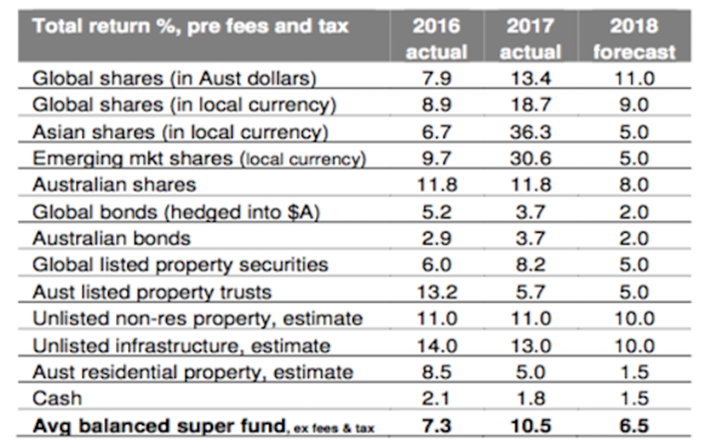
    The “sweet spot” of solid global growth and low inflation/benign central banks helped drive strong investment returns overall.

    Source: Thomson Reuters, Morningstar, REIA, AMP Capital

    • Global shares pushed sharply higher supported by strong earnings, low interests rates and growing investor confidence. While Eurozone, Japanese and Australian shares saw 5-7% corrections along the way, US shares only saw brief 2-3% pullbacks. So volatility was very low.
    • The big surprise was that the US dollar fell rather than rose as low inflation kept expectations for Fed rate hikes depressed. This helped boost US shares but dragged on Eurozone shares as the Euro rose.

    • Asian and emerging market shares were star performers thanks to leverage to global growth, rising commodity prices and a weaker $US, which reduced debt servicing costs. 
    • Australian shares had good returns but were relative laggards as has generally been the case this decade with weaker underlying profit growth. 
    • Bonds had mediocre returns. While inflation surprised on the downside, ultra-low yields constrained returns.
    • Real estate investment trusts had a somewhat constrained year as investors remained a bit wary of listed yield plays.
    • Unlisted commercial property and infrastructure continued to do well as investors sought their still relatively high yields.
    • Australian residential property returns slowed as the heat came out of the Sydney and Melbourne property markets.    
    • Cash and bank term deposit returns were poor reflecting record low RBA interest rates. 
    • Reflecting US dollar softness, the $A actually rose helped by modest gains in commodity prices. 
    • Reflecting strong returns from shares and unlisted assets, balanced superannuation fund returns were strong.


    2018 – looking ok but expect more volatility

    2018 is likely to remain favourable for investors, but more constrained and volatile. The key global themes are likely to be:

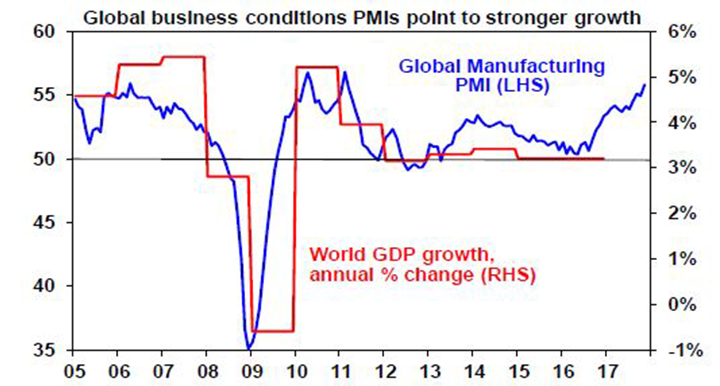
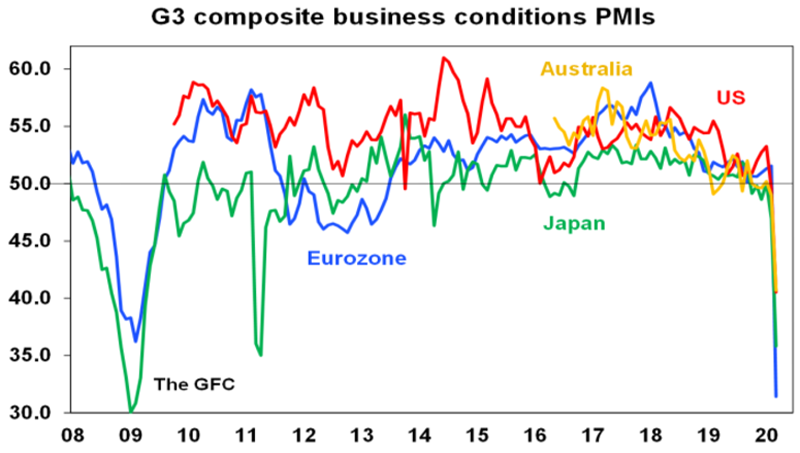
    • Global growth to remain strong. Global growth is likely to move up to 3.7%, ranging from around 2% in advanced to around 6.5% in China, with the US receiving a boost from tax cuts. Leading growth indicators such as business conditions PMIs points to continuing strong growth, but just bear in mind that they don’t get much better than this. Overall, this should mean continuing strong global profit growth albeit momentum is likely to peak.

    World GDP Growth, annual % change (RHS)

    Source: Bloomberg, IMF, AMP Capital

    • US inflation starting to lift. Global inflation is likely to remain low, but it’s likely to pick up in the US as spare capacity is declining, wages growth is picking up and as higher commodity prices feed through. We don’t expect a surge and the flow through in other major countries will be gradual. But higher US inflation may disrupt the yield trade at times and cause some nervousness.
    • Monetary policy divergence to continue. The Fed is likely to hike four times in 2018 (which is more than markets are allowing) and to continue to quantitative tightening but other central banks are likely to lag.
    • Political risk may have more impact after a relatively benign 2017. US political risk is likely to become more of a focus again (with the Mueller inquiry getting closer to Trump, the November mid-term elections likely to see the Republicans lose the House and the risk that Trump may resort to populist policies like protectionism to shore up his support), the Italian election is likely to see the anti-Euro Five Star Movement do well (albeit not well enough to firm government), North Korean risks are unresolved and there is the risk of an early election in Australia.

    Fortunately, there is still no sign of the sort of excesses the drive recessions and deep bear markets in shares: there has been no major global bubble in real estate or business investment; there is the bitcoin mania but not enough people are exposed to that to make it economically significant globally; inflation is unlikely to rise so far that it causes a major problem; share markets are not unambiguously overvalued and global monetary conditions are easy. So arguably the “sweet spot” remains in place, but it may start to become a bit messier.

    For Australia, while the boost to growth from housing will start to slow and consumer spending will be constrained, a declining drag from mining investment and strength in non-mining investment, public infrastructure investment and export volumes should see growth around 3%.  However, as a result of uncertainties around consumer spending along the low wages growth and inflation, the RBA is unlikely to start raising interest rates until late 2018 at the earliest.

    Implications for investors

    Continuing strong economic and earnings growth and still-low inflation should keep overall investment returns favorable but stirring US inflation, the drip feed of Fed rate hikes and a possible increase in political risk are likely to constrain returns and increase volatility after the relative calm of 2017;

    • Global shares are due a decent correction and are likely to see more volatility, but they are likely to trend higher and we favour Europe (which remains very cheap) and Japan over the US, which is likely to be constrained by tighter monetary policy and a rising US dollar. Favour global bans and industrials over tech stocks that have had a huge run.
    • Emerging markets are likely to underperform if the $US rises as we expect.
    • Australian shares are likely to do okay but with returns constrained to around 8% with moderate earnings growth. Expect the ASX 200 to reach 6300 by end 2018.
    • Commodity prices are likely to push higher in response to strong global growth.
    • Low yields and capital losses from a gradual rise in bond yields are likely to see low returns from bonds.
    • Commercial property and infrastructure are likely to continue benefitting from the ongoing search for yield by investors.
    • National capital city residential property price gains are expected to slow to around zero as the air comes out of the Sydney and Melbourne property boom and prices fall by around 5%, but Perth and Darwin bottom out, Adelaide and Brisbane see moderate gains and Hobart booms.
    • Cash and bank deposits are likely to continue to provide poor returns, with term deposit rates running around 2.2%.
    • The $A is likely to fall to around $US0.70, but with little change against the Yen and the Euro, as the gap between the Fed Funds rate and the RBA’s cash rate goes negative.

    What to watch?

    The main things to keep an eye on in 2018 are:

    • The risks around Trump – the Mueller inquiry and the mid-term elections. We don’t see the Republicans impeaching Trump (unless there is evidence of clear illegality) but he could turn to more popular policies such as a trade war with China, a spat over the South China Sea or a clash with North Korea to boost his support.
    • How quickly US inflation turns up – a rapid upswing is not our base case but it would see a more aggressive Fed, more upwards pressure on the $US, which would be negative for US and emerging marketing shares and a rapid rise in bond yields.
    • The Italian election – the anti-Euro Five Star Movement is likely to do well and, even though it’s hard to see them being able to form government, this could cause nervousness;
    • Whether China post the Party Congress embarks on a more reform-focused agenda resulting in a sharp decline in economic growth – unlikely but it’s a risk.
    • Whether non-mining investment, infrastructure spending and export volumes are able to offset constrained consumer spending and a downturn in the housing cycle and how far Sydney and Melbourne property prices fall.

    Concluding comment

    Well another year ended, and a new year starts.  Last year turned out to be a solid year for returns, as we still recover from the GFC running 10 years ago. And yes we will have some volatility, but barring a catastrophe, things look reasonably good.  As usual, if you’ve had a well-diversified portfolio, volatility can be well managed. They key here is to sit down and do a financial progress meeting, and if you feel a need to talk to your financial planner, please call Sydney Financial Planning to organise that meeting. 

    Thank you, Bill Bracey.

    Bill Bracey FChFP | Principal Sydney Financial Planning
    Authorised Representative Charter Financial Planning


    Still have some questions?

    If you want to discuss your investment strategy or financial strategies with one of our advisors – call us to arrange an appointment on 02 9328 0876.


    This main article was prepared by Dr Shane Oliver. Dr Shane Oliver, Head of Investment Strategy and Economics and Chief Economist at AMP Capital is responsible for AMP Capital’s diversified investment funds. He also provides economic forecasts and analysis of key variables and issues affecting, or likely to affect, all asset markets.

    Important note: While every care has been taken in the preparation of this document, AMP Capital Investors Limited (ABN 59 001 777 591, AFSL 232497) and AMP Capital Funds Management Limited (ABN 15 159 557 721, AFSL 426455) make no representations or warranties as to the accuracy or completeness of any statement in it including, without limitation, any forecasts. Past performance is not a reliable indicator of future performance. This document has been prepared for the purpose of providing general information, without taking account of any particular investor’s objectives, financial situation or needs. An investor should, before making any investment decisions, consider the appropriateness of the information in this document, and seek professional advice, having regard to the investor’s objectives, financial situation and needs. This document is solely for the use of the party to whom it is provided.

    General Disclaimer: This article contains information that is general in nature. It does not take into account the objectives, financial situation or needs of any particular person. You need to consider your financial situation and needs before making any decisions based on this information. Please seek personal financial advice prior to acting on this information.

    Be a senior entrepreneur

    Be a senior entrepreneur on your own terms!

    Be a senior entrepreneur

    Retirement is no longer the destination it used to be. If you’re like many Aussies who are heading into their later years after a lifetime of developing skills and expertise, you undoubtedly have more to offer, not less. If you’re thinking about starting your own business or considering how you’ll keep sharing your skills and experience in your later years, you’re not alone. 

    Many Aussies are blazing the trail into self-employment after retirement. And one of the effects of the increasing number of people venturing beyond retirement is the rising number of groups forming to provide guidance and help for older Aussies as they navigate through change in the digital age. 

    Many older Aussies are far from ready to retire into the armchair just yet. Life after work can be a time for harnessing passions and creating new ways to help others or generate income.

    If you’re thinking about going out on your own, you may be aiming to find your true purpose—what you really want to do. Are you inspired by ideas about getting involved in an area that interests you personally, creating something new or just giving back? New ventures can give you fresh energy and a renewed sense of purpose. 

    Here are some things for you to consider if you’re thinking about foraying into the world as a senior entrepreneur: 

    1. What do you love doing?

    Find ways to be involved in doing the things you love. Follow your passion and aim to reap rewards on all levels: financially, mentally and emotionally. Working on something that interests you personally can be more sustainable and rewarding because a labour of love doesn’t feel like work. 

    2. Find like-minded people.

    Find people who share your interests regardless of any age differences. Discussing ideas with people experienced in the areas you may not be familiar with can lift your ideas from the drawing board into reality, without you having to pay for expensive mistakes. Communities like Hub Australia provide co-working services for small businesses. 

    3. Start small.

    By following in the footsteps of other successful people, you can start with small steps and test your ideas and decisions along the way without it costing you dearly. You’ll be able to see if an idea works or not—and adapt quickly as you learn what your market wants. Because there are no guarantees in business, it can be costly to risk everything on one idea. 

    4. Get financially organised. 

    The most valuable thing you can do to help yourself is to get on top of things financially. If your savings are on the line and the way you’ll earn money is changing, come and have a chat with us. You don’t have to do it all alone—together we can make sure everything’s arranged so you’ll be better off, not worse.

    Help is at hand

    If you’re aiming to go out on your own, consider contacting organisations like the SeniorPreneurs Foundation or Elderberry—groups like these can help you connect with other people who are forging ahead to become their own bosses and continue sharing their invaluable skills and experience on their own terms.

    As you’re weighing up the pros and cons or wondering if or how you can become a senior entrepreneur, come and see us. We can help you manage the financial implications of being in business and any impacts on your government entitlements.


    You have some great ideas, but have a few more questions?

    We are always here to help guide you on your financial journey. Contact us for advice on how to get started or have your current situation reviewed, call us on 02 9328 0876.


    General Disclaimer: This article contains information that is general in nature. It does not take into account the objectives, financial situation or needs of any particular person. You need to consider your financial situation and needs before making any decisions based on this information. Please seek personal financial advice prior to acting on this information.

    Career health check

    Give your career a health check

    Career health check

    If you answered ‘yes’ to the last question, it might be time to give your career a health check. We all know the benefits of having regular medical check-ups but, just like your body, your career needs a regular review to make sure you’re on track to meet your goals. 

    Do a career health check

    The average time Aussies spend in a job is about 3 years and 4 months (as at June 2014) so if you’ve been in your job for more than three years, now might be a good time to give your career a quick health check. 

    But before you hit the search button on your favourite recruitment site, take time to work out what you really want to do – then you’ll have more chance of finding, or working towards, the job that will make you happy. 

    Here are some tips for a career health check:

    1.Take your pulse

    List your top three work achievements over the last year. If you’re struggling to come up with any, think about where you want to be in five or ten years’ time. Will your current job get you there? 

    2. Check your vital signs

    List the top five reasons (in priority order) you’re in your current job. If you’re ranking your bonus and long-service leave higher than your job satisfaction, then things might be a little out of balance. It might be time to ask yourself whether you’re at the right place in your career. 

    3. Take your own medicine

    Think about how you could improve your career prospects:

    1. Refresh your personal brand – update your Linkedin profile, write a blog or upload articles which are relevant to your career. 
    2. Update your resume with your recent achievements. Make sure they match the type of work you’re looking for. 
    3. Do you need to study, get some training or update your skills? 
    4. Attend professional development events, workshops, seminars and conferences.
    5. Join professional associations to meet like-minded people in your industry. 
    6. Collaborate in online forums where you can show your expertise on a subject.

    Should you stay or should you go?

    It’s one of the hardest questions to answer. Can you achieve your career goals where you are or do you need to look for a fresh start somewhere else?

    If you’ve built up a solid reputation at your current employer, consider applying for a different role at the same company to give you a new challenge.

    Perhaps you want more life/work balance? If so, you could consider working part-time, as a consultant or doing freelance jobs.

    But if you still feel as though you’re just going through the motions, it could be time to get on the front foot and take action. A career health check could help to keep you on track, reignite your spark and help you get (and keep) the job you’ve always wanted.


    Does your career need a health check?

    Whether your goal is to be debt-free, save enough to buy a property or to have a comfortable retirement, having the right income strategies can make a huge difference. Get in otuch to arrance to speak with one of our advisors on 02 9328 0876.


    General Disclaimer: This article contains information that is general in nature. It does not take into account the objectives, financial situation or needs of any particular person. You need to consider your financial situation and needs before making any decisions based on this information. Please seek personal financial advice prior to acting on this information.

    Super Basics

    Back to basics

    Super Basics

    Effectively, Superannuation is a way to fund your retirement. It’s an investment vehicle and a means of saving for your future. Within your superannuation fund, you can have a portfolio of shares, property, cash and a variety of other investments. Superannuation is appealing because of its lenient tax treatment when you’re working (accumulation phase) as well as when you’ve hit retirement (pension phase).

    The notion is backed by the government who have made it mandatory for all Australian employers to pay ‘super’ to their workers – this is what’s known as ‘super guarantee’.

    There are many ways to build your super balance and the easiest way is through the super guarantee scheme.  For the current financial year (FY16/17), the general super guarantee percentage is 9.5% of normal earnings.

    If your total salary is $70,000 inclusive of super than $6,073 (9.5%) of your salary will be contributed into your super fund leaving you with a net salary of $63,927.

    In addition to the super guarantee concept, you can choose to make personal contributions. There are various ways to make personal contributions:

    • Salary sacrifice
      your employer pays part of your salary directly into your super fund instead of your bank account
    • Non concessional contributions (NCC)
      After-tax income that you deposit into your super fund
    • Spouse contributions
      Depositing money into your partners super fund may entitle you to a tax offset

    One of the most common questions is ‘how much money will I need before I can retire?’

    The answer is dependent upon the lifestyle you choose to lead, the age at which you retire, your outgoings, and income producing options i.e. working part-time in retirement etc.


    Our experienced team of financial advisers can help you get your super sorted and put you on the right path to financial success. Reach out today by submitting a meeting request or call us to arrange an appointment for your preferred time and date on 02 9328 0876.


    Is your super working well for you?

    Our experienced team of financial advisers can help you get your super sorted and put you on the right path to financial success. To arrange an appointment call us on 02 9328 0876.


    Wealth Building Tips

    Wealth building tips x 4

    Wealth Building Tips

    We all have to start somewhere right? Some people are trying to build wealth from ground zero, while others may have been gifted with a head start from the likes of an inheritance. Either way, the following four tips apply to everybody, regardless of where you currently are in your financial journey. 

    1. Spend less than you earn

    You will hear plenty of professionals, institutions and the press talking about ways to boost your investment returns. At the same time, there are always apparent experts warning you to stay away from the stock market, or suggesting that property is immune from risk. Ultimately, boosting your return and the art of timing the market are neither important – at least, when you’re starting out. Instead, you should focus on your money habits and spending less than you earn – no other factors will have a greater impact.   Sydney Financial Planning has written an entire blog on ways to spend less than you earn.

    2. Get some structure. How is your money being invested?

    ‘Asset allocation’ is financial lingo for how your money is divided up between cash, fixed interest, shares and property. Years of research, wisdom and countless professionals suggest that 90% of the investment return an investor will receive is dependent on their asset allocation i.e. how much of your money is in shares, property or cash and fixed interest. Past performance suggests that shares and property have a higher rate of return than cash, term deposits and fixed interest. Obviously though, shares and property carry a higher risk. If time is on your side (at least 7 – 10 years) it might be worth restructuring your asset allocation – an investor who holds a higher allocation to shares and property should outperform an investor that has less allocation to shares and property. 

     3. Stick to your plan – Time in the market as opposed to timing the market

    There will be times when you will want to steer away from the plan. For example, when the market is going well, people generally want to be more aggressive and more subdued when the market is down. Many investors give into temptations which are sometimes based on emotions as opposed to sound strategy and planning. The danger of acting on emotions is that often it leads to buying high and selling low, which if repeated will lead to failure. To avoid this, block out the media noise and stick to your plan. Don’t let the news of the day change your mind! 

    4. The 8th Wonder of the World – Compound Interest 

    Let’s assume you would like to be save a million dollars by age 65. Using a flat rate of 6% in the figures below, these are the monthly contributions you would need to make based on the age you start saving:
             Age 25: $499.64 per month
             Age 35: $990.55 per month
             Age 45: $2,153.54 per month
             Age 55: $6,071.69 per month   

    The message is simple. The earlier you start, the easier it is to build wealth. Even small amounts that are regularly invested can transform into large sums over time. Be warned though; compound interest can also work against you when you have debt. It is amazing to see that over a 30 year mortgage term, you generally pay (depending on interest rates) up to 3 times the amount originally borrowed. By making extra repayments (however small), you can save significant amount of penny’s over time.


    You love this concept, but have a few more questions?

    We are always here to help guide you on your financial journey. Contact us for advice on how to get started or have your current wealth situation reviewed, call us on 02 9328 0876.


    General Disclaimer: This article contains information that is general in nature. It does not take into account the objectives, financial situation or needs of any particular person. You need to consider your financial situation and needs before making any decisions based on this information. Please seek personal financial advice prior to acting on this information.

    Some things never change

    Some things never change

    Some things never change

    Predicting future can be difficult and mostly impossible. Especially if one’s trying to predict things which are completely out of their hands. Like, entirely! But guess what, surprisingly (not really that surprising to the scholars of human behaviour), most predictions are made about exactly those – things that are out of our hands!

    We’re in the third week of the New Year and the mainstream media are already saturated with headlines about market predictions, interest rate predictions etc..So I made my own list. However, the difference is, that these are about the one thing we can all fully control, if we choose to – our own behaviour.

    I’m almost certain that my forecast won’t make the headlines because it doesn’t contain the information ‘the people want’. It’s not the sensational news or ‘the secret’ information that will bring them wealth. Well, actually it will, but not in the immediate form as they all expect.So without further ado, here are my top 5 behavioural predictions for this year (and in fact every year thereafter, since human behaviour just doesn’t change):

    1 . We will keep looking for ‘the right’ product that will ‘save’ us.

    Most corporations spend ridiculous amounts of money to employ top marketing agencies to sell their products. These behaviour wizards understand too well how the human brain works and create wonderful campaigns that simply fool us. They play to our basic emotions – fear and desire, but lately also pride, frustration and self-esteem. And the vast majority of the population will follow and buy whatever they’re selling, not realising, the new product won’t make any difference in their long term well-being – financial or emotional. They will happily keep chasing it, year and year again, with their super fund, insurance company, mortgage provider.

    2. We will ignore the behavioural (please read boring) issues that actually make all the difference.

    After more than a decade of professional practice, I’m yet to see a prospective client who will come to me asking for assistance with their patience, disciplined spending or emotional decision making. They all come asking to check if their super can be ‘’invested better’ (whatever that means) to deliver greater returns, or for better rates with their mortgage, or a cheaper insurance product. When I start explaining to them that it’s not the product that will deliver the outcomes they’re after and that it’s actually themselves who can do that via better money habits and mindful consideration of how they go about things, they get disappointed. Many don’t believe me. They continue pursuing the ‘whatever other crazy issues they’re convinced are important’ as everyone else, which will eventually drive them to the ground.

    blog content spf quote the question

    3. We will continue focusing on (out) performance.

    The ‘timing and selection’ culture we live in is obsessed with being better than average. We were told by our parents we can be the best so we expect nothing less from the results of financial products we buy. Not realising that the consistently best performance can’t be delivered year in, year out, we allow ourselves to participate in the rat race we can never win. Most of us will not want to see that it doesn’t have to be that way. That the best product performance (or the outperformance) isn’t required to pay off our debts fast, educate our kids or retire early. Most of us will not accept that the only real outperformance is the one we can deliver ourselves via long term and disciplined planning, with the help of a third party coach, keeping an eye on our vulnerable money behaviour.

    4. We’ll keep buying things we don’t need.

    There is a considerable amount of research through books, movies and more about ‘how buying stuff does not make us happy’ (in the long term). Most of us just don’t want to (?) get the memo. It’s actually getting worse and more pathetic, with big companies now skipping parents and market directly to our children. And oh boy, do we all know what a kid’s shitty behaviour does to a parent who is tired, lacking sleep and just wants to have a quiet moment or just wants to pop into the grocery store to only buy milk. So what do we do? We give in. To our kids, to fashion, to our marketing and social media driven culture… but it’s so hard to save money these days, isn’t it…?

    5. We won’t listen to financial advice professionals.

    Less than 5% of the Australian population has a dedicated financial coach who overlooks their family’s finances and long term interest. How can we expect to get ahead, to live lives on our own terms, to get financially independent, to retire early or whatever the headlines we buy into say if we choose not to have hard conversations about the way we spend money? Well, because it’s easier and so much more exciting to look up stuff online or chat to our friends or read an article about the latest products and hottest suburbs to buy in right now. Therefore, we will continue to choose to not engage a financial advice professional because we’ll continue to justify it to ourselves – don’t you read the paper or watch a TV report about them? It makes us feel better to say that and we won’t have to look for anyone (and use our brain). So we’ll just continue to Google…

    Well, there you go. My top five (although the list goes on). I’ll be delighted to check in again in December to see if they came true.

    But I’m pretty bloody confident…because they do every year…


    Need some help getting started?

    If you’d like the prediction for your future to be different, maybe it’s time to look at your financial behaviour, we can help you – call us for professional advice on how to achieve a different future 02 9328 0876.


    Article by Michal Bodi | Senior Financial Planner


    General Disclaimer: This article contains information that is general in nature. It does not take into account the objectives, financial situation or needs of any particular person. You need to consider your financial situation and needs before making any decisions based on this information. Please seek personal financial advice prior to acting on this information.

    When in doubt - kick it out!

    When in doubt…kick it out!

    When in doubt - kick it out!

    Not just a soft kick either. Preferably boot it out as hard as you can. The method to his madness allowed you (and the team) to regroup, take time to set your formation and get ready to go again. Sure you might have lost possession and some ground but you’re not behind on the scoreboard and you’re still in the game. I often think of this in the context of investing. Just like soccer, investing is full of high emotion and decision making is too often clouded by stress.

    When you’re investing in the share market and your portfolio drops 4% in one day, or 30% over one year it’s not uncommon to lose your head and start to question your investment game plan. Common sense might not always prevail and a knee jerk reaction can quickly follow.

    The level headed question we need to be asking ourselves is, “is this recent correction a temporary setback or is there something more serious going on that requires a change in our game plan?” In times of nervousness and high emotion it’s often good to reflect and put things in context.

    If we think about what’s happening with a clear mind, we could view a share price reduction as a great opportunity to accumulate more shares at attractive prices and for retirees this might highlight the importance of maintaining cash and other defensive assets in our investment portfolios to ensure we don’t have to sell and take a loss. The biggest challenge we all face in times of high emotion and stress is whether we have the presence of mind to see this not as a crisis but rather as an opportunity. Warren Buffet sums it up well by saying “be fearful when others are greedy and greedy when others are fearful”.

    Coming back to my soccer coach again (who’s as equally wise as Warren Buffet), when share markets correct and it feels like the opposition is bearing down on us and we need to make a quick decision under stress, kick the ball out! Take a deep breath, rally the troops and get back on with the game plan. Easier said than done I know. That’s why we all need a coach or an adviser to remind us of the bigger picture. If you find yourself thinking, should I be doing something different and be changing my investments we encourage you to contact your adviser to regroup and talk about your investment game plan.


    Are you ready to kick something out?

    We are always here to help guide you on your financial journey. Contact us for advice on how to get started or have your current situation reviewed, call us on 02 9328 0876.


    Article by Gary Winwood-Smith | Partner & Senior Financial Planner


    General Disclaimer: This article contains information that is general in nature. It does not take into account the objectives, financial situation or needs of any particular person. You need to consider your financial situation and needs before making any decisions based on this information. Please seek personal financial advice prior to acting on this information.

    Investing under uncertainty

    Investing under uncertainty

    Investing under uncertainty

    Uncertainty is here to stay; we have no say in that. So, we spend time and energy on keeping our heads down and continuing to fund our plan – we have a full control over that.

    Here we are in a tectonic shift in the world’s geopolitical order, occasioned by Russia’s tragic war on Ukraine, the severe supply chain issues caused by offshoring of manufacturing and services to Asia. And we find ourselves in the grip of the most severe inflation outbreak in 40 years. No one can begin to predict how these situations will resolve themselves (even though it doesn’t stop many from trying)…much less when. Nor can anyone begin to imagine how the capital markets will adapt to said resolution(s). We are once again in a perfect cloud of unknowing.

    It is also – and this is what we find human nature can often be bitterly incapable of grasping – irrelevant to the investment policy of a long-term, goal focused, plan-driven investor. And I say again: current events are perfectly irrelevant to the investment policy of the long-term equity investor.

    What is the essence of successful long-term equity investing? It is the continuing practice of rationality under uncertainty. To me it means basing our investment policy on our financial plan as distinctly opposed to a view of the economy and the markets. This is where rationality begins and ends.

    Two years ago, we could not begin to imagine how lethal the pandemic was going to be, nor when effective vaccines would become available in sufficient quantity. Today, we can’t anticipate what Putin will do in Ukraine, nor how the back of this inflation will ultimately be broken. Nothing has changed; we’ve just moved on to a different set of unknowables.

    Meanwhile our clients’ retirement dates are bearing down on them at the same pace. The amount of money they need to accumulate has if anything gone up with inflation. And the only hope they have in the world for a secure retirement and meaningful legacy are the premium return of shares of brilliantly managed companies, whose short to intermediate-term corrections cannot be anticipated, much less timed.

    What we can know amid all this uncertainty—and just about all we need to know—is that the great companies in Australia and the world are already adjusting to this reordering. Today’s crisis invariably becomes yesterday’s news. Not only will you not be worried about this stuff ten years from now, you won’t even remember it.

    It all comes down to the main reason you hired us, to acting vs. reacting: keeping your head down and continuing to fund your plan, looking neither to the right nor to the left. Looking at history, not headlines.

    This is a glorious time to be a mainstream share investor for the long haul – even if, just at this moment,it feels like we can’t see a foot in front of our faces.

    We realise that on any given day, optimism can often sound like a crazy concept while pessimism on the other hand can feel like a good advice from a friend. We also realise that ours may be the only calm voice of long-term optimism you hear. We just want to make sure you hear it. Today’s the day.


    Key takeaways:

    • Try to minimise the noise. If news headlines make you feel uncomfortable,reduce your exposure to them. Their objective is to capture your attention, not to provide you with rational investment strategy.
    • Follow your investment plan, not headlines. Your plan is carefully designed to help you reach your life goals. If your goals haven’t changed, your investment strategy most likely doesn’t need changing. Only people without plans follow the headlines (they have nothing else to focus on)
    • Remember fundamentals. History doesn’t repeat but it rhymes. Look at the spread between the real-life returns (after inflation) of growth assets like shares and the real-life returns of cash and bonds.
    • Price versus value. When price (e.g. share price) of an asset decreases, the value of investing in that assets increases (and vice versa). If you’re still contributing to your investments/super, lower share market prices represent better value for your money.
    • Income vs account balance. If you already retired and your investment objective is to generate a lifestyle sustaining income, that income is paid based on the amount of your investment units, not your account balance. Make sure you focus on the right thing.
    • Optimism is the only realism. Having the faith in the future is number one investment principle we follow. It always gets tested when markets correct, and it can make all the difference.

    If you get ever concerned about your investment strategy, please always contact your adviser before you make any decisions. It’s one of the main reasons you hired us.


    Michal Bodi
    Partner and Senior Financial Planner


    Do you have a long-term investing strategy in place?

    Speak with one of our Financial Planners about the best investing approach for your circumstances, either book a meeting or get in contact with us on 02 9328 0876.


    Article by Michal Bodi | Partner and Senior Financial Planner

    General Disclaimer: This article contains information that is general in nature. It does not take into account the objectives, financial situation or needs of any particular person. You need to consider your financial situation and needs before making any decisions based on this information. Please seek personal financial advice prior to acting on this information.

    Cashflow remains king

    Cashflow remains king

    Cashflow remains king

    Both are equally important, and if I had a dollar for each time I had a discussion with a client about how much is enough cash in a portfolio, I’d be a wealthy man.

    Today’s challenging periods have reminded us why it remains so critical our clients maintain a cash reverse and have a sound understanding of their cashflow positions (both personally and within their investment accounts).

    Over the last few years our clients have avoided selling growth assets in a downmarket and we want to keep it this way for as long as we can. We’ve managed to do this by putting in place cash reserves for our retired clients so they can continue to meet their pension payments and by putting in personal cash reserves to meet any unexpected expenses and avoid the need to make withdrawals from their investment accounts at an unfavorable time and at a discount. Our accumulators have been maintaining cash at bank to support any disruptions to their employment income.

    So back to the question, how much cash is enough? Everyone has a safety blanket number, however when determining cash allocations for our clients it really depends on their life stage. Accumulators may only need to hold 2% – 5% of cash in their portfolio’s whereas retired clients will need to hold much more than this.

    Min cash holdings for our retired clients can range from 1 – 3 years pension payments. The biggest trade off being the low return generated by cash exaggerated by interest rates being at an all-time low. A high cash allocation will have a larger drag on the long term return of your investment portfolio and ultimately impact the longevity of the account. So generally speaking, the higher the account balance the less cash allocation necessary (as a % of account balance).

    The Government has continued to help people preserve cash positions by reducing the minimum pension requirements by 50% for retirees drawing from their accountbased pensions again for the 2022/23 financial year. The minimums are:

    Age

    Normal Rate

    New rate for 2022/23

    Under 65 4.00% 2.00%
    65-74 5.00% 2.50%
    75-79 6.00% 3.00%
    80-84   7.00% 3.50%
    85-89 9.00%  4.50%
    90-94 11.00% 5.50%
    95 and over 14.00% 7.00%


    With limited opportunity for travel and a reduction in discretionary spending we’ve seen many of our clients requiring less cash to meet their living expenses. This has provided us with an opportunity to reduce payments to our pension clients over the past 12-24 months.

    However, with inflation looming we expect to see an increasing pressure on the need to increase pension payments as the cost of living increases over the next 12 -24 months.

    How can we better manage our cash positions in our investment portfolio’s going forward?

    Most of our clients have been fortunate to save more in their personal bank accounts which will help to fund travel and discretionary spending as the world continues to open up post covid. This will alleviate pressure on making large increases to pension payments in the short term. We have prepared and factored a risking cost of living into your financial plan and investment portfolios as our financial modelling allows for a CPI increase in pension payments annually.

    For our retired clients, or those transitioning to retirement its prudent to review the cashflow within your pension account. This is the cornerstone conversation at all our review meetings. Money in (distributions from our investments) and money out determine our cashflow position with pension payments making up the bulk of money going out. If there’s an opportunity to hold or even reduce your pension payments this coming year before we see significant inflation, we will be discussing this with you at your annual review meeting.

    Do you have the right amount of cash reserves?

    Speak with one of our Investment and retirement specialist about the best strategy for your circumstances, either book a meeting or get in contact with us on 02 9328 0876.


    Article by Gary Winwood-Smith | Senior Financial Planner

    General Disclaimer: While every care has been taken in the preparation of this document, Sydney Financial Planning and Charter FP make no representations or warranties as to the accuracy or completeness of any statement in it.This article contains information that is general in nature. It does not take into account the objectives, financial situation or needs of any particular person. You need to consider your financial situation and needs before making any decisions based on this information. Please seek personal financial advice prior to acting on this information.


    Are you getting the best rates?

    Loyal to a fault

    Are you getting the best rates?

    Sticking with the same loan longer than three years can cost borrowers thousands, with competition to win business resulting in new customers paying lower rates than existing ones.

    This so-called loyalty tax has become such a hot topic, the Australian Competition and Consumer Commission has recommended mortgage holders review their options regularly and consider switching to secure better terms. Now is a great time to follow that advice and get in touch.

    Rush to reset

    Homeowner refinancing has hit an all-time record in the past six months, and it’s easy to see why, with interest rates at long-term lows. But it’s not just fixed rates borrowers should have their eye on. Homeowners with variable rates need to check they aren’t unwittingly paying a loyalty tax too.

    Reserve Bank figures show owner-occupiers who took out new variable loans in October 2021 paid, on average, 2.63 per cent interest, while those with existing variable loans paid rates around 0.37 per cent higher rates at 3 per cent.1 On a loan around $350,000, that’s potentially adding an extra $1,295 in interest each year.

    As a customer there’s few things more galling than finding out someone who came to the party late has been given a bigger slice of cake than you. That’s why the most empowering thing you can do is to simply shop around, which is what I can do for you.

    Annual review

    Being financially savvy is about developing good habits, and one of the best for homeowners is to book an annual appointment to review your home loan arrangements.

    The start of a new year is the perfect time to dive in. People usually have a little more headspace before the year really ramps up and finding savings can be a great cure for that summer spending hangover.

    Speak to me to check how current variable rates compare, or perhaps it’s a good time to consider locking in a deal. Fixed rates have increased recently and speculation is mounting about a possible official interest rate rise in late 2022 or early in 2023.

    More than interest only

    Of course, refinancing isn’t always about interest rates alone, although they are a big part of the equation. It may be about building more flexibility into your loan with offset and redraw facilities, the ability to make additional repayments, or unlock equity for a renovation, a major purchase or holiday.

    Some borrowers may even want to consider options such as splitting a home loan between both fixed and variable options.

    It’s all about what your goals and priorities are right now, and we all know that can change unexpectedly year on year.

    Broker insight

    The home loan market has never been more competitive and we’re adding more lenders to our panel each year, with more loan products and features. It can be daunting, but it’s also where I can offer you an advantage in guiding you through what’s out there to meet your needs.

    I can also help calculate how any potential savings stack up in the short and long term against any search and switch costs. It’s important to stay on top of rates and offerings in a fast-moving market. So, get in touch to arrange a quick check-up for your home loan.


    Need some help working out if you can get a more suitable rate for your mortgage?

    Get some professional advice from our Mortgage expert Leigh Morris, call 02 9328 0876 to arrange a meeting.


    Article by Leigh Morris  – SFP Financial

    1 Lenders’ Interest Rates, Reserve Bank of Australia (published monthly online: rba.gov.au/statistics/interest-rates/#lenders-rates-table)

    General Disclaimer: While every care has been taken in the preparation of this document, Sydney Financial Planning and Charter FP make no representations or warranties as to the accuracy or completeness of any statement in it.This article contains information that is general in nature. It does not take into account the objectives, financial situation or needs of any particular person. You need to consider your financial situation and needs before making any decisions based on this information. Please seek personal financial advice prior to acting on this information.


    Opportunity of being young and free

    The opportunity called being ‘Young and Free’

    Opportunity of being young and free

    Because I think it’s really easy NOT to manage your money differently to people around you – to simply do what everyone else is doing. Ok, this may be completely fine if you’re only surrounded by successful people with happy life and balance. If this is the case, no need to read further.

    If you’re still reading though, you need to realise one thing – most people around you can’t help you – they’ve done more money mistakes in their lives they would ever admit to…

    They’ll tell you things like – ‘You’re young, enjoy life, you have plenty of time…’

    What they don’t say is – ‘You’ll end up like us – having to slave for forty odd years working in the jobs you hate (but you’ll turn up to anyway because you have to pay the bills somehow), all just because you leave important money decisions for later’.

    I wonder how many of them would say – ‘Don’t copy what we did. Learn how to prioritise with your money. Learn how to save and invest when you get your first job. It’s when you have much less commitments and much more flexibility. Don’t waste your early years and use your time potential to your advantage.’

    If you form your good money habits and start early, your life can be full of options later. Options like working doing what you love (most likely owning your own business), living closer to your work and being home early every night so you can read your kids a book before they go to bed. Isn’t that what life is all about – spending memorable moments with your loved ones?

     In order to get there, you need to stop living for today only. Although it sounds great and hippy, what it’s going to create for you is money slavery.

     Instead, start looking at your life in ten-year blocks. This means looking at a consequence of every decision you make with your money – what will it be in ten years’ time?

     For example – How much do you spend on coffees, lunches, dinners, drinks, parties, clothes every week? Let’s make assumptions, but be fairly conservative, shall we? One coffee a day ($4), three lunches a week, including weekends ($60), trendy café brunch on Saturday ($20), one dinner a week ($40), drinks on the weekend ($100), one new outfit per month ($150).

    Putting all the ad-hoc expenses aside – trips, buying of new gadgets, birthdays, holidays etc. our regular assumed expenditure totals at staggering $282 per week! Once that $282 leaves your wallet, it’s gone forever. The opportunity you had is lost.

    Now, let’s imagine you’ll keep doing some of those things, but only spend $132 per week – meaning you save and invest $150 every week.

    Starting at zero, investing in a low-cost diversified share fund, in ten years, you’ll end up with a portfolio worth over $145,000! Boom!

    Who said it’s hard to buy a home in Sydney? It can be, if you do what everyone else around you is doing. But if you start this exercise at 18, you’ll have some options available to you at 28, right?

    Ok, you may not want to buy a home, but you can invest this money for income and have a perpetual portfolio generating over $7,000 per year income (whilst still fully preserving the capital). It’s a great way to fund your annual holidays – with no extra work required. Ever.

    These are pretty basic concepts which are simple and easy to understand. But are they easy to do? No way!

    Two main reasons:

    •  We get lost in details – the best time to invest, the best investments, the best performance – we live in the timing and selection culture which is putting us through so much pressure and noise we get confused.
    •  Even simple concepts can be hard to do (or to keep doing consistently for long time) – patience and discipline is not taught at schools.


    That’s where you need clarity, focus and a constant push from someone else to make sure you stick to your plan and you don’t mess it up. After all, it’s worth every cent – have options to live your life the way you want it.

    What are you planning to do with your opportunity? One thing is clear – it’s never too late to start.


    Need some help getting clarity and focus with your money?

    Why not book an appointment with one of our planners to review your opportunity to get ahead, contact us on 02 9328 0876.


    NB: Numbers are based on 2015 prices (written in 2015), however the same principles apply.

    General Disclaimer: This article contains information that is general in nature. It does not take into account the objectives, financial situation or needs of any particular person. You need to consider your financial situation and needs before making any decisions based on this information. Please seek personal financial advice prior to acting on this information.

    Photo by Krists Luhaers on Unsplash

    8 key learnings from 2020

    8 key learnings from 2020

    8 key learnings from 2020

    Or by talk of the next best thing that’s going to make you rich.

    The investment world is far from predictable and neat. In fact, it’s the exact opposite – the uncertainty is the only certainty we have. It’s well known for sucking investors in during the good times and spitting them out during the bad times. We hear claims that investing ‘has become more difficult’ in recent years reflecting a surge in the flow of information and opinion. This has been magnified by a digital media where everyone is vying for attention and the best way to get this attention is via headlines of impending crisis. This all adds to the uncertainty and potentially erratic investment decisions.

    Against this backdrop, we present you with eight key things for investors to bear in mind in order to be successful. But how does the coronavirus pandemic impact these? This note reviews each in view of the pandemic.

    1. Make the most of the power of compound interest

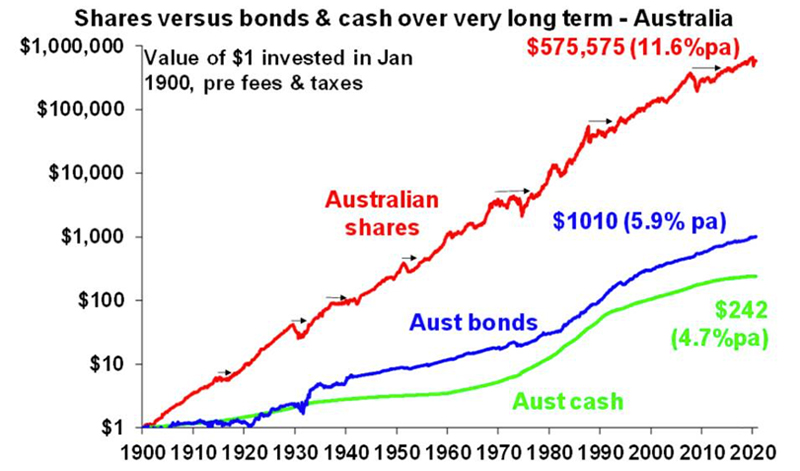
    The next chart is one of our favourites and it shows the value of one dollar invested in 1900 in Australian cash, bonds and equities with interest and dividends reinvested along the way. That one dollar would be worth $242 today if it had been invested in cash. But if it had been invested in bonds it would be worth $1,010 and if it was allocated to Australian shares it would be worth $575,575. Although the average return on shares (11.6% pa) is just double that on bonds (5.9% pa), the magic of compounding higher returns over long periods leads to a substantially higher balance. The same applies to other growth assets like property. So, the best way to build wealth is to take advantage of the power of compound interest and have a decent exposure to growth assets. Of course, the price for higher returns is higher volatility but the impact of compounding higher returns from growth assets is huge over long periods.

    chart shares vs bonds cash over long term

    Source: Global Financial Data, AMP Capital

    The coronavirus pandemic does nothing to change this, any more than previous setbacks like WW1 and Spanish Flu, the Great Depression, the 1973-74 bear market, the 1987 crash or the GFC did. The collapse in interest rates and earnings yields means the returns seen over the last 120 years will likely be a lot lower over the next decade. But this partly reflects the collapse in inflation (so in real terms things are not quite so bad). And without getting into forecasting, shares offering a dividend yield of 3.5% (4.5% with franking credits) should provide superior medium term returns and hence grow wealth far better than bonds where the ten-year income is 0.85% pa!!! (which is the return you will get over the next ten years).

    2. Don’t get thrown off by the cycle

    Investment markets constantly go through cyclical phases of good times and bad. Some are short and sharp, some can spread over many years. But all eventually set up their own reversal – eg. as falls make shares cheap and low interest rates help them rebound. The trouble is that cycles can throw investors off a well thought out investment strategy that aims to meet their financial goals and take advantage of longer-term returns. But they also create opportunities. In a longer term context the roughly 35% plunge and then rebound in shares associated with coronavirus was just another cyclical swing – albeit it occurred faster reflecting the unique nature of the shock which saw a faster than normal hit to economies and then faster than normal deployment of fiscal stimulus and monetary easing. The key was not to get thrown off when markets plunge and stick to your strategy – it was designed to meet your goals.

    3. Invest for the long term

    This one is a little no brainer. Investing is all about long term returns. If you ever wondered why (or you just can’t remember), it’s because of one thing – inflation. In the long run, the cost of living doubles every 15-20 years and if we keep money sit in the bank account, we’re eroding the purchasing power of what we own.

    Looking back, it always looks obvious as to why things happened. But that’s just Harry Hindsight talking! Looking forward no-one has a perfect crystal ball. As JK Galbraith observed “there are two kinds of forecasters: those who don’t know, and those who don’t know they don’t know.” Usually the grander the forecast the greater the need for scepticism as such calls invariably get the timing wrong or are dead wrong. If getting markets right were easy, then all the predictors would be mega rich and would have stopped doing it. During the pandemic with all sorts of forecasts as to what it would mean, most of which provided little help in actually getting the market low back in March let alone the rebound. Given the difficulty in getting market moves right in the short-term, it’s best to have a long-term plan, focused on your long-term goals and stick to it.

    4. Diversify

    Don’t put all your eggs in one basket. Hands up if this is the first time you hear it! It’s a well-known fact that having a well-diversified portfolio will provide a much smoother ride. But for whatever reason, especially when it comes to larger sums of money, we don’t do what we know we should be doing. For example, global and Australian shares provide similar returns over the very long term but in the March quarter this year global shares in Australian dollars fell less than half as much as Australian shares. Similarly, income investors who just had a few Australian bank stocks would have been hard hit by bank dividend cuts earlier this year whereas those with a broader exposure to high dividend paying companies would have seen their dividend income hold up a lot better. Lastly, those property investors, relying only on rental income from tenants would feel a heat not being able to replace them during the pandemic.

    5. Turn down the noise

    After having worked out a plan and investment strategy that’s right for you, it’s important to turn down the noise. Like most things, it’s easier said than done. The digital world we live in is providing us (minute by minute) with market updates, opinions about economy and what we should do. But much of this information and opinion is of poor quality. As “bad news sells” there has always been pressure on editors to put the negative news on the front page of newspapers. This has gone into hyperdrive through the coronavirus pandemic (as it does through any temporary period of increased uncertainty) – with a massively stepped up flow of economic information (eg the Australian Bureau of Statistics now publishes key jobs reports three times a month and there is now a focus on weekly economic statistics). This may be of use in providing timely information on how the economy is travelling but it’s also added immensely to the flow of information and often its contradictory. This is all leading to heightened uncertainty and shorter investment horizons which in turn can add to the risk that you could be thrown off well thought out investment strategies. The key is to turn down the volume on all this noise.

    Contact your planner and talk through your thinking process. This also means keeping your investment strategy relatively simple. Don’t waste too much time on individual shares or funds as it’s your high-level asset allocation that will mainly drive the return and volatility you will get. Here are several tips to help turn down the noise:

    • Talk to your adviser. One of the (if not the biggest) values they can provide you with is put things into perspective and help you stick to your plan.
    • Recognise that it’s normal for markets to swing from one extreme to another – the volatility is there for a good reason – to deliver premium long-term returns.
    • Only follow reliable news (if there’s such a thing) and turn off all “notifications” on your smart device.
    • Focus on things you can control. If it’s beyond your control, move on.
    • Try to avoid making big investment decisions during the ‘crisis du jour’ until you’re feeling less emotional.
    • Don’t’ check your investments on a day to day basis it’s a coin toss as to whether the share market will rise or fall but the longer you stretch it out between looking at your investments the more likely you will get positive news.

    6. Beware the crowd at extremes

    It feels safe to stick with a crowd (it’s in our DNA) and at times the investment crowd can be right. However, at extremes the crowd is invariably wrong – whether it’s at market highs like in the late 1990s tech boom or market lows like in March 2020. The problem with crowds is that eventually everyone who wants to buy in a boom (or sell in a bust) will do so and then the only way is down (or up after crowd panics). As Warren Buffet has said the key is to “be fearful when others are greedy and greedy when others are fearful”. And coronavirus does nothing to change that.

    7. Focus on investments with sustainable premium income

    If it looks dodgy, hard to understand or has to be based on obscure valuation measures then it’s best to stay away. By contrast, quality assets that generate sustainable income (profits, rents, dividends) and don’t rely on debt or financial engineering are more likely to deliver. Again, the coronavirus hit does nothing to change this.

    8. Get advice

    Last but not least by any means – having a third party, objective point of view to stop us from acting emotionally is money well spent. Given the psychological traps we are all susceptible to (like discounting of the future or tendency to over-react to current investment market conditions), we pay more attention to information and opinion that confirms our own views and the increasing complexity of investing that makes it anything but easy.

    A good approach is to seek advice in much the same way you might use a specialist to look after your needs. As with doctors or personal trainers, it’s best to hire service of a professional adviser you are comfortable with and you can trust. All of our planners have planners of their own – to provide valuable third-party perspective and to help them deal with their own emotions and complexities of planning.

    In closing, we realise we have sent you more than usual communications this year. It was for a good reason – to explain things and to guide you through an extremely challenging year. The upshot of this is that if you listened, you’d have prospered. Investing needs a lot of patience, cold head and constant guidance. After 32 years of guiding our clients, we can confidently say that knowing what to do is not enough. It’s what we end up doing actually matters to our financial outcomes and that’s why we’re here – to help you do what you might know you need to do, just sometimes your gut feeling says otherwise.

    As we wind down 2020 and look forward to 2021, please know that if you let us help you with your decisions, you are well positioned to take advantage of these volatile times. It will surely continue to be a wild ride but that’s what builds long term wealth and prosperity for our advised clients.


    Thank you for your ongoing trust.

    Bill Bracey FChFP | Managing Director of Sydney Financial Planning


    Are you in the best position to take advantage or these volatile times?

    Why not book an appointment with one of our planners to review your current situation, contact us on 02 9328 0876.


    General Disclaimer: This article contains information that is general in nature. It does not take into account the objectives, financial situation or needs of any particular person. You need to consider your financial situation and needs before making any decisions based on this information. Please seek personal financial advice prior to acting on this information.


    Investment Goals Setting

    Investment goal setting

    Investment Goals Setting

    Planning for your goals when you invest means giving yourself the best chance of success.

    Without a plan, it’s easy to get distracted by daily headlines. You can end up reacting to the news, timing the market, chasing returns and missing out on long-term gains.

    With a plan, you know where you’re heading because you have a map. Along the way, you may not know exactly what each day will bring or have control of everything but a plan will keep you focused on your goals.

    1

    Quantifying your goals

    The best way to define your goals is to make them time and dollar specific. This means we assign them a timeframe and the dollar figure we’re going for. If you have multiple goals (for example, paying for both retirement and your child’s education expenses), each needs to be clearly defined and accounted for.

    This step is often skipped as investors tend to quickly jump to solutions. However, defining your goals delivers clarity and a sense of ownership over your investment plan. We work with you to help you get this right. People don’t come to us with clearly defined financial goals, so don’t feel pressured into feeling like you need that clarity before seeking financial advice. Client goals are born in our first meeting.

    2

    Constructing your investment plan

    With clarity around your goals, it’s possible to move on to establishing a plan to achieve them. This involves working out the initial and ongoing regular dollar amount to invest and a suitable investment strategy. These will depend on the specifications of your goals and are prepared by your financial planner. Your planner will explain the reasons behind the recommendations as well as suitable products that will fit your plan.

    Because most objectives are long-term, your investment plan should be designed to endure through changing market environments, and should be flexible enough to adjust for unexpected events along the way.

    A sound investment plan can help you to practice healthy investor behaviour, because it demonstrates the purpose and value of asset allocation, diversification, and rebalancing. It also helps you to stay focused on your intended contribution and spending rates.

    3

    The danger of lacking a plan

    Without a plan, investors often build their portfolios from the bottom up, focusing on each investment holding rather than on how the portfolio as a whole is serving your objectives.

    Another way to characterise this process is “fund collecting”: Investors can be drawn into evaluating a particular fund or other type of investment and, if it seems attractive, they buy it, often without thinking about how or where it may fit within the overall asset allocation.

    While paying close attention to each investment may seem logical, this process can lead to a collection of holdings that does not serve your ultimate needs. As a result, your portfolio may wind up being under diversified (all your eggs in one basket) or you may end up holding a whole lot of expensive double ups (over diversification).

    With no plan to focus on, investors are led into such situations by common, avoidable mistakes such as performance chasing, market timing, or reacting to market “noise.” They are moved to action by the performance of the broader equity market, increasing their equities exposure during bull markets and reducing it during bear markets. Such “buy high, sell low” behaviour has been well documented and caused by our hard-wired emotional response to fear, rather than a rational one.

    4

    Staying focused on your goals

    Once the plan is in place, it’s revisited on a regular basis so you can track your progress.

    The future will not go exactly according to plan and that’s ok. It’s not about getting things exactly right about the future because we can’t. Your investment plan will, at some point, inevitably become an outdated map. The landscape will change. That’s life.

    Our ongoing planning process will ensure we address things as they come up. We’ll communicate with you on a regular basis, sometimes more frequently than other times.


    Having us on your side means we won’t continue to defend the outdated map but instead will be your guide in the ever-changing landscape. We’re here to make sure you’re heading the right direction. We’ve got you.

    Every now and then you will have a tendency to listen to ideas that can hurt you financially. We believe investors should employ their time and effort up front, on the plan, rather than in ongoing evaluation of each new idea that hits the headlines. This simple step can pay off tremendously in helping you stay on the path toward your financial goals.

    So, whether it’s a new car, education expenses or a comfortable retirement, if you keep your eyes on the end goal, you’ll stand more chance of reaching your destination and achieving investment success.

    The most important step is to begin.


    How does your investment goal strategy look?

    If you want a fresh look at how to reach your investment goals, book an appointment with one of our experienced planners, contact us on 02 9328 0876.


    Article by Sydney Financial Planning

    General Disclaimer: This article contains information that is general in nature. It does not take into account the objectives, financial situation or needs of any particular person. You need to consider your financial situation and needs before making any decisions based on this information. Please seek personal financial advice prior to acting on this information.


    Coronavirus - Recession, Depression or Economic Hit?

    Is coronavirus driving a recession, depression or an economic hit like no other?

    Coronavirus - Recession, Depression or Economic Hit?

  • There are big differences between the current disruption to economic activity – which could be very deep in the short term – and past recessions and depressions.
  • Introduction

    Global and Australian shares have fallen well beyond the 20% decline commonly used to delineate a bear market. From their highs to their recent lows major share markets have had roughly 35% falls as investors have moved to factor in a big hit to growth from coronavirus shutdowns.

    Recession now looks inevitable and they tend to be associated with deep and long bear markets, but now there is even talk of depression suggesting an even deeper bear market. In reality, there are big differences now compared to past recessions and the Great Depression, so it really looks like an economic hit like no other with very different implications for the bear market in shares. But let’s first look at past bear markets as they provide some lessons for investors regardless of the cause.

    The two bears – gummy & grizzly

    There are 2 types of bear markets in shares:

    • “gummy” bear markets with falls around 20% meeting the technical definition many apply for a bear market but where a year after falling 20% the market is up (like in 1998 in the US, 2011 and 2015-16 for Australian & global shares); and
    • “grizzly” bear markets where falls are a lot deeper and usually longer lived (like in 1973-74, US and global shares through the tech wreck or the GFC).

    I can’t claim the terms “gummy bear” and “grizzly bear” as I first saw them applied by stockbroker Credit Suisse a few years ago. But they are a good way to conceptualise bear markets. Grizzly bears maul investors but gummy bears eventually leave a nicer taste (like the lollies!). The next table takes a closer look at bear markets. It shows conventionally defined bear markets in Australian shares since 1900 – where a bear market is a 20% decline that is not fully reversed within 12 months. The first column shows bear markets, the second shows the duration of their falls and the third shows the size of the falls. The fourth shows the percentage change in share prices 12 months after the initial 20% decline. The final column shows the size of the rebound over the first 12 months from the low.

    bear markets au shares since 1900

    Based on the All Ords. I have defined a bear market as a 20% or greater fall in shares that is not fully reversed within 12 months. Source: Global Financial Data, Bloomberg, AMP Capital

    Since 1900 there have been 12 gummy bear markets (in black) and six grizzly bears (in red). Several points stand out.

    • First, gummy bear markets tend to be shorter & see smaller declines around 26% compared to 46% for the grizzly bears.
    • Second, the average rally over 12 months after the initial 20% fall is 15% for the gummy bear markets but it’s a 23% decline for the grizzly bear markets.
    • Third, the deeper grizzly bear markets are invariably associated with recession, whereas the milder gummy bear markets including the 1987 share market crash tend not to be. All the six grizzly bear markets, excepting that of 1951-52, saw either a US or Australian recession or both whereas less than half of the gummy bear markets saw recession. It’s also the case for the US share market.
    • Finally, once the bear market ends the rebound is strong with an average gain of 29%. Trying to time this is hard with many who get out on the way down finding they don’t get back in until the market has risen above where they sold!

    Recession versus depression or something else?

    So, one of the key messages from history is that if we have a recession then the bear market will likely be grizzly and severe with markets even lower than they are today in 12 months’ time. It’s not necessarily that simple though as the shock this time is very different to those seen in the past. But first the bad news. Recession now looks inevitable. There is now even talk of “depression”. While there is a huge unknown around how long it will take to control the virus and hence how long the shutdowns will last it is looking clear that the short term hit to GDP will be deeper than anything seen in the post WW2 period hence the increasing references to the pre-war depression:

    • Chinese business conditions PMIs for February fell an unprecedented 24 points due to shutdowns starting 23rd January. Consistent with this Chinese economic activity indicators are down 20% from levels a year ago. Chinese March quarter GDP could well be down 10% or so.
    • Business conditions PMIs for the US, Eurozone, Japan and Australia all plunged in March as lockdowns ramped up. The average decline for these countries composite business conditions PMIs was an unprecedented 12 pts. This takes them below levels seen in the GFC. And the shutdowns have only just started so further falls are likely in April. So like China, developed countries could conceivably see 10% or so falls in GDP centred around the June quarter.

    g3 bus conditions pmis

    Source: Bloomberg, AMP Capital

    impact to Australia GDP from covid19

    Source: ABS, AMP Capital

    • By way of example the next chart shows the industry make-up of the Australian economy. The shutdowns will see a large hit to roughly 25% of the Australian economy, particularly accommodation & culture, retailing & real estate.

    Big differences v past recessions and depressions

    But while the slump in economic activity may be deeper than anything seen in the post war period, depression may not be the best description. Most definitions of depression focus on it being over several years and seeing a very deep fall in GDP compared to a recession which is shorter and shallower. The current hit to economic activity may be very deep but it won’t necessarily be longer than past recessions. And there is good reason to believe that if the virus comes under control in the next 2-6 months and we minimize the collateral damage from the shutdowns that the hit to activity may be shorter. There are big differences between the current situation and that of past recessions and Great Depression of the 1930s:

    • First, recessions and The Great Depression (which saw GDP contract by 36% over 4 years and unemployment rise to 25% in the US and GDP fall by 9.4% in Australia with a rise in unemployment to 20%) were preceded by a period of excess in terms of investment, consumer discretionary spending, private debt growth and inflation that had to be unwound. This time around there has been no generalised period of excess and there has been no large-scale monetary tightening to bring on a downturn.
    • Second, monetary policy was tightened in the lead up to past recessions and in the early phase of the Great Depression whereas global monetary policy was eased last year and that easing has accelerated this month with rate cuts, a renewed ramp up of quantitative easing (QE) and central banks around the world establishing various ways to ensure credit flows to the economy. In the 1930s banks were simply allowed to fail. Now they are being supported by ultra-cheap funding. Much of this owes to the GFC experience which has made it easier for central banks to now ramp up QE and introduce support mechanisms.
    • Third, going into the Great Depression fiscal policy was tightened to balance budgets whereas in the last month we have seen massive and still growing global fiscal policy stimulus swamping that of the GFC. The latest US fiscal stimulus package alone is around 9% of US GDP.

    g20 countries fiscal thrust

    Source: IMF, AMP Capital

    • Fourth, there has been no trade war such as the Smoot-Hawley 20% tariffs on US imports that were met by global retaliation and saw global trade collapse in the 1930s.

    The bottom line is that while we may see the biggest hit to global and Australian GDP since the 1930s thanks to the shutdowns, there are big differences compared to the Depression suggesting that a long drawn out global downturn is not inevitable. Basically, it’s a disruption to normal activity caused by the need to stay at home. In fact, growth could rebound quickly once the virus is under control and policy stimulus impacts. Which in turn should benefit share markets and could see this latest bear market turn into a gummy bear market rather than a grizzly bear market. Of course, at this point we are still waiting for convincing evidence that markets have bottomed. And the key is that the number of new cases of coronavirus starts to slow and that collateral damage from the shutdowns are kept to a minimum.

    Closing Comment

    Wow a lot can change in a short period of time!

    In my last update I acknowledge there was a lot we did not know about this event and how it may play out. I finished with what we do know. After 31 years in Financial Planning
    I have learnt that numbers and history do not lie, that’s why we are obsessed with numbers and graphs to illustrate, our conclusions.

    I now ask you to re-read the table above, of what happened to the Australian Share market over the past 100 years when negative events occurred Globally, then look at the % gain in first 12 months after a low. Numbers don’t lie, nor history. Markets will recover, and when you’re sick you talk to the Medical Dr, when your financial affairs are sick talk to the Financial Dr. Now more than ever, you need to talk and review your situation to navigate out of here.

    Please feel free to call us, we’re here to help you.

    Bill and the team at SFP.


    Remember we are available to help you during this unprecedented time…

    If you have ANY please get in touch to speak with one of our Financial Planners we’re here to help, either book a virtual meeting of get in contact with us on 02 9328 0876.


    Article by Bill Bracey – Principal & Senior Financial Planner | Sydney Financial Planning


    This article was prepared by Dr Shane Oliver. Dr Shane Oliver who provides economic forecasts and analysis of key variables and issues affecting, or likely to affect, all asset markets. He also provides economic forecasts and analysis of key variables and issues affecting, or likely to affect, all asset markets.

    Important note: While every care has been taken in the preparation of this document, AMP Capital Investors Limited (ABN 59 001 777 591, AFSL 232497) and AMP Capital Funds Management Limited (ABN 15 159 557 721, AFSL 426455) make no representations or warranties as to the accuracy or completeness of any statement in it including, without limitation, any forecasts. Past performance is not a reliable indicator of future performance. This document has been prepared for the purpose of providing general information, without taking account of any particular investor’s objectives, financial situation or needs. An investor should, before making any investment decisions, consider the appropriateness of the information in this document, and seek professional advice, having regard to the investor’s objectives, financial situation and needs. This document is solely for the use of the party to whom it is provided.

    General Disclaimer: This article contains information that is general in nature. It does not take into account the objectives, financial situation or needs of any particular person. You need to consider your financial situation and needs before making any decisions based on this information. Please seek personal financial advice prior to acting on this information.

    Coronavirus and Financial Markets Melt Down

    Coronavirus and financial markets melt down. What to do?

    Coronavirus and Financial Markets Melt Down

    Maybe I was wrong? Australians rushing out buying toilet paper and fighting over it like it was gold being handed out for free.

    Some wise person once said:

    “Off with the head and on goes a pumpkin!”

    Thank god my clients still have their own head and use the knowledge they have gained through us and are not making irrational decisions about their investments.

    Yes, the phone rang, and yes, we are all concerned, but the vast majority asked me then same question.

    Q: “Bill, in all your correspondence you have sent us this calendar year – is this what you meant when you said, “This is how the rich get richer and the poor get poorer”?

    A: YES!

    Then most asked me…

    Q: “Is the time right now to start to invest when assets values have fallen greatly?”

    A: YES! (but I also say) patience grasshopper.


    This crisis will eventually pass, as investors and Australians become accustomed to the new normal that included the new coronavirus COVID-19, becoming a normal part of daily life along with the flu, obesity, car accidents and other medical issues.

    The difficult part is the ‘unknown’ as we don’t know how long the dislocation phase will last, where we need to reduce social interaction and possible isolation for a limited time. This has significant economic impacts and greatly increases the probability of a recession.

    The global markets have moved from raging Bull to Bear Market. How long will this last and when is it good to start investing again?

    That’s the Million-dollar question.

    The answer is; nobody knows. The best advice is everybody’s situation is vastly different and you need individual high-quality advice.

    What I do know is;

    • That we are in a bear market and we don’t know how far away the bottom is.
    • That right now there is possibly some phenomenal buying opportunities.
    • That markets perform over time and bounce back as seen in the below table.

      sfp e15 001 us stock markets 10 worst days

      Source: Schroders. Refinitv data correct as at 3 March, 2020. Data shown is for the S&P 500 Total Return Index, which includes price increases and dividend payments. Past performance is not a guide to future returns. 413199

    • This is a period of adjustment because we are moving from a long Bull market and nobody can ever pick the bottom of the Bear Market (nor the top of the Bull Market for that matter).
    • If you buy somewhere towards the bottom of the market, there is exceptional value and money to be made.
    • In times like this, the poor unadvised panic and sell at the bottom, and the well-advised rich buy from the poor. That’s how the Rich get Richer!
    • I’ve started investing part of my spare cash back into to the market.
    • I’ve been through many of these volatile times before I’ve learnt what to do and how to best advise clients, as do all our Financial Planners at Sydney Financial Planning.

    If you still have questions and things are not clear; I urge you to arrange to talk with your Financial Planner.


    Bill Bracey and the advice team


    Have you set things up to weather this trend?

    If you need your personal situation reviewed by your Financial Planner or you don’t have a planner yet, get in contact with us on 02 9328 0876.


    Bill Bracey – Principal & Senior Financial Planner | Sydney Financial Planning

    General Disclaimer: This article contains information that is general in nature. It does not take into account the objectives, financial situation or needs of any particular person. You need to consider your financial situation and needs before making any decisions based on this information. Please seek personal financial advice prior to acting on this information.

    2020 plunge in shares

    The plunge in shares – seven things investors need to keep in mind

    2020 plunge in shares

  • Shares may still have more downside and the uncertainty around the coronavirus crisis is very high, but we are of the view that it’s just another correction.
  • Key things for investors to bear in mind are that: corrections are normal; in the absence of recession, a deep bear market is unlikely; selling shares after a fall locks in a loss; share pullbacks provide opportunities for investors to buy them more cheaply; while shares may have fallen, dividends are smoother; and finally, to avoid getting thrown off a long-term investment strategy it’s best to turn down the noise during times like this.
  • Introduction

    The plunge in share markets over the last week has generated much coverage and consternation. This is understandable given the rapidity of the falls – with US shares having their fastest 10% fall from an all-time high on record – and the uncertainty around the coronavirus (Covid-19) and its impact on economic activity. From their highs to recent lows US shares have fallen 13%, Eurozone shares have fallen 16%, Japanese and Chinese shares have fallen 12% and Australian shares have fallen 12%. This note looks at the issues for investors and puts the falls into context.

    What’s driving the latest plunge?

    The plunge basically reflects two things.

    • After very strong gains from their last greater than 5% correction into August last year, share markets had become vulnerable to a correction.
    • The uncertainty around the impact of the coronavirus outbreak which is on the verge of becoming a pandemic and its impact on global growth has unnerved investors dramatically. Shares had recovered from their initial fall on the back of the virus into early February on signs that the number of new cases in China was falling (which is continuing), limited cases outside China and expectations that policy easing would limit any damage. This has been blown apart in the last week as cases have popped up en masse in Italy, South Korea and Iran, more cases have appeared elsewhere around the world and this has resulted in expectations of a deeper and longer hit to global growth.

    After big falls shares have become technically oversold, measures of negative investor sentiment such as the VIX (or fear) index and demand for option protection have spiked. So, shares could have a short-term bounce. But given the uncertainties around Covid-19 – with more cases in the US and Australia likely to pop up – the situation could get worse before it gets better, so the share pullback could have further to go – notwithstanding short-term bounces.

    Considerations for investors

    Sharp market falls with headlines screaming that billions of dollars have been wiped off the share market are stressful for investors as no one likes to see the value of their investments decline. The current situation is doubly stressful because of fears for our own and others health – particularly for the elderly. However, several things are worth bearing in mind:

    First, while they all have different triggers and unfold a bit differently to each other, periodic corrections in share markets of the order of 5%, 15% and even 20% are healthy and normal. For example, during the tech/dot-com boom from 1995 to early 2000, the US share market had seven pull backs greater than 5% ranging from 6% up to 19% with an average decline of 10%. During the same period, the Australian share market had eight pullbacks ranging from 5% to 16% with an average fall of 8%. All against a backdrop of strong returns every year.

    During the 2003 to 2007 bull market, the Australian share market had five 5% plus corrections ranging from 7% to 12%, again with strong positive returns every year. More recently, the Australian share market had a 10% pullback in 2012, an 11% fall in 2013 (the taper tantrum), an 8% fall in 2014, a 20% fall between April 2015 and February 2016, a 7% fall early in 2018, a 14% fall between August and December 2018 and a 7% fall into August last year. And this has all been in the context of a gradual rising trend. And it has been similar for global shares – with the last big fall in US shares being a 20% plunge into Christmas eve 2018. See the next chart. While they can be painful, share market corrections are healthy because they help limit a build-up in complacency and excessive risk taking.
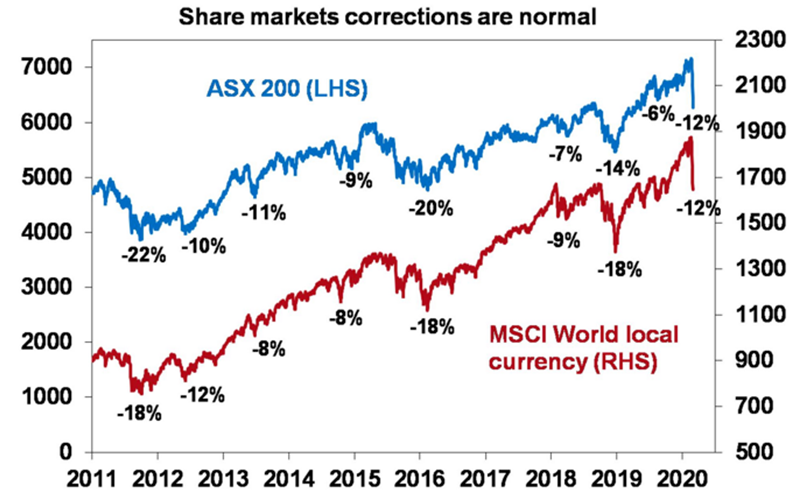
    sfp e14 001 corrections normal

    Source: Bloomberg, AMP Capital

    sfp e14 002 Australian shares climb a wall of worry

    Source: Bloomberg, AMP Capital

    Related to this, shares climb a wall of worry over many years with numerous events dragging them down periodically, but with the long-term trend ultimately up & providing higher returns than other more stable assets. Bouts of volatility are the price we pay for the higher longer-term returns from shares.

    Second, the main driver of whether we see a correction (a fall of 5% to 15%) or even a mild bear market (with say a 20% decline that turns around relatively quickly like we saw in 2015-2016) as opposed to a major bear market (like that seen in the global financial crisis (GFC)) is whether we see a recession or not – notably in the US as the US share markets tends to lead for most major global markets. The next table shows US share market falls greater than 10% since the 1970s. I know it’s heavy – but I like this table! The first column shows the period of the fall, the second shows the decline in months, the third shows the percentage decline from top to bottom, the fourth shows whether the decline was associated with a recession or not and the fifth shows the gains in the share market one year after the low. Falls associated with recessions are highlighted in red.
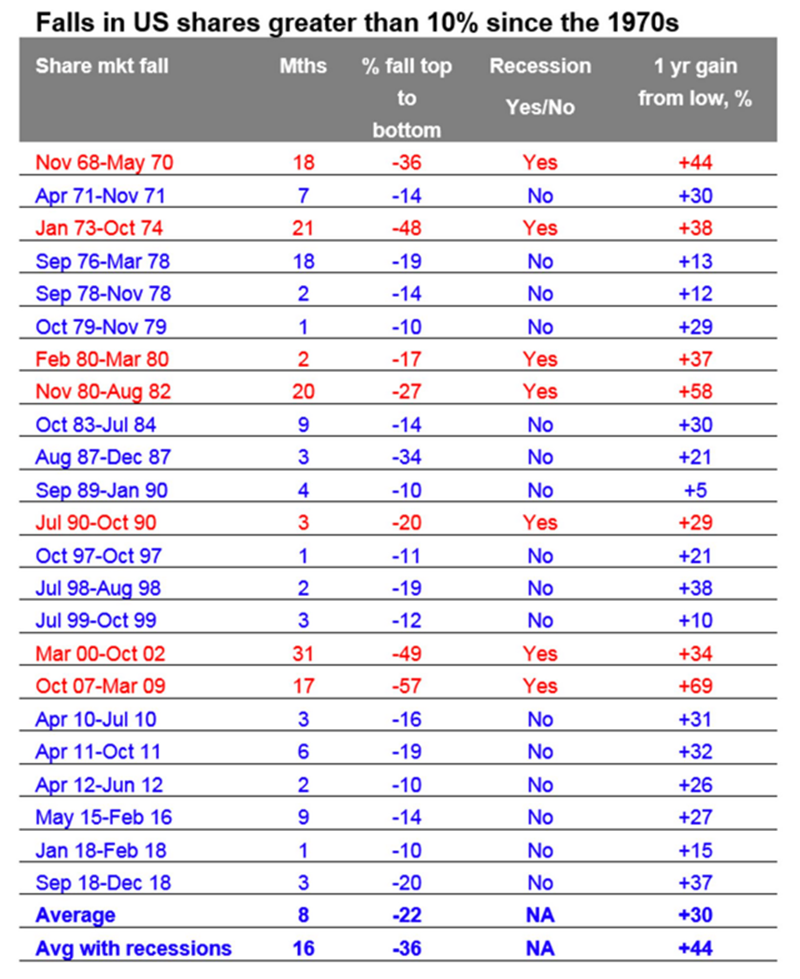
    sfp e14 003 falls in us market greater than 1970s

    Source: Bloomberg, AMP Capital

    Several points stand out:

    • First, share market falls associated with recession tend to be longer and deeper. 
    • Second, after the low the, share markets generally rebound sharply – which invariably makes it very hard for investors to time, as by the time they realise what has happened and get back in the market is above where they sold. 
    • Finally, as would be expected the share market rebound in the year after the low is much greater following falls associated with recession.

    So, whether a recession is imminent or not in the US is critical in terms of whether we will see a major bear market or not. In fact, the same applies to Australian shares. Our assessment is that a US/global recession is not inevitable. We have not seen the excesses – in terms of overall debt growth (although housing debt is a source of risk in Australia), overinvestment, capacity constraints and inflation – that normally precede recessions in the US, globally or Australia. And we have not seen the sort of monetary tightening that leads into recession. In fact, monetary conditions remain very easy. However, the uncertainty around the coronavirus outbreak and the likelihood of economic shutdowns designed to contain it beyond those in China do suggest a greater than normal risk on this front. That said even if there were a recession growth would likely rebound quickly once the virus came under control as economic activity sprang back to normal helped by policy stimulus.

    Third, selling shares or switching to a more conservative investment strategy or superannuation option after a major fall just locks in a loss. With all the talk of billions being wiped off the share market, it may be tempting to sell. But this just turns a paper loss into a real loss with no hope of recovering. The best way to guard against making a decision to sell on the basis of emotion after a sharp fall in markets (as many including me are tempted to do!) is to adopt a well thought out, long-term strategy and stick to it.

    Fourth, when shares and growth assets fall, they are cheaper and offer higher long-term return prospects. So, the key is to look for opportunities the pullback provides – shares are cheaper and some more than others. It’s impossible to time the bottom but one way to do it is to average in over time.

    Fifth, while shares have fallen, dividends from the market haven’t. They will come under some pressure as the economy and profits take a hit from a deeper and longer coronavirus outbreak. But companies like to smooth their dividends over time – they never go up as much as earnings in the good times and so rarely fall as much in the bad times. So, the income flow you are receiving from a well-diversified portfolio of shares is likely to remain attractive, particularly against bank deposits.
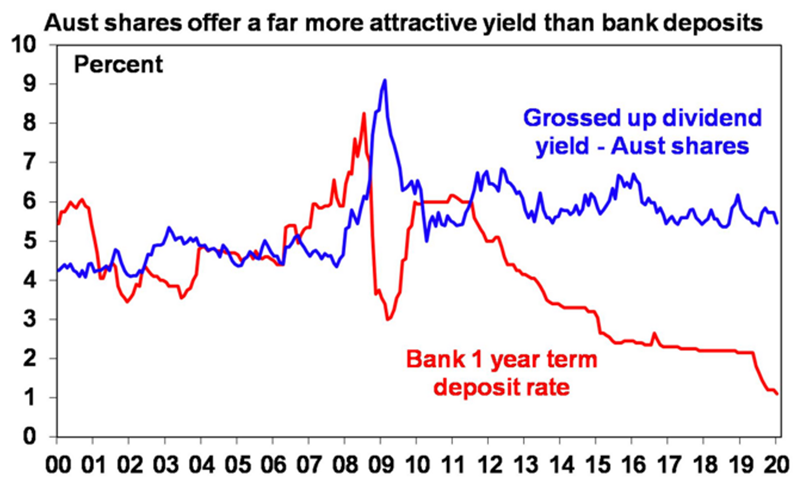
    sfp e14 004 aust shares offer attractive yield

    Source: RBA, Bloomberg, AMP Capital

    Sixth, shares and other related assets often bottom at the point of maximum bearishness, ie, just when you and everyone else feel most negative towards them. So, the trick is to buck the crowd. “Be fearful when others are greedy. Be greedy when others are fearful,” as Warren Buffett has said.

    Finally, turn down the noise. At times like this, negative news reaches fever pitch. Talk of billions wiped off share markets and warnings of disaster help sell copy and generate clicks & views. But we are rarely told of the billions that market rebounds and the rising long-term trend in share prices adds to the share market. Moreover, they provide no perspective and only add to the sense of panic. All of this makes it harder to stick to an appropriate long-term strategy let alone see the opportunities that are thrown up. So best to turn down the noise.

    Concluding Comment

    So in summary as I suggested in January in my update to you, times like this offer opportunity and we have seen times like this before. This is where the rich get richer and the poor non advised, get poorer.

    Please take time to watch my 5 minute video that explains what you should be doing with this market.


    Now more than ever its important to keep your nerve and shut out the media who pump FEAR into the masses.

    Please feel free to contact us at Sydney Financial Planning, we are experienced at dealing with volatile times and know what to do.

    Bill Bracey and the team


    Have you set things up to weather this trend?

    If you need your personal situation reviewed by your SFP Planner or you don’t have a planner yet, get in contact with us on 02 9328 0876.


    Bill Bracey – Principal & Senior Financial Planner | Sydney Financial Planning


    This article was prepared by Dr Shane Oliver. Dr Shane Oliver who provides economic forecasts and analysis of key variables and issues affecting, or likely to affect, all asset markets. He also provides economic forecasts and analysis of key variables and issues affecting, or likely to affect, all asset markets.

    Important note: While every care has been taken in the preparation of this document, AMP Capital Investors Limited (ABN 59 001 777 591, AFSL 232497) and AMP Capital Funds Management Limited (ABN 15 159 557 721, AFSL 426455) make no representations or warranties as to the accuracy or completeness of any statement in it including, without limitation, any forecasts. Past performance is not a reliable indicator of future performance. This document has been prepared for the purpose of providing general information, without taking account of any particular investor’s objectives, financial situation or needs. An investor should, before making any investment decisions, consider the appropriateness of the information in this document, and seek professional advice, having regard to the investor’s objectives, financial situation and needs. This document is solely for the use of the party to whom it is provided.

    General Disclaimer: This article contains information that is general in nature. It does not take into account the objectives, financial situation or needs of any particular person. You need to consider your financial situation and needs before making any decisions based on this information. Please seek personal financial advice prior to acting on this information.

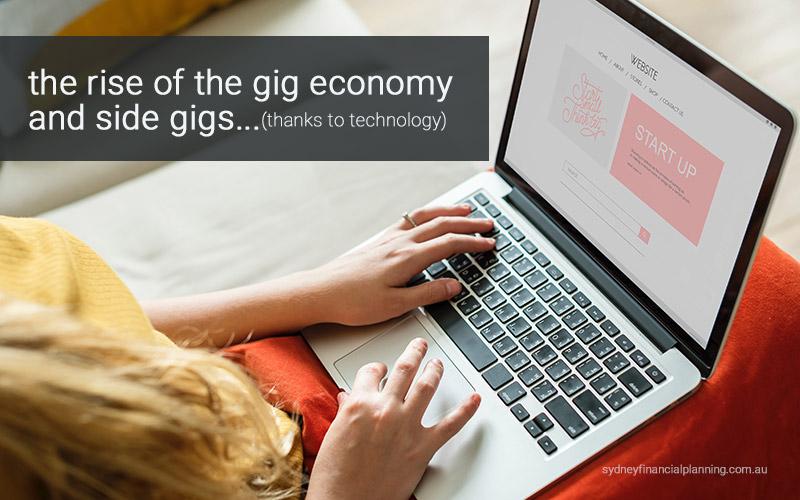
    What do Australians want financial advice on?

    What do Australians want financial advice on?

    What do Australians want financial advice on?

    According to the recent ASIC report [1], the topics Australians want financial advice on:

    • Investments (e.g. shares and managed funds) 45%
    • Retirement income planning 37%
    • Growing superannuation 31%
    • Budgeting or cash flow management 22%
    • Aged care planning 18%

    Despite this, only 12% of Australian surveyed sought financial advice in the past 12 months.

    Like many Australians, you might have thought about helping secure your family’s financial future by working with a financial adviser.

    According to the recent Australian Securities & Investments Commission report, ‘Financial advice: What consumers really think [2], 79% of Australians believe “financial advisers have expertise in financial matters that I do not have”.

    Yet here’s the kicker: only 12% have actually sought advice in the past 12 months.

    The good news is 41% of Australians intend to get financial advice in the future, and 25% intend on doing so in the next 12 months. Below we’ve covered the areas they are most interested in seeking advice on.

    1. Investment Advice

    According to the ASIC report, perhaps unsurprisingly, 45% of Australians want advice on investments (e.g. shares and managed funds)

    But, a 2019 report by global investment solutions firm Russell Investments – ‘Why work with a financial adviser? [3]’ states that researchers have discovered over 200 unconscious biases that influence our decisions, which could have a detrimental effect on our future wealth.

    “People tend to let their emotions and other human tendencies influence their decision making. But when it comes to investing, acting like a human may actually cost you money,” the Russell Investments report states.

    “To be a successful investor, it is important to be objective and disciplined when making investment decisions.

    2. Retirement Income Planning

    According to the ASIC report, 37% of survey participants wanted advice on retirement income planning.

    Indeed, according to the 2017 ASX Australian Investor Study [4] report, retirement and wealth accumulation are “front of mind for all age groups, and individuals are investing in products that reflect these goals”.

    The ASX report states that a single person seeking a ‘modest’ lifestyle in retirement requires a lump sum of at least $370,000 (without the age pension) invested and returning 7% p.a.

    For couples, this lump sum needs to be at least $400,000.

    In order to have a ‘comfortable’ retirement, households will require double these amounts.

    One of the most important jobs a financial adviser has is helping you to determine the best investment strategy and risk profile to achieve your long-term retirement objectives.

    “Investing early to accumulate wealth will make the difference between a modest and a comfortable retirement in the future – and whether or not individuals will need to rely on the age pension,” the ASX report states.

    Financial advisers, like us, can help you craft a diversified portfolio that is intended to provide not just a comfortable living when you eventually retire, but also design a strategy that takes into account your age, circumstances and risk appetite.

    3. Superannuation

    The ASIC survey shows that 31% of Australians also want advice on growing their superannuation.

    Now, superannuation seems to be another one of those financial topics that people know about, but don’t truly understand, despite the major long-term benefits.

    In fact, research by the Association of Superannuation Funds of Australia (ASFA)[5], has found that Australians under 30 years of age tend to have higher balances in their superannuation accounts than their bank accounts.

    And yet, 40% of young people have absolutely no idea what their superannuation balance is.

    There are also several tax deduction benefits related to superannuation contributions, and this is the kind of information a financial adviser can provide while helping you get the most out of your superannuation plan.

    4. Cash Flow

    It turns out that 22% of ASIC survey participants wanted advice on budgeting or cash flow management. And for good reason.

    This is where we can really make an impact in your current day-to-day life – not just decades down the track. We can help you manage your monthly budgets, reduce your debt and make sure you have enough cash flow to comfortably make it to the end of each month.


    Let us help you sleep better and get your financial future on track.

    Speaking with one of our financial advisors is a good place to start. Make a booking or call us on 02 9328 0876 to arrange a meeting.


    [1] & [2] Australian Securities and Investments Commission (ASIC) August 2019, Financial advice: what consumers really think, viewed January 2020 https://download.asic.gov.au/media/5243978/rep627-published-26-august-2019.pdf © AUSTRALIAN SECURITIES & INVESTMENTS COMMISSION. REPRODUCED WITH PERMISSION. PLEASE SEE THE WEBSITE FOR FURTHER INFO
    [3] Russell Investments 2019, Why work with a financial adviser?, viewed January 2200 https://www.jsagroup.com.au/wp-content/uploads/2019/08/2019-Value-of-an-Adviser_Investor-Report.pdf
    [4] Deloitte Access Economics 2017, ASX Australian Investor Study, viewed January 2020 https://www.asx.com.au/documents/resources/2017-asx-investor-study.pdf
    [5] The Association of Superannuation Funds of Australia Limited (AFSA) 2020, Young people and superannuation, viewed January 2020 http://www.superguru.com.au/about-super/youngpeople

    General Disclaimer: This article contains information that is general in nature. It does not take into account the objectives, financial situation or needs of any particular person. You need to consider your financial situation and needs before making any decisions based on this information. Please seek personal financial advice prior to acting on this information.