Tag: Investing

The income or growth conundrum

The income or growth conundrum

The income or growth conundrum

We love investment income at SFP, because it adds real money to your investment account which you can use in the real world. Don’t get me wrong, capital growth is great (both the income and capital are important considerations for any investment), however, until you sell something it’s not real money we can use at the shops. And the problem with selling investments is that we then have to give up the future income from it. A bit of a conundrum.

They say, “horses for courses”. Depending on what life stage you’re in will depend on what investment return you might be favouring. Our accumulator clients might be focusing more on capital growth, whereas our retired clients might be more focused on a growing income from their investments.

Investment income may come in the form of interest, rent, dividends or distributions (as they call them from managed funds). The quality of the income is determined by the quality of the underlying investment, with consistency and reliability being two important factors we deem to be represented in quality income. The other important factor is the ability for the income to increase over time.

If you’re accumulating wealth over the longer-term, your focus is likely to be on capital growth, with income generated from that investment being used to purchase additional investments. However, there comes a point in time where your capital has grown sufficiently, and now your focus will be more on generating income to support your lifestyle.

If you need to access capital to fund your lifestyle expenses, you become a forced seller and must accept what the market gives you. This is generally not a situation many of our accumulator clients have dealt with, as we can set a retirement target date and plan accordingly, so we know when we’re likely going to need to access our investment capital.

The greatest challenge is for our pre-retiree or retiree clients, in that they may be in a situation where they have insufficient cash to fund their next pension payment. If the underlying investments produce sufficient income to top-up your cash account, then you won’t need to sell assets to fund your withdrawals, which is an ideal scenario.

This is where having a well-defined strategy comes into play, and why it forms an important part of our planning process for clients in retirement, or close to retirement. By looking ahead, we can determine the optimal timing for adjusting your investment strategy, as well as consider appropriate underlying investments to meet your needs going forward.

Re-investing dividends provides the opportunity to grow your portfolio at a greater pace over time, compared to banking your dividends. This applies regardless of whether you’re putting additional funds in or not, the dividends will be used to purchase more shares or units in your portfolio. This is known as “compounding returns”.

Where your strategy is largely to build your portfolio over a long period of time and your personal circumstances enable this to happen consistently (generally while you’re working) then re-investing dividends has proven to be an effective strategy.

However, if you require a regular income from your investments (such as in retirement), your dividends may be better served being directed to your cash or transaction account. This will in effect ‘top up’ your cash account and allow you to continue funding your income needs.

The decision to re-invest income, or allocate income to cash, really depends on your overall needs and there may be a combination of both of these approaches built into your overall plan.


Article by Steven Stolle
Financial Planner | Director


Does your portfolio have a long-term investing strategy in place?

Speak with one of our Financial Planners about the best investing approach for your circumstances, call 02 9328 0876 to arrange a meeting.


General Disclaimer: This article contains information that is general in nature. It does not take into account the objectives, financial situation or needs of any particular person. You need to consider your financial situation and needs before making any decisions based on this information. Please seek personal financial advice prior to acting on this information.


 

Transitioning into retirement? Start to get your buckets in place early.

Transitioning into retirement? Start to get your buckets in place early.

Transitioning into retirement? Start to get your buckets in place early.

However, the devils in the detail when executing a well-diversified investment portfolio and it largely depends on which life stage you’re at when selecting the right approach.

There are two approaches to implementing a well-diversified investment portfolio, the first being a diversified multi asset investment fund and the second being a well-diversified “investment bucket” portfolio approach. They both spread a client’s funds across difference asset classes to smooth the returns however one approach works especially well for our accumulator clients whilst the other is the foundation for managing our retired client’s portfolio’s.

This article focuses on the “investment bucket” diversification approach for our retired clients. This framework generally has a least 4 “buckets” ranging from the short-term bucket for transactions to the long term bucket for capital growth and protecting our clients purchasing power.

Bucket 1: The short-term bucket.

The transaction or cash account. Pays for pension payments and costs.

Think of bucket number 1 like a glass of water, as we drink from it (draw money out) the water level reduces. We need to top this glass back up to ensure we can keep drinking as retirement is thirsty work. How do we top it back up? We direct the ‘water’ from buckets 2, 3 and 4 to this bucket. That way we can keep drinking. Should the water levels fall too low we may need to sell some of the profits from buckets 3 and 4 to top back up however we only want to do this when there are profits to take, however, we need to allow sufficient time for those assets to flourish and grow.

sfp bucket 002

Bucket 2: The cash reserve.

Holds a year of pension payment provisions along with an amount reserved for emergencies and unexpected expenses.

In the event we need to top up bucket 1 within the first 5 years we can call on the reserve bucket to help us out. We can use these funds at a pinch to ensure there’s enough water (or cash) in bucket 1 to draw on. This is our contingency account for what ifs. Needs to be readily accessible. Could be a high interest cash managed fund and a Term Deposit (depending on how much we’re holding in reserve).


sfp bucket 003

Bucket 3: The medium-term bucket.

Our 5–7-year money with a focus on delivering steady, reliable, and growing income.

Generally invested with the primary goal to provide growing income and ensure asset value keeps pace with inflation to preserve the purchasing power of our funds. This bucket generally invests largely in blue chip Australian shares with a focus on paying fully franked dividends, infrastructure and bonds with high yields. As we all know the cost of living doesn’t stop increasing for anybody and retirees know they need to be drawing a higher income each year.

sfp bucket 004

Bucket 4: The long-term bucket.

Our 7 – 10-year money. Invested largely in growth assets such as shares and property with a timeframe of 7-10 years.

Our primary investment objective for this bucket is to preserve the purchasing power of our capital. Therefore, this bucket’s goal is to produce capital growth along with some income. Income from this bucket is directed to bucket number 1 (or reinvested in we can afford it).

When should I start transitioning to an “investment bucket: portfolio approach?

There’s no set answer however generally speaking allowing somewhere between 3 and 5 years prior to retirement is best practice and allows sufficient time to build up our short and medium term buckets. We’ll be raising this with you at your annual progress meeting.


Gary Winwood-Smith
Director | Senior Financial Planner


Do you need help with the conundrum of income or growth?

Speak with one of our Financial Planners about the best investment strategy for your circumstances, call 02 9328 0876 to arrange a meeting.


General Disclaimer: This article contains information that is general in nature. It does not take into account the objectives, financial situation or needs of any particular person. You need to consider your financial situation and needs before making any decisions based on this information. Please seek personal financial advice prior to acting on this information.
 

Focusing on the right thing with investing

Focusing on the right thing

Focusing on the right thing with investing

2022 could have gone into the books as an unrelievedly ‘bad’ year, indeed quite the worst one since the onset of the Global Financial Crisis in 2008. But of course, that isn’t the case because the share prices are just one aspect of their total return.

The other is dividends – the actual cash disbursements companies make to their owners (shareholders) out of their earnings, and the income on which many retired investors are living. In 2022, those dividends went up just shy of 11% from 2021. You read that right, last year’s S&P 500 cash dividend was 10.8% higher than 2021’s. (It was the 13th year in a row that dividends went up, and the 11th consecutive record high.)

That’s sort of what dividends do, and indeed it only makes common sense: since in the aggregate the 500 companies in the Index have significantly increased their earnings over time, they’ve been able – and quite willing – to reward their shareholders by raising their cash dividends. 

This wasn’t a one-year wonder. In the last 50 years – beginning with the annus horribilis 1973, the dividends went up because the earnings went up – more than 18 times.

Well fine, in fact pretty terrific. But in the next breath, you might very intelligently ask: how much of that dividend increase was lost to the erosion of purchasing power? In other words, how much did the cost of living go up in those 50 years? The answer is that the Consumer Price Index increased 6.4 times, from December 1973 to December 2022.

If that’s starting to look to you like the S&P 500’s cash dividend has quietly gone up, this half century past, close to three times more than has the cost of living, I’m happy to confirm that you’re reading the situation just exactly right.

You may wonder why no one (apart from your financial planner, who may have to be restrained from shouting it from the housetops) has ever reported this to you. Permit me to speculate: (1) It’s a pure goodness, and financial journalism tends to devote very little space to purely good things. And (2) it isn’t really “news”, but rather a cumulatively very powerful truth.

So, if some bank you’d never even heard of busted out today because it lent a bunch of money to some crypto bros, be assured that that’s just about all you’re going to be reading and hearing about for a while. Indeed, I can pretty much guarantee that “Tortoise continues inexplicably to beat hare” won’t ever be the big headline on your financial “news” feed, so you needn’t bother looking for it.

Here’s why an 11% jump in the cash dividend in spite of any temporary declines in the share prices, should have been every long-term equity investor’s key takeaway from 2022:

For the pre-retirement investor – trying with all his/her might to accumulate enough capital for retirement – it’s because a significantly increased stream of dividends was being reinvested at significantly reduced share prices. That’s the great (though somehow not obvious) beauty of compounding, as you make most of your money in a bear market; you just don’t realize it at the time.

And of course, for retired investors, it’s how their increased income may well have stayed ahead of their inflating living costs. CPI inflation was pretty dreadful in 2022, but it was nowhere near 11%. Remember: it isn’t your account statement you’ll be taking to the supermarket throughout perhaps three decades of retirement; it’s your income.

Just one man’s opinion, I guess. But if people looked up their dividend income every 90 days instead of checking their account balances every 90 minutes, they just might become markedly more successful investors.


Article by Michal Bodi

Senior Financial Planner | Partner


Does your portfolio have a long-term investing strategy in place?

Speak with one of our Financial Planners about the best investing approach for your circumstances, call 02 9328 0876 to arrange a meeting.


General Disclaimer: This article contains information that is general in nature. It does not take into account the objectives, financial situation or needs of any particular person. You need to consider your financial situation and needs before making any decisions based on this information. Please seek personal financial advice prior to acting on this information.

 

Recession & volatile world markets

Volatile world markets

Recession & volatile world markets

You are not alone! Last year I forewarned the continuing volatility of the financial markets and Australian housing market. Currently, the average house prices fall is approximately 10%. We still feel that some suburbs may fall a little further, though there seems to be some leveling off overall. The concern is that as some people come out of a 2-year fixed term mortgage at 2% and go to a new variable rate of above 5%, the increase may be unaffordable and force them to sell. Time will tell.

The Australian and worlds stock market prices are showing signs of recovery after a wild ride caused by the increased interest rates, inflation, supply shortages and uncertainty thanks to Mr Putin.
Most leading economists now see the world slowing due to high interest rates and believe we will enter a period of recession worldwide. Yes, the R word! Australia may see a softer landing but still never nice, Europe a hard landing, and the USA a moderate recession. How will all these events affect my portfolio that is managed by Sydney Financial Planning?

Well, as we go into a recession the worlds governments will need to stimulate the economy. In Australia like in other countries, they will begin to lower interest rates probably later this year or early next year. We will enter this next economic cycle and as interest rates fall it will stimulate growth assets. Typically, shares first, followed in time by property, but this may take some time to turn.

From a historical point, a similar cycle occurred in 1973-74 due the OPEC oil crisis, where the price of oil doubled. The share markets and property both fell heavily, then when the oil price came down, the interest rates went down quickly as the world went into recession and the Australian share market went up over 60 % in one year.

I’m not suggesting a huge share price uplift next year, but many past economic cycles have shown us this trend is what typically happens next.


Source: Bloomberg, AMP Capital

Here we are again, finding ourselves having to navigate through volatility for reasons out of everyone’s control. However, there are variables we can control – these include having a plan and regular guidance helping us stick to it, and investing only in quality assets, managed by quality fund managers. That is something we can choose to do, that is also something that stands the test of time. Remember only the patient will get rewarded.

In summary, still expect volatility (that never goes away and it’s completely normal and organic), interest rates will start to go down again and when they do enjoy the upward cycle. In the meantime, take advantage of this uncertainty as it provides rare buying opportunities at lower prices, helping you build wealth and securing your future.

Please feel free to call your financial planner or our mortgage broker from SFP Home Finance and we can review your situation and advise you for your future.

Bill Bracey
Founder & Managing Director


Not sure how to take advantage of this volatile market and rare opportunity?

Speak with one of our Financial Planners about the best approach for your circumstances, either book a meeting or get in contact with us on 02 9328 0876.


General Disclaimer: This article contains information that is general in nature. It does not take into account the objectives, financial situation or needs of any particular person. You need to consider your financial situation and needs before making any decisions based on this information. Please seek personal financial advice prior to acting on this information.

Five charts on investing to keep in mind in rough times like now

Five charts on investing to keep in mind in rough times like now

Five charts on investing to keep in mind in rough times like now

  • This makes it all the more important to stay focussed on the basic principles of successful investing.
  • These five charts focus on critical aspects of investing that are insightful in times of market stress: the power of compound interest; don’t get blown off by cyclical swings; the roller coaster of investor emotion; the wall of worry; & market timing is hard.
  • Introduction

    The coronavirus crisis is first and foremost a human crisis and my thoughts are particularly with those on the front line of this battle. But, of course, it’s impacting many aspects of life at present, including investment markets. Successful investing can be really difficult in times like the present when markets have collapsed into a bear market with falls globally of around 30% from their highs amidst immense uncertainty about the economic hit from coronavirus and how much policy stimulus and central bank support can head off collateral damage and boost an eventual recovery. Trying to work this out is driving huge volatility in investment markets making it very easy for short term traders to get whipsawed. I will be the first to admit that my crystal ball is even hazier than normal right now. As the US economist, JK Galbraith once said “there are two types of economists – those that don’t know and those that don’t know they don’t know.’And this is certainly an environment where much is unknown.

    But while history does not repeat in that each cycle is different it does rhyme in that each has many common characteristics. So, while we haven’t seen a pandemic driven bear market before the basic principles of investing have not changed. This note revisits five charts I find particularly useful in times of stress.

    Chart #1 The power of compound interest

    This is my favourite chart. It shows the value of $1 invested in various Australian assets in 1900 allowing for the reinvestment of dividends and interest along the way. That $1 would have grown to $242 if invested in cash, to $1017 if invested in bonds and to $481,910 if invested in shares.

    Source: Bloomberg, AMP Capital

    While the average return since 1900 is only double that in shares relative to bonds, the huge difference between the two at the end owes to the impact of compounding – or earning returns on top of returns. So, any interest or return earned in one period is added to the original investment so that it all earns a return in the next period. And so on. I only have Australian residential property data back to 1926 but out of interest it shows (on average!) similar long term compounded returns to shares..

    Key message: to grow our wealth, we must have exposure to growth assets like shares and property. While shares have collapsed lately amidst massive coronavirus uncertainty and the short-term outlook for Australian housing is vulnerable too, both will likely do well over the long-term.

    Chart #2 Don’t get blown off by cyclical swings

    The trouble is that shares can have lots of setbacks along the way as is evident during the periods highlighted by the arrows on the previous chart. Just like now. Even annual returns in the share market are highly volatile, but longer-term returns tend to be solid and relatively smooth as can be seen in the next chart.

    Since 1900, for Australian shares roughly two years out of ten have had negative returns but there are no negative returns over rolling 20-year periods.

    The higher returns shares produce over time relative to cash and bonds is compensation for the periodic setbacks they have. But understanding that these periodic setbacks are just an inevitable part of investing is important in being able to stay the course and get the benefit of the higher long-term returns shares and other growth assets provide over time.

    Source: Bloomberg, AMP Capital

    Key message: short-term sometimes violent swings in share markets are a fact of life but the longer the time horizon, the greater the chance your investments will meet their goals. So, in investing, time is on your side and it’s best to invest for the long-term when you can.

    Chart #3 The roller coaster of investor emotion

    It’s well known that the swings in investment markets are more than can be justified by moves in investment fundamentals alone – like profits, dividends, rents and interest rates. This is because investor emotion plays a huge part. This has been more than evident over the past few weeks.

    The roller coaster of investor emotion

    Source: Russell Investments, AMP Capital

    The next chart shows the roller coaster that investor emotion traces through the course of an investment cycle. Once a cycle turns down in a bear market, euphoria gives way to anxiety, denial, capitulation and ultimately depression at which point the asset class is under-loved and undervalued and everyone who is going to sell has – and it becomes vulnerable to good (or less bad) news. This is the point of maximum opportunity. Once the cycle turns up again, depression gives way to hope and optimism before eventually seeing euphoria again.

    Key message: investor emotion plays a huge role in magnifying the swings in investment markets. The key for investors is not to get sucked into this emotional roller coaster. Of course, doing this is easier said than done which is why many investors end up getting wrong footed by the investment cycle.

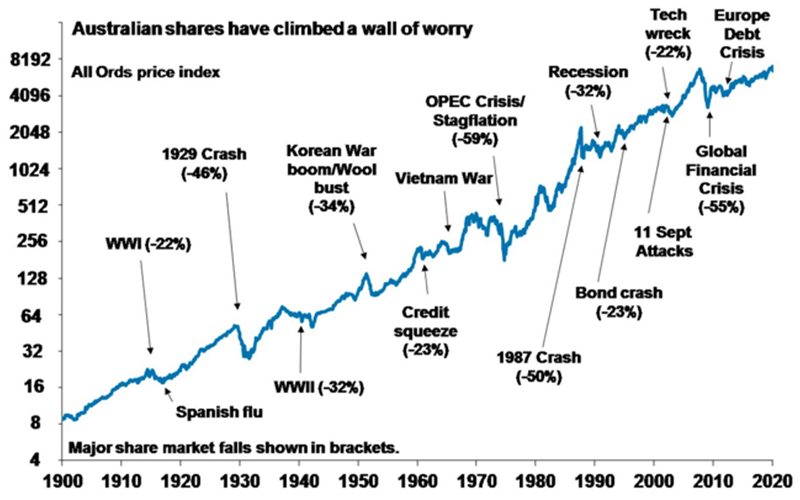
    Chart #4 The wall of worry

    There is always something for investors to worry about. And in a world where social media is competing intensely with old media it all seems more magnified and worrying. This is arguably evident now in relation to coronavirus uncertainty. The global economy has had plenty of worries over the last century, but it got over them with Australian shares returning 11.5% per annum since 1900, with a broad rising trend in the All Ords price index as can be seen in the next chart, and US shares returning 9.6% pa. (Note that this chart shows the All Ords share price index whereas the first chart shows the value of $1 invested in the All Ords accumulation index, which allows for changes in share prices and dividends.)

    Australian shares have climbed a wall of worry

    Source: ASX, AMP Capital

    Key message: worries are normal around the economy and investments and sometimes they become intense – like now. But they eventually pass. For example, back in mid-January it seemed the bushfires, smoke shrouding our cities and regular news of homes and lives lost would never end. But when I went to regional NSW in the last week it was lovely, green and wet. And so, it is with coronavirus – this too will pass eventually.

    Chart #5 Timing is hard

    The temptation to time markets is immense. With the benefit of hindsight many swings in markets like the tech boom and bust and the GFC look inevitable and hence forecastable and so it’s natural to think why not switch between say cash and shares within your super to anticipate market moves.

    Missing the best days and the worst days

    Covers Jan 1995 to 17 March 2020. Source: Bloomberg, AMP Capital

    This is particularly the case in times of emotional stress like now when all the news around coronavirus and its impact on the economy is bad. Fair enough if you have a process and put the effort in. But without a tried and tested market timing process, trying to time the market is difficult.

    A good way to demonstrate this is with a comparison of returns if an investor is fully invested in shares versus missing out on the best (or worst) days. The next chart shows that if you were fully invested in Australian shares from January 1995, you would have returned 8% pa (with dividends but not allowing for franking credits, tax and fees).

    Key things for SFP clients to remember

    After 35 years of advising Sydney Financial Planning clients, the key message I need to remind everyone is; we have been through this sort of volatility/storm before. As uncomfortable as it is for all – the sun will come out again, and the next upward cycle will come. We just need to weather this storm and have confidence as an advised client your portfolio is built to manage volatility.

    The last key message to remember is GFC in both 2008-2010 and COVID in 2019-2020 painful as it was at the time; we urged you to use the lower market values to buy in at lower prices and ride the wave out of the issue of the day.

    Today I’m saying the same.


    Bill Bracey – CEO and Founder | Sydney Financial Planning


    How is your long-term strategy and investment opportunity looking?

    Speak with one of our Financial Planners about the best approach for your circumstances, either book a meeting or get in contact with us on 02 9328 0876.


    This article was prepared by Dr Shane Oliver with closing summary by William Bracey – CEO & Senior Financial Planner from Sydney Financial Planning. Dr Shane Oliver who provides economic forecasts and analysis of key variables and issues affecting, or likely to affect, all asset markets. He also provides economic forecasts and analysis of key variables and issues affecting, or likely to affect, all asset markets.

    Important note: While every care has been taken in the preparation of this document, AMP Capital Investors Limited (ABN 59 001 777 591, AFSL 232497) and AMP Capital Funds Management Limited (ABN 15 159 557 721, AFSL 426455) make no representations or warranties as to the accuracy or completeness of any statement in it including, without limitation, any forecasts. Past performance is not a reliable indicator of future performance. This document has been prepared for the purpose of providing general information, without taking account of any particular investor’s objectives, financial situation or needs. An investor should, before making any investment decisions, consider the appropriateness of the information in this document, and seek professional advice, having regard to the investor’s objectives, financial situation and needs. This document is solely for the use of the party to whom it is provided.

    General Disclaimer: This article contains information that is general in nature. It does not take into account the objectives, financial situation or needs of any particular person. You need to consider your financial situation and needs before making any decisions based on this information. Please seek personal financial advice prior to acting on this information.

    Volatility = premium returns

    Shares sliding again – what’s driving it and is there any light at the end of the tunnel?

    Volatility = premium returns

  • With the rising risk of global recession, global and Australian shares are at high risk of further falls in the short term.
  • However, it’s not all negative. Pipeline inflation pressures are continuing to decline and inflation expectations remain relatively low which should enable central banks to become less hawkish from later this year. Share market seasonality also improves into December and the direction setting US share market normally sees strong gains after mid-term elections.
  • Introduction

    Investors could be forgiven for looking back on the pandemic years of 2020 and 2021 with fond memories – because after the initial shock in February-March 2020 it was a period of strong returns and relative calm in investment markets. This year has been anything but.

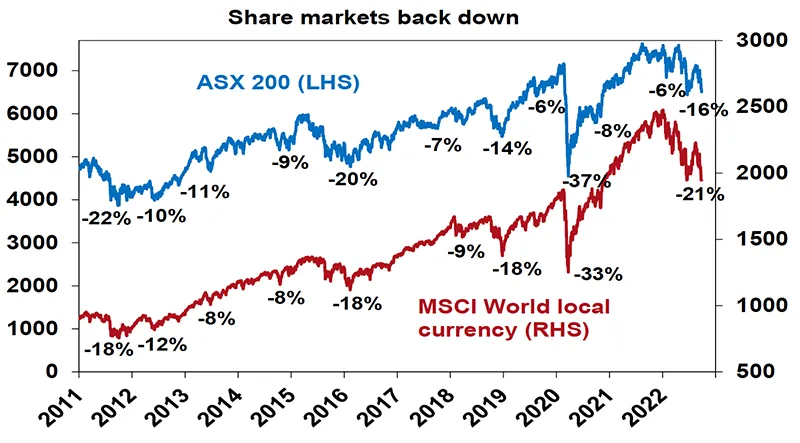
    Share markets back down

    Source: Strategas, AMP

    After falling sharply into mid-June (at which point US shares had fallen 24% from their highs, global shares 21% and Australian shares 16%), share markets rallied into mid-August reversing half of their declines on the back of hopes the Fed would pivot towards an easier monetary stance and hopefully avoid a recession. Since mid-August though shares have fallen again and are now back to around their June lows.

    And, bond yields have pushed up again with US, UK, German 10-year yields rising to levels not seen in a decade.

    What’s driving the renewed weakness

    The plunge in shares back to their June lows mostly reflects the same concerns that drove the falls into June:

    • Inflation remains high or is still rising depending on the country. For example, US headline inflation is still 8.3%yoy and core inflation at 6.3%yoy in August is still under pressure from rising services inflation. Headline inflation is 8.9% in the UK, 9.1% in Europe, 9.9% in the UK and an estimated 7.2% in Australia.
    • Global central banks have become more hawkish noting that permanently high inflation will lead to lower living standards and the longer inflation stays high the greater the risk that inflation expectations move higher, making it harder to get down. As a result, they are committed to getting it back to target and have been flagging more rate hikes (eg with the dot plot of Fed interest rate forecasts around 1% higher than 3 months ago) and an implied tolerance for a recession in order to get it under control.

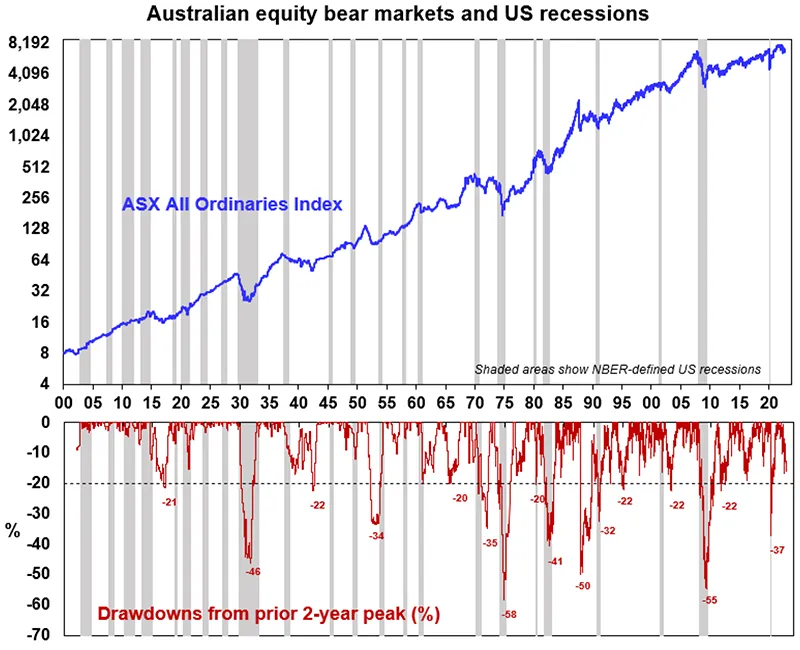
    Australian equity bear markets and us recessions

    Source: ASX, Bloomberg, AMP

    • Increasingly hawkish central banks are bad for shares in the short term for two reasons. First higher interest rates and make shares less attractive from a valuation perspective. Second, a recession would weigh on company profits. Recession is now almost certain in Europe and about a 50% probability in the US. In Australia the probability of recession is now around 40% (if as we expect the cash rate peaks around 3%, but if it rises to 4.3% as predicted by the money market then recession is probable here). Historically deep bear markets in US and Australian shares have tended to be associated with a US recession.
    • Fears of an escalation of the Ukraine war – after Russia’s troop mobilisation, “referenda” to incorporate occupied areas into Russia and a threat to use nuclear weapons. Ongoing tensions with China and the approaching November US mid-term elections are not helping.
    • A large fiscal stimulus in the UK has caused a surge in UK bond yields & plunge in the pound adding to fears of a crisis. While the new Government’s tax cuts and deregulation may have supply side merit the benefits of this tend to take years to become apparent and in the meantime the risk is that it adds to inflation and fears about runaway debt.
    • We are in a weak period of the year seasonally for shares – with September being the weakest month of the year on average for shares and October known for volatility. This can be magnified when the trend in shares is down.
    • As seen in the first half the year, tech stocks and particularly crypto currencies remain the biggest losers of monetary tightening, after being the biggest winners of easy money.

    Shares are oversold and on technical support at their June lows so could bounce from here. But the risks are skewed to the downside in the short term. While investor confidence is very negative, we have yet to see the sort of spike in put/call option ratios or VIX that normally signals major market bottoms. The RBA is fortunately starting to sound a bit more balanced and aware of the way monetary policy impacts with a lag, but the danger is that the Fed and central banks have become locked into supersized hikes based on backward looking inflation and jobs data, and a loss of confidence in their ability to forecast inflation at a time when they should be giving more attention to monetary policy lags. This increases the risk of overtightening driving a deep recession with earnings downgrades driving another leg down in share prices (after the first leg down which was driven by rising bond yields). A decisive break below the June low for the US share market could open up another 10% leg down with a similar flow through to Australian shares.

    It’s not all doom and gloom

    However, there is some light at the end of the tunnel on a 12-month view:

    • Central banks determination to stop high inflation becoming entrenched is good news from a longer-term perspective as the 1970s experience tells us that the alternative would be bad for economies, jobs and investment markets.
    • Producer price inflation looks to have peaked in the US, UK, China and Japan.
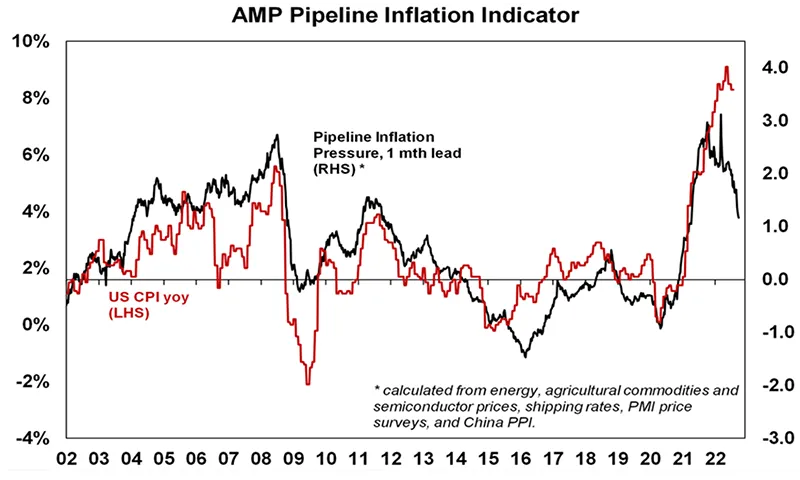
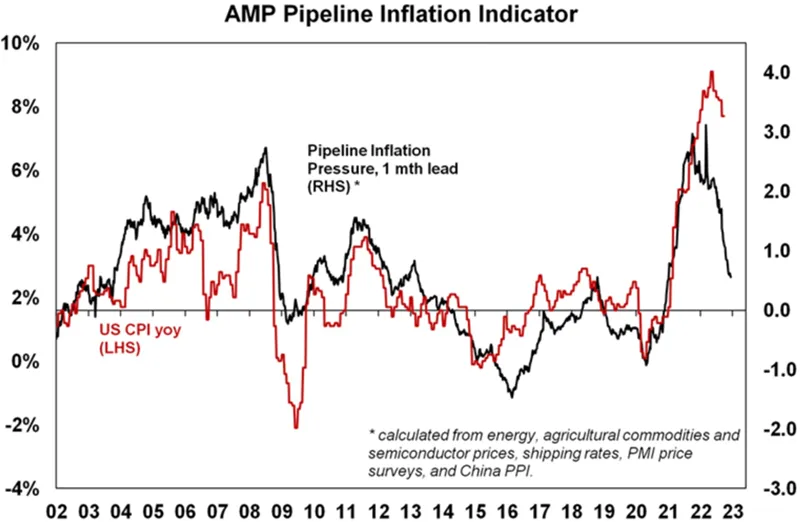
    • This is consistent with our Pipeline Inflation Indicator which is continuing to trend down given falling price and cost components in business surveys, falling freight rates and lower commodity prices (outside of gas and coal).

    AMP pipeline inflation indicator

    Source: Bloomberg, AMP

    • Some of the key components that initially drove higher inflation in the US are starting to slow with weakening growth in new market rents (which with a lag drives about 33% of the US CPI) and softening used car prices.
    • Consumer inflation expectations have fallen in the US and Australia, helped by aggressive central bank moves and falling petrol prices. US 5 year plus inflation expectations have fallen back to 2.8% which is well below the near 10% level seen in 1980. This should make it easier for central banks to get inflation back down without having to take interest rates to exorbitant levels.
    • Money supply growth has slowed from its 2020 surge, and this is likely to contribute to lower inflation ahead.
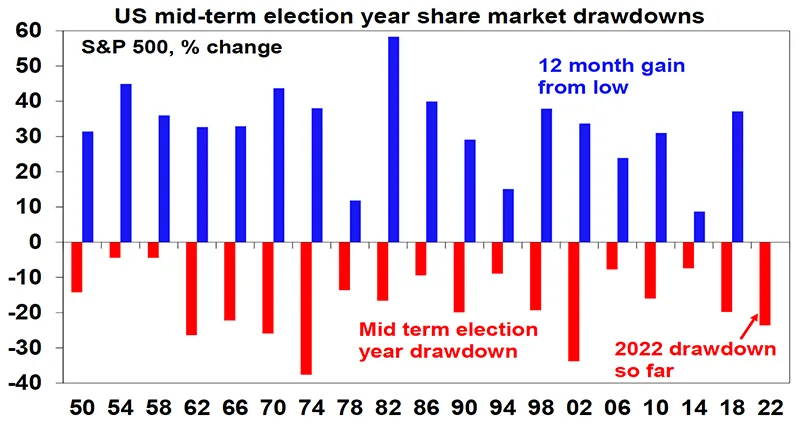
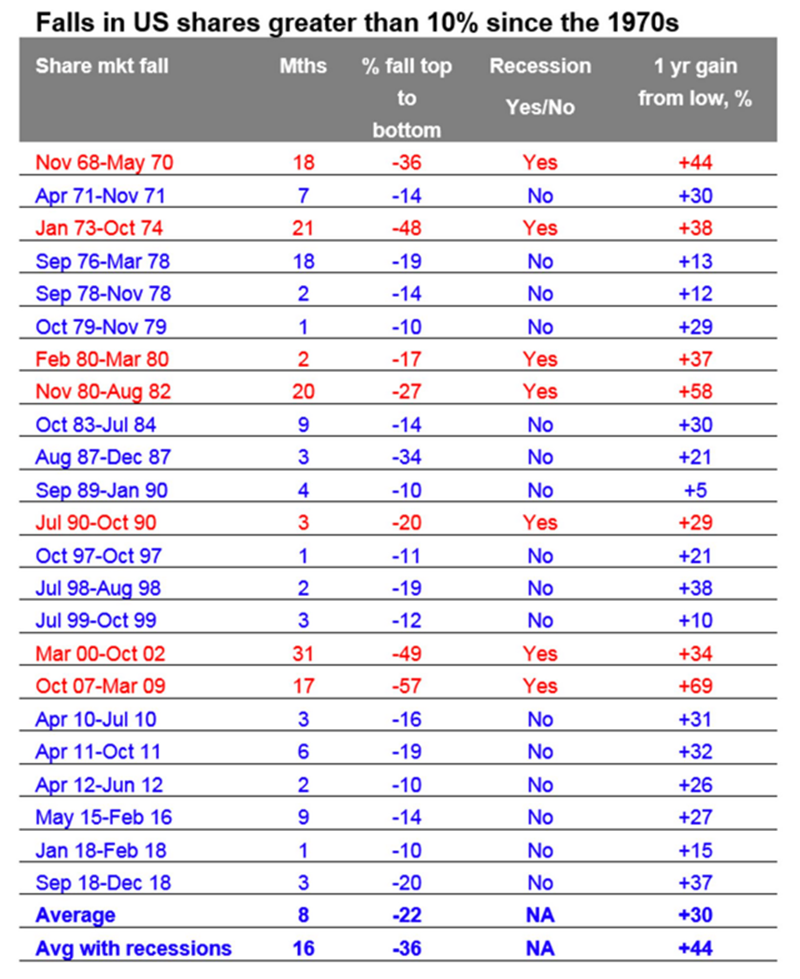
    • Post US mid-term election returns tend to be strong, just as mid-term election year drawbacks tend to be more severe – with an average top to bottom fall of 17% in US shares in mid-term election years followed by an average 33% gain one year from the low.

    US mid term election share market drawdowns

    Source: AMP

    The bottom line is that while short-term inflation remains high, these considerations are consistent with the US having reached peak inflation and point to lower inflation ahead which should enable central banks to slow the pace of hiking by year end, in time to avoid a severe recession.

    If this applies in the US, then Australia should follow as its lagging the US by about six months with respect to inflation. (Although we expect the RBA to slow the pace of rate hikes well ahead of the US – given the greater sensitivity of the Australian household sector to higher rates than in the US and lower inflation pressures in Australia.) For this reason, while short term risks around shares remain high, we remain optimistic on shares on a 12-month horizon.

    Key things for SFP clients to remember

    Sharp share market falls are stressful for investors as no one likes to see their investments fall in value. And try as one may, it’s never easy to accurately predict economies and shares.

    1. share market pullbacks are healthy and normal – their volatility is the price we pay for the higher returns they provide over the long term;
    2. it’s very hard to time market moves so the key is to stick to an appropriate long-term investment strategy;
    3. selling shares after a fall locks in a loss;
    4. share pullbacks provide opportunities for investors to buy them more cheaply;
    5. shares invariably bottom with maximum bearishness;
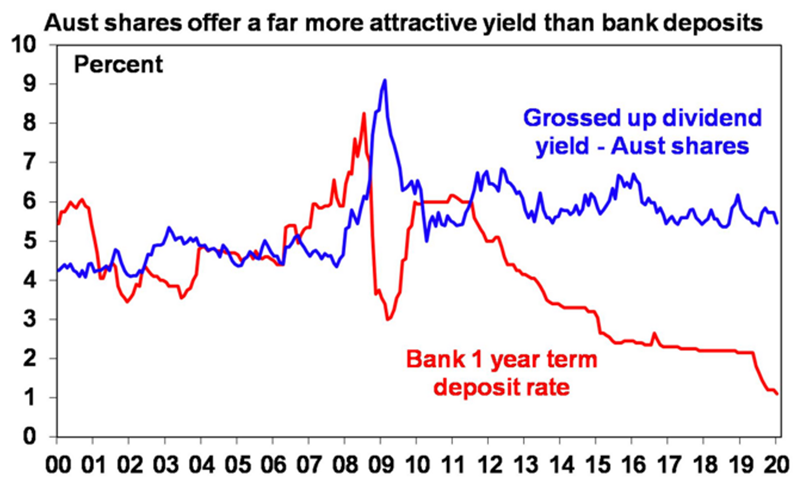
    6. Australian shares still offer an attractive income (or cash) flow relative to bank deposits; and
    7. to avoid getting thrown off a long-term strategy – it’s best to turn down the noise around all the negative news flow.

    In closing, market volatility is a real investor’s friend, and the key is to embrace it. I have also recorded a video for you to watch on this topic (please watch until the end). If you are still concerned, we encourage you to talk to your adviser and call 02 9328 0876.

    Bill Bracey – CEO and Founder
    Sydney Financial Planning


    Is your share portfolio well positioned for long-term returns and benefits?

    Speak with one of our financial planners about the best approach for your circumstances, either book a meeting or get in contact with us on 02 9328 0876.


    This article was prepared by William Bracey and Dr Shane Oliver. Dr Shane Oliver who provides economic forecasts and analysis of key variables and issues affecting, or likely to affect, all asset markets. He also provides economic forecasts and analysis of key variables and issues affecting, or likely to affect, all asset markets.

    Important note: While every care has been taken in the preparation of this document, AMP Capital Investors Limited (ABN 59 001 777 591, AFSL 232497) and AMP Capital Funds Management Limited (ABN 15 159 557 721, AFSL 426455) make no representations or warranties as to the accuracy or completeness of any statement in it including, without limitation, any forecasts. Past performance is not a reliable indicator of future performance. This document has been prepared for the purpose of providing general information, without taking account of any particular investor’s objectives, financial situation or needs. An investor should, before making any investment decisions, consider the appropriateness of the information in this document, and seek professional advice, having regard to the investor’s objectives, financial situation and needs. This document is solely for the use of the party to whom it is provided.

    General Disclaimer: This article contains information that is general in nature. It does not take into account the objectives, financial situation or needs of any particular person. You need to consider your financial situation and needs before making any decisions based on this information. Please seek personal financial advice prior to acting on this information.

    2022 review & 2023 outlook

    SFP Insights – 2022 review & 2023 outlook

    2022 review & 2023 outlook

  • 2023 is likely to remain volatile and a retest of 2022 lows for shares is a high risk. But easing inflation, central banks getting off the brakes (with the RBA at or close to the peak on rates), economic growth likely stronger than feared & improved valuations should make for better returns.
  • Australian residential property prices likely have more downside, ahead of a September quarter low.
  • The main things to keep an eye on are: inflation; central banks and interest rates; US politics; China tensions; and Australian residential property prices.
  • 2022 – from Covid to inflation & surging interest rates

    The good news is that 2022 finally saw the world shake off the grip of Coronavirus as it transitioned from a pandemic to endemic (albeit it’s still causing problems in China). However, the past year turned out far more difficult for investors than might have been thought a year ago:

    • Inflation, which already rose in 2021 surged to levels not seen for decades, largely reflecting pandemic related distortions to supply and reopening & a stimulus driven surge in demand & floods in Australia.
    • Russia invaded Ukraine, leading to a surge in energy & food prices.
    • Central banks moved to aggressively withdraw monetary stimulus and raised interest rates at the fastest pace seen in decades to deal with inflation and rising inflation expectations.
    • Bond yields surged in response to the rise in inflation & interest rates.
    • Chinese growth fell sharply, reflecting its zero-Covid policy and a continuing property downturn despite policy stimulus.
    • Geopolitical tensions surged with war in Ukraine and worries about a Chinese invasion of Taiwan following President Xi Jinping’s power consolidation, although there were hopes of a thaw near year end.
    • As a result of all this, investors increasingly fretted about recession.
    • Tech stocks and crypto currencies, having been the biggest winners of the Covid lockdowns & easy money, were hit hard by reopening and monetary tightening, ultimately proving no hedge against inflation.

    Growth was still ok – but a lot weaker than expected

    Despite these problems, global GDP is still expected to have come in at around 3.2% which is weaker than the 5% or so growth expected a year ago and down from 6% in 2021, but still reasonable as reopening and stimulus helped. And in Australia, GDP is expected to have been around 3.5%, lower than expected a year ago and down from 4.8% in 2021, but still reasonable. The growth slowdown saw a slowdown in profits. But the main problem for investment markets was the rise in inflation, interest rates and bond yields.

    Investment returns for major asset classes

    Total return %, pre fees and tax 2021 actual 2022* actual 2023 forecast
    Global shares (in Aust dollars) 29.6 -12.5 4.0
    Global shares (in local currency) 24.3 -16.4 7.0
    Asian shares (in local currency) -6.8 -18.3 10.0
    Emerging mkt shares (local currency) -0.2 -15.5 10.0
    Australian shares 17.2 -1.1 10.0
    Global bonds (hedged into $A) -1.5 -12.3 3.0
    Australian bonds -2.9 -9.7 4.0
    Global real estate investment trusts 30.9 -25.9 9.0
    Aust real estate investment trusts 26.1 -20.5 9.0
    Unlisted non-res property, estimate 12.3 11.5 4.0
    Unlisted infrastructure, estimate 12.0 10.0 5.0
    Aust residential property, estimate 23.0 -7.0 -7.0
    Cash 0.0 1.3 3.1
    Avg balanced super fund, ex fees & tax 14.3 -5.2 6.3

    *Year to date to Nov. Source: Thomson Reuters, Morningstar, REIA, AMP

    • Global shares had a rough year with a plunge of 23% into October on inflation, interest rate and recession worries, before a rally cut losses.
    • Chinese shares led the weakness, not helped by its zero Covid policy, followed by Asian shares, given their exposure to China and cyclical sensitivity. US shares also underperformed reflecting its high-tech exposure & aggressive Fed tightening.
    • Australian shares outperformed, helped by strong commodity prices and a relatively less hawkish RBA.
    • Government bonds slumped as yields surged on high inflation & rate hikes. Australian bonds had their worst year since 1973 or the 1930s.
    • Real estate investment trusts fell with the surge in bond yields.
    • Unlisted property & infrastructure returns remained strong, being less sensitive to short-term share market and bond yield moves.
    • Home prices fell sharply reflecting poor affordability after a boom &, particularly, as mortgage rates rose, reducing home buyer capacity.
    • Cash and bank term deposit returns improved but were still low.
    • The $A fell with share markets on growth concerns and relatively aggressive Fed rate hikes into October, before a partial recovery.
    • Balanced super funds had negative returns reflecting poor share and bond returns. This followed very strong returns in 2021.

    2023 – lower inflation and lower growth

    First the bad news: inflation is still way too high at around 7 to 11% in many advanced countries; tight labour markets risk wage-price spirals; central banks are still warning of more rate hikes; the risk of recession is high with inverted yield curves and weak confidence largely in response to rate hikes; the US has returned to divided Government with the risk of debt ceiling and funding standoffs; war continues in Ukraine; and tensions remain with China and Iran. Even Covid continues to disrupt – but mainly in China as cases surge as it reopens. These all suggest another volatile year and possibly continuation of the bear market in global shares.

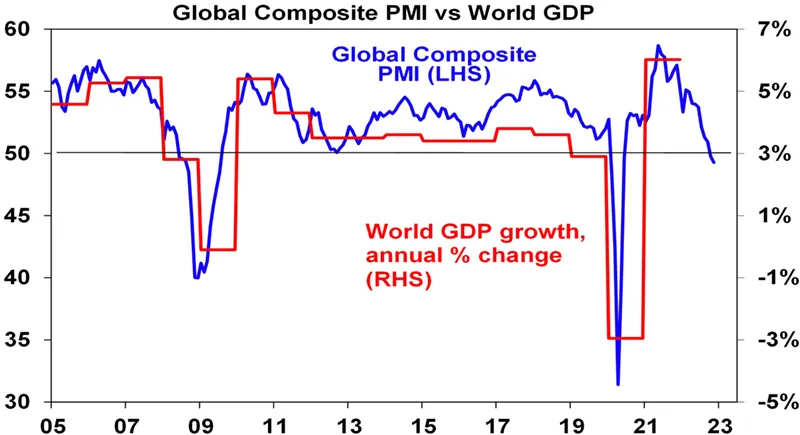
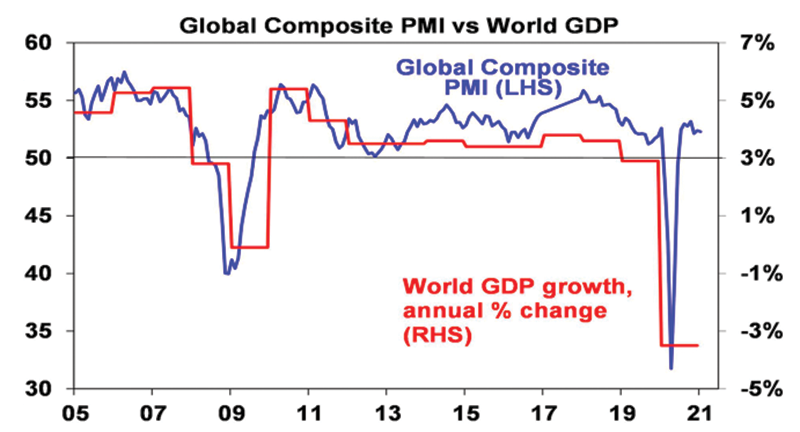
    Global composite PMI vs world GDP

    PMIs are surveys of business confidence and conditions. Source: Bloomberg, IMF, AMP

    However, there is reason for optimism. First, inflationary pressures may have peaked and are slowing rapidly (as reflected in our Pipeline Inflation Indicator): supply chain pressures have eased; demand is cooling; and labour markets are showing signs of topping out. In fact, it may only require a slight pull back in demand (to push capacity utilisation back down to normal & unemployment above the NAIRU – or non-accelerating inflation rate of unemployment, with the return of immigration helping in Australia) to further depress inflationary pressure significantly. This suggests inflation could fall faster than central banks expect in 2023.

    Second, central banks are likely nearing the peak in rates. The Fed is already moving to slow hikes, but conditions are likely to be soft enough to allow it to pause from around March ahead of rate cuts later in 2023. Sure, its signalling more but just as its signals were too dovish a year ago its signals now are likely too hawkish! In Australia, we see the RBA as being at or close to the top (3.1% is our base case for the peak with 3.35% our risk case) as by February/March conditions are likely to be weak enough to allow a pause, ahead of rate cuts in late 2023/early 2024.

    AMP pipeline inflation indicator

    Note that this is more a guide to direction than level. Source: Bloomberg, AMP

    Third, it seems everyone is talking about recession for 2023, such that it’s a consensus call. The risk is very high (probably over 50% in the US and Europe) and this will likely keep markets volatile given the threat to earnings. But it may not turn out to be as bad as feared.

    • In the US it may just be a sharp slowdown or mild recession in 2023 – if the Fed starts to ease up on the brake soon and given the absence of other excesses that need to be unwound, eg, there has been no overinvestment in housing & capex and leverage is low.
    • Europe has moved away from Russian gas very quickly and providing its winter is mild, may continue to hold up better than feared.
    • Or lags in the way rate hikes impact may mean recession does not hit till 2024, meaning its too early for share markets to discount just yet.
    • After initial Covid related setbacks, Chinese growth is likely to rebound in 2023 as it reopens. Just like occurred in other countries upon reopening (recall Australia’s Omicron disruptions earlier in 2022) China is likely to see a surge in cases initially. But markets are likely to largely look through this to the reopening boost ahead which will provide an offset to slower growth in the US and Europe.
    • Australian growth is likely to slow but avoid recession, reflecting the less aggressive RBA, the pipeline of home building work yet to be completed and the strong business investment outlook.

    Finally, geopolitics may not be so bad in 2023: there are no major elections in key countries in 2023; the war in Ukraine may not get any more threatening; and the Cold War with China may see a bit of a thaw.

    Overall, global growth in 2023 is likely to be around 2.5%, well down from 6% in 2021, but not recession in aggregate. In Australia, growth is expected to slow to 1.5% in the year ahead. And inflation is likely to fall.

    Implications for investors

    Easing inflation pressures, central banks moving to get off the brakes, economic growth proving stronger than feared and improved valuations should make for better returns in 2023. But there are likely to be bumps on the way – particularly regarding recession risks – & this could involve a retest of 2022 lows or new lows in shares before the upswing resumes.

    • Global shares are expected to return around 7%. The post mid-term election year normally results in above average gains in US shares, but US shares are likely to remain a relative underperformer compared to non-US shares reflecting still higher price to earnings multiples (17.5 times forward earnings in the US versus 12 times forward earnings for non-US shares). The $US is also likely to weaken which should benefit emerging and Asian shares.
    • Australian shares are likely to outperform again, helped by stronger economic growth than in other developed countries and ultimately stronger growth in China supporting commodity prices and as investors continue to like the grossed-up dividend yield of around 5.5%. Expect the ASX 200 to end 2023 at around 7,500.
    • Bonds are likely to provide returns around running yield or a bit more, as inflation slows and central banks become less hawkish.
    • Unlisted commercial property and infrastructure are expected to see slower returns, reflecting the lagged impact of weaker share markets and higher bond yields (on valuations).
    • Australian home prices are likely to fall further as rate hikes continue to impact, resulting in a top to bottom fall of 15-20%, but with prices expected to bottom around the September quarter, ahead of gains late in the year as the RBA moves toward rate cuts.
    • Cash and bank deposits are expected to provide returns of around 3%, reflecting the back up in interest rates through 2022.
    • A rising trend in the $A is likely over the next 12 months, reflecting a downtrend in the now overvalued $US, the Fed moving to cut rates and solid commodity prices helped by stronger Chinese growth.

    Key things for SFP clients to remember

    The Lord giveth and taketh! 2021 he gave and 2022 he took back some of the gains.

    2023 will be dominated by again high volatility, but for our advised clients who rode the storm out over the past 2 years, still overall were rewarded. My continued quote in 2021 and in 2022  was “that’s how the rich get richer and the poor poorer”.  

    In November 2021, I wrote to you warning the Financial Markets will get the wobbles over the next 12 months. Wow was that spot on!. Volatility will remain the key feature of 2023.

    Key issues to watch

    • Inflation being tamed.
    • US Politics.
    • The worlds Governments being all highly leveraged in debt after COVID and the need to lower debt, in a controlled way as interest rates go up.
    • China- Taiwan issues.
    • Ukraine conflict effecting Europe.
    • Australian House prices continuing to fall or stable out. 

    We are not out of the woods yet! but for our advised clients who we help navigate these choppy waters, the medium to longer term rewards will be there. History has proven in periods like this once the volatility passes we will return to sound growth and higher returns.

    Patience Grasshopper!  

    Bill Bracey – CEO and Founder
    Sydney Financial Planning


    Is your share portfolio well positioned for long-term returns and benefits?

    Speak with one of our Financial Planners about the best approach for your circumstances, either book a meeting or get in contact with us on 02 9328 0876.


    This article was prepared by William Bracey and Dr Shane Oliver. Dr Shane Oliver who provides economic forecasts and analysis of key variables and issues affecting, or likely to affect, all asset markets. He also provides economic forecasts and analysis of key variables and issues affecting, or likely to affect, all asset markets.

    Important note: While every care has been taken in the preparation of this document, AMP Capital Investors Limited (ABN 59 001 777 591, AFSL 232497) and AMP Capital Funds Management Limited (ABN 15 159 557 721, AFSL 426455) make no representations or warranties as to the accuracy or completeness of any statement in it including, without limitation, any forecasts. Past performance is not a reliable indicator of future performance. This document has been prepared for the purpose of providing general information, without taking account of any particular investor’s objectives, financial situation or needs. An investor should, before making any investment decisions, consider the appropriateness of the information in this document, and seek professional advice, having regard to the investor’s objectives, financial situation and needs. This document is solely for the use of the party to whom it is provided.

    General Disclaimer: This article contains information that is general in nature. It does not take into account the objectives, financial situation or needs of any particular person. You need to consider your financial situation and needs before making any decisions based on this information. Please seek personal financial advice prior to acting on this information.

    Investing under uncertainty

    Investing under uncertainty

    Investing under uncertainty

    Uncertainty is here to stay; we have no say in that. So, we spend time and energy on keeping our heads down and continuing to fund our plan – we have a full control over that.

    Here we are in a tectonic shift in the world’s geopolitical order, occasioned by Russia’s tragic war on Ukraine, the severe supply chain issues caused by offshoring of manufacturing and services to Asia. And we find ourselves in the grip of the most severe inflation outbreak in 40 years. No one can begin to predict how these situations will resolve themselves (even though it doesn’t stop many from trying)…much less when. Nor can anyone begin to imagine how the capital markets will adapt to said resolution(s). We are once again in a perfect cloud of unknowing.

    It is also – and this is what we find human nature can often be bitterly incapable of grasping – irrelevant to the investment policy of a long-term, goal focused, plan-driven investor. And I say again: current events are perfectly irrelevant to the investment policy of the long-term equity investor.

    What is the essence of successful long-term equity investing? It is the continuing practice of rationality under uncertainty. To me it means basing our investment policy on our financial plan as distinctly opposed to a view of the economy and the markets. This is where rationality begins and ends.

    Two years ago, we could not begin to imagine how lethal the pandemic was going to be, nor when effective vaccines would become available in sufficient quantity. Today, we can’t anticipate what Putin will do in Ukraine, nor how the back of this inflation will ultimately be broken. Nothing has changed; we’ve just moved on to a different set of unknowables.

    Meanwhile our clients’ retirement dates are bearing down on them at the same pace. The amount of money they need to accumulate has if anything gone up with inflation. And the only hope they have in the world for a secure retirement and meaningful legacy are the premium return of shares of brilliantly managed companies, whose short to intermediate-term corrections cannot be anticipated, much less timed.

    What we can know amid all this uncertainty—and just about all we need to know—is that the great companies in Australia and the world are already adjusting to this reordering. Today’s crisis invariably becomes yesterday’s news. Not only will you not be worried about this stuff ten years from now, you won’t even remember it.

    It all comes down to the main reason you hired us, to acting vs. reacting: keeping your head down and continuing to fund your plan, looking neither to the right nor to the left. Looking at history, not headlines.

    This is a glorious time to be a mainstream share investor for the long haul – even if, just at this moment,it feels like we can’t see a foot in front of our faces.

    We realise that on any given day, optimism can often sound like a crazy concept while pessimism on the other hand can feel like a good advice from a friend. We also realise that ours may be the only calm voice of long-term optimism you hear. We just want to make sure you hear it. Today’s the day.


    Key takeaways:

    • Try to minimise the noise. If news headlines make you feel uncomfortable,reduce your exposure to them. Their objective is to capture your attention, not to provide you with rational investment strategy.
    • Follow your investment plan, not headlines. Your plan is carefully designed to help you reach your life goals. If your goals haven’t changed, your investment strategy most likely doesn’t need changing. Only people without plans follow the headlines (they have nothing else to focus on)
    • Remember fundamentals. History doesn’t repeat but it rhymes. Look at the spread between the real-life returns (after inflation) of growth assets like shares and the real-life returns of cash and bonds.
    • Price versus value. When price (e.g. share price) of an asset decreases, the value of investing in that assets increases (and vice versa). If you’re still contributing to your investments/super, lower share market prices represent better value for your money.
    • Income vs account balance. If you already retired and your investment objective is to generate a lifestyle sustaining income, that income is paid based on the amount of your investment units, not your account balance. Make sure you focus on the right thing.
    • Optimism is the only realism. Having the faith in the future is number one investment principle we follow. It always gets tested when markets correct, and it can make all the difference.

    If you get ever concerned about your investment strategy, please always contact your adviser before you make any decisions. It’s one of the main reasons you hired us.


    Michal Bodi
    Partner and Senior Financial Planner


    Do you have a long-term investing strategy in place?

    Speak with one of our Financial Planners about the best investing approach for your circumstances, either book a meeting or get in contact with us on 02 9328 0876.


    Article by Michal Bodi | Partner and Senior Financial Planner

    General Disclaimer: This article contains information that is general in nature. It does not take into account the objectives, financial situation or needs of any particular person. You need to consider your financial situation and needs before making any decisions based on this information. Please seek personal financial advice prior to acting on this information.
    Cashflow remains king

    Cashflow remains king

    Cashflow remains king

    Both are equally important, and if I had a dollar for each time I had a discussion with a client about how much is enough cash in a portfolio, I’d be a wealthy man.

    Today’s challenging periods have reminded us why it remains so critical our clients maintain a cash reverse and have a sound understanding of their cashflow positions (both personally and within their investment accounts).

    Over the last few years our clients have avoided selling growth assets in a downmarket and we want to keep it this way for as long as we can. We’ve managed to do this by putting in place cash reserves for our retired clients so they can continue to meet their pension payments and by putting in personal cash reserves to meet any unexpected expenses and avoid the need to make withdrawals from their investment accounts at an unfavorable time and at a discount. Our accumulators have been maintaining cash at bank to support any disruptions to their employment income.

    So back to the question, how much cash is enough? Everyone has a safety blanket number, however when determining cash allocations for our clients it really depends on their life stage. Accumulators may only need to hold 2% – 5% of cash in their portfolio’s whereas retired clients will need to hold much more than this.

    Min cash holdings for our retired clients can range from 1 – 3 years pension payments. The biggest trade off being the low return generated by cash exaggerated by interest rates being at an all-time low. A high cash allocation will have a larger drag on the long term return of your investment portfolio and ultimately impact the longevity of the account. So generally speaking, the higher the account balance the less cash allocation necessary (as a % of account balance).

    The Government has continued to help people preserve cash positions by reducing the minimum pension requirements by 50% for retirees drawing from their accountbased pensions again for the 2022/23 financial year. The minimums are:

    Age

    Normal Rate

    New rate for 2022/23

    Under 65 4.00% 2.00%
    65-74 5.00% 2.50%
    75-79 6.00% 3.00%
    80-84   7.00% 3.50%
    85-89 9.00%  4.50%
    90-94 11.00% 5.50%
    95 and over 14.00% 7.00%


    With limited opportunity for travel and a reduction in discretionary spending we’ve seen many of our clients requiring less cash to meet their living expenses. This has provided us with an opportunity to reduce payments to our pension clients over the past 12-24 months.

    However, with inflation looming we expect to see an increasing pressure on the need to increase pension payments as the cost of living increases over the next 12 -24 months.

    How can we better manage our cash positions in our investment portfolio’s going forward?

    Most of our clients have been fortunate to save more in their personal bank accounts which will help to fund travel and discretionary spending as the world continues to open up post covid. This will alleviate pressure on making large increases to pension payments in the short term. We have prepared and factored a risking cost of living into your financial plan and investment portfolios as our financial modelling allows for a CPI increase in pension payments annually.

    For our retired clients, or those transitioning to retirement its prudent to review the cashflow within your pension account. This is the cornerstone conversation at all our review meetings. Money in (distributions from our investments) and money out determine our cashflow position with pension payments making up the bulk of money going out. If there’s an opportunity to hold or even reduce your pension payments this coming year before we see significant inflation, we will be discussing this with you at your annual review meeting.

    Do you have the right amount of cash reserves?

    Speak with one of our Investment and retirement specialist about the best strategy for your circumstances, either book a meeting or get in contact with us on 02 9328 0876.


    Article by Gary Winwood-Smith | Senior Financial Planner

    General Disclaimer: While every care has been taken in the preparation of this document, Sydney Financial Planning and Charter FP make no representations or warranties as to the accuracy or completeness of any statement in it.This article contains information that is general in nature. It does not take into account the objectives, financial situation or needs of any particular person. You need to consider your financial situation and needs before making any decisions based on this information. Please seek personal financial advice prior to acting on this information.

     

    Are you getting the best rates?

    Loyal to a fault

    Are you getting the best rates?

    Sticking with the same loan longer than three years can cost borrowers thousands, with competition to win business resulting in new customers paying lower rates than existing ones.

    This so-called loyalty tax has become such a hot topic, the Australian Competition and Consumer Commission has recommended mortgage holders review their options regularly and consider switching to secure better terms. Now is a great time to follow that advice and get in touch.

    Rush to reset

    Homeowner refinancing has hit an all-time record in the past six months, and it’s easy to see why, with interest rates at long-term lows. But it’s not just fixed rates borrowers should have their eye on. Homeowners with variable rates need to check they aren’t unwittingly paying a loyalty tax too.

    Reserve Bank figures show owner-occupiers who took out new variable loans in October 2021 paid, on average, 2.63 per cent interest, while those with existing variable loans paid rates around 0.37 per cent higher rates at 3 per cent.1 On a loan around $350,000, that’s potentially adding an extra $1,295 in interest each year.

    As a customer there’s few things more galling than finding out someone who came to the party late has been given a bigger slice of cake than you. That’s why the most empowering thing you can do is to simply shop around, which is what I can do for you.

    Annual review

    Being financially savvy is about developing good habits, and one of the best for homeowners is to book an annual appointment to review your home loan arrangements.

    The start of a new year is the perfect time to dive in. People usually have a little more headspace before the year really ramps up and finding savings can be a great cure for that summer spending hangover.

    Speak to me to check how current variable rates compare, or perhaps it’s a good time to consider locking in a deal. Fixed rates have increased recently and speculation is mounting about a possible official interest rate rise in late 2022 or early in 2023.

    More than interest only

    Of course, refinancing isn’t always about interest rates alone, although they are a big part of the equation. It may be about building more flexibility into your loan with offset and redraw facilities, the ability to make additional repayments, or unlock equity for a renovation, a major purchase or holiday.

    Some borrowers may even want to consider options such as splitting a home loan between both fixed and variable options.

    It’s all about what your goals and priorities are right now, and we all know that can change unexpectedly year on year.

    Broker insight

    The home loan market has never been more competitive and we’re adding more lenders to our panel each year, with more loan products and features. It can be daunting, but it’s also where I can offer you an advantage in guiding you through what’s out there to meet your needs.

    I can also help calculate how any potential savings stack up in the short and long term against any search and switch costs. It’s important to stay on top of rates and offerings in a fast-moving market. So, get in touch to arrange a quick check-up for your home loan.


    Need some help working out if you can get a more suitable rate for your mortgage?

    Get some professional advice from our Mortgage expert Leigh Morris, call 02 9328 0876 to arrange a meeting.


    Article by Leigh Morris  – SFP Financial

    1 Lenders’ Interest Rates, Reserve Bank of Australia (published monthly online: rba.gov.au/statistics/interest-rates/#lenders-rates-table)

    General Disclaimer: While every care has been taken in the preparation of this document, Sydney Financial Planning and Charter FP make no representations or warranties as to the accuracy or completeness of any statement in it.This article contains information that is general in nature. It does not take into account the objectives, financial situation or needs of any particular person. You need to consider your financial situation and needs before making any decisions based on this information. Please seek personal financial advice prior to acting on this information.

     

    SFP Investment Outlook Q&A - February 2022

    SFP investment outlook Q&A – February 2022

    SFP Investment Outlook Q&A - February 2022

  • Wages growth is likely to pick up to 3% this year.
  • A Russian invasion of Ukraine risks a short term hit to shares followed by recovery over the next 3 to 12 mths.
  • Introduction

    This note covers the main questions investors commonly have regarding the investment outlook in a simple Q&A format.

    Is the rise in inflation temporary or permanent?

    I suspect it’s a bit of both. Much of the rise in inflation (to a 40 year high in the US and to 3.5%yoy in Australia) can be traced to distortions caused by the pandemic which boosted goods demand and restricted supply (both of goods & workers). Global energy prices are also being boosted by geopolitical tensions (notably in Europe). As consumer demand rebalances back to services, workers return and production catches up to demand, inflation should subside over the next 12 months or so.

    However, underlying inflation is unlikely to fall back to pre-pandemic lows and risks running above central banks targets over the next 5-10 years: we are now seeing much easier monetary and fiscal policy & many of the structural forces that drove low inflation look to be going in reverse: globalisation is in retreat; the ratio of workers to consumers is in decline; and we are now seeing bigger more interventionist government.

    Will wages growth rise too?

    Wages growth has already lifted to 4-5% yoy in the US, depending on the measure. But it has higher inflation and has seen less workers return through the reopening than in Australia. Nevertheless, numerous signs point to faster wages growth in Australia: the jobs market is tight, pushing towards full employment; various business surveys point to rising labour costs; ABS data shows payroll wages accelerating relative to jobs; and there are numerous anecdotes of wage pressure. We expect wages growth to rise to a 3% annual pace by mid-year.

    How high will Australian interest rates rise?

    We expect the RBA to start raising the cash rate in August (possibly June) after news of more strong inflation data, unemployment below 4% and wages growth pushing up to 3% and see the cash rate rising to around 1.5 to 2% over the next two years or so. This would add a similar amount to variable mortgage rates. It will take household debt interest payments relative to income back to around 2018 levels. Higher household debt to income levels relative to the past and compared to say, the US, along with falling house prices will allow the RBA to proceed cautiously in raising rates through next year and see rates peak at lower levels compared to the past. Australia also has half the US’s inflation rate.

    Will the end of QE & rate hikes be a double whammy?

    Not really. Bond buying by central banks (or Quantitative Easing) was an alternative to cutting rates when rates had hit zero. With economic activity recovering and inflation up, it makes sense to end it and begin the withdrawal of the liquidity that was pumped in via QE (ie start quantitative tightening). But central banks can manage this with rate hikes to make sure the overall tightening in monetary conditions is not excessive.

    Is coronavirus no longer an economic concern?

    Not quite, but nearly. Starting last year each successive covid wave seems to have had progressively less economic impact. This reflects a combination of vaccines, new treatments and recent covid variants being less harmful which has combined to enable reopening to continue. While the risk remains of a new variant which is more harmful, causing a setback, coronavirus could finally be moving from a pandemic to being endemic.

    Is the economic recovery on track?

    While supply side constraints, monetary tightening, geopolitical threats and covid will constrain global and Australian economic growth, it will still be reasonable at around 4.5% this year. Key drivers are likely to be: ongoing reopening; pent up demand and excess savings; still easy monetary policy; strong business investment; and low inventory levels.

    How would a Russian invasion of Ukraine impact investment markets?

    Russia has been building up its military presence on the Ukraine border and is demanding that Ukraine never join NATO and NATO not station strategic weapons there. Negotiations have made little progress as the US fears consequences in other parts of the world if NATO does not stand tough. If anything, tensions have worsened as NATO has been shoring up Ukrainian defences and Russia has built up more military assets around it, with the US warning of possible imminent invasion. However, Russia has signalled it will continue with talks. Of course, there is a long history of various crisis events impacting share markets (major events in wars, terrorist attacks, financial crisis, etc) and the pattern is the same – an initial sharp fall followed by a rebound. Based on multiple crisis since 1907 Ned Davis Research found an average decline of 7% in the US share market from such events, but 6 months later the market is up 10% on average and 1 year later its up around 15%. Put very simply, there are four scenarios:

    1. Russia stands down – this would provide a very brief boost for share markets, including Australian shares (eg +1%).
    2. Russia moves in to occupy the Donbas (which is already controlled by Russian separatists) with sanctions from the west but not so onerous that Russia cuts of gas to Europe – this could see a brief hit to markets (say -2-4%) like in the 2014 Ukraine crisis but it would soon be forgotten about.
    3. Russian invasion of all of Ukraine with significant sanctions and Russia stopping gas to Europe (causing a stagflationary shock to Europe & possibly globally as oil prices rise further) but no NATO military involvement – this could see a bigger hit to markets (say -10%) but then recovery over six months.
    4. Invasion of all of Ukraine with significant sanctions, gas supplies cut & NATO military involvement – this could be a large negative for markets (say -15-20%) as war in Europe, albeit on its edge, fully reverses the “peace dividend” of the 1990s. Markets may then take 6-12 months to recover.

    Scenario 1 is still possible & it’s hard to see Russia undertaking a full invasion of Ukraine given the huge cost it would incur, let alone NATO troops being involved, but some combination of scenarios 2 and 3 are possible. But the history of such events points to an initial hit to shares, followed by a rebound.

    What is the threat posed by global geopolitical tensions – including those with China?

    Geopolitical issues have been building since the GFC and seemed to get a push along by the pandemic. The key drivers have been: a populist backlash against economically rationalist policies; the declining relative power of the US; and the polarising impact of social media. The most pressing are those with Russia (see above), China (in relation to Taiwan and trade with Australia) and Iran (in relation to its nuclear ambitions and oil supply). Although hard to time, they all make for a potentially more volatile ride in markets and possibly contribute to a less favourable return environment as they threaten higher inflation and less globalisation. It should be noted though that the economic impact of Australia’s tensions with China has been minor to date as most of the exports impacted were fungible commodities and able to find other markets. The same may apply in relation to iron ore if the adjustment occurs slowly.

    Will the Australian Federal election have much impact?

    There is a tendency for Australian shares to be somewhat flat in the run up to Federal elections followed by a bounce once it’s over and this is likely to apply this year with the election likely in May. In contrast to the 2019 election where Labor offered a higher tax and higher regulation agenda the policy differences so far appear less significant and if this remains the case the impact on investment markets is likely to be minor.

    What is the outlook for Australian home prices?

    From their pandemic lows in 2020 Australian dwelling prices are up 25%, but the gains have been slowing since March last year. We expect a further slowing in the months ahead as a result of worsening affordability, already rising fixed mortgage rates and rising variable rates from around August with average prices peaking in the September quarter and then falling into 2024. While prices are likely to rise 3% this year, they are likely to fall -5-10% next year. Top to bottom the fall could be around -10-15%, which would take prices back to the levels of mid last year. Sydney and Melbourne are the most vulnerable to higher rates as they have worse affordability and higher debt to income levels. They are both likely to see house prices peak by mid-year and risk top to bottom price falls of around 15%, whereas other cities and regions may not peak till later this year and have more modest top to bottom price falls.

    Will the return of immigrants support home prices?

    The return of immigrants this year will provide some support but will unlikely be enough to stop falls given the dominant impact of higher mortgage rates in constraining demand and given the likelihood that the initial return of immigrants will be gradual and won’t offset the net negative immigration of the last two years.

    How can we improve housing affordability?

    This requires a multifaceted solution across all levels of government with targets to be achieved over say a five-year period. My list of policies to improve affordability includes:

    • Measures to boost new supply – relaxing land use rules, releasing land faster and speeding up approval processes.
    • Matching the level of immigration in a post pandemic world to the ability of the property market to supply housing.
    • Encouraging greater decentralisation – the “work from home” phenomenon shows this is possible, but it should be helped along with appropriate infrastructure and of course measures to boost regional housing supply. Excess CBD office space should be speedily converted to residential.
    • Tax reform to replace stamp duty with land tax (to make it easier for empty nesters to downsize & cutting the upfront burden for first home buyers) & cutting the capital gains tax discount (to end a distortion favouring speculation).

    What is the outlook for commercial property?

    Commercial property may see weakness in retail and office returns as the influence of the pandemic on online buying and working from home impacts as retail and office leases come up for renewal, but industrial property is likely to be strong.

    Should investors invest in Bitcoin and other cryptos?

    It’s hard to see Bitcoin becoming digital cash – its transactions are slow and high cost, its highly volatile and it’s a massive user of electricity. It’s not an asset generating cash flows like rent or dividends which makes it very hard to value. And it appears to move in magnified fashion relative to shares, particularly during share market falls making it a poor portfolio diversifier. All of which makes it hard to justify other than as something to speculate on! Of course, this is not to say it can’t go up further as more jump on the bandwagon. Blockchain and distributed ledger technology offer significant potential but it’s hard to separate this from the speculation around crypto currencies.

    Will high inflation cause a share market crash?

    Shares have had a very strong rebound from their pandemic lows and are vulnerable to higher inflation as it puts upwards pressure on interest rates and downwards pressure on share market valuations (or price to earnings multiples). However, while a crash is always a risk it’s not our base case. First, earnings expectations are still being revised up albeit not as strongly as a year ago. Second, while monetary policy will be tightened its unlikely to become so tight as to cause a recession and slump in earnings. Finally, share markets still offer a strong earnings yield premium relative to bond yields in contrast to in the year 2000 when bond yields rose above earnings yields. Of course, if inflation just continues to surge then the risks to shares will increase.

    What are good hedges against higher inflation?

    Sustained higher inflation will ultimately mean upwards pressure on the yield structure in the economy which is negative for investments that have benefitted from years of low and falling interest rates, like high PE tech stocks. The best protection against sustained higher inflation would be inflation linked bonds, real assets like commodities and parts of the share market that will see stronger earnings growth.

    With bond yields still low why invest in bonds?

    Bonds are likely to see another year of negative returns this year reflecting still low starting point yields and capital losses as yields rise. However, they are still a good portfolio diversifier as they are likely to rally if significant concerns arise about a recession.

    Closing comments

    So, in closing , although we sent an economic update only 4 weeks ago, a lot has happened in the past 4 weeks and potentially a lot more can happen. It’s how we react in these times. Rather than panic, we take advantage of mispriced markets that always recover given some time.

    As I also say, if you’re an advised client, you don’t need to worry. However, if you’re not regularly reviewing your investments and overall strategy with one of our Financial Planners, you need to act swiftly. 

    Stay calm, review if needed and ride this one out with our recommended strategies.


    Bill Bracey – CEO, Managing Director
    Sydney Financial Planning  


    Your long-term strategy and investments positioned for taking take advantage of mispriced markets?

    Speak with one of our Financial Planners about the best approach for your circumstances, either book a meeting or get in contact with us on 02 9328 0876.


    This article was prepared by William Bracey and Dr Shane Oliver. Dr Shane Oliver who provides economic forecasts and analysis of key variables and issues affecting, or likely to affect, all asset markets. He also provides economic forecasts and analysis of key variables and issues affecting, or likely to affect, all asset markets.

    Important note: While every care has been taken in the preparation of this document, AMP Capital Investors Limited (ABN 59 001 777 591, AFSL 232497) and AMP Capital Funds Management Limited (ABN 15 159 557 721, AFSL 426455) make no representations or warranties as to the accuracy or completeness of any statement in it including, without limitation, any forecasts. Past performance is not a reliable indicator of future performance. This document has been prepared for the purpose of providing general information, without taking account of any particular investor’s objectives, financial situation or needs. An investor should, before making any investment decisions, consider the appropriateness of the information in this document, and seek professional advice, having regard to the investor’s objectives, financial situation and needs. This document is solely for the use of the party to whom it is provided.

    General Disclaimer: This article contains information that is general in nature. It does not take into account the objectives, financial situation or needs of any particular person. You need to consider your financial situation and needs before making any decisions based on this information. Please seek personal financial advice prior to acting on this information.

    7 key charts for investors to watch in 2021

    Seven key charts for investors to watch regarding the global economy and investment markets this year

    7 key charts for investors to watch in 2021

  • Seven key global charts worth keeping an eye on by investors this year are: the trend in new coronavirus cases and deaths; global business conditions PMIs; unemployment; global inflation; bond yields; the gap between earnings yields and bond yields; and the US dollar.
  • Introduction

    Our high-level investment view is that while shares are vulnerable to a short term correction having run up hard since early November, overall investment returns will be solid this year on the back of economic recovery (driven by stimulus and the deployment of vaccines allowing a more sustained reopening) at the same time that interest rates remain low. And we are likely to see a further shift in relative returns to investments that benefit from recovery – resources, industrials, tourism stocks and financials. This note looks at seven charts we see as critical to the outlook.

    Chart #1 – new coronavirus cases

    The deployment of vaccines holds hope for a sustained global reopening and return to something more normal and our base case is that this will be successful over the next year or so. Key to watch will be the trend in new coronavirus cases and deaths.

    global covid cases and deaths

    Source: ourworldindata.org, AMP Capital

    Global new cases have slowed again lately but this appears to owe more to the latest round of lockdowns as only around 5% of developed countries’ populations and less in emerging countries have been vaccinated. Uncertainty remains around vaccine effectiveness in preventing infection and serious illness, their effectiveness against new mutations, how long protection lasts for, what portion of the population will need exposure or vaccination for herd immunity, etc. That said, there are some positive signs regarding vaccine efficacy beyond formal trials out of Israel where vaccination is above 30%.

    Chart # 2 – global business conditions PMIs

    global composite pmi vs global gdp

    Source: Bloomberg, AMP Capital

    Global Purchasing Managers Indexes (PMIs) – surveys of purchasing managers at businesses in most major countries – are an excellent and timely guide to the state of the global economy. Since the initial lockdown lows early last year they have rebounded sharply, albeit with the services sector still lagging given distancing restrictions and remain consistent with strong growth this year. They will ideally need to improve further to see our expectation for global growth of over 5% this year and to underpin a strong rebound in profits.

    Chart 3 – unemployment and underemployment

    At present, investors face the ideal backdrop of improving growth but low interest rates. Key to watch in terms of the latter is spare capacity. One of the best measures of this is unemployment and underemployment

    labour underutilisation rate

    Source: Bloomberg, AMP Capital

    The combination of unemployment and underemployment has fallen sharply from last year’s highs but remains relatively high in the US and Australia. A continuing sharp fall from here would bring forward the time when central banks move from easing to being primed for tightening. That said we have a long way to go to full employment as even pre-coronavirus levels did not generate much inflationary pressure.

    Chart 4 – global inflation

    core inflation

    Source: Bloomberg, AMP Capital

    This year has started with a bit of an inflation scare and US and Australian headline CPI inflation measures look like rising to around 3.5-4% over the year to the June quarter as last year’s June quarter price slump drops out of annual calculations and higher commodity prices feed through. Core and underlying inflation measures will remain the main focus of central banks and right now they are well below target in the US, Europe, Japan and China as is the RBA’s preferred measure of underlying inflation in Australia at 1.2% year on year.

    Chart 5 – bond yields

    Long term bond yields plunged in the initial stages of the pandemic on safe haven demand and then as central banks bought bonds to inject cash into their economies. Higher long bond yields and steeper yield curves (i.e. the gap between long term yields and short-term interest rates) are part and parcel of economic recovery as a result of less saving and more borrowing.

    If we don’t see higher bond yields it would raise concerns that risk taking and investment – or borrowing short and lending long – may not occur. That said, we don’t want bond yields to rise too far too fast lest they boost borrowing costs too quickly and so crimp the recovery and put pressure on share market valuations – as occurred in 1994. So far so good with bond yields up from last year’s lows (by around 0.5% in the US and Australia and less elsewhere) but not dramatically so. More upside in yields is likely this year but too rapid a rise – perhaps as investors who are loaded up on bonds seek to offload them – would be a concern.

    us and au 10 year bond yields

    Source: NBER, Bloomberg, AMP Capital

    Chart 6 – the gap between earnings and bond yields

    The rebound in shares since March has pushed traditional valuations like price to earnings multiples to extremes leading some to fret about overvaluation and a bubble. But shares should trade on higher PEs and hence lower earnings yields when interest rates and bond yields fall. Once this is allowed for, share valuations are not extreme.

    shares remain cheap relative to bonds

    Source: Thomson Reuters, AMP Capitall

    One way to look at this is to compare the earnings yield on shares (i.e. the inverse of the PE) to the 10-year bond yield. Despite the rally in shares and recent rise in bond yields, it indicates that shares still provide a decent risk premium over bonds. This gap is worth watching – rising bond yields would make shares less attractive, but this can be offset by rising company profits where we expect to see strong gains this year.

    Chart 7 – the US dollar

    The US dollar is a counter cyclical currency so cyclical moves in it against a range of currencies are of global significance and bear close watching. Because of the relatively low exposure of the US economy to cyclical sectors like manufacturing and materials, the $US tends to be a “risk-of” currency, i.e. it goes up when there are worries about global growth and down when the outlook brightens. And a lot of global debt is denominated in US dollars particularly in emerging countries, so when the $US goes up it makes it tough for emerging countries.

    If we are right though and the global economy continues to recover, then the $US is likely to decline further (i.e. the red line in the next chart will fall further) which would be positive for emerging countries. It would also mean more upside for the $A against the $US (i.e. the blue line will continue to trend up) – the big movements in which are primarily a $US story. 

    us vs major currencies and australia

    Source: Bloomberg, AMP Capital

    Concluding Comments

    Well, we survived 2020, what a wide year ending in a huge recovery, as dramatic as the correction which caused it. Thanks again to all our well-advised clients, who heeded our advice to ride the correction out.

    Our January 2021 SFP Insight, gives you a snap shot of where we think the world and the world markets are and what to watch out for 2021, as market indicators.

    The US elections over now, so we are all getting back to work and hopefully getting ‘the jab’ soon.
    The sooner it happens, the sooner the economy will recover. In 2021 we expect to see a lot of volatility. Governments and households have gorged on cheap debt, which inflates shares and property markets. Every concerning news will also scare the markets as nations and households hold more debt. As that continues, a lot of incidental investors will sell hard assets fast causing compounding effect of the market volatility.

    After saying that, as interest rates will remain low for a while, governments worldwide wanting to stimulate economies, what better place to invest other than shares and property. So, in short, we see a continued rush to buy these assets as interest rates remain so low and inflation starting to come back.

    You can only take advantage of investment opportunities and purchase discounted assets if you have surplus cashflow and cash reserves. Reinvestment plans benefit from dollar cost averaging in volatile markets. Planning for opportunities and guiding our clients in the changing landscape is what we specialise in. This is a cycle that has been going on for hundreds of years, our job is to help our clients navigate this maze and build wealth.

    Hang onto your hats as we enter the new year, already full of unexpected ups and downs. No matter what happens in the markets, by the end of 2021 well advised clients will have built considerably more wealth.  

    Best wishes for 2021, we look forward to advising you in exciting times.


    Bill and the team at SFP.


    Need some help working the best investment strategies for your 2021 portfolio?

    Speak with one of our Financial Planners to help you navigate these exciting times, either book a meeting or get in contact with us on 02 9328 0876.


    This article was prepared by William Bracey and Dr Shane Oliver. Dr Shane Oliver who provides economic forecasts and analysis of key variables and issues affecting, or likely to affect, all asset markets. He also provides economic forecasts and analysis of key variables and issues affecting, or likely to affect, all asset markets.

    Important note: While every care has been taken in the preparation of this document, AMP Capital Investors Limited (ABN 59 001 777 591, AFSL 232497) and AMP Capital Funds Management Limited (ABN 15 159 557 721, AFSL 426455) make no representations or warranties as to the accuracy or completeness of any statement in it including, without limitation, any forecasts. Past performance is not a reliable indicator of future performance. This document has been prepared for the purpose of providing general information, without taking account of any particular investor’s objectives, financial situation or needs. An investor should, before making any investment decisions, consider the appropriateness of the information in this document, and seek professional advice, having regard to the investor’s objectives, financial situation and needs. This document is solely for the use of the party to whom it is provided.

    General Disclaimer: This article contains information that is general in nature. It does not take into account the objectives, financial situation or needs of any particular person. You need to consider your financial situation and needs before making any decisions based on this information. Please seek personal financial advice prior to acting on this information.
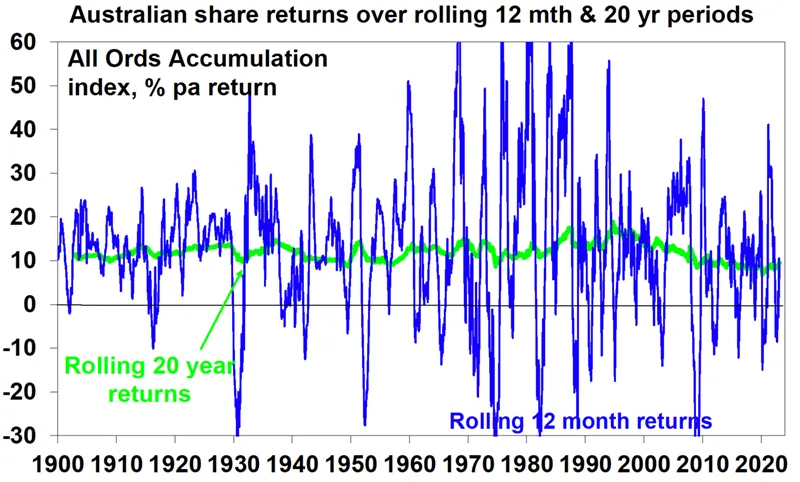
    Investment Goals Setting

    Investment goal setting

    Investment Goals Setting

    Planning for your goals when you invest means giving yourself the best chance of success.

    Without a plan, it’s easy to get distracted by daily headlines. You can end up reacting to the news, timing the market, chasing returns and missing out on long-term gains.

    With a plan, you know where you’re heading because you have a map. Along the way, you may not know exactly what each day will bring or have control of everything but a plan will keep you focused on your goals.

    1

    Quantifying your goals

    The best way to define your goals is to make them time and dollar specific. This means we assign them a timeframe and the dollar figure we’re going for. If you have multiple goals (for example, paying for both retirement and your child’s education expenses), each needs to be clearly defined and accounted for.

    This step is often skipped as investors tend to quickly jump to solutions. However, defining your goals delivers clarity and a sense of ownership over your investment plan. We work with you to help you get this right. People don’t come to us with clearly defined financial goals, so don’t feel pressured into feeling like you need that clarity before seeking financial advice. Client goals are born in our first meeting.

    2

    Constructing your investment plan

    With clarity around your goals, it’s possible to move on to establishing a plan to achieve them. This involves working out the initial and ongoing regular dollar amount to invest and a suitable investment strategy. These will depend on the specifications of your goals and are prepared by your financial planner. Your planner will explain the reasons behind the recommendations as well as suitable products that will fit your plan.

    Because most objectives are long-term, your investment plan should be designed to endure through changing market environments, and should be flexible enough to adjust for unexpected events along the way.

    A sound investment plan can help you to practice healthy investor behaviour, because it demonstrates the purpose and value of asset allocation, diversification, and rebalancing. It also helps you to stay focused on your intended contribution and spending rates.

    3

    The danger of lacking a plan

    Without a plan, investors often build their portfolios from the bottom up, focusing on each investment holding rather than on how the portfolio as a whole is serving your objectives.

    Another way to characterise this process is “fund collecting”: Investors can be drawn into evaluating a particular fund or other type of investment and, if it seems attractive, they buy it, often without thinking about how or where it may fit within the overall asset allocation.

    While paying close attention to each investment may seem logical, this process can lead to a collection of holdings that does not serve your ultimate needs. As a result, your portfolio may wind up being under diversified (all your eggs in one basket) or you may end up holding a whole lot of expensive double ups (over diversification).

    With no plan to focus on, investors are led into such situations by common, avoidable mistakes such as performance chasing, market timing, or reacting to market “noise.” They are moved to action by the performance of the broader equity market, increasing their equities exposure during bull markets and reducing it during bear markets. Such “buy high, sell low” behaviour has been well documented and caused by our hard-wired emotional response to fear, rather than a rational one.

    4

    Staying focused on your goals

    Once the plan is in place, it’s revisited on a regular basis so you can track your progress.

    The future will not go exactly according to plan and that’s ok. It’s not about getting things exactly right about the future because we can’t. Your investment plan will, at some point, inevitably become an outdated map. The landscape will change. That’s life.

    Our ongoing planning process will ensure we address things as they come up. We’ll communicate with you on a regular basis, sometimes more frequently than other times.


    Having us on your side means we won’t continue to defend the outdated map but instead will be your guide in the ever-changing landscape. We’re here to make sure you’re heading the right direction. We’ve got you.

    Every now and then you will have a tendency to listen to ideas that can hurt you financially. We believe investors should employ their time and effort up front, on the plan, rather than in ongoing evaluation of each new idea that hits the headlines. This simple step can pay off tremendously in helping you stay on the path toward your financial goals.

    So, whether it’s a new car, education expenses or a comfortable retirement, if you keep your eyes on the end goal, you’ll stand more chance of reaching your destination and achieving investment success.

    The most important step is to begin.


    How does your investment goal strategy look?

    If you want a fresh look at how to reach your investment goals, book an appointment with one of our experienced planners, contact us on 02 9328 0876.


    Article by Sydney Financial Planning

    General Disclaimer: This article contains information that is general in nature. It does not take into account the objectives, financial situation or needs of any particular person. You need to consider your financial situation and needs before making any decisions based on this information. Please seek personal financial advice prior to acting on this information.


    Coronavirus - Recession, Depression or Economic Hit?

    Is coronavirus driving a recession, depression or an economic hit like no other?

    Coronavirus - Recession, Depression or Economic Hit?

  • There are big differences between the current disruption to economic activity – which could be very deep in the short term – and past recessions and depressions.
  • Introduction

    Global and Australian shares have fallen well beyond the 20% decline commonly used to delineate a bear market. From their highs to their recent lows major share markets have had roughly 35% falls as investors have moved to factor in a big hit to growth from coronavirus shutdowns.

    Recession now looks inevitable and they tend to be associated with deep and long bear markets, but now there is even talk of depression suggesting an even deeper bear market. In reality, there are big differences now compared to past recessions and the Great Depression, so it really looks like an economic hit like no other with very different implications for the bear market in shares. But let’s first look at past bear markets as they provide some lessons for investors regardless of the cause.

    The two bears – gummy & grizzly

    There are 2 types of bear markets in shares:

    • “gummy” bear markets with falls around 20% meeting the technical definition many apply for a bear market but where a year after falling 20% the market is up (like in 1998 in the US, 2011 and 2015-16 for Australian & global shares); and
    • “grizzly” bear markets where falls are a lot deeper and usually longer lived (like in 1973-74, US and global shares through the tech wreck or the GFC).

    I can’t claim the terms “gummy bear” and “grizzly bear” as I first saw them applied by stockbroker Credit Suisse a few years ago. But they are a good way to conceptualise bear markets. Grizzly bears maul investors but gummy bears eventually leave a nicer taste (like the lollies!). The next table takes a closer look at bear markets. It shows conventionally defined bear markets in Australian shares since 1900 – where a bear market is a 20% decline that is not fully reversed within 12 months. The first column shows bear markets, the second shows the duration of their falls and the third shows the size of the falls. The fourth shows the percentage change in share prices 12 months after the initial 20% decline. The final column shows the size of the rebound over the first 12 months from the low.

    bear markets au shares since 1900

    Based on the All Ords. I have defined a bear market as a 20% or greater fall in shares that is not fully reversed within 12 months. Source: Global Financial Data, Bloomberg, AMP Capital

    Since 1900 there have been 12 gummy bear markets (in black) and six grizzly bears (in red). Several points stand out.

    • First, gummy bear markets tend to be shorter & see smaller declines around 26% compared to 46% for the grizzly bears.
    • Second, the average rally over 12 months after the initial 20% fall is 15% for the gummy bear markets but it’s a 23% decline for the grizzly bear markets.
    • Third, the deeper grizzly bear markets are invariably associated with recession, whereas the milder gummy bear markets including the 1987 share market crash tend not to be. All the six grizzly bear markets, excepting that of 1951-52, saw either a US or Australian recession or both whereas less than half of the gummy bear markets saw recession. It’s also the case for the US share market.
    • Finally, once the bear market ends the rebound is strong with an average gain of 29%. Trying to time this is hard with many who get out on the way down finding they don’t get back in until the market has risen above where they sold!

    Recession versus depression or something else?

    So, one of the key messages from history is that if we have a recession then the bear market will likely be grizzly and severe with markets even lower than they are today in 12 months’ time. It’s not necessarily that simple though as the shock this time is very different to those seen in the past. But first the bad news. Recession now looks inevitable. There is now even talk of “depression”. While there is a huge unknown around how long it will take to control the virus and hence how long the shutdowns will last it is looking clear that the short term hit to GDP will be deeper than anything seen in the post WW2 period hence the increasing references to the pre-war depression:

    • Chinese business conditions PMIs for February fell an unprecedented 24 points due to shutdowns starting 23rd January. Consistent with this Chinese economic activity indicators are down 20% from levels a year ago. Chinese March quarter GDP could well be down 10% or so.
    • Business conditions PMIs for the US, Eurozone, Japan and Australia all plunged in March as lockdowns ramped up. The average decline for these countries composite business conditions PMIs was an unprecedented 12 pts. This takes them below levels seen in the GFC. And the shutdowns have only just started so further falls are likely in April. So like China, developed countries could conceivably see 10% or so falls in GDP centred around the June quarter.

    g3 bus conditions pmis

    Source: Bloomberg, AMP Capital

    impact to Australia GDP from covid19

    Source: ABS, AMP Capital

    • By way of example the next chart shows the industry make-up of the Australian economy. The shutdowns will see a large hit to roughly 25% of the Australian economy, particularly accommodation & culture, retailing & real estate.

    Big differences v past recessions and depressions

    But while the slump in economic activity may be deeper than anything seen in the post war period, depression may not be the best description. Most definitions of depression focus on it being over several years and seeing a very deep fall in GDP compared to a recession which is shorter and shallower. The current hit to economic activity may be very deep but it won’t necessarily be longer than past recessions. And there is good reason to believe that if the virus comes under control in the next 2-6 months and we minimize the collateral damage from the shutdowns that the hit to activity may be shorter. There are big differences between the current situation and that of past recessions and Great Depression of the 1930s:

    • First, recessions and The Great Depression (which saw GDP contract by 36% over 4 years and unemployment rise to 25% in the US and GDP fall by 9.4% in Australia with a rise in unemployment to 20%) were preceded by a period of excess in terms of investment, consumer discretionary spending, private debt growth and inflation that had to be unwound. This time around there has been no generalised period of excess and there has been no large-scale monetary tightening to bring on a downturn.
    • Second, monetary policy was tightened in the lead up to past recessions and in the early phase of the Great Depression whereas global monetary policy was eased last year and that easing has accelerated this month with rate cuts, a renewed ramp up of quantitative easing (QE) and central banks around the world establishing various ways to ensure credit flows to the economy. In the 1930s banks were simply allowed to fail. Now they are being supported by ultra-cheap funding. Much of this owes to the GFC experience which has made it easier for central banks to now ramp up QE and introduce support mechanisms.
    • Third, going into the Great Depression fiscal policy was tightened to balance budgets whereas in the last month we have seen massive and still growing global fiscal policy stimulus swamping that of the GFC. The latest US fiscal stimulus package alone is around 9% of US GDP.

    g20 countries fiscal thrust

    Source: IMF, AMP Capital

    • Fourth, there has been no trade war such as the Smoot-Hawley 20% tariffs on US imports that were met by global retaliation and saw global trade collapse in the 1930s.

    The bottom line is that while we may see the biggest hit to global and Australian GDP since the 1930s thanks to the shutdowns, there are big differences compared to the Depression suggesting that a long drawn out global downturn is not inevitable. Basically, it’s a disruption to normal activity caused by the need to stay at home. In fact, growth could rebound quickly once the virus is under control and policy stimulus impacts. Which in turn should benefit share markets and could see this latest bear market turn into a gummy bear market rather than a grizzly bear market. Of course, at this point we are still waiting for convincing evidence that markets have bottomed. And the key is that the number of new cases of coronavirus starts to slow and that collateral damage from the shutdowns are kept to a minimum.

    Closing Comment

    Wow a lot can change in a short period of time!

    In my last update I acknowledge there was a lot we did not know about this event and how it may play out. I finished with what we do know. After 31 years in Financial Planning
    I have learnt that numbers and history do not lie, that’s why we are obsessed with numbers and graphs to illustrate, our conclusions.

    I now ask you to re-read the table above, of what happened to the Australian Share market over the past 100 years when negative events occurred Globally, then look at the % gain in first 12 months after a low. Numbers don’t lie, nor history. Markets will recover, and when you’re sick you talk to the Medical Dr, when your financial affairs are sick talk to the Financial Dr. Now more than ever, you need to talk and review your situation to navigate out of here.

    Please feel free to call us, we’re here to help you.

    Bill and the team at SFP.


    Remember we are available to help you during this unprecedented time…

    If you have ANY please get in touch to speak with one of our Financial Planners we’re here to help, either book a virtual meeting of get in contact with us on 02 9328 0876.


    Article by Bill Bracey – Principal & Senior Financial Planner | Sydney Financial Planning


    This article was prepared by Dr Shane Oliver. Dr Shane Oliver who provides economic forecasts and analysis of key variables and issues affecting, or likely to affect, all asset markets. He also provides economic forecasts and analysis of key variables and issues affecting, or likely to affect, all asset markets.

    Important note: While every care has been taken in the preparation of this document, AMP Capital Investors Limited (ABN 59 001 777 591, AFSL 232497) and AMP Capital Funds Management Limited (ABN 15 159 557 721, AFSL 426455) make no representations or warranties as to the accuracy or completeness of any statement in it including, without limitation, any forecasts. Past performance is not a reliable indicator of future performance. This document has been prepared for the purpose of providing general information, without taking account of any particular investor’s objectives, financial situation or needs. An investor should, before making any investment decisions, consider the appropriateness of the information in this document, and seek professional advice, having regard to the investor’s objectives, financial situation and needs. This document is solely for the use of the party to whom it is provided.

    General Disclaimer: This article contains information that is general in nature. It does not take into account the objectives, financial situation or needs of any particular person. You need to consider your financial situation and needs before making any decisions based on this information. Please seek personal financial advice prior to acting on this information.

    Coronavirus and Financial Markets Melt Down

    Coronavirus and financial markets melt down. What to do?

    Coronavirus and Financial Markets Melt Down

    Maybe I was wrong? Australians rushing out buying toilet paper and fighting over it like it was gold being handed out for free.

    Some wise person once said:

    “Off with the head and on goes a pumpkin!”

    Thank god my clients still have their own head and use the knowledge they have gained through us and are not making irrational decisions about their investments.

    Yes, the phone rang, and yes, we are all concerned, but the vast majority asked me then same question.

    Q: “Bill, in all your correspondence you have sent us this calendar year – is this what you meant when you said, “This is how the rich get richer and the poor get poorer”?

    A: YES!

    Then most asked me…

    Q: “Is the time right now to start to invest when assets values have fallen greatly?”

    A: YES! (but I also say) patience grasshopper.


    This crisis will eventually pass, as investors and Australians become accustomed to the new normal that included the new coronavirus COVID-19, becoming a normal part of daily life along with the flu, obesity, car accidents and other medical issues.

    The difficult part is the ‘unknown’ as we don’t know how long the dislocation phase will last, where we need to reduce social interaction and possible isolation for a limited time. This has significant economic impacts and greatly increases the probability of a recession.

    The global markets have moved from raging Bull to Bear Market. How long will this last and when is it good to start investing again?

    That’s the Million-dollar question.

    The answer is; nobody knows. The best advice is everybody’s situation is vastly different and you need individual high-quality advice.

    What I do know is;

    • That we are in a bear market and we don’t know how far away the bottom is.
    • That right now there is possibly some phenomenal buying opportunities.
    • That markets perform over time and bounce back as seen in the below table.

      sfp e15 001 us stock markets 10 worst days

      Source: Schroders. Refinitv data correct as at 3 March, 2020. Data shown is for the S&P 500 Total Return Index, which includes price increases and dividend payments. Past performance is not a guide to future returns. 413199

    • This is a period of adjustment because we are moving from a long Bull market and nobody can ever pick the bottom of the Bear Market (nor the top of the Bull Market for that matter).
    • If you buy somewhere towards the bottom of the market, there is exceptional value and money to be made.
    • In times like this, the poor unadvised panic and sell at the bottom, and the well-advised rich buy from the poor. That’s how the Rich get Richer!
    • I’ve started investing part of my spare cash back into to the market.
    • I’ve been through many of these volatile times before I’ve learnt what to do and how to best advise clients, as do all our Financial Planners at Sydney Financial Planning.

    If you still have questions and things are not clear; I urge you to arrange to talk with your Financial Planner.


    Bill Bracey and the advice team


    Have you set things up to weather this trend?

    If you need your personal situation reviewed by your Financial Planner or you don’t have a planner yet, get in contact with us on 02 9328 0876.


    Bill Bracey – Principal & Senior Financial Planner | Sydney Financial Planning

    General Disclaimer: This article contains information that is general in nature. It does not take into account the objectives, financial situation or needs of any particular person. You need to consider your financial situation and needs before making any decisions based on this information. Please seek personal financial advice prior to acting on this information.
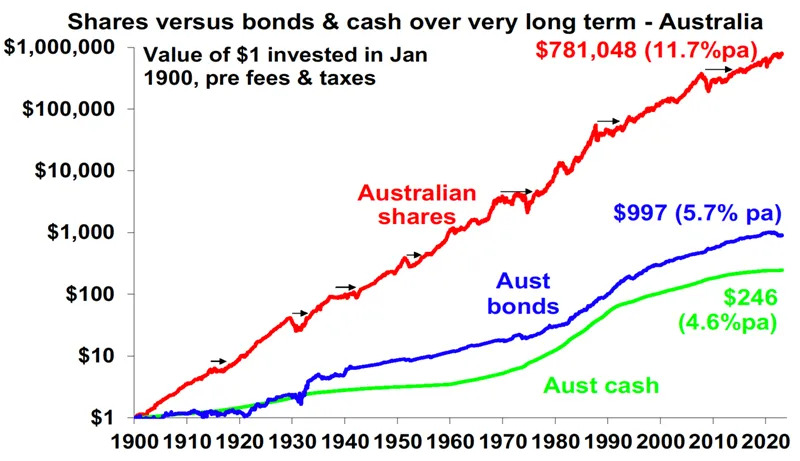
    2020 plunge in shares

    The plunge in shares – seven things investors need to keep in mind

    2020 plunge in shares

  • Shares may still have more downside and the uncertainty around the coronavirus crisis is very high, but we are of the view that it’s just another correction.
  • Key things for investors to bear in mind are that: corrections are normal; in the absence of recession, a deep bear market is unlikely; selling shares after a fall locks in a loss; share pullbacks provide opportunities for investors to buy them more cheaply; while shares may have fallen, dividends are smoother; and finally, to avoid getting thrown off a long-term investment strategy it’s best to turn down the noise during times like this.
  • Introduction

    The plunge in share markets over the last week has generated much coverage and consternation. This is understandable given the rapidity of the falls – with US shares having their fastest 10% fall from an all-time high on record – and the uncertainty around the coronavirus (Covid-19) and its impact on economic activity. From their highs to recent lows US shares have fallen 13%, Eurozone shares have fallen 16%, Japanese and Chinese shares have fallen 12% and Australian shares have fallen 12%. This note looks at the issues for investors and puts the falls into context.

    What’s driving the latest plunge?

    The plunge basically reflects two things.

    • After very strong gains from their last greater than 5% correction into August last year, share markets had become vulnerable to a correction.
    • The uncertainty around the impact of the coronavirus outbreak which is on the verge of becoming a pandemic and its impact on global growth has unnerved investors dramatically. Shares had recovered from their initial fall on the back of the virus into early February on signs that the number of new cases in China was falling (which is continuing), limited cases outside China and expectations that policy easing would limit any damage. This has been blown apart in the last week as cases have popped up en masse in Italy, South Korea and Iran, more cases have appeared elsewhere around the world and this has resulted in expectations of a deeper and longer hit to global growth.

    After big falls shares have become technically oversold, measures of negative investor sentiment such as the VIX (or fear) index and demand for option protection have spiked. So, shares could have a short-term bounce. But given the uncertainties around Covid-19 – with more cases in the US and Australia likely to pop up – the situation could get worse before it gets better, so the share pullback could have further to go – notwithstanding short-term bounces.

    Considerations for investors

    Sharp market falls with headlines screaming that billions of dollars have been wiped off the share market are stressful for investors as no one likes to see the value of their investments decline. The current situation is doubly stressful because of fears for our own and others health – particularly for the elderly. However, several things are worth bearing in mind:

    First, while they all have different triggers and unfold a bit differently to each other, periodic corrections in share markets of the order of 5%, 15% and even 20% are healthy and normal. For example, during the tech/dot-com boom from 1995 to early 2000, the US share market had seven pull backs greater than 5% ranging from 6% up to 19% with an average decline of 10%. During the same period, the Australian share market had eight pullbacks ranging from 5% to 16% with an average fall of 8%. All against a backdrop of strong returns every year.

    During the 2003 to 2007 bull market, the Australian share market had five 5% plus corrections ranging from 7% to 12%, again with strong positive returns every year. More recently, the Australian share market had a 10% pullback in 2012, an 11% fall in 2013 (the taper tantrum), an 8% fall in 2014, a 20% fall between April 2015 and February 2016, a 7% fall early in 2018, a 14% fall between August and December 2018 and a 7% fall into August last year. And this has all been in the context of a gradual rising trend. And it has been similar for global shares – with the last big fall in US shares being a 20% plunge into Christmas eve 2018. See the next chart. While they can be painful, share market corrections are healthy because they help limit a build-up in complacency and excessive risk taking.

    sfp e14 001 corrections normal

    Source: Bloomberg, AMP Capital

    sfp e14 002 Australian shares climb a wall of worry

    Source: Bloomberg, AMP Capital

    Related to this, shares climb a wall of worry over many years with numerous events dragging them down periodically, but with the long-term trend ultimately up & providing higher returns than other more stable assets. Bouts of volatility are the price we pay for the higher longer-term returns from shares.

    Second, the main driver of whether we see a correction (a fall of 5% to 15%) or even a mild bear market (with say a 20% decline that turns around relatively quickly like we saw in 2015-2016) as opposed to a major bear market (like that seen in the global financial crisis (GFC)) is whether we see a recession or not – notably in the US as the US share markets tends to lead for most major global markets. The next table shows US share market falls greater than 10% since the 1970s. I know it’s heavy – but I like this table! The first column shows the period of the fall, the second shows the decline in months, the third shows the percentage decline from top to bottom, the fourth shows whether the decline was associated with a recession or not and the fifth shows the gains in the share market one year after the low. Falls associated with recessions are highlighted in red.

    sfp e14 003 falls in us market greater than 1970s

    Source: Bloomberg, AMP Capital

    Several points stand out:

    • First, share market falls associated with recession tend to be longer and deeper. 
    • Second, after the low the, share markets generally rebound sharply – which invariably makes it very hard for investors to time, as by the time they realise what has happened and get back in the market is above where they sold. 
    • Finally, as would be expected the share market rebound in the year after the low is much greater following falls associated with recession.

    So, whether a recession is imminent or not in the US is critical in terms of whether we will see a major bear market or not. In fact, the same applies to Australian shares. Our assessment is that a US/global recession is not inevitable. We have not seen the excesses – in terms of overall debt growth (although housing debt is a source of risk in Australia), overinvestment, capacity constraints and inflation – that normally precede recessions in the US, globally or Australia. And we have not seen the sort of monetary tightening that leads into recession. In fact, monetary conditions remain very easy. However, the uncertainty around the coronavirus outbreak and the likelihood of economic shutdowns designed to contain it beyond those in China do suggest a greater than normal risk on this front. That said even if there were a recession growth would likely rebound quickly once the virus came under control as economic activity sprang back to normal helped by policy stimulus.

    Third, selling shares or switching to a more conservative investment strategy or superannuation option after a major fall just locks in a loss. With all the talk of billions being wiped off the share market, it may be tempting to sell. But this just turns a paper loss into a real loss with no hope of recovering. The best way to guard against making a decision to sell on the basis of emotion after a sharp fall in markets (as many including me are tempted to do!) is to adopt a well thought out, long-term strategy and stick to it.

    Fourth, when shares and growth assets fall, they are cheaper and offer higher long-term return prospects. So, the key is to look for opportunities the pullback provides – shares are cheaper and some more than others. It’s impossible to time the bottom but one way to do it is to average in over time.

    Fifth, while shares have fallen, dividends from the market haven’t. They will come under some pressure as the economy and profits take a hit from a deeper and longer coronavirus outbreak. But companies like to smooth their dividends over time – they never go up as much as earnings in the good times and so rarely fall as much in the bad times. So, the income flow you are receiving from a well-diversified portfolio of shares is likely to remain attractive, particularly against bank deposits.

    sfp e14 004 aust shares offer attractive yield

    Source: RBA, Bloomberg, AMP Capital

    Sixth, shares and other related assets often bottom at the point of maximum bearishness, ie, just when you and everyone else feel most negative towards them. So, the trick is to buck the crowd. “Be fearful when others are greedy. Be greedy when others are fearful,” as Warren Buffett has said.

    Finally, turn down the noise. At times like this, negative news reaches fever pitch. Talk of billions wiped off share markets and warnings of disaster help sell copy and generate clicks & views. But we are rarely told of the billions that market rebounds and the rising long-term trend in share prices adds to the share market. Moreover, they provide no perspective and only add to the sense of panic. All of this makes it harder to stick to an appropriate long-term strategy let alone see the opportunities that are thrown up. So best to turn down the noise.

    Concluding Comment

    So in summary as I suggested in January in my update to you, times like this offer opportunity and we have seen times like this before. This is where the rich get richer and the poor non advised, get poorer.

    Please take time to watch my 5 minute video that explains what you should be doing with this market.


    Now more than ever its important to keep your nerve and shut out the media who pump FEAR into the masses.

    Please feel free to contact us at Sydney Financial Planning, we are experienced at dealing with volatile times and know what to do.

    Bill Bracey and the team


    Have you set things up to weather this trend?

    If you need your personal situation reviewed by your SFP Planner or you don’t have a planner yet, get in contact with us on 02 9328 0876.


    Bill Bracey – Principal & Senior Financial Planner | Sydney Financial Planning


    This article was prepared by Dr Shane Oliver. Dr Shane Oliver who provides economic forecasts and analysis of key variables and issues affecting, or likely to affect, all asset markets. He also provides economic forecasts and analysis of key variables and issues affecting, or likely to affect, all asset markets.

    Important note: While every care has been taken in the preparation of this document, AMP Capital Investors Limited (ABN 59 001 777 591, AFSL 232497) and AMP Capital Funds Management Limited (ABN 15 159 557 721, AFSL 426455) make no representations or warranties as to the accuracy or completeness of any statement in it including, without limitation, any forecasts. Past performance is not a reliable indicator of future performance. This document has been prepared for the purpose of providing general information, without taking account of any particular investor’s objectives, financial situation or needs. An investor should, before making any investment decisions, consider the appropriateness of the information in this document, and seek professional advice, having regard to the investor’s objectives, financial situation and needs. This document is solely for the use of the party to whom it is provided.

    General Disclaimer: This article contains information that is general in nature. It does not take into account the objectives, financial situation or needs of any particular person. You need to consider your financial situation and needs before making any decisions based on this information. Please seek personal financial advice prior to acting on this information.
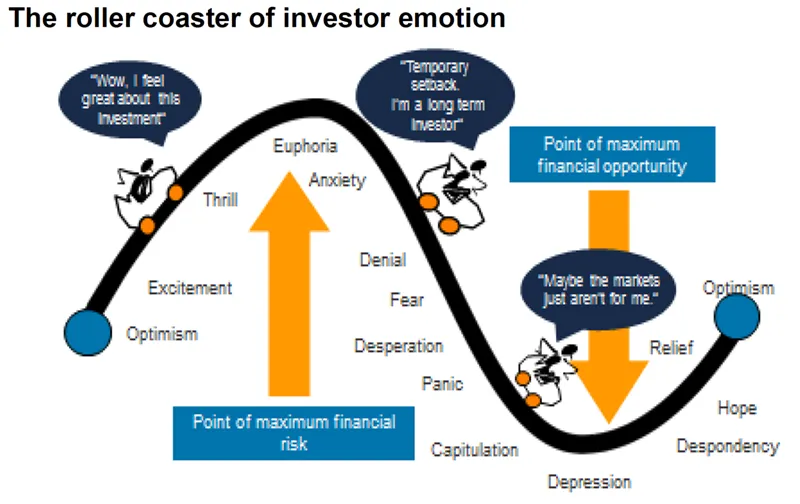
    What do Australians want financial advice on?

    What do Australians want financial advice on?

    What do Australians want financial advice on?

    According to the recent ASIC report [1], the topics Australians want financial advice on:

    • Investments (e.g. shares and managed funds) 45%
    • Retirement income planning 37%
    • Growing superannuation 31%
    • Budgeting or cash flow management 22%
    • Aged care planning 18%

    Despite this, only 12% of Australian surveyed sought financial advice in the past 12 months.

    Like many Australians, you might have thought about helping secure your family’s financial future by working with a financial adviser.

    According to the recent Australian Securities & Investments Commission report, ‘Financial advice: What consumers really think [2], 79% of Australians believe “financial advisers have expertise in financial matters that I do not have”.

    Yet here’s the kicker: only 12% have actually sought advice in the past 12 months.

    The good news is 41% of Australians intend to get financial advice in the future, and 25% intend on doing so in the next 12 months. Below we’ve covered the areas they are most interested in seeking advice on.

    1. Investment Advice

    According to the ASIC report, perhaps unsurprisingly, 45% of Australians want advice on investments (e.g. shares and managed funds)

    But, a 2019 report by global investment solutions firm Russell Investments – ‘Why work with a financial adviser? [3]’ states that researchers have discovered over 200 unconscious biases that influence our decisions, which could have a detrimental effect on our future wealth.

    “People tend to let their emotions and other human tendencies influence their decision making. But when it comes to investing, acting like a human may actually cost you money,” the Russell Investments report states.

    “To be a successful investor, it is important to be objective and disciplined when making investment decisions.

    2. Retirement Income Planning

    According to the ASIC report, 37% of survey participants wanted advice on retirement income planning.

    Indeed, according to the 2017 ASX Australian Investor Study [4] report, retirement and wealth accumulation are “front of mind for all age groups, and individuals are investing in products that reflect these goals”.

    The ASX report states that a single person seeking a ‘modest’ lifestyle in retirement requires a lump sum of at least $370,000 (without the age pension) invested and returning 7% p.a.

    For couples, this lump sum needs to be at least $400,000.

    In order to have a ‘comfortable’ retirement, households will require double these amounts.

    One of the most important jobs a financial adviser has is helping you to determine the best investment strategy and risk profile to achieve your long-term retirement objectives.

    “Investing early to accumulate wealth will make the difference between a modest and a comfortable retirement in the future – and whether or not individuals will need to rely on the age pension,” the ASX report states.

    Financial advisers, like us, can help you craft a diversified portfolio that is intended to provide not just a comfortable living when you eventually retire, but also design a strategy that takes into account your age, circumstances and risk appetite.

    3. Superannuation

    The ASIC survey shows that 31% of Australians also want advice on growing their superannuation.

    Now, superannuation seems to be another one of those financial topics that people know about, but don’t truly understand, despite the major long-term benefits.

    In fact, research by the Association of Superannuation Funds of Australia (ASFA)[5], has found that Australians under 30 years of age tend to have higher balances in their superannuation accounts than their bank accounts.

    And yet, 40% of young people have absolutely no idea what their superannuation balance is.

    There are also several tax deduction benefits related to superannuation contributions, and this is the kind of information a financial adviser can provide while helping you get the most out of your superannuation plan.

    4. Cash Flow

    It turns out that 22% of ASIC survey participants wanted advice on budgeting or cash flow management. And for good reason.

    This is where we can really make an impact in your current day-to-day life – not just decades down the track. We can help you manage your monthly budgets, reduce your debt and make sure you have enough cash flow to comfortably make it to the end of each month.


    Let us help you sleep better and get your financial future on track.

    Speaking with one of our financial advisors is a good place to start. Make a booking or call us on 02 9328 0876 to arrange a meeting.


    [1] & [2] Australian Securities and Investments Commission (ASIC) August 2019, Financial advice: what consumers really think, viewed January 2020 https://download.asic.gov.au/media/5243978/rep627-published-26-august-2019.pdf © AUSTRALIAN SECURITIES & INVESTMENTS COMMISSION. REPRODUCED WITH PERMISSION. PLEASE SEE THE WEBSITE FOR FURTHER INFO
    [3] Russell Investments 2019, Why work with a financial adviser?, viewed January 2200 https://www.jsagroup.com.au/wp-content/uploads/2019/08/2019-Value-of-an-Adviser_Investor-Report.pdf
    [4] Deloitte Access Economics 2017, ASX Australian Investor Study, viewed January 2020 https://www.asx.com.au/documents/resources/2017-asx-investor-study.pdf
    [5] The Association of Superannuation Funds of Australia Limited (AFSA) 2020, Young people and superannuation, viewed January 2020 http://www.superguru.com.au/about-super/youngpeople

    General Disclaimer: This article contains information that is general in nature. It does not take into account the objectives, financial situation or needs of any particular person. You need to consider your financial situation and needs before making any decisions based on this information. Please seek personal financial advice prior to acting on this information.
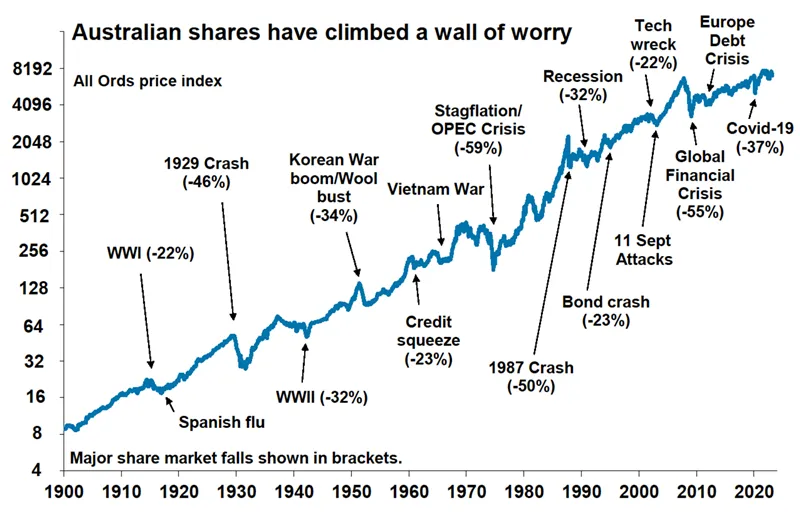
     

    Are grandparents giving too much?

    Are grandparents giving too much?

    Are grandparents giving too much?

    Not so long ago, it was the norm for adult children to lend a financial helping hand to their ageing parents. These days, the support is more likely to flow downwards, and grandparents are increasingly likely to provide financial support to their children – and even grandchildren.

    As school costs soar for instance, a growing number of grandparents are dipping into their pockets to give their grandchildren a quality education. Industry research shows almost one in four education savings plans are started by people aged 60 or older.i

    In other families, time rather than money is being provided. Faced with expensive and often limited formal childcare options, many working families turn to grandparents as a source of low cost childcare. A 2014 report by AMP and the National Centre for Social and Economic Modelling (NATSEM)ii found that grandparents provide 23% of all childcare to children aged under 12.

    Informal childcare can be taxing

    Quite naturally, many grandparents relish the opportunity to spend one-on-one time with their grandkids. However, along with the physical demands of caring for a youngster, providing childcare can also be financially taxing, and it’s not just about occasional outings to the zoo or the purchase of a few age appropriate toys.

    At a time when the pension eligibility age is being raised and pension rates reduced, caring for a grandchild can have a significant impact on a grandparent’s financial wellbeing.

    One in five have changed jobs to offer childcare

    A survey by National Seniors Australiaiii found many grandparents who provide informal childcare are ‘working around care’, and making significant adjustments to their own career as a result. Among those surveyed, 70% altered the days or shifts they worked, 55% reduced their working hours, and 18% had even changed their job because of their caring commitment.

    On the plus side, the same study found grandparents reported enjoying a far better relationship with both their grandchild and adult child as a result of providing care. But it comes at a cost. Just over one-third (34%) of respondents said their childcare responsibilities had a negative impact on their incomes, household budgets and/or retirement savings.

    It’s all about finding a balance

    These results highlight the need for seniors to find a balance in how – and how much – they help their adult offspring and grandchildren.

    We all want the best for our family but as we age we need to think about our own needs too. Increasing longevity means longer retirement periods to plan for, and giving too much today could limit your ability to remain financially independent throughout retirement.

    Having open and frank discussions with your adult children about the level of support you can realistically provide – both physical and financial – is the starting point in achieving this balance. These may not be easy conversations to have but they are critical to achieve a win-win for all family members.

    Speak to us about the best way to structure your finances so you can help your adult children while still achieving your retirement goals.


    Need help structuring your finances so you can help your children?

    Speaking with one of our financial advisors is a good place to start. Make a booking or call us on 02 9328 0876 to arrange a meeting.


    i Australian Unity media release: Grandparents step in to fill the education savings gap, 31 October 2014
    ii AMP.NATSEM Income and Wealth Report, Child Care Affordability in Australia, Issue 35 – June 2014.
    iii National Seniors Australia, Grandparent childcare and labour market participation in Australia, September 2015

    General Disclaimer: This article contains information that is general in nature. It does not take into account the objectives, financial situation or needs of any particular person. You need to consider your financial situation and needs before making any decisions based on this information. Please seek personal financial advice prior to acting on this information.
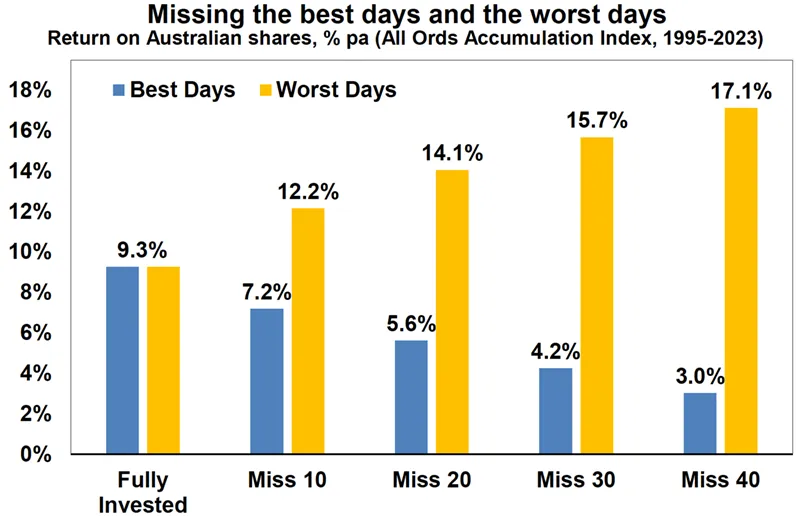
     

    Super investment options

    Super investment options – what’s right for you?

    Super investment options

    If there’s one thing certain in life it’s change. And generally your attitude towards saving and investing will change as you get older.

    How your super is invested when starting your first job may not be the right approach when you’re approaching retirement. Luckily you can change your investment options at any time and this could make a real difference to how much money you have when you retire.

    There are usually several different investment options to choose from. If you haven’t selected an investment option, you’re probably invested in your fund’s default option, which will generally take a balanced approach to risk and return.

    To get up to speed on your super investment options, we’ve answered three common questions: how your money is invested, the different options available, and how your stage of life may influence your preferences.

    What do super funds do with my money?

    Typically, no less than 9.5% of your before-tax salary (if you’re eligible) is paid into super, which is then taxed at a maximum of 15%. Your super fund will invest this money over the course of your working life, so you can hopefully retire comfortably.

    Your super fund will let you choose from a range of investment options and generally the main difference will be the level of risk you’re willing to take to potentially generate higher returns.

    If you’re not sure what you’re invested in, contact your super fund. You may also be able to see your current investment option by logging into your super fund’s online portal – this may also give you a current balance and other information such as your projected super savings over a lifetime.

    What are the super investment options I can choose from?

    Most super funds let you choose from a range, or mix of investment options and asset classes. These might include ‘growth’, ‘balanced’, ‘conservative’ and ‘cash’ but the terms can differ across super funds. Here’s a small sample of the typical type of investment options available:

      • Growth options aim for higher returns over the long term, however losses can also be notable when markets aren’t performing. They typically invest around 85% in shares or property.


      • Balanced options don’t tend to perform as well as growth options over the long term, but the loss is also less when there are market downturns. They typically invest around 70% in shares or property, with the rest in fixed interest and cash.


      • Conservative options generally aim to reduce the risk of market volatility and therefore may generate lower returns. They typically invest around 30% in shares and property, with the rest in fixed interest and cash.


    • Cash options aim to generate stable returns to safeguard the money you’ve accumulated. They typically invest 100% in deposits with Australian deposit-taking institutions, such as banks, building societies and credit unions.

    Super funds may have different allocations, so it’s important to read your super fund’s product disclosure statement before making any decisions. It could be a good idea to consider factors such as your current stage in life, and future plans and goals before choosing the super investment option that’s right for you.

    What’s the right investment option for me?

    Choosing the most suitable investment option generally comes down to your goals for retirement, your attitude to risk and the time you have available to invest.

    If you’re young, you may have more time to ride out market highs and lows, and therefore be willing to take on more risk in the hope of achieving higher returns.

    If you’re closer to being able to access your super, you may prefer a conservative approach as a share market crash could be harder to recover from than if you’re 20 years away from retirement.

    While many people put off thinking about super, being informed and engaged from a young age and throughout your career may make a big difference to the returns generated and your final super balance.


    Need some help working out the best option for you?

    Why not book an appointment with one of our planners to go through your individualc circumstances, contact us on 02 9328 0876.


    Article by – AMP Life Limited. First published December 2019.

    General Disclaimer: This article contains information that is general in nature. It does not take into account the objectives, financial situation or needs of any particular person. You need to consider your financial situation and needs before making any decisions based on this information. Please seek personal financial advice prior to acting on this information.
    Investment Properties 2020

    Sydney rental yields at new low

    Investment Properties 2020

    Sydney rents dropped over December, forcing yields down to a record low of 3 per cent, according to property researcher CoreLogic. Melbourne rents managed growth of 1.4 per cent but this did not stop yields falling to 3.3 per cent, while looking likely to hit 2017 lows of 3.1 per cent this year.

    Nationally rents grew 1.2 per cent on an annualised basis, but the increase in property prices saw yields fall 0.2 per cent to 3.8 per cent through 2019.

    CoreLogic’s head of research, Tim Lawless, said investors needed to be strategic going forward.

    “It all depends on your investment philosophy,” he said. “Inherent scarcity and demand in blue-chip suburbs offer good capital gains but lower yield profiles.”

    Financial planner William Bracey told The Australian, investors needed to moderate their expectations around returns from residential property.

    gross rental yeilds 2020

    He said continually growing house prices and increased supply in the marketplace had made the 5 per cent yields that were taken for granted in the 1980s and 1990s now unattainable.

    “It’s not just prices going up, but there is also a lot more stock on the market,” Mr Bracey said.

    “Without a shortage, people now have choices. Therefore, it’s a pressure on yields because people aren’t going to pay as high rents.”

    Mr Bracey suggested alternative investment options.

    “People are always chasing yield but it’s just not there, certainly not in residential,” he said. “But interestingly enough, commercial real estate is still holding up okay.

    “Generally speaking, commercial property prices have held and the yields have held reasonably well. For argument’s sake, in a well diversified commercial property fund, you may be getting 5 per cent or 6 per cent yield.”

    Outside of the major cities, the tight rental market of Hobart was one of the strongest in the country, with investors benefiting from relatively affordable property and strong housing demand. Rents grew 6 per cent over the year, while yields rose to 5.1 per cent.

    Darwin and Perth also grew to offer returns of 5.9 per cent and 4.3 per cent respectively. Adelaide (4.4 per cent) and Brisbane (4.5 per cent) yields held through 2019.

    Independent economist Andrew Wilson said that while investors had been generally sluggish to get back into the market with tight lending acting as a barrier to entry, the fertile economic environment still made residential property a sound investment.

    “We have a low yield economy at the moment and I think more investors generally will be looking at property given the potential for capital growth and what remains still a tax positive environment, in terms of those tax policies including negative gearing, tax depreciation to discounts on capital gains. You would expect to see more invested in the market,” Mr Wilson said.


    Still have some questions?

    If you want to discuss your property portfolio or investment property with one of our planners. Call us to arrange an appointment on 02 9328 0876.


    Article by Mackenzie Scott | The Australian

    Copyright The Australian – First Published in the Australian 03 January 2020 – https://www.theaustralian.com.au/business/property/sydney-rental-yields-at-new-low/news-story

    Mackenzie Scott is a property and general news reporter based in Brisbane. Prior to joining The Australian in 2018, she was the editorial coordinator at NewsMediaWorks, covering media and publishing, and editor at travel and lifestyle website Xplore Sydney.

    General Disclaimer: This article contains information that is general in nature. It does not take into account the objectives, financial situation or needs of any particular person. You need to consider your financial situation and needs before making any decisions based on this information. Please seek personal financial advice prior to acting on this information.