Tag: Investing

Economy review of 2019 and outlook for 2020

Review of 2019, outlook for 2020 – the beat goes on
Economy review of 2019 and outlook for 2020

  • 2020 is likely to see global growth pick up with monetary policy remaining easy. Expect the RBA to cut the cash rate to 0.25% and to undertake quantitative easing.
  • Against this backdrop, share markets are likely to see reasonable but more constrained & volatile returns, and bond yields are likely to back up resulting in good but more modest returns from a diversified mix of assets.
  • The main things to keep an eye on are: the trade wars; the US election; global growth; Chinese growth; and fiscal versus monetary stimulus in Australia.
  • 2019 – growth down, returns up

    Christmas 2018 was not a great one for many investors with an almost 20% slump in US shares from their high in September to their low on Christmas Eve, capping off a year of bad returns from share markets and leading to much trepidation as to what 2019 would hold. But 2019 has turned out to be a good year for investors, defying the gloom of a year ago. In fact, some might see it as perverse – given all the bad news around and the hand wringing about recession, high debt levels, inequality and the rise of populist leaders. Then again that’s often the way markets work – bottoming when everyone is gloomy then climbing a wall of worry. The big global negatives of 2019 were:

    • The trade war and escalating US-China tensions generally. A trade truce and talks collapsed several times leading to a new ratcheting up of tariffs before new talks into year end. 
    • Middle East tensions flared periodically but without a lasting global impact & the Brexit saga dragged on although a near-term hard Brexit looks to have been avoided.
    • Slowing growth in China to 6%. This largely reflected an earlier credit tightening, but the trade war also impacted.
    • Slowing global growth as the trade war depressed investment & combined with an inventory downturn and tougher auto emissions to weigh on manufacturing & profits.
    • Recession obsession with “inverted yield curves” – many saw the growth slowdown as turning into a recession.

    But it wasn’t all negative as the growth slowdown & low inflation saw central banks ease, with the Fed cutting three times and the ECB reinstating quantitative easing. This was the big difference with 2018 which saw monetary tightening.

    Australia also saw growth slow – to below 2% – as the housing construction downturn, weak consumer spending and investment and the drought all weighed. This in turn saw unemployment and underemployment drift up, wages growth remain weak and inflation remain below target. As a result, the RBA was forced to change course and cut interest rates three times from June and to contemplate quantitative easing.The two big surprises in Australia were the re-election of the Coalition Government which provided policy continuity and the rebound in the housing market from mid-year.

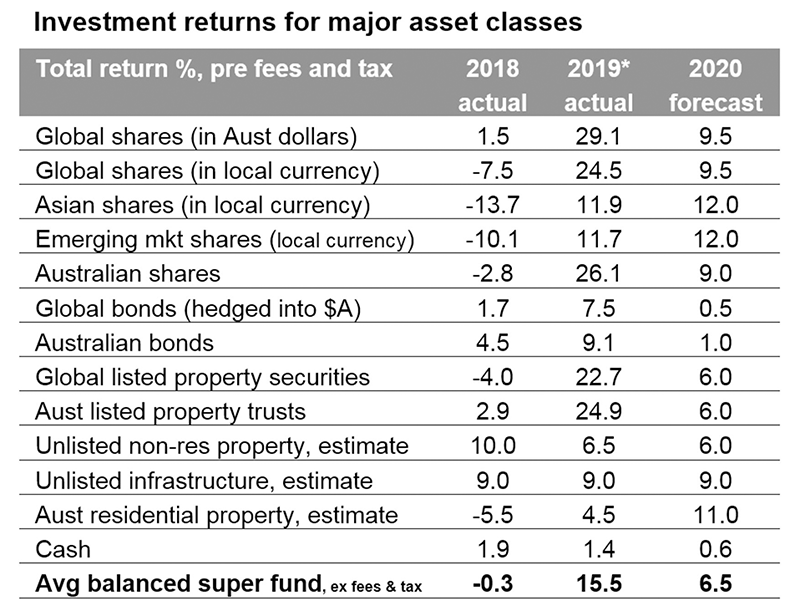
    While much of the news was bad, monetary easing and the prospect it provided for stronger growth ahead combined with the low starting point resulted in strong returns for investors. Investment returns for major asset classes 2019
    *Yr to date to Nov. Source: Thomson Reuters, Morningstar, REIA, AMP Capital

    • Global shares saw strong gains as markets recovered from their 2018 slump, bond yields fell making shares very cheap and monetary conditions eased. This was despite several trade related setbacks along the way. Global share returns were boosted on an unhedged basis because the $A fell.
    • Emerging market shares did well but lagged given their greater exposure to trade and manufacturing and a still rising $US along with political problems in some countries.
    • Australian share prices finally surpassed their 2007 record high thanks to the strong global lead, monetary easing and support for yield sensitive sectors from low bond yields.
    • Government bonds had strong returns as bond yields fell as inflation and growth slowed, central banks cut rates and quantitative easing returned.
    • Real estate investment trusts were strong on the back of lower bonds yields and monetary easing.
    • Unlisted commercial property and infrastructure continued to do well as investors sought their still relatively high yields. However, Australian retail property suffered a correction.
    • Commodity prices rose with oil & iron up but metals down.
    • Australian house prices fell further into mid-year before rebounding as the Federal election removed the threat to negative gearing & the capital gains tax discount, the RBA cut interest rates and the 7% mortgage test was relaxed.
    • Cash and bank term deposit returns were poor reflecting new record low RBA interest rates.
    • The $A fell with a lower interest rates and a strong $US.
    • Reflecting strong gains in most assets, balanced superannuation funds look to have seen strong returns.

    2020 vision – growth up, returns still good

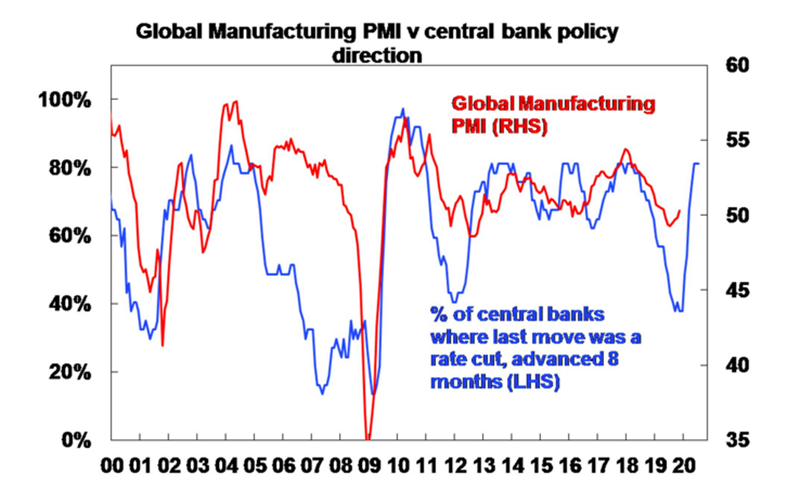
    The global slowdown still looks like the mini slowdowns around 2012 and 2015-16. Business conditions indicators have slowed but remain far from GFC levels. See next chart.
    Global manufacturing PMI vs bank policy direction

    While the slowdown has persisted for longer than we expected – mostly due to President Trump’s escalating trade wars – a global recession remains unlikely, barring a major external shock. The normal excesses that precede recessions like high inflation, rapid growth in debt or excessive investment have not been present in the US and globally. While global monetary conditions tightened in 2018, they remained far from tight and the associated “inversion” in yield curves has been very shallow and brief. And monetary conditions have now turned very easy again with a significant proportion of central banks easing this year. See chart. The big global themes for 2020 are likely to be:

    • A pause in the trade war but geopolitical risk to remain high. The risks remain high on the trade front – with President Trump still ramping up mini tariffs on various countries to sound tough to his base and uncertainty about a deal with China, but he is likely to tone it down through much of 2020 to reduce the risk to the US economy knowing that if he lets it slide into recession and/or unemployment rise he likely won’t get re-elected. A “hard Brexit” is also unlikely albeit risks remain. That said geopolitical risks will remain high given the rise of populism and continuing tensions between the US & China. In particular, the US election will be an increasing focus if a hard-left candidate wins the Democrat nomination.
    • Global growth to stabilise and turn up. Global business conditions PMIs have actually increased over the last few months suggesting that monetary easing may be getting traction. Global growth is likely to average around 3.3% in 2020, up from around 3% in 2019. Overall, this should support reasonable global profit growth.
    • Continuing low inflation and low interest rates. While global growth is likely to pick up it won’t be overly strong and so spare capacity will remain. Which means that inflationary pressure will remain low. In turn this points to continuing easy monetary conditions globally, with some risk that the Fed may have a fourth rate cut.
    • The US dollar is expected to peak and head down. During times of uncertainty and slowing global growth like over the last two years the $US tends to strengthen partly reflecting the lower exposure of the US economy to cyclical sectors like manufacturing and materials. This is likely to reverse in the year ahead as cyclical sectors improve.

    In Australia, strength in infrastructure spending and exports will help keep the economy growing but it’s likely to remain constrained to around 2% by the housing construction downturn, subdued consumer spending and the drought. This is likely to see unemployment drift up, wages growth remain weak and underlying inflation remain below 2%. With the economy remaining well below full employment and the inflation target, the RBA is expected to cut the official cash rate to 0.25% by March, & undertake quantitative easing by mid-year, unless the May budget sees significant fiscal stimulus. Some uptick in growth is likely later in the year as housing construction bottoms, stimulus impacts and stronger global growth helps.

    Implications for investors

    Improved global growth and still easy monetary conditions should drive reasonable investment returns through 2020 but they are likely to be more modest than the double-digit gains of 2019 as the starting point of higher valuations and geopolitical risks are likely to constrain gains & create some volatility:

    • Global shares are expected to see returns around 9.5% helped by better growth and easy monetary policy. 
    • Cyclical, non-US and emerging market shares are likely to outperform, particularly if the US dollar declines and trade threat recedes as we expect.
    • Australian shares are likely to do okay but with returns also constrained to around 9% given sub-par economic & profit growth. Expect the ASX 200 to reach 7000 by end 2019.
    • Low starting point yields and a slight rise in yields through the year are likely to result in low returns from bonds.
    • Unlisted commercial property and infrastructure are likely to continue benefitting from the search for yield but the decline in retail property values will still weigh on property returns.
    • National capital city house prices are expected to see continued strong gains into early 2020 on the back of pent up demand, rate cuts and the fear of missing out. However, poor affordability, the weak economy and still tight lending standards are expected to see the pace of gains slow leaving property prices up 10% for the year as a whole.
    • Cash & bank deposits are likely to provide very poor returns.
    • The $A is likely to fall to around $US0.65 as the RBA eases further but then drift up a bit as global growth improves to end 2019 little changed.

    What to watch?

    The main things to keep an eye on in 2020 are as follows:

    • The US trade wars – we are assuming some sort of de-escalation in the run up to the presidential election, but Trump is Trump and often can’t help but throw grenades.
    • US politics: the Senate is unlikely to remove Trump from office if the House votes to impeach and another shutdown is also unlikely but both could cause volatility as could the US election if a hard-left Democrat gets up (albeit unlikely). 
    • A hard Brexit looks like being avoided but watch UK/EU free trade negotiations through the year.
    • Global growth indicators – like the PMI shown in the chart above need to keep rising.
    • Chinese growth – a continued slowing in China would be a major concern for global growth.
    • Monetary v fiscal stimulus in Australia – significant fiscal stimulus could head off further RBA rate cuts and quantitative easing.
    • Low interest rates – look like they’re here to stay for some time yet, that means low returns for cash.
    • Fixed Interest and Bonds – WILL REMAIN LOW YIELDING FOR INVESTORS IN THE SHORT TO MEDIUM TERM, assets like shares and property, can and will have volatility, these assets usually increase in times of extended low interest. I call it ” There’s no Other Option Theory”, IN SHORT, if you’re only getting approx. 1.5 % on cash and can ride out volatility, there really is no other option..

    Concluding comment

    Over time and studying economics for over 120 years, we’ve seen times like this before and what usually happens; is the rich get richer and the poor get poorer.

    The reason why? the rich can borrow money cheaply and can afford to borrow at low cost. Sadly the poor cannot and are forced to sell assets cheaply. Unfair as this is, it’s our job to use this knowledge to help our clients build wealth.

    Now more than ever it’s important to have an ongoing advice relationship with an experienced Financial Planner. Make sure you’re having your regular review with one of our experienced planners and start taking advantage of the knowledge we have to help build wealth.

    Happy New Year to all our clients and hang onto your hats for yet another interesting investment year.

    Bill Bracey and the SFP team.


    Have you set things up to weather this trend?

    If you need your personal situation reviewed by your SFP Planner or you don’t have a planner yet, get in contact with us on 02 9328 0876.


    Bill Bracey – Principal & Senior Financial Planner | Sydney Financial Planning


    Original article prepared by Dr Shane Oliver. Dr Shane Oliver who provides economic forecasts and analysis of key variables and issues affecting, or likely to affect, all asset markets. He also provides economic forecasts and analysis of key variables and issues affecting, or likely to affect, all asset markets.

    Important note: While every care has been taken in the preparation of this document, AMP Capital Investors Limited (ABN 59 001 777 591, AFSL 232497) and AMP Capital Funds Management Limited (ABN 15 159 557 721, AFSL 426455) make no representations or warranties as to the accuracy or completeness of any statement in it including, without limitation, any forecasts. Past performance is not a reliable indicator of future performance. This document has been prepared for the purpose of providing general information, without taking account of any particular investor’s objectives, financial situation or needs. An investor should, before making any investment decisions, consider the appropriateness of the information in this document, and seek professional advice, having regard to the investor’s objectives, financial situation and needs. This document is solely for the use of the party to whom it is provided.

    General Disclaimer: This article contains information that is general in nature. It does not take into account the objectives, financial situation or needs of any particular person. You need to consider your financial situation and needs before making any decisions based on this information. Please seek personal financial advice prior to acting on this information.


    The wisdom of investing

    The wisdom of ‘no change’ recommendation in investing

    The wisdom of investing

    This may sound pessimistic but unfortunately, it’s not an incorrect statement. It refers to our human behaviour when it comes to investing – the investor behaviour.

    The investor behaviour needs to be managed via the disciplined but simple recommendation of ‘no change’ which most of our clients have experienced for years. It’s simple but effective. It may sound repetitive and even boring, but without it we would all end up chasing the annual ‘The top 5 stocks to invest in 2019’ type of headlines (and end up broke).

    As huan beings, we are bound by a number of complex but natural preconceptions which literally stop us from acting rationally while investing throughout our lifetime. This set of biases basically prevents us from processing reality in a rational way and makes us incapable of executing and sustaining a successful investment strategy that can last a lifetime.

    The next thing that’s important to acknowledge is that these matters are cognitive in nature and therefore can’t be ‘fixed’ by investor education, as is so often suggested by media and Barefoot Investor type literature. We can’t overcome human nature by learning, just as we can’t change left-handed writing with psychotherapy. Understanding is an intellectual issue, and we’re all capable of that. However, processing it correctly and accepting it is an emotional issue which requires close partnership with an empathetic but tough loving, third party investment adviser.

    There are four main reasons for our inability sustain a successful investment strategy on our own:

    Physiological reason

    Fear is by far the biggest inhibitor of wealth building. We are all equipped with a processing centre of fear in our brain – the right amygdala. This fantastic piece of hardware used to help us process fear and anxiety when running away from a lion in the savannahs of Africa over 40,000 years ago. It instinctively guided us to stick together with our herd or to run away and save our skin. It was essential for our survival back then but it’s not doing us any favours now when facing the fear of capital markets. Whether it’s fear of loss when seeing our investments (temporarily) reducing in price or fear of missing out when seeing others making money (incorrectly branded as greed by media), it’s always fear. How we naturally respond to it contributes to our inability to deal with it the right way.

    Psychological reason

    Human beings all suffer from what’s called an asymmetric loss aversion, which simply means that losing money feels twice as bad as making money feels good. This, combined with our difficulty in distinguishing between a temporary market decline and a permanent loss, ensures casualties in every market correction. Together with the media fed thesis of ‘This time it’s different’, it enables the investor’s tortured psyche to escape not only from the pain of ‘loss’ but also from any obligation to continue investing rationally.

    Cultural reason

    This refers to our inability to distinguish between currency (medium of exchange for products and services) and money (stockpile of purchasing power). It’s culturally unavailable to our human mind that at just average inflation of 3% pa (the average rise in cost of living), what costs us $1 today will cost us $2.44 in 30 years’ time. The erosion of purchasing power will devalue every dollar we own by almost 60%. No one is paying attention to it on a daily basis (because we can’t) but it makes all the difference in the long run. It wisely forms the reasonable basis to invest our savings but our human mind just gets distracted.

    Perceptual reason

    What we perceive to be a good investment and the way we define risk and safety are fundamentally flawed. Our mind works completely fine when it comes to making every day financial decisions, but when it comes to investing (in shares) it never does. In all economic decisions we make regularly, when the price of something reduces (everything else being equal), we’re naturally drawn to it. Discounted prices offer good opportunities to get more value for money. The converse is also true – when the price of say business suits increases, we stop buying them and wait until the mid-year year sale. You know what I’m talking about when I say I feel extremely proud, I bought two suits and a shirt for a price of just one suit. It brings us pride and joy, and rightly so.                                                                        

    In relation to investments, when the price of an investment is rising, all the fundamentals tell us its value is reducing and the risk of investing in that asset is now higher so we should be more cautious. Conversely, when the investment prices temporarily fall (typically because of some imaginative doom and gloom prognosis), economic fundamentals tell us that the value of investing in those assets increases, the risk is reducing, and we should increase our appetite to buy more. Tragically, human nature makes us do exactly the opposite. We step up our purchases when markets rise (pretty close to the top) and we sell what we own when markets fall (pretty close to the bottom) and we keep doing it until we go broke. Our perception stands in the way of making the rational investment decisions.

    As I already mentioned at the start, this is a normal, human reaction and it has nothing to do with what we know. It has everything to do with what we feel and that’s why we all need a helping hand to stop us. Our human nature needs someone to stop it from essentially destroying us.

    Only your financial planner can do that for you and discourage you from making a wrong decision by so often saying, don’t make any changes or don’t react. In its pure essence, it’s the most important recommendation we make. Even if it means no change. It’s about the ability to stay patient and disciplined when others lose faith in what they’re doing. We call it the ‘Zen of Investing’ and it’s the only way to enjoy the benefits of the compound interest we all strive for.


    Does your investing behaviour need some professional support?

    Speaking with one of our financial planners could make all the difference. Make a booking or call us on 02 9328 0876 to arrange a meeting.


    Aricle by Michal Bodi

    General Disclaimer: Originally published by The Sydney Morning Herald on 13 October 2018. This article contains information that is general in nature. It does not take into account the objectives, financial situation or needs of any particular person. You need to consider your financial situation and needs before making any decisions based on this information. Please seek personal financial advice prior to acting on this information.

    Photo by Tyler Miligan on Unsplash


    Make the most of superannuation tax benefits

    Make the most of superannuation – tax deductible personal contributions

    Make the most of superannuation tax benefits

    However, due to the current contribution caps and rules, this also means that planning ahead over the longer term is the most effective  way to maximise the potential benefits of super. Particularly worth noting, are the recent changes which allow for the ability to claim tax deductions on personal super contributions.

    The concessional contribution cap of $25,000 applies to everyone, regardless of their age or superannuation balance. The ‘less than 10 per cent employment income’ rule no longer applies when looking to claim a tax deduction for personal superannuation contributions. Broadly, anyone who is eligible to contribute to super can claim a tax deduction for their personal contribution (other conditions apply, talk to your adviser). Keep in mind the 9.5% SG contribution from your employer is counted in this amount.

    How this might benefit you in practice

    Clients who already make salary sacrifice contributions may be asking, “what’s the big fuss around personal tax-deductible contributions”?  In the end it creates the same tax effective outcome whether you choose to do this regularly via employer salary sacrifice or “ad hoc” via personal lump sum contributions. While this is true, there can be some advantages for people in the following circumstances:

    • Flexibility to calculate capacity and “top up” towards end of financial year: It has been challenging for employees with “lumpy” incomes to salary sacrifice in the past – it’s hard to determine how much your employer will contribute for the year (as it’s hard to project the amount of income for the year). The new super arrangements simplify this situation – you now have the flexibility to top-up concessional super contributions (up to the $25,000 cap) towards the end of the financial year. This offers more certainty around income and super contributions for the year to date.  
    • Won’t reduce your SGC: The salary sacrifice contribution is classified as an employer contribution, and some employers simply include your salary sacrifice contributions to reduce or eliminate their SG obligation (proposed legislation is currently being drafted to eliminate this practice).
    • Employer doesn’t offer salary sacrifice: Some employees are not offered salary sacrifice arrangements all together. You can now effectively “salary sacrifice” by making voluntary personal contributions and then claiming these personal super contributions as a tax deduction in your tax return.
    • You now control the timing: The control, including the timing of when salary sacrifice contributions are made, is effectively in the hands of the employer. Unlike compulsory SG contributions (which must be remitted to the employee’s super fund no later than 28 days after the end of the relevant quarter), no such time frame exists for salary sacrifice contributions. This makes the employee reliant on the employer to do this in a timely fashion. In contrast, making regular personal contributions or one-off contributions towards the end of the financial year (you can choose whether or not to claim a tax deduction at that time), may allow people to take greater control of their super contribution strategy.
    • Easier to sacrifice bonuses: The need for an effective agreement to be in place with your employer prior to the salary/income being earned which reduces flexibility and can make it difficult to sacrifice bonuses or extra income.
    • Save interest in the meantime: Tax deductible contributions could also be combined with other strategies like keeping these “provisioned” contributions aside in your offset account in the meantime, which can reduce the cost of your loan.
    • Accrue any unused amounts from 2018/19: Beginning in 2018–19, a person can start  to accrue unused amounts of concessional contributions cap and carry-forward these unused amounts. Provided your total superannuation balance prior 30 June is under $500,000, the first year a person can make additional concessional contributions from their accrued unused amounts is in the 2019–20 financial year.

    Important reminder around admin and claiming a tax deduction.

    The ‘paperwork’ requirements to qualify for a deduction for a personal superannuation contribution have not changed. The member must complete a valid Notice of Intention (NOI) to claim a tax deduction and lodge this with their super fund.

    To be eligible to claim a tax deduction for a personal contribution, clients must notify the super fund of their intention to claim a tax deduction using the NOI and receive an acknowledgement from the fund by whichever of the following dates occurs first:

    • before they lodge their income tax return for the income year in which the contribution was made
    • by the end of the income year following the income year in which the contribution was made

    Personal super contributions that the ATO allows as a tax deduction in the individual’s tax return will count towards their concessional contribution cap.
    If employer super contributions are also received, clients will need to make sure these are taken into account when determining how much to claim as a personal tax deduction.

    Also requiring consideration is the individual’s tax-free threshold: effectively $21,594 in 2018–19. Clients who bring their taxable income below these thresholds by making salary sacrifice and/or personal deductible contributions will find that they are paying contributions tax (15%) in the super fund when they could be paying zero tax personally. The amount of personal contributions that can be claimed as a tax deduction is also limited to the member’s taxable income, i.e. taxable income cannot be reduced below zero.


    We encourage you not to leave things to the last minute. Super contributions are generally allocated and count towards a client’s contribution cap in the year in which they are received by the fund. Clients need to accordingly allow several business days for contributions made by BPAY® or similar methods to reach the fund.

    Business owners should also consult their accountant or business advisor to consider other taxation and reporting matters, such as finalising trust distributions, claiming asset write-offs and the amount of personal super contribution to claim a tax deduction for.


    Need some help to get started?

    For more help and strategies on taking care of your super contributions, speak to your planner at SFP. Or if you don’t have a planner yet let us arrange an appointment, contact us on 02 9328 0876.


    Article by Sydney Financial Planning

    General Disclaimer: This article contains information that is general in nature. It does not take into account the objectives, financial situation or needs of any particular person. You need to consider your financial situation and needs before making any decisions based on this information. Please seek personal financial advice prior to acting on this information.

     

    Things to avoid as a newbie investor

    Things to avoid as a newbie investor

    Things to avoid as a newbie investor

    1. Failing to plan

    When looking to invest, it’s generally wise to think about:

    • your current position and how much you can realistically afford to invest (consider what other financial priorities you have or existing debts you may be paying off?)
    • your goals and when you want to achieve them
    • implications for the short/medium and long term
    • whether you understand what you’re actually investing in
    • whether you know how to track performance and make adjustments
    • if you want to invest yourself, or with the help of a broker or adviser.

    2. Not knowing your risk tolerance

    As a general rule, investments that carry more risk are better suited to long-term timeframes, as investment performance can change rapidly and unpredictably. However, being too conservative with your investments may make it harder for you to reach your financial goals. Low-risk (or conservative) investment options tend to have lower returns over the long term but can be less likely to lose you money if markets perform badly. Medium-risk (or balanced) investment options tend to contain a mix of both low and high-risk assets. These options could be suitable for someone who wants to see their investments grow over time but is still wary of risk. High-growth (or aggressive) investment options tend to provide higher returns over the long term but can experience significant losses during market downturns. These types of investments are generally better suited to investors with longer term horizons who can wait out volatile economic cycles.

    3. Thinking investment returns are always guaranteed

    The idea of guaranteed returns sounds wonderful, but the truth when it comes to investing is returns are generally not guaranteed. There are risks attached to investing, which means while you could make money, you might break even, or lose money should your investments decrease in value. On top of that, liquidity, which refers to how quickly your assets can be converted into cash, may be an issue. Depending on what type of investment you hold or what may happen in markets at any point in time, you mightn’t be able to cash in certain investments when you need to.

    4. Putting all your eggs in one basket

    Investment diversification can be achieved by investing in a mix of:

    • asset classes (cash, fixed interest, bonds, property and shares)
    • industries (e.g. finance, mining, health care)
    • markets (e.g. Australia, Asia, the United States).

    The reason diversifying may be a good thing is it could help you to level out volatility and risk, as you may be less exposed to a single financial event.

    5. Believing the opinions of every Tom, Dick and Harry

    Changing your strategy on the basis of market news may or may not be a good idea. After all, people have made all sorts of market predictions over the years, all of which haven’t necessarily come true. On top of that, we all have that one friend that likes to pretend they’re a property, share or general investment guru, who while may come across as persuasive in their market commentary, does not have the qualifications to be giving people advice. With that in mind, if you’re looking for guidance, you’re probably better off consulting your financial adviser who may be able to give you a more well-rounded picture of the current climate and the potential advantages and disadvantages you should be across.

    6. Making rash decisions based on fear or excitement

    Many investors get caught up in media hype and or fear and buy or sell investments at the top and bottom of the market. Like with anything in life, it is easy to get stressed and concerned about the future and act impulsively but like with other things this may not be a smart thing to do. While there may be times when active and emotional investing could be profitable, generally a solid strategy and staying on course through market peaks and troughs will result in more positive returns. We can help you make investment choices that are right for you. Get in touch today.


    Need help with starting in investing?

    We can help you decide what is the best strategy according to your goals. Make a booking or call us on 02 9328 0876 to arrange a meeting.


    General Disclaimer: This article contains information that is general in nature. It does not take into account the objectives, financial situation or needs of any particular person. You need to consider your financial situation and needs before making any decisions based on this information. Please seek personal financial advice prior to acting on this information.


    Australia slides into a “per capita recession

    Australia slides into a “per capita recession

     Australia slides into a “per capita recession

  • The RBA is on track to cut rates this year and the housing downturn will likely see Australian shares continue to underperform global shares.
  • Introduction

    Much has been made of Australia’s nearly 28 years without a recession. Despite many seeing recession as inevitable in response to the 1997 Asian crisis, the 2000-2003 tech wreck, the GFC and the “end” of the mining boom Australia has seemingly sailed on through each of these regardless. This has been thanks to a combination of economic reforms in the 1980s and 90s, the floating $A that falls whenever there is a major global problem providing a shock absorber, strong growth in China, desynchronised cycles across industry sectors and states, strong population growth and good luck. The question now is whether Australia’s luck has run out with housing turning down (and less economic reform in recent times)? While we see a constrained period for Australia as housing turns down, we still don’t see recession (albeit it’s a risk).

    Australian growth has slowed again

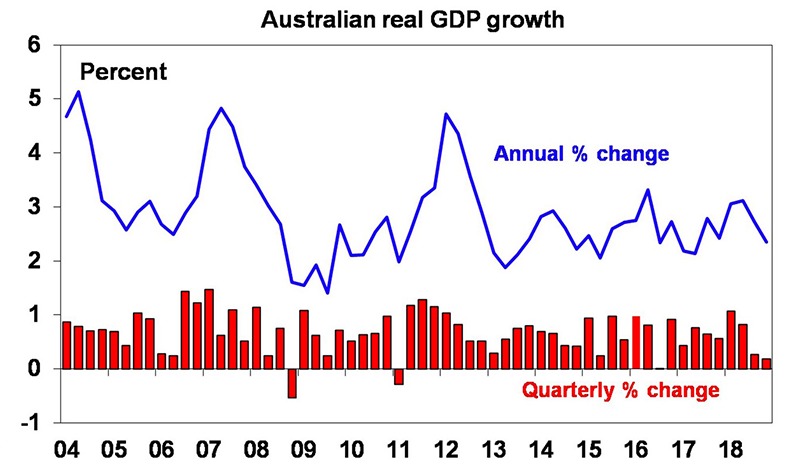
    December quarter GDP growth was just 0.2% quarter on quarter, with a fall in housing investment, weak consumer spending and business investment and a detraction from trade only partly offset by solid public demand.

    australian real gdp growth

    Source: ABS

    Coming on the back of just 0.3% growth in the September quarter this is not good news. It means growth has slowed to 2.3% over the year to December and, even worse, annualised growth over the last six months has slumped to just 1%. It also means Australia has slipped into a “per capita” recession with GDP per person now falling for two quarters in a row, for the first time since 2006.

    Housing downturn to be a significant drag on growth

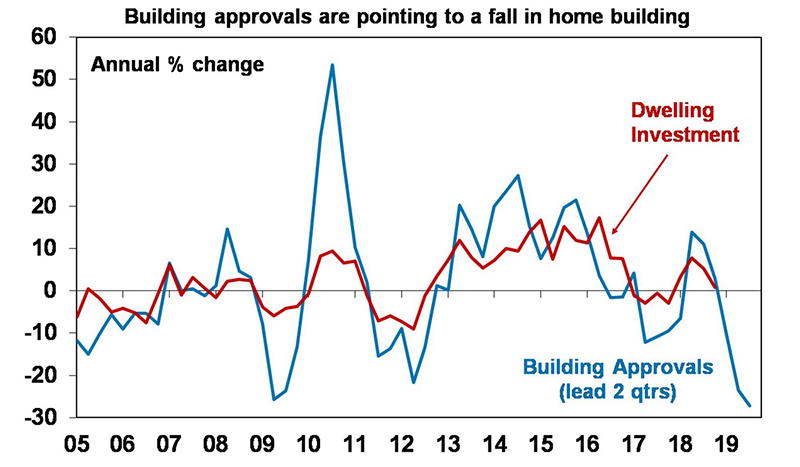
    The bad news is that growth is likely to remain under pressure as the housing downturn intensifies. Approvals to build new homes have fallen sharply. And while auction clearance rates have bounced at the start of the year we doubt this is the start of a recovery in house prices given the long list of negatives for house prices including: tight credit; the switch from interest only to principle and interest loans; record unit supply; issues around new building quality; an 80% or so collapse in foreign demand; fears that negative gearing and capital gains tax arrangements will be made less favourable if there is a change of government; and falling prices feeding on themselves. We see Sydney and Melbourne home prices falling another 15% or so as part of a total top to bottom fall of around 25% out to next year, which will see national average home prices have a top to bottom fall of around 15%. So far we are only about half way there.

    We estimate that the housing downturn will detract around 1 to 1.5 percentage points from growth this year with:

    • a direct detraction from growth as the housing construction cycle turns down. This is likely to amount to around 0.4 percentage points per annum (which was what it added on average during the construction boom).

    sfp e10 building approvals pointing to fall

    ource: ABS


    • reduced demand for household equipment retail sales as dwelling completions top out and decline.
    • a negative wealth effect on consumer spending of around 1-1.2% pa. Rising housing wealth helped drive decent growth in consumer spending in NSW and Victoria as households reduced the amount they saved as their housing wealth rose. This is now likely to go in reverse detracting around 0.7 percentage points from GDP growth.
    • there could also be a feedback loop into further bank credit tightening if non-performing loans and defaults rise as unemployment starts to rise.

    The east coast drought could also act as an ongoing drag on growth with a “mild” El Nino hanging around although this may be mild at around a 0.2 percentage point growth detraction.


    proportion of aust companies with profits up

    Source: ABS

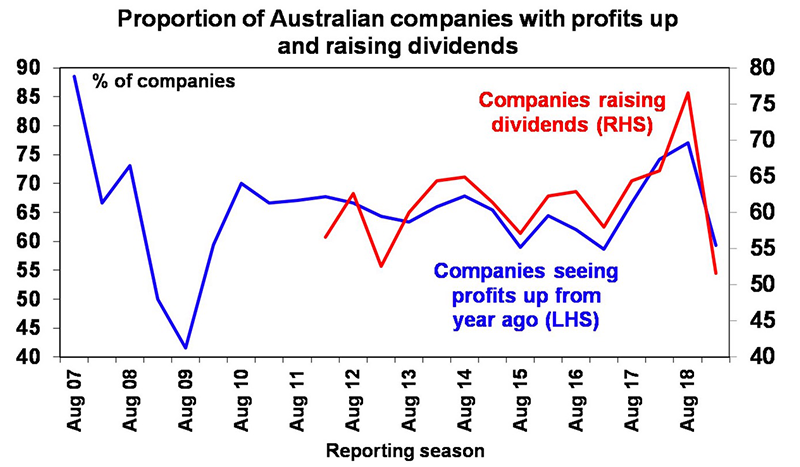
    The weakness in relation to the domestic economy is evident in in weak profit results for domestically exposed companies in the recent December half year profit reporting season. While results were better than feared enabling shares to rise, the ratio of upside surprise to downside was its weakest since 2009, only 59% saw profits rise from a year ago and only 52% raised their dividends from a year ago which (notwithstanding “special” dividends from a few companies) indicates a lack of confidence in the outlook. While consensus expectations for profit growth for this financial year held at 4%, this was only because of an upgrade to resources profit growth to 14% with profit growth in the rest of the market falling to just 1%.

    Five sources of support for the economy

    The risks to the economy from the property downturn are significant – particularly if unemployment rises sharply driving mortgage defaults and forced selling. However, there are five sources of support for the economy which should mean that a traditional (as opposed to a per capita) recession is unlikely:

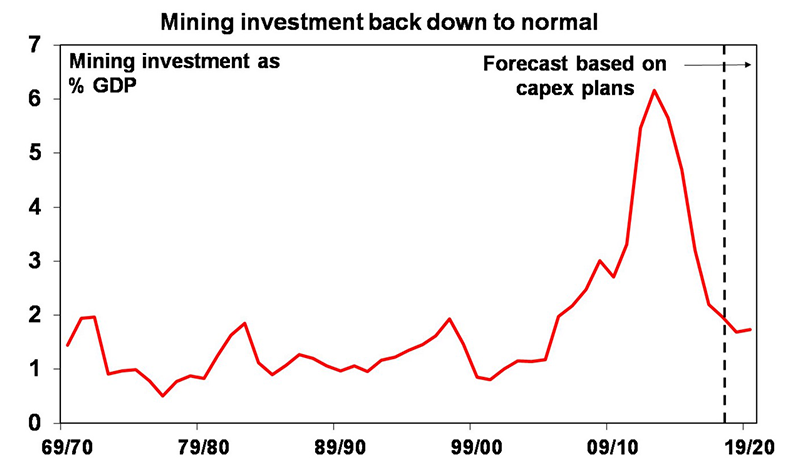
    • First, the drag on growth from slumping mining investment (which averaged around 1.5 percentage points per annum) is fading as mining investment is close to the bottom.

    mining investments

    Source: ABS


    actual and expected cap expediture

    Source: ABS

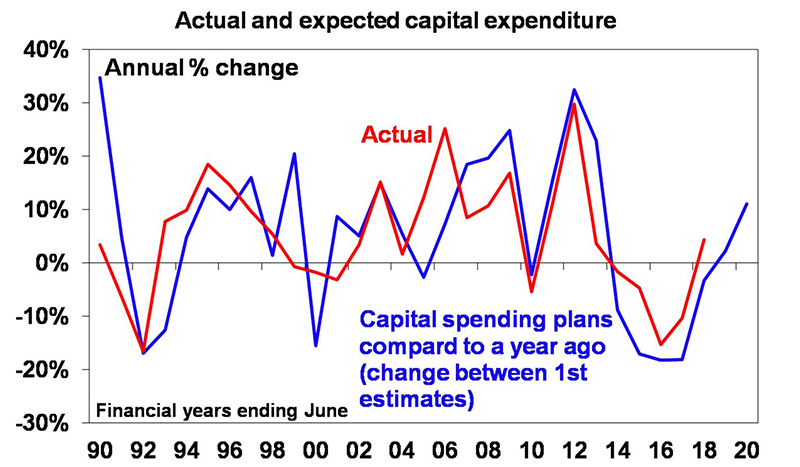
    • Second, surveys point to a recovery in non-mining investment. Business investment plans for next financial year are well up on plans a year ago.


    • Third, public infrastructure spending is rising solidly.
    • Fourth, demand for our exports is likely to improve through this year as global growth picks up led by China in response to stimulus measures and a likely fading of trade war risks. 
    • Finally, policy stimulus is likely to help with the April Budget and election outcome likely to see some combination of tax cuts or increased spending (under Labor) from July and the RBA likely to cut interest rates. 

    Given the cross currents, we have revised our growth forecasts down to around 2-2.5% over the next year or so. So we see some pick up from the dismal second half 2018 pace and no recession but growth will still be well below potential and RBA forecasts.

    Implications – higher unemployment/lower inflation


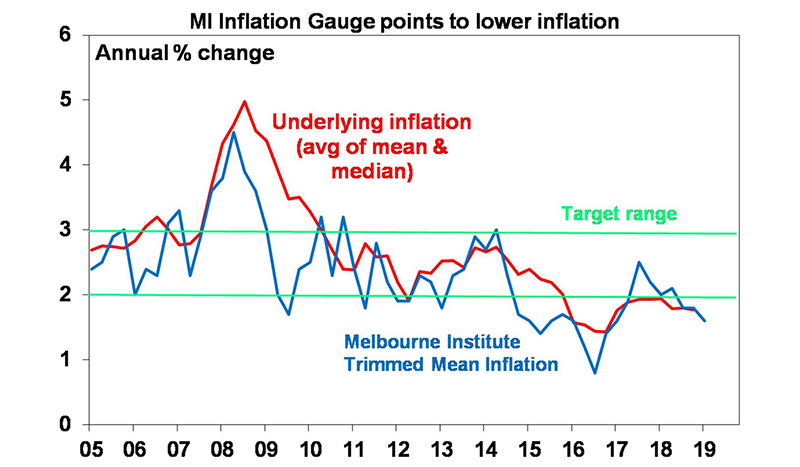
    Growth around 2-2.5% won’t be enough to further eat into spare labour market capacity let alone absorb new entrants to the workforce so we see unemployment rising to around 5.5% by year end. This is consistent with slowing job vacancies already becoming evident. This in turn points to wages growth remaining weak. Meanwhile, it’s hard to see much uptick in inflationary pressure. The latest Melbourne Institute Inflation Gauge points to ongoing weakness in underlying inflation.

    MI inflation guage points to lower inflation

    Source: ABS, Melbourne Institute


    RBA on track to cut rates

    Against the backdrop of soft growth and inflation we continue to see the RBA cutting the cash rate to 1% this year. Rate cuts won’t be aimed at reinflating the property market but supporting households with a mortgage to offset the negative wealth effect. And banks will likely have no choice but to pass the cuts on given the bad publicity of not doing so.

    Implications for investors

    For investors this all means: bank deposit rates will remain poor; Australian bonds will continue outperforming global bonds; Australian shares are likely to remain relative underperformers compared to global shares as the housing downturn weighs; and with the RBA likely to cut and the Fed on hold the $A is likely to fall into the high $US0.60s.

    So in closing

    • As per our January Newsletter the indicated market volatility will increase in 2019, so be prepared. Overall there are some troubling signs for the Australian economy, thus possible volatility in financial markets and some asset classes.
    • Don’t lose sight that volatility is a normal reaction to good and bad news.
    • Don’t lose sight that most well diversified balance styles forms have returned over 7% each year, in the past 8 years.
    • Don’t lose sight markets go up and down and up again.
    • Don’t panic when volatility hits.
    • Don’t forget the value of our advice.

    Bill Bracey and the team.


    Not sure if your portfolio is on track?

    Making sure you have your portfolio organised to weather this volatile first half of the year is key, get in contact with us on 02 9328 0876.


    Bill Bracey – Principal & Senior Financial Planner | Sydney Financial Planning


    This article was prepared by Dr Shane Oliver. Dr Shane Oliver who provides economic forecasts and analysis of key variables and issues affecting, or likely to affect, all asset markets. He also provides economic forecasts and analysis of key variables and issues affecting, or likely to affect, all asset markets.

    Important note: While every care has been taken in the preparation of this document, AMP Capital Investors Limited (ABN 59 001 777 591, AFSL 232497) and AMP Capital Funds Management Limited (ABN 15 159 557 721, AFSL 426455) make no representations or warranties as to the accuracy or completeness of any statement in it including, without limitation, any forecasts. Past performance is not a reliable indicator of future performance. This document has been prepared for the purpose of providing general information, without taking account of any particular investor’s objectives, financial situation or needs. An investor should, before making any investment decisions, consider the appropriateness of the information in this document, and seek professional advice, having regard to the investor’s objectives, financial situation and needs. This document is solely for the use of the party to whom it is provided.

    This article contains information that is general in nature. It does not take into account the objectives, financial situation or needs of any particular person. You need to consider your financial situation and needs before making any decisions based on this information.

    Macro investment outlook - 2019

    2019 – a list of lists regarding the macro investment outlook

    Macro investment outlook - 2019

    Introduction

    2017 was a great year for well diversified investors – returns were solid (balanced super funds returned around 10%) and volatility was low. So optimism was high going into 2018 but it turned out to be anything but great for investors who saw poor returns (average balanced super funds look to have lost around 1-2%) and volatile markets. As a result, and in contrast to a year ago, there is much trepidation about the year ahead. Having just written lists for Christmas presents and New Year resolutions, I was again motivated to provide a summary of key insights and views on the investment outlook in simple point form. In other words, a list of lists. So here goes.

    Five key things that went wrong in 2018

    In 2018 global growth was good, profits were up, inflation was benign and monetary conditions were relatively easy.
    It should have been good for markets. There were five reasons it wasn’t:

    • Fear of the Fed – the Fed didn’t really surprise but investors became increasingly concerned that it would overtighten. This reached a crescendo in late December.
    • US dollar strength – a rising US dollar is a defacto global monetary tightening and this weighed particularly on emerging countries and US earnings expectations.
    • Geopolitics – President Trump’s trade war hit confidence from March and morphed into fears of a broader Cold War with China. Other worries around Trump (with ongoing turmoil in his team, fears of impeachment as the Mueller inquiry progresses and a return to divided government) along with the populist government in Italy also weighed.
    • Global desynchronisation – US growth was strong, but it slowed everywhere else.
    • In Australia, tightening credit conditions (with fears of a credit crunch due to the Royal Commission) and falling house prices weighed on banks & growth expectations.

    Five lessons from 2018

    • Global growth remains fragile with post GFC caution lingering. This and technological change are helping to keep inflation down. Trade war fears didn’t help. Amongst other things this means central banks need to tread carefully in normalising monetary policy.
    • Investors continue to find it easy to fear the worst – this has been evident in three major circa 20% sharemarket declines since the GFC – in 2011, 2015-16 and now 2018.
    • Geopolitics remains a significant driver of markets and economic conditions.
    • Government bonds remain a great diversifier – they rallied when shares plunged.
    • Stuff happens – history tells us markets have periodic setbacks. 2018 was just another example.

    Five big picture themes for 2019

    • Policy pause and stimulus – the turmoil in markets and threat to global growth is likely to drive a policy response early this year with the Fed pausing, China providing morestimulus and the ECB providing cheap bank financing. There may also be some fiscal easing in Europe.
    • While global growth is likely to weaken a bit further in the coming months, it’s likely to stabilise and resynchronis as the year progresses helped by policy stimulus, an easing in the $US and by the late 2018 plunge in energy costs.
    • Global inflation is likely to remain benign helped by the 2018 growth slowdown and fall in energy costs. In this sense the malaise of 2018 by forestalling inflation and hence monetary tightening has arguably helped extend the economic cycle. The US remains most at risk on the inflation front though given its still tight labour market.
    • But expect volatility to remain high given the lower level of spare capacity in the US and ongoing political risk.
    • Australian growth is expected to be sub-par as the housing downturn detracts 1-1.5 percentage points or so off growth.

    Key views on markets for 2019

    • Global shares could still make new lows early in 2019 (much as occurred in 2016) and volatility is likely to remain high but valuations are now improved and reasonable growth and profits should see a recovery through 2019 helped by more policy stimulus.
    • Emerging markets are likely to outperform if the $US is more constrained as we expect.
    • After a low early in the year and high volatility, Australian shares are likely to do okay, recovering to around 6000 or so by year end.
    • The Australian Election in the first half of 2019 will cause negative volatility
    • Low yields are likely to see low returns from bonds, but they continue to provide an excellent portfolio diversifier.
    • Unlisted commercial property and infrastructure are likely to see slower returns over the year ahead. This is likely to be particularly the case for Australian retail property.
    • National capital city house prices are likely to fall roughly 5% led again by 10% or so price falls in Sydney and Melbourne off the back of tight credit, rising supply, reduced foreign demand & possible tax changes under a Labor Government.
    • Cash and bank deposits are likely to provide poor returns as the RBA cuts the official cash rate to 1% by end 2019.
    • Beyond any near-term bounce as the Fed moves towards a pause on rate hikes next year, the $A is likely to fall into the $US0.60s as the gap between the RBA’s cash rate and the US Fed Funds rate will still likely push further into negative territory as the RBA moves to cut rates.

    Six things to watch

    • The US trade war – while it may now be on hold thanks to negotiations with China, Europe and Japan these could go wrong and see it flare up again. US/China tensions generally pose a significant risk for markets.
    • US inflation and the Fed – our base case is that US inflation remains around 2% enabling the Fed to pause/go slower, but if it accelerates then it will mean more aggressive tightening, a sharp rebound in bond yields
      and a much stronger $US which would be bad for emerging markets.
    • Global growth indicators – if we are to be right, growth indicators need to stabilise in the next six months.
    • Chinese growth – a continued slowing in China would be a major concern for global growth and commodity prices.
    • Politics – political risks abound in the US with the Mueller inquiry getting ever closer to President Trump and a return to divided government leading to risks around raising the debt ceiling and Trump adopting more populist policies.
    • In Europe the main risks are around Brexit, Italy and the EU parliamentary elections in May. Australia’s election risks are more interventionist government policy and tax changes.
    • The property price downturn in Australia – how deep it gets and whether non-mining investment, infrastructure spending and export earnings are able to offset the drag from housing construction and consumer spending.
    • Australian Election April/May 2019.

    Seven things investors should allow for in rough times

    • Times like the present are stressful for investors. No one likes to see their wealth fall and uncertainty seems very high. I don’t have a perfect crystal ball, so from the point of sensible long-term investing the following points are worth bearing in mind.
    • First, periodic sharp setbacks in share markets are healthy and normal. Shares literally climb a wall ofworry over many years with periodic setbacks, but with the long-term trend providing higher returns than more stable assets. The setbacks are the price we pay for the higher long-term return from shares.
    • Second, selling shares or switching to a more conservative strategy after a major fall just locks in a loss. The best way to guard against selling on the basis of emotion is to adopt a well thought out, long-term investment strategy.
    • Third, when growth assets fall they are cheaper and offer higher long-term return prospects. So, the key is to look for opportunities that pullbacks provide.
    • Fourth, while shares may have fallen in value, the dividends from the market haven’t. The income flow you are receiving from a diversified portfolio of shares remains attractive.
    • Fifth, shares often bottom at the point of maximum bearishness. So, when everyone is negative and cautious it’s often time to buy.
    • Sixth, turn down the noise on financial news. In periods of market turmoil, the flow of negative news reaches fever pitch, which makes it very hard to stick to a well-considered, long-term strategy let alone see the opportunities.
    • Finally, accept that it’s a low nominal return world – low nominal growth and low bond yields and earnings yields mean lower long-term returns. This means that periods of relative high returns like in 2017 are often followed by weaker years.

    So in closing

    • 2019 will see more volatility, especially in the first half of the year.
    • Get ready for volatility and don’t panic.
    • Only worry if you have not reviewed your portfolio with your Sydney Financial Planner in the past 12 months – and if not, do so!
    • Remember it‘s the well advised investor who builds wealth.


    Is it time to review your portfolio?

    Getting organised with your investments in 2019 and preparing for this volatile first half of the year is key, get in contact with us on 02 9328 0876.


    Bill Bracey | Principal & Senior Financial Planner

    This initial article was prepared by Dr Shane Oliver. Dr Shane Oliver, Head of Investment Strategy and Economics and Chief Economist at AMP Capital is responsible for AMP Capital’s diversified investment funds. He also provides economic forecasts and analysis of key variables and issues affecting, or likely to affect, all asset markets.

    Important note: While every care has been taken in the preparation of this document, AMP Capital Investors Limited (ABN 59 001 777 591, AFSL 232497) and AMP Capital Funds Management Limited (ABN 15 159 557 721, AFSL 426455) make no representations or warranties as to the accuracy or completeness of any statement in it including, without limitation, any forecasts. Past performance is not a reliable indicator of future performance. This document has been prepared for the purpose of providing general information, without taking account of any particular investor’s objectives, financial situation or needs. An investor should, before making any investment decisions, consider the appropriateness of the information in this document, and seek professional advice, having regard to the investor’s objectives, financial situation and needs. This document is solely for the use of the party to whom it is provided.

    This article contains information that is general in nature. It does not take into account the objectives, financial situation or needs of any particular person. You need to consider your financial situation and needs before making any decisions based on this information.